REVIEW 3 major objections 5 minor 45 references
BWM argues that a low-cost, action-conditioned visual world model—which predicts future observations from an initial frame, a short history, and a chunk of robot commands—can serve as both a data engine and a pre-deployment policy evaluator
Reviewed by Pith at T0; open to challenge. T0 means a machine referee read the full paper against a public rubric. the ladder, T0–T4 →
T0 review · deepseek-v4-flash
2026-08-03 09:39 UTC pith:7COXKC3V
load-bearing objection BWM is a solid, reproducible systems contribution whose headline policy-evaluator result depends on an unvalidated success criterion that should be fixed before the claim is trusted. the 3 major comments →
BWM: A Low-Cost High-Fidelity World Simulator for Robot Learning
The pith
A machine-rendered reading of the paper's core claim, the machinery that carries it, and where it could break.
Core claim
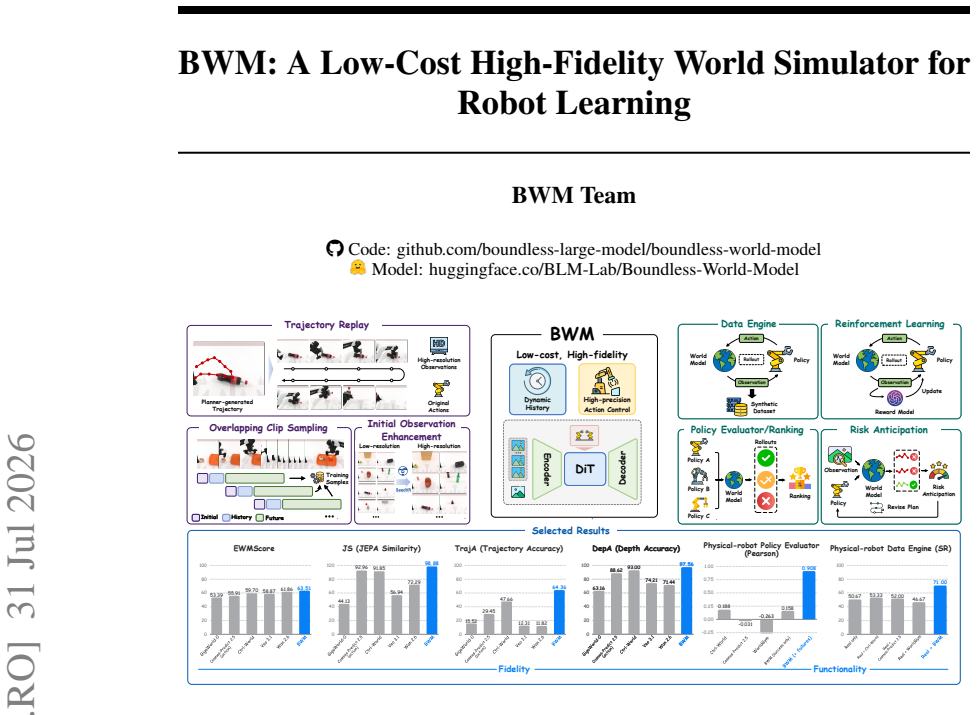
The paper establishes that a world model initialized from a pretrained video diffusion backbone and post-trained on robot data can act as a stateful simulator: it keeps the initial scene latent clean, adds light noise to history latents, and injects robot actions both frame-wise and at the latent level, then optimizes a future-only flow-matching objective. The paper demonstrates two uses: as a data engine, model-generated, action-aligned trajectories improve downstream imitation policies in simulation and on hardware; as a policy evaluator, closed-loop rollouts scored with a failure-inclusive success criterion correlate strongly with physical outcomes (r = 0.908). The central claim is that t
What carries the argument
The central mechanism is chunked action-conditioned autoregression in latent video space. The model takes a fixed initial-environment observation, a dynamically updated history window, and a temporally aligned action chunk; actions are injected through cross-attention per frame and through action-conditioned timestep embeddings (AdaLN), so fine-grained control can steer each predicted frame. A future-only flow-matching loss trains the model to predict only the new chunk, and at inference the model discards conditional frames, appends predictions to history, and advances the action window, producing stateful rollouts. The data pipeline—trajectory replay at higher resolution, overlapping clip
Load-bearing premise
The load-bearing premise is that the failure-inclusive rule used to score a rollout is the right measure of physical-task success; the paper does not pre-specify or independently validate that rule, and without it the headline evaluator correlation drops from 0.908 to 0.158 (success-only), so the central policy-evaluation claim collapses if the rule is arbitrary.
What would settle it
Run BWM's evaluator on a new set of tasks and policies with the failure-inclusive success criterion fixed in advance, and check its Pearson correlation against hardware outcomes. If r falls near zero (as the success-only variant does) or if the hand-chosen criterion does not match human labels of success and failure, the claim that BWM predicts hardware outcomes is refuted. A second check: remove the failure-inclusive scoring and see whether any protocol recovers r ≈ 0.9.
If this is right
- If BWM's fidelity holds beyond the tested scenes, robot labs can replace part of real-robot data collection with model rollouts: adding 40 generated trajectories to 50 real ones raised hardware success from about 51% to 71% across six tasks.
- A closed-loop policy evaluator based on BWM could screen candidate policies and anticipate failure modes before any physical execution, since failure-inclusive rollouts matched hardware outcomes with a Pearson correlation of 0.908.
- Action-aligned high-resolution replay matters more than visual super-resolution: rerendered 480p training frames beat super-resolved 240p by about 10.5 points in trajectory accuracy, so data collection design is a first-class component of world-model fidelity.
- Because the model starts from a general video prior and needs only domain-specific post-training, building a simulator for a new robot or scene should be far cheaper than building and calibrating a physics simulator.
Where Pith is reading between the lines
- The near-zero correlation of the success-only evaluator (r = 0.158) versus 0.908 for the failure-inclusive variant suggests BWM's usefulness may hinge on modeling failures rather than successes; whether that generalizes is untested, and the success criterion was not pre-specified.
- The paper validates BWM as a data engine and policy evaluator, but it also proposes the simulator for reinforcement learning and risk anticipation; using it for RL would require checking whether reward signals from rollouts remain stable under distribution shift from policy updates.
- A stronger test would be cross-task generalization: all physical tasks share one robot and similar tabletop scenes, so it remains open whether fidelity and the high correlation survive new objects, lighting, or camera placements.
- The low-cost claim depends on simulator replay being available for training; when only low-resolution real video exists, super-resolution alone underperforms, so the practical cost advantage may shrink outside settings where high-resolution replay is possible.
Editorial analysis
A structured set of objections, weighed in public.
Referee Report
Summary. The paper presents BWM, an action-conditioned video-diffusion world model for robot manipulation, built on Wan2.2 and trained on RoboTwin trajectories. The central claims are threefold: (i) BWM achieves the highest WorldArena EWMScore (63.51) among compared simulators; (ii) BWM-generated trajectories improve downstream imitation policies, both in the two-task WorldArena data-engine setting (94.50% average success vs. 71.50% for real-data training) and on six physical-robot tasks (71.00% vs. 53.33% for the strongest baseline); and (iii) BWM closed-loop rollouts provide a policy evaluator whose task-level success-rate estimates correlate with hardware outcomes (r=0.908, MAE=14.67). The architecture combines initial-environment guidance, dynamic history, and dual-path action conditioning (cross-attention plus AdaLN), with ablations supporting these design choices. The paper also releases code, checkpoints, and interfaces.
Significance. If the fidelity and functional claims hold, BWM is a practically significant contribution: it offers a low-cost, open-source world simulator with both data-engine and policy-evaluator utilities, addressing a real bottleneck in robot learning. The paper's evaluation is unusually broad for the area, covering a standardized benchmark, physical-robot fidelity, two downstream functions, and extensive ablations. The release of the full ecosystem is a concrete strength, and the WorldArena results place BWM competitively against strong baselines. However, the policy-evaluator claim rests on a poorly specified and potentially post hoc 'failure-inclusive' success criterion, and several quantitative claims lack statistical support. The contribution is therefore promising but not yet fully established.
major comments (3)
- [§5.3.3, Table 8] The headline policy-evaluator result, r=0.908 with MAE=14.67, is obtained only from the 'BWM (+ failures)' row. The 'BWM (success only)' row gives r=0.158 and MAE=36.67, worse than Ctrl-World on both metrics. The paper never defines how failed rollouts are detected, scored, or combined: §4.3 only says a 'task-specific success criterion' is used, and §5.3.3 does not specify what 'failure-inclusive' means operationally. With n=6 task-level pairs and no confidence intervals or leave-one-task-out analysis, the reported r=0.908 may reflect post hoc selection among plausible scoring variants. This is load-bearing because the central conclusion of policy-evaluation fidelity rests on this single row. Please pre-specify the failure-inclusive protocol, apply it identically to baselines, and report uncertainty and robustness (e.g., bootstrap or leave-one-task-out).
- [§5.2.2, Table 3; §5.3.2, Table 7] The data-engine claim 'strongest overall performance ... across the two validated functions' is supported by only two simulation tasks (adjust bottle and click bell) and by physical-robot results without error bars or multiple seeds. In Table 3, the 94.50% versus 71.50% difference is reported as a point estimate; no variance, number of seeds, or significance test is given. In Table 7, each success rate is based on 25 hardware trials, so the per-task differences (e.g., 88 vs. 64 for Fold Towel) may be within binomial noise. Please provide confidence intervals, multiple seeds, or per-task trial-level data, and explicitly state whether the two-task simulation protocol is intended as a proof-of-concept or as a general claim.
- [Abstract, §1, Appendix A] The paper's summary of the WorldArena leaderboard is internally inconsistent. The abstract and contributions state 'ranks first overall in the WorldArena Challenge across Track 1 and its two Track 2 applications' and 'first overall when scores ... are combined', while §1 and Appendix A report 'second overall' on Track 1 (BWM-Fast), 'first' on the open-source Track 2 data-engine leaderboard, and 'second' on the policy-evaluator leaderboard. The appendix figures show BWM-Fast as second overall and BLM as first only in the open-source Track 1 list. The 'first overall combined' claim is not demonstrated by the provided leaderboards. Please reconcile these statements and state precisely which leaderboard positions are being claimed.
minor comments (5)
- [§5.3.1, Tables 5–6] The physical-robot fidelity gains over Cosmos-Predict 2.5 are small (1.23 in third-person EWMScore, 0.14 in wrist EWMScore). The text emphasizes 'consistent advantages', but several submetrics do not favor BWM (e.g., motion smoothness, photometric consistency in the third-person view). Please temper the wording or add variance estimates to support 'consistent'.
- [§5.2.3, Table 4] While BWM's r=0.978 is strong, it is below Ctrl-World (0.986). The text's characterization 'within 0.008 of Ctrl-World' is accurate but the broader conclusion that BWM is the best policy evaluator in simulation is not supported by this table; the physical-robot result is the deciding evidence.
- [§4.2, Eq. (2)] The notation ezτ = [z0, ezhist, zfutτ] is used for the model input, but the text says the history receives low-level perturbation while z0 remains clean. It would help to define the concatenation order explicitly and to state whether the same noise schedule is applied to all history frames.
- [§5.1, Implementation Details] The implementation details list da=14, H=8, K=72, P=3, G=4 but do not explain the choice of these values beyond ablation results for H and K. The normalization bounds p1/p99 and σh are free parameters; please state how they were selected and whether they were tuned on the validation set.
- [Global] The abstract claims 'ranks first overall in the WorldArena Challenge' while the introduction says 'second overall'; this should be fixed in the revision. Also, Figure 1 reports 'Physical-robot Data Engine (SR) 71.00' but the axis label says 'SR' without defining it in the caption.
Circularity Check
No significant circularity; central derivation is self-contained against external benchmarks, with a minor post-hoc protocol-selection caveat.
full rationale
BWM's derivation chain is not circular. The model's training objective (Eq. 2) is a future-only flow-matching loss over action-aligned observation clips, with the initial environment and dynamic history used as conditioning; no evaluation target enters the loss. Simulator fidelity is scored on held-out WorldArena validation sequences and physical-robot videos against external baselines (Wan, Cosmos, Ctrl-World, etc.), and the data-engine claims are downstream policy success on RoboTwin or hardware, where BWM-generated trajectories are not substituted into the success definition. The policy-evaluator claim correlates closed-loop rollouts with external RoboTwin or hardware outcomes; there is no equation by which BWM's predicted success rate is forced to equal the hardware rate. The main caveat is Section 5.3.3/Table 8: the 'failure-inclusive' success criterion is not pre-specified, the success-only variant gives r=0.158 rather than 0.908, and the same criterion is not applied to baselines; this is a post-hoc selection/external-validity risk, not a constructional circularity. Self-citations [9] and [45] are background and component references and are not load-bearing for the central derivation. The abstract's 'first overall' also conflicts with the introduction/appendix's 'second overall' on Track 1, but that is a reporting inconsistency, not circularity.
Axiom & Free-Parameter Ledger
free parameters (3)
- Action normalization bounds p1/p99 =
not reported
- History-noise scale σh =
not reported
- Context lengths H=8, K=72; boundary actions P=3; grouping G=4 =
H=8, K=72, P=3, G=4
axioms (4)
- domain assumption Replaying RoboTwin trajectories at higher resolution preserves action-observation temporal alignment because execution order and timestamps are unchanged.
- domain assumption The future-only flow-matching objective with clean initial latent and perturbed history produces stable, action-responsive autoregressive rollouts.
- domain assumption WorldArena metric scores and baseline results are valid, comparable external measurements of fidelity and functionality.
- domain assumption The task-specific success criterion used to score rollouts is a faithful proxy for physical success.
read the original abstract
Reliable robot learning requires a world simulator that can predict action consequences before execution on physical hardware, including risky and failure-prone outcomes. Existing physics simulators require substantial asset construction and calibration and still face a sim-to-real gap, while video generators often lack precise control over their responses to fine-grained robot actions. In this paper, we present the Boundless World Model (BWM), an open-source, low-cost, high-fidelity world simulator for robot manipulation. BWM is an action-conditioned world model that combines initial-environment guidance, dynamic visual history, and temporally aligned robot-action conditioning for stateful autoregressive prediction of future observations. We construct action-aligned training clips through trajectory replay, overlapping clip sampling, and initial-observation enhancement. BWM serves as a data engine that augments imitation-learning data with action-aligned rollouts, and as a policy evaluator for closed-loop assessment, risk anticipation, and policy ranking. Experiments on the WorldArena benchmark and physical robots demonstrate improved simulator fidelity and functional utility across the data-engine and policy-evaluator settings. BWM ranks first overall in the WorldArena Challenge across Track 1 and its two Track 2 applications. We release the BWM open-source ecosystem, including model checkpoints, training and inference code, and interfaces for data generation and policy evaluation.
Figures


Reference graph
Works this paper leans on
-
[1]
Gemini Robotics: Bringing AI into the physical world.arXiv preprint arXiv:2503.20020, 2025
Gemini Robotics Team. Gemini Robotics: Bringing AI into the physical world.arXiv preprint arXiv:2503.20020, 2025
Pith/arXiv arXiv 2025
-
[2]
Johan Bjorck, Fernando Castañeda, Nikita Cherniadev, Xingye Da, et al. GR00T N1: An open foundation model for generalist humanoid robots.arXiv preprint arXiv:2503.14734, 2025
Pith/arXiv arXiv 2025
-
[3]
π∗ 0.6: a VLA that learns from experience.arXiv preprint arXiv:2511.14759, 2025
Physical Intelligence, Ali Amin, Raichelle Aniceto, Ashwin Balakrishna, et al. π∗ 0.6: a VLA that learns from experience.arXiv preprint arXiv:2511.14759, 2025
Pith/arXiv arXiv 2025
-
[4]
Zijun Lin, Jiafei Duan, Haoquan Fang, Dieter Fox, et al. FailSafe: Reasoning and recovery from failures in vision-language-action models.arXiv preprint arXiv:2510.01642, 2025
Pith/arXiv arXiv 2025
-
[5]
Ulas Berk Karli and Tesca Fitzgerald. RECALL: Recovery experience collection for active lifelong learning in vision-language-action models.arXiv preprint arXiv:2606.23617, 2026
Pith/arXiv arXiv 2026
-
[6]
Evaluating real-world robot manipulation policies in simulation
Xuanlin Li, Kyle Hsu, Jiayuan Gu, Oier Mees, et al. Evaluating real-world robot manipulation policies in simulation. InProceedings of the Conference on Robot Learning, pages 3705–3728, 2025
2025
-
[7]
Tianxing Chen, Zanxin Chen, Baijun Chen, Zijian Cai, et al. RoboTwin 2.0: A scalable data generator and benchmark with strong domain randomization for robust bimanual robotic manipulation.arXiv preprint arXiv:2506.18088, 2025
Pith/arXiv arXiv 2025
-
[8]
Ziyao Wang, Bingying Wang, Hanrong Zhang, Tingting Du, et al. Vision-language-action in robotics: A survey of datasets, benchmarks, and data engines.arXiv preprint arXiv:2604.23001, 2026
Pith/arXiv arXiv 2026
-
[9]
Towards generalist embodied AI: A survey on world models for VLA agents.TechRxiv, 2026
Wentao Tan, Lei Zhu, Bowen Wang, Enci Xie, et al. Towards generalist embodied AI: A survey on world models for VLA agents.TechRxiv, 2026. doi: 10.36227/techrxiv.176948355. 54623875/v1. 16
-
[10]
World model for robot learning: A comprehensive survey.arXiv preprint arXiv:2605.00080, 2026
Bohan Hou, Gen Li, Jindou Jia, Tuo An, et al. World model for robot learning: A comprehensive survey.arXiv preprint arXiv:2605.00080, 2026
Pith/arXiv arXiv 2026
-
[11]
Video generation models as world simulators
Tim Brooks, Bill Peebles, Connor Holmes, Will DePue, et al. Video generation models as world simulators. OpenAI Technical Report, 2024
2024
-
[12]
Movie gen: A cast of media foundation models.arXiv preprint arXiv:2410.13720, 2024
The Movie Gen team. Movie gen: A cast of media foundation models.arXiv preprint arXiv:2410.13720, 2024
Pith/arXiv arXiv 2024
-
[13]
Wan: Open and advanced large-scale video generative models.arXiv preprint arXiv:2503.20314, 2025
Ang Wang, Baole Ai, Bin Wen, Chaojie Mao, et al. Wan: Open and advanced large-scale video generative models.arXiv preprint arXiv:2503.20314, 2025
Pith/arXiv arXiv 2025
-
[14]
Diffusion models are real- time game engines
Dani Valevski, Yaniv Leviathan, Moab Arar, and Shlomi Fruchter. Diffusion models are real- time game engines. InProceedings of the International Conference on Learning Representations, 2025
2025
-
[15]
Genie 3: A new frontier for world models
Jack Parker-Holder and Shlomi Fruchter. Genie 3: A new frontier for world models. Google DeepMind Technical Report, 2025
2025
-
[16]
Yanjiang Guo, Lucy Xiaoyang Shi, Jianyu Chen, and Chelsea Finn. Ctrl-World: A controllable generative world model for robot manipulation.arXiv preprint arXiv:2510.10125, 2025
Pith/arXiv arXiv 2025
-
[17]
Evaluating robot policies in a world model
Julian Quevedo, Percy Liang, and Sherry Yang. Evaluating robot policies in a world model. arXiv preprint arXiv:2506.00613, 2025
arXiv 2025
-
[18]
World simulation with video foundation models for physical AI.arXiv preprint arXiv:2511.00062, 2025
NVIDIA. World simulation with video foundation models for physical AI.arXiv preprint arXiv:2511.00062, 2025
Pith/arXiv arXiv 2025
-
[19]
Yuzhi Chen, Ronghan Chen, Dongjie Huo, Yandan Yang, et al. ABot-PhysWorld: Interactive world foundation model for robotic manipulation with physics alignment.arXiv preprint arXiv:2603.23376, 2026
arXiv 2026
-
[20]
Yu Shang, Zhuohang Li, Yiding Ma, Weikang Su, et al. WorldArena: A unified benchmark for evaluating perception and functional utility of embodied world models.arXiv preprint arXiv:2602.08971, 2026
arXiv 2026
-
[21]
Andreas Blattmann, Tim Dockhorn, Sumith Kulal, Daniel Mendelevitch, et al. Stable video dif- fusion: Scaling latent video diffusion models to large datasets.arXiv preprint arXiv:2311.15127, 2023
Pith/arXiv arXiv 2023
-
[22]
HunyuanVideo 1.5 technical report
Bing Wu, Chang Zou, Changlin Li, Duojun Huang, et al. HunyuanVideo 1.5 technical report. arXiv preprint arXiv:2511.18870, 2025
Pith/arXiv arXiv 2025
-
[23]
Seedance 1.5 pro: A native audio-visual joint generation foundation model
ByteDance Seed. Seedance 1.5 pro: A native audio-visual joint generation foundation model. arXiv preprint arXiv:2512.13507, 2025
Pith/arXiv arXiv 2025
-
[24]
GameFactory: Creating new games with generative interactive videos
Jiwen Yu, Yiran Qin, Xintao Wang, Pengfei Wan, et al. GameFactory: Creating new games with generative interactive videos. InProceedings of the IEEE/CVF International Conference on Computer Vision, pages 11590–11599, 2025
2025
-
[25]
Zile Wang, Zexiang Liu, Jiaxing Li, Kaichen Huang, et al. Matrix-Game 3.0: Real-time and streaming interactive world model with long-horizon memory.arXiv preprint arXiv:2604.08995, 2026
Pith/arXiv arXiv 2026
-
[26]
IRASim: A fine-grained world model for robot manipulation
Fangqi Zhu, Hongtao Wu, Song Guo, Yuxiao Liu, et al. IRASim: A fine-grained world model for robot manipulation. InProceedings of the IEEE/CVF International Conference on Computer Vision, 2025
2025
-
[27]
Lirui Wang, Kevin Zhao, Chaoqi Liu, and Xinlei Chen. Learning real-world action-video dynamics with heterogeneous masked autoregression.arXiv preprint arXiv:2502.04296, 2025
Pith/arXiv arXiv 2025
-
[28]
Yixiang Chen, Peiyan Li, Jiabing Yang, Keji He, et al. BridgeV2W: Bridging video generation models to embodied world models via embodiment masks.arXiv preprint arXiv:2602.03793, 2026. 17
arXiv 2026
-
[29]
Zhennan Jiang, Kai Liu, Yuxin Qin, Shuai Tian, et al. World4RL: Diffusion world models for policy refinement with reinforcement learning for robotic manipulation.arXiv preprint arXiv:2509.19080, 2025
arXiv 2025
-
[30]
Junjin Xiao, Yandan Yang, Xinyuan Chang, Ronghan Chen, et al. World-Env: Leveraging world model as a virtual environment for VLA post-training.arXiv preprint arXiv:2509.24948, 2025
Pith/arXiv arXiv 2025
-
[31]
Senyu Fei, Siyin Wang, Li Ji, Ao Li, et al. SRPO: Self-referential policy optimization for vision-language-action models.arXiv preprint arXiv:2511.15605, 2025
arXiv 2025
-
[32]
Zhennan Jiang, Shangqing Zhou, Yutong Jiang, Zefang Huang, et al. WoVR: World models as reliable simulators for post-training VLA policies with RL.arXiv preprint arXiv:2602.13977, 2026
Pith/arXiv arXiv 2026
-
[33]
Scalable policy evaluation with video world models.arXiv preprint arXiv:2511.11520, 2025
Wei-Cheng Tseng, Jinwei Gu, Qinsheng Zhang, Hanzi Mao, et al. Scalable policy evaluation with video world models.arXiv preprint arXiv:2511.11520, 2025
arXiv 2025
-
[34]
Yue Liao, Pengfei Zhou, Siyuan Huang, Donglin Yang, et al. Genie envisioner: A unified world foundation platform for robotic manipulation.arXiv preprint arXiv:2508.05635, 2025
Pith/arXiv arXiv 2025
-
[35]
Joel Jang, Seonghyeon Ye, Zongyu Lin, Jiannan Xiang, et al. DreamGen: Unlocking gen- eralization in robot learning through video world models.arXiv preprint arXiv:2505.12705, 2025
Pith/arXiv arXiv 2025
-
[36]
GigaWorld Team, Angen Ye, Boyuan Wang, Chaojun Ni, et al. GigaWorld-0: World models as data engine to empower embodied AI.arXiv preprint arXiv:2511.19861, 2025
arXiv 2025
-
[37]
Anlan Yu, Zaishu Chen, Peili Song, Zhiqing Hong, et al. WM-DAgger: Enabling efficient data aggregation for imitation learning with world models.arXiv preprint arXiv:2604.11351, 2026
Pith/arXiv arXiv 2026
-
[38]
Zezhong Qian, Xiaowei Chi, Yuming Li, Shizun Wang, et al. WristWorld: Generating wrist- views via 4D world models for robotic manipulation.arXiv preprint arXiv:2510.07313, 2025
arXiv 2025
-
[39]
SeedVR2: One-step video restoration via diffusion adversarial post-training
Jianyi Wang, Shanchuan Lin, Zhijie Lin, Yuxi Ren, et al. SeedVR2: One-step video restoration via diffusion adversarial post-training. InProceedings of the International Conference on Learning Representations, 2026
2026
-
[40]
Yaron Lipman, Ricky T. Q. Chen, Heli Ben-Hamu, Maximilian Nickel, et al. Flow match- ing for generative modeling. InProceedings of the International Conference on Learning Representations, 2023
2023
-
[41]
CogVideoX: Text-to-video diffusion models with an expert transformer
Zhuoyi Yang, Jiayan Teng, Wendi Zheng, Ming Ding, et al. CogVideoX: Text-to-video diffusion models with an expert transformer. InProceedings of the International Conference on Learning Representations, 2025
2025
-
[42]
TesserAct: Learning 4d embodied world models.arXiv preprint arXiv:2504.20995, 2025
Haoyu Zhen, Qiao Sun, Hongxin Zhang, Junyan Li, et al. TesserAct: Learning 4d embodied world models.arXiv preprint arXiv:2504.20995, 2025
Pith/arXiv arXiv 2025
-
[43]
Yao Feng, Hengkai Tan, Xinyi Mao, Chendong Xiang, et al. Vidar: Embodied video diffusion model for generalist manipulation.arXiv preprint arXiv:2507.12898, 2025
Pith/arXiv arXiv 2025
-
[44]
Xiaowei Chi, Peidong Jia, Chun-Kai Fan, Xiaozhu Ju, et al. WoW: Towards a world omniscient world model through embodied interaction.arXiv preprint arXiv:2509.22642, 2025
arXiv 2025
-
[45]
Heng Zhi, Wentao Tan, Lei Zhu, Fengling Li, et al. MOTIF: Learning action motifs for few-shot cross-embodiment transfer.arXiv preprint arXiv:2602.13764, 2026. 18 A WorldArena Leaderboards This appendix presents the WorldArena leaderboards for BWM’s base world-simulation capability and its two applications, the data engine and policy evaluator. The method ...
arXiv 2026
discussion (0)
Sign in with ORCID, Apple, or X to comment. Anyone can read and Pith papers without signing in.