From Materials Database to Materials Bank: Assetizing Data for AI Driven Materials Innovation
Pith reviewed 2026-07-01 04:49 UTC · model grok-4.3
The pith
A Materials Bank uses a BankCard framework to turn materials data into standardized assets for AI-driven innovation.
A machine-rendered reading of the paper's core claim, the machinery that carries it, and where it could break.
Core claim
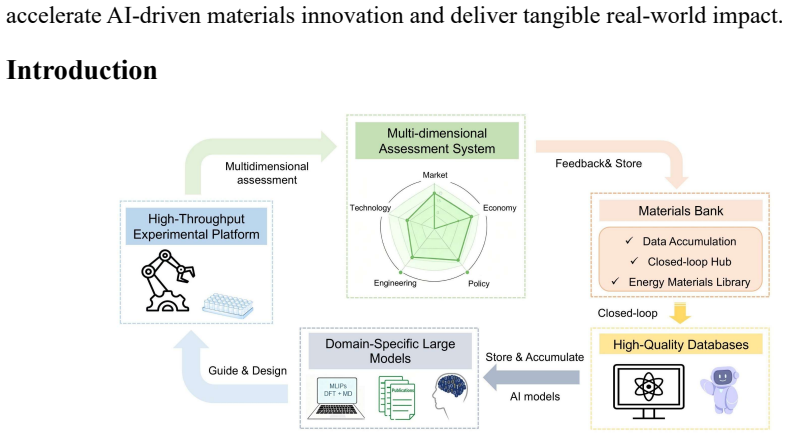
The paper proposes the Materials Bank as a value-filtering and assetization layer that operates beyond traditional databases. It elevates qualified candidates into standardized, upgradable materials assets via the multi-dimensional BankCard framework. By unifying databases, AI models, automated experimentation, and multi-criteria assessment into a cohesive closed-loop ecosystem, the Materials Bank establishes a trajectory from data to knowledge, candidate, asset, and product, bridging academic discovery and industrial demand.
What carries the argument
The BankCard framework is the central mechanism, a multi-dimensional assessment covering scientific validity, synthesis feasibility, application readiness, and industrial value that systematically elevates data into assets.
If this is right
- Establishes a trajectory from data to knowledge, candidate, asset, and product.
- Unifies databases, AI models, automated experimentation, and assessment into a closed-loop ecosystem.
- Serves as decision infrastructure bridging academic discovery and industrial demand.
- Offers a scalable paradigm to accelerate AI-driven materials innovation.
Where Pith is reading between the lines
- The framework's effectiveness would require developing specific, practical criteria and validation methods not provided in the proposal.
- This model could potentially be extended to assetize data in related fields such as chemical synthesis or nanotechnology.
- Industry adoption of the standardized assets would be necessary for the trajectory to product to be realized.
Load-bearing premise
That the BankCard framework can be practically defined and applied with clear criteria to elevate data into assets.
What would settle it
An attempt to implement the Materials Bank on existing materials datasets that fails to produce any assets meeting industrial criteria would show the framework does not achieve the claimed assetization.
Figures
read the original abstract
Driven by high-throughput experimentation, computational modeling, and artificial intelligence (AI), materials data has expanded at an unprecedented rate. Conventional materials databases function only as passive repositories, archiving raw experimental records indiscriminately including both successful and failed data, without systematic value filtering or asset management. This creates a critical gap between massive data accumulation and actionable innovation, hindering the identification of high-potential materials and industrial translation. To address this bottleneck, we propose an industrialization-oriented Materials Bank, a dedicated valuefiltering and assetization layer that operates beyond traditional databases. It does not merely curate high-quality data but systematically elevates qualified candidates into standardized, upgradable materials assets via a multi-dimensional BankCard framework covering scientific validity, synthesis feasibility, application readiness, and industrial value. By unifying databases, AI models, automated experimentation, and multi-criteria assessment into a cohesive closed-loop ecosystem, the Materials Bank establishes a clear trajectory from data to knowledge, candidate, asset, and product. It serves not as an enhanced database or screening tool, but as a decision infrastructure bridging academic discovery and industrial demand, offering a scalable paradigm to accelerate AI-driven materials innovation and deliver tangible real-world impact.
Editorial analysis
A structured set of objections, weighed in public.
Referee Report
Summary. The paper claims that conventional materials databases act only as passive repositories of raw data without value filtering, creating a gap to industrial innovation. It proposes a Materials Bank as an industrialization-oriented layer that applies a multi-dimensional BankCard framework (scientific validity, synthesis feasibility, application readiness, industrial value) to elevate qualified data into standardized, upgradable assets. This is achieved by unifying databases, AI models, automated experimentation, and multi-criteria assessment into a closed-loop ecosystem that traces a trajectory from data to knowledge, candidate, asset, and product.
Significance. If the BankCard framework could be made operational with concrete, reproducible criteria, the proposal would address a genuine bottleneck in translating materials data into actionable assets and could provide a scalable decision infrastructure bridging academia and industry. However, the manuscript supplies no implementation details, scoring methods, or validation, so the claimed significance remains hypothetical.
major comments (1)
- [Abstract (and main proposal text)] The central claim requires that the four-dimensional BankCard framework can be defined and applied to systematically convert data into assets, yet the manuscript lists the dimensions without any explicit criteria, weighting rules, scoring functions, thresholds, or a single worked example on even one material. This absence renders the asserted trajectory from data to asset unevaluable and unfalsifiable.
Simulated Author's Rebuttal
We thank the referee for the constructive feedback. The comment correctly identifies that the BankCard framework is presented at a high conceptual level. We address this below and will revise the manuscript to strengthen the proposal.
read point-by-point responses
-
Referee: [Abstract (and main proposal text)] The central claim requires that the four-dimensional BankCard framework can be defined and applied to systematically convert data into assets, yet the manuscript lists the dimensions without any explicit criteria, weighting rules, scoring functions, thresholds, or a single worked example on even one material. This absence renders the asserted trajectory from data to asset unevaluable and unfalsifiable.
Authors: We agree that the current text provides only the four dimension names without operational definitions, scoring rules, or examples, which limits evaluability. The manuscript's scope is a high-level architectural proposal rather than a fully specified implementation. To address the concern, the revised version will add a dedicated subsection under the BankCard framework that supplies (i) preliminary qualitative and quantitative criteria for each dimension, (ii) an illustrative weighting scheme and threshold logic, and (iii) one worked example applying the framework to a concrete material candidate. These additions will make the data-to-asset trajectory traceable while preserving the paper's focus on the overall paradigm. revision: yes
Circularity Check
No circularity: conceptual proposal without derivations or fitted claims
full rationale
The paper is a high-level conceptual proposal introducing a Materials Bank and BankCard framework with four dimensions (scientific validity, synthesis feasibility, application readiness, industrial value). No equations, derivations, quantitative predictions, fitted parameters, or self-citation chains appear in the text. The central claim is an assertion of a new infrastructure layer rather than a reduction of any result to its own inputs by construction. This matches the default expectation for non-circular papers; absence of operational definitions is a separate issue of specificity, not circularity.
Axiom & Free-Parameter Ledger
axioms (2)
- domain assumption Materials data contains both successful and failed records that require systematic value filtering for industrial use.
- ad hoc to paper A multi-dimensional assessment covering scientific validity, synthesis feasibility, application readiness, and industrial value can be operationalized to create assets.
invented entities (2)
-
Materials Bank
no independent evidence
-
BankCard framework
no independent evidence
Reference graph
Works this paper leans on
-
[1]
Commentary From Materials Database to Materials Bank: Assetizing Data for AI- Driven Materials Innovation Chenyao Ma a, Di Zhang c d, Weibo Gong b, Wei Du a b, Rui Su a, Yuhang Chen a, Kan Xu a, Huan Gu a, Limin Li a b*, Piao Ma a b*, Zhenghao Li e*, and Hao Li c* a. Suzhou MatSource Technology Co., Ltd., Suzhou 215000, Jiangsu, China. b. Gusu Laboratory ...
discussion (0)
Sign in with ORCID, Apple, or X to comment. Anyone can read and Pith papers without signing in.