REVIEW 3 major objections 3 minor 50 references
Hadron and Nuclear Physics on the Light Front
T0 review · 3 major / 3 minor · reviewed 2026-08-14 · deepseek-v4-flash
Pith's one-line read One scale κ predicts hadron masses and the full QCD coupling.
desk verdict A readable proceedings-style summary of the Brodsky–Deur LF holography program, but the 'all-scale QCD coupling' claim is a fit dressed as a prediction, and the quoted ΛMS agreement is a consistency check of that fit, not an independent test. read the letter →
The pith
A machine-rendered reading of the paper's core claim, the machinery that carries it, and where it could break.
The reading
What carries the argument
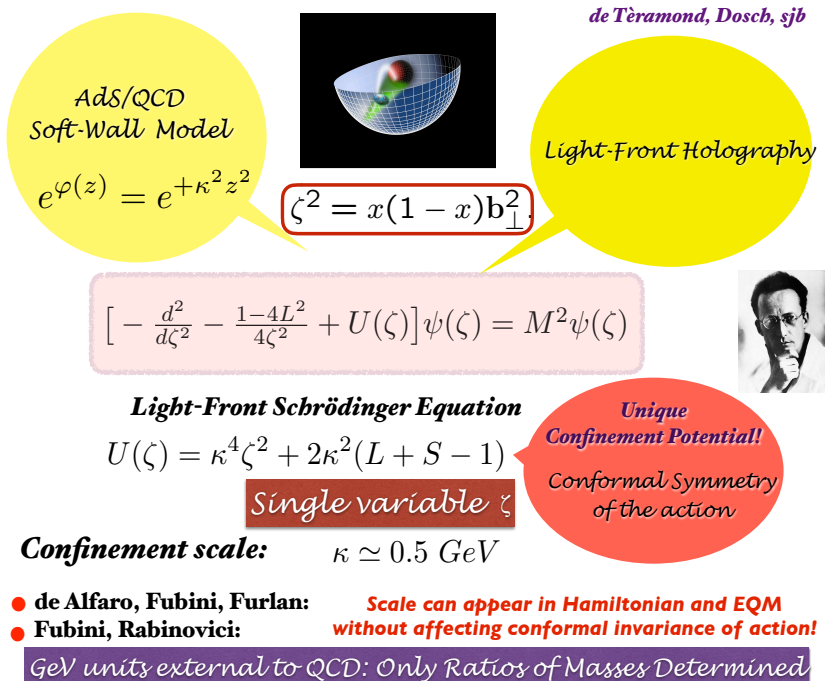
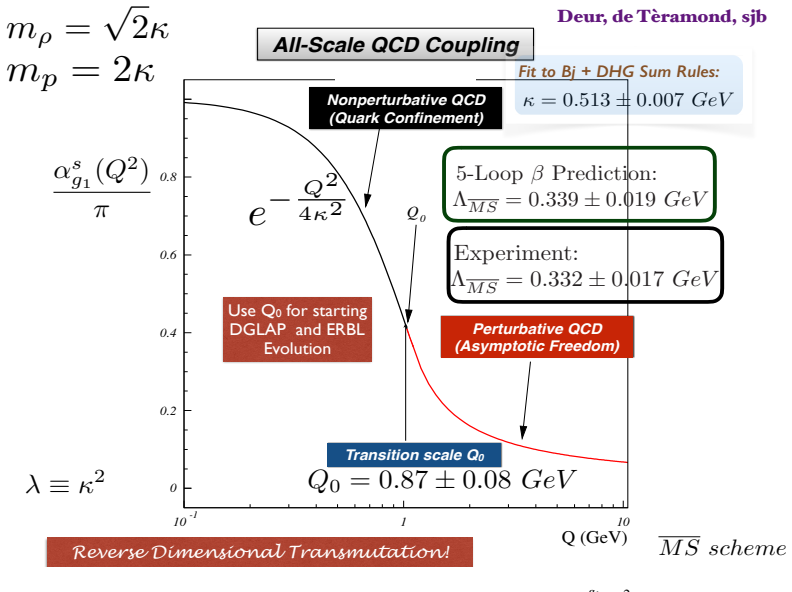
The central mechanism is the light-front Schrödinger equation with the confinement potential $U(\zeta) = \kappa^4 \zeta^2 + 2\kappa^2(L+S-1)$, obtained both from the dAFF procedure and from the soft-wall $\mathrm{AdS}_5$ model with dilaton $\exp(+\kappa^2 z^2)$. The scale $\kappa$ is the single parameter that determines the meson mass spectrum $M^2(n,L,S) = 4\kappa^2(n+L+S/2)$, the universal Regge slope in $n$ and $L$, and the Gaussian nonperturbative coupling $\alpha_s^{g_1}(Q^2) = \pi e^{-Q^2/4\kappa^2}$. Matching this coupling to the perturbative QCD running at $Q_0$ is what connects $\kappa$ to $\Lambda_{\mathrm{MS}}$, so the same $\kappa$ underlies confinement, spectroscopy, and the all-scale coupling.
What would settle it
Measure the effective charge $\alpha_s^{g_1}(Q^2)$ from the Bjorken sum rule at $Q^2$ between 0.1 and 1 GeV$^2$; if its shape departs from $\pi e^{-Q^2/4\kappa^2}$ with $\kappa = 0.513$ GeV, or if matching it to perturbative QCD at $Q_0$ fails to reproduce the measured $\Lambda_{\mathrm{MS}}$, then the single-$\kappa$ picture connecting confinement, spectroscopy, and the coupling is falsified.
Extended reading notes
Core claim
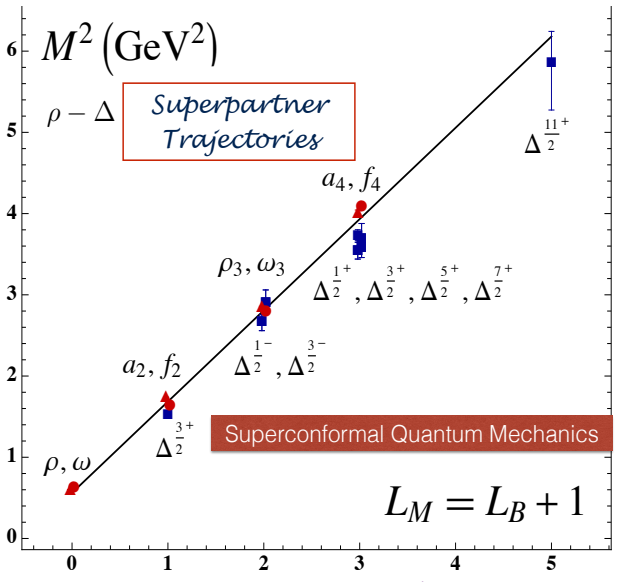
Light-front quantization, combined with the dAFF procedure, yields a color-confining potential $\kappa^4 \zeta^2$ for quark-antiquark mesons, where $\zeta$ is the light-front radial variable conjugate to the invariant mass squared. The same potential, including spin-dependent terms, follows from the holographic $\mathrm{AdS}_5$ (five-dimensional anti-de Sitter) model when the action is modified by the dilaton $\exp(+\kappa^2 z^2)$ in the fifth dimension. Superconformal algebra organizes the eigensolutions into unified Regge trajectories for mesons, baryons, and tetraquarks of the same parity, with universal slopes in the radial quantum number $n$ and orbital angular momentum $L$. The nonperturbative running coupling measured via the Bjorken sum rule takes the predicted Gaussian form $\alpha_s^{g_1}(Q^2) = \pi e^{-Q^2/4\kappa^2}$, and matching its value and slope to perturbative QCD at $Q_0 = 0.87 \pm 0.08$ GeV yields $\Lambda_{\mathrm{MS}} = 0.339 \pm 0.019$ GeV, consistent with the measured $0.332 \pm 0.017$ GeV, thereby connecting the confinement scale $\kappa$ to perturbative hadron dynamics.
Load-bearing premise
The argument assumes that the $\mathrm{AdS}_5$ soft-wall geometry with the dilaton $\exp(+\kappa^2 z^2)$, together with the dAFF procedure, is the correct strong-coupling description of QCD confinement, with $\kappa$ fitted to data rather than derived from the QCD Lagrangian.
Editorial extensions
If this is right
- Hadron masses and Regge slopes become predictions of one parameter: with massless quarks, $M^2(n,L,S) = 4\kappa^2(n+L+S/2)$.
- The QCD running coupling is defined at all momenta by matching the Gaussian nonperturbative form to perturbative QCD at the transition scale $Q_0 \approx 0.87$ GeV.
- Hadron masses are expressible in terms of $\Lambda_{\mathrm{MS}}$: $m_p = \sqrt{2}\,\kappa = 3.21\,\Lambda_{\mathrm{MS}}$ and $m_\rho = \kappa = 2.2\,\Lambda_{\mathrm{MS}}$.
- Superconformal algebra predicts mass-degenerate 4-plets of mesons, baryons, and tetraquarks with the same Regge slope, testable across the light, strange, charm, and bottom sectors.
- The transition scale $Q_0$ can serve as the starting scale for DGLAP and ERBL evolution, tightening collider predictions when combined with the principle of maximum conformality.
Reading between the lines
- If the single-$\kappa$ picture is right, the same confining potential should also fix glueball and hybrid masses; extracting that prediction would give a direct test outside the meson-baryon-tetraquark sectors treated here.
- The Gaussian low-$Q^2$ coupling implies a smooth, non-singular infrared behavior; a lattice measurement of the static quark potential at long distances could check whether the implied string tension matches $\kappa$.
- The $\kappa$-to-$\Lambda_{\mathrm{MS}}$ matching could be sharpened by computing scheme-independent quantities such as the cusp anomalous dimension, avoiding the scheme dependence of the current five-loop comparison.
- Nuclear applications such as hidden-color components in the deuteron wavefunction and nuclear-bound quarkonium follow naturally from the same light-front Hamiltonian; future electron-ion collider data on deuteron form factors at large momentum transfer could expose these Fock states.
Signed reviews
Editorial analysis
A structured set of objections, weighed in public.
Referee Report
Summary. The manuscript is a compact review/position paper arguing that light-front quantization combined with the AdS/QCD soft-wall model and the dAFF mechanism provides a unified description of hadron spectroscopy, nuclear phenomena, and the QCD running coupling. It presents the LF Schrödinger equation with a confining potential κ^4 ζ^2, superconformal relations connecting meson, baryon, and tetraquark spectra, and a Gaussian effective charge α_g1(Q^2)=π exp(−Q^2/4κ^2) that is matched to perturbative QCD to determine Λ_MS and the transition scale Q0.
Significance. The program is significant if the identifications hold: one scale κ would connect confinement, the hadron spectrum, Regge slopes, and the low-Q behavior of the QCD coupling, with a frame-independent Hamiltonian method. The paper's strengths are its concise summary of an extensive body of prior work, the explicit spectroscopic comparisons in Figs. 2 and 3, and the clear logical structure. The main caveats are that κ is fit to the very data used for validation, and the soft-wall/dAFF mapping is assumed rather than derived; these make the headline 'all-scales coupling' claim weaker than stated.
major comments (3)
- [Section 5] The Gaussian form α_g1(Q^2)=π exp(−Q^2/4κ^2) is presented as a prediction, but the same section fits κ=0.513±0.007 GeV to the measured α_g1 data and then uses this fitted value to obtain Λ_MS=0.339±0.019 GeV by matching value and slope at Q0. The agreement with the PDG value is therefore a consistency check of a one-parameter fit, not an independent determination. Please either determine κ from an independent input, for example from the hadron spectrum alone, before comparing with α_g1, or explicitly label the Λ_MS result as a consistency check and soften the statement in §6 that the coupling is 'obtained ... consistent with experiment'.
- [Section 3] The color-confining LF equation and the Gaussian coupling are derived from the soft-wall AdS5 model with dilaton exp(+κ^2 z^2) and the dAFF procedure. This identification of the soft-wall/dAFF potential with the true QCD confinement mechanism is assumed, not derived from the QCD Lagrangian, and the manuscript provides no independent lattice or other nonperturbative check. Because the Regge slopes, spectroscopy, and the all-scales coupling all rest on this mapping, the paper should state explicitly that this is a model assumption and give a concrete test that could falsify it; otherwise the central claim in §6 remains conditional on the model.
- [Section 5] The mass relations quoted in §5 are internally inconsistent. The text states m_p=√2 κ and m_ρ=κ, but the meson formula M^2=4κ^2(n+L+S/2) in §3 and the labeling in Fig. 3 imply m_ρ=√2 κ and m_p=2κ; numerically, with κ=0.513 GeV and Λ_MS=0.339 GeV, neither assignment gives the quoted chain m_p=√2κ=3.21Λ_MS, m_ρ=κ=2.2Λ_MS. Please correct the relations and specify exactly which states are being compared.
minor comments (3)
- [References] References [26] and [29] are identical (Dosch, de Téramond, Brodsky, Phys. Rev. D 91, 085016); please consolidate or cite distinct papers.
- [Section 4] There is a comma splice before 'The q¯q mesons with orbital angular momentum...', and the phrase 'same parity and twist as equal-mass members of the same 4-plet representation' is hard to parse; please rephrase for clarity.
- [Section 5] The matching procedure that yields Q0 and Λ_MS is described only in words; adding the explicit matching equations would help readers verify the quoted uncertainties.
Circularity Check
The all-scale coupling is a one-parameter fit to the data it claims to predict, and the confining potential is an ansatz imported from self-cited prior work; the Gaussian shape and the independent PDG Lambda_MS value provide partial independent content.
-
fitted input called prediction
[Section 5, 'The QCD Running Coupling at all Scales' (p. 5), and Fig. 3.]
"The dilaton e+κ2z2 soft-wall modification of the AdS5 metric, together with LF holography, predicts the functional behavior of the running coupling in the smallQ2 domain [39]: αg1s(Q2) =πe−Q2/4κ2. Measurements of αg1s(Q2) [40,41] are remarkably consistent with this predicted Gaussian form; the best fit givesκ = 0.513±0.007 GeV , see Fig. 3."
The predicted nonperturbative coupling contains one free scale, κ, and that scale is fitted to the very same α_g1 measurements that are then quoted as confirming the prediction. The agreement with experiment is therefore partly built in: the one-parameter Gaussian can accommodate any smoothly decreasing dataset by adjusting κ. The same fitted κ is then used for the Q0 matching, the ΛMS value, and the hadron-mass relations, so the 'all-scale coupling consistent with experiment' claim in Section 6 inherits the fitted scale rather than being an independent prediction. What remains genuinely predictive is the Gaussian shape and the fixed normalization π, which is why the circularity is partial.
-
ansatz smuggled in via citation
[Section 3, 'Light-front Holography' (p. 3), with Fig. 1's 'Unique Confinement Potential!' label.]
"A color-confining LF equation for mesons of arbitrary spin J can be derived [17] from the holographic mapping of the 'soft-wall model' modification of AdS5 space for the specific dilaton profile e+κ2z2, where z is the fifth dimension variable of the five-dimensional AdS5 space."
The 'derivation' of the confining potential κ⁴ζ² is conditioned on a specific dilaton profile chosen in the authors' own soft-wall program, and the uniqueness of that potential is asserted in Fig. 1 without an independent derivation from the QCD Lagrangian. The citation [17] is self-authored prior work in which the dilaton is adopted as the soft-wall ansatz, so citing it as the origin of the potential hides the fact that the model identification is an input, not a consequence. Since the Gaussian coupling, the Regge slopes, and the κ-to-ΛMS matching in Section 5 all rest on this potential, the ansatz is load-bearing even though the cited work is prior work.
full rationale
The paper's genuinely first-principles material—LF quantization, boost-invariant Fock-state wavefunctions, and the causal frame-independent Hamiltonian framework—is self-contained and does not reduce to its inputs. The circularity enters at the model-to-data interface. In Section 5, the soft-wall model predicts α_g1(Q²)=π exp(−Q²/4κ²), and the paper then fixes κ by a best fit to the same α_g1 measurements that are cited as validating the prediction; the all-scale coupling and the summary claim 'consistent with experiment' therefore partly reduce to a one-parameter fit. This is mitigated because the Gaussian shape and the fixed normalization are not fitted and the PDG ΛMS value is an independent external comparison, so the agreement with ΛMS is a genuine consistency check rather than a pure tautology. A second load-bearing step is the identification of κ⁴ζ² with real color confinement: Section 3 presents this as derived from the specific dilaton profile e^{+κ²z²}, citing the authors' own soft-wall program, where that profile is an ansatz rather than a consequence of the QCD Lagrangian. The superconformal mass degeneracies and the independent PDG comparison give the paper some external anchor, so this is partial circularity rather than a complete collapse; score 6 rather than 8 or 10.
Assumptions & free parameters
free parameters (1)
- κ (confinement/Regge scale) =
0.513 ± 0.007 GeV
assumptions (5)
- ad hoc to paper The dAFF procedure, when applied to the QCD LF Hamiltonian, generates the physical color-confining potential κ^4 ζ^2, with κ identified as the QCD mass scale.
- domain assumption AdS5 with the soft-wall dilaton e^{+κ²z²} is holographically dual to 3+1 QCD at fixed LF time.
- ad hoc to paper Hadronic eigensolutions of QCD organize into representations of superconformal algebra even though the QCD Lagrangian is not supersymmetric.
- domain assumption The effective charge α_g1 is a valid nonperturbative definition of the QCD coupling, and its low-Q Gaussian form can be matched in value and slope to pQCD at a scale Q0.
- domain assumption LF quantization provides a complete and causal quantization of QCD in which structure functions and form factors are computed from LFWFs without vacuum-induced current contributions.
Cite this review
Pith. "Pith review of Hadron and Nuclear Physics on the Light Front." pith.science (2026). https://pith.science/paper/7IEDCXIX
@misc{pith2026190801043,
  author       = {Pith},
  title        = {Pith review of: Hadron and Nuclear Physics on the Light Front},
  year         = {2026},
  howpublished = {\url{https://pith.science/paper/7IEDCXIX}},
  note         = {Machine review of arXiv:1908.01043}
}
read the original abstract
The QCD light-front (LF) Hamiltonian equation H_{LF}|\Psi> = M^2 |\Psi> derived from quantization at fixed LF time \tau = t+z/c provides a causal, frame-independent, method for computing hadron spectroscopy as well as dynamical observables such as structure functions, transverse momentum distributions, and distribution amplitudes. The LF formalism also leads to novel nuclear phenomena, such as "hidden color", "color transparency", "nuclear-bound quarkonium" and the shadowing and antishadowing of nuclear structure functions. For example, there are five distinct color-singlet Fock state representations of the six color-triplet quarks of the deuteron. The hidden color Fock states become manifest when the deuteron is probed when it has small transverse size, as in measurements of the deuteron form factor at large momentum transfer. The QCD Lagrangian with zero quark mass has no explicit mass scale. However, as shown by de Alfaro, Fubini, and Furlan (dAFF), a mass scale can appear in the equations of motion without affecting the conformal invariance of the Action. When one applies the dAFF procedure to the QCD LF Hamiltonian, it leads to a color confining potential \kappa^4 \zeta^2 for mesons, where \zeta^2 is the LF radial variable conjugate to the qbar-q invariant mass squared. The same result, including spin terms, is obtained using LF holography (AdS/QCD) -- the duality between LF dynamics and AdS_5 -- if one modifies the AdS_5 Action by the dilaton exp{+\kappa^2 z^2} in the fifth dimension z. If this procedure is generalized using superconformal algebra, the resulting LF eigensolutions provide unified Regge spectroscopy of mesons, baryons, and tetraquarks, including remarkable supersymmetric relations between the masses of mesons, baryons and tetraquarks with a universal Regge slope...
Figures
Reference graph
Works this paper leans on
-
[1]
P. A. M. Dirac, Rev. Mod. Phys. 21, 392 (1949)
1949
- [2]
- [3]
-
[4]
V . F. Weisskopf, Physics Today 13, 9, 24 (1960)
work page 1960
-
[5]
E. P. Wigner, Annals Math. 40, 149 (1939) [Nucl. Phys. Proc. Suppl. 6, 9 (1989)]. 7
work page 1939
-
[6]
F. E. Low, Phys. Rev. 96, 1428 (1954)
work page 1954
-
[7]
S. B. Gerasimov, Sov. J. Nucl. Phys. 2, 430 (1966) [Yad. Fiz. 2, 598 (1965)]
work page 1966
-
[8]
S. D. Drell and A. C. Hearn, Phys. Rev. Lett. 16, 908 (1966)
1966
Show all 50 references
-
[9]
Hosoda and K
M. Hosoda and K. Yamamoto, Prog. Theor. Phys. 36 (2), 425 (1966)
1966
-
[10]
S. J. Brodsky and J. R. Primack, Phys. Rev. 174, 2071 (1968)
1968
-
[11]
S. J. Brodsky, C. R. Ji and G. P. Lepage, Phys. Rev. Lett. 51, 83 (1983)
1983
-
[12]
S. J. Brodsky and A. H. Mueller, Phys. Lett. B 206, 685 (1988)
1988
-
[13]
S. J. Brodsky, I. A. Schmidt and G. F. de de T ´eramond, Phys. Rev. Lett. 64, 1011 (1990)
1990
-
[14]
E. M. Aitala et al. [E791 Collaboration], Phys. Rev. Lett. 86, 4768 (2001) [hep-ex/0010043]
2001 arXiv
-
[15]
S. J. Brodsky and H. J. Lu, Phys. Rev. Lett. 64, 1342 (1990)
1990
-
[16]
S. J. Brodsky, G. F. de T´eramond, H. G. Dosch and J. Erlich, Phys. Rept.584, 1 (2015) [arXiv:1407.8131]
2015 arXiv
-
[17]
G. F. de T ´eramond, H. G. Dosch and S. J. Brodsky, Phys. Rev. D87, 7, 075005 (2013) [arXiv:1301.1651]
2013 arXiv
-
[18]
de Alfaro, S
V . de Alfaro, S. Fubini and G. Furlan, Nuovo Cim. A 34, 569 (1976)
1976
-
[19]
Regge, Nuovo Cim
T. Regge, Nuovo Cim. 14, 951 (1959)
1959
-
[20]
Veneziano, Nuovo Cim
G. Veneziano, Nuovo Cim. A 57, 190 (1968)
1968
-
[21]
S. J. Brodsky, G. F. de T ´eramond and H. G. Dosch, Phys. Lett. B 729, 3 (2014) [arXiv:1302.4105]
2014 arXiv
-
[22]
S. J. Brodsky, Few Body Syst. 57, 8, 703 (2016) [arXiv:1601.06328]
2016 arXiv
-
[23]
Gutsche, V
T. Gutsche, V . E. Lyubovitskij, I. Schmidt and A. Vega, Phys. Rev. D 91, 11, 114001 (2015) [arXiv:1501.02738]
2015 arXiv
-
[24]
Gutsche, V
T. Gutsche, V . E. Lyubovitskij and I. Schmidt, Phys. Rev. D94, 11, 116006 (2016) [arXiv:1607.04124]
2016 arXiv
-
[25]
G. F. de T ´eramond, H. G. Dosch and S. J. Brodsky, Phys. Rev. D91, 4, 045040 (2015) [arXiv:1411.5243]
2015 arXiv
-
[27]
S. J. Brodsky, G. F. de T ´eramond,, H. G. Dosch and C. Lorc `e, Int. J. Mod. Phys. A 31, 19, 1630029 (2016) [arXiv:1606.04638]
2016 arXiv
-
[28]
Nielsen, S
M. Nielsen, S. J. Brodsky, G. F. de T ´eramond,, H. G. Dosch, F. S. Navarra and L. Zou, Phys. Rev. D 98, 3, 034002 (2018) [arXiv:1805.11567]
2018 arXiv
-
[29]
H. G. Dosch, G. F. de T ´eramond, S. J. Brodsky, Phys. Rev. D91, 8, 085016 (2015) [arXiv:1501.00959]
2015 arXiv
-
[30]
R. S. Sufian, G. F. de T ´eramond, S. J. Brodsky, A. Deur and H. G. Dosch, Phys. Rev. D 95, 1, 014011 (2017) [arXiv:1609.06688]
2017 arXiv
-
[31]
G. F. de T ´eramond, et al. [HLFHS Collaboration], Phys. Rev. Lett. 120, 18, 182001 (2018) [arXiv:1801.09154]
2018 arXiv
-
[32]
A. Deur, S. J. Brodsky and G. F. de T ´eramond, Prog. Part. Nucl. Phys. 90, 1 (2016) [arXiv:1604.08082]
2016 arXiv
-
[33]
Grunberg, Phys
G. Grunberg, Phys. Lett. 95B, 70 (1980) Erratum: [Phys. Lett. 110B, 501 (1982)]
1980
-
[34]
J. D. Bjorken, Phys. Rev. 148, 1467 (1966)
1966
- [35]
- [36]
- [37]
-
[38]
S. J. Brodsky and H. J. Lu, Phys. Rev. D 51, 3652 (1995) [hep-ph/9405218]
1995 arXiv
-
[39]
S. J. Brodsky, G. F. de T ´eramond and A. Deur, Phys. Rev. D 81, 096010 (2010) [arXiv:1002.3948]
2010 arXiv
-
[40]
A. Deur, V . Burkert, J. P. Chen and W. Korsch, Phys. Lett. B650, 244 (2007) [hep-ph/0509113]
2007 arXiv
-
[41]
A. Deur, V . Burkert, J. P. Chen and W. Korsch, Phys. Lett. B665, 349 (2008) [arXiv:0803.4119]
2008 arXiv
-
[42]
A. Deur, S. J. Brodsky and G. F. de T ´eramond, Phys. Lett. B 750, 528 (2015) [arXiv:1409.5488]
2015 arXiv
-
[43]
S. J. Brodsky, G. F. de T ´eramond, A. Deur and H. G. Dosch, Few Body Syst. 56, 6-9, 621 (2015) [arXiv:1410.0425]
2015 arXiv
-
[44]
K. A. Olive et al. [Particle Data Group], Chin. Phys. C 38, 090001 (2014)
2014
-
[45]
Zee, Princeton, UK: Princeton Univ
A. Zee, Princeton, UK: Princeton Univ. Pr. (2010) 576 p
2010
-
[46]
V . N. Gribov and L. N. Lipatov, Sov. J. Nucl. Phys.15, 438 (1972) [Yad. Fiz. 15, 781 (1972)]
1972
-
[47]
Altarelli and G
G. Altarelli and G. Parisi, Nucl. Phys. B 126, 298 (1977)
1977
-
[48]
Y . L. Dokshitzer, Sov. Phys. JETP46, 641 (1977) [Zh. Eksp. Teor. Fiz. 73, 1216 (1977)]
1977
-
[49]
G. P. Lepage and S. J. Brodsky, Phys. Lett. 87B, 359 (1979)
1979
-
[50]
A. V . Efremov and A. V . Radyushkin, Phys. Lett.94B, 245 (1980)
1980
-
[51]
Mojaza, S
M. Mojaza, S. J. Brodsky and X. G. Wu, Phys. Rev. Lett. 110, 192001 (2013) [arXiv:1212.0049]. 8
2013 arXiv
Reviewed August 14, 2026 · model on record in the stance chip above.
Discussion (0). Continue with ORCID to comment.