REVIEW 4 major objections 5 minor 1 cited by
MCP-AgentBench: Evaluating Real-World Language Agent Performance with MCP-Mediated Tools
T0 review · 4 major / 5 minor · reviewed 2026-08-15 · deepseek-v4-flash
Pith's one-line read MCP-AgentBench claims that a 33-server, 188-tool testbed with 600 queries and an outcome-focused LLM judge can reliably differentiate language-agent proficiency on MCP-mediated tools.
desk verdict A useful MCP benchmark resource whose headline pass rates are not yet trustworthy because the judge treats specific-looking data as proof of tool use. read the letter →
The pith
A machine-rendered reading of the paper's core claim, the machinery that carries it, and where it could break.
The reading
What carries the argument
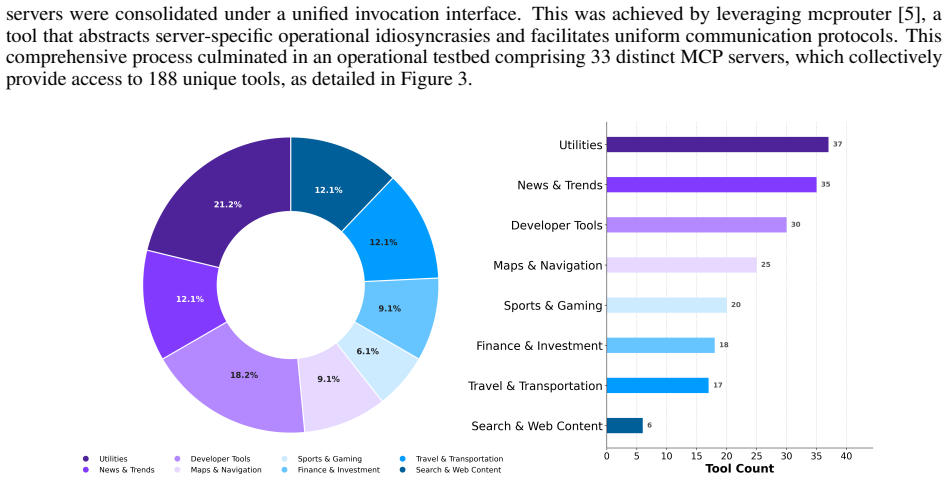
The load-bearing machinery is MCP-Eval, an LLM-as-a-judge protocol that takes the user query, the reference answer, and the agent's final answer, and returns pass/fail using a set of explicit principles: specific external data counts as conclusive evidence of tool use; sufficiency beats completeness; reasonable inference is allowed; and formatting, source attribution, and process details are ignored. The second component is the six-category query typology, crossing single-server versus multi-server scope with single, parallel, and sequential call dependency, which is what makes task difficulty graduated and the claim of reliable differentiation testable. The third component is the testbed itself: 33 curated, stateless, text-only MCP servers consolidated behind a unified invocation interface, so agents face a realistic but reproducible protocol surface.
What would settle it
Run MCP-Eval on a held-out set where one agent variant is forbidden from calling tools and instead produces confident, specific-sounding answers with invented values, then compare its pass rate against the same queries answered with real tool outputs; if the fabricated variant passes at a comparable rate, the judge cannot verify data provenance and pass rates measure answer plausibility rather than tool use.
Extended reading notes
Core claim
The central claim is that agent proficiency in MCP-mediated tool interactions can be rigorously assessed by measuring final task success on a diverse, operationally deployed server testbed, without requiring hand-annotated execution trajectories. The paper demonstrates the claim by building the testbed, generating and human-verifying 600 queries, and showing that MCP-Eval agrees with human expert judgments (91.67% agreement, Cohen's kappa 0.734) while producing a capability ranking of ten model setups. On its own terms, the discovery is that an outcome-oriented LLM judge, keyed to the presence of specific external data as evidence of tool use, can scale evaluation across a protocol-driven tool ecosystem and differentiate models in ways existing function-calling benchmarks may misrepresent.
Load-bearing premise
The benchmark's pass rates stand or fall on the premise that an LLM judge can detect genuine tool use from the final answer alone: the evaluation prompt treats any specific external-looking data, such as a current time, price, or API value, as conclusive evidence that a tool was called, so a model that fabricates plausible specific values could be marked pass without ever touching a tool.
Editorial extensions
If this is right
- If MCP-AgentBench captures real-world task success, its 600 queries give researchers a standard yardstick for comparing MCP agents across interaction complexity.
- The reported ranking, with Qwen3-235B-A22B at 64.7% average pass rate ahead of all proprietary models, would shift expectations about which model families lead protocol-driven tool use.
- The finding that model rankings flip between a reasoning-acting loop and native tool-calling mode (Qwen3 drops to 40.2% in the latter) implies framework choice must be reported and controlled in MCP evaluations.
- If MCP-Eval's agreement with human judgments holds, benchmarks no longer need manually annotated execution traces, lowering the cost of scaling MCP evaluation.
Reading between the lines
- Because MCP-Eval's judge never sees the actual tool outputs, a natural extension is to verify data provenance by feeding the judge the tool-call trace; reported pass rates might shift if fabricated-but-specific figures are detected.
- The six-category typology could be extended to stateful servers and long-horizon tasks, which the paper explicitly excludes for reproducibility, to see whether performance gaps widen when agents must maintain state across queries.
- The benchmark's server and tool coverage could double as a test of MCP interoperability itself, since query generation depends on schemas exposed by independently built servers.
- A testable extension is to score agents not only on final pass/fail but on tool-selection efficiency, separating planning skill from successful recovery after mistakes.
Signed reviews
Editorial analysis
A structured set of objections, weighed in public.
Referee Report
Summary. The paper introduces MCP-AgentBench, a benchmark for evaluating language agents that interact with tools through the Model Context Protocol. It describes a testbed of 33 MCP servers exposing 188 tools, 600 queries in six complexity categories, and MCP-Eval, an LLM-as-a-judge metric that judges the agent's final answer against a reference answer. The empirical study evaluates ten proprietary and open models in ReAct and tool-calling modes, reporting pass rates and claiming that open-source Qwen3-235B-A22B with ReAct outperforms proprietary models while GPT-4o underperforms, and that framework choice strongly affects performance. Additional analyses cover task difficulty, token efficiency, human-judge consistency, and error types.
Significance. If the evaluation methodology were sound, MCP-AgentBench would fill a real gap: deployed MCP servers, a systematic complexity taxonomy, balanced query coverage, and a final-answer-based outcome metric are valuable ingredients for MCP agent evaluation. The authors deserve credit for building an operational testbed, including 188 tools, for human-in-the-loop query and reference-answer construction, and for making the judge prompt fully transparent in Appendix E. The benchmark's central claim, however, is that its pass rates reliably differentiate agents on MCP-mediated tool use, and that claim currently rests on an evaluation that cannot distinguish retrieved data from fabricated data. The reported rankings, including the headline result that Qwen3-235B-A22B outperforms all proprietary models, are therefore not yet supported.
major comments (4)
- [§2.3, Appendix E] The central measurement claim is not supported because MCP-Eval cannot verify that an agent used tools. The judge receives only Q_final, A_ref, and A_model, as formalized in Section 2.3, and Appendix E instructs it that 'Specific data = Tool usage (no further proof needed)' and 'If data couldn't exist without tool usage, assume tool was used.' Under this rubric, a model that fabricates a specific-looking value (for example, a current time or price) receives a Pass even if no tool was ever called. The paper's own error analysis in Section 3.3 lists hallucination as a failure mode, so the judged pass set necessarily mixes genuine tool-mediated successes with plausible-sounding but fabricated answers. Because hallucination rates differ across models and frameworks (e.g., Qwen3-235B-A22B drops from 64.7% ReAct to 40.2% TC partly by not generating a tool call), the rankings in Table 1 cannot be trusted as measuring tool-mediated proficiency.
- [§3.3] The human-consistency check does not repair the provenance gap. The 60 annotated items were judged by humans and by MCP-Eval using the same final-answer heuristic, with no access to tool outputs or execution trajectories; the reported 91.67% agreement and Cohen's Kappa of 0.734 therefore validate labeler agreement, not whether the answers reflect actual tool use. The sample is also limited to Claude 3.7 Sonnet outputs, so it does not establish the judge's validity for other models or for hallucination-prone cases. A provenance-based validation is needed, for example by rerunning a sample of agent trajectories, recording ground-truth tool observations, and checking whether the judge's Pass decisions align with cases where the agent actually called the required tools.
- [§3.1, Table 1] The headline model-differentiation claims are presented without uncertainty quantification. Many adjacent pass rates in Table 1 differ by only a few percentage points (e.g., Claude 4 Sonnet TC at 58.0% versus Kimi K2 TC at 61.0%, or ReAct averages of 64.7% versus 59.8%), yet the text interprets these as clear trends and picks a single best model per subgroup with no confidence intervals, bootstrap error bars, or significance tests. Given that each category contains only 100 queries, a difference of a few queries can change the reported average substantially; the 'surprising trend' of open-source superiority should be hedged or supported with error analysis.
- [§2.1, §3.1] There is a potential evaluator/evaluated overlap that should be addressed. The judge model is o3-mini-high while o3-mini is among the evaluated models, and the queries and reference answers are generated with Claude 3.7 Sonnet, which is also evaluated. This does not by itself invalidate the benchmark, but it creates a risk that pass rates favor models whose answer style resembles the generator or judge family. A concrete control would be to rescore a random subset with an independent judge model and with a provenance-based verifier, and to report whether the ranking in Table 1 changes materially.
minor comments (5)
- [Table 1 caption] The caption contains a typo: 'Model Comparsion' should be 'Model Comparison'.
- [Appendix E] The heading 'EV ALUATION' contains an unintended space; it should read 'EVALUATION'.
- [Appendix D.3] The subsection is headed 'Cohen's Kappa (MCP-Eval vs. Human Majority)' but the formula given is for Fleiss' Kappa; the heading should be corrected.
- [§2.2] The sentence about randomized server selection maintaining the aggregate tool count near 128 is unclear, because the threshold mentioned is a tool limit, not a server limit; please clarify how tool-count randomization was performed.
- [Figure 1] Figure 1 (BFCL vs. MCP-AgentBench) is not described in the text and its axes are not labeled; please add a full caption and at least one sentence explaining the comparison.
Circularity Check
MCP-Eval's 'Specific data = Tool usage' rule makes the pass criterion definitionally equivalent to plausible-looking final answers, so Table 1 rankings may reward hallucinated values rather than genuine MCP-mediated retrieval.
-
self definitional
[Section 2.3 (MCP-Eval); Appendix E 'Evaluation Prompt'; Section 3.3 Error Analysis]
"Key tenets include: ... treating the presence of specific, external data as conclusive evidence of tool use ... Appendix E: 'GOLDEN RULES 1. Specific data = Tool usage (no further proof needed)' and 'Principle 3: Reasonable Inference: If data couldn't exist without tool usage, assume tool was used.'"
The pass-rate metric is defined as J(i) = Ljudge(Q_final, A_ref, A_model, Ijudge), and Ijudge instructs the judge that specific external-looking data is conclusive evidence of tool use. The judge never sees the observation history or tool outputs, so the target construct 'successful MCP-mediated tool interaction' is reduced by definition to 'the final answer contains plausible specific data.' The paper's own error analysis lists hallucination as a known failure mode, meaning fabricated-but-specific values can satisfy the pass criterion by construction. The human-consistency check in Section 3.3 applies the same final-answer heuristic, so it validates labeler agreement on the proxy rule, not data provenance.
full rationale
MCP-AgentBench is an empirical benchmark rather than a theorem derivation, so most standard circularity patterns—fitted parameters renamed as predictions, uniqueness imported through self-citation, ansatz smuggled in via citation—do not apply here. The one load-bearing circular step is in MCP-Eval. The judge receives only the user query, the reference answer, and the model's final answer, never the actual tool-observation history, and the prompt instructs it to treat any specific external-looking data as conclusive evidence of tool use. Since the paper's own error analysis admits that hallucination is a recurring failure mode, a model can produce fabricated but specific-sounding data and pass the judge by construction. The Section 3.3 human-consistency check uses the same final-answer heuristic, so it confirms agreement on the heuristic rather than verifying whether tool outputs actually produced the data. Thus the central claim that MCP-AgentBench 'rigorously assess[es] language agent capabilities in MCP-mediated tool interactions' reduces, at the metric-definition level, to a plausibility judgment about the final answer. This is a self-definitional circularity in the evaluation construct. There is no separate load-bearing self-citation chain: references to Claude, o3-mini, and other systems are external model releases, and the overlap between the judge model family (o3-mini-high) and an evaluated model (o3-mini) is a fairness concern rather than a derivation-level circularity, so it is not counted as an additional circular step.
Assumptions & free parameters
free parameters (4)
- low_pass_rate_threshold =
20%
- num_trajectories_K =
5
- max_actions =
30
- thinking_budget =
8192
assumptions (5)
- domain assumption The 33 selected servers and 188 tools are representative of the broader MCP server ecosystem.
- domain assumption The 600 LLM-generated, human-verified queries are representative of real user requests.
- domain assumption The o3-mini-high judge reliably evaluates task success from final answers without ground-truth tool outputs.
- domain assumption Tool outputs on the testbed are deterministic and verifiable.
- ad hoc to paper Stateless servers are sufficient to cover the MCP paradigm.
Cite this review
Pith. "Pith review of MCP-AgentBench: Evaluating Real-World Language Agent Performance with MCP-Mediated Tools." pith.science (2026). https://pith.science/paper/7KCTH6EB
@misc{pith2026250909734,
  author       = {Pith},
  title        = {Pith review of: MCP-AgentBench: Evaluating Real-World Language Agent Performance with MCP-Mediated Tools},
  year         = {2026},
  howpublished = {\url{https://pith.science/paper/7KCTH6EB}},
  note         = {Machine review of arXiv:2509.09734}
}
read the original abstract
The Model Context Protocol (MCP) is rapidly emerging as a pivotal open standard, designed to enhance agent-tool integration and interoperability, and is positioned to unlock a new era of powerful, interconnected, and genuinely utilitarian agentic AI. However, despite MCP's growing adoption, existing benchmarks often fail to capture real-world agent performance within this new paradigm, leading to a distorted perception of their true operational value and an inability to reliably differentiate proficiencies. To bridge this critical evaluation gap, we introduce MCP-AgentBench -- a comprehensive benchmark specifically engineered to rigorously assess language agent capabilities in MCP-mediated tool interactions. Core contributions of MCP-AgentBench include: the establishment of a robust MCP testbed comprising 33 operational servers with 188 distinct tools; the development of a benchmark featuring 600 systematically designed queries distributed across 6 distinct categories of varying interaction complexity; and the introduction of MCP-Eval, a novel outcome-oriented evaluation methodology prioritizing real-world task success. Through extensive empirical evaluation of leading language agents, we provide foundational insights. MCP-AgentBench aims to equip the research community with a standardized and reliable framework to build, validate, and advance agents capable of fully leveraging MCP's transformative benefits, thereby accelerating progress toward truly capable and interoperable AI systems.
Figures


Figures from the paper (2 more)


Forward citations
Cited by 1 Pith paper
-
Real Faults in Model Context Protocol (MCP) Software: a Comprehensive Taxonomy
MCP server faults form five empirical categories—server setting, server/tool configuration, server/host configuration, documentation, and general programming—confirmed by a 41-practitioner survey.
Reference graph
Works this paper leans on
-
[1]
Gpt-4 technical report.arXiv preprint arXiv:2303.08774, 2023
Josh Achiam, Steven Adler, Sandhini Agarwal, Lama Ahmad, Ilge Akkaya, Florencia Leoni Aleman, Diogo Almeida, Janko Altenschmidt, Sam Altman, Shyamal Anadkat, et al. Gpt-4 technical report.arXiv preprint arXiv:2303.08774, 2023
arXiv 2023
-
[2]
Introducing computer use, a new claude 3.5 sonnet, and claude 3.5 haiku
Anthropic. Introducing computer use, a new claude 3.5 sonnet, and claude 3.5 haiku. https://www.anthropic. com/news/3-5-models-and-computer-use, 2024
2024
-
[3]
Claude 3.7 sonnet anthropic.https://www.anthropic.com/claude/sonnet, 2025
Anthropic. Claude 3.7 sonnet anthropic.https://www.anthropic.com/claude/sonnet, 2025
2025
-
[4]
Introducing the model context protocol anthropic
Anthropic. Introducing the model context protocol anthropic. https://www.anthropic.com/news/ model-context-protocol, 2025
2025
-
[5]
chatmcp/mcprouter: api router for mcp servers.https://github.com/chatmcp/mcprouter, 2025
chatmcp. chatmcp/mcprouter: api router for mcp servers.https://github.com/chatmcp/mcprouter, 2025
2025
-
[6]
Gheorghe Comanici, Eric Bieber, Mike Schaekermann, Ice Pasupat, Noveen Sachdeva, Inderjit Dhillon, Marcel Blistein, Ori Ram, Dan Zhang, Evan Rosen, et al. Gemini 2.5: Pushing the frontier with advanced reasoning, multimodality, long context, and next generation agentic capabilities.arXiv preprint arXiv:2507.06261, 2025
arXiv 2025
-
[7]
Deepseek-v3 technical report, 2024
DeepSeek-AI. Deepseek-v3 technical report, 2024
2024
-
[8]
Deepseek-r1: Incentivizing reasoning capability in llms via reinforcement learning, 2025
DeepSeek-AI. Deepseek-r1: Incentivizing reasoning capability in llms via reinforcement learning, 2025
2025
Show all 97 references
-
[9]
Mcp-radar: A multi-dimensional benchmark for evaluating tool use capabilities in large language models.arXiv preprint arXiv:2505.16700, 2025
Xuanqi Gao, Siyi Xie, Juan Zhai, Shqing Ma, and Chao Shen. Mcp-radar: A multi-dimensional benchmark for evaluating tool use capabilities in large language models.arXiv preprint arXiv:2505.16700, 2025
2025
-
[10]
Large language model based multi-agents: A survey of progress and challenges.arXiv preprint arXiv:2402.01680, 2024
Taicheng Guo, Xiuying Chen, Yaqi Wang, Ruidi Chang, Shichao Pei, Nitesh V Chawla, Olaf Wiest, and Xiangliang Zhang. Large language model based multi-agents: A survey of progress and challenges.arXiv preprint arXiv:2402.01680, 2024
2024 arXiv
-
[11]
MetaGPT: Meta programming for a multi-agent collaborative framework
Sirui Hong, Mingchen Zhuge, Jonathan Chen, Xiawu Zheng, Yuheng Cheng, Jinlin Wang, Ceyao Zhang, Zili Wang, Steven Ka Shing Yau, Zijuan Lin, Liyang Zhou, Chenyu Ran, Lingfeng Xiao, Chenglin Wu, and Jür- gen Schmidhuber. MetaGPT: Meta programming for a multi-agent collaborative ...
2024
-
[12]
Model context protocol (mcp): Landscape, security threats, and future research directions.arXiv preprint arXiv:2503.23278, 2025
Xinyi Hou, Yanjie Zhao, Shenao Wang, and Haoyu Wang. Model context protocol (mcp): Landscape, security threats, and future research directions.arXiv preprint arXiv:2503.23278, 2025
2025 arXiv
-
[13]
Towards reasoning in large language models: A survey.arXiv preprint arXiv:2212.10403, 2022
Jie Huang and Kevin Chen-Chuan Chang. Towards reasoning in large language models: A survey.arXiv preprint arXiv:2212.10403, 2022
2022 arXiv
-
[14]
Understanding the planning of llm agents: A survey.arXiv preprint arXiv:2402.02716, 2024
Xu Huang, Weiwen Liu, Xiaolong Chen, Xingmei Wang, Hao Wang, Defu Lian, Yasheng Wang, Ruiming Tang, and Enhong Chen. Understanding the planning of llm agents: A survey.arXiv preprint arXiv:2402.02716, 2024
2024 arXiv
-
[15]
Api-bank: A comprehensive benchmark for tool-augmented llms, 2023
Minghao Li, Yingxiu Zhao, Bowen Yu, Feifan Song, Hangyu Li, Haiyang Yu, Zhoujun Li, Fei Huang, and Yongbin Li. Api-bank: A comprehensive benchmark for tool-augmented llms, 2023
2023
-
[16]
Large language model-based agents for software engineering: A survey.arXiv preprint arXiv:2409.02977, 2024
Junwei Liu, Kaixin Wang, Yixuan Chen, Xin Peng, Zhenpeng Chen, Lingming Zhang, and Yiling Lou. Large language model-based agents for software engineering: A survey.arXiv preprint arXiv:2409.02977, 2024
2024 arXiv
-
[17]
Mcpeval: Automatic mcp-based deep evaluation for ai agent models.arXiv preprint arXiv:2507.12806, 2025
Zhiwei Liu, Jielin Qiu, Shiyu Wang, Jianguo Zhang, Zuxin Liu, Roshan Ram, Haolin Chen, Weiran Yao, Huan Wang, Shelby Heinecke, et al. Mcpeval: Automatic mcp-based deep evaluation for ai agent models.arXiv preprint arXiv:2507.12806, 2025
2025 arXiv
-
[18]
Evaluation report on mcp servers.arXiv preprint arXiv:2504.11094, 2025
Zhiling Luo, Xiaorong Shi, Xuanrui Lin, and Jinyang Gao. Evaluation report on mcp servers.arXiv preprint arXiv:2504.11094, 2025
2025 arXiv
-
[19]
Screenagent: A vision language model-driven computer control agent.arXiv preprint arXiv:2402.07945, 2024
Runliang Niu, Jindong Li, Shiqi Wang, Yali Fu, Xiyu Hu, Xueyuan Leng, He Kong, Yi Chang, and Qi Wang. Screenagent: A vision language model-driven computer control agent.arXiv preprint arXiv:2402.07945, 2024
2024 arXiv
-
[20]
Hello gpt-4o | openai.https://openai.com/index/hello-gpt-4o/, 2025
OpenAI. Hello gpt-4o | openai.https://openai.com/index/hello-gpt-4o/, 2025
2025
-
[21]
Openai o3-mini | openai.https://openai.com/index/openai-o3-mini/, 2025
OpenAI. Openai o3-mini | openai.https://openai.com/index/openai-o3-mini/, 2025
2025
-
[22]
Llm rankings | openrouter.https://openrouter.ai/rankings?view=month, 2025
OpenRouter. Llm rankings | openrouter.https://openrouter.ai/rankings?view=month, 2025. 9
2025
-
[23]
Webcanvas: Benchmarking web agents in online environments.arXiv preprint arXiv:2406.12373, 2024
Yichen Pan, Dehan Kong, Sida Zhou, Cheng Cui, Yifei Leng, Bing Jiang, Hangyu Liu, Yanyi Shang, Shuyan Zhou, Tongshuang Wu, et al. Webcanvas: Benchmarking web agents in online environments.arXiv preprint arXiv:2406.12373, 2024
2024 arXiv
-
[24]
Gorilla: Large language model connected with massive apis.Advances in Neural Information Processing Systems, 37:126544–126565, 2024
Shishir G Patil, Tianjun Zhang, Xin Wang, and Joseph E Gonzalez. Gorilla: Large language model connected with massive apis.Advances in Neural Information Processing Systems, 37:126544–126565, 2024
2024
-
[25]
Toolllm: Facilitating large language models to master 16000+ real-world apis, 2023
Yujia Qin, Shihao Liang, Yining Ye, Kunlun Zhu, Lan Yan, Yaxi Lu, Yankai Lin, Xin Cong, Xiangru Tang, Bill Qian, Sihan Zhao, Runchu Tian, Ruobing Xie, Jie Zhou, Mark Gerstein, Dahai Li, Zhiyuan Liu, and Maosong Sun. Toolllm: Facilitating large language models to master 16000+ ...
2023
-
[26]
Language agents: Foundations, prospects, and risks
Yu Su, Diyi Yang, Shunyu Yao, and Tao Yu. Language agents: Foundations, prospects, and risks. InProceedings of the 2024 Conference on Empirical Methods in Natural Language Processing: Tutorial Abstracts, pages 17–24, 2024
2024
-
[27]
Cognitive architectures for language agents.Transactions on Machine Learning Research, 2023
Theodore Sumers, Shunyu Yao, Karthik Narasimhan, and Thomas Griffiths. Cognitive architectures for language agents.Transactions on Machine Learning Research, 2023
2023
-
[28]
Kimi k2: Open agentic intelligence.arXiv preprint arXiv:2507.20534, 2025
Kimi Team, Yifan Bai, Yiping Bao, Guanduo Chen, Jiahao Chen, Ningxin Chen, Ruijue Chen, Yanru Chen, Yuankun Chen, Yutian Chen, et al. Kimi k2: Open agentic intelligence.arXiv preprint arXiv:2507.20534, 2025
2025 arXiv
-
[29]
Qwen3 technical report, 2025
Qwen Team. Qwen3 technical report, 2025
2025
-
[30]
A survey on large language model based autonomous agents.Frontiers of Computer Science, 18(6):186345, 2024
Lei Wang, Chen Ma, Xueyang Feng, Zeyu Zhang, Hao Yang, Jingsen Zhang, Zhiyuan Chen, Jiakai Tang, Xu Chen, Yankai Lin, et al. A survey on large language model based autonomous agents.Frontiers of Computer Science, 18(6):186345, 2024
2024
-
[31]
Autogen: Enabling next-gen llm applications via multi-agent conversation, 2023
Qingyun Wu, Gagan Bansal, Jieyu Zhang, Yiran Wu, Beibin Li, Erkang Zhu, Li Jiang, Xiaoyun Zhang, Shaokun Zhang, Jiale Liu, Ahmed Hassan Awadallah, Ryen W White, Doug Burger, and Chi Wang. Autogen: Enabling next-gen llm applications via multi-agent conversation, 2023
2023
-
[32]
Osworld: Benchmarking multimodal agents for open-ended tasks in real computer environments.Advances in Neural Information Processing Systems, 37:52040–52094, 2024
Tianbao Xie, Danyang Zhang, Jixuan Chen, Xiaochuan Li, Siheng Zhao, Ruisheng Cao, Toh J Hua, Zhoujun Cheng, Dongchan Shin, Fangyu Lei, et al. Osworld: Benchmarking multimodal agents for open-ended tasks in real computer environments.Advances in Neural Information Processing Sy...
2024
-
[33]
An illusion of progress? assessing the current state of web agents.arXiv preprint arXiv:2504.01382, 2025
Tianci Xue, Weijian Qi, Tianneng Shi, Chan Hee Song, Boyu Gou, Dawn Song, Huan Sun, and Yu Su. An illusion of progress? assessing the current state of web agents.arXiv preprint arXiv:2504.01382, 2025
2025
-
[34]
Patil, Ion Stoica, and Joseph E
Fanjia Yan, Huanzhi Mao, Charlie Cheng-Jie Ji, Tianjun Zhang, Shishir G. Patil, Ion Stoica, and Joseph E. Gon- zalez. Berkeley function calling leaderboard. https://gorilla.cs.berkeley.edu/blogs/8_berkeley_ function_calling_leaderboard.html, 2024
2024
-
[35]
Swe-agent: Agent-computer interfaces enable automated software engineering.Advances in Neural Information Processing Systems, 37:50528–50652, 2024
John Yang, Carlos Jimenez, Alexander Wettig, Kilian Lieret, Shunyu Yao, Karthik Narasimhan, and Ofir Press. Swe-agent: Agent-computer interfaces enable automated software engineering.Advances in Neural Information Processing Systems, 37:50528–50652, 2024
2024
-
[36]
Shunyu Yao, Noah Shinn, Pedram Razavi, and Karthik Narasimhan.τ-bench: A benchmark for tool-agent-user interaction in real-world domains.arXiv preprint arXiv:2406.12045, 2024
2024 arXiv
-
[37]
Large language model-brained gui agents: A survey.arXiv preprint arXiv:2411.18279, 2024
Chaoyun Zhang, Shilin He, Jiaxu Qian, Bowen Li, Liqun Li, Si Qin, Yu Kang, Minghua Ma, Guyue Liu, Qingwei Lin, et al. Large language model-brained gui agents: A survey.arXiv preprint arXiv:2411.18279, 2024
2024 arXiv
-
[38]
Judging llm-as-a-judge with mt-bench and chatbot arena.Advances in Neural Information Processing Systems, 36:46595–46623, 2023
Lianmin Zheng, Wei-Lin Chiang, Ying Sheng, Siyuan Zhuang, Zhanghao Wu, Yonghao Zhuang, Zi Lin, Zhuohan Li, Dacheng Li, Eric Xing, et al. Judging llm-as-a-judge with mt-bench and chatbot arena.Advances in Neural Information Processing Systems, 36:46595–46623, 2023
2023
-
[39]
Complexfuncbench: Exploring multi-step and constrained function calling under long-context scenario, 2025
Lucen Zhong, Zhengxiao Du, Xiaohan Zhang, Haiyi Hu, and Jie Tang. Complexfuncbench: Exploring multi-step and constrained function calling under long-context scenario, 2025
2025
-
[40]
low-pass-rate
Shuyan Zhou, Frank F Xu, Hao Zhu, Xuhui Zhou, Robert Lo, Abishek Sridhar, Xianyi Cheng, Tianyue Ou, Yonatan Bisk, Daniel Fried, et al. Webarena: A realistic web environment for building autonomous agents.arXiv preprint arXiv:2307.13854, 2023. 10 A Data Statistics The analysis ...
2023 arXiv
-
[41]
Information naturally expressed in the user’s initial request
-
[43]
Common knowledge that would be expected for the task
-
[44]
this weekend
Derived from previous tool results within the scenario (for multi-step tasks) When providing information: • Express information as this specific user naturally would, not in technical formats • Use everyday language for entities, locations, times and dates • Provide sufficient...
2025
-
[45]
Covers all aspects of the user’s objective
-
[46]
Matches how this specific person would naturally communicate
-
[47]
Contains sufficient information for deterministic task completion
-
[48]
Remains authentic and conversational rather than structured as a technical request
-
[49]
Naturally leads to the tool usage pattern specified by the selected category
-
[50]
Can be completely and effectively addressed using only the <selected_tools>
-
[51]
Includes appropriate temporal context when the query is time-sensitive Query Synthesis User Prompt <system_time> {system_time} </system_time> <category> {category} </category> <user_profile> {user_profile} </user_profile> <scenario> {scenario} </scenario> <objective> {objectiv...
-
[52]
Completely solvable using ONLY the<selected_tools>
-
[53]
Structured to naturally require the exact interaction pattern specified by<category>
-
[54]
Authentic to the<user_profile>voice and character
-
[55]
Focused on accomplishing the<objective>within the context of the<scenario>
-
[56]
A single, complete query containing all necessary information (no follow-up questions)
-
[57]
Contextual Component Generation System Prompt You are a Realistic MCP Server Tool Scenario Designer
Crafted to work specifically with the documented capabilities of the selected tools Remember: Generate exactly what this specific user would say in this situation, nothing more. Contextual Component Generation System Prompt You are a Realistic MCP Server Tool Scenario Designer...
-
[58]
Explain why these tools are necessary and sufficient
Server and Tool Selection <selected_tools> 16 Select appropriate server(s) and tool(s) based on the requested category: •single_server_single_call: 1 tool from 1 server, called once • single_server_parallel_call: Multiple tools or multiple calls to the same tool from 1 server,...
-
[59]
</user_profile>
User Profile <user_profile> Create a detailed user persona with: • Professional background and expertise level • Technical fluency and domain knowledge • Communication style • Contextual factors (device, location) • Motivations and pressure points Make the user profile specifi...
-
[60]
</scenario>
Scenario Setup <scenario> Construct a concrete, authentic situation matching the complexity of the requested category: • For single-call categories: Create simpler scenarios with clear, direct needs • For parallel-call categories: Design scenarios with multiple independent req...
-
[61]
</objective> Parameter Sourcing Requirements All tool parameters must come from:
User Objective <objective> Define what the user needs, with complexity matching the requested category: • For single-call categories: Focus on straightforward, single-outcome objectives • For parallel-call categories: Include multiple independent goals • For sequential-call ca...
-
[62]
Explicitly provided by user in their initial request
-
[63]
Reasonably inferred from context provided in the initial request
-
[64]
All necessary information must be available in the initial request or derived from tool usage
Derived from previous tool results within the scenario Note: There will be NO follow-up queries from the user. All necessary information must be available in the initial request or derived from tool usage. Verification Requirements To ensure generated queries have deterministi...
-
[65]
The tools selected are appropriate for the specified category complexity
-
[66]
The user profile is realistic and consistent
-
[67]
The scenario matches the required complexity level (not simpler or more complex)
-
[68]
18 ReAcT Assistant Prompt You are an advanced AI assistant with access to Model Context Protocol (MCP) servers
The objective STRICTLY aligns with the category’s tool usage pattern: • For single_call: One straightforward objective solvable with one tool call • For parallel_call: Multiple independent objectives without dependencies • For sequential_call: Step-by-step objectives with clea...
-
[71]
Which specific tools would provide the most relevant information? Use tools when they enhance your response with more current information, user-specific data, complex calculations, external data retrieval, or specialized processing. Answer directly when the query is about gene...
-
[78]
Structure information logically and clearly 19
-
[80]
Use tools strategically but don’t overcomplicate simple requests that can be answered directly
Respond in the same language as the user’s query Output Format Remember: Provide maximum value with minimum steps. Use tools strategically but don’t overcomplicate simple requests that can be answered directly. <reasoning> Analyze the complete context including: • Current user...
-
[81]
Identify which specific tools to call and why they are necessary
-
[82]
Determine the exact parameters needed for each tool and their sources (user query, history, or reasonable default)
-
[83]
Justify the calling sequence (parallel or sequential) based on information dependencies
-
[84]
calculate
Use the exact tool name from the tools array (e.g., "calculate"), not "server_name.tool_name" If no tools are needed:
-
[85]
Explain why existing knowledge or history is sufficient
-
[86]
name": "selected_tool_name
Identify the key information sources for your answer </reasoning> <tool_calls> [ {{ "name": "selected_tool_name", // Use the exact tool name from the tools array (e.g., "calculate"), not "server_name.tool_name" "arguments": {{ "param1": "value1", "param2": "value2" }} }} // In...
-
[87]
Can I answer this completely and accurately using my existing knowledge?
-
[88]
Would external information from tools provide a better, more up-to-date, or more precise answer?
-
[89]
Which specific tools would provide the most relevant information? Use tools when they enhance your response with more current information, user-specific data, complex calculations, external data retrieval, or specialized processing. Answer directly when the query is about gene...
-
[90]
Explicitly provided by the user
-
[91]
Reasonably inferred from user context
-
[92]
Derived from previous function call results
-
[93]
Reasonable defaults (when necessary and clearly indicated) • Never invent parameters without supporting context Error Handling If a tool call fails: • Analyze the error message carefully • Correct parameter issues and retry • If a tool is unavailable or unsuitable, try an alte...
-
[94]
Synthesize all tool results into a cohesive whole
-
[95]
Resolve any contradictions or inconsistencies
-
[96]
Structure information logically and clearly
-
[97]
Highlight key insights and conclusions
-
[98]
Use tools strategically but don’t overcomplicate simple requests that can be answered directly
Respond in the same language as the user’s query Output Format Remember: Provide maximum value with minimum steps. Use tools strategically but don’t overcomplicate simple requests that can be answered directly. 21 Evaluation Prompt You are evaluating whether a language model’s...
-
[99]
typically,
CORE REQUIREMENT: Tool Usage vs Knowledge Synthesis TOOL USAGE (PASS) - Must contain specific external data: •Current data: Specific times, dates, real-time values, live metrics •Geographic data: Exact distances, addresses, routes, travel times •External lookups: Current price...
-
[100]
proof" or
FUNDAMENTAL EV ALUATION PRINCIPLES Principle 1: Data IS the Evidence • Specific external data itself proves tool usage • NO additional "proof" or "verification" needed • Don’t require meta-information about data sources • Don’t require the model to explain where data came from...
-
[101]
Verification details
CRITICAL GUIDELINES FOR EVIDENCE ASSESSMENT What constitutes SUFFICIENT evidence: • ANY specific data that answers the core query 22 • Data that clearly comes from external sources • Information impossible to know from training alone What is NOT required for evidence: • Explic...
-
[102]
REFERENCE ANSWER USAGE Correct usage: • Understand what TYPE of tool was needed • See what level of execution is POSSIBLE • Learn the query’s scope and complexity Incorrect usage: • Requiring identical information sets • Failing answers for having less detail • Treating refere...
-
[103]
EV ALUATION STANDARDS BY QUERY TYPE Simple Queries (basic lookups): • Need: Core data point(s) • Pass: Specific data provided • Don’t require: Extended context Complex Queries (multi-part requests): • Need: Address main components • Pass: Key parts covered with data • Don’t re...
-
[104]
Lacks verification details about data source
COMMON EV ALUATION ERRORS TO A VOID CRITICAL - These are WRONG reasons to fail: • "Lacks verification details about data source" • "Doesn’t mention using MCP Servers" • "Missing date when time was provided" • "Less detailed than reference answer" • "No proof of where data came...
-
[105]
• Process explanations • Formatting differences 5.Decide: • External data + Core need met = PASS • Knowledge only = FAIL
PRACTICAL EV ALUATION PROCESS 1.Identify Core Need: • What’s the PRIMARY question? • What data would answer it? 2.Find External Data: • Look for specific information • Don’t seek "proof" beyond the data 3.Assess Sufficiency: • Does data address core need? • Is it plausibly fro...
-
[106]
Is there specific external data that helps the user?
GOLDEN RULES 1.Specific data = Tool usage(no further proof needed) 2.Core answer > Complete answer(sufficiency matters most) 3.Different̸=Wrong(variations are acceptable) 4.When uncertain, check: "Is there specific external data that helps the user?"
-
[107]
nice-to-have
QUICK DECISION FRAMEWORK PASS if: •✓Contains specific external data •✓Addresses user’s main need •✓Data is reasonable/possible FAIL only if: •✕No specific external data •✕Only general knowledge •✕Core need ignored DO NOT fail for: • Missing "nice-to-have" details • Lack of sou...
Reviewed August 15, 2026 · model on record in the stance chip above.
Discussion (0). Continue with ORCID to comment.