A Pixel-by-Pixel Path to Population III Discovery with JWST
Pith reviewed 2026-07-01 01:35 UTC · model grok-4.3
The pith
Spatially resolved pixel comparisons raise Population III recovery rates to about 90 percent in favorable JWST configurations.
A machine-rendered reading of the paper's core claim, the machinery that carries it, and where it could break.
Core claim
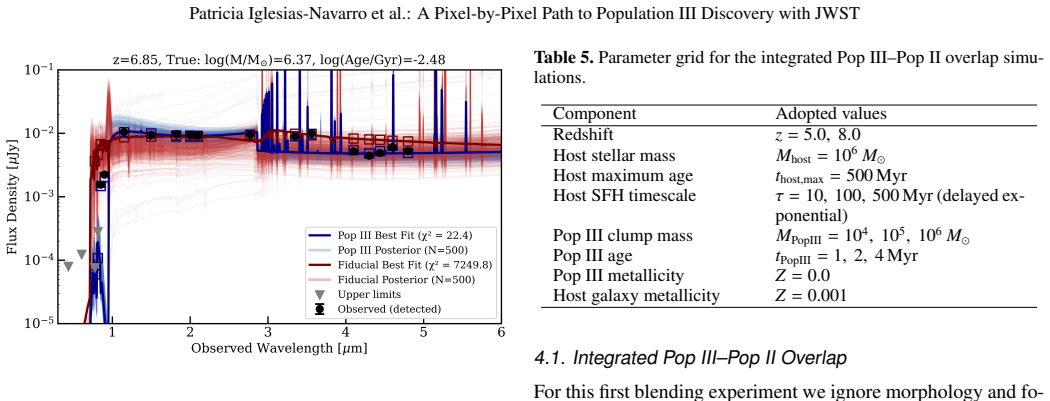
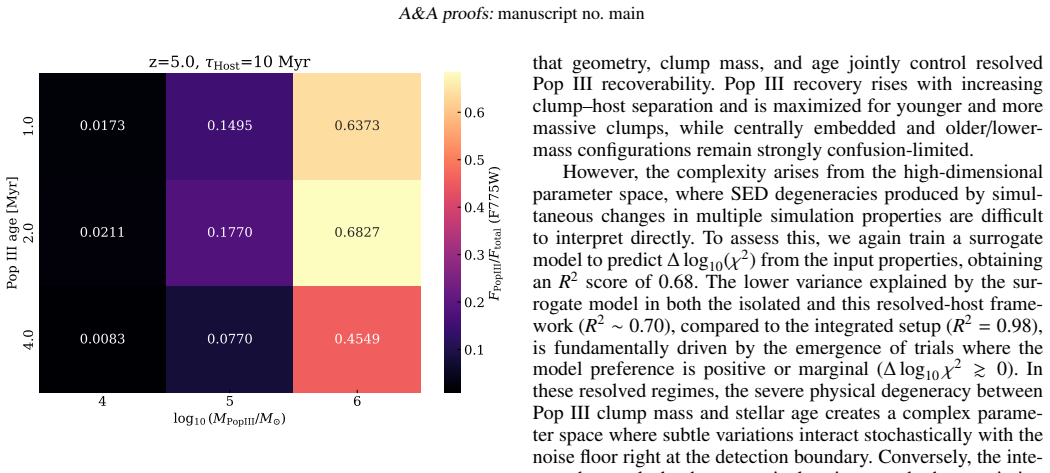
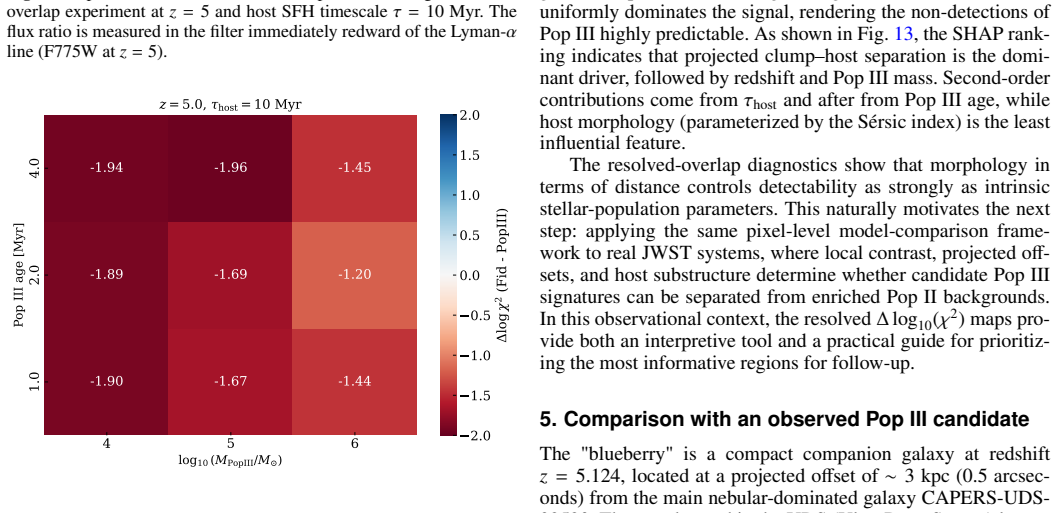
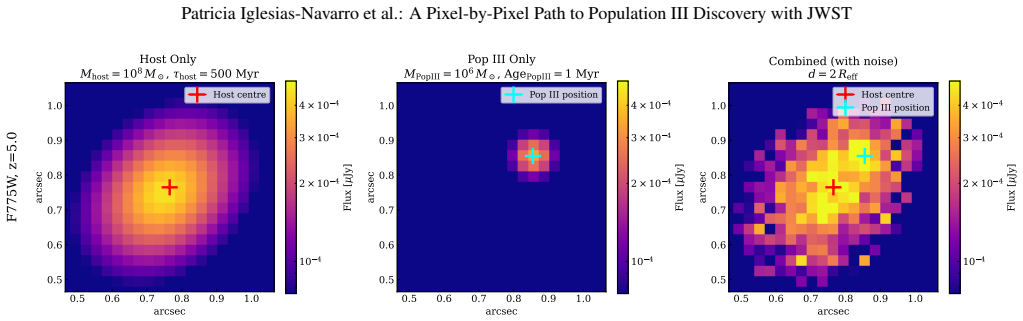
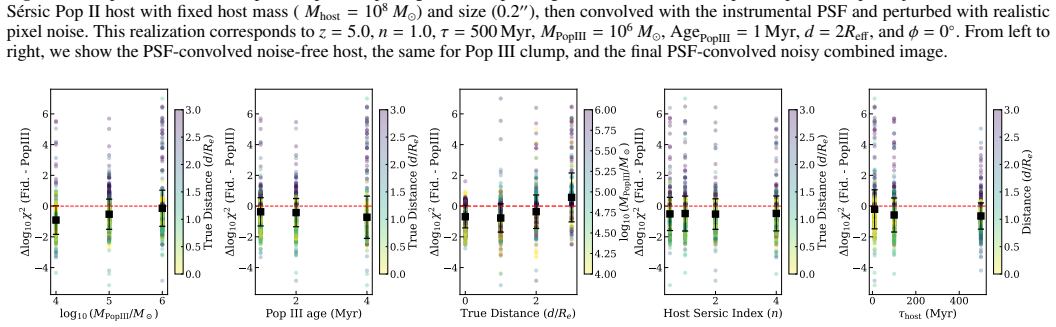
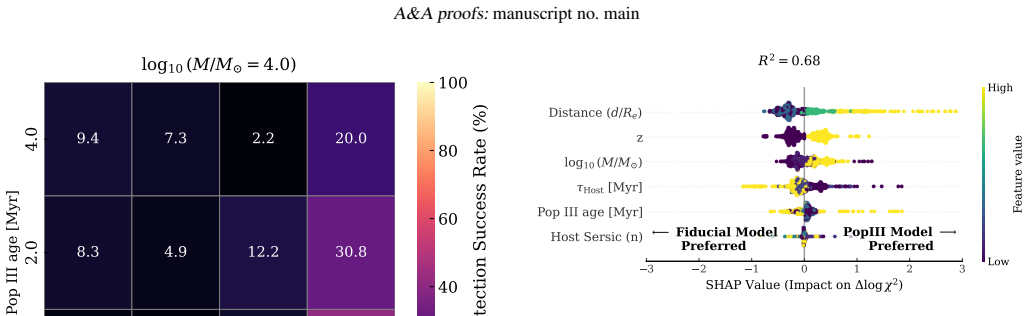
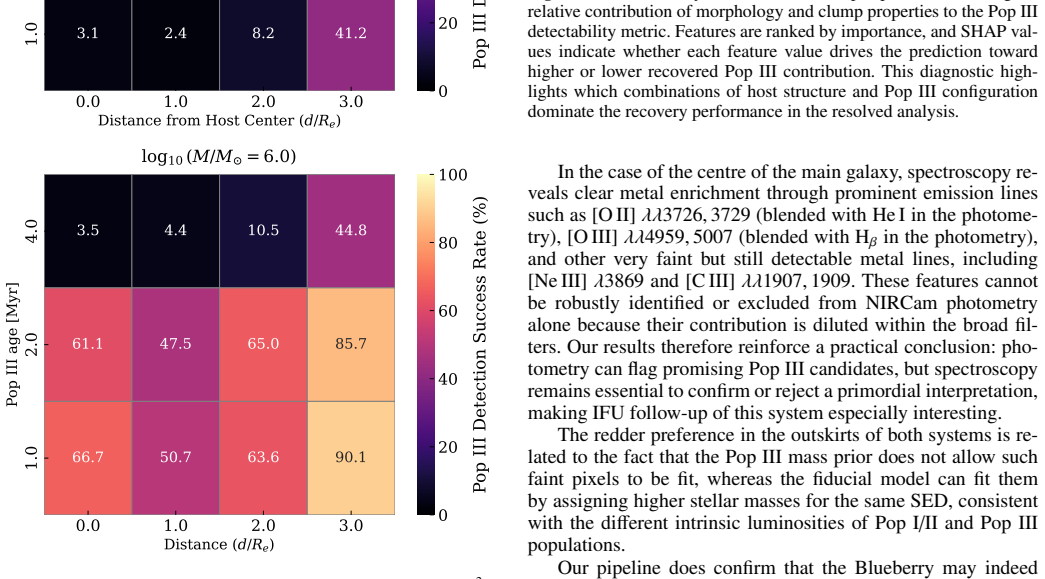
Spatially resolved, pixel-based model comparison substantially improves recoverability of Population III clumps compared with unresolved analyses. Detectability reaches its highest values for young and massive clumps located in nearly-quenched hosts at larger projected separations from the galaxy center, attaining roughly 90 percent recovery in those favorable setups, whereas older and centrally embedded clumps remain rarely recovered. When the same pipeline is run on a published candidate source, a compact blue companion is preferentially assigned Pop III-like models while the main host is better described by standard metal-enriched models.
What carries the argument
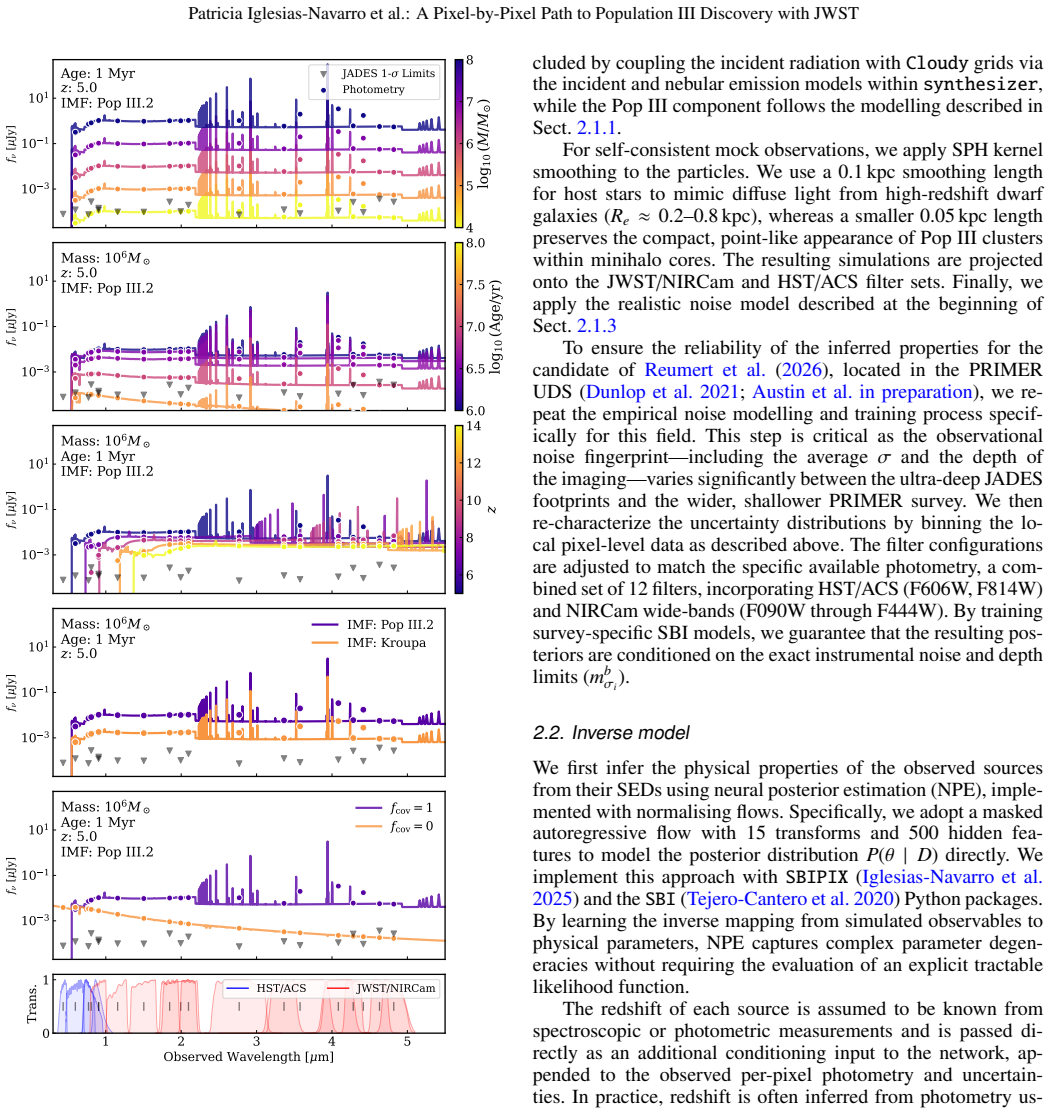
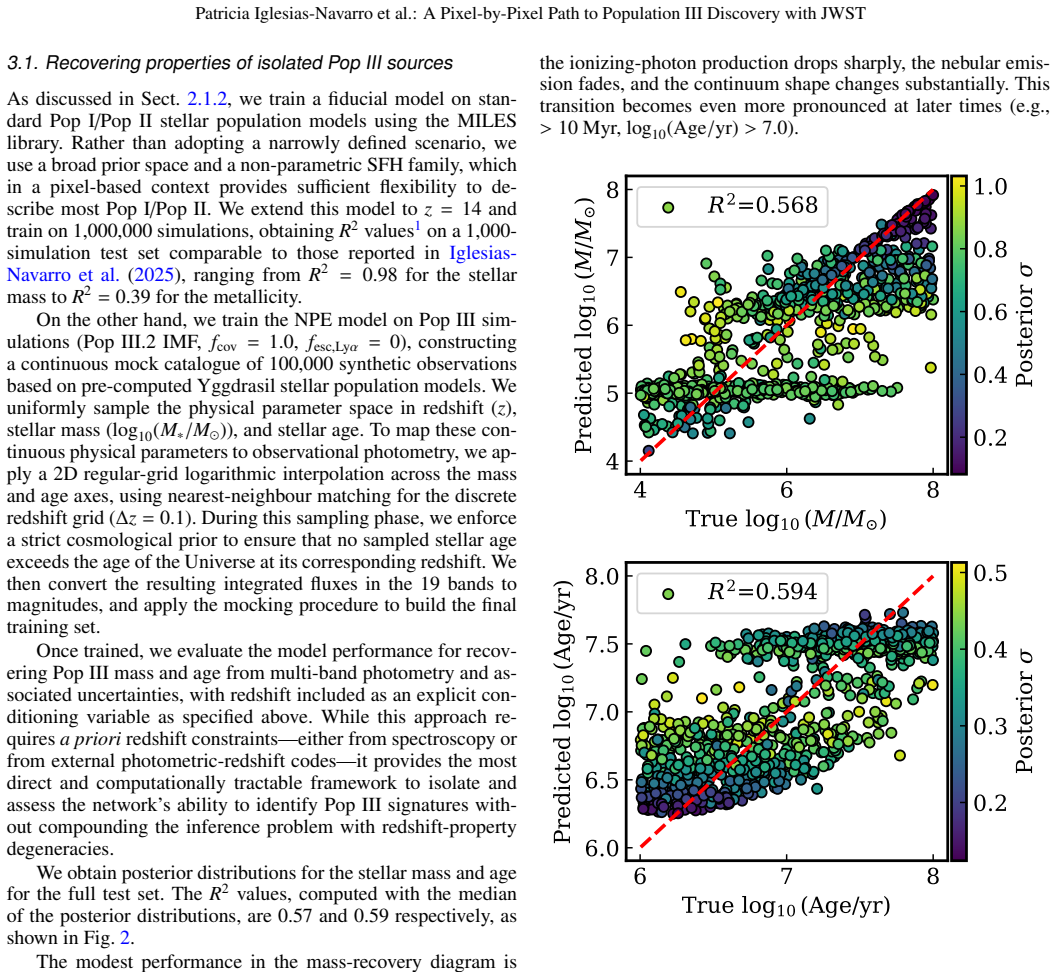
Simulation-based inference applied to pixel-level spectral energy distribution fits that compare JWST-mocked data against libraries of Yggdrasil primordial stellar population models under varied initial mass function, nebular emission, and Lyman-alpha transmission choices.
If this is right
- Detectability is highest for young and massive Pop III clumps in nearly-quenched hosts at larger projected separations from their centers.
- Older and centrally embedded clumps show low recovery rates under the same conditions.
- Application to an observed candidate source assigns Pop III-like models to a compact blue companion while assigning standard models to the host.
- The results supply concrete selection criteria that favor imaging-first strategies followed by targeted spectroscopy.
Where Pith is reading between the lines
- Surveys could allocate more time to high-resolution imaging modes that enable similar pixel-wise comparisons across many fields.
- The same resolved comparison technique could be tested on other rare high-redshift populations whose spectra differ from the dominant background.
- Joint analysis of imaging and follow-up spectra might tighten the classification of sources already flagged by the pixel method.
Load-bearing premise
The selected primordial stellar population models generate spectra that remain sufficiently different from metal-enriched models for the inference procedure to assign the correct label at the reported recovery fractions under realistic noise and filter conditions.
What would settle it
Run the identical pixel-level inference pipeline on new JWST imaging that contains injected young massive clumps at large separations and measure whether the recovered fraction actually approaches 90 percent.
Figures


read the original abstract
The identification of the first generation of metal-free stars, known as Population III (Pop~III), remains a primary goal of modern observational astronomy. While JWST has discovered an abundance of UV-bright galaxies at $z > 10$, distinguishing primordial stellar populations from early metal-enriched systems is a significant challenge. We present an end-to-end framework that combines physically motivated forward modelling from Yggdrasil primordial models with simulation-based inference (SBI) to test Pop~III detectability in JWST-like observations, from isolated sources to realistic overlap with enriched (Pop~II) hosts. Our analysis spans several Pop~III initial mass function (IMF) assumptions, nebular configurations, and Lyman-$\alpha$ transmission scenarios, while mocking the noise properties and filter coverage of the JWST Advanced Deep Extragalactic Survey (JADES). We find that unresolved or integrated analyses are strongly limited by host-galaxy contamination, whereas spatially resolved, pixel-based model comparison substantially improves recoverability. In our resolved experiments, detectability is highest for young and massive Pop~III clumps in nearly-quenched hosts at larger projected separations from their centres, reaching $\sim 90\%$ recovery in favourable configurations, while older and centrally embedded clumps are rarely recovered. Applying the framework to a literature candidate yields spatially differentiated behaviour: a compact blue companion is preferentially described by Pop~III-like models, while the host is better explained by fiducial Pop~I/II models. Our pipeline provides practical criteria for future searches and motivates imaging-first, spectroscopy-assisted strategies for identifying primordial stellar populations in JWST data.
Editorial analysis
A structured set of objections, weighed in public.
Referee Report
Summary. The paper presents an end-to-end simulation-based inference (SBI) framework that forward-models Yggdrasil Pop III spectra (varying IMF, nebular emission, and Lyα transmission) convolved with JADES-like JWST filters and noise, then compares pixel-resolved versus integrated photometry to quantify Pop III clump recoverability in the presence of Pop II hosts. It reports that spatially resolved, pixel-by-pixel model comparison yields substantially higher recovery (up to ~90% in favorable cases of young, massive, offset clumps in nearly-quenched hosts) than unresolved analyses, applies the pipeline to a literature candidate, and offers practical search criteria.
Significance. If the central distinguishability result holds after validation, the work would be significant for JWST-era searches: it supplies concrete, observationally motivated criteria (age, mass, projected separation, host quenching) that shift strategy toward imaging-first, spectroscopy-assisted follow-up and demonstrates the practical gain from resolved over integrated photometry. The use of controlled mocks with realistic noise properties is a strength.
major comments (3)
- [Abstract] Abstract and § on recovery experiments: the headline ~90% recovery fractions are reported without error bars, cross-validation folds, or explicit sensitivity tests to model misspecification (e.g., changes in atmosphere grids or stellar-evolution tracks outside Yggdrasil). This leaves the quantitative claims difficult to assess for robustness.
- [Methods (forward modeling)] Methods on forward modeling and SBI classifier: the pipeline relies exclusively on Yggdrasil Pop III versus Pop II libraries; no cross-check against an independent zero-metallicity spectral library is described. If spectral separation is driven by library-specific features rather than generic Pop III signatures, the quoted recovery rates and the derived search criteria are not portable.
- [Results (resolved experiments)] Results on resolved versus unresolved comparison: while the qualitative improvement from pixel-based analysis is plausible, the manuscript provides no quantitative breakdown of how the SBI posterior or decision threshold behaves under realistic host contamination gradients or filter coverage variations, making it hard to judge whether the reported gain is load-bearing or an artifact of the chosen mock setup.
minor comments (2)
- [Abstract] The abstract states that the framework 'provides practical criteria' but does not list them explicitly; a concise bullet list or table summarizing the favored configurations (age, mass, separation, host properties) would improve usability.
- [Methods] Notation for the SBI likelihood or classifier output is not defined in the provided abstract; clarifying whether the reported percentages are true-positive rates at fixed false-positive threshold or marginal posteriors would aid reproducibility.
Simulated Author's Rebuttal
We thank the referee for their detailed and constructive report. We have carefully considered each major comment and provide point-by-point responses below. Where appropriate, we indicate revisions that will be incorporated into the manuscript.
read point-by-point responses
-
Referee: [Abstract] Abstract and § on recovery experiments: the headline ~90% recovery fractions are reported without error bars, cross-validation folds, or explicit sensitivity tests to model misspecification (e.g., changes in atmosphere grids or stellar-evolution tracks outside Yggdrasil). This leaves the quantitative claims difficult to assess for robustness.
Authors: We agree that presenting recovery fractions as point estimates limits assessment of robustness. In the revised manuscript we will add uncertainties on the recovery rates derived from bootstrap resampling across multiple independent noise realizations. We will also include sensitivity tests that vary IMF parameters and nebular emission strength within the Yggdrasil framework. Full cross-validation against independent spectral libraries lies outside the present scope, which focuses on demonstrating the method with established Pop III models; this is noted as a valuable direction for future work. revision: partial
-
Referee: [Methods (forward modeling)] Methods on forward modeling and SBI classifier: the pipeline relies exclusively on Yggdrasil Pop III versus Pop II libraries; no cross-check against an independent zero-metallicity spectral library is described. If spectral separation is driven by library-specific features rather than generic Pop III signatures, the quoted recovery rates and the derived search criteria are not portable.
Authors: Yggdrasil is the standard library for Pop III synthesis because of its self-consistent treatment of zero-metallicity stellar evolution and nebular processes. The separation we recover is driven by physically generic features (absence of metal lines, strong nebular continuum and Lyα). Nevertheless, to address concerns about portability we will expand the methods discussion to state the reliance on this library explicitly and to outline how the derived search criteria could be validated with alternative zero-metallicity grids in follow-up studies. revision: yes
-
Referee: [Results (resolved experiments)] Results on resolved versus unresolved comparison: while the qualitative improvement from pixel-based analysis is plausible, the manuscript provides no quantitative breakdown of how the SBI posterior or decision threshold behaves under realistic host contamination gradients or filter coverage variations, making it hard to judge whether the reported gain is load-bearing or an artifact of the chosen mock setup.
Authors: Our mock suite already spans a range of host contamination levels, projected separations and the JADES filter set. To make the robustness of the resolved advantage more transparent we will add supplementary figures that quantify how the SBI posterior probability and decision threshold vary as functions of contamination gradient and across modest changes in filter coverage. revision: yes
Circularity Check
No significant circularity; recovery rates from external model mocks
full rationale
The paper constructs its framework by forward-modeling spectra from the external Yggdrasil library, convolving with JWST filters, and adding mocked JADES noise before applying SBI; the quoted recovery fractions (up to ~90%) are obtained by testing this pipeline on the resulting simulated pixel data. No equation in the provided text reduces these rates to a fit performed on the same observations being evaluated, nor does any self-citation chain make the distinguishability between Pop III and Pop II labels tautological by construction. The analysis therefore remains a standard simulation-based validation exercise against an independent spectral library rather than a self-referential loop.
Axiom & Free-Parameter Ledger
axioms (2)
- domain assumption Yggdrasil primordial models produce spectra representative of true Pop III populations across the tested IMF, nebular, and Lyman-alpha scenarios
- domain assumption JWST noise properties and filter transmission curves in the JADES survey can be accurately reproduced by the mock observations
Reference graph
Works this paper leans on
-
[1]
and Chatzikos, Marios and Guzman, Fernando and others , title =
Ferland, Gary J. and Chatzikos, Marios and Guzman, Fernando and others , title =. Revista Mexicana de Astronom\'ia y Astrof\'isica , volume =
-
[2]
and Roper, William J
Lovell, Christopher C. and Roper, William J. and Vijayan, Aswin P. and Wilkins, Stephen M. and Newman, Sophie and Seeyave, Louise , title =. The Open Journal of Astrophysics , volume =. 2025 , doi =
2025
-
[3]
The Dust Content and Opacity of Actively Star-Forming Galaxies
Daniela Calzetti and Lee Armus and Ralph C. Bohlin and Anne L. Kinney and Jan Koornneef and Thaisa Storchi. The Dust Content and Opacity of Actively Star. , month =. doi:10.1086/308692 , issn =
work page internal anchor Pith review doi:10.1086/308692
-
[4]
Mesa Isochrones and Stellar Tracks (MIST)
Jieun Choi and Aaron Dotter and Charlie Conroy and Matteo Cantiello and Bill Paxton and Benjamin D Johnson , doi =. Mesa Isochrones and Stellar Tracks (MIST). I. SOLAR-SCALED MODELS , volume =. , month =
-
[5]
The Propagation of Uncertainties in Stellar Population Synthesis Modeling. I. The Relevance of Uncertain Aspects of Stellar Evolution and the Initial Mass Function to the Derived Physical Properties of Galaxies. , keywords =. doi:10.1088/0004-637X/699/1/486 , archivePrefix =. 0809.4261 , primaryClass =
work page internal anchor Pith review Pith/arXiv arXiv doi:10.1088/0004-637x/699/1/486
-
[6]
The Propagation of Uncertainties in Stellar Population Synthesis Modeling. III. Model Calibration, Comparison, and Evaluation. , keywords =. doi:10.1088/0004-637X/712/2/833 , archivePrefix =. 0911.3151 , primaryClass =
work page internal anchor Pith review Pith/arXiv arXiv doi:10.1088/0004-637x/712/2/833
-
[7]
Modeling the Panchromatic Spectral Energy Distributions of Galaxies , volume =
Charlie Conroy , doi =. Modeling the Panchromatic Spectral Energy Distributions of Galaxies , volume =. , month =
-
[8]
The 2013 Release of Cloudy. , keywords =. doi:10.48550/arXiv.1302.4485 , archivePrefix =. 1302.4485 , primaryClass =
work page internal anchor Pith review Pith/arXiv arXiv doi:10.48550/arxiv.1302.4485 2013
-
[9]
Accelerated Bayesian SED Modeling Using Amortized Neural Posterior Estimation , volume =
ChangHoon Hahn and Peter Melchior , doi =. Accelerated Bayesian SED Modeling Using Amortized Neural Posterior Estimation , volume =. , month =
-
[10]
Hainline and Benjamin D
Kevin N. Hainline and Benjamin D. Johnson and Brant Robertson and Sandro Tacchella and Jakob M. Helton and Fengwu Sun and Daniel J. Eisenstein and Charlotte Simmonds and Michael W. Topping and Lily Whitler and Christopher N. A. Willmer and Marcia Rieke and Katherine A. Suess and Raphael E. Hviding and Alex J. Cameron and Stacey Alberts and William M. Bake...
-
[11]
Iyer and Eric Gawiser and Sandra M
Kartheik G. Iyer and Eric Gawiser and Sandra M. Faber and Henry C. Ferguson and Jeyhan Kartaltepe and Anton M. Koekemoer and Camilla Pacifici and Rachel S. Somerville , doi =. Nonparametric Star Formation History Reconstruction with Gaussian Processes. I. Counting Major Episodes of Star Formation , volume =. , month =
-
[12]
Reconstruction of Galaxy Star Formation Histories through SED Fitting: The Dense Basis Approach , volume =
Kartheik Iyer and Eric Gawiser , doi =. Reconstruction of Galaxy Star Formation Histories through SED Fitting: The Dense Basis Approach , volume =. , month =
-
[13]
How to Measure Galaxy Star Formation Histories
Joel Leja and Adam C Carnall and Benjamin D Johnson and Charlie Conroy and Joshua S Speagle , doi =. How to Measure Galaxy Star Formation Histories. II. Nonparametric Models , volume =. , month =
-
[14]
Schaerer , doi =
D. Schaerer , doi =. On the properties of massive Population III stars and metal-free stellar populations , volume =. , keywords =
-
[15]
Circumstellar Dust Around AGB Stars and Implications for Infrared Emission from Galaxies
Circumstellar Dust around AGB Stars and Implications for Infrared Emission from Galaxies. , keywords =. doi:10.1088/0004-637X/806/1/82 , archivePrefix =. 1504.00900 , primaryClass =
work page internal anchor Pith review Pith/arXiv arXiv doi:10.1088/0004-637x/806/1/82
-
[16]
Cervino and D
M. Cervino and D. Valls-Gabaud , doi =. On biases in the predictions of stellar population synthesis models , volume =. , month =
-
[17]
B. T. Draine and Aigen Li , doi =. Infrared Emission from Interstellar Dust. IV. The Silicate. , month =
-
[18]
Neural Spline Flows , volume =
Conor Durkan and Artur Bekasov and Iain Murray and George Papamakarios , issn =. Neural Spline Flows , volume =. Advances in Neural Information Processing Systems , month =
-
[19]
ChangHoon Hahn and K. J. Kwon and Rita Tojeiro and Malgorzata Siudek and Rebecca E. A. Canning and Mar Mezcua and Jeremy L. Tinker and David Brooks and Peter Doel and Kevin Fanning and Enrique Gaztañaga and Robert Kehoe and Martin Landriau and Aaron Meisner and John Moustakas and Claire Poppett and Gregory Tarle and Benjamin Weiner and Hu Zou , doi =. The...
-
[20]
Encyclopedia of Astrophysics, Volume 4 , year = 2026, volume =
The spectral energy distributions of galaxies. Encyclopedia of Astrophysics, Volume 4 , year = 2026, volume =. doi:10.1016/B978-0-443-21439-4.00127-9 , adsurl =
-
[21]
On the variation of the initial mass function , volume =
P Kroupa , doi =. On the variation of the initial mass function , volume =. , month =
-
[22]
Robert and Robin J
Jean Michel Marin and Pierre Pudlo and Christian P. Robert and Robin J. Ryder , doi =. Approximate Bayesian Computational methods , volume =. Statistics and Computing , keywords =
-
[23]
The Art of Measuring Physical Parameters in Galaxies: A Critical Assessment of Spectral Energy Distribution Fitting Techniques. , keywords =. doi:10.3847/1538-4357/acacff , archivePrefix =. 2212.01915 , primaryClass =
-
[24]
Evolutionary stellar population synthesis with MILES - I
A Vazdekis and P Sánchez-Blázquez and J Falcón-Barroso and A J Cenarro and M A Beasley and N Cardiel and J Gorgas and R F Peletier , doi =. Evolutionary stellar population synthesis with MILES - I. The base models and a new line index system , url =. , month =
-
[25]
B., Venditti , A., Bromm , V., et al
How Massive Can a Population III Starburst Be? Simulating the First Galaxies with High Lyman-Werner Background. arXiv e-prints , keywords =. doi:10.48550/arXiv.2603.23209 , archivePrefix =. 2603.23209 , primaryClass =
-
[26]
The Pristine HeII Emitter near GN-z11: Constraining the Mass Distribution of the First Stars
The Pristine He II Emitter near GN-z11: Constraining the Mass Distribution of the First Stars. , keywords =. doi:10.3847/2041-8213/ae64e1 , archivePrefix =. 2603.20363 , primaryClass =
work page internal anchor Pith review Pith/arXiv arXiv doi:10.3847/2041-8213/ae64e1 2041
-
[27]
The search for Population III: Confirmation of a HeII emitter with no metal lines at z=10.6
The search for Population III: Confirmation of a HeII emitter with no metal lines at z=10.6. arXiv e-prints , keywords =. doi:10.48550/arXiv.2603.20362 , archivePrefix =. 2603.20362 , primaryClass =
work page internal anchor Pith review Pith/arXiv arXiv doi:10.48550/arxiv.2603.20362
-
[28]
GA-NIFS & JADES: Confirmation of pristine gas near GN-z11. arXiv e-prints , keywords =. doi:10.48550/arXiv.2603.20360 , archivePrefix =. 2603.20360 , primaryClass =
-
[29]
A hot, nebular-dominated galaxy interacting with a pristine PopIII system uncovered by JWST. arXiv e-prints , keywords =. doi:10.48550/arXiv.2603.13471 , archivePrefix =. 2603.13471 , primaryClass =
-
[30]
The Spectral Evolution of the First Galaxies. I. James Webb Space Telescope Detection Limits and Color Criteria for Population III Galaxies. , keywords =. doi:10.1088/0004-637X/740/1/13 , archivePrefix =. 1105.0921 , primaryClass =
work page internal anchor Pith review Pith/arXiv arXiv doi:10.1088/0004-637x/740/1/13
-
[31]
Cosmological Simulation with Population III Stellar Feedback and Metal Enrichment I: Model Description And Convergence Test , year =
Bocheng Zhu and Liang Gao , month =. Cosmological Simulation with Population III Stellar Feedback and Metal Enrichment I: Model Description And Convergence Test , year =
-
[32]
The Importance of the Population III Initial Mass Function in Determining the Characteristics of the Earliest Galaxies , volume =
Richard Sarmento and Evan Scannapieco , doi =. The Importance of the Population III Initial Mass Function in Determining the Characteristics of the Earliest Galaxies , volume =. , month =
-
[33]
An ultra-faint, chemically primitive galaxy forming in the reionization era. , keywords =. doi:10.1038/s41586-026-10374-1 , archivePrefix =. 2506.11846 , primaryClass =
-
[34]
LAP1-B is the First Observed System Consistent with Theoretical Predictions for Population III Stars. , keywords =. doi:10.3847/2041-8213/ae122f , archivePrefix =. 2508.03842 , primaryClass =
-
[35]
Nakajima and R
K. Nakajima and R. Maiolino , doi =. Diagnostics for PopIII galaxies and direct collapse black holes in the early universe , volume =. , keywords =
-
[36]
On the obser v ability and identification of Population III galaxies with JWST , volume =
James A Trussler and Christopher J Conselice and Nathan J Adams and Roberto Maiolino and Kimihiko Nakajima and Erik Zackrisson and Duncan Austin and Leonardo Ferreira and Tom Harvey , doi =. On the obser v ability and identification of Population III galaxies with JWST , volume =. , keywords =
-
[37]
Naidu and John Chisholm and Hakim Atek and Ryan Endsley and Vasily Kokorev and Lukas J
Seiji Fujimoto and Rohan P. Naidu and John Chisholm and Hakim Atek and Ryan Endsley and Vasily Kokorev and Lukas J. Furtak and Richard Pan and Boyuan Liu and Volker Bromm and Alessandra Venditti and Eli Visbal and Richard Sarmento and Andrea Weibel and Pascal A. Oesch and Gabriel Brammer and Daniel Schaerer and Angela Adamo and Danielle A. Berg and Rachel...
-
[38]
Nitrogen enhancements 440 Myr after the big bang: supersolar N/O, a tidal disruption event, or a dense stellar cluster in GN-z11?. , keywords =. doi:10.1093/mnras/stad1579 , archivePrefix =. 2302.10142 , primaryClass =
-
[39]
and Lee, Su-In , title =
Lundberg, Scott M. and Lee, Su-In , title =. Advances in Neural Information Processing Systems 30 (NeurIPS 2017) , editor =. 2017 , publisher =
2017
-
[40]
and Erion, Gabriel and Chen, Hugh and DeGrave, Alex and Prutkin, Jordan M
Lundberg, Scott M. and Erion, Gabriel and Chen, Hugh and DeGrave, Alex and Prutkin, Jordan M. and Nair, Bala and Katz, Ronit and Himmelfarb, Jordan and Bansal, Nisha and Lee, Su-In , title =. Nature Machine Intelligence , volume =. 2020 , doi =
2020
-
[41]
, year = 2005, month = sep, volume =
The Discovery and Analysis of Very Metal-Poor Stars in the Galaxy. , year = 2005, month = sep, volume =. doi:10.1146/annurev.astro.42.053102.134057 , adsurl =
-
[42]
The First Stars. , keywords =. doi:10.1146/annurev.astro.42.053102.134034 , archivePrefix =. astro-ph/0311019 , primaryClass =
-
[43]
On the properties of massive Population III stars and metal-free stellar populations
On the properties of massive Population III stars and metal-free stellar populations. , keywords =. doi:10.1051/0004-6361:20011619 , archivePrefix =. astro-ph/0110697 , primaryClass =
work page internal anchor Pith review Pith/arXiv arXiv doi:10.1051/0004-6361:20011619
-
[44]
Forming the First Stars in the Universe: The Fragmentation of Primordial Gas
Forming the First Stars in the Universe: The Fragmentation of Primordial Gas. , keywords =. doi:10.1086/312385 , archivePrefix =. astro-ph/9910224 , primaryClass =
work page internal anchor Pith review Pith/arXiv arXiv doi:10.1086/312385
-
[45]
The transition from Population III to normal galaxies: Lyalpha and He II emission and the ionising properties of high redshift starburst galaxies. , keywords =. doi:10.1051/0004-6361:20021525 , archivePrefix =. astro-ph/0210462 , primaryClass =
work page internal anchor Pith review Pith/arXiv arXiv doi:10.1051/0004-6361:20021525
-
[46]
The first stars: formation of binaries and small multiple systems. , keywords =. doi:10.1111/j.1365-2966.2009.16113.x , archivePrefix =. 0908.0712 , primaryClass =
-
[47]
The First Galaxies: Chemical Enrichment, Mixing, and Star Formation
The First Galaxies: Chemical Enrichment, Mixing, and Star Formation. , keywords =. doi:10.1088/0004-637X/716/1/510 , archivePrefix =. 1003.0472 , primaryClass =
work page internal anchor Pith review Pith/arXiv arXiv doi:10.1088/0004-637x/716/1/510
-
[48]
The challenges of identifying Population III stars in the early Universe. , keywords =. doi:10.1093/mnras/stad1903 , archivePrefix =. 2207.04751 , primaryClass =
-
[49]
A Hide-and-seek Game: Looking for Population III Stars during the Epoch of Reionization through the He II 1640 Line. , keywords =. doi:10.3847/2041-8213/ad7387 , archivePrefix =. 2405.10940 , primaryClass =
-
[50]
Possible Indirect Confirmation of the Existence of Pop III Massive Stars by Gravitational Wave
Possible indirect confirmation of the existence of Pop III massive stars by gravitational wave. , keywords =. doi:10.1093/mnras/stu1022 , archivePrefix =. 1402.6672 , primaryClass =
work page internal anchor Pith review Pith/arXiv arXiv doi:10.1093/mnras/stu1022
-
[51]
Simulation-based inference of galaxy properties from JWST pixels. , keywords =. doi:10.1051/0004-6361/202555810 , archivePrefix =. 2506.04336 , primaryClass =
-
[52]
arXiv e-prints , keywords =
Catching the Nebular Needle in a Polluted Haystack: Line-emission Signatures from Population III-forming Pockets around Massive Galaxies at the End of Reionization. arXiv e-prints , keywords =
-
[53]
JWST PRIMER: a new multifield determination of the evolving galaxy UV luminosity function at redshifts z ≃ 9 - 15. , keywords =. doi:10.1093/mnras/stae2037 , archivePrefix =. 2403.03171 , primaryClass =
-
[54]
PRIMER: Public Release IMaging for Extragalactic Research
-
[55]
Very Bright, Very Blue, and Very Red: JWST CAPERS Analysis of Highly Luminous Galaxies with Extreme Ultraviolet Slopes at z = 10. , keywords =. doi:10.3847/1538-4357/ae0a1f , archivePrefix =. 2507.10518 , primaryClass =
-
[56]
Predicted UV properties of very metal-poor starburst galaxies
Predicted UV properties of very metal-poor starburst galaxies. , keywords =. doi:10.1051/0004-6361/201015236 , archivePrefix =. 1008.2114 , primaryClass =
work page internal anchor Pith review Pith/arXiv arXiv doi:10.1051/0004-6361/201015236
-
[57]
SBI - A toolkit for Simulation-Based Inference , volume =
Alvaro Tejero-Cantero and Jan Boelts and Michael Deistler and Jan-Matthis Lueckmann and Conor Durkan and Pedro J Gonçalves and David S Greenberg and Jakob H Macke , doi =. SBI - A toolkit for Simulation-Based Inference , volume =. The Journal of Open Source Software , keywords =
-
[58]
Flexible simulation-based inference for galaxy photometric fitting with synthesizer. , keywords =. doi:10.1093/mnras/stag282 , archivePrefix =. 2511.10640 , primaryClass =
-
[59]
PyPHER: Python-based PSF Homogenization kERnels
-
[60]
Metal-polluted Population III Galaxies and How to Find Them. , keywords =. doi:10.3847/2041-8213/adf4e3 , archivePrefix =. 2506.17400 , primaryClass =
-
[61]
Towards a universal analytical model for Population III star formation: interplay between feedback and fragmentation. , keywords =. doi:10.1093/mnras/stae2066 , archivePrefix =. 2407.14294 , primaryClass =
-
[62]
, year = 2023, month = jul, volume =
Signatures of the first stars in the James Webb Space Telescope deep images. , year = 2023, month = jul, volume =
2023
-
[63]
Possible Population III signatures at z = 10.6 in the halo of GN-z11
JADES. Possible Population III signatures at z = 10.6 in the halo of GN-z11. , keywords =. doi:10.1051/0004-6361/202347087 , archivePrefix =. 2306.00953 , primaryClass =
-
[64]
, year = 2024, volume =
Evidence of Primordial Stars in a Lensed Clump at z = 8.16. , year = 2024, volume =
2024
-
[65]
, year = 2022, volume =
Fast, Slow, Early, Late: Quenching Massive Galaxies at z 0.8. , year = 2022, volume =
2022
-
[66]
PNAS , year = 2020, volume =
Cranmer, Kyle and Brehmer, Johann and Louppe, Gilles , title = ". PNAS , year = 2020, volume =
2020
-
[67]
, year = 2019, volume =
Fast likelihood-free cosmology with neural density estimators and active learning. , year = 2019, volume =
2019
-
[68]
, year = 2024, volume =
Deriving the star formation histories of galaxies from spectra with simulation-based inference. , year = 2024, volume =
2024
-
[69]
Machine Learning: Science and Technology , year = 2022, volume =
DIGS: deep inference of galaxy spectra with neural posterior estimation. Machine Learning: Science and Technology , year = 2022, volume =
2022
-
[70]
, year = 2023, volume =
Ruby Galaxies: Exceptionally Massive and Quiescent Galaxy Candidates at z 7. , year = 2023, volume =
2023
-
[71]
The Journal of Open Source Software , keywords =
Synthesizer: Synthetic Observables for Modern Astronomy. The Journal of Open Source Software , keywords =. doi:10.21105/joss.09436 , archivePrefix =. 2506.15811 , primaryClass =
-
[72]
International Conference on Machine Learning , pages=
Sampling-based accuracy testing of posterior estimators for general inference , author=. International Conference on Machine Learning , pages=. 2023 , organization=
2023
-
[73]
The First Light And Reionisation Epoch Simulations (FLARES). , year = 2021, volume =. doi:10.1093/mnras/staa3360 , adsurl =
-
[74]
The First Light And Reionisation Epoch Simulations (FLARES): the ultraviolet luminosity function at z = 5--10. , year = 2021, volume =. doi:10.1093/mnras/staa3761 , adsurl =
-
[75]
Machine Learning: Science and Technology , year = 2024, month = mar, volume =
Evidence networks: simple and scalable simulation-based model comparison. Machine Learning: Science and Technology , year = 2024, month = mar, volume =. doi:10.1088/2632-2153/ad23b0 , adsurl =
-
[76]
2023, arXiv e-prints, arXiv:2312.05411
Deep Bayes Factors. arXiv e-prints , keywords =. doi:10.48550/arXiv.2312.05411 , archivePrefix =. 2312.05411 , primaryClass =
-
[77]
2026, arXiv e-prints, arXiv:2603.26489
Conditional Neural Bayes Ratio Estimation for Experimental Design Optimisation. arXiv e-prints , keywords =. doi:10.48550/arXiv.2603.26489 , archivePrefix =. 2603.26489 , primaryClass =
-
[78]
2025, arXiv e-prints, arXiv:2503.23156
Neural Bayes estimation and selection for complex bivariate extremal dependence models. arXiv e-prints , keywords =. doi:10.48550/arXiv.2503.23156 , archivePrefix =. 2503.23156 , primaryClass =
-
[79]
Quantum marginal inequalities and the conjectured entropic inequalities
Likelihood-Free Parameter Estimation with Neural Bayes Estimators. The American Statistician , year = 2023, month = aug, volume =. doi:10.1080/00031305.2023.2249522 , adsurl =
work page internal anchor Pith review Pith/arXiv arXiv doi:10.1080/00031305.2023.2249522 2023
-
[80]
MEGATRON: the environments of Population III stars at Cosmic Dawn and their connection to present-day galaxies. , keywords =. doi:10.1093/mnras/stag529 , archivePrefix =. 2510.06853 , primaryClass =
work page internal anchor Pith review Pith/arXiv arXiv doi:10.1093/mnras/stag529
discussion (0)
Sign in with ORCID, Apple, or X to comment. Anyone can read and Pith papers without signing in.