REVIEW 5 major objections 6 minor 39 references
Causal-Paced Deep Reinforcement Learning
T0 review · 5 major / 6 minor · reviewed 2026-08-15 · deepseek-v4-flash
Pith's one-line read The paper tries to establish that task selection in curriculum reinforcement learning can be driven by an interaction-data proxy for causal task difference, avoiding any need for a known structural causal model, and that this proxy…
desk verdict A genuinely new way to shape curricula with approximate causal mismatch—but the main experiment's speedup can't yet be pinned on causality, and the abstract overstates one result. read the letter →
The pith
A machine-rendered reading of the paper's core claim, the machinery that carries it, and where it could break.
The reading
What carries the argument
The load-bearing object is the modular ensemble: state and action autoencoders trained with a $\beta$-VAE loss, a transition predictor, and a reward predictor, each replicated $K=10$ times. Disagreement is the standard deviation of predictions across ensemble members, $\text{Disagreement}_i = \mathrm{std}\{\hat{y}^{(k)}_i(\cdot)\}_{k=1}^{K}$, and a weighted sum over the four components forms the causal misalignment score $CM(c)$. The per-task cost $R_j + CM(c_j)$ is fed into CURROT's optimal-transport context update, which moves the task sampling distribution toward the target while keeping consecutive distributions close and requiring a minimal per-task return. High disagreement is read as structural unfamiliarity, so the teacher shifts sampling mass toward tasks the agent's models do not yet agree on.
What would settle it
Run the same modular ensembles on two causally identical tasks that differ only in goal position (as in Sparse Goal Reaching) and check whether transition and reward disagreement stay flat. If those disagreements rise with goal position or shape the curriculum, the signal is measuring noise, not causal difference.
Extended reading notes
Core claim
The central claim is that, in deterministic MDPs, the causal difference between two tasks can be approximated by the difference in four constituents—state, action, transition, and reward—and that this approximation can be computed from data by training an ensemble of $K$ predictors per component and taking the standard deviation of their predictions as disagreement. This yields the causal misalignment score $CM(c)=\sum_i w_i\,\text{Disagreement}_i$, which CP-DRL adds to the episodic return as a per-task cost inside CURROT's constrained optimal-transport curriculum update. On Point Mass, CP-DRL reaches $6.17\pm0.08$ at epoch 195, about 10.2% above CURROT's $5.6\pm0.34$, with low throughout-training variance; on Bipedal Walker Trivial it converges fastest with reduced variance, and on the Infeasible variant it posts the highest mean return of $130.61\pm9.32$ at 30k steps. In Sparse Goal Reaching, where causal structure is invariant, the disagreement signal is mostly noise and CP-DRL underperforms CURROT.
Load-bearing premise
The method stands or falls on the premise that, in a deterministic MDP, causal differences between tasks are fully captured by state, action, transition, and reward changes, and that the spread among quickly trained ensemble models is a faithful measure of those changes rather than of fitting noise.
Editorial extensions
If this is right
- Curriculum design no longer requires a ground-truth causal model: disagreement among cheap modular predictors is a sufficient novelty signal to guide task selection.
- On Point Mass, the curriculum closes to the target gate position and narrows gate width faster than CURROT, yielding about 10.2% higher final return.
- On Bipedal Walker, CP-DRL trades a small final-return gap in the Trivial setting for markedly lower variance and faster convergence, and reaches the highest mean return mid-training in the Infeasible setting.
- When structural variation is absent, as in Sparse Goal Reaching, the causal signal adds only noise, so a safe deployment should fall back to non-causal curriculum signals in structurally flat task families.
Reading between the lines
- If the disagreement proxy is valid, the same per-component ensembles can be reused as a cheap diagnostic for dynamics or representation shift in continual RL settings beyond curricula.
- The SGR failure suggests a selection rule: run CP-DRL's causal cost only when task variation is known to alter dynamics or reward; otherwise fall back to a non-causal curriculum cost.
- A noise-aware extension would separate aleatoric from epistemic disagreement in stochastic environments; without it, the CM score likely tracks environment noise, which the deterministic-MDP assumption currently excludes.
- The component weights are hand-set; an adaptive or learned weighting (for example, up-weighting transition disagreement and down-weighting reward disagreement) could remove the main tuning burden and improve transfer to new environments.
Signed reviews
Editorial analysis
A structured set of objections, weighed in public.
Referee Report
Summary. The paper proposes CP-DRL, a curriculum reinforcement learning method that attempts to approximate differences between tasks' structural causal models from interaction data only. It trains modular ensembles of state, action, transition, and reward predictors, defines a Causal Misalignment (CM) score as a weighted sum of ensemble disagreements, and adds this score to the episodic return inside the CURROT optimal-transport curriculum objective. Experiments are reported on Point Mass, Bipedal Walker (Trivial and Infeasible), and Sparse Goal Reaching, along with a validation study in CausalWorld and a sensitivity analysis in Appendix E. The authors report faster convergence on Point Mass, reduced variance in Bipedal Walker-Trivial, and a high mid-training peak in Bipedal Walker-Infeasible, and they release full code.
Significance. If the causal interpretation were established, CP-DRL would be a useful contribution: it would replace the ground-truth SCM assumption of causally aligned curriculum learning with a data-driven proxy, potentially broadening the applicability of structure-aware curricula to realistic RL settings. The paper has clear strengths: the full implementation is released, multiple random seeds are used, the appendices transparently report a failure case (SGR), and the component-wise sensitivity analysis is a sensible diagnostic step. However, the central claim that the CM score measures causal-structure difference is not yet supported. The signal in the main benchmark reduces to transition-ensemble disagreement in a stochastic environment, and the paper provides no control separating causal misalignment from aleatoric noise, initialization variance, or generic input distribution shift. The published claims therefore outrun the evidence.
major comments (5)
- [§2.2, App. B.1, Table 1, Eq. (5)] The deterministic assumption in §2.2 is contradicted by the Point Mass environment description in Appendix B.1, where the Euler update includes Gaussian noise epsilon ~ N(0, 0.05^2). Since Table 1 sets the PM weights to w_state = w_action = w_reward = 0 and w_transition = 10, the CM score in Eq. (5) is exactly 10 times the standard deviation of transition-predictor ensembles on noisy transitions. Eq. (4) therefore conflates aleatoric noise and ensemble initialization variance with structural change. The PM improvement over CURROT cannot be attributed to causal-structure awareness without a matched non-causal control, for example a CURROT baseline with a generic uncertainty bonus (value disagreement or transition-prediction error) of identical architecture. Please add such an ablation and quantify how much of the PM gain remains when the causal interpretation is removed.
- [App. E and App. F] The sensitivity analysis in Appendix E shows that disagreement tracks block size, action scale, and reward scale, but all of these manipulations also change the marginal state and action distributions seen by the predictors, so the reported monotonic trends are also consistent with ordinary out-of-distribution input shift rather than with changes in causal mechanism. Appendix F is more direct: when only the goal location changes and the causal structure is fixed, the authors state that disagreement is "primarily driven by noise" and CP-DRL "degenerates into a noisier variant of CURROT." This is exactly the failure mode one would expect if the PM signal is generic uncertainty rather than causal misalignment. The paper needs a positive control that changes the mechanism while holding the input distribution fixed, or an analysis showing that the PM transition disagreement tracks structural change beyond what OOD input shift alone would produce.
- [§4.2, Abstract] The abstract claims CP-DRL "achieves the highest average performance in the Infeasible variant," but §4.2 reports that CURROT's final return is 123.58 ± 5.72 versus CP-DRL's 101.85 ± 13.87. CP-DRL's 130.61 ± 9.32 is a mid-training peak at 30k steps, not a final or overall average improvement. Please either rephrase the abstract to say "highest peak mid-training return" or provide an aggregate measure (e.g., mean return over the full training period) that supports "highest average performance." The current wording overstates the result.
- [Algorithm 1, line 15] The method adds CM(c_j) directly to the episodic return R_j inside the CURROT cost. The relative scale of the two terms is unspecified, and on Point Mass, where returns are small and w_transition = 10, the CM term may dominate the transport objective. No sensitivity analysis or normalization is reported for this additive combination. Please report the typical numerical scales of R_j and CM(c_j) for each environment, and include an ablation that varies the combination (e.g., multiplicative weighting or normalization) to show that the reported behavior is not driven by an accidentally chosen scale.
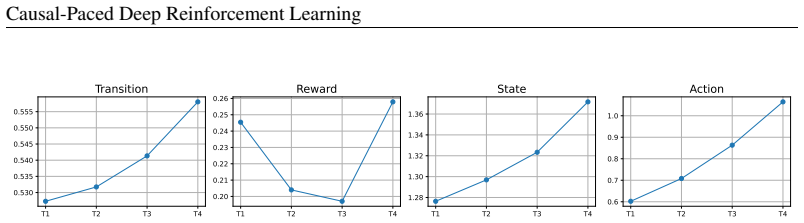
- [§4, Fig. 6 and Fig. 7] The claims of "faster convergence," "reduced variance," and "comparable final returns" rely on visual inspection of mean curves, but no significance tests or per-seed scatter are reported. This matters especially in Bipedal Walker-Infeasible, where only 3 seeds are used and the confidence intervals are wide. Please report significance tests (e.g., bootstrap or Mann-Whitney on final returns) or show individual seed curves so that the stability and variance claims can be assessed quantitatively.
minor comments (6)
- [Author affiliation] The affiliation contains a typo: "Gwangju Intsitute of Science and Technology" should be "Gwangju Institute of Science and Technology."
- [§2.2] The action space is denoted X in the SCM paragraph but A in the MDP definition in §2.1 and elsewhere; please use a consistent symbol throughout.
- [Figure 1] In the diagram label "CausalDifference" should be split into "Causal Difference" to match the prose.
- [Fig. 6 and Fig. 7 legends] The legend labels "CURROT (best method)" are confusing because CURROT is not the best final method in the Infeasible setting; relabel as "strongest baseline" or similar.
- [Fig. 4] The CausalWorld validation states that disagreement metrics are averaged over three random seeds, but Figure 4 shows no error bars or confidence intervals; please add them or state explicitly that only means are reported.
- [Algorithm 1] Please clarify whether the ensemble models are trained incrementally across curriculum iterations and whether the disagreement for a sampled context is computed before or after the ensemble is updated on that context's trajectory; this timing affects the interpretation of CM as "unfamiliarity."
Circularity Check
No significant circularity: CP-DRL's causal misalignment signal is an empirically evaluated proxy, not a fitted or self-referential input to the reported performance claims.
full rationale
The paper's derivation chain separates inputs from claimed outputs. The CM score (Eq. 5) is defined as a weighted sum of ensemble prediction standard deviations (Eq. 4) computed from interaction data; it is not fit to, nor defined in terms of, the final returns it is claimed to improve. The curriculum objective (Algorithm 1, line 15) combines episodic return R_j with CM(c_j) inside CURROT, and the reported PM/BW results are external benchmark comparisons against unrelated baselines (CURROT, SPRL, GoalGAN, etc.), so the empirical gains are not forced by construction. No load-bearing self-citation appears: the framework builds on external prior work (Li et al. 2024; Klink et al. 2022; Zhang et al. 2020), and none of the authors' own prior results are invoked to force a conclusion. The toy CausalWorld validation (Section 3.2 and Appendix E) tests whether modular disagreement tracks manipulated task factors; this is an empirical sensitivity check, not an equation-level circularity. Appendix F even reports a failure mode (SGR) where CM degenerates into a noisier variant of CURROT, which is inconsistent with the hypothesis that the positive PM results are trivially forced by the construction of the signal. Concerns that 'causal misalignment' is a renamed generic uncertainty signal, or that the PM setting violates the deterministic assumption underlying the SCM decomposition, are validity and ablation concerns rather than demonstrations that a prediction reduces to its input. Under the hard rules, no circular step can be exhibited with a specific equation-level reduction, so the appropriate finding is no significant circularity.
Assumptions & free parameters
free parameters (2)
- Component weights w_i for CM score =
PM: w_transition=10, w_state=w_action=w_reward=0; BW: w_state=100, w_action=20, w_transition=100, w_reward=100
- Relative scale of return and CM score in CURROT cost =
Implicitly 1 (R_j + CM(c_j))
assumptions (4)
- domain assumption The MDP is deterministic with no exogenous variables (U = empty).
- domain assumption SCM difference between tasks is fully represented by differences in state, action, transition, and reward components.
- ad hoc to paper Ensemble disagreement is a valid proxy for structural unawareness / causal misalignment.
- ad hoc to paper Adding CM to episodic return in the CURROT cost preserves the curriculum's constraints and objectives.
invented entities (1)
-
Causal Misalignment (CM) score
Cite this review
Pith. "Pith review of Causal-Paced Deep Reinforcement Learning." pith.science (2026). https://pith.science/paper/7L2VSLCK
@misc{pith2026250702910,
  author       = {Pith},
  title        = {Pith review of: Causal-Paced Deep Reinforcement Learning},
  year         = {2026},
  howpublished = {\url{https://pith.science/paper/7L2VSLCK}},
  note         = {Machine review of arXiv:2507.02910}
}
read the original abstract
Designing effective task sequences is crucial for curriculum reinforcement learning (CRL), where agents must gradually acquire skills by training on intermediate tasks. A key challenge in CRL is to identify tasks that promote exploration, yet are similar enough to support effective transfer. While recent approach suggests comparing tasks via their Structural Causal Models (SCMs), the method requires access to ground-truth causal structures, an unrealistic assumption in most RL settings. In this work, we propose Causal-Paced Deep Reinforcement Learning (CP-DRL), a curriculum learning framework aware of SCM differences between tasks based on interaction data approximation. This signal captures task novelty, which we combine with the agent's learnability, measured by reward gain, to form a unified objective. Empirically, CP-DRL outperforms existing curriculum methods on the Point Mass benchmark, achieving faster convergence and higher returns. CP-DRL demonstrates reduced variance with comparable final returns in the Bipedal Walker-Trivial setting, and achieves the highest average performance in the Infeasible variant. These results indicate that leveraging causal relationships between tasks can improve the structure-awareness and sample efficiency of curriculum reinforcement learning. We provide the full implementation of CP-DRL to facilitate the reproduction of our main results at https://github.com/Cho-Geonwoo/CP-DRL.
Figures


Figures from the paper (9 more)


Reference graph
Works this paper leans on
-
[1]
a uble, Anirudh Goyal, Alexander Neitz, Manuel W \
Ossama Ahmed, Frederik Tr \"a uble, Anirudh Goyal, Alexander Neitz, Manuel W \"u thrich, Yoshua Bengio, Bernhard Sch \"o lkopf, and Stefan Bauer. Causalworld: A robotic manipulation benchmark for causal structure and transfer learning. In International Conference on Learning Representations, 2021
work page 2021
-
[2]
Woulda, coulda, shoulda: Counterfactually-guided policy search
Lars Buesing, Theophane Weber, Yori Zwols, Nicolas Heess, Sebastien Racaniere, Arthur Guez, and Jean-Baptiste Lespiau. Woulda, coulda, shoulda: Counterfactually-guided policy search. In International Conference on Learning Representations, 2018
work page 2018
-
[3]
Minimalistic gridworld environment for gymnasium
Maxime Chevalier-Boisvert, Lucas Willems, and Suman Pal. Minimalistic gridworld environment for gymnasium. https://github.com/Farama-Foundation/Minigrid, 2018. Accessed: 2025-06-01
work page 2018
-
[4]
Diversify & Conquer : Outcome-directed curriculum rl via out-of-distribution disagreement
Daesol Cho, Seungjae Lee, and H Jin Kim. Diversify & Conquer : Outcome-directed curriculum rl via out-of-distribution disagreement. Advances in Neural Information Processing Systems, 36: 0 53593--53623, 2023 a
work page 2023
-
[5]
Daesol Cho, Seungjae Lee, and H Jin Kim. Outcome-directed reinforcement learning by uncertainty & temporal distance-aware curriculum goal generation. arXiv preprint arXiv:2301.11741, 2023 b
arXiv 2023
-
[6]
Reverse curriculum generation for reinforcement learning
Carlos Florensa, David Held, Markus Wulfmeier, Michael Zhang, and Pieter Abbeel. Reverse curriculum generation for reinforcement learning. In Conference on Robot Learning, pp.\ 482--495. PMLR, 2017
work page 2017
-
[7]
Automatic goal generation for reinforcement learning agents
Carlos Florensa, David Held, Xinyang Geng, and Pieter Abbeel. Automatic goal generation for reinforcement learning agents. In Proceedings of the International Conference on Machine Learning, pp.\ 1515--1528. PMLR, 2018
work page 2018
-
[8]
Automated curriculum learning for neural networks
Alex Graves, Marc G Bellemare, Jacob Menick, Remi Munos, and Koray Kavukcuoglu. Automated curriculum learning for neural networks. In Proceedings of the International Conference on Machine Learning, pp.\ 1311--1320. PMLR, 2017
work page 2017
Show all 39 references
-
[9]
Contextual markov decision processes
Assaf Hallak, Dotan Di Castro, and Shie Mannor. Contextual markov decision processes. arXiv preprint arXiv:1502.02259, 2015
2015 arXiv
-
[10]
beta-vae: Learning basic visual concepts with a constrained variational framework
Irina Higgins, Loic Matthey, Arka Pal, Christopher Burgess, Xavier Glorot, Matthew Botvinick, Shakir Mohamed, and Alexander Lerchner. beta-vae: Learning basic visual concepts with a constrained variational framework. In International Conference on Learning Representations, 2017
2017
-
[11]
Curriculum reinforcement learning using optimal transport via gradual domain adaptation
Peide Huang, Mengdi Xu, Jiacheng Zhu, Laixi Shi, Fei Fang, and Ding Zhao. Curriculum reinforcement learning using optimal transport via gradual domain adaptation. Advances in Neural Information Processing Systems, 35: 0 10656--10670, 2022
2022
-
[12]
Open-endedness is essential for artificial superhuman intelligence
Edward Hughes, Michael Dennis, Jack Parker-Holder, Feryal Behbahani, Aditi Mavalankar, Yuge Shi, Tom Schaul, and Tim Rockt \"a schel. Open-endedness is essential for artificial superhuman intelligence. arXiv preprint arXiv:2406.04268, 2024
2024 arXiv
-
[13]
Prioritized level replay
Minqi Jiang, Edward Grefenstette, and Tim Rockt \"a schel. Prioritized level replay. In Proceedings of the International Conference on Machine Learning, pp.\ 4940--4950. PMLR, 2021
2021
-
[14]
Self-paced contextual reinforcement learning
Pascal Klink, Hany Abdulsamad, Boris Belousov, and Jan Peters. Self-paced contextual reinforcement learning. In Conference on Robot Learning, pp.\ 513--529. PMLR, 2020 a
2020
-
[15]
Self-paced deep reinforcement learning
Pascal Klink, Carlo D'Eramo, Jan R Peters, and Joni Pajarinen. Self-paced deep reinforcement learning. Advances in Neural Information Processing Systems, 33: 0 9216--9227, 2020 b
2020
-
[16]
A probabilistic interpretation of self-paced learning with applications to reinforcement learning
Pascal Klink, Hany Abdulsamad, Boris Belousov, Carlo D'Eramo, Jan Peters, and Joni Pajarinen. A probabilistic interpretation of self-paced learning with applications to reinforcement learning. Journal of Machine Learning Research, 22 0 (182): 0 1--52, 2021 a
2021
-
[17]
Boosted curriculum reinforcement learning
Pascal Klink, Carlo D'Eramo, Jan Peters, and Joni Pajarinen. Boosted curriculum reinforcement learning. In International Conference on Learning Representations, 2021 b
2021
-
[18]
Curriculum reinforcement learning via constrained optimal transport
Pascal Klink, Haoyi Yang, Carlo D’Eramo, Jan Peters, and Joni Pajarinen. Curriculum reinforcement learning via constrained optimal transport. In Proceedings of the International Conference on Machine Learning, pp.\ 11341--11358. PMLR, 2022
2022
-
[19]
On the benefit of optimal transport for curriculum reinforcement learning
Pascal Klink, Carlo D'Eramo, Jan Peters, and Joni Pajarinen. On the benefit of optimal transport for curriculum reinforcement learning. IEEE Transactions on Pattern Analysis and Machine Intelligence, 2024
2024
-
[20]
Causally aligned curriculum learning
Mingxuan Li, Junzhe Zhang, and Elias Bareinboim. Causally aligned curriculum learning. In International Conference on Learning Representations, 2024. URL https://openreview.net/forum?id=hp4yOjhwTs
2024
-
[21]
Curriculum learning for reinforcement learning domains: A framework and survey
Sanmit Narvekar, Bei Peng, Matteo Leonetti, Jivko Sinapov, Matthew E Taylor, and Peter Stone. Curriculum learning for reinforcement learning domains: A framework and survey. Journal of Machine Learning Research, 21 0 (181): 0 1--50, 2020
2020
-
[22]
Evolving curricula with regret-based environment design
Jack Parker-Holder, Minqi Jiang, Michael Dennis, Mikayel Samvelyan, Jakob Foerster, Edward Grefenstette, and Tim Rockt \"a schel. Evolving curricula with regret-based environment design. In Proceedings of the International Conference on Machine Learning, pp.\ 17473--17498. PMLR, 2022
2022
-
[23]
Causality: Models, Reasoning, and Inference
Judea Pearl. Causality: Models, Reasoning, and Inference. Cambridge University Press, 2 edition, 2009. doi:10.1017/CBO9780511803161
2009 doi
-
[24]
Transportability of causal and statistical relations: A formal approach
Judea Pearl and Elias Bareinboim. Transportability of causal and statistical relations: A formal approach. In Proceedings of the AAAI Conference on Artificial Intelligence, volume 25, pp.\ 247--254, 2011
2011
-
[25]
Teacher algorithms for curriculum learning of deep rl in continuously parameterized environments
R \'e my Portelas, C \'e dric Colas, Katja Hofmann, and Pierre-Yves Oudeyer. Teacher algorithms for curriculum learning of deep rl in continuously parameterized environments. In Conference on Robot Learning, pp.\ 835--853. PMLR, 2020
2020
-
[26]
Teachmyagent: a benchmark for automatic curriculum learning in deep rl
Cl \'e ment Romac, R \'e my Portelas, Katja Hofmann, and Pierre-Yves Oudeyer. Teachmyagent: a benchmark for automatic curriculum learning in deep rl. In Proceedings of the International Conference on Machine Learning, pp.\ 9052--9063. PMLR, 2021
2021
-
[27]
Diffusion-based curriculum reinforcement learning
Erdi Sayar, Giovanni Iacca, Ozgur S Oguz, and Alois Knoll. Diffusion-based curriculum reinforcement learning. Advances in Neural Information Processing Systems, 37: 0 97587--97617, 2024
2024
-
[28]
Schrader
Max-Philipp B. Schrader. Gym-sokoban. https://github.com/mpSchrader/gym-sokoban, 2018. Accessed: 2025-06-04
2018
-
[29]
Causal influence detection for improving efficiency in reinforcement learning
Maximilian Seitzer, Bernhard Sch \"o lkopf, and Georg Martius. Causal influence detection for improving efficiency in reinforcement learning. Advances in Neural Information Processing Systems, 34: 0 22905--22918, 2021
2021
-
[30]
Causal curiosity: Rl agents discovering self-supervised experiments for causal representation learning
Sumedh A Sontakke, Arash Mehrjou, Laurent Itti, and Bernhard Sch \"o lkopf. Causal curiosity: Rl agents discovering self-supervised experiments for causal representation learning. In Proceedings of the International Conference on Machine Learning, pp.\ 9848--9858. PMLR, 2021
2021
-
[31]
Model-based transfer reinforcement learning based on graphical model representations
Yuewen Sun, Kun Zhang, and Changyin Sun. Model-based transfer reinforcement learning based on graphical model representations. IEEE Transactions on Neural Networks and Learning Systems, 2021
2021
-
[32]
Proximal curriculum for reinforcement learning agents
Georgios Tzannetos, B \'a rbara Gomes Ribeiro, Parameswaran Kamalaruban, and Adish Singla. Proximal curriculum for reinforcement learning agents. Transactions on Machine Learning Research, 2023
2023
-
[33]
Towards skilled population curriculum for multi-agent reinforcement learning
Rundong Wang, Longtao Zheng, Wei Qiu, Bowei He, Bo An, Zinovi Rabinovich, Yujing Hu, Yingfeng Chen, Tangjie Lv, and Changjie Fan. Towards skilled population curriculum for multi-agent reinforcement learning. arXiv preprint arXiv:2302.03429, 2023
2023 arXiv
-
[34]
Robust deep reinforcement learning through bootstrapped opportunistic curriculum
Junlin Wu and Yevgeniy Vorobeychik. Robust deep reinforcement learning through bootstrapped opportunistic curriculum. In Proceedings of the International Conference on Machine Learning, pp.\ 24177--24211. PMLR, 2022
2022
-
[35]
A survey on causal discovery: Theory and practice
Alessio Zanga, Elif Ozkirimli, and Fabio Stella. A survey on causal discovery: Theory and practice. International Journal of Approximate Reasoning, 151: 0 101--129, 2022
2022
-
[36]
A survey on causal reinforcement learning
Yan Zeng, Ruichu Cai, Fuchun Sun, Libo Huang, and Zhifeng Hao. A survey on causal reinforcement learning. IEEE Transactions on Neural Networks and Learning Systems, 2024
2024
-
[37]
Automatic curriculum learning through value disagreement
Yunzhi Zhang, Pieter Abbeel, and Lerrel Pinto. Automatic curriculum learning through value disagreement. Advances in Neural Information Processing Systems, 33: 0 7648--7659, 2020
2020
-
[38]
Invariant action effect model for reinforcement learning
Zheng-Mao Zhu, Shengyi Jiang, Yu-Ren Liu, Yang Yu, and Kun Zhang. Invariant action effect model for reinforcement learning. In Proceedings of the AAAI Conference on Artificial Intelligence, volume 36, pp.\ 9260--9268, 2022
2022
-
[39]
write newline
" write newline "" before.all 'output.state := FUNCTION n.dashify 't := "" t empty not t #1 #1 substring "-" = t #1 #2 substring "--" = not "--" * t #2 global.max substring 't := t #1 #1 substring "-" = "-" * t #2 global.max substring 't := while if t #1 #1 substring * t #2 gl...
Reviewed August 15, 2026 · model on record in the stance chip above.
Discussion (0). Continue with ORCID to comment.