REVIEW 5 major objections 6 minor 9 references
This paper claims that a multi-agent framework's AI-assistability is driven by convention alignment — a single canonical API pattern — not by declarative design, and supports this with a controlled benchmark across ten frameworks.
Reviewed by Pith at T0; open to challenge. T0 means a machine referee read the full paper against a public rubric. the ladder, T0–T4 →
T0 review · deepseek-v4-flash
2026-08-03 05:09 UTC pith:7LY5LLUY
load-bearing objection The benchmark and protocol are worth taking seriously, but the abstract's central AI-assistability claim is not derivable from the body, and the main correlation is partly circular due to outcome-weighted rubric design. the 5 major comments →
Declarative by Design, Assistable Only by Convention: Benchmarking Multi-Agent Frameworks for AI-Assistability
The pith
A machine-rendered reading of the paper's core claim, the machinery that carries it, and where it could break.
Core claim
The core discovery is stated in the abstract as 'convention alignment, not declarative design alone, is the primary driver of AI-assistability,' with a reported correlation between structural alignment and pass@1 of r = 0.576 (the full text reports r = 0.565). Using the Agent-as-a-Tool pattern, identical orchestration logic was implemented in ten frameworks, and GitHub Copilot was asked to recreate each implementation from documentation alone. Structural alignment — an LLM-as-Judge score comparing generated code against human-authored idiomatic references — strongly predicts runtime success for frameworks with a single canonical pattern, such as Agno, Claude SDK, and OpenAI Agents, each achi
What carries the argument
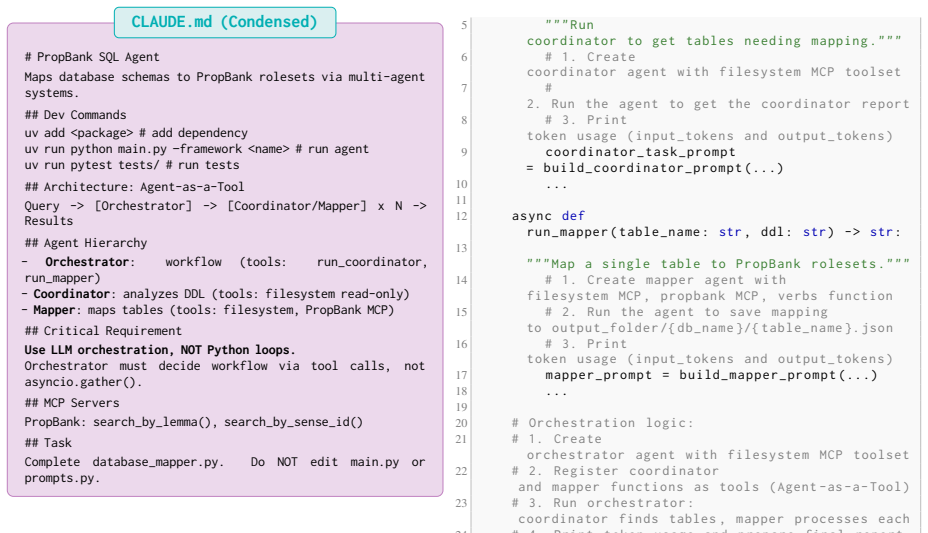
The AI-assistability metric combines structural alignment (an LLM-as-Judge score, weighted toward MCP integration and API usage, that compares generated code against human reference implementations) with functional correctness (pass@1, binary runtime validity). The test vehicle is DDL2PropBank, a benchmark mapping relational schemas to PropBank rolesets, accessed through MCP servers for filesystem and PropBank queries; this architecture is held identical across all ten frameworks, isolating framework-induced differences.
Load-bearing premise
The claim rests on the structural alignment score being a trustworthy measure of idiomatic code that is independent of runtime success — but the judge rubric's component weights are derived from the same failure-cause statistics the score is then used to predict, so the reported correlation could be partly built into the metric.
What would settle it
Recompute the judge-score vs. pass@1 correlation using a rubric whose component weights are fixed before any code generation runs, or with all seven components weighted equally; if the correlation drops to near zero or the framework ranking changes, the convention-alignment conclusion is an artifact of the rubric weighting rather than a property of the frameworks.
If this is right
- Framework developers should prioritize converging on a single canonical API pattern before expanding documentation, since documentation volume amplifies whatever pattern structure exists.
- Declarative design alone does not guarantee AI-assistability; abstractions that are novel or under-represented in LLM training data can lower success even for otherwise clean frameworks.
- The demonstrated methodology — a novel task, identical agent logic, and dual structural/functional evaluation — offers a reusable template for comparing future agent frameworks.
- For frameworks with a single canonical pattern, a quick LLM-based structural alignment score can serve as a cheap proxy for runtime correctness, but this proxy overestimates correctness for multi-pattern frameworks.
- The paper's own ethics discussion flags a homogenization risk: as more developers rely on AI assistants, adoption may converge on 'AI-friendly' patterns at the expense of architectural diversity.
Where Pith is reading between the lines
- The headline correlation is partly circular: the judge rubric weights MCP integration and API usage most heavily because those components most strongly predicted runtime failure in the same evaluation set, so the reported r between judge score and pass@1 could be an artifact of the weighting rather than a discovered law.
- The 0.576 in the abstract and 0.565 in the full text are not the same number; the exact value should not be treated as stable, and the paper's own two renditions of its central statistic deserve reconciliation.
- A testable extension of the paper's convergence principle: artificially expose a coding assistant to more canonical examples of a low-scoring declarative framework, and measure whether its AI-assistability rises without any change to the framework itself — this would separate 'convention exposure' from 'design'.
- Because the benchmark's novelty fades as DDL2PropBank becomes known, the authors' shelf-life caveat implies that AI-assistability comparisons will need continuously fresh tasks or sandboxed setups to remain meaningful.
Editorial analysis
A structured set of objections, weighed in public.
Referee Report
Summary. The paper introduces DDL2PropBank, a benchmark that maps relational database schemas to PropBank rolesets, and uses it to evaluate ten multi-agent frameworks (MAFs) along two dimensions: code complexity (static metrics) and AI-assistability (whether GitHub Copilot can generate correct framework-specific code from documentation). The authors implement identical Agent-as-a-Tool logic across frameworks, score generated code with an LLM judge for structural alignment to human-authored references, and test runtime validity. The main claim is that 'convention alignment, not declarative design alone, is the primary driver of AI-assistability' (abstract, r = 0.576; full text §5.1 reports r = 0.565), with Agno as the strongest framework and DSPy as the weakest. The paper also reports a three-tier code-complexity spectrum and identifies API convergence as more important than documentation volume.
Significance. If the central claim holds, the paper makes a useful contribution: it proposes a controlled, novel benchmark task for comparing MAFs, contributes a PropBank MCP server, and releases all implementations and evaluation scripts. The static complexity analysis is careful and the limitations are candidly acknowledged. However, the headline result is currently not independently established because the structural-alignment rubric is weighted using the same experiment's failure statistics, and the abstract's composite AI-assistability metric is undefined in the body. The correlation between judge score and runtime validity is therefore partly constructed rather than discovered. With a neutral-weight reanalysis and a properly defined metric, the paper could be a solid benchmark contribution; the present version does not yet support its strongest conclusion.
major comments (5)
- [Abstract vs. §5.1] The abstract introduces AI-assistability 𝒜ℐ as a composite metric and reports r = 0.576 between σ̄ and pass@1, and assigns Agno the score 0.55. The full text never defines 𝒜ℐ; §5.1 and Figure 10 report r = 0.565 between the LLM-judge score and pass@1. The central quantitative claim is therefore not derivable from the body. Please define 𝒜ℐ explicitly, give per-framework values, and reconcile the two correlation coefficients.
- [§4.2.1, Table 2] The LLM-as-Judge rubric weights MCP integration and API usage at 0–4 'because they most strongly predict runtime validity', citing failure-cause statistics (73% MCP, 18% API) from the same 60-run experiment. This makes the judge score label-dependent: the correlation in §5.1 between judge score and pass@1 is partly constructed by the rubric weights. Please recompute with fixed, pre-registered weights (or a neutral rubric) and report sensitivity; otherwise the reported r is not an independent validation of structural alignment as a proxy.
- [§4.2.1] Structural alignment is measured against the authors' own human-written reference implementations. Consequently, 'convention alignment' is operationalized as convergence to the authors' code, not to an independent community idiomatic standard. The paper's conclusion that 'API convergence, not documentation volume, determines AI-assistability' (§8) would require evidence that the references are representative of idiomatic usage — e.g., alignment with official tutorials or examples, or a second judge not conditioned on the reference implementations.
- [§4.2.2, §5.1] Runtime validity is defined as 'completes without exceptions and produces correctly-structured JSON for all 8 tables'. This is a syntactic/execution check, not a semantic correctness check: it does not verify that the chosen PropBank rolesets and argument-to-column mappings are correct. Given that the paper claims to measure generation of 'correct, framework-specific code', pass@1 as reported is really 'runs and produces well-formed output'. Please add a semantic accuracy metric (e.g., agreement with ground-truth mappings) or qualify the claim throughout.
- [§5.2, Table 10, Figure 4] Framework-level pass@1 is computed from only 6 runs per framework (3 Copilot runs × 2 model tiers). The values 83% (5/6), 75% (4/6), 67% (4/6), 50% (3/6), and 33% (2/6) have wide confidence intervals and are not significantly different from one another at conventional levels. Please report exact counts, add confidence intervals, and avoid ranking frameworks without a formal comparison.
minor comments (6)
- [Figure 3] The caption says 'identical inputs' for all frameworks, but the documentation URL differs per framework. Clarify that the project scaffold is identical while the documentation source is framework-specific.
- [Table 6] The Pydantic AI row is garbled ('9552 3 1.00 46 470 334'), making the table hard to read. Please fix the formatting.
- [§2.3.2] Minor grammar: 'which frameworks has the least code complexity' should be 'which frameworks have the lowest code complexity'.
- [Table 9] The phrase 'Frameworks below the rule are 3–5× more expensive per roleset' is unclear; define what 'below the rule' means.
- [Figure 10] The x-axis bins overlap (6–9, 9–12, 12–15, 15–18, 18+). Specify bin edges (e.g., [6,9), [9,12), etc.) to avoid ambiguity.
- [§G.2] The table of cost-effectiveness mixes different run conditions (e.g., 'ground-truth implementations' vs. AI-generated). Clarify whether costs are for reference runs only, and how this relates to the AI-assistability evaluation.
Circularity Check
The headline correlation between structural alignment and pass@1 is partly built into the LLM-as-Judge rubric, whose weights are chosen from the same experiment's failure labels; the abstract's composite AI-assistability definition also makes the 'primary driver' claim partially definitional.
specific steps
-
fitted input called prediction
[Section 4.2.1 (Table 2) and Section 5.1 (Figure 10)]
"MCP integration and API usage receive higher weights (0–4) because they most strongly predict runtime validity: MCP configuration errors cause 73% of runtime failures, while API misuse accounts for another 18%. ... The Pearson correlation of r= 0.565 between judge score and pass@1 confirms that the LLM-as-Judge methodology captures meaningful code quality dimensions."
The structural-alignment judge score is constructed by assigning extra weight to MCP and API components specifically because those components were observed, within the same 60-run experiment, to predict the pass/fail label. The paper then reports the correlation between this label-informed weighted score and the same pass@1 labels as independent evidence that 'structural alignment strongly predicts runtime success.' The outcome information is baked into the predictor weights, so the reported r=0.565 is partly an artifact of the rubric design rather than a cleanly discovered relationship.
-
self definitional
[Abstract]
"We introduce AI-assistability ($\mathcal{AI}$), a composite metric ... combining structural alignment ($\bar{\sigma}$) with functional correctness (pass@1). ... We find that convention alignment, not declarative design alone, is the primary driver of AI-assistability ($r = 0.576$ between $\bar{\sigma}$ and pass@1)."
AI-assistability is defined as a composite of σ̄ and pass@1, so the claim that σ̄ is a 'primary driver' of AI-assistability is true by construction: σ̄ is one of the two inputs to the metric. The cited correlation is between the two inputs of the composite, not between σ̄ and the composite, and the full text never defines the abstract's 𝒜ℐ or reconciles r=0.576 with Section 5.1's r=0.565.
full rationale
The benchmark and the 60-run Copilot evaluation are genuine, self-contained efforts, and I find no load-bearing self-citation circularity: the DDL2PropBank task, the static code-complexity analysis, and the runtime validity testing stand on their own. However, the paper's central claim—that structural alignment (convention alignment) predicts or drives runtime success—is partially constructed rather than discovered. Section 4.2.1 weights the MCP and API components of the LLM-as-Judge rubric using failure-cause statistics from the same experiment, and Section 5.1 then presents the correlation of that weighted score with pass@1 (r=0.565) as validation of the methodology. This is label leakage into the predictor construction; a neutral-weight or pre-registered rubric would be required to support the claimed relationship. The abstract's AI-assistability composite makes the 'primary driver' statement additionally definitional, and the unexplained discrepancy between r=0.576 (abstract) and r=0.565 (body) prevents the headline result from being derived from the full text. The small per-framework sample sizes (6 runs) are a statistical concern but not circularity.
Axiom & Free-Parameter Ledger
free parameters (2)
- LLM-as-Judge rubric weights =
0–3 for agent components; 0–4 for MCP integration and API usage
- Structural alignment acceptance thresholds =
Judge score 18+ 'high'; median 15.9; 50% pass@1 threshold
axioms (6)
- domain assumption PropBank rolesets are an appropriate semantic target for database schema events
- domain assumption The PropBank MCP server faithfully represents PropBank frames
- domain assumption GitHub Copilot with Claude Haiku/Sonnet is representative of AI coding assistants
- domain assumption LLM-as-Judge via Claude Opus reliably rates structural alignment
- domain assumption Runtime success (no exceptions, valid JSON) implies correct implementation
- domain assumption The Agent-as-a-Tool pattern is representative of real agentic use
invented entities (1)
-
AI-assistability composite metric 𝒜ℐ
no independent evidence
read the original abstract
Multi-agent frameworks (MAFs) promise to simplify LLM-driven software development, yet no principled metric captures how well AI coding assistants can generate correct, framework-specific code. We introduce \textit{AI-assistability} ($\mathcal{AI}$), a composite metric that quantifies a framework's amenability to AI-assisted development by combining structural alignment ($\bar{\sigma}$) with functional correctness (pass@1). To evaluate this metric in a controlled setting, we design DDL2PropBank, a novel benchmark task that maps relational database schemas to PropBank semantic rolesets, and implement identical agent logic across ten frameworks using the Agent-as-a-Tool pattern. Our results challenge the intuition that declarative framework design guarantees AI-assistability: Agno, with a single canonical pattern and convention-aligned API, achieves the highest $\mathcal{AI}$ score (0.55), while DSPy -- the most declarative framework by design -- scores lowest (0.07), as its novel abstractions are insufficiently represented in AI training data. We find that convention alignment, not declarative design alone, is the primary driver of AI-assistability ($r = 0.576$ between $\bar{\sigma}$ and pass@1). All artifacts -- DDL2PropBank, PropBank MCP server, and all implementations -- are available at https://github.com/ahmeshaf/ddl2propbank
Figures



Reference graph
Works this paper leans on
-
[1]
Core Action Identification Ask: What real-world actions does this table RECORD or TRACK? Example: Table orders→order, request, fulfill, cancel, return
-
[2]
Favor verbs differing along: intent vs execution, initiation vs completion
Action Diversity (Avoid Synonyms) Do NOT include lexical variants (e.g., buy/purchase/acquire). Favor verbs differing along: intent vs execution, initiation vs completion
-
[3]
Temporal & Causal Sequencing Consider: initiation (submit, request)→modification (update)→resolution (complete, cancel)
-
[4]
A large-scale survey on the usability of AI programming assistants: Successes and challenges. InProceedings of the IEEE/ACM 46th International Conference on Software Engineering (ICSE), pages 605–617, Lisbon, Portugal. ACM. Yunbo Long, Liming Xu, and Alexandra Brintrup. 2025. LLM-TabLogic: Preserving inter-column logical rela- tionships in synthetic tabul...
Pith/arXiv arXiv 2025
-
[8]
get_action_verbs
Domain-Aware Reasoning E-commerce→checkout, fulfill, refund | Healthcare→ diagnose, prescribe ## Output Return requested number of verbs as a simple list (base-form, no explanations) Figure 8: Prompt for the GetActionVerbs LLM-tool. The tool receives table context (name, columns, foreign keys) and returns candidate action verbs for PropBank queries. OpenA...
2024
-
[9]
""Map a single table to PropBank rolesets
Run the agent to get the coordinator report 8# 3. Print token usage (input_tokens and output_tokens) 9coordinator_task_prompt = build_coordinator_prompt(...) 10... 11 12async def run_mapper(table_name: str, ddl: str) -> str: 13 """Map a single table to PropBank rolesets.""" 14# 1. Create mapper agent with filesystem MCP, propbank MCP, verbs function 15# 2...
-
[2022]
Taicheng Guo, Xiuying Chen, Yaqi Wang, Ruidi Chang, Shichao Pei, Nitesh V
An actionable framework for understanding and improving developer experience.IEEE Trans- actions on Software Engineering, 49(4):1411–1425. Taicheng Guo, Xiuying Chen, Yaqi Wang, Ruidi Chang, Shichao Pei, Nitesh V . Chawla, Olaf Wiest, and Xi- angliang Zhang. 2024. Large language model based multi-agents: A survey of progress and challenges. InProceedings ...
2024
-
[2024]
Agentscope: A flexible yet robust multi-agent platform.Preprint, arXiv:2402.14034. Dawei Gao, Zitao Li, Yuexiang Xie, Weirui Kuang, Liuyi Yao, Bingchen Qian, Zhijian Ma, Yue Cui, Haohao Luo, Shen Li, Lu Yi, Yi Yu, Shiqi He, Zhiling Luo, Wenmeng Zhou, Zhicheng Zhang, Xuguang He, Ziqian Chen, Weikai Liao, and 4 others. 2025. AgentScope 1.0: A developer-cent...
Pith/arXiv arXiv 2025
-
[2025]
Agentic AI frameworks: Architectures, protocols, and design challenges.arXiv preprint arXiv:2508.10146. Systematic review of major agentic frameworks (CrewAI, LangGraph, AutoGen) examining architectures, communication protocols, and memory management. David Dowty. 1991. Thematic proto-roles and argument selection.Language, 67(3):547–619. Zhihua Duan and J...
Pith/arXiv arXiv 1991
discussion (0)
Sign in with ORCID, Apple, or X to comment. Anyone can read and Pith papers without signing in.