REVIEW 4 major objections 6 minor 48 references
A deepfake detector whose training is refreshed by an open adversarial competition keeps pace with the generative frontier, and dated snapshots outperform static baselines on recent fakes.
Reviewed by Pith at T0; open to challenge. T0 means a machine referee read the full paper against a public rubric. the ladder, T0–T4 →
T0 review · deepseek-v4-flash
2026-08-02 05:47 UTC pith:7MO7KI4L
load-bearing objection A serious, honestly-reported evaluation of a continuously refreshed detector; the refresh mechanism is plausible but not yet causally isolated from architecture churn. the 4 major comments →
Continuously Evolving Deepfake Detection: An Architecture and Public-Benchmark Evaluation of a Dynamic Detection System
The pith
A machine-rendered reading of the paper's core claim, the machinery that carries it, and where it could break.
Core claim
The central claim is that the system adapts even though every individual snapshot is static: each frozen export inherits a training distribution that is days, not years, behind the generative frontier. The evidence is a dated April 2026 export that, without per-benchmark tuning, reaches 0.936 AUC on Sumsub original images, 0.915 on the Deepfake-Eval-2024 image track, and 0.822 on its video track; and a temporal back-test in which successive snapshots improve from 0.842 to 0.902 AUC (image) and 0.864 to 0.936 (video) on test sets drawn from generators absent from a November 2025 static baseline's training.
What carries the argument
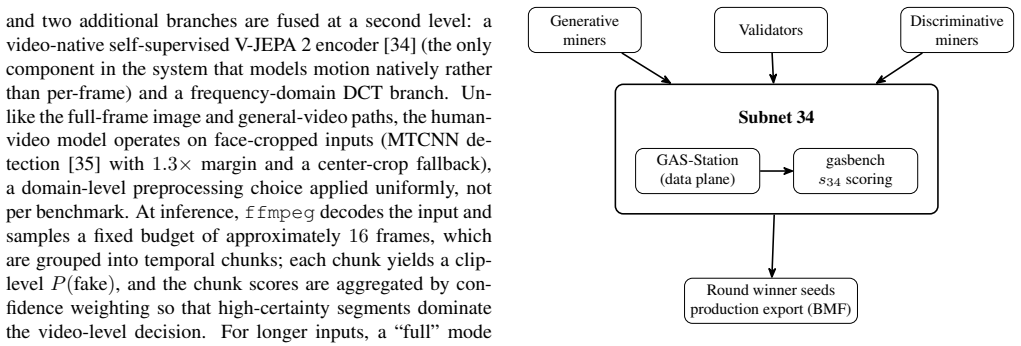
The mechanism is an open adversarial competition (the paper's SN34 loop): generative miners serve state-of-the-art generators under validator checks, discriminative miners submit detector checkpoints scored by a combined discrimination-and-calibration reward, and the winner seeds the production export. This loop, together with the GAS-Station dataset of verified adversarial media, is what continually refreshes the training distribution; the detector itself is a heterogeneous ensemble of four vision backbones with separate image, general-video, and face-video checkpoints.
Load-bearing premise
The entire adaptation argument rests on the forward GAS-Station weeks being genuinely post-export and on the perceptual-hash contamination audit catching all training near-duplicates; if either fails, the temporal and cross-dataset improvements are unsupported.
What would settle it
Take the production API snapshot dated April 15, 2026, run it on the timestamped GAS-Station weeks 26–28, and verify the published recall; then check a random sample of those weeks against the training corpora with a stronger near-duplicate search than perceptual hashing. If recall is much lower, or if duplicates surface, the mechanism's claimed freshness is refuted.
If this is right
- If the central claim holds, static benchmark retraining cycles are too slow; detection systems need continuous data refresh to remain usable.
- Public benchmarks should adopt temporal protocols (train on early generators, test on later ones) as a standard evaluation axis.
- The incentive mechanism turns the adversarial process into a scalable data engine: new generators enter the challenge distribution within hours rather than months.
- The contamination-aware evaluation subsets (frame-level near-duplicate audit) should become standard practice for reporting cross-dataset face-video results.
Where Pith is reading between the lines
- The same incentive-driven refresh idea could transfer to other non-stationary detection problems, e.g., fraud, malware, and spam, where the adversary's distribution also drifts weekly.
- The paper's own failure analysis suggests pixel-space (non-latent) generators like Hourglass are a current blind spot; a testable prediction is that once such generators enter the competition stream, subsequent snapshots will close that gap.
- The forward GAS-Station evaluation is only as strong as the guarantee that those weeks are truly post-export; an independent third party could re-run the exact API snapshot on those timestamped weeks to verify the recall figures.
- The reported parity with the best commercial detector on Deepfake-Eval-2024 image track depends on a 95% CI that includes the published value; a larger in-the-wild sample would sharpen whether the system genuinely matches or exceeds commercial tools.
Editorial analysis
A structured set of objections, weighed in public.
Referee Report
Summary. The paper presents BitMind Forensics (BMF), a deepfake-detection system built on the Bittensor SN34 incentive loop. The authors argue that static detectors are structurally doomed by generative drift, and that BMF's continuous, incentive-driven refresh of the training distribution is what keeps it current. They evaluate a single April 15, 2026 export (image, general-video, and human-video checkpoints) on nineteen public datasets, reporting strong results on in-the-wild benchmarks (Sumsub, Deepfake-Eval-2024), AI-image panels (Community Forensics, GenImage), and AI-video suites (GenVidBench, GenVideo). A temporal study shows successive dated exports improving on fixed test sets of recent-generator media, and a forward test on the GAS-Station stream shows the frozen snapshot flagging a stable fraction of post-export synthetic media. The paper is transparent about unfavorable numbers (e.g., 24% TPR@1%FPR on Deepfake-Eval video, ECE 0.479 on Sumsub, FF++ accuracy 31%) and releases its evaluation harness.
Significance. If the central claim were established, the paper would make a meaningful contribution: reframing deepfake detection as a process-level, non-stationary problem rather than an architecture-level one, and providing a large public benchmark evaluation of a deployed system. Genuine strengths include: one fixed snapshot with no per-benchmark tuning; DeLong confidence intervals on primary benchmarks; honest reporting of adverse operating points; a forward evaluation on post-export GAS-Station weeks; and a public harness (gasbench). The GAS-Station release is also a useful community resource. However, the paper's headline causal claim — that successive snapshot improvements are caused by training-data freshness rather than by architecture evolution or other confounds — is not yet supported by the evidence presented. The paper itself acknowledges this gap in §5.4 and §6.3, which makes the issue load-bearing rather than incidental.
major comments (4)
- [§5.4, §6.3, §3.4] The central claim that continuous data refresh, not architecture, keeps BMF current is not isolated by the temporal study. As the paper states in §5.4, successive snapshots 'may differ in architecture as well as training data'; §3.4 explains that each round is winner-take-all and the winning basis seeds the next export, so the architecture can change between snapshots. The observed monotone AUC gains (image 0.842→0.902; video 0.864→0.936) could therefore reflect better architectures surfaced by the competition, more training data in general, different model selection, or a combination. The paper's own §6.3 leaves 'an ablation isolating training-data freshness (the same model retrained without the most recent months of data)' to future work. That ablation is not optional for the paper's thesis; it is the decisive experiment. Without it, or without a comparison that holds the architecture
- [§5.4, Table 20, §4.2] The forward GAS-Station evaluation does not resolve the confound identified above. Showing that a frozen April snapshot maintains roughly stable recall on post-export weeks (image 0.929→0.917; video 0.789→0.814) is consistent with the mechanism working, but it is equally consistent with a static detector that generalizes reasonably to new generators; no comparison against a detector trained once on older data is provided. In addition, the claim that the GAS-Station weeks are genuinely post-export and free of leakage rests on the validators' C2PA/prompt checks and timestamped partitions, but §4.2 and §3.4 do not describe how timestamps are verified or how an adversarial generative miner could be prevented from backdating or mislabeling submissions. Since the forward test is a key piece of evidence for the deployment model, this verification needs to be described concretely.
- [§5.3.3, Table 19, §7] The face-video cross-dataset claims against Effort (DFDC 0.947 vs 0.843; Celeb-DF v2 0.9985 vs 0.956) rely on the contamination audit, which the paper itself limits to 'media-level duplication' and explicitly does not exclude 'person-level identity overlap' for celebrity-sourced benchmarks. If identity leakage inflates scores, those headline numbers are unsupported. Moreover, the comparison is not split-matched: BMF is scored on audit-verified subsets of roughly 1K clips, while Effort's published numbers come from the canonical protocol. The paper labels the comparison 'indicative' in the Table 19 caption, but the abstract and conclusion state the cross-dataset victory more flatly. Please either provide an identity-controlled analysis (e.g., train/test disjoint by person where feasible) or temper the abstract/conclusion claims to match the actual strength of the evidence.
- [§4.3, Table 4] All baseline comparisons use published point values rather than re-run baselines, and several rows are explicitly 'indicative' due to metric or aggregation mismatches (Community Forensics, DF40). This is disclosed, but it means the paper's comparative claims are weaker than a head-to-head evaluation would be. In particular, the Deepfake-Eval video comparison (BMF 0.822 vs best commercial 0.79) is reported as a numerical win even though the published 0.79 falls just below BMF's CI [0.791, 0.848] and the baseline is reported to two decimals. A matched re-run of at least the primary in-the-wild baselines would substantially strengthen the comparative claims.
minor comments (6)
- [§3.4, Eq. (3)] The quantities ^MCC and eB are described as 'normalized' but the normalization is not defined. Please specify the exact transformations and state whether α=1.2 and β=1.8 are fixed across all rounds.
- [Table 1] The backbone name 'EV A-L/14' appears to be a typo for 'EVA-L/14'; please correct.
- [§5.2.1] The attribution of Sumsub robustness 'primarily to full-frame scoring without a face-crop stage' is a plausible post-hoc hypothesis, but the ablations in §6.3 show that under degradation the ensemble can be diluted by weaker branches. Consider marking this as a hypothesis and testing it explicitly, e.g., by adding a face-crop condition to the ablation.
- [§5.4, Table 21] The dates are inconsistent: the text says 'November 7, 2025' while the table header says 'Nov 7 (static)'. Use a single format throughout.
- [Table 22] The Sumsub ECE of 0.479 is reported for the pooled all-conditions set, but Table 8 does not break ECE down by manipulation condition. Reporting per-condition ECE would help readers see where calibration degrades.
- [Reproducibility Statement] Because model weights are not public, independent verification must go through the production API. It would be helpful to state whether the API exposes per-sample softmax scores (needed to recompute DeLong CIs) and whether the released gasbench harness includes the exact preprocessing and routing used for the paper's reported numbers.
Circularity Check
No significant circularity: external benchmarks carry the central results; the one self-citation is not load-bearing, and the temporal claim is limited by an acknowledged confound rather than circular.
full rationale
The paper's headline benchmark claims are not defined in terms of its own outputs: one dated export is scored on nineteen public datasets with no per-benchmark tuning, and the metrics are compared to published external baselines. No parameter is fitted to the headline test sets, and no reported AUC is constructed from the system's own training signal. The only self-citation ([29], the BitMind SN34 framework) is background: the present paper specifies the mechanism in detail in §3.4 and tests it independently, so the citation is not load-bearing for the central claims. The closest thing to a circular risk is the temporal study in §5.4, where later snapshots are evaluated on generators they have already seen in training. The paper states this explicitly ('The test generators are absent from the training data of the static baseline only; the later snapshots have seen media from these generator families in training (though not the test items themselves), by design'), and frames the study as an end-to-end mechanism back-test rather than a zero-shot freshness test. The paper's own §6.3 also concedes the causal attribution is incomplete: 'An ablation isolating training-data freshness (the same model retrained without the most recent months of data) is left to future work; the temporal study (§5.4) provides the system-level version of that evidence.' §5.4 additionally concedes that successive snapshots 'may differ in architecture as well as training data.' That is a real internal-validity gap, but it is not circularity: the observed monotone improvement is not forced by definition, no equation equates the temporal gain to a fitted parameter, and the test items are not the training items. Score 2 reflects the minor non-load-bearing self-citation and the deferred freshness ablation, not substantive circular derivation.
Axiom & Free-Parameter Ledger
free parameters (5)
- Ensemble fusion weights =
A1 1/6, A2 1/6, B 1/3, C 1/3
- SN34 scoring weights (α, β) =
α=1.2, β=1.8
- Cosine-head scale and fake-logit bias =
s=30, bias +0.5
- Decision threshold =
0.5 fixed
- Video inference budget =
16 frames, 1.3× face margin, confidence-weighted pooling
axioms (6)
- standard math DeLong method gives valid AUC confidence intervals for correlated samples
- domain assumption The public benchmarks are representative of real circulated deepfakes
- domain assumption Validator C2PA and prompt-alignment checks keep GAS-Station media genuinely synthetic and correctly timestamped
- ad hoc to paper Delayed fool-rate reward makes the challenge distribution track the generative frontier
- domain assumption Frame-level perceptual-hash audit detects training near-duplicates
- domain assumption MTCNN face crops are an adequate uniform preprocessing for face-video benchmarks
invented entities (3)
-
BMF (dated production export)
no independent evidence
-
Bittensor Subnet 34 incentive loop
no independent evidence
-
GAS-Station
independent evidence
read the original abstract
Deepfake detectors that achieve near-perfect scores on academic benchmarks collapse on real-world content: recent in-the-wild evaluations report AUC drops of 45-50% for state-of-the-art open-source models. We argue this gap is structural: static detectors are trained once against a moving generative frontier. We present BitMind Forensics (BMF), trained through Bittensor SN34, an open adversarial competition that continually refreshes the training distribution. We evaluate one dated export comprising image, general-video, and human-video checkpoints across nineteen public datasets: the canonical face-swap suites (FaceForensics++, Celeb-DF v1/v2/++, DFDC, DFD, UADFV, DF40) and recent in-the-wild and AI-generated-media benchmarks (Sumsub, Deepfake-Eval-2024, WildRF, Community Forensics, AIGCDetectBench, GenImage, AI-GenBench, AIGIBench, RAID, GenVidBench, GenVideo-100K). BMF reaches 0.936 AUC on Sumsub's original images and 0.872 pooled AUC over its full four-condition manipulation battery (1.4M images), staying robust under perturbation (0.855 JPEG, 0.799 downscaled), while GPEN enhancement improves detection (0.996). On Deepfake-Eval-2024, it matches the best commercial detector on images (0.915 vs 0.90) and exceeds it on video (0.822 vs 0.79), far above the best open-source detectors (0.56 and 0.63). It reaches 0.991 AUC on a 21-generator AI-image panel and 0.918 on GenVidBench, and exceeds the FF++-trained frontier on DFDC (0.947 vs 0.843) and Celeb-DF v2 (0.9985 vs 0.956), both contamination-audited, with statistical parity on Celeb-DF++. In a temporal study, successive dated exports improve on held-out media from generators absent from the static baseline's training (image 0.842 to 0.902; video 0.864 to 0.936). Our evaluation harness is public, and at publication the production API serves the exact evaluated snapshot for independent verification.
Figures

Reference graph
Works this paper leans on
-
[1]
Orthogonal subspace decomposition for gen- eralizable AI-generated image detection (Effort),
Z. Yanet al., “Orthogonal subspace decomposition for gen- eralizable AI-generated image detection (Effort),” inICML,
-
[2]
GenImage: A million-scale benchmark for de- tecting AI-generated image,
M. Zhuet al., “GenImage: A million-scale benchmark for de- tecting AI-generated image,” inNeurIPS Datasets & Bench- marks, 2023. arXiv:2306.08571
Pith/arXiv arXiv 2023
-
[3]
Deepfake-Eval-2024: A multi-modal in-the-wild benchmark of Deepfakes circulated in 2024,
N. A. Chandraet al., “Deepfake-Eval-2024: A multi-modal in-the-wild benchmark of Deepfakes circulated in 2024,” in CVPR Workshops, 2026. arXiv:2503.02857
Pith/arXiv arXiv 2024
-
[4]
A sanity check for AI-generated image detec- tion,
S. Yanet al., “A sanity check for AI-generated image detec- tion,” inICLR, 2025. arXiv:2406.19435
Pith/arXiv arXiv 2025
-
[5]
Evaluating Deepfake detec- tors in the wild,
V . Pirogov and M. Artemev, “Evaluating Deepfake detec- tors in the wild,” inICML DataWorld Workshop, 2025. arXiv:2507.21905
Pith/arXiv arXiv 2025
-
[6]
Fit for purpose? Deepfake detection in the real world,
G. Lin, L. Lin, C. P. Walker, D. S. Schiff, and S. Hu, “Fit for purpose? Deepfake detection in the real world,” 2025. arXiv:2510.16556
arXiv 2025
-
[7]
M. Rettinger, B. Beaumont, N.-A. Le-Khac, and H.-H. Nguyen-Le, “How effective are publicly accessible Deepfake detection tools? a comparative evaluation of open-source and free-to-use platforms,” 2026. arXiv:2603.04456
arXiv 2026
-
[8]
Perfor- mance decay in Deepfake detection: The limitations of train- ing on outdated data,
J. Richings, M. Leblanc, I. Groves, and V . Nockles, “Perfor- mance decay in Deepfake detection: The limitations of train- ing on outdated data,” 2025. arXiv:2511.07009
arXiv 2025
-
[9]
Community forensics: Using thou- sands of generators to train fake image detectors,
J. Park and A. Owens, “Community forensics: Using thou- sands of generators to train fake image detectors,” inCVPR,
-
[10]
FaceForensics++: Learning to detect manip- ulated facial images,
A. Rössleret al., “FaceForensics++: Learning to detect manip- ulated facial images,” inICCV, 2019. arXiv:1901.08971
Pith/arXiv arXiv 2019
-
[11]
Detecting Deepfakes with self- blended images,
K. Shiohara and T. Yamasaki, “Detecting Deepfakes with self- blended images,” inCVPR, 2022. arXiv:2204.08376
Pith/arXiv arXiv 2022
-
[12]
Implicit identity leakage: The stumbling block to improving Deepfake detection generalization,
S. Donget al., “Implicit identity leakage: The stumbling block to improving Deepfake detection generalization,” inCVPR,
-
[13]
Z. Yanet al., “Transcending forgery specificity with latent space augmentation for generalizable Deepfake detection,” in CVPR, 2024. arXiv:2311.11278
Pith/arXiv arXiv 2024
-
[14]
Towards universal fake image detectors that generalize across generative models,
U. Ojha, Y . Li, and Y . J. Lee, “Towards universal fake image detectors that generalize across generative models,” inCVPR,
-
[15]
Forgery-aware adaptive transformer for generalizable synthetic image detection,
H. Liuet al., “Forgery-aware adaptive transformer for generalizable synthetic image detection,” inCVPR, 2024. arXiv:2312.16649
Pith/arXiv arXiv 2024
-
[16]
C2P-CLIP: Injecting category common prompt in CLIP to enhance generalization in Deepfake detection,
C. Tanet al., “C2P-CLIP: Injecting category common prompt in CLIP to enhance generalization in Deepfake detection,” in AAAI, 2025. arXiv:2408.09647
Pith/arXiv arXiv 2025
-
[17]
DIRE for diffusion-generated image detec- tion,
Z. Wanget al., “DIRE for diffusion-generated image detec- tion,” inICCV, 2023. arXiv:2303.09295
Pith/arXiv arXiv 2023
-
[18]
DRCT: Diffusion reconstruction contrastive training towards universal detection of diffusion generated im- ages,
B. Chenet al., “DRCT: Diffusion reconstruction contrastive training towards universal detection of diffusion generated im- ages,” inICML, 2024. PMLR 235:7621–7639
2024
-
[19]
C. Tanet al., “Rethinking the up-sampling operations in CNN- based generative network for generalizable Deepfake detec- tion,” inCVPR, 2024. arXiv:2312.10461
Pith/arXiv arXiv 2024
-
[20]
A bias-free training paradigm for more general AI-generated image detection,
F. Guillaro, G. Zingarini, B. Usman, A. Sud, D. Coz- zolino, and L. Verdoliva, “A bias-free training paradigm for more general AI-generated image detection,” inCVPR, 2025. arXiv:2412.17671
Pith/arXiv arXiv 2025
-
[21]
S. Jiaet al., “Can ChatGPT detect deepfakes? a study of us- ing multimodal large language models for media forensics,” in CVPR Workshops, 2024. arXiv:2403.14077
Pith/arXiv arXiv 2024
-
[22]
Z. Xuet al., “FakeShield: Explainable image forgery detection and localization via multi-modal large language models,” in ICLR, 2025. arXiv:2410.02761
Pith/arXiv arXiv 2025
-
[23]
DeepfakeBench: A comprehensive benchmark of Deepfake detection,
Z. Yanet al., “DeepfakeBench: A comprehensive benchmark of Deepfake detection,” inNeurIPS Datasets & Benchmarks,
-
[24]
DF40: Toward next-generation Deep- fake detection,
Z. Yanet al., “DF40: Toward next-generation Deep- fake detection,” inNeurIPS Datasets & Benchmarks, 2024. arXiv:2406.13495
Pith/arXiv arXiv 2024
-
[25]
Fake or JPEG? revealing com- mon biases in generated image detection datasets,
P. Grommeltet al., “Fake or JPEG? revealing com- mon biases in generated image detection datasets,” 2024. arXiv:2403.17608
Pith/arXiv arXiv 2024
-
[26]
DeMamba: AI-generated video de- tection on million-scale GenVideo benchmark,
H. Chenet al., “DeMamba: AI-generated video de- tection on million-scale GenVideo benchmark,” 2024. arXiv:2405.19707
Pith/arXiv arXiv 2024
-
[27]
GenVidBench: A challenging bench- mark for detecting AI-generated video,
Z. Niet al., “GenVidBench: A challenging bench- mark for detecting AI-generated video,” inAAAI, 2026. arXiv:2501.11340
arXiv 2026
-
[28]
AI-GenBench: A new ongoing benchmark for AI-generated image detection,
L. Pellegriniet al., “AI-GenBench: A new ongoing benchmark for AI-generated image detection,” inV erimedia Workshop @ IJCNN, 2025. arXiv:2504.20865
arXiv 2025
-
[29]
Survival of the fittest detec- tors: A decentralized framework for evolving Deep- fake detection,
BitMind Research Team, “Survival of the fittest detec- tors: A decentralized framework for evolving Deep- fake detection,” tech. rep., BitMind Research, 2024. https://assets.bitmindlabs.ai/pdfs/ survival-of-the-fittest-detectors.pdf
2024
-
[30]
Z. Liu, H. Mao, C.-Y . Wu, C. Feichtenhofer, T. Darrell, and S. Xie, “A convnet for the 2020s,” inCVPR, 2022. arXiv:2201.03545
Pith/arXiv arXiv 2022
-
[31]
EV A-02: A visual representation for neon genesis,
Y . Fang, Q. Sun, X. Wang, T. Huang, X. Wang, and Y . Cao, “EV A-02: A visual representation for neon genesis,”Image and Vision Computing, vol. 149, 2024. arXiv:2303.11331
Pith/arXiv arXiv 2024
-
[32]
Learning trans- ferable visual models from natural language supervision,
A. Radford, J. W. Kim, C. Hallacy,et al., “Learning trans- ferable visual models from natural language supervision,” in ICML, 2021. arXiv:2103.00020
Pith/arXiv arXiv 2021
-
[33]
O. Siméoni, H. V . V o, M. Seitzer, F. Baldassarre,et al., “DI- NOv3,” 2025. arXiv:2508.10104
Pith/arXiv arXiv 2025
-
[34]
V-JEPA 2: Self-supervised video mod- els enable understanding, prediction and planning,
M. Assranet al., “V-JEPA 2: Self-supervised video mod- els enable understanding, prediction and planning,” 2025. arXiv:2506.09985
Pith/arXiv arXiv 2025
-
[35]
Joint face detec- tion and alignment using multi-task cascaded convolutional networks,
K. Zhang, Z. Zhang, Z. Li, and Y . Qiao, “Joint face detec- tion and alignment using multi-task cascaded convolutional networks,”IEEE Signal Processing Letters, vol. 23, no. 10, pp. 1499–1503, 2016. arXiv:1604.02878
Pith/arXiv arXiv 2016
-
[36]
Is artificial intelligence generated image detection a solved problem? (AIGIBench),
Z. Liet al., “Is artificial intelligence generated image detection a solved problem? (AIGIBench),” 2025. arXiv:2505.12335
arXiv 2025
-
[37]
Real- time Deepfake detection in the real-world,
B. Cavia, E. Horwitz, T. Reiss, and Y . Hoshen, “Real- time Deepfake detection in the real-world,” 2024. arXiv:2406.09398. 15
Pith/arXiv arXiv 2024
-
[38]
RAID: A dataset for testing the adversar- ial robustness of AI-generated image detectors,
H. Eddoubiet al., “RAID: A dataset for testing the adversar- ial robustness of AI-generated image detectors,” inNeurIPS Datasets & Benchmarks, 2025. arXiv:2506.03988
arXiv 2025
-
[39]
CNN-generated images are surprisingly easy to spot. . . for now,
S.-Y . Wang, O. Wang, R. Zhang, A. Owens, and A. A. Efros, “CNN-generated images are surprisingly easy to spot. . . for now,” inCVPR, 2020. arXiv:1912.11035
Pith/arXiv arXiv 2020
-
[40]
Tracing hyperparame- ter dependencies for model parsing via learnable graph pooling network,
X. Guo, V . Asnani, S. Liu, and X. Liu, “Tracing hyperparame- ter dependencies for model parsing via learnable graph pooling network,” inNeurIPS, 2024. arXiv:2312.02224
Pith/arXiv arXiv 2024
-
[41]
Comparing the areas under two or more correlated receiver operating characteristic curves: A nonparametric approach,
E. R. DeLong, D. M. DeLong, and D. L. Clarke-Pearson, “Comparing the areas under two or more correlated receiver operating characteristic curves: A nonparametric approach,” Biometrics, vol. 44, no. 3, pp. 837–845, 1988
1988
-
[42]
Celeb-DF: A large- scale challenging dataset for DeepFake forensics,
Y . Li, X. Yang, P. Sun, H. Qi, and S. Lyu, “Celeb-DF: A large- scale challenging dataset for DeepFake forensics,” inCVPR,
-
[43]
The DeepFake detection challenge (DFDC) dataset,
B. Dolhanskyet al., “The DeepFake detection challenge (DFDC) dataset,” 2020. arXiv:2006.07397
Pith/arXiv arXiv 2020
-
[44]
SimSwap: An efficient framework for high fidelity face swapping,
R. Chen, X. Chen, B. Ni, and Y . Ge, “SimSwap: An efficient framework for high fidelity face swapping,” inACM Multime- dia, 2020. arXiv:2106.06340
Pith/arXiv arXiv 2020
-
[45]
GAN prior embedded network for blind face restoration in the wild,
T. Yang, P. Ren, X. Xie, and L. Zhang, “GAN prior embedded network for blind face restoration in the wild,” inCVPR, 2021. arXiv:2105.06070
Pith/arXiv arXiv 2021
-
[46]
Exposing deep fakes using incon- sistent head poses,
X. Yang, Y . Li, and S. Lyu, “Exposing deep fakes using incon- sistent head poses,” inICASSP, 2019. arXiv:1811.00656
Pith/arXiv arXiv 2019
-
[47]
Celeb-DF++: A large-scale challenging video DeepFake benchmark for generalizable forensics,
Y . Liet al., “Celeb-DF++: A large-scale challenging video DeepFake benchmark for generalizable forensics,” 2025. arXiv:2507.18015
Pith/arXiv arXiv 2025
-
[48]
Scalable high-resolution pixel- space image synthesis with Hourglass diffusion transformers,
K. Crowson, S. A. Baumann, A. Birch, T. M. Abraham, D. Z. Kaplan, and E. Shippole, “Scalable high-resolution pixel- space image synthesis with Hourglass diffusion transformers,” inICML, 2024. arXiv:2401.11605. 16
arXiv 2024
discussion (0)
Sign in with ORCID, Apple, or X to comment. Anyone can read and Pith papers without signing in.