REVIEW 5 major objections 4 minor 41 references
This paper derives two closed-form adaptive schedules for CFG distillation and shows they beat static baselines at 2-step text-to-image generation on three backbones.
Reviewed by Pith at T0; open to challenge. T0 means a machine referee read the full paper against a public rubric. the ladder, T0–T4 →
T0 review · deepseek-v4-flash
2026-08-02 07:39 UTC pith:7MX3OYQB
load-bearing objection A genuinely simple, cheap-to-add pair of scheduling heuristics for CFG distillation, wrapped in an information-theoretic story that doesn't fully support them. the 5 major comments →
IB-Flow: Information Bottleneck-Guided CFG Distillation for Few-Step Text-to-Image Generation
The pith
A machine-rendered reading of the paper's core claim, the machinery that carries it, and where it could break.
Core claim
The paper's central claim is that the two control knobs of CFG augmentation in few-step distillation—supervisor timestep τ and guidance strength ω—can be derived as closed-form optima of a mutual-information maximization with a KL-divergence constraint, i.e., an information bottleneck. The optimal target is τ* = min(1, t + κ/(||v_c − v_u|| + ε)), meaning the teacher is consulted close to the student's current time when the conditional/unconditional vector-field residual is large, and farther ahead when the residual is small. The optimal strength is ω*(t) = 1 + (ω_max − 1)/(1 + γ·SNR(t)) with SNR(t) = t²/(1−t)², so guidance is strongest early and decays to the unconditional manifold as t→1. T
What carries the argument
The load-bearing object is the information-bottleneck reformulation of the CFG distillation update: maximize I(x_τ; x_1 | x_t) subject to D_KL(p_t ‖ p_τ) ≤ δ. Lemma 1 approximates the KL term locally as ½(τ−t)²||Δv_t||², using the Fisher metric and identifying the CFG residual v_c − v_u with the gradient of pointwise mutual information. Lemma 2 converts the budget into an admissible stride √(2δ)/||Δv_t||, and Theorem 1 clips the resulting target timestep; Theorem 2 derives the SNR-dependent strength from the I-MMSE relation that residual uncertainty is inversely proportional to SNR. Together they turn the blind static injection of prior methods into a parameter-free, state-dependent schedule
Load-bearing premise
The whole derivation leans on Lemma 1's local KL approximation (D_KL ≈ ½(τ−t)²||Δv||²), which is a Fisher-metric estimate valid for tiny steps; the method then uses it to justify strides as large as κ = 1.5, where nothing guarantees the approximation still holds.
What would settle it
Train a 2-step student with τ*(t) replaced by the globally optimal constant timestep found by grid search; if a constant beats the dynamic target, the instance-awareness claim fails. Alternatively, numerically evaluate D_KL between the student marginal at t and the teacher at τ*(t) and check whether it stays within δ = κ²/2 ≈ 1.13 for κ = 1.5; a large violation would falsify Lemma 1 as the basis of the schedule.
If this is right
- At 2 NFE, the dynamic schedules improve benchmark alignment over static-CFG baselines on each of the three tested backbones, with the largest reported gains in global structure and texture axes.
- Early in generation the method anchors the student to safe low-frequency structure; late in generation it retracts guidance to ω = 1, which is claimed to eliminate CFG over-conditioning artifacts like oversaturation and over-sharpening.
- Because the schedules are closed-form and zero-overhead, adopting them costs no extra inference or training computation beyond the baseline.
- The ablation isolates complementary roles: the dynamic target primarily restores structural fidelity and semantic alignment, while the dynamic strength primarily restores color and texture fidelity.
- The framework is stated for flow matching and rectified flow; applying the same closed forms to SDE-based diffusion would require additional approximation for nonlinear variance schedules.
Where Pith is reading between the lines
- If the bottleneck proxy holds, the same residual-gated stride could be applied in any teacher–student trajectory distillation, not just CFG: the supervisor step length becomes a function of local discrepancy, softening the tradeoff between learning speed and divergence in other domains.
- The SNR logistic decay is a simple analytic rule; a testable extension is using ω*(t) at inference time on a non-distilled CFG model to reduce oversaturation, since the derivation does not obviously depend on the student.
- The reported sensitivity to the divergence budget (quality peaks at κ = 1.5 and drops at κ = 3.0) suggests the closed-form optimum is only as good as the local KL approximation; a natural follow-up is to estimate the budget per instance from the residual norm rather than fixing it globally.
Editorial analysis
A structured set of objections, weighed in public.
Referee Report
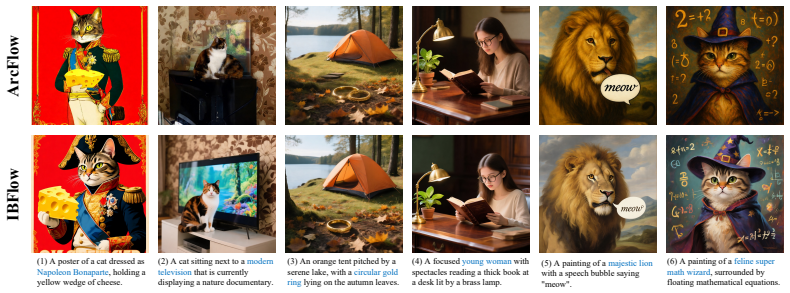
Summary. The paper proposes IB-Flow, a two-schedule distillation method for few-step (2-NFE) text-to-image generation. The first schedule selects the teacher timestep τ*_CA(xt,t) = min(1, t + κ/||v_c−v_u||_2) (Eq. 11) from an information-bottleneck (IB) constraint, and the second schedule decays the CFG strength as ω*(t)=1+(ωmax−1)/(1+γ·SNR(t)) (Eq. 13). The authors claim these are closed-form optimal solutions of an IB-constrained mutual-information maximization, and report experiments on FLUX.1-dev, OpenUni-L-512, and Qwen-Image-20B at 2 NFE, showing consistent improvements over ArcFlow on GenEval, DPG-Bench, and OneIG-Bench.
Significance. If the theoretical derivation were rigorous, the paper would contribute a principled, parameter-light method for CFG-distilled few-step generation, a practically important problem. The empirical study is a strength: three large-scale backbones, standardized benchmarks, ablations, and a public code repository. However, the central 'closed-form optimal' claim is not supported by the presented mathematics: key lemmas contain unproven proportionalities, fitted constants, and an unproven monotonicity assertion. The method may still be valuable as a heuristic, and the empirical gains are plausible, but the paper currently overstates its theoretical and statistical status.
major comments (5)
- [Appendix A.1, Eq. (9) and Eq. (19)] Lemma 1 states D_KL(p_t∥p_τ) ≈ ½(τ−t)²∥Δv_t∥² as an equality-like approximation, but the proof in Eq. (19) derives only proportionality ('∝'), and all constants are silently absorbed into κ=√(2δ). The proportionality constant may depend on t, c, and x_t, so Eq. (11) is not a closed-form solution of the constrained problem (8). This is load-bearing because Theorem 1 and the 'zero-overhead closed-form optimal' claim rest on it. The manuscript must either prove a constant-free bound or explicitly reframe Eq. (11) as a heuristic.
- [Appendix A.3, Eq. (22)] The proof of Theorem 1 asserts monotonicity I(X_{τ1};X1|Xt) ≤ I(X_{τ2};X1|Xt) for τ1≤τ2. This is not generally true for an arbitrary Markov evolution and is not proved. Since the 'greedy take-the-equality' step in Theorem 1 depends on this monotonicity, the derivation of τ*_CA is incomplete without a proof or a precise condition on the flow-matching path.
- [Lemma 1 and Table 4] The Fisher/Taylor approximation in Lemma 1 is valid only for infinitesimal Δt, but the method deliberately uses κ=1.5 and computes potentially large strides τ−t = κ/||Δv_t||. The authors do not quantify typical Δt values in training, nor do they validate the quadratic approximation in the regime actually used. The degradation at κ=3.0 (Table 4) is consistent with the approximation breaking, but this also means the 'optimal' κ=1.5 is a fitted operating point, not a consequence of the IB formulation.
- [Appendix A.4, Eq. (12) and Theorem 2] Theorem 2 is derived from proportionality assumptions that are not established. The IB objective (12) contains a β hyperparameter that does not appear in the solution; instead, new free parameters γ and ω_max are introduced. The proof substitutes H(X1|Xt) ∝ 1/(1+SNR(t)) and then asserts Δω(t) should scale with this residual uncertainty, but that assertion does not follow from optimizing (12). Thus Eq. (13) is not demonstrated to be closed-form optimal; it is a heuristic SNR decay.
- [Tables 1–5] All head-to-head numbers are reported without error bars, multiple seeds, or significance tests. Several margins are small (e.g., GenEval 0.86 vs 0.84 in Table 1; 0.86 vs 0.85 in Table 3). The conclusion that IB-Flow 'shatters the performance ceiling' is not statistically supported, especially for the smaller gains on OpenUni. At minimum, the authors should report repeated runs with variance or a significance test.
minor comments (4)
- [Section 4.1 / Table 4] In Section 4.1, 'κ=1.5, γ=1.0' is stated; Table 4's 'full0.86/88.67' contains a typo ('full' should be 'full score' or similar).
- [References] References [39] and [40] appear to be duplicate entries of the same work ('One-step diffusion with distribution matching distillation'), both with identical venue and page numbers. Please merge or disambiguate.
- [Table 1 caption] The caption says 'The NFE of Qwen-Image-20B is recorded as 50×2 since it uses CFG.' The same convention is used for OpenUni (20×2), but the table lists '20×2' without explanation; please state the convention in the caption.
- [Eq. (14)] The phrase 'theoretically grounded, parameter-free objective' is misleading: κ, γ, and ω_max remain free hyperparameters. Consider rephrasing to 'few-parameter' or explicitly enumerate them.
Circularity Check
The two 'closed-form optimal' schedules contain hand-tuned constants (κ=1.5 from Table 4, γ=1.0) absorbed from proportionality relations, so the reported benchmarks partly confirm the fit rather than a parameter-free IB prediction.
specific steps
-
fitted input called prediction
[Theorem 1 / Eq. (11), Sec. 3.2.2; hyperparameters in Sec. 4.1; Table 4 in Sec. 4.3]
"τ ∗ CA(xt, t) = min(1, t+ κ/∥vc t (xt)−v u t (xt)∥2 +ϵ), where κ= √(2δ) emerges as a hyperparameter ... The closed-form schedule attains its peak at κ=1.5, where IBFlow recovers the full 0.86/88.67."
The derivation in App. A.1 establishes only proportionality (Eq. 19: D_KL ∝ ½(τ−t)²∥Δv∥²), not the equality in Lemma 1. The unknown proportionality constant is absorbed into κ=√(2δ), so κ is not determined by the IB formulation. Table 4 then selects κ=1.5 by maximizing the same GenEval/DPG numbers that Table 1 reports as the SOTA result. The 'closed-form optimal' target therefore reduces by construction to a tuned decay on the CFG-residual norm, and the benchmark gains partly validate the fitted κ rather than a parameter-free IB prediction.
-
fitted input called prediction
[Theorem 2 / Eq. (13), App. A.4; Sec. 4.1 hyperparameters]
"ω∗(t) = 1 + (ωmax −1)· 1/(1+γ·SNR(t)), where SNR(t) = t2/(1−t)2 ... γ is a temperature hyperparameter meticulously calibrating the sensitivity to the SNR transition."
The proof of Theorem 2 introduces γ as the unspecified proportionality constant in H(X1|Xt) ∝ 1/(1+SNR(t)) and then asserts that the CFG drive 'should scale' with that residual uncertainty. No step in the derivation fixes γ; the experiments set γ=1.0. Consequently the reported gains attributed to the 'entropy-aware schedule' are partly an evaluation of this hand-calibrated parameter, not a confirmation of a uniquely optimal ω*(t) derived from the IB objective. The paper's claim in Sec. 3.4 of a 'parameter-free objective' is contradicted by the presence of both κ and γ.
full rationale
The paper's central theoretical contribution is the derivation of two 'closed-form optimal' schedules, τ*_CA(xt,t) and ω*(t), from an information-bottleneck formulation. In both cases the proof chain stops at a proportionality relation and the missing constant is folded into a tunable hyperparameter: κ=√(2δ) for the injection target and γ for the injection strength. The paper then fixes κ=1.5 by a benchmark sweep (Table 4) and γ=1.0 as a default, and reports state-of-the-art results on those same benchmarks. Thus the empirical superiority is partly a confirmation of fitted values rather than a test of a parameter-free prediction. The approximation in Lemma 1 is also only valid for infinitesimal strides, while κ=1.5 produces large strides, so the claimed 'closed-form optimal' solution is closer to a hand-tuned residual-norm decay than to a rigorous optimum. There is no load-bearing self-citation chain: the references to Decoupled DMD and ArcFlow are external prior work, and the method is evaluated on public benchmarks. The issue is not self-citation but that the central 'predictions' reduce, by the paper's own equations and hyperparameter choices, to fitted schedules. This warrants a partial-circularity score of 6 rather than higher: the functional forms (inverse residual norm, SNR decay to 1) retain some independent content, but the optimality claims are not supported without the fitted constants.
Axiom & Free-Parameter Ledger
free parameters (5)
- κ (divergence budget, κ=√(2δ)) =
1.5 (chosen from Table 4 sweep)
- γ (SNR temperature) =
1.0
- ω_max (maximum guidance scale) =
4.0
- ε (numerical stabilizer) =
not specified
- β (IB balance in Eq. 12) =
unused/undefined
axioms (5)
- domain assumption The linear flow path x_t = t x_1 + (1−t) x_0 with x_0 ~ N(0,I) and SNR(t)=t²/(1−t)²
- standard math I-MMSE relation: residual entropy H(X1|Xt) ∝ 1/(1+SNR(t))
- ad hoc to paper Δω(t) = ω(t)−1 should be proportional to residual uncertainty H(X1|Xt)
- ad hoc to paper I(X_τ; X1|Xt) is non-decreasing in τ
- ad hoc to paper D_KL(p_t∥p_τ) ≈ ½(τ−t)²||Δv_t||² with proportionality constants absorbed into κ
read the original abstract
While large-scale text-to-image generative models have achieved unprecedented visual performance, their inherent reliance on multi-step iterative solvers incurs severe inference latency. Few-step distillation targeting the Classifier-Free Guidance (CFG) trajectory has emerged as the prevalent dual-dimensional compression paradigm. However, existing frameworks remain subjugated by a coarse-grained blind injection paradigm that perpetually enforces a globally static guidance strength while indiscriminately sampling the supervisor timestep. This state-agnostic design completely disregards the intrinsic nature of image generation as a dynamic evolutionary process characterized by progressive entropy reduction, which not only restricts the performance boundary of few-step compression but also precipitates severe CFG over-conditioning artifacts. To transcend these limitations, we re-examine the distillation procedure through the theoretical lens of Information Theory, formally modeling it as a dynamic mutual information game constrained by the Information Bottleneck (IB) principle. Specifically, we dismantle traditional blind assumptions via a dual-track adaptive framework. To determine the injection target, we propose an instance-aware selection mechanism that transmutes the intractable KL divergence constraint into a zero-overhead closed-form solution predicated on the local vector field norm. To regulate the injection strength, we introduce an entropy-aware schedule that dynamically decays alongside the SNR, applying maximal thrust for initial structural anchoring before smoothly reverting to the natural manifold to refine micro-details. Extensive empirical evaluations corroborate that our framework fundamentally eradicates over-conditioning artifacts, shattering the performance ceiling to achieve SOTA generative fidelity under extremely stringent 2-step configurations.
Figures


Reference graph
Works this paper leans on
-
[1]
FLUX.1: Open-weights state-of-the-art text-to-image generation
Black Forest Labs. FLUX.1: Open-weights state-of-the-art text-to-image generation. https://github. com/black-forest-labs/flux, 2024. FLUX.1-dev model release
2024
-
[2]
Chang et al
J. Chang et al. OneIG-Bench: A comprehensive benchmark for fine-grained text-to-image generation. arXiv preprint, 2025. Five-axis benchmark: Alignment, Text, Diversity, Style, Reasoning
2025
-
[3]
H. Chen, Y . Zhang, H. Tan, L. Guibas, G. Wetzstein, and S. Bi. pi-flow: Policy-based few-step generation via imitation distillation. InICLR, 2026
2026
-
[4]
T. M. Cover and J. A. Thomas.Elements of Information Theory. Wiley-Interscience, 2nd edition, 2006
2006
-
[5]
Z. Geng, M. Deng, X. Bai, J. Z. Kolter, and K. He. Mean flows for one-step generative modeling.arXiv preprint arXiv:2505.13447, 2025
Pith/arXiv arXiv 2025
-
[6]
Ghosh, H
D. Ghosh, H. Hajishirzi, and L. Schmidt. GenEval: An object-focused framework for evaluating text-to- image alignment. InNeurIPS, 2023
2023
-
[7]
J. Gu, T. Chen, D. Berthelot, H. Zheng, Y . Wang, R. Zhang, L. Dinh, M. A. Bautista, J. Susskind, and S. Zhai. Starflow: Scaling latent normalizing flows for high-resolution image synthesis.arXiv preprint arXiv:2506.06276, 2025
Pith/arXiv arXiv 2025
-
[8]
D. Guo, S. Shamai, and S. Verdú. Mutual information and minimum mean-square error in gaussian channels.IEEE Transactions on Information Theory, 51(4):1261–1282, 2005
2005
-
[9]
J. Ho, A. Jain, and P. Abbeel. Denoising diffusion probabilistic models.Advances in neural information processing systems, 33:6840–6851, 2020
2020
-
[10]
J. Ho and T. Salimans. Classifier-free diffusion guidance.arXiv preprint arXiv:2207.12598, 2022
Pith/arXiv arXiv 2022
-
[11]
J. Ho, T. Salimans, A. Gritsenko, W. Chan, M. Norouzi, and D. J. Fleet. Video diffusion models.Advances in neural information processing systems, 35:8633–8646, 2022
2022
-
[12]
X. Hu, R. Wang, Y . Fang, B. Fu, P. Cheng, and G. Yu. ELLA: Equip diffusion models with LLM for enhanced semantic alignment.arXiv preprint arXiv:2403.05135, 2024. Introduces the DPG-Bench benchmark
Pith/arXiv arXiv 2024
-
[13]
B. Kim, Y .-G. Hsieh, M. Klein, M. Cuturi, J. C. Ye, B. Kawar, and J. Thornton. Simple reflow: Improved techniques for fast flow models.arXiv preprint arXiv:2410.07815, 2024
Pith/arXiv arXiv 2024
- [14]
-
[15]
S. Lin, A. Wang, and X. Yang. Sdxl-lightning: Progressive adversarial diffusion distillation.arXiv preprint arXiv:2402.13929, 2024
Pith/arXiv arXiv 2024
-
[16]
Lipman, R
Y . Lipman, R. T. Chen, H. Ben-Hamu, M. Nickel, and M. Le. Flow matching for generative modeling. In The Eleventh International Conference on Learning Representations, 2023
2023
-
[17]
D. Liu, P. Gao, D. Liu, R. Du, Z. Li, Q. Wu, X. Jin, S. Cao, S. Zhang, H. Li, and S. Hoi. Decoupled dmd: Cfg augmentation as the spear, distribution matching as the shield.arXiv preprint arXiv:2511.22677, 2024
arXiv 2024
-
[18]
D. Liu, P. Sun, Y . Han, Z. Cheng, C. Chen, and T. Lin. Self-adversarial one step generation via condition shifting.arXiv preprint arXiv:2604.12322, 2026
Pith/arXiv arXiv 2026
-
[19]
X. Liu, C. Gong, and Q. Liu. Flow straight and fast: Learning to generate and transfer data with rectified flow. InThe Eleventh International Conference on Learning Representations, 2023
2023
-
[20]
X. Liu, X. Zhang, J. Ma, J. Peng, et al. Instaflow: One step is enough for high-quality diffusion-based text-to-image generation. InThe Twelfth International Conference on Learning Representations, 2023
2023
-
[21]
E. Luhman and T. Luhman. Knowledge distillation in iterative generative models for improved sampling speed.arXiv preprint arXiv:2101.02388, 2021
Pith/arXiv arXiv 2021
-
[22]
W. Luo, T. Hu, S. Zhang, J. Sun, Z. Li, and Z. Zhang. Diff-instruct: A universal approach for transferring knowledge from pre-trained diffusion models. InAdvances in Neural Information Processing Systems, volume 36, 2024
2024
-
[23]
Qwen-Image-Lightning: Few-step distillation of qwen-image
ModelTC Team. Qwen-Image-Lightning: Few-step distillation of qwen-image. https://github.com/ ModelTC/Qwen-Image-Lightning, 2025. 8-step distillation of Qwen-Image
2025
-
[24]
Rombach, A
R. Rombach, A. Blattmann, D. Lorenz, P. Esser, and B. Ommer. High-resolution image synthesis with latent diffusion models. InProceedings of the IEEE/CVF conference on computer vision and pattern recognition, pages 10684–10695, 2022
2022
-
[25]
Saharia, W
C. Saharia, W. Chan, S. Saxena, L. Li, J. Whang, E. L. Denton, K. Ghasemipour, R. Gontijo Lopes, B. Karagol Ayan, T. Salimans, et al. Photorealistic text-to-image diffusion models with deep language understanding.Advances in neural information processing systems, 35:36479–36494, 2022
2022
-
[26]
T. Salimans and J. Ho. Progressive distillation for fast sampling of diffusion models.arXiv preprint arXiv:2202.00512, 2022
Pith/arXiv arXiv 2022
-
[27]
Sauer, D
A. Sauer, D. Lorenz, A. Blattmann, and R. Rombach. Adversarial diffusion distillation. InEuropean Conference on Computer Vision, pages 87–103. Springer, 2024
2024
-
[28]
Sohl-Dickstein, E
J. Sohl-Dickstein, E. Weiss, N. Maheswaranathan, and S. Ganguli. Deep unsupervised learning using nonequilibrium thermodynamics. InInternational conference on machine learning, pages 2256–2265. pmlr, 2015. 10
2015
-
[29]
Y . Song, P. Dhariwal, M. Chen, and I. Sutskever. Consistency models. 2023
2023
-
[30]
Y . Song, J. Sohl-Dickstein, D. P. Kingma, A. Kumar, S. Ermon, and B. Poole. Score-based generative mod- eling through stochastic differential equations. InInternational Conference on Learning Representations, 2021
2021
-
[31]
Sun and T
P. Sun and T. Lin. Any-step generation via N-th order recursive consistent velocity field estimation. In ICLR, 2026. RCGM
2026
-
[32]
Tishby, F
N. Tishby, F. C. Pereira, and W. Bialek. The information bottleneck method. InThe 37th annual Allerton conference on communication, control, and computing, pages 368–377, 1999
1999
-
[33]
F.-Y . Wang, Z. Huang, A. Bergman, D. Shen, P. Gao, M. Lingelbach, K. Sun, W. Bian, G. Song, Y . Liu, et al. Phased consistency models. InAdvances in Neural Information Processing Systems, 2024
2024
- [34]
-
[35]
C. Wu, P. Zheng, R. Yan, S. Xiao, X. Luo, Y . Wang, et al. Qwen-Image technical report.arXiv preprint arXiv:2508.02324, 2025
Pith/arXiv arXiv 2025
-
[36]
S. Wu, Z. Wu, Z. Gong, Q. Tao, S. Jin, Q. Li, W. Li, and C. C. Loy. OpenUni: A simple baseline for unified multimodal understanding and generation.arXiv preprint arXiv:2505.23661, 2025
Pith/arXiv arXiv 2025
-
[37]
A. Yang et al. ArcFlow: Unleashing 2-step text-to-image generation via high-precision non-linear flow distillation.arXiv preprint arXiv:2602.09014, 2026
arXiv 2026
-
[38]
T. Yin, M. Gharbi, T. Park, R. Zhang, E. Shechtman, F. Durand, and B. Freeman. Improved distribution matching distillation for fast image synthesis.Advances in Neural Information Processing Systems, 37:47455–47487, 2024
2024
-
[40]
T. Yin, M. Gharbi, R. Zhang, E. Shechtman, F. Durand, W. T. Freeman, and T. Park. One-step diffusion with distribution matching distillation. InProceedings of the IEEE/CVF conference on computer vision and pattern recognition, pages 6613–6623, 2024
2024
-
[41]
K. Zheng, Y . Wang, Q. Ma, H. Chen, J. Zhang, Y . Balaji, J. Chen, M.-Y . Liu, J. Zhu, and Q. Zhang. Large scale diffusion distillation via score-regularized continuous-time consistency.arXiv preprint arXiv:2510.08431, 2025
Pith/arXiv arXiv 2025
-
[42]
Deepfakes
Y . Zhu, X. Liu, and Q. Liu. Slimflow: Training smaller one-step diffusion models with rectified flow. In European Conference on Computer Vision, pages 342–359. Springer, 2024. 11 A Proofs of the Information-Bottleneck Formulation This appendix provides the full proofs of Lemma 1, Lemma 2, Theorem 1, and Theorem 2 stated in the main text. The presentation...
2024
discussion (0)
Sign in with ORCID, Apple, or X to comment. Anyone can read and Pith papers without signing in.