REVIEW 4 major objections 5 minor 20 references
The paper argues that knowledge editing destroys math and code reasoning because the preservation covariance is built from the wrong distribution, and shows that sampling the model's own continuations seeded with one random token fixes it.
Reviewed by Pith at T0; open to challenge. T0 means a machine referee read the full paper against a public rubric. the ladder, T0–T4 →
T0 review · deepseek-v4-flash
2026-08-02 14:25 UTC pith:7OEGHI3E
load-bearing objection The core idea—estimating the preservation covariance from the model's own random-seeded generations—is genuinely new and worth studying, but the paper's 'consistent' preservation claim is contradicted by its own tables; the real effect is mostly Qwen3-AlphaEdit-specific. the 4 major comments →
Moir: Let the Model Direct Its Own Story for Robust Cross-Domain Knowledge Editing
The pith
A machine-rendered reading of the paper's core claim, the machinery that carries it, and where it could break.
Core claim
MOIR's central assertion is that the self-generated covariance CMOIR samples from the model's actual internalized distribution, covering exactly the subspaces the model relies on, regardless of whether they appear in any external corpus. The paper proves that for closed-form covariance-constrained editors, the update depends on the input distribution only through the uncentered covariance C, because the output-side factor G cancels in the closed-form optimum (Proposition 1). Empirically, replacing the standard encyclopedic proxy with CMOIR delays or prevents the collapse of GSM8K and HumanEval under both MEMIT and AlphaEdit, in batch and sequential regimes, across OLMo-2, Llama-3.1, and Qwen
What carries the argument
The uncentered activation covariance C = (1/N) Σ k_i k_i^T, computed at the input to the targeted MLP layer, is the single distributional object that determines a covariance-constrained editor's update. MOIR constructs C from autoregressive continuations seeded with one uniformly random vocabulary token, which breaks the instruction-template attractor and lets the model sample the broader subspaces it has internalized. Proposition 1 shows that the output-side K-FAC factor G cancels in the closed-form optimum, so the choice of C—self-generated versus corpus-derived—fully controls what gets preserved.
Load-bearing premise
The load-bearing premise is that continuations seeded with one random token reproduce the model's true operative activation distribution closely enough that the estimated covariance covers the math and code subspaces; if the model's decoding is mode-collapsed or the random seed never enters those regions, self-generation misses them.
What would settle it
Run MOIR on a model whose decoding distribution is pathologically mode-collapsed, for example after extreme RLHF, then apply 20,000 AlphaEdit batch edits and measure GSM8K accuracy; if math accuracy collapses despite MOIR because the self-generated covariance under-samples that specialized domain, the core approximation fails.
If this is right
- Knowledge editing no longer requires access to pretraining or post-training corpora; a roughly two-hour one-time generation from the deployed model provides the preservation covariance.
- Covariance-based editors can sustain tens of thousands of batch and sequential edits without collapsing math and code reasoning, as long as their preservation space is aligned with the model's operative distribution.
- The model itself is the most accessible source of the shifted post-training manifold; static corpora, including the original pretraining mixture, are systematically biased proxies.
- Since the editing update depends only on the input covariance, improving the distribution used to estimate C is a strict improvement across editors without architectural changes.
Where Pith is reading between the lines
- If the self-generated covariance truly tracks the operative distribution, the same idea could be used to audit which capability subspaces a deployed model has internalized, separate from any editing task.
- A testable extension the paper leaves open is whether memory-based or hypernetwork editors, which use covariance-like operators, would also benefit from self-generated preservation spaces.
- The single-random-token recipe suggests a general principle for probing internalized distributions: a minimal off-manifold perturbation escapes post-training attractors while staying within the model's learned statistics; this could inform data-free evaluation beyond editing.
Editorial analysis
A structured set of objections, weighed in public.
Referee Report
Summary. The paper argues that the cross-domain capability collapse observed in covariance-based knowledge editors (MEMIT, AlphaEdit) stems from the choice of the preservation distribution used to estimate C. It proposes MOIR, which estimates C from the model's own decoding distribution by seeding generation with a single random vocabulary token. Claims are made that this 'self-generated manifold' consistently extends preservation across OLMo-2, Llama-3.1, and Qwen3, in both batch and sequential regimes, up to 20K edits, with a headline GSM8K recovery from 10.9% to 79.9% on Qwen3-8B under AlphaEdit batch editing. The paper also proves Proposition 1 (the parameter update depends on the input distribution only through the input covariance) and Lemma 3 (TV-Lipschitz continuity of the covariance map).
Significance. If the central empirical claim were true, the contribution would be significant: a data-free, drop-in replacement for the preservation covariance that consistently extends the usable edit budget across models and editors. The theoretical component is sound: Proposition 1 is correct and cleanly isolates the role of C, and Lemma 3 provides a usable bound. The method is also practical, requiring only a one-time generation pass. However, the paper's own tables contradict the 'consistently extends preservation' claim. The effect is large and clear only for Qwen3-8B under AlphaEdit; in several OLMo-2 and Llama-3 conditions, CMOIR is indistinguishable from or slightly worse than CWiki. Without confidence intervals or a pre-registered multi-seed analysis, the current evidence does not establish the proposed general principle, only a promising mechanism for a specific model/editor combination.
major comments (4)
- [Section 6, Table 10] The claim that 'CMOIR sustains 0.5–0.7 preservation throughout 10^4 edits' under MEMIT sequential editing is directly contradicted by Table 10. OLMo-2: preservation HM is 0.503 at 200 edits, then 0.000 at 500, 1K, 2K, and 5K edits. Llama-3: preservation HM is 0.460 at 100 edits, then 0.000 at 200 edits and all later counts. Only Qwen3 retains non-zero preservation at 5K (0.657). Thus the 'across all three models' statement in Section 6 is false.
- [Table 11 and Table 12] The 'consistently extends preservation' claim also fails under AlphaEdit. In Table 11 (batch), CMOIR is slightly worse than CWiki at OLMo-2 5K (0.600 vs 0.603) and Llama-3 5K (0.662 vs 0.669). In Table 12 (sequential), Llama-3 is consistently worse at 500 (0.670 vs 0.675), 1K (0.668 vs 0.676), and 2K (0.661 vs 0.672) edits. These reversals are small, but the paper claims consistency and reports no confidence intervals, so they cannot be dismissed as noise.
- [Section 4, Table 2] The key design choice, seed length k=1, is selected on OLMo-2 using the same Se/Sp harmonic-mean scores that later serve as the headline evaluation metrics. This is selection-on-evaluation risk. The paper reports only a single run of each configuration and no variance across seeds or generated samples. A proper validation would hold out the seed-length choice or report bootstrap/interval estimates before claiming 'consistent' improvements elsewhere.
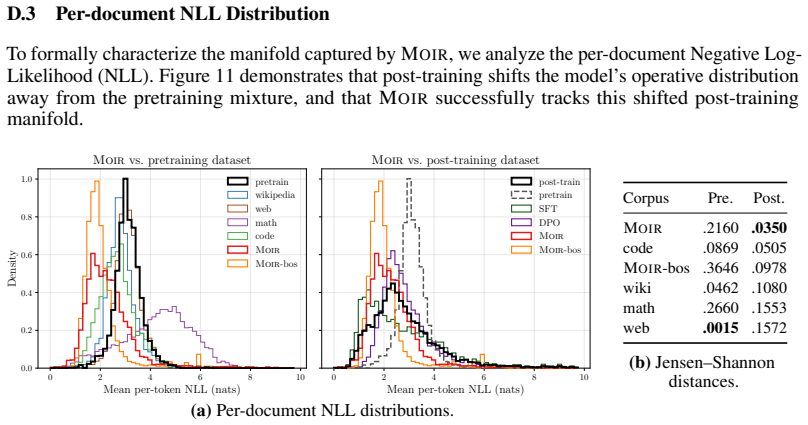
- [Appendix A.1, Eq. (4)] The load-bearing approximation E_{x~pθ(·|s)}[φφ^T] ≈ E_{x~Dtrain}[φφ^T] is asserted rather than demonstrated. The NLL/JSD analyses in Figure 3 and Figure 11 are suggestive about token-level distributions, but they do not directly validate equality at the activation-covariance level. The paper's own Limitations section concedes that extreme RLHF mode collapse would under-sample rare capabilities. This is an additional correctness risk, though the empirical contradictions in Tables 10–12 are already sufficient to undermine the central claim.
minor comments (5)
- [Section 3.1] The text says 'Please refer to Appendix C for the full mathematical formulations,' but the parameter-update formulations are in Appendix B, not Appendix C.
- [Table 10 caption] The caption 'MEMIT sequential editing (cached)' uses 'cached' without explaining what is cached; either define it or remove it.
- [Section 1, final paragraph] 'The tested models sustain 79.9% accuracy on GSM8K after 20,000 edits' is inaccurate: only Qwen3-8B under AlphaEdit batch achieves this, as the abstract itself states.
- [Figure 5] The sentence 'Figure 5 and 13 shows task-wise preservation' mixes singular/plural; should read 'Figures 5 and 13 show.'
- [Table 4] The row 'Qwen3-8B' likely denotes the instruct variant but is not labeled as such, unlike 'OLMo2-7B-Instruct' and 'Llama-3.1-8B-Instruct.'
Circularity Check
No significant circularity: CMOIR is a parameter-free sample covariance, Proposition 1 is proven in-appendix, and the headline results are external-benchmark measurements.
full rationale
The derivation chain is not circular. Proposition 1 (Sec. 5.1, App. B.2) is a self-contained proof that closed-form covariance-constrained updates depend only on the input covariance A; it does not assume the empirical preservation results. CMOIR (Eq. 3, Algorithm 1) is an uncentered sample covariance of keys extracted from the model's own unconditional generations; it contains no parameters fitted to preservation benchmarks. The load-bearing premise, Eq. 4, is explicitly stated as an approximation ('The approximation is exact when p_theta(.|s)=D_train marginally over s'), and the Limitations section concedes the extreme RLHF mode-collapse failure mode; this is an empirical assumption, not a reduction of the conclusion to the premise. The preservation evaluations (Tables 9-12) use external benchmarks that are not used to construct C, so the GSM8K result is an independent measurement, not a renamed input. The main caveat is that seed length k=1 is selected from Table 2 using the same Se/Sp harmonic means used in one evaluation arm, but this is a hyperparameter-selection risk, not a construction-level circularity, and it does not make the held-out Qwen3/Llama3 results forced by definition. No load-bearing self-citations or imported uniqueness claims appear.
Axiom & Free-Parameter Ledger
free parameters (4)
- Seed length k (number of random prefix tokens) =
1
- Number of generated sequences N (MOIR) =
100,000
- MEMIT regularization weight lambda =
15,000
- AlphaEdit null-space projection threshold tau =
Per-model from grid {0.02, 0.005, 0.001, 0.0005}
axioms (4)
- domain assumption K-FAC factorization F ≈ A ⊗ G holds for the targeted MLP layer
- ad hoc to paper The model's self-generated distribution with a single random seed approximates the training/operative distribution (Eq. 4)
- standard math Activations are bounded: Mℓ := sup ∥φℓ(x)∥₂ < ∞
- domain assumption The post-training (SFT/DPO) distribution is the correct target to preserve for deployed models
read the original abstract
While language models remain frozen at their training state, the world evolves continuously. Knowledge editing has emerged as a key alternative to full retraining, but its deployment is bottlenecked by the erosion of core capabilities: mathematical and programmatic reasoning collapse while encyclopedic recall remains intact. We trace this asymmetric degradation to a distributional mismatch. Covariance-based editors preserve only the subspaces spanned by their reference corpus, but fail to capture the operative distribution shaped by post-training such as SFT and DPO. Static external corpora, including Wikipedia and even the original pretraining mixture, cannot recover this shifted manifold. We propose Moir, which estimates the preservation covariance $C$ directly from the model itself by sampling from its own decoding distribution. Seeding generation with a single random vocabulary token bypasses the instruction-following templates that otherwise dominate sampled outputs, exposing the broader subspaces the model has internalized. Moir requires no external data and serves as a drop-in component for any covariance-based editor, a practical advantage given that the pre- and post-training corpora of most modern LLMs are not publicly accessible. Across OLMo-2, Llama-3.1, and Qwen-3 (7-8B), under both MEMIT and AlphaEdit and in batch and sequential regimes, Moir consistently extends preservation in the most vulnerable domains, most strikingly on Qwen3-8B after 20,000 AlphaEdit batch edits, it retains 79.9% GSM8K accuracy compared to 10.9% with the Wikipedia baseline. These results suggest that aligning the preservation distribution with the model's operative distribution is a key factor in non-destructive editing, and that the model itself may be the most accessible source of that distribution for deployed systems.
Figures




Reference graph
Works this paper leans on
-
[1]
Algorithm 1MOIR: Self-Generated Covariance Estimation Require:Modelp θ, target layersL, token budgetN, max sequence lengthS, vocabularyV Ensure:Sample covariances{ ˆC ℓ MOIR }ℓ∈L 1: ˆC ℓ ←0 d×d for eachℓ∈ L;n←0 2:whilen < Ndo 3:Sample seed tokenz∼Uniform(V){rand×1} 4:Generatex 1:T ∼p θ(· |z)withT≤S{Autoregressive sampling} 5:foreachℓ∈ Ldo 6:Extract keysk ...
2025
-
[3]
mostly preserved
HellaSwag and ARC-Challenge use length-normalized accuracy ( acc_norm) to correct for vary- ing completion lengths among multiple-choice options, following the standard protocol in lm-evaluation-harness [Gao et al., 2024]. GSM8K uses strict string matching of the final numerical answer rather than flexible extraction, which provides a more conservative es...
2024
-
[6]
Mor Geva, Roei Schuster, Jonathan Berant, and Omer Levy
URLhttps://zenodo.org/records/12608602. Mor Geva, Roei Schuster, Jonathan Berant, and Omer Levy. Transformer feed-forward layers are key-value memories. InEmpirical Methods in Natural Language Processing (EMNLP),
-
[7]
The llama 3 herd of models.arXiv preprint arXiv:2407.21783,
Aaron Grattafiori, Abhimanyu Dubey, Abhinav Jauhri, Abhinav Pandey, Abhishek Kadian, Ahmad Al-Dahle, Aiesha Letman, Akhil Mathur, Alan Schelten, Alex Vaughan, et al. The llama 3 herd of models.arXiv preprint arXiv:2407.21783,
-
[8]
OLMo: Accelerating the science of language models
Dirk Groeneveld, Iz Beltagy, Pete Walsh, et al. OLMo: Accelerating the science of language models. arXiv preprint arXiv:2402.00838,
-
[9]
Jia-Chen Gu, Hao-Xiang Xu, Jun-Yu Ma, Pan Lu, Zhen-Hua Ling, Kai-Wei Chang, and Nanyun Peng. Model editing can hurt general abilities of large language models.arXiv preprint arXiv:2401.04700, 2024a. Jia-Chen Gu, Hao-Xiang Xu, Jun-Yu Ma, Pan Lu, Zhen-Hua Ling, Kai-Wei Chang, and Nanyun Peng. Model editing harms general abilities of large language models: R...
-
[10]
Xiyu Liu, Qingyi Si, Zhengxiao Liu, Chenxu Yang, Naibin Gu, and Zheng Lin. Beyond the covariance trap: Unlocking generalization in same-subject knowledge editing for large language models.arXiv preprint arXiv:2603.15518,
-
[12]
Keisuke Sakaguchi, Ronan Le Bras, Chandra Bhagavatula, and Yejin Choi
arXiv:2501.00656. Keisuke Sakaguchi, Ronan Le Bras, Chandra Bhagavatula, and Yejin Choi. WinoGrande: an adversarial winograd schema challenge at scale.Commun. ACM, 64(9):99–106,
-
[13]
Luca Soldaini, Rodney Kinney, Akshita Bhagia, et al. Dolma: An open corpus of three trillion tokens for language model pretraining research.arXiv preprint arXiv:2402.00159,
-
[14]
URLhttps://github.com/togethercomputer/RedPajama-Data. Peng Wang, Ningyu Zhang, Bozhong Tian, Zekun Xi, Yunzhi Yao, Ziwen Xu, Mengru Wang, Shengyu Mao, Xiaohan Wang, Siyuan Cheng, Kangwei Liu, Yuansheng Ni, Guozhou Zheng, and Huajun Chen. Easyedit: An easy-to-use knowledge editing framework for large language models. arXiv preprint arXiv:2308.07269,
-
[17]
The single-vector case (k∗ ∈R din, b∈R dout) follows identically, yielding∆W ⋆ =b(A −1k∗)⊤/(k∗⊤A−1k∗)
The residual satisfies Tr(G δW A δW⊤) =∥G 1/2 δW A1/2∥2 F ≥0, with equality forcing δW= 0 when G≻0 . The single-vector case (k∗ ∈R din, b∈R dout) follows identically, yielding∆W ⋆ =b(A −1k∗)⊤/(k∗⊤A−1k∗). Second proof (Lagrangian; PD case directly, PSD by continuity). Assume first G≻0 . The La- grangian L= Tr(G∆W A∆W ⊤)−Tr Λ⊤(∆W Knew −R) has stationarity c...
2024
-
[18]
as our main method with N= 100K , matching the conventional sample size, unless otherwise noted (e.g.,⟨bos⟩). •C OLMoMix (OLMo-2 only): C computed from the actual OLMo-Mix-1124 pretraining mixture (which we refer to as the oracle) as a weighted sum of component-wise covariances (construction detailed in Appendix A.2). 19 C.2 Implementation and Reproducibi...
2020
-
[20]
The integer must be ... 4 Concept <|assistant|>The term “digital natives” refers to individuals who were born during or after the digital age–-roughly those who came ... 5 Math 4c \] To calculate the product: \[ 4 \times 3^4 \] We first calculate \(3^4\): \[ 3^4 = 3 \times ... 6 Code <|contador>++; That command would increment the counter (“contador”) eac...
-
[2018]
Training verifiers to solve math word problems.arXiv preprint arXiv:2110.14168,
Karl Cobbe, Vineet Kosaraju, Mohammad Bavarian, Mark Chen, Heewoo Jun, Lukasz Kaiser, Matthias Plappert, Jerry Tworek, Jacob Hilton, Reiichiro Nakano, Christopher Hesse, and John Schulman. Training verifiers to solve math word problems.arXiv preprint arXiv:2110.14168,
-
[2019]
Ningyu Zhang, Yunzhi Yao, Bozhong Tian, Peng Wang, Shumin Deng, Mengru Wang, Zekun Xi, Shengyu Mao, Jintian Zhang, Yuansheng Ni, Siyuan Cheng, Ziwen Xu, Xin Xu, Jia-Chen Gu, Yong Jiang, Pengjun Xie, Fei Huang, Lei Liang, Zhiqiang Zhang, Xiaowei Zhu, Jun Zhou, and Huajun Chen. A comprehensive study of knowledge editing for large language models.arXiv prepr...
-
[2021]
Vinaik Chhetri, A. B. Siddique, and Umar Farooq. Understanding robustness of model editing in code LLMs: An empirical study.arXiv preprint arXiv:2511.03182,
-
[2023]
Mark Chen, Jerry Tworek, Heewoo Jun, Qiming Yuan, Henrique Ponde de Oliveira Pinto, Jared Kaplan, Harri Edwards, Yuri Burda, Nicholas Joseph, Greg Brockman, Alex Ray, Raul Puri, Gretchen Krueger, Michael Petrov, Heidy Khlaaf, Girish Sastry, Pamela Mishkin, Brooke Chan, Scott Gray, Nick Ryder, Mikhail Pavlov, Alethea Power, Lukasz Kaiser, Mohammad Bavarian...
-
[2024]
Qwen technical report.arXiv preprint arXiv:2309.16609,
Jinze Bai, Shuai Bai, Yunfei Chu, et al. Qwen technical report.arXiv preprint arXiv:2309.16609,
-
[2025]
Think you have solved question answering? try ARC, the AI2 reasoning challenge
Peter Clark, Isaac Cowhey, Oren Etzioni, Tushar Khot, Ashish Sabharwal, Carissa Schoenick, and Oyvind Tafjord. Think you have solved question answering? try ARC, the AI2 reasoning challenge. arXiv preprint arXiv:1803.05457,
-
[2026]
Perturbation-restrained sequential model editing.arXiv preprint arXiv:2405.16821,
Jun-Yu Ma, Hong Wang, Hao-Xiang Xu, Zhen-Hua Ling, and Jia-Chen Gu. Perturbation-restrained sequential model editing.arXiv preprint arXiv:2405.16821,
discussion (0)
Sign in with ORCID, Apple, or X to comment. Anyone can read and Pith papers without signing in.