REVIEW 2 major objections 5 minor 44 references
A quantum circuit that routes a time-travel register through a decoder forces the consistency fixed point to be the recovered message.
Reviewed by Pith at T0; open to challenge. T0 means a machine referee read the full paper against a public rubric. the ladder, T0–T4 →
T0 review · deepseek-v4-flash
2026-08-01 07:20 UTC pith:7PPG6JOG
load-bearing objection A clean conditional theorem and an honest hardware study, but the exact unique-fixed-point result only provably holds for m=1; still worth accepting after a clarifying revision. the 2 major comments →
Closed Timelike Curve Decoding on Quantum Hardware
The pith
A machine-rendered reading of the paper's core claim, the machinery that carries it, and where it could break.
Core claim
The central claim is that in the ideal register-separated circuit the map induced on the CTC register is exactly the replacement channel Φ(σ)=ρ_M for every incoming state σ, so the consistency equation has the unique solution σ*=ρ_M. The proof depends on the factorization of the total operation into an active scrambler–decoder block and an idle dump register, and on the decoder's recovery property. The paper further proves that if the actual noisy map is within diamond distance δ of the replacement channel, then any fixed point is within δ in trace distance. Hardware and simulation results for single-qubit instances quantify how close the implemented post-selected decoder branch comes to thi
What carries the argument
The load-bearing device is the two-SWAP register separation. A first SWAP moves the unknown incoming CTC state onto a dump register, so the subsequent scrambler–decoder block never sees it; a second SWAP moves the decoder's output into the CTC register. This routing, combined with the recovery condition that the active block reproduces the message state on its output register, converts the CTC consistency map into the replacement channel σ↦ρ_M. The hardware study uses the single-qubit amplitude-amplified version of the decoder and a classical-feedback iteration of the estimated map, with fixed-point convergence controlled by the contraction mapping theorem.
Load-bearing premise
The argument assumes the active scrambler–decoder block always reproduces the prepared message on its output register; the paper verifies this only numerically for ten message states and approximately on hardware, not for arbitrary messages or under noise.
What would settle it
Fix a message state and run the register-separated circuit twice, once with the incoming CTC register prepared in |0⟩ and once in |+⟩, then tomograph the CTC register after the final SWAP. If the two output states differ by more than the calibration noise floor, the induced map is not the replacement channel and the claimed unique fixed point fails; conversely, identical outputs support the theorem.
If this is right
- The consistency fixed point of a decoder-in-the-loop CTC is the recovered message, so the ideal model needs no additional selection rule.
- Noisy hardware inherits the replacement behavior only approximately; the diamond-distance bound gives a quantitative certificate for how close a real device must be to guarantee a near-message fixed point.
- Direct tomography of the CTC-input map—varying σ at fixed message—would certify the fixed point; the paper's hardware runs initialize σ instead, so they validate the decoder branch rather than the full consistency loop.
- The post-selection overhead of roughly a factor of four per single-qubit message and exponential growth for larger messages makes strict post-selection impractical beyond a few qubits, motivating feedforward or amplitude amplification.
- The parameter sweeps and quantum-geometric diagnostics separate message-recovery fidelity from global-state sensitivity, giving noise probes that track different features of the circuit.
Where Pith is reading between the lines
- Editorial inference: a direct hardware test of the replacement channel could run the register-separated circuit with two different incoming CTC states, e.g. |0⟩ and |+⟩, and compare the post-SWAP output; different outputs would falsify the channel.
- Editorial inference: if replacement-channel behavior holds under realistic noise, the circuit functions as an overwrite operation on the chronology-violating register—a controlled 'history erasure' that might be useful for benchmarking decoherence in scrambling circuits.
- Editorial inference: the same two-SWAP routing could be applied to any reliable recovery map, not just the specific decoder used here, turning any successful decoding procedure into a CTC consistency fixed point.
- Editorial inference: the echo-based proxy for the quantum geometric tensor appears to be a sensitive noise indicator; its deviation from predicted constancy could serve as a calibration diagnostic in other multi-qubit circuits.
Editorial analysis
A structured set of objections, weighed in public.
Referee Report
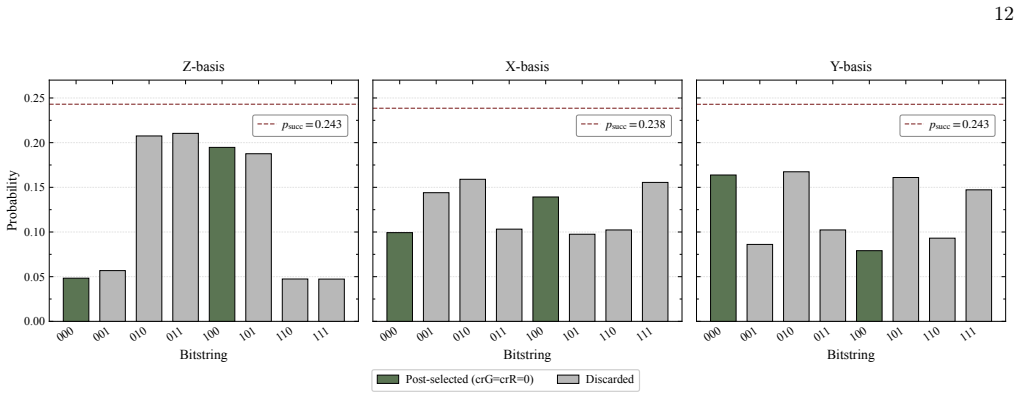
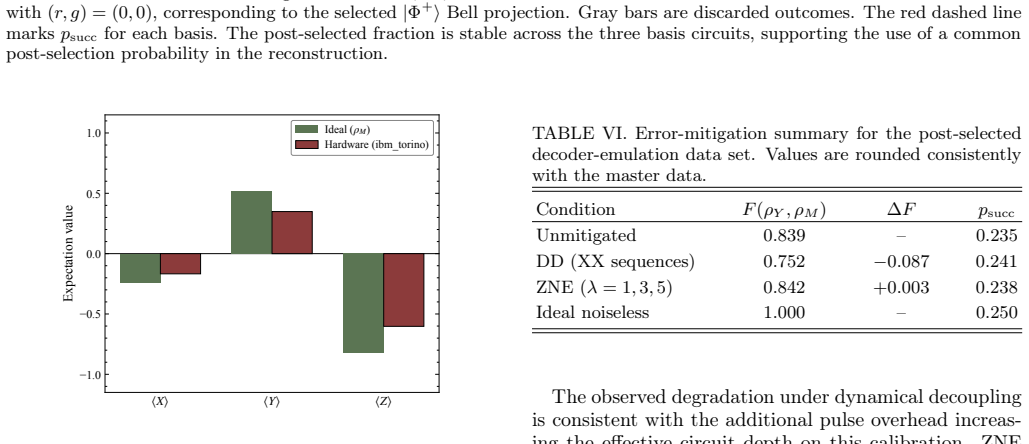
Summary. The paper studies a circuit model of Deutsch closed timelike curves in which a Yoshida–Kitaev-type recovery map is placed inside a fixed-point loop. The main theoretical result (Theorem II.1) is a conditional statement: if the active scrambler–decoder block between two SWAPs exactly reproduces the prepared message on the output register (Eq. (9)), then the induced Deutsch map on the CTC register is the replacement channel σ ↦ ρ_M, with the unique fixed point σ* = ρ_M. The proof uses register routing to send the incoming CTC state to a dump wire and then swaps the recovered message back into C. Lemma II.2 gives an approximate fixed-point bound under diamond-norm deviation from the replacement channel. The experimental part implements Lloyd-type post-selected decoder circuits for m = 1 (with a parallel two-qubit pipeline) on IBM hardware, reporting post-selection probabilities consistent with 1/4 and 1/16, recovered-state fidelity around 0.84, parameter sweeps, error-mitigation comparisons, and QGT/Loschmidt-echo diagnostics. A classical-feedback iteration for the estimated CPTP map is also formulated, with stopping bounds based on trace-norm step sizes.
Significance. If the theorem's hypothesis is met, the construction gives a clean, finite-dimensional illustration of how a D-CTC consistency condition can force the chronology-violating register to a specific message state. The paper has real strengths: Theorem II.1 is proved directly from the stated assumptions; Lemma II.2's diamond-norm argument is correct; the analytic fidelity formulas (32)–(33) agree with noiseless simulation; the hardware analysis distinguishes local and routing-aware noise models and reports code/data availability. The main caveat is that the exact replacement-channel statement is not instantiated by the paper's own amplitude-amplified decoder for multi-qubit messages, so the scope of the exact claim needs to be re-stated. The paper is also honest about the fact that the hardware runs do not directly test the Deutsch self-consistency condition.
major comments (2)
- [§III / Appendix B, Eq. (B4), and Theorem II.1] Theorem II.1 is conditional on Eq. (9), but the paper's concrete amplitude-amplified construction satisfies Eq. (9) exactly only for m = 1. For m > 1, Eq. (B4) and Table III give N_W(m) such that the success probability is sin^2[(2N_W+1)arcsin(2^{-m})] < 1 (about 0.961 for m = 2 and 0.997 for m = 3). The output on Y is then a mixture of ρ_M and a failure component, so Eq. (9) fails and the exact conclusion σ* = ρ_M is not supported for this circuit family when m > 1. The sound statement for those circuits is Lemma II.2 with δ no smaller than the residual failure probability. Please either supply an exact-recovery routine for all m or explicitly re-scope the theorem and abstract to say that the exact replacement-channel result is an idealized conditional statement, with the finite-iterate construction instantiating it for m = 1 only. As written, the abstract's unqualified "unique fixed po
- [§IV.A and §VI] The hardware runs do not probe the Deutsch self-consistency condition itself. The would-be CTC input is initialized, and the post-SWAP wire labelled M is reused as a decoder auxiliary, so the executed circuit is not the register-separated Fig. 2 circuit with an arbitrary incoming CTC state σ. Consequently, the experimental data validate the post-selected decoder branch and its diagnostics, but do not directly support the replacement-channel/fixed-point conclusion. The authors acknowledge this in Sec. VI, but because the title and abstract emphasize "on quantum hardware," the distinction should be made prominent in the abstract and conclusions. This is a limitation rather than an internal inconsistency, but it is load-bearing for the experimental framing.
minor comments (5)
- [§III and §IV.A] The relationship between Fig. 3 (described as the amplitude-amplified circuit used in the hardware study) and Fig. 4 (the probabilistic post-selected emulation) is confusing. The reported p_succ ≈ 1/4 indicates the probabilistic, non-amplified decoder; please clarify which figure generated which data and how the Grover reflection N_W = 1 is used in the post-selected data set.
- [References] Ref. [18] has a DOI-like string "10.1103/tm83-sxpm" that appears to be a placeholder; please correct the citation.
- [Appendix B, Eq. (B4) and Table III] The expression π4 2^m should be typeset as (π/4)2^m. The ratio column N_W(m)/N_W(m-1) is useful but should be described as asymptotic rather than exact for small m.
- [Abstract] The sentence "the induced map on the CTC register is the replacement channel ... with the unique fixed point ρ_M" should include the qualifier "when the active branch recovers the message exactly," and the multi-qubit approximate case should be mentioned or deferred.
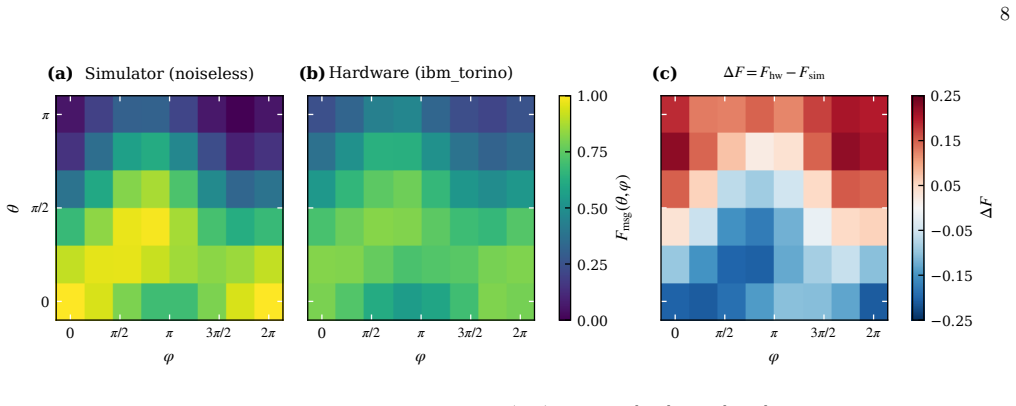
- [§V.C / Fig. 8] The text says the sweep is over θ ∈ [0, π], but Fig. 8 displays θ up to 2π. Please align the axis range with the stated grid or explain the extension.
Circularity Check
No significant circularity: Theorem II.1 is an explicit conditional whose recovery assumption (Eq. 9) is an external Yoshida-Kitaev property, independently verified here for the m=1 instance; hardware results are measurements, not fitted predictions.
full rationale
The central derivation is conditional and non-circular. Theorem II.1 explicitly assumes the recovery property — "Suppose that the complete active operation between the two SWAPs factorizes as ... and that this active scrambler–decoder block reproduces the message state on Y ... (Eq. 9)" — and proves, via the register-routing ledger (first SWAP shunts the incoming CTC state σ to the idle dump wire, so the active block sees only ρ_M; final SWAP writes the recovered state into C), that the induced Deutsch map is the replacement channel Φ(σ)=ρ_M with unique fixed point σ*=ρ_M. The conclusion is a direct consequence of the stated routing and recovery assumptions (Eqs. 8–9), not secretly assumed. The recovery property itself is imported from Yoshida–Kitaev (Ref. [14], external to the present authors) and is independently checked in Appendix A for ten message states on the compressed decoder; the theorem is stated conditionally, and the imperfect case is handled separately by Lemma II.2's diamond-norm bound. The hardware sections report measurements rather than fitted 'predictions': post-selection probability ≈1/4 and recovered-state fidelity ≈0.84 are raw data compared with noiseless simulator values, and the parameter sweep compares simulator rank ordering to hardware (Spearman 0.94) without fitting the theory to the data. The only self-citation (Ref. [37]) is the authors' GitHub repository cited for code availability and carries no argumentative weight. One structural caveat — a correctness concern, not circularity: with the fixed-iterate amplitude-amplified decoder, Eq. (9) holds exactly only for m=1 (N_W=1, success probability 1); for m>1 the success probability sin^{-2}? is sin^2[(2N_W+1)arcsin(2^{-m})] < 1, so the exact unique-fixed-point conclusion for the explicit circuit family would require a different exact-recovery routine. The paper honestly acknowledges the missing certificate: "a full fixed-point process certificate would additionally require direct tomography of the CTC-input map" (Sec. VI). Overall, the derivation is self-contained and appropriately hedged; score 1 reflects only the non-load-bearing code-availability self-citation.
Axiom & Free-Parameter Ledger
free parameters (4)
- Scrambler unitary U (Eq. B1) =
8×8 real self-inverse matrix
- Message state angles (θ_m, φ_m) =
(2.5, 2.0) rad
- Local perturbation sweep grid =
6×8 over θ∈[0,π], φ∈[0,2π]
- Loschmidt-echo step sizes δ =
{0.5, 0.7, 1.0, 1.3, 1.5}
axioms (6)
- domain assumption Deutsch self-consistency condition σ* = Φ(σ*) with density-matrix fixed point
- domain assumption The SWAP-based register-routing circuit in Fig. 2 is a valid finite-dimensional realization of a D-CTC
- domain assumption Yoshida-Kitaev recovery property of the active decoder block (Eq. 9)
- domain assumption Post-selected Bell projection selects the |Φ+⟩ branch with success probability 4^{-m} for an m-qubit message
- standard math Ricochet identity for Bell pairs (Eq. 31) and standard single-qubit rotation identities
- domain assumption IBM calibration data (readout/CZ error rates) are accurate enough for the routing-aware noise model NM4
invented entities (1)
-
Register-separated dump register M_dump (post-first-SWAP message wire)
independent evidence
read the original abstract
Deutsch closed timelike curves (D-CTCs) are described by a fixed-point condition for a chronology-violating register. We study a finite-dimensional circuit model that places a Hayden--Preskill/Yoshida--Kitaev recovery map inside such a consistency loop. A register-routing construction makes the Deutsch map explicit: an initial SWAP moves the incoming CTC state to an idle dump register, the scrambler and decoder act on the remaining active registers, and a final SWAP writes the recovered message back to the CTC register. When the active branch recovers the message, the induced map on the CTC register is the replacement channel \(\sigma\mapsto \rho_M\), with the unique fixed point \(\rho_M\). We implement the associated Lloyd-type post-selected decoder circuits on quantum hardware and formulate a classical-feedback iteration for the experimentally estimated map. Qiskit simulations and IBM-hardware data for single-qubit instances quantify decoder fidelity, post-selection overhead, routing-dependent noise, and quantum-geometric susceptibility.
Figures






Reference graph
Works this paper leans on
-
[1]
QPT diagnostics for the message-to-output process ΦM→C onibm_kingston
Scrambling unitary and Grover reflection For the emulations, we use the scrambler U= 1 2 √ 2 1 1 1−1 1−1−1−1 1−1 1 1 1 1−1 1 1 1−1 1 1−1 1 1 −1 1 1 1−1−1−1 1 1 1 1−1−1 1 1 1 −1 1−1−1 1 1−1 1 −1−1 1−1 1−1 1 1 −1 1 1 1 1 1 1−1 .(B1) TABLE I. QPT diagnostics for the message-to-output process ΦM→C onibm_kingston. The quantity∆ ...
-
[2]
The full deterministic Yoshida–Kitaev decoder also includes the number of 11 TABLE II
Resource estimates For the fixed-iterate circuit used in the single-qubit demonstration, the pre-transpilation two-qubit gate count scales linearly withm. The full deterministic Yoshida–Kitaev decoder also includes the number of 11 TABLE II. Pre-transpilation gate count for the fixed-iterate decoder-emulation circuit. The full deterministic decoder cost i...
-
[3]
Worm- holes, time machines, and the weak energy condition,
M. S. Morris, K. S. Thorne, and U. Yurtsever, “Worm- holes, time machines, and the weak energy condition,” Phys. Rev. Lett. 61 (Sep, 1988) 1446–1449.https:// link.aps.org/doi/10.1103/PhysRevLett.61.1446
-
[4]
The values in Table VI use a single master-data convention for the post-selected baseline and post-selection probability
Error mitigation and noisy-simulator validation We compared three post-selected runs: an unmitigated baseline, a dynamical-decoupling run with XX sequences, and a zero-noise extrapolation (ZNE) run using gate fold- ing at noise amplification factorsλ= 1,3,5. The values in Table VI use a single master-data convention for the post-selected baseline and post...
-
[5]
A separate identity echo gaveP id 00 = 0.9816, identifying a 1.84% systematic noise floor with the same upward effect on the extracted metric
= 0.236, a shift larger than the quoted statistical un- certainty. A separate identity echo gaveP id 00 = 0.9816, identifying a 1.84% systematic noise floor with the same upward effect on the extracted metric. Equation (D11) predicts thatΩϕϕ is constant. Hard- ware estimates withδ ϕ = 1.0agree nearθ= 0but rise strongly at largerθ. The rise reflects noise-...
-
[6]
An Example of a New Type of Cosmological Solutions of Einstein’s Field Equations of Gravitation,
K. Godel, “An Example of a New Type of Cosmological Solutions of Einstein’s Field Equations of Gravitation,” Rev. Mod. Phys. 21 (1949) 447–450
1949
-
[7]
Closed timelike curves produced by pairs of movingcosmicstrings: Exactsolutions,
J. R. Gott, “Closed timelike curves produced by pairs of movingcosmicstrings: Exactsolutions,” Phys.Rev.Lett. 66 (Mar, 1991) 1126–1129.https://link.aps.org/doi/ 10.1103/PhysRevLett.66.1126
-
[8]
Computability the- oryofclosedtimelikecurves,
S.Aaronson, M.Bavarian, T.Cubitt, S.Grewal, G.Guel- trini, R. O’Donnell, and M. Raat, “Computability the- oryofclosedtimelikecurves,” 2024.https://arxiv.org/ abs/1609.05507
Pith/arXiv arXiv 2024
-
[9]
Lewis, The Paradoxes of Time Travel, ch
D. Lewis, The Paradoxes of Time Travel, ch. 26, pp. 357– 15
-
[10]
Can closed timelike curves or nonlinear quan- tum mechanics improve quantum state discrimination or help solve hard problems?,
C. H. Bennett, D. Leung, G. Smith, and J. A. Smolin, “Can closed timelike curves or nonlinear quan- tum mechanics improve quantum state discrimination or help solve hard problems?,” Phys. Rev. Lett. 103 (Oct, 2009) 170502.https://link.aps.org/doi/10. 1103/PhysRevLett.103.170502
2009
-
[11]
Quantum mechanics near closed timelike lines,
D. Deutsch, “Quantum mechanics near closed timelike lines,” Physical Review D 44 no. 10, (1991) 3197–3217
1991
-
[12]
Open timelike curves violate heisenberg’s uncertainty princi- ple,
J. L. Pienaar, T. C. Ralph, and C. R. Myers, “Open timelike curves violate heisenberg’s uncertainty princi- ple,” Phys. Rev. Lett. 110 (Feb, 2013) 060501.https:// link.aps.org/doi/10.1103/PhysRevLett.110.060501
-
[13]
Closed timelike curves make quantum and classical computing equivalent,
S. Aaronson and J. Watrous, “Closed timelike curves make quantum and classical computing equivalent,” Pro- ceedings of the Royal Society A 465 no. 2102, (2009) 631–647, arXiv:0808.2669 [quant-ph]
Pith/arXiv arXiv 2009
-
[14]
Efficient decoding for the hayden-preskill protocol,
B. Yoshida and A. Kitaev, “Efficient decoding for the hayden-preskill protocol,” 2017.https://arxiv.org/ abs/1710.03363
Pith/arXiv arXiv 2017
-
[15]
Computers with closed timelike curves can solve hard problems efficiently,
T. A. Brun, “Computers with closed timelike curves can solve hard problems efficiently,” Foundations of Physics Letters 16 no. 3, (2003) 245–253.http://dx.doi.org/ 10.1023/A:1025967225931
-
[16]
Experimental simulation of closed timelike curves,
M. Ringbauer, M. A. Broome, C. R. Myers, A. G. White, and T. C. Ralph, “Experimental simulation of closed timelike curves,” Nature Communications 5 (2014) 4145
2014
-
[17]
Perfect state distin- guishability and computational speedups with postse- lected closed timelike curves,
T. A. Brun and M. M. Wilde, “Perfect state distin- guishability and computational speedups with postse- lected closed timelike curves,” Foundations of Physics 42 no. 3, (2011) 341–361.http://dx.doi.org/10.1007/ s10701-011-9601-0
2011
-
[18]
Quantum state cloning using deutschian closed timelike curves,
T. A. Brun, M. M. Wilde, and A. Winter, “Quantum state cloning using deutschian closed timelike curves,” Phys. Rev. Lett. 111 (Nov, 2013) 190401.https://link. aps.org/doi/10.1103/PhysRevLett.111.190401
-
[19]
Black holes as mirrors: quantum information in random subsystems,
P. Hayden and J. Preskill, “Black holes as mirrors: quantum information in random subsystems,” Journal of High Energy Physics 2007 no. 09, (2007) 120–120. http://dx.doi.org/10.1088/1126-6708/2007/09/120
-
[20]
Comment on “the black hole final state
D. Gottesman and J. Preskill, “Comment on “the black hole final state”,” Journal of High Energy Physics 2004 no. 03, (2004) 026, arXiv:hep-th/0311269
Pith/arXiv arXiv 2004
-
[21]
Closed timelike curves via postselection: The- ory and experimental test of consistency,
S. Lloyd, L. Maccone, R. Garcia-Patron, V. Giovan- netti, Y. Shikano, S. Pirandola, L. A. Rozema, A. Darabi, Y. Soudagar, L. K. Shalm, and A. M. Stein- berg, “Closed timelike curves via postselection: The- ory and experimental test of consistency,” Phys. Rev. Lett. 106 (Jan, 2011) 040403.https://link.aps.org/ doi/10.1103/PhysRevLett.106.040403
-
[22]
L. Leone, S. F. E. Oliviero, Y. Zhou, and A. Hamma, “Quantum Chaos is Quantum,” Quantum 5 (May, 2021) 453.https://doi.org/10.22331/q-2021-05-04-453
-
[23]
Quantum mechanics of time travel through post-selected teleportation,
S. Lloyd, L. Maccone, R. Garcia-Patron, V. Giovan- netti, and Y. Shikano, “Quantum mechanics of time travel through post-selected teleportation,” Physical Re- view D 84 no. 2, (2011).http://dx.doi.org/10.1103/ PhysRevD.84.025007
2011
-
[24]
Y.-T. Huang, H.-W. Huang, J.-D. Lin, A. Miranow- icz, N. Lambert, G.-Y. Chen, F. Nori, and Y.-N. Chen, “Experimental simulation of postselected closed time- like curves for decoding scrambled quantum informa- tion,” Phys. Rev. Res. 8 (Apr, 2026) 023084.https: //link.aps.org/doi/10.1103/tm83-sxpm
-
[25]
G. T. Horowitz and J. Maldacena, “The black hole fi- nal state,” Journal of High Energy Physics 2004 no. 02, (2004) 008, arXiv:hep-th/0310281
Pith/arXiv arXiv 2004
-
[26]
Riemannian structure on manifolds of quantum states,
J. P. Provost and G. Vallee, “Riemannian structure on manifolds of quantum states,” Communications in Math- ematical Physics 76 no. 3, (1980) 289–301
1980
-
[27]
J. Maldacena, S. H. Shenker, and D. Stanford, “A bound on chaos,” Journal of High Energy Physics 2016 no. 08, (2016) 106, arXiv:1503.01409 [hep-th]
Pith/arXiv arXiv 2016
-
[28]
R. Cheng, “Quantum geometric tensor (fubini-study met- ric) in simple quantum system: A pedagogical introduc- tion,” 2013.https://arxiv.org/abs/1012.1337
Pith/arXiv arXiv 2013
-
[29]
Information scrambling in quantum cir- cuits,
X. Mi, P. Roushan, C. Quintana, S. Mandrà, J. Marshall, C. Neill, F. Arute, K. Arya, J. Atalaya, R. Babbush, J. C. Bardin, R. Barends, J. Basso, A. Bengtsson, S. Boixo, A. Bourassa, M. Broughton, B. B. Buckley, D. A. Buell, B. Burkett, N. Bushnell, Z. Chen, B. Chiaro, R. Collins, W. Courtney, S. Demura, A. R. Derk, A. Dunsworth, D. Eppens, C. Erickson, E....
2021
-
[30]
Disentangling scrambling and decoherence via quantum teleportation,
B. Yoshida and N. Y. Yao, “Disentangling scrambling and decoherence via quantum teleportation,” Phys. Rev. X 9 (Jan, 2019) 011006.https://link.aps.org/doi/10. 1103/PhysRevX.9.011006
2019
-
[31]
Scramblingandcomplexityinphasespace,
Q. Zhuang, T. Schuster, B. Yoshida, and N. Y. Yao, “Scramblingandcomplexityinphasespace,” PhysicalRe- view A 99 no. 6, (2019).http://dx.doi.org/10.1103/ PhysRevA.99.062334
2019
-
[32]
A fast quantum mechanical algorithm for database search,
L. K. Grover, “A fast quantum mechanical algorithm for database search,” Proceedings of the 28th Annual ACM Symposium on Theory of Computing (STOC) (1996) 212–219, arXiv:quant-ph/9605043
Pith/arXiv arXiv 1996
-
[33]
Geometry and non-adiabatic response in quantum and classical systems,
M. Kolodrubetz, D. Sels, P. Mehta, and A. Polkovnikov, “Geometry and non-adiabatic response in quantum and classical systems,” Physics Reports 697 (2017) 1–87, arXiv:1602.01062 [cond-mat.stat-mech]
Pith/arXiv arXiv 2017
-
[34]
•Classical-feedback iteration:an experimentally es- timated CPTP map is iterated in classical control until a fixed point is reached or until a stopping criterion is met
and can be exponentially costly in the inverse suc- cess probability. •Classical-feedback iteration:an experimentally es- timated CPTP map is iterated in classical control until a fixed point is reached or until a stopping criterion is met. The seven-qubit circuits used below realize the post- selected decoder branch. The classical-feedback con- struction...
-
[35]
Mea- surements of the quantum geometric tensor in solids,
M. Kang, S. Kim, Y. Qian, P. M. Neves, L. Ye, J. Jung, D. Puntel, F. Mazzola, S. Fang, C. Jozwiak, A. Bost- wick, E. Rotenberg, J. Fuji, I. Vobornik, J.-H. Park, J. G. Checkelsky, B.-J. Yang, and R. Comin, “Mea- surements of the quantum geometric tensor in solids,” Nature Physics 21 no. 1, (Nov., 2024) 110–117.http: //dx.doi.org/10.1038/s41567-024-02678-8
-
[36]
The quan- tum geometric tensor in a parameter-dependent curved space,
J. A. Austrich-Olivares and J. D. Vergara, “The quan- tum geometric tensor in a parameter-dependent curved space,” Entropy 24 no. 9, (2022) 1236.http://dx.doi. org/10.3390/e24091236
-
[37]
Quantum state 16 tomography on closed timelike curves using weak mea- surements,
L. G. Bishop, F. Costa, and T. C. Ralph, “Quantum state 16 tomography on closed timelike curves using weak mea- surements,” Class. Quantum Grav.42, 045018 (2025). https://doi.org/10.1088/1361-6382/ada90b
-
[38]
Veri- fied quantum information scrambling,
K. A. Landsman, C. Figgatt, T. Schuster, N. M. Linke, B. Yoshida, N. Y. Yao, and C. Monroe, “Veri- fied quantum information scrambling,” Nature 567 no. 7746, (Mar., 2019) 61–65.http://dx.doi.org/10.1038/ s41586-019-0952-6
2019
-
[39]
Quan- tum amplitude amplification and estimation,
G. Brassard, P. Høyer, M. Mosca, and A. Tapp, “Quan- tum amplitude amplification and estimation,” in Quan- tum Computation and Information, vol. 305 of Contem- porary Mathematics, pp. 53–74. American Mathematical Society, 2002. arXiv:quant-ph/0005055
Pith/arXiv arXiv 2002
-
[40]
Quantum computing, postselection, and probabilistic polynomial-time,
S. Aaronson, “Quantum computing, postselection, and probabilistic polynomial-time,” Proceedings of the Royal Society A 461 no. 2063, (2005) 3473–3482, arXiv:quant- ph/0412187
arXiv 2063
-
[41]
Predicting many properties of a quantum system from very few mea- surements,
H.-Y. Huang, R. Kueng, and J. Preskill, “Predicting many properties of a quantum system from very few mea- surements,” Nature Physics 16 no. 10, (2020) 1050–1057. http://dx.doi.org/10.1038/s41567-020-0932-7
-
[42]
Loschmidt echo,
A. Wisniacki, “Loschmidt echo,” Scholarpedia 7 no. 8, (2012) 11687.http://dx.doi.org/10.4249/ scholarpedia.11687
2012
-
[43]
Closed-Time-Like-Curves,
S. N. Morapakula, “Closed-Time-Like-Curves,” Apr., 2026.https://github.com/Qubit1718/ Closed-Time-Like-Curve
2026
-
[369]
John Wiley & Sons, Ltd, 2016
2016
discussion (0)
Sign in with ORCID, Apple, or X to comment. Anyone can read and Pith papers without signing in.