REVIEW 4 major objections 5 minor 57 references
ReGuidance: A Simple Diffusion Wrapper for Boosting Sample Quality on Hard Inverse Problems
T0 review · 4 major / 5 minor · reviewed 2026-08-07 · deepseek-v4-flash
Pith's one-line read ReGuidance wraps any diffusion inverse solver by inverting its output to a latent and re-running DPS from there, improving realism and measurement consistency on hard inpainting and superresolution.
desk verdict A simple, honest wrapper idea with solid inpainting evidence, but the superresolution claims and the 'first DPS guarantee' framing overreach what the paper actually shows. read the letter →
The pith
A machine-rendered reading of the paper's core claim, the machinery that carries it, and where it could break.
The reading
What carries the argument
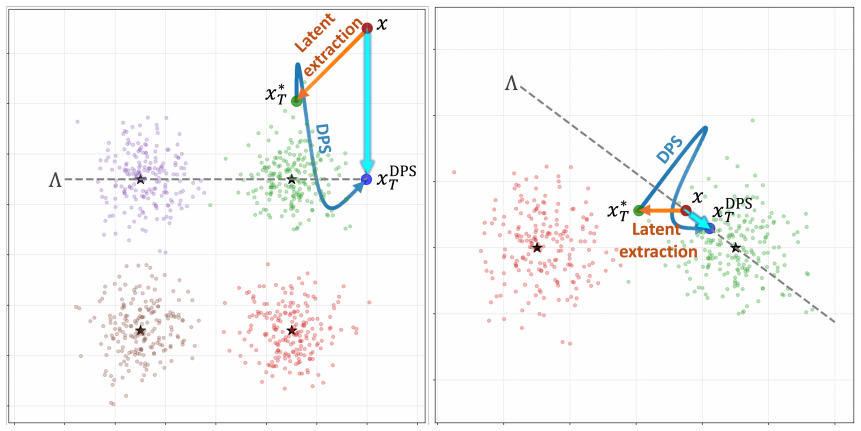
The load-bearing object is the combination of two deterministic ODEs: reverse probability-flow ODE latent extraction followed by DPS-ODE. The reverse probability-flow ODE is the deterministic time-reversal of the Ornstein-Uhlenbeck forward process, and running it backwards from a candidate image yields a latent that inherits the candidate's structure; running DPS-ODE forward from that latent applies the measurement-consistency velocity while keeping the trajectory on the data manifold. In the theory, a modified version (ModifiedReGuidance) drops the $\operatorname{sech}^2$ term from the DPS velocity to make the analysis tractable, and the proof tracks the evolution of $\tanh$ along the trajectory in three stages to show reward is approximately preserved and the sample contracts toward a mode. The empirical message is that a small neighborhood around each good latent gives robust outputs, while good latents form a disconnected set, so the wrapper both recovers and selects among these basins.
What would settle it
Concretely, on the 16x superresolution setting used in the paper, refine the ODE solver until the reverse-then-forward inversion of a ground-truth image returns that image with negligible error; if ReGuidance's gains over DAPS do not grow accordingly, then the lossy inversion rather than the latent basin is the operative mechanism. Alternatively, on large-box inpainting, if a random $\mathcal{N}(0, I)$ latent initialization of DPS-ODE matches ReGuidance's LPIPS and CMMD scores, the inversion step is superfluous.
Extended reading notes
Core claim
The central discovery is that the choice of latent initialization determines what DPS-ODE accomplishes, and that the right latent can be obtained by inverting the candidate solution through the same pretrained diffusion model used for generation. Algorithm 1 does this in two steps: (I) run the unconditional probability flow ODE in reverse from candidate $x$ to obtain latent $x_T^*$; (II) run the DPS-ODE from $x_T^*$ to produce the new reconstruction. On ImageNet 256x256, applying this wrapper to DAPS, DDRM, and DPS reduces LPIPS and CMMD on large box-inpainting and often improves both metrics on 8x/16x superresolution, with qualitatively more realistic completions. The theory shows that for a uniform $\{\pm R\}^d$ Gaussian mixture with inpainting measurements, ReGuidance maps $x$ to a point within $\mathrm{poly}(\sigma, e^{-T})$ of the affine subspace of measurement-consistent reconstructions (Theorem 5), while for a two-Gaussian mixture with maximal-reward input it contracts the output toward the mode $z_1$ by a factor that tends to $\langle v, e_1\rangle^2$ as $\sigma \to 0$ (Theorem 4), under a bound on the initial latent. A matching negative result (Theorem 6) says that the DPS-ODE cannot be replaced by the stochastic SDE without losing this guarantee.
Load-bearing premise
The method rests on the assumption that the reverse probability-flow ODE maps a candidate reconstruction into a latent basin from which DPS-ODE improves the image; the paper's own Figure 10 shows this inversion is lossy, and Theorem 4 additionally assumes an unverified bound on the extracted latent.
Editorial extensions
If this is right
- Wrapping DAPS, DDRM, or DPS with ReGuidance improves LPIPS and CMMD on large box-inpainting on ImageNet and gives substantial CMMD gains at 16x superresolution.
- DPS performance must be analyzed relative to its initial latent; the guarantees show the DPS-ODE endpoint is determined by that initialization.
- Stochastic versions of DPS, such as DDIM with $\eta = 1.0$, do not inherit ReGuidance's boost and can underperform the original baseline.
- The reward-boosting guarantee extends to exponentially many modes under inpainting measurements, while realism boosting is shown for the two-mode case.
- ReGuidance is well-defined for any reward model, so the same invert-and-resample recipe transfers beyond inverse problems, although the experiments focus on image restoration.
Reading between the lines
- A natural stress test not run in the paper: apply ReGuidance to non-inverse reward guidance, since the wrapper only needs a pretrained score and a reward model.
- The disconnectedness of good latents suggests that actively searching or optimizing over the latent set could be a stronger axis for inference-time compute than accepting whichever latent the inversion returns.
- The observed inversion loss at 16x superresolution implies the wrapper's ceiling on extreme downsampling may be set by the ODE solver's discretization, so more accurate inversion could transfer to larger gains.
- The contraction factor tending to $\langle v, e_1\rangle^2$ suggests that measurements nearly orthogonal to the signal direction may give weaker theoretical realism boosts, a regime the theorem explicitly avoids.
Editorial analysis
A structured set of objections, weighed in public.
Referee Report
Summary. The paper proposes ReGuidance, a wrapper around existing diffusion-based inverse-problem solvers. Given a candidate reconstruction x, the method first runs the unconditional probability-flow ODE backward from x to obtain a latent x*_T, then runs the DPS-ODE from that latent to produce a new reconstruction. The authors claim this boosts both sample realism and measurement consistency on hard inpainting and super-resolution tasks, and they support the claim with experiments on ImageNet and CIFAR-10 plus theoretical guarantees for Gaussian-mixture toy models. The theory consists of a reward-boosting result (Theorem 5) showing projection to the measurement-consistent affine subspace for a uniform product-of-signed-Gaussians mixture, a negative result for the SDE variant (Theorem 6), and a realism-boosting contraction result (Theorem 4) for a two-mode Gaussian mixture under a modified DPS velocity.
Significance. If the empirical claims held as stated, the paper would make a useful practical contribution: it identifies the choice of DPS latent initialization as a design axis, proposes a simple and cheap way to exploit it, and gives theoretical evidence that this can improve reward and realism on simple multimodal models. The ODE-versus-SDE distinction in Theorem 6 is valuable because it explains why deterministic inversion matters. The paper also honestly includes an appendix proof that DPS does not sample the tilted distribution. However, the super-resolution experiments directly contradict the abstract's blanket claim of significant improvement, the metric labeled 'measurement consistency' is not a measurement-consistency metric, and the main theoretical guarantee applies to a modified algorithm under an unverified initial-condition assumption. The inpainting results are promising and largely consistent with the wrapper's mechanism, but the current form overstates the scope.
major comments (4)
- [§3.3 and Table 5] The central empirical claim that ReGuidance 'significantly boosts sample quality and measurement consistency' on super-resolution is not supported by the paper's own Table 5. For the 8x and 16x super-resolution settings, 9 of the 12 non-ground-truth entries worsen under ReGuidance: DAPS LPIPS worsens from 0.410 to 0.510 and from 0.545 to 0.590; DDRM LPIPS worsens from 0.393 to 0.405 and from 0.511 to 0.530, and DDRM CMMD worsens from 1.232 to 1.435 and from 1.549 to 1.971; DPS CMMD worsens from 0.566 to 0.655 and from 0.576 to 0.705. The sentence in §3.3 that 'ReGuidance continues to improve both sample quality and measurement consistency, even under heavy downsampling' is therefore contradicted by the table it refers to. The abstract and §3.3 must be revised to describe the inpainting results as the main empirical evidence and to characterize super-resolution as mixed, or the super-resolution experiments need to be redone with settings that actually show improvement. No error bars, seeds, or confidence intervals are reported anywhere, so the word 'significantly' in the abstract is not statistically justified.
- [§3.1, 'Metrics'] The paper states that 'for measurement consistency, we use the LPIPS score of the generated sample relative to the ground truth image.' LPIPS relative to ground truth is a perceptual reconstruction-quality metric, not a measure of consistency with the observed measurement y. The reward in the inverse problem is r(x) = -||y - Ax||^2, and the text explicitly identifies reward with measurement consistency in §2.1.2 and Algorithm 1. Reporting LPIPS-to-ground-truth under the label 'measurement consistency' conflates two distinct axes and makes it impossible to verify the claim that ReGuidance improves measurement consistency. The authors should either report the actual data-consistency error ||y - A x||, or relabel the metric throughout and adjust the claims.
- [§4.2.1, Theorem 4 and Eq. (MDPS-ODE)] The headline 'first rigorous algorithmic guarantee for DPS' is overstated because Theorem 4 is proven for ModifiedReGuidance, a modified ODE that drops the sech^2 term from the DPS velocity field. The authors justify this by saying the term is 'cumbersome for our analysis and does not qualitatively impact the behavior,' but no formal bound is given for the error incurred by this removal. Moreover, Theorem 4 assumes an unverified bound on the initial latent, <x_MDPS_0, v> <= c R <v, e1>, and Lemma 1 only establishes the sign of the first latent coordinate and constancy of the second coordinate; it does not establish the assumed bound from the input reconstruction x. The result should be explicitly framed as a guarantee for ModifiedReGuidance under an additional initialization assumption, and the relation between this modified dynamics and the DPS-ODE actually run in Algorithm 1 should be quantified.
- [Appendix D.2.1 and Figure 10] The key mechanism of ReGuidance is that reverse-PF-ODE inversion from a candidate reconstruction lands in a 'good' latent basin. The paper's own evidence acknowledges that this inversion is lossy: Figure 10 shows that running the unconditional ODE from an inverted latent does not return to the original image, and the text states that 'artifacts introduced by discretization error are magnified with ReGuidance.' This is a load-bearing limitation because the super-resolution experiments, where the wrapper performs worst, are precisely the settings where the inversion error appears largest. The paper needs to quantify the inversion error (e.g., reconstruction error before and after the ODE round trip) and to explain why the same artifacts do not undermine the inpainting results. Without such a quantitative assessment, the claim that the wrapper consistently boosts sample quality cannot be evaluated even for inpainting.
minor comments (5)
- [§4.1, paragraph before Theorem 1] The text says 'for small values of the hyperparameter σ,' but σ is the observation-noise standard deviation, not a tunable hyperparameter of the algorithm; please rephrase.
- [Theorem 5] There is a typo: 'measurment' should be 'measurement'. Also, 'inpainting measurment' should be defined more precisely; the current phrasing 'a Boolean matrix with exactly one nonzero entry in each row' does not specify that it selects distinct coordinates.
- [Appendix D.1.1, Table 3] The text says the CIFAR-10 results show a 'near universal boost,' but in Table 3 the small-inpainting LPIPS worsens from 0.147 to 0.151. Please qualify the claim accordingly.
- [Algorithm 1] The notation in Step 1 writes x*_0 = x and integrates dx*_t = -(x*_t + ∇ log q_t(x*_t)) dt for t from 0 to T, which is a backward time-reversal of the probability-flow ODE. It would help readers if the text explicitly stated that the score in this step is evaluated at time t of the forward process, not at T-t as in Step 2.
- [§3.2 and Table 1] The 'Ground Truth + ReGuidance' row is reported as a baseline, but it uses knowledge of the ground truth; the caption and text should consistently flag this row as an oracle rather than a method, since reading it as a baseline can obscure the comparison.
Circularity Check
No substantive circularity: the derivations are explicit ODE analyses; the main caveats are a self-defined DPS variant and an internal empirical inconsistency, not an equation-level reduction.
full rationale
I walked the derivation chain in Sections 2 and 4 and Appendices B-C. Algorithm 1 is defined by two explicit ODEs: a reverse unconditional probability-flow ODE to extract a latent, followed by a DPS-ODE from that latent. Theorems 5 and 4 are proved from the Gaussian-mixture score formulas and the DPS velocity field; no parameter is fitted to the target outputs, and no conclusion is assumed among the premises. The unmeasured-coordinate part of Theorem 5 is described as holding 'by design' because Step 1 plus the unconditional part of Step 2 is an exact time-reversal pair; that is the intended construction, not an equation-level identity smuggled in as a prediction. The headline 'first rigorous algorithmic guarantee for DPS' is narrower than stated: the realism guarantee (Theorem 4) is for ModifiedReGuidance, which omits the sech^2 term from the DPS velocity, and it assumes a bound on the initial latent; this is a scope limitation rather than circularity. The only self-citations, [KSCE24] in a related-work list and [CCL+23] for discretization being orthogonal, are not load-bearing. The empirical superresolution claim is contradicted by the paper's own Table 5 (e.g., DAPS LPIPS worsens from 0.410 to 0.510 and DDRM CMMD from 1.232 to 1.435 at 8x), and Appendix D.2.1 concedes that inversion artifacts are 'magnified by ReGuidance'; this is an internal inconsistency in the empirical claim, not a circular derivation. Score 2 reflects the minor self-citations and the self-defined target of the DPS guarantee, not a substantive circularity.
Assumptions & free parameters
free parameters (3)
- Guidance strength rho =
not reported for experiments; theory sets rho=1/sigma^2
- Time horizon T for both ODEs =
not reported
- Number of denoising and inversion steps, DDIM discretization =
not reported
assumptions (6)
- domain assumption Exact score functions ∇ln q_t are known.
- domain assumption Exact simulation of the probability flow ODE and DPS-ODE.
- ad hoc to paper Data is a uniform mixture of identity-covariance Gaussians on {±R}^d.
- ad hoc to paper Data is a two-mode Gaussian mixture with means z1=R e1 and z2=-R e1 and a single linear measurement.
- ad hoc to paper The sech^2 term in the DPS velocity is negligible and may be removed.
- ad hoc to paper Initial latent satisfies <x_MDPS_0, v> <= c R <v,e1> and x is sufficiently close to mode z1.
Cite this review
Pith. "Pith review of ReGuidance: A Simple Diffusion Wrapper for Boosting Sample Quality on Hard Inverse Problems." pith.science (2026). https://pith.science/paper/7US4Y2DW
@misc{pith2026250610955,
  author       = {Pith},
  title        = {Pith review of: ReGuidance: A Simple Diffusion Wrapper for Boosting Sample Quality on Hard Inverse Problems},
  year         = {2026},
  howpublished = {\url{https://pith.science/paper/7US4Y2DW}},
  note         = {Machine review of arXiv:2506.10955}
}
abstract
There has been a flurry of activity around using pretrained diffusion models as informed data priors for solving inverse problems, and more generally around steering these models using reward models. Training-free methods like diffusion posterior sampling (DPS) and its many variants have offered flexible heuristic algorithms for these tasks, but when the reward is not informative enough, e.g., in hard inverse problems with low signal-to-noise ratio, these techniques veer off the data manifold, failing to produce realistic outputs. In this work, we devise a simple wrapper, ReGuidance, for boosting both the sample realism and reward achieved by these methods. Given a candidate solution $\hat{x}$ produced by an algorithm of the user's choice, we propose inverting the solution by running the unconditional probability flow ODE in reverse starting from $\hat{x}$, and then using the resulting latent as an initialization for DPS. We evaluate our wrapper on hard inverse problems like large box in-painting and super-resolution with high upscaling. Whereas state-of-the-art baselines visibly fail, we find that applying our wrapper on top of these baselines significantly boosts sample quality and measurement consistency. We complement these findings with theory proving that on certain multimodal data distributions, ReGuidance simultaneously boosts the reward and brings the candidate solution closer to the data manifold. To our knowledge, this constitutes the first rigorous algorithmic guarantee for DPS.
Figures


Figures from the paper (11 more)




Reference graph
Works this paper leans on
-
[1]
Provable posterior sampling with denoising oracles via tilted transport
Joan Bruna and Jiequn Han. Provable posterior sampling with denoising oracles via tilted transport. Advances in Neural Information Processing Systems , 37:82863--82894, 2024
work page 2024
-
[2]
Training diffusion models with reinforcement learning
Kevin Black, Michael Janner, Yilun Du, Ilya Kostrikov, and Sergey Levine. Training diffusion models with reinforcement learning. In The Twelfth International Conference on Learning Representations , 2024
work page 2024
-
[3]
Ashish Bora, Ajil Jalal, Eric Price, and Alexandros G. Dimakis. Compressed sensing using generative models. In Doina Precup and Yee Whye Teh, editors, Proceedings of the 34th International Conference on Machine Learning , volume 70 of Proceedings of Machine Learning Research , pages 537--546. PMLR, 06--11 Aug 2017
work page 2017
-
[4]
Lorenzo Baldassari, Ali Siahkoohi, Josselin Garnier, Knut Solna, and Maarten V. de Hoop. Conditional score-based diffusion models for bayesian inference in infinite dimensions. In Thirty-seventh Conference on Neural Information Processing Systems , 2023
work page 2023
-
[5]
Sampling is as easy as learning the score: theory for diffusion models with minimal data assumptions
Sitan Chen, Sinho Chewi, Jerry Li, Yuanzhi Li, Adil Salim, and Anru Zhang. Sampling is as easy as learning the score: theory for diffusion models with minimal data assumptions. In The Eleventh International Conference on Learning Representations , 2023
work page 2023
-
[6]
Diffusion posterior sampling for general noisy inverse problems
Hyungjin Chung, Jeongsol Kim, Michael Thompson Mccann, Marc Louis Klasky, and Jong Chul Ye. Diffusion posterior sampling for general noisy inverse problems. In The Eleventh International Conference on Learning Representations , 2023
work page 2023
-
[7]
Mr image denoising and super-resolution using regularized reverse diffusion
Hyungjin Chung, Eun Sun Lee, and Jong Chul Ye. Mr image denoising and super-resolution using regularized reverse diffusion. IEEE Transactions on Medical Imaging , 42(4):922--934, 2022
work page 2022
-
[8]
Inverse optimization: Theory and applications
Timothy CY Chan, Rafid Mahmood, and Ian Yihang Zhu. Inverse optimization: Theory and applications. Operations Research , 73(2):1046--1074, 2025
work page 2025
Show all 57 references
-
[9]
Solving inverse problems via diffusion-based priors: An approximation-free ensemble sampling approach
Haoxuan Chen, Yinuo Ren, Martin Renqiang Min, Lexing Ying, and Zachary Izzo. Solving inverse problems via diffusion-based priors: An approximation-free ensemble sampling approach. arXiv preprint arXiv:2506.03979 , 2025
2025 arXiv
-
[10]
Improving diffusion models for inverse problems using manifold constraints
Hyungjin Chung, Byeongsu Sim, Dohoon Ryu, and Jong Chul Ye. Improving diffusion models for inverse problems using manifold constraints. In Alice H. Oh, Alekh Agarwal, Danielle Belgrave, and Kyunghyun Cho, editors, Advances in Neural Information Processing Systems , 2022
2022
-
[11]
Kevin Clark, Paul Vicol, Kevin Swersky, and David J. Fleet. Directly fine-tuning diffusion models on differentiable rewards. In The Twelfth International Conference on Learning Representations , 2024
2024
-
[12]
Score-based diffusion models for accelerated mri
Hyungjin Chung and Jong Chul Ye. Score-based diffusion models for accelerated mri. Medical Image Analysis , page 102479, 2022
2022
-
[13]
A survey on diffusion models for inverse problems
Giannis Daras, Hyungjin Chung, Chieh-Hsin Lai, Yuki Mitsufuji, Jong Chul Ye, Peyman Milanfar, Alexandros G Dimakis, and Mauricio Delbracio. A survey on diffusion models for inverse problems. arXiv preprint arXiv:2410.00083 , 2024
-
[14]
Imagenet: A large-scale hierarchical image database
Jia Deng, Wei Dong, Richard Socher, Li-Jia Li, Kai Li, and Li Fei-Fei. Imagenet: A large-scale hierarchical image database. In 2009 IEEE Conference on Computer Vision and Pattern Recognition , pages 248--255, 2009
2009
-
[15]
Carles Domingo-Enrich, Michal Drozdzal, Brian Karrer, and Ricky T. Q. Chen. Adjoint matching: Fine-tuning flow and diffusion generative models with memoryless stochastic optimal control. In The Thirteenth International Conference on Learning Representations , 2025
2025
-
[16]
Diffusion models beat GAN s on image synthesis
Prafulla Dhariwal and Alexander Quinn Nichol. Diffusion models beat GAN s on image synthesis. In A. Beygelzimer, Y. Dauphin, P. Liang, and J. Wortman Vaughan, editors, Advances in Neural Information Processing Systems , 2021
2021
-
[17]
Conditional diffusion models for semantic 3d brain mri synthesis
Zolnamar Dorjsembe, Hsing-Kuo Pao, Sodtavilan Odonchimed, and Furen Xiao. Conditional diffusion models for semantic 3d brain mri synthesis. IEEE Journal of Biomedical and Health Informatics , 2024
2024
-
[18]
Diffusion posterior sampling for linear inverse problem solving: A filtering perspective
Zehao Dou and Yang Song. Diffusion posterior sampling for linear inverse problem solving: A filtering perspective. In The Twelfth International Conference on Learning Representations , 2024
2024
-
[19]
DEFT : Efficient fine-tuning of diffusion models by learning the generalised \ h\ -transform
Alexander Denker, Francisco Vargas, Shreyas Padhy, Kieran Didi, Simon V Mathis, Riccardo Barbano, Vincent Dutordoir, Emile Mathieu, Urszula Julia Komorowska, and Pietro Lio. DEFT : Efficient fine-tuning of diffusion models by learning the generalised \ h\ -transform. In The Th...
2024
-
[20]
Reinforcement learning for fine-tuning text-to-image diffusion models
Ying Fan, Olivia Watkins, Yuqing Du, Hao Liu, Moonkyung Ryu, Craig Boutilier, Pieter Abbeel, Mohammad Ghavamzadeh, Kangwook Lee, and Kimin Lee. Reinforcement learning for fine-tuning text-to-image diffusion models. In Thirty-seventh Conference on Neural Information Processing ...
2023
-
[21]
Diffusion posterior sampling is computationally intractable
Shivam Gupta, Ajil Jalal, Aditya Parulekar, Eric Price, and Zhiyang Xun. Diffusion posterior sampling is computationally intractable. In International Conference on Machine Learning , pages 17020--17059. PMLR, 2024
2024
-
[22]
Protein design with guided discrete diffusion
Nate Gruver, Samuel Stanton, Nathan Frey, Tim GJ Rudner, Isidro Hotzel, Julien Lafrance-Vanasse, Arvind Rajpal, Kyunghyun Cho, and Andrew G Wilson. Protein design with guided discrete diffusion. Advances in neural information processing systems , 36:12489--12517, 2023
2023
-
[23]
Denoising diffusion probabilistic models
Jonathan Ho, Ajay Jain, and Pieter Abbeel. Denoising diffusion probabilistic models. In H. Larochelle, M. Ranzato, R. Hadsell, M.F. Balcan, and H. Lin, editors, Advances in Neural Information Processing Systems , volume 33, pages 6840--6851. Curran Associates, Inc., 2020
2020
-
[24]
Gans trained by a two time-scale update rule converge to a local nash equilibrium
Martin Heusel, Hubert Ramsauer, Thomas Unterthiner, Bernhard Nessler, and Sepp Hochreiter. Gans trained by a two time-scale update rule converge to a local nash equilibrium. Advances in neural information processing systems , 30, 2017
2017
-
[25]
An edit friendly ddpm noise space: Inversion and manipulations
Inbar Huberman-Spiegelglas, Vladimir Kulikov, and Tomer Michaeli. An edit friendly ddpm noise space: Inversion and manipulations. In Proceedings of the IEEE/CVF Conference on Computer Vision and Pattern Recognition , pages 12469--12478, 2024
2024
-
[26]
Med-cdiff: Conditional medical image generation with diffusion models
Alex Ling Yu Hung, Kai Zhao, Haoxin Zheng, Ran Yan, Steven S Raman, Demetri Terzopoulos, and Kyunghyun Sung. Med-cdiff: Conditional medical image generation with diffusion models. Bioengineering , 10(11):1258, 2023
2023
-
[27]
Rethinking fid: Towards a better evaluation metric for image generation
Sadeep Jayasumana, Srikumar Ramalingam, Andreas Veit, Daniel Glasner, Ayan Chakrabarti, and Sanjiv Kumar. Rethinking fid: Towards a better evaluation metric for image generation. In Proceedings of the IEEE/CVF Conference on Computer Vision and Pattern Recognition , pages 9307-...
2024
-
[28]
Denoising diffusion restoration models
Bahjat Kawar, Michael Elad, Stefano Ermon, and Jiaming Song. Denoising diffusion restoration models. In Advances in Neural Information Processing Systems , 2022
2022
-
[29]
Learning multiple layers of features from tiny images
Alex Krizhevsky, Geoffrey Hinton, et al. Learning multiple layers of features from tiny images. 2009
2009
-
[30]
Diffusion models for black-box optimization
Siddarth Krishnamoorthy, Satvik Mehul Mashkaria, and Aditya Grover. Diffusion models for black-box optimization. In Andreas Krause, Emma Brunskill, Kyunghyun Cho, Barbara Engelhardt, Sivan Sabato, and Jonathan Scarlett, editors, Proceedings of the 40th International Conference...
2023
-
[31]
Aayush Karan, Kulin Shah, Sitan Chen, and Yonina C. Eldar. Unrolled denoising networks provably learn to perform optimal bayesian inference. In The Thirty-eighth Annual Conference on Neural Information Processing Systems , 2024
2024
-
[32]
Repaint: Inpainting using denoising diffusion probabilistic models, 2022
Andreas Lugmayr, Martin Danelljan, Andres Romero, Fisher Yu, Radu Timofte, and Luc Van Gool. Repaint: Inpainting using denoising diffusion probabilistic models, 2022
2022
-
[33]
Alkhouri, Saiprasad Ravishankar, and Qing Qu
Xiang Li, Soo Min Kwon, Ismail R. Alkhouri, Saiprasad Ravishankar, and Qing Qu. Decoupled data consistency with diffusion purification for image restoration, 2024
2024
-
[34]
Diffusion model for data-driven black-box optimization
Zihao Li, Hui Yuan, Kaixuan Huang, Chengzhuo Ni, Yinyu Ye, Minshuo Chen, and Mengdi Wang. Diffusion model for data-driven black-box optimization. arXiv preprint arXiv:2403.13219 , 2024
2024 arXiv
-
[35]
Derivative-free guidance in continuous and discrete diffusion models with soft value-based decoding, 2024
Xiner Li, Yulai Zhao, Chenyu Wang, Gabriele Scalia, Gokcen Eraslan, Surag Nair, Tommaso Biancalani, Shuiwang Ji, Aviv Regev, Sergey Levine, and Masatoshi Uehara. Derivative-free guidance in continuous and discrete diffusion models with soft value-based decoding, 2024
2024
-
[36]
Deep generative adversarial neural networks for compressive sensing mri
Morteza Mardani, Enhao Gong, Joseph Y Cheng, Shreyas S Vasanawala, Greg Zaharchuk, Lei Xing, and John M Pauly. Deep generative adversarial neural networks for compressive sensing mri. IEEE transactions on medical imaging , 38(1):167--179, 2018
2018
-
[37]
Null-text inversion for editing real images using guided diffusion models, 2022
Ron Mokady, Amir Hertz, Kfir Aberman, Yael Pritch, and Daniel Cohen-Or. Null-text inversion for editing real images using guided diffusion models, 2022
2022
-
[38]
Variational diffusion posterior sampling with midpoint guidance
Badr MOUFAD, Yazid Janati, Lisa Bedin, Alain Oliviero Durmus, randal douc, Eric Moulines, and Jimmy Olsson. Variational diffusion posterior sampling with midpoint guidance. In The Thirteenth International Conference on Learning Representations , 2025
2025
-
[39]
Inference-time scaling for diffusion models beyond scaling denoising steps
Nanye Ma, Shangyuan Tong, Haolin Jia, Hexiang Hu, Yu-Chuan Su, Mingda Zhang, Xuan Yang, Yandong Li, Tommi Jaakkola, Xuhui Jia, et al. Inference-time scaling for diffusion models beyond scaling denoising steps. arXiv preprint arXiv:2501.09732 , 2025
2025 arXiv
-
[40]
Posterior sampling in high dimension via diffusion processes, 2024
Andrea Montanari and Yuchen Wu. Posterior sampling in high dimension via diffusion processes, 2024
2024
-
[41]
Metzler, Richard G
Gregory Ongie, Ajil Jalal, Christopher A. Metzler, Richard G. Baraniuk, Alexandros G. Dimakis, and Rebecca Willett. Deep learning techniques for inverse problems in imaging. IEEE Journal on Selected Areas in Information Theory , 1(1):39--56, 2020
2020
-
[42]
Not all noises are created equally: Diffusion noise selection and optimization
Zipeng Qi, Lichen Bai, Haoyi Xiong, and Zeke Xie. Not all noises are created equally: Diffusion noise selection and optimization. arXiv preprint arXiv:2407.14041 , 2024
2024 arXiv
-
[43]
Fleet, and Mohammad Norouzi
Chitwan Saharia, Jonathan Ho, William Chan, Tim Salimans, David J. Fleet, and Mohammad Norouzi. Image super-resolution via iterative refinement. IEEE Transactions on Pattern Analysis and Machine Intelligence , 45(4):4713--4726, 2023
2023
-
[44]
A general framework for inference-time scaling and steering of diffusion models, 2025
Raghav Singhal, Zachary Horvitz, Ryan Teehan, Mengye Ren, Zhou Yu, Kathleen McKeown, and Rajesh Ranganath. A general framework for inference-time scaling and steering of diffusion models, 2025
2025
-
[45]
Score-based generative modeling through stochastic differential equations
Yang Song, Jascha Sohl-Dickstein, Diederik P Kingma, Abhishek Kumar, Stefano Ermon, and Ben Poole. Score-based generative modeling through stochastic differential equations. In International Conference on Learning Representations , 2021
2021
-
[46]
Pseudoinverse-guided diffusion models for inverse problems
Jiaming Song, Arash Vahdat, Morteza Mardani, and Jan Kautz. Pseudoinverse-guided diffusion models for inverse problems. In International Conference on Learning Representations , 2023
2023
-
[47]
Inference-time alignment in diffusion models with reward-guided generation: Tutorial and review, 2025
Masatoshi Uehara, Yulai Zhao, Chenyu Wang, Xiner Li, Aviv Regev, Sergey Levine, and Tommaso Biancalani. Inference-time alignment in diffusion models with reward-guided generation: Tutorial and review, 2025
2025
-
[48]
Amortizing intractable inference in diffusion models for vision, language, and control
Siddarth Venkatraman, Moksh Jain, Luca Scimeca, Minsu Kim, Marcin Sendera, Mohsin Hasan, Luke Rowe, Sarthak Mittal, Pablo Lemos, Emmanuel Bengio, Alexandre Adam, Jarrid Rector-Brooks, Yoshua Bengio, Glen Berseth, and Nikolay Malkin. Amortizing intractable inference in diffusio...
2024
-
[49]
Boltz-1: Democratizing biomolecular interaction modeling
Jeremy Wohlwend, Gabriele Corso, Saro Passaro, Mateo Reveiz, Ken Leidal, Wojtek Swiderski, Tally Portnoi, Itamar Chinn, Jacob Silterra, Tommi Jaakkola, et al. Boltz-1: Democratizing biomolecular interaction modeling. bioRxiv , pages 2024--11, 2024
2024
-
[50]
End-to-end diffusion latent optimization improves classifier guidance
Bram Wallace, Akash Gokul, Stefano Ermon, and Nikhil Naik. End-to-end diffusion latent optimization improves classifier guidance. In Proceedings of the IEEE/CVF International Conference on Computer Vision , pages 7280--7290, 2023
2023
-
[51]
Deep compressed sensing
Yan Wu, Mihaela Rosca, and Timothy Lillicrap. Deep compressed sensing. In International Conference on Machine Learning , pages 6850--6860. PMLR, 2019
2019
-
[52]
Trippe, Christian A
Luhuan Wu, Brian L. Trippe, Christian A. Naesseth, David M. Blei, and John P. Cunningham. Practical and asymptotically exact conditional sampling in diffusion models, 2024
2024
-
[53]
Zero-shot image restoration using denoising diffusion null-space model
Yinhuai Wang, Jiwen Yu, and Jian Zhang. Zero-shot image restoration using denoising diffusion null-space model. The Eleventh International Conference on Learning Representations , 2023
2023
-
[54]
Provably robust score-based diffusion posterior sampling for plug-and-play image reconstruction, 2024
Xingyu Xu and Yuejie Chi. Provably robust score-based diffusion posterior sampling for plug-and-play image reconstruction, 2024
2024
-
[55]
Improving diffusion inverse problem solving with decoupled noise annealing
Bingliang Zhang, Wenda Chu, Julius Berner, Chenlin Meng, Anima Anandkumar, and Yang Song. Improving diffusion inverse problem solving with decoupled noise annealing. arXiv preprint arXiv:2407.01521 , 2024
2024 arXiv
-
[56]
The unreasonable effectiveness of deep features as a perceptual metric
Richard Zhang, Phillip Isola, Alexei A Efros, Eli Shechtman, and Oliver Wang. The unreasonable effectiveness of deep features as a perceptual metric. In Proceedings of the IEEE conference on computer vision and pattern recognition , pages 586--595, 2018
2018
-
[57]
Denoising diffusion models for plug-and-play image restoration
Yuanzhi Zhu, Kai Zhang, Jingyun Liang, Jiezhang Cao, Bihan Wen, Radu Timofte, and Luc Van Gool. Denoising diffusion models for plug-and-play image restoration. In IEEE Conference on Computer Vision and Pattern Recognition Workshops (NTIRE) , 2023
2023
Reviewed August 7, 2026 · model on record in the stance chip above.
Discussion (0). Sign in to comment.