The complex kinematics of the young stars orbiting the supermassive black hole in the Galactic center can be explained by the presence of an intermediate mass companion of Sgr A^star
Pith reviewed 2026-06-27 16:22 UTC · model grok-4.3
The pith
An intermediate-mass companion to Sgr A* plus resonant relaxation in a depleting gas disk produces the observed orbits of young stars in the Galactic center.
A machine-rendered reading of the paper's core claim, the machinery that carries it, and where it could break.
Core claim
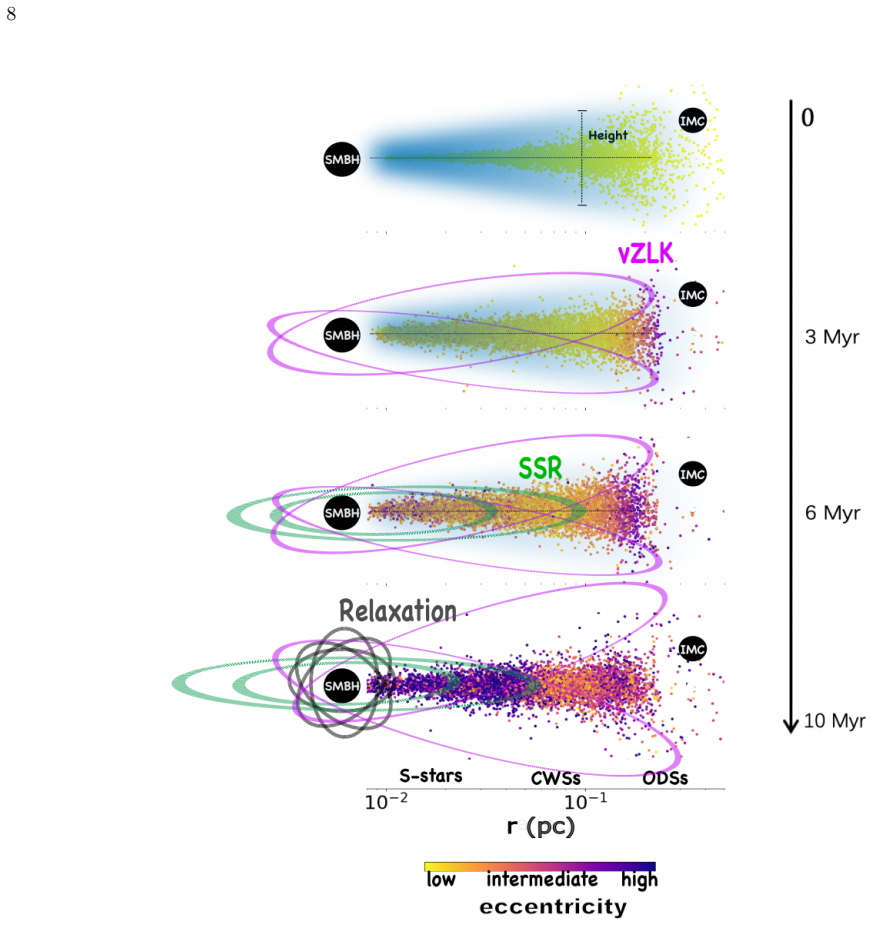
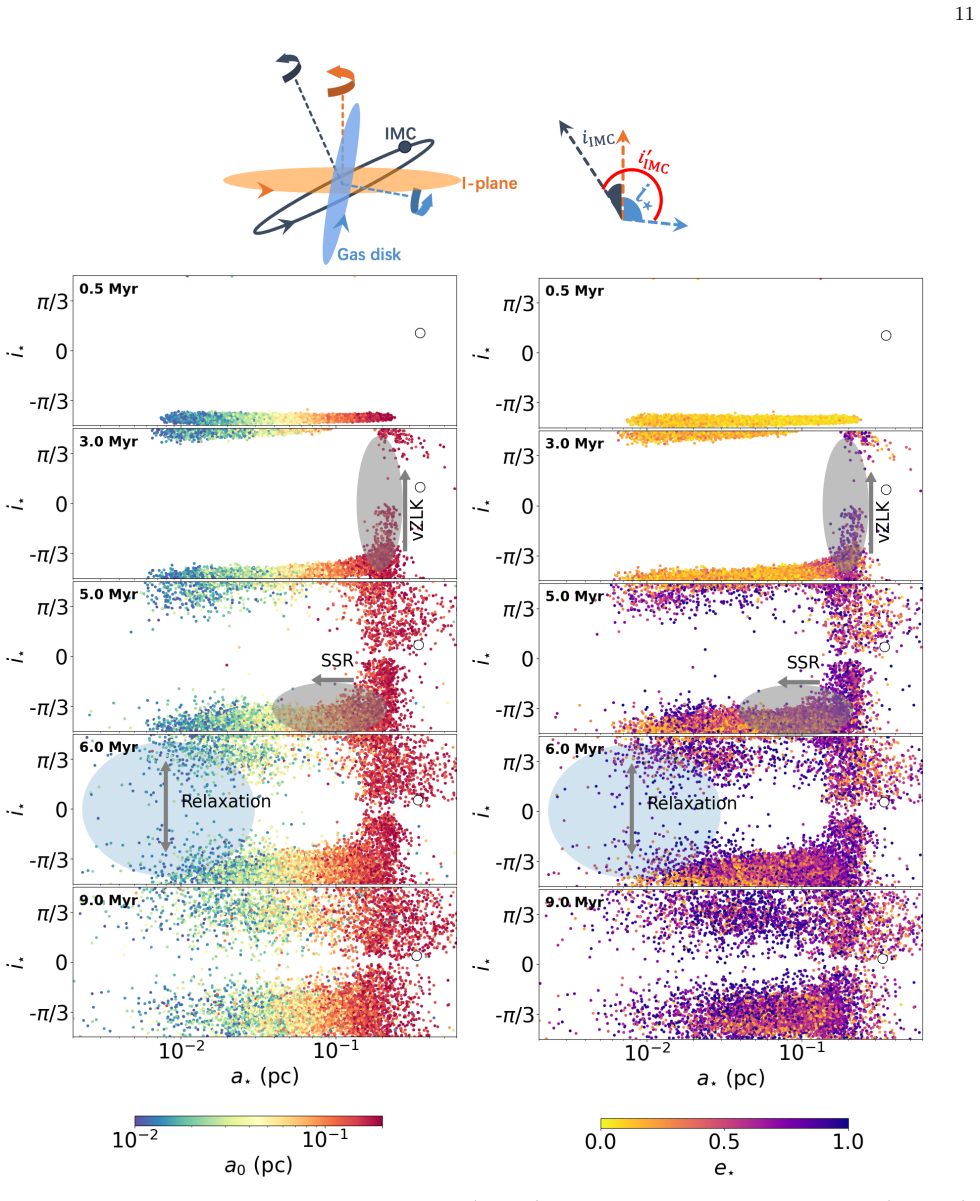
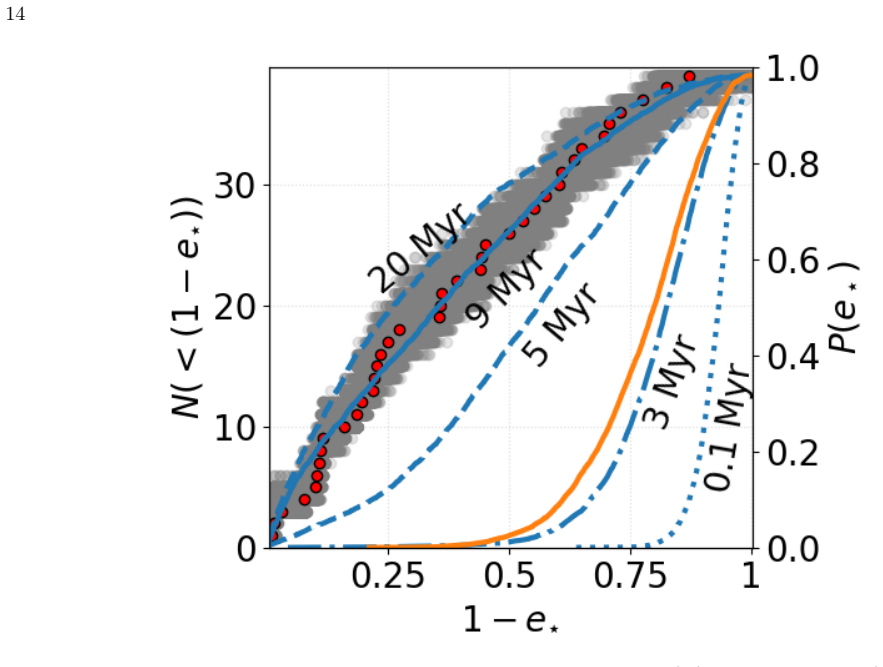
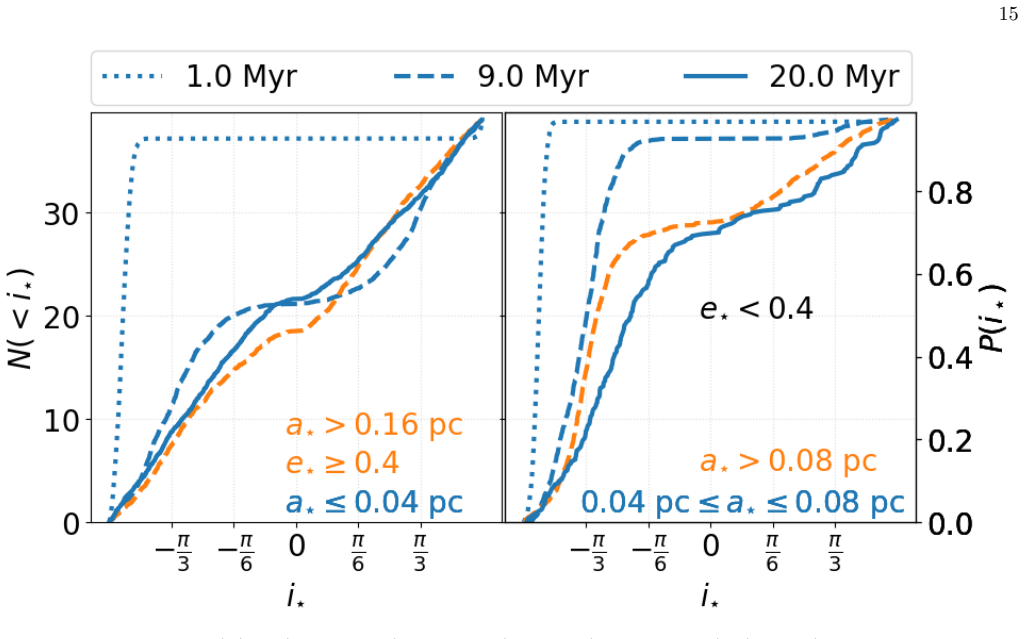
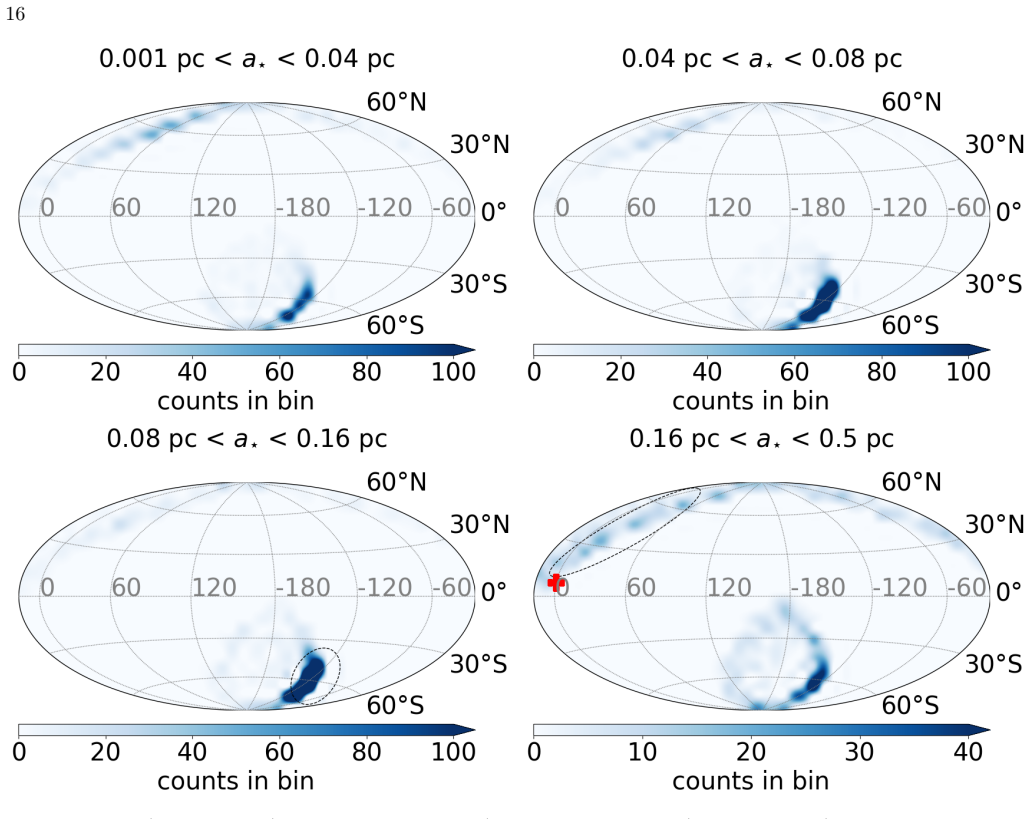
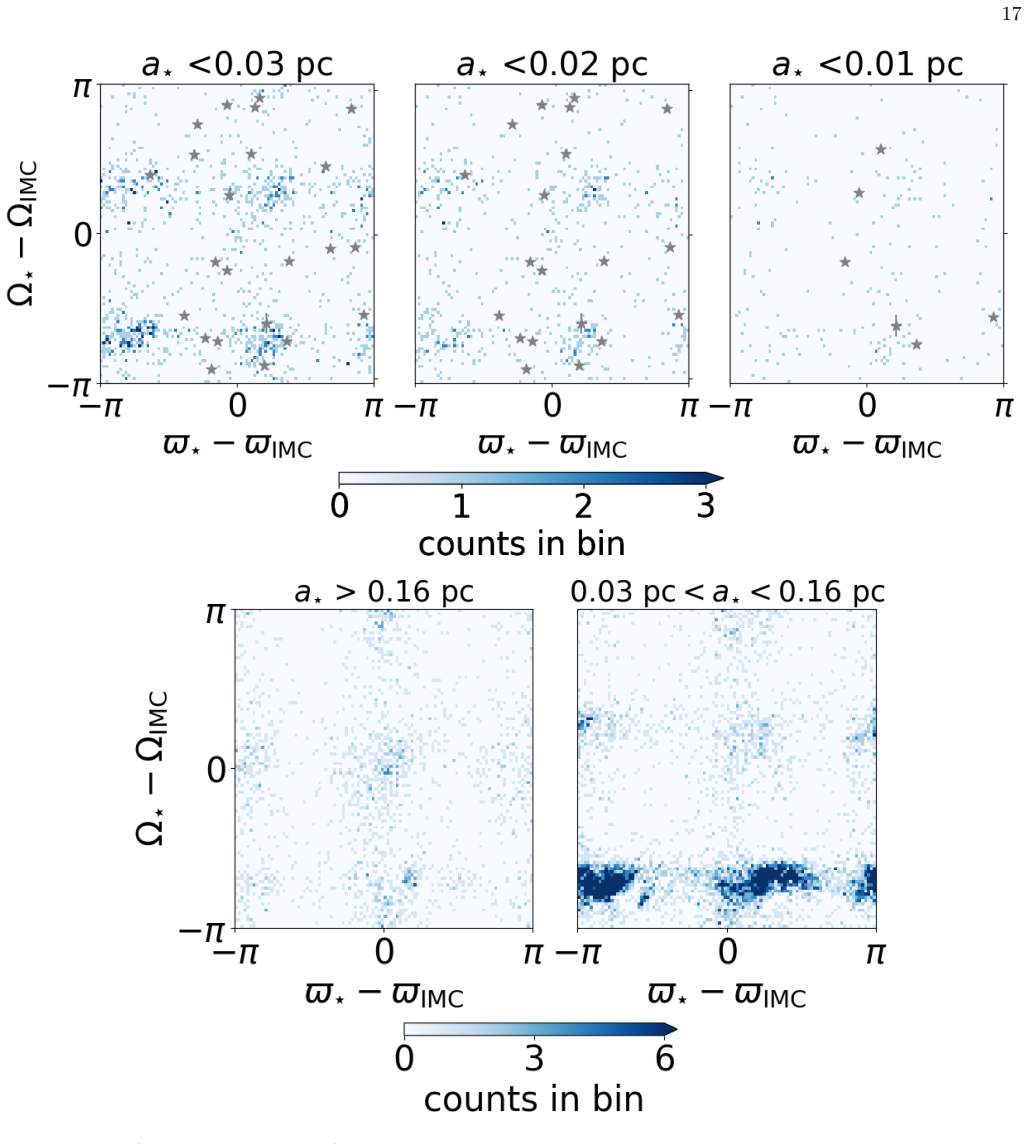
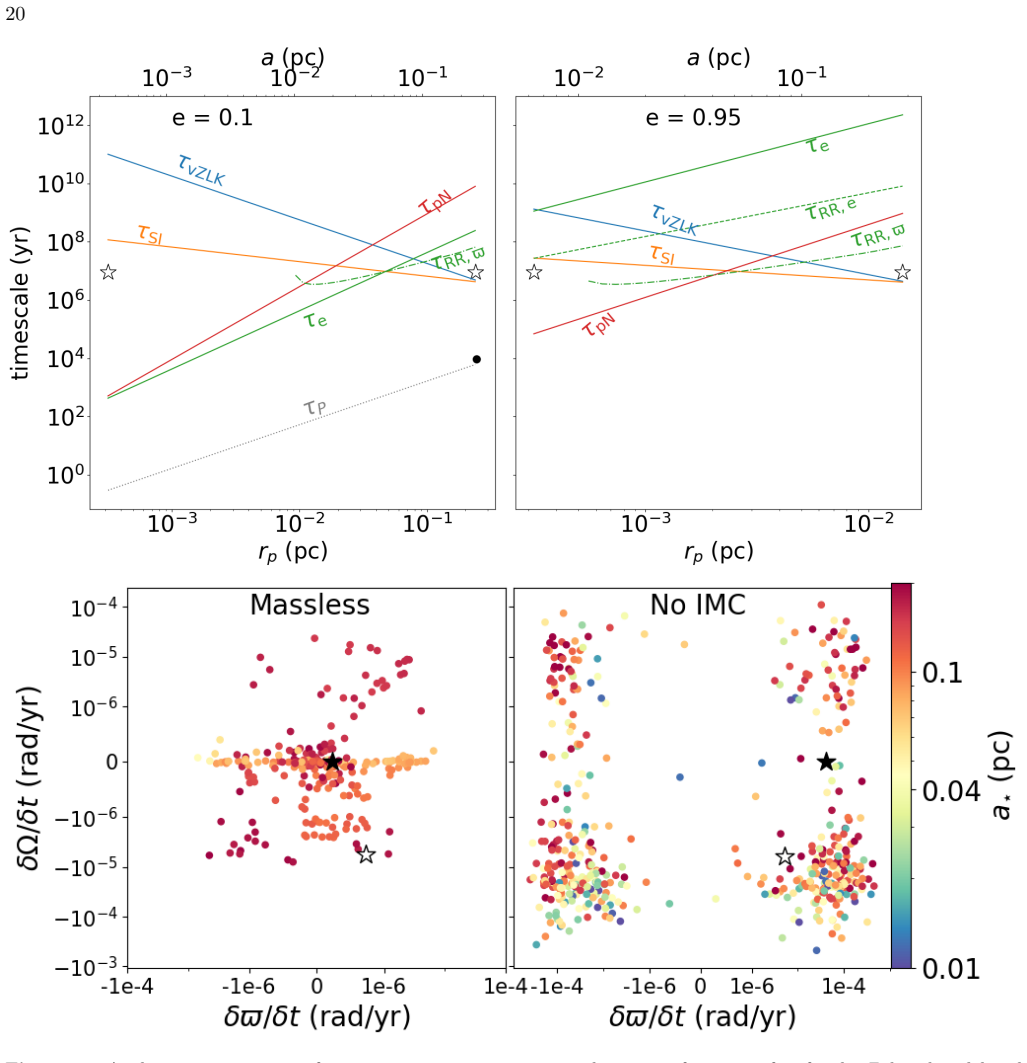
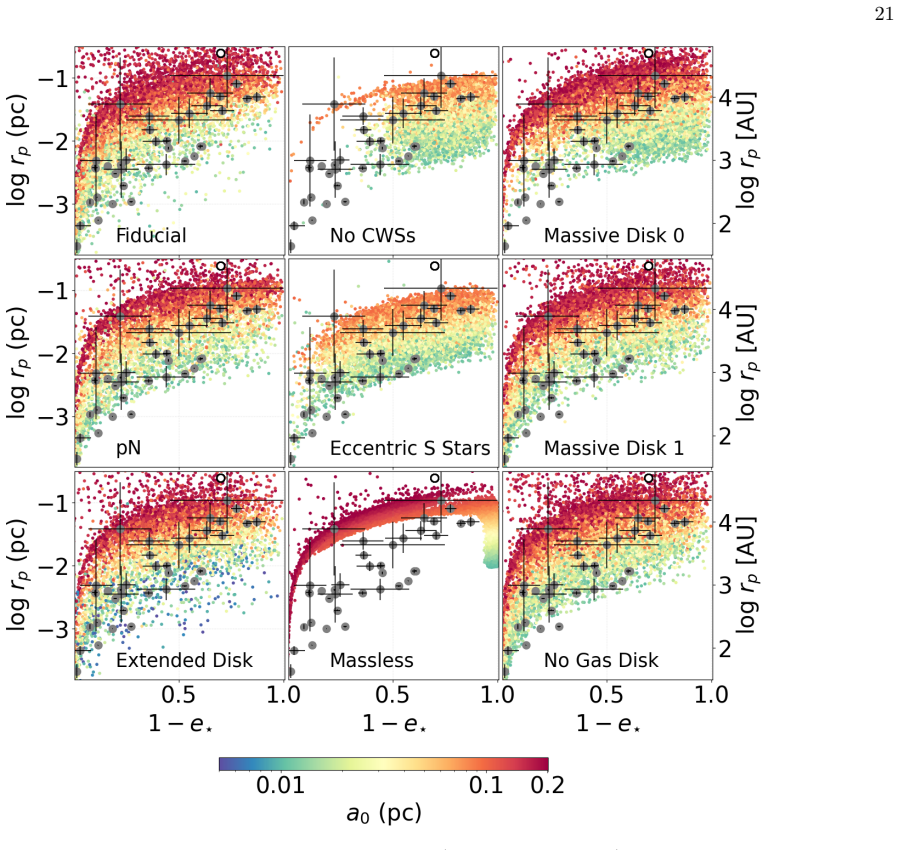
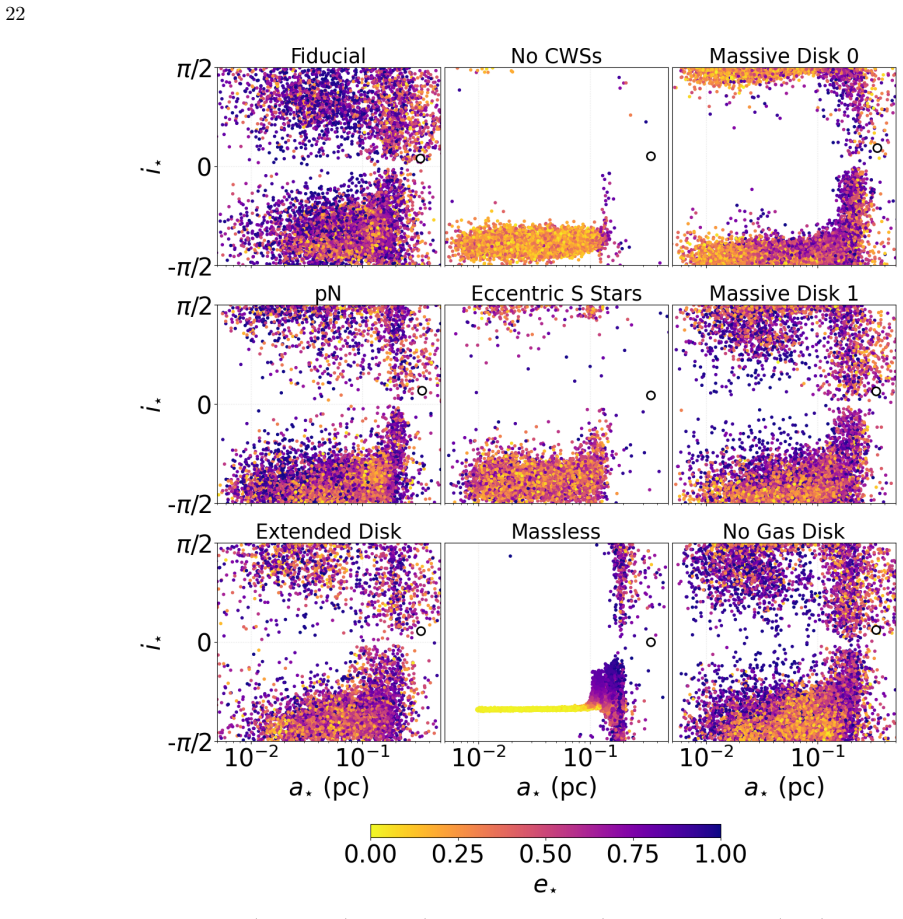
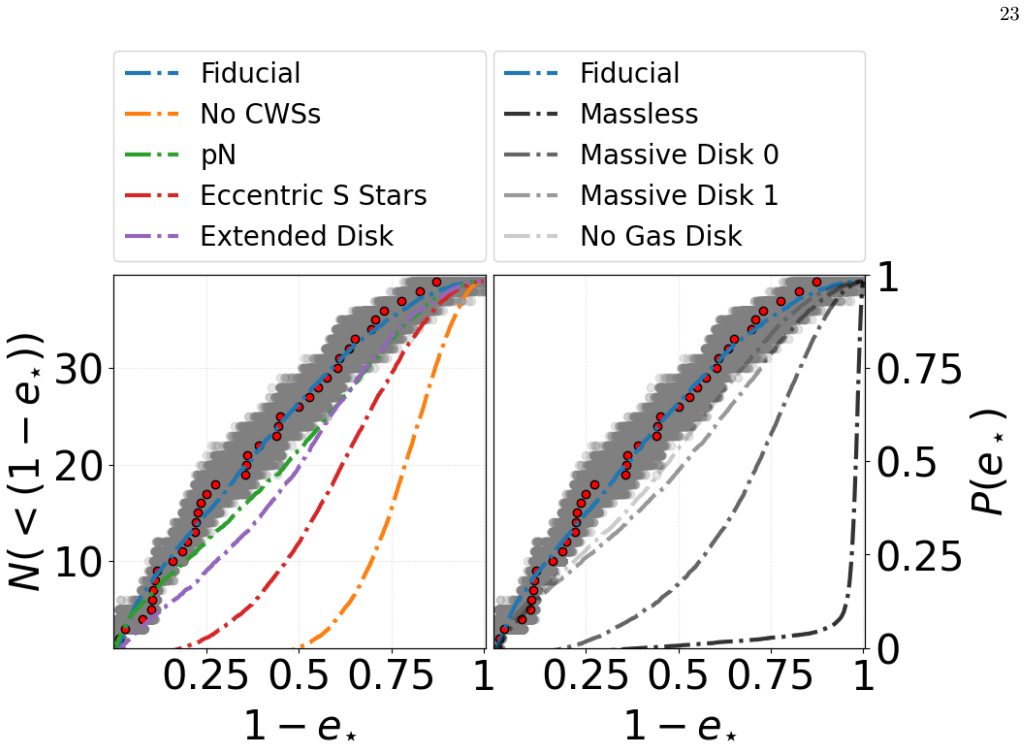
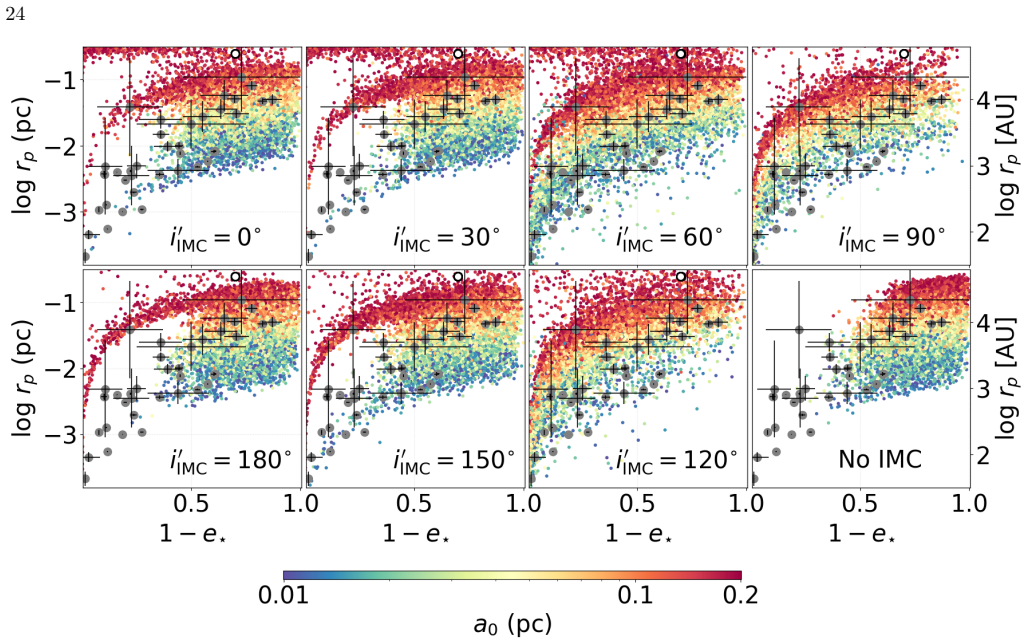
The disparate present-day orbits of the S-stars, CWSs, and ODSs would only be concurrently attainable, within their multi-Myr age, under the combined influence of IMC's secular perturbation and these stars' resonant relaxation in a depleting gaseous-disk environment.
What carries the argument
Secular perturbation by an independent intermediate-mass companion (IMC) of Sgr A* acting together with resonant relaxation inside a depleting gaseous disk.
If this is right
- The single natal disk plus IMC interaction produces both the clockwise disk and the surrounding off-disk population.
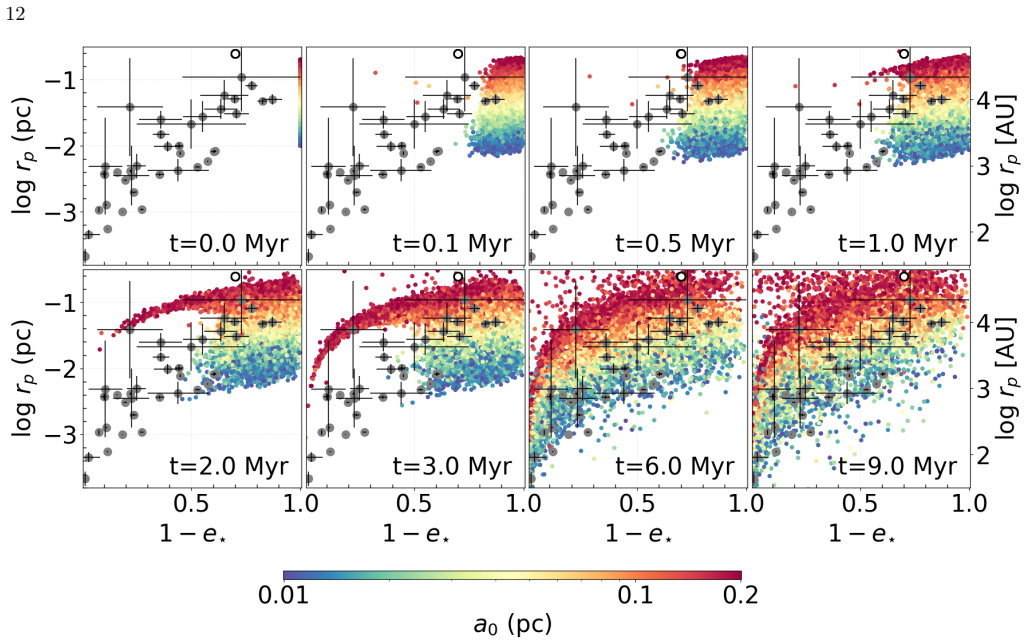
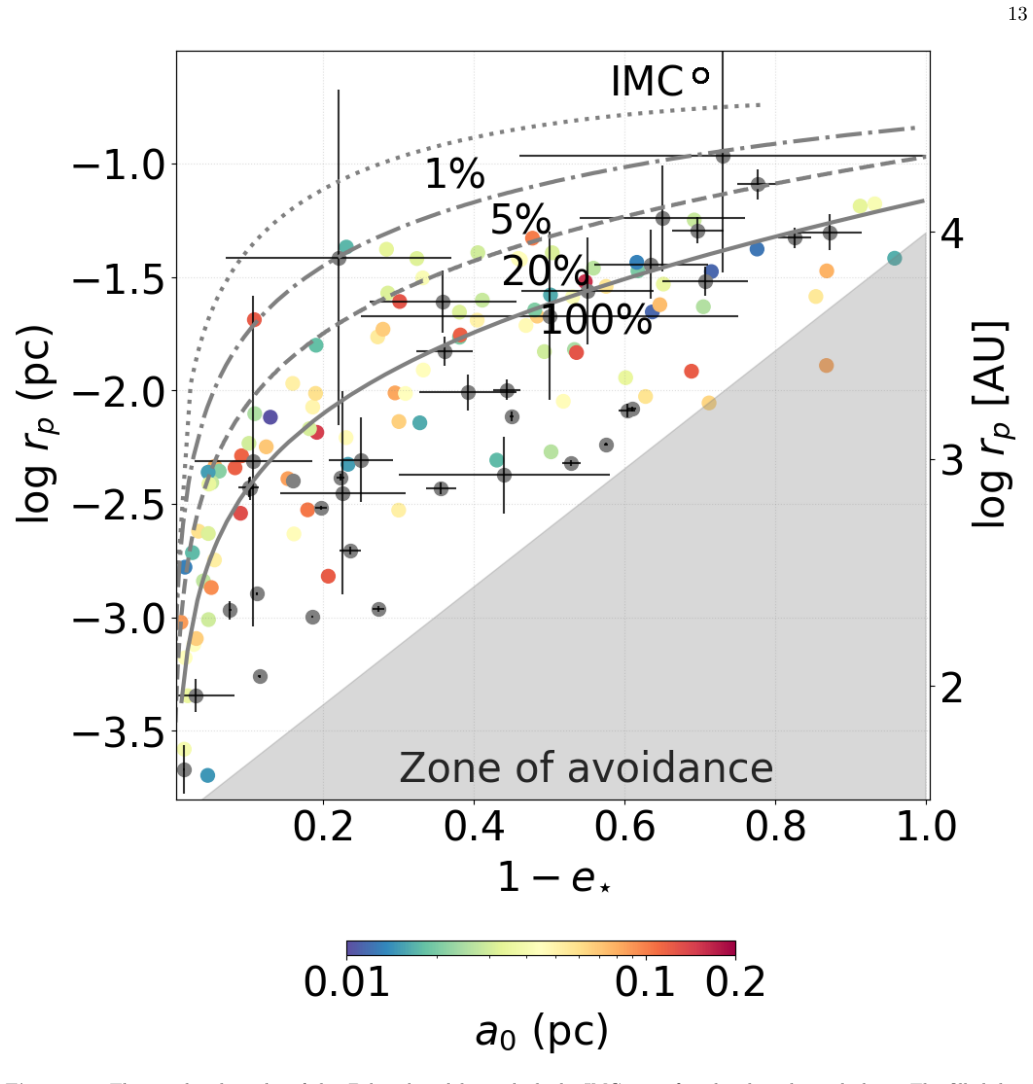
- The same mechanism generates the observed zone of avoidance in S-star eccentricity versus pericenter distance.
- Close encounters with the IMC naturally eject some stars as hyper-velocity stars.
- The model requires the gaseous disk to deplete on a timescale comparable to the stellar ages for resonant relaxation to sculpt the final orbits.
Where Pith is reading between the lines
- If such a companion exists, similar objects may be detectable around other nearby supermassive black holes through stellar-orbit monitoring.
- Removing the IMC from the simulation should prevent the observed orbital diversity from arising within the available time.
- The required disk depletion rate could be tested against independent estimates of gas inflow and star-formation history in the Galactic center.
Load-bearing premise
An independent intermediate-mass companion with mass and orbital parameters sufficient to drive the required secular perturbations must exist on the observed timescale, together with a depleting gaseous disk whose properties permit resonant relaxation to operate as modeled.
What would settle it
Precise astrometric or radial-velocity monitoring that either detects or rules out an object of the predicted mass and orbit within a few tenths of a parsec of Sgr A*.
Figures
read the original abstract
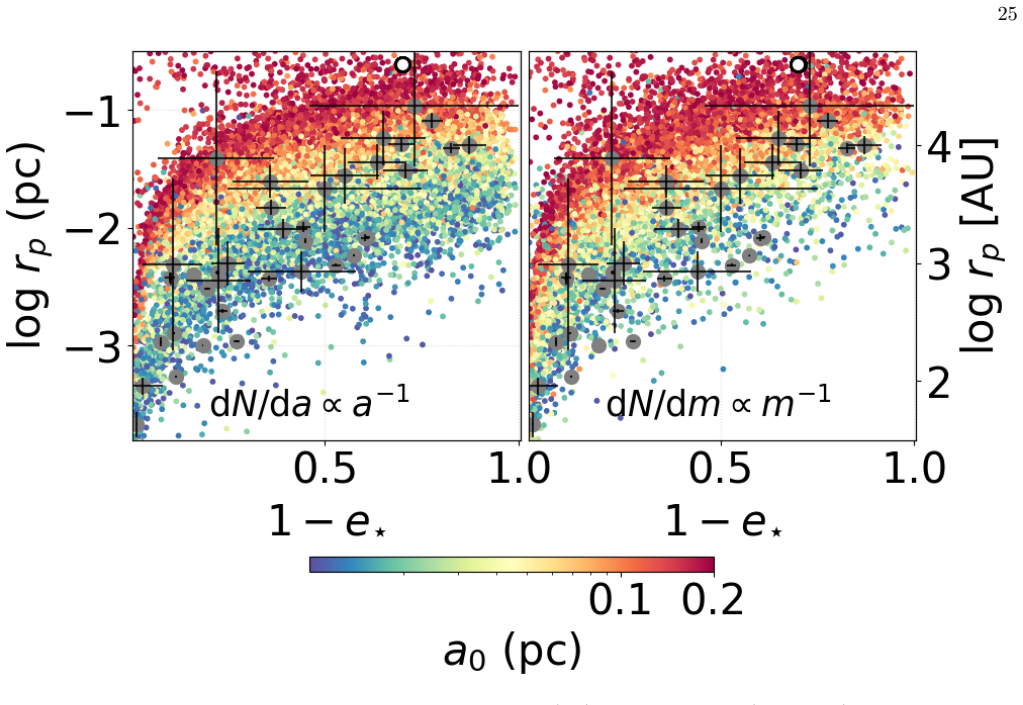
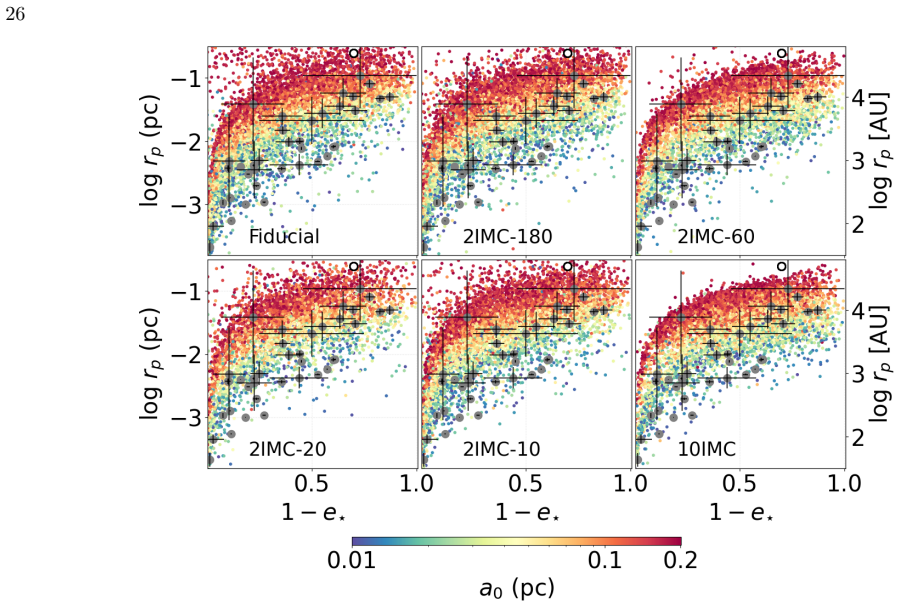
The sub-parsec proximity around the Sgr A$^\star$ supermassive black hole (SMBH) in the center of the Milky Way contains an inner cluster of eccentric S-stars with randomly oriented orbits, a midway-disk of clockwise-rotating stars (CWSs), and a surrounding population of off-the-disk stars (ODSs). Despite their diverse kinematic properties, all three-populations appear to be massive (WR/O/B types) and have similarly limited life span $\tau_\star \sim 6-15$ Myr. Several scenarios, including star formation induced by SMBH's close encounters with one or more gas clouds as well as impulsive close scattering by a putative intermediate-mass companion (IMC) of Sgr A$^\star$ possible an intermediate-mass black hole (IMBH), have been proposed to explain piecemeal for the origin and dynamical evolution of S-stars, CWSs, ODSs, as well as hyper-velocity stars in the Galaxy. But, their coexistence and the origin of a recently discovered zone of avoidance in S-stars' eccentricity-peri-centric-distance distribution remain enigmatic. Here, we construct a unified model to comprehensively take into account these stars' interaction with each other, their single natal disk, and an independent IMC. We show their disparate present-day orbits would only be concurrently attainable, within their multi-Myr age, under the combined influence of IMC's secular perturbation and these stars' resonant relaxation in a depleting gaseous-disk environment.
Editorial analysis
A structured set of objections, weighed in public.
Referee Report
Summary. The manuscript constructs a unified dynamical model for the young massive stars near Sgr A*, comprising the eccentric S-stars, the clockwise disk (CWSs), and off-disk stars (ODSs). It argues that the observed orbital distributions of these co-eval populations (ages ~6-15 Myr) are attainable only through the joint action of secular torques from an intermediate-mass companion (IMC) and resonant relaxation within a depleting gaseous natal disk, while also addressing the reported zone of avoidance in eccentricity-pericenter space.
Significance. If the central claim is substantiated, the work would supply a single coherent channel that simultaneously accounts for the disparate kinematics of three stellar groups whose origins have previously been treated separately. The explicit inclusion of mutual stellar interactions, the natal disk, and an independent IMC represents an integrative step beyond piecemeal scenarios; however, the absence of quantitative control experiments limits the strength of the uniqueness assertion at present.
major comments (2)
- [Abstract] Abstract: the claim that the observed orbits 'would only be concurrently attainable... under the combined influence of IMC's secular perturbation and these stars' resonant relaxation in a depleting gaseous-disk environment' is presented without reported control simulations (IMC mass set to zero, or disk depletion frozen) that would demonstrate the necessity of both ingredients within the stellar lifetime.
- [Abstract] The manuscript supplies no equations, simulation parameters, or quantitative comparisons that would allow an independent check of whether the final distributions are reached only when both the IMC and the depleting disk are active, as asserted in the abstract.
Simulated Author's Rebuttal
We thank the referee for their constructive report. We address each major comment point by point below, agreeing where the manuscript requires strengthening.
read point-by-point responses
-
Referee: [Abstract] Abstract: the claim that the observed orbits 'would only be concurrently attainable... under the combined influence of IMC's secular perturbation and these stars' resonant relaxation in a depleting gaseous-disk environment' is presented without reported control simulations (IMC mass set to zero, or disk depletion frozen) that would demonstrate the necessity of both ingredients within the stellar lifetime.
Authors: We agree that explicit control simulations are needed to substantiate the necessity claim. The manuscript presents results from the complete model (IMC plus depleting disk plus mutual interactions) that reproduce the observed distributions within 6-15 Myr. In the revised version we will add two sets of control runs—one with IMC mass set to zero and one with disk depletion frozen—to demonstrate that neither mechanism alone reaches the observed orbital properties of all three populations on the required timescale. revision: yes
-
Referee: [Abstract] The manuscript supplies no equations, simulation parameters, or quantitative comparisons that would allow an independent check of whether the final distributions are reached only when both the IMC and the depleting disk are active, as asserted in the abstract.
Authors: The governing equations for secular torques from the IMC and for resonant relaxation in a time-dependent disk are given in Section 2; numerical parameters (IMC mass range, disk surface-density evolution, stellar number and masses) appear in Section 3 and Table 1; and direct quantitative comparisons of final eccentricity, inclination, and pericenter distributions with observations are shown in Section 4 and Figures 5–7. To make the uniqueness assertion independently verifiable we will also include the control-run outcomes and a short methods summary in the revised abstract. revision: partial
Circularity Check
No significant circularity detected.
full rationale
The manuscript presents a numerical unified model that incorporates an assumed IMC and a depleting gaseous disk to demonstrate concurrent attainability of the observed S-star, CWS, and ODS orbits within the stellar lifetime. The central claim is framed as a demonstration of possibility under these assumptions rather than a closed derivation that reduces by construction to its inputs. No equations, fitted parameters renamed as predictions, or self-citations are exhibited in the text that would trigger any of the enumerated circularity patterns. The model remains self-contained against external benchmarks as a consistency check.
Axiom & Free-Parameter Ledger
free parameters (2)
- IMC mass and orbit
- gas-disk depletion timescale
axioms (1)
- domain assumption All three stellar populations formed in a single natal disk and share the same 6-15 Myr age.
invented entities (1)
-
intermediate-mass companion (IMC) of Sgr A*
no independent evidence
Reference graph
Works this paper leans on
-
[1]
Aarseth, S. J. 2003, Gravitational N-Body Simulations (Cambridge University Press)
2003
-
[2]
Aarseth, S. J., Lin, D. N. C., & Palmer, P. L. 1993, Astrophys. J., 403, 351, doi: 10.1086/172208
-
[3]
Alexander, R. D., Begelman, M. C., & Armitage, P. J. 2007, Astrophys. J., 654, 907, doi: 10.1086/509709
-
[4]
Ali, B., Paul, D., Eckart, A., et al. 2020, Astrophys. J., 896, 100, doi: 10.3847/1538-4357/ab93ae
-
[5]
Ali-Dib, M., & Lin, D. N. C. 2023, Mon. Not. R. Astron. Soc., 526, 5824, doi: 10.1093/mnras/stad2774
-
[6]
Alig, C., Schartmann, M., Burkert, A., & Dolag, K. 2013, Astrophys. J., 771, 119, doi: 10.1088/0004-637X/771/2/119
-
[7]
Artymowicz, P., Lin, D. N. C., & Wampler, E. J. 1993, Astrophys. J., 409, 592, doi: 10.1086/172690
-
[8]
Baganoff, F. K., Maeda, Y., Morris, M., et al. 2003, Astrophys. J., 591, 891, doi: 10.1086/375145
-
[9]
Evidence for Warped Disks of Young Stars in the Galactic Center
Bartko, H., Martins, F., Fritz, T. K., et al. 2009, Astrophys. J., 697, 1741, doi: 10.1088/0004-637X/697/2/174110. 48550/arXiv.0811.3903
work page internal anchor Pith review Pith/arXiv arXiv doi:10.1088/0004-637x/697/2/174110 2009
-
[10]
Bartko, H., Martins, F., Trippe, S., et al. 2010, Astrophys. J., 708, 834, doi: 10.1088/0004-637X/708/1/83410.48550/ arXiv.0908.2177
-
[11]
Baumgardt, H., Gualandris, A., & Portegies Zwart, S. 2006, Mon. Not. R. Astron. Soc., 372, 174, doi: 10.1111/j.1365-2966.2006.10818.x
-
[12]
The Astronomical Journal , author =
Bhaskar, H., Li, G., Hadden, S., Payne, M. J., & Holman, M. J. 2021, Astron. J., 161, 48, doi: 10.3847/1538-3881/abcbfc
-
[13]
1987, Galactic dynamics (Princeton University Press)
Binney, J., & Tremaine, S. 1987, Galactic dynamics (Princeton University Press)
1987
-
[14]
Bonnell, I. A., & Rice, W. K. M. 2008, Science, 321, 1060, doi: 10.1126/science.1160653
-
[15]
Burkert, A., Gillessen, S., Lin, D. N. C., et al. 2024, Astrophys. J., 962, 81, doi: 10.3847/1538-4357/ad17bb
-
[16]
Cantiello, M., Jermyn, A. S., & Lin, D. N. C. 2021, Astrophys. J., 910, 94, doi: 10.3847/1538-4357/abdf4f
-
[17]
Chu, D. S., Do, T., Ghez, A., et al. 2023, Astrophys. J., 948, 94, doi: 10.3847/1538-4357/acc93e
-
[18]
Davies, M. B., & Lin, D. N. C. 2020, Mon. Not. R. Astron. Soc., 498, 3452, doi: 10.1093/mnras/staa2590
-
[19]
Do, T., Ghez, A. M., Morris, M. R., et al. 2009, Astrophys. J., 703, 1323, doi: 10.1088/0004-637X/703/2/1323
-
[20]
Eisenhauer, F., Genzel, R., Alexander, T., et al. 2005, Astrophys. J., 628, 246, doi: 10.1086/430667 Event Horizon Telescope Collaboration, Akiyama, K.,
-
[21]
Alberdi, A., et al. 2022a, Astrophys. J. Lett., 930, L12, doi: 10.3847/2041-8213/ac6674 —. 2022b, Astrophys. J. Lett., 930, L17, doi: 10.3847/2041-8213/ac6756
-
[22]
Fragione, G., & Loeb, A. 2020, Astrophys. J. Lett., 901, L32, doi: 10.3847/2041-8213/abb9b4
-
[23]
Frank, J., & Rees, M. J. 1976, Mon. Not. R. Astron. Soc., 176, 633, doi: 10.1093/mnras/176.3.633
-
[24]
Freitag, M., Amaro-Seoane, P., & Kalogera, V. 2006, Astrophys. J., 649, 91, doi: 10.1086/506193
-
[25]
K., Gillessen, S., Dodds-Eden, K., et al
Fritz, T. K., Gillessen, S., Dodds-Eden, K., et al. 2010, ApJ, 721, 395, doi: 10.1088/0004-637X/721/1/395
-
[26]
Garaud, P., & Lin, D. N. C. 2007, Astrophys. J., 654, 606, doi: 10.1086/509041
-
[27]
2020, ApJ, 904, 118, doi: 10.3847/1538-4357/abbf4f —
Generozov, A. 2020, ApJ, 904, 118, doi: 10.3847/1538-4357/abbf4f —. 2021, MNRAS, 501, 3088, doi: 10.1093/mnras/staa3851
-
[28]
The Astrophysical Journal , author =
Generozov, A., & Madigan, A.-M. 2020, ApJ, 896, 137, doi: 10.3847/1538-4357/ab94bc
-
[29]
Generozov, A., Nayakshin, S., & Madigan, A. M. 2022, MNRAS, 512, 4100, doi: 10.1093/mnras/stac419
-
[30]
Generozov, A., Perets, H. B., Bordoni, M. S., et al. 2025, A&A, 696, A68, doi: 10.1051/0004-6361/202453272
-
[31]
Genzel, R., Eckart, A., Ott, T., & Eisenhauer, F. 1997, Mon. Not. R. Astron. Soc., 291, 219, doi: 10.1093/mnras/291.1.219 31
-
[32]
2010, Reviews of Modern Physics, 82, 3121, doi: 10.1103/RevModPhys.82.3121
Genzel, R., Eisenhauer, F., & Gillessen, S. 2010, Reviews of Modern Physics, 82, 3121, doi: 10.1103/RevModPhys.82.3121
-
[33]
The Astrophysical Journal , author =
Genzel, R., Sch¨ odel, R., Ott, T., et al. 2003, Astrophys. J., 594, 812, doi: 10.1086/377127
-
[34]
Gerhard, O. 2001, Astrophys. J.l, 546, L39, doi: 10.1086/318054
-
[35]
M., Becklin, E., Duchjne, G., et al
Ghez, A. M., Becklin, E., Duchjne, G., et al. 2003, Astronomische Nachrichten Supplement, 324, 527, doi: 10.1002/asna.200385103
-
[36]
Ghez, A. M., Klein, B. L., Morris, M., & Becklin, E. E. 1998, Astrophys. J., 509, 678, doi: 10.1086/306528
-
[37]
Ghez, A. M., Salim, S., Hornstein, S. D., et al. 2005, Astrophys. J., 620, 744, doi: 10.1086/427175
-
[38]
Gillessen, S., Plewa, P. M., Eisenhauer, F., et al. 2017, Astrophys. J., 837, 30, doi: 10.3847/1538-4357/aa5c41
-
[39]
Goodman, J. 2003, Mon. Not. R. Astron. Soc., 339, 937, doi: 10.1046/j.1365-8711.2003.06241.x GRAVITY Collaboration, Abuter, R., Amorim, A., et al. 2020, Astron. Astrophys., 636, L5, doi: 10.1051/0004-6361/202037813 GRAVITY Collaboration, Abuter, R., Aimar, N., et al. 2023, Astron. Astrophys., 677, L10, doi: 10.1051/0004-6361/202347416 Gravity Collaboratio...
-
[40]
Gualandris, A., Gillessen, S., & Merritt, D. 2010, Mon. Not. R. Astron. Soc., 409, 1146, doi: 10.1111/j.1365-2966.2010.17373.x
-
[41]
The Astrophysical Journal , author =
Gualandris, A., & Merritt, D. 2009, Astrophys. J., 705, 361, doi: 10.1088/0004-637X/705/1/361 G¨ urkan, M. A., & Rasio, F. A. 2005, Astrophys. J., 628, 236, doi: 10.1086/430694
-
[42]
Habibi, M., Gillessen, S., Martins, F., et al. 2017, Astrophys. J., 847, 120, doi: 10.3847/1538-4357/aa876f
-
[43]
Hansen, B. M. S., & Milosavljevi´ c, M. 2003, Astrophys. J. Lett., 593, L77, doi: 10.1086/378182 Heißel, G., Paumard, T., Perrin, G., & Vincent, F. 2022, Astron. Astrophys., 660, A13, doi: 10.1051/0004-6361/202142114
-
[44]
Hills, J. G. 1975, Nature, 254, 295, doi: 10.1038/254295a0 —. 1980, Astrophys. J., 235, 986, doi: 10.1086/157703 —. 1988, Nature, 331, 687, doi: 10.1038/331687a0
-
[45]
Hobbs, A., & Nayakshin, S. 2009, MNRAS, 394, 191, doi: 10.1111/j.1365-2966.2008.14359.x
-
[46]
Hopman, C., & Alexander, T. 2006, Astrophys. J., 645, 1152, doi: 10.1086/504400
-
[47]
Huang, J., Lin, D. N. C., & Shields, G. 2023, Mon. Not. R. Astron. Soc., 525, 5702, doi: 10.1093/mnras/stad2642
-
[48]
Ida, S., & Lin, D. N. C. 2004, Astrophys. J., 604, 388, doi: 10.1086/381724
-
[49]
Innanen, K. A., Zheng, J. Q., Mikkola, S., & Valtonen, M. J. 1997, Astron. J., 113, 1915, doi: 10.1086/118405
-
[50]
Iorio, L. 2020, Astrophys. J., 904, 186, doi: 10.3847/1538-4357/abbfb5
-
[51]
Jia, S., Xu, N., Lu, J. R., et al. 2023, Astrophys. J., 949, 18, doi: 10.3847/1538-4357/acb939
-
[52]
Kim, S. S., & Morris, M. 2003, Astrophys. J., 597, 312, doi: 10.1086/378347
-
[53]
Kocsis, B., & Tremaine, S. 2011, Mon. Not. R. Astron. Soc., 412, 187, doi: 10.1111/j.1365-2966.2010.17897.x10. 48550/arXiv.1006.0001 —. 2015, Mon. Not. R. Astron. Soc., 448, 3265, doi: 10.1093/mnras/stv05710.48550/arXiv.1406.1178
-
[54]
1998, Icarus, 131, 171, doi: 10.1006/icar.1997.5840
Kokubo, E., & Ida, S. 1998, Icarus, 131, 171, doi: 10.1006/icar.1997.5840
-
[55]
Kozai, Y. 1962, Astron. J, 67, 591, doi: 10.1086/108790
-
[56]
Krabbe, A., Genzel, R., Eckart, A., et al. 1995, Astrophys. J. Lett., 447, L95, doi: 10.1086/309579
-
[57]
1997, Astron
Laskar, J. 1997, Astron. Astrophys., 317, L75
1997
-
[58]
1918, Physikalische Zeitschrift, 19, 156
Lense, J., & Thirring, H. 1918, Physikalische Zeitschrift, 19, 156
1918
-
[59]
Levin, Y. 2006, Astrophys. J., 653, 1203, doi: 10.1086/507830 —. 2007, Mon. Not. R. Astron. Soc., 374, 515, doi: 10.1111/j.1365-2966.2006.11155.x —. 2024, ApJ, 975, 278, doi: 10.3847/1538-4357/ad81f5
-
[60]
Levin, Y., & Beloborodov, A. M. 2003, Astrophys. J. Lett., 590, L33, doi: 10.1086/376675
-
[61]
Levin, Y., Wu, A., & Thommes, E. 2005, Astrophys. J., 635, 341, doi: 10.1086/497286
-
[62]
Li, Y.-P., Chen, Y.-X., Lin, D. N. C., & Zhang, X. 2021, Astrophys. J., 906, 52, doi: 10.3847/1538-4357/abc883
-
[63]
Lidov, M. L. 1962, Planetary and Space Science, 9, 719, doi: 10.1016/0032-0633(62)90129-0 L¨ ockmann, U., & Baumgardt, H. 2008, Mon. Not. R. Astron. Soc., 384, 323, doi: 10.1111/j.1365-2966.2007.12699.x —. 2009, Mon. Not. R. Astron. Soc., 394, 1841, doi: 10.1111/j.1365-2966.2009.14466.x L¨ ockmann, U., Baumgardt, H., & Kroupa, P. 2009, Mon. Not. R. Astron...
-
[64]
Lu, J. R., Ghez, A. M., Hornstein, S. D., et al. 2006, Journal of Physics: Conference Series, 54, 279, doi: 10.1088/1742-6596/54/1/044
-
[65]
Lu, J. R., Ghez, A. M., Hornstein, S. D., et al. 2009, Astrophys. J., 690, 1463, doi: 10.1088/0004-637X/690/2/1463 32
-
[66]
Lu, Y., Yu, Q., & Lin, D. N. C. 2007, Astrophys. J. Lett., 666, L89, doi: 10.1086/521708
-
[67]
MacLeod, M., & Lin, D. N. C. 2020, Astrophys. J., 889, 94, doi: 10.3847/1538-4357/ab64db
-
[68]
Madigan, A.-M., Hopman, C., & Levin, Y. 2011, Astrophys. J., 738, 99, doi: 10.1088/0004-637X/738/1/99
-
[69]
Astronomy and Astrophysics , author =
Maillard, J. P., Paumard, T., Stolovy, S. R., & Rigaut, F. 2004, Astron. Astrophys., 423, 155, doi: 10.1051/0004-6361:20034147
-
[70]
Marks, M., Kroupa, P., Dabringhausen, J., & Pawlowski, M. S. 2012, MNRAS, 422, 2246, doi: 10.1111/j.1365-2966.2012.20767.x
-
[71]
Matsubayashi, T., Makino, J., & Ebisuzaki, T. 2007, Astrophys. J., 656, 879, doi: 10.1086/510344
-
[72]
2013, Dynamics and Evolution of Galactic Nuclei (Princeton University Press)
Merritt, D. 2013, Dynamics and Evolution of Galactic Nuclei (Princeton University Press)
2013
-
[73]
Merritt, D., Gualandris, A., & Mikkola, S. 2009, Astrophys. J. Lett., 693, L35, doi: 10.1088/0004-637X/693/1/L35
-
[74]
W., Thorne, K
Misner, C. W., Thorne, K. S., & Wheeler, J. A. 1973, Gravitation (Princeton University Press)
1973
-
[75]
Murray, C. D., & Dermott, S. F. 2000, Solar System Dynamics (Cambridge University Press), doi: 10.1017/CBO9781139174817
-
[76]
Nagasawa, M., Lin, D. N. C., & Thommes, E. 2005, Astrophys. J., 635, 578, doi: 10.1086/497386
-
[77]
Annual Review of Astronomy and Astrophysics , author =
Naoz, S. 2016, Annu. Rev. Astron. Astrophys, 54, 441, doi: 10.1146/annurev-astro-081915-023315
-
[78]
Naoz, S., Rose, S. C., Michaely, E., et al. 2022, Astrophys. J. Lett., 927, L18, doi: 10.3847/2041-8213/ac574b
-
[79]
Nayakshin, S., Cuadra, J., & Springel, V. 2007, Mon. Not. R. Astron. Soc., 379, 21, doi: 10.1111/j.1365-2966.2007.11938.x
-
[80]
Owen, J. E., & Lin, D. N. C. 2023, Mon. Not. R. Astron. Soc., 519, 397, doi: 10.1093/mnras/stac3506
discussion (0)
Sign in with ORCID, Apple, or X to comment. Anyone can read and Pith papers without signing in.