REVIEW 3 major objections 3 minor 1 cited by
Even without a local tensor product structure, a lattice gauge theory obeys a generalized LOCC theorem: local operations and classical communication cannot generate operationally accessible entanglement.
Reviewed by Pith at T0; open to challenge. T0 means a machine referee read the full paper against a public rubric. the ladder, T0–T4 →
T0 review · deepseek-v4-flash
2026-08-03 14:35 UTC pith:7YLJKHNZ
load-bearing objection A careful and mostly sound lattice-gauge framework for local operations and a generalized LOCC theorem; the FME application has an unmodeled relaxation step that is asserted rather than derived, and the stress-test objection overclaims in a way that should not be repeated. the 3 major comments →
Local Operations and Field Mediated Entanglement without a Local Tensor Product Structure
The pith
A machine-rendered reading of the paper's core claim, the machinery that carries it, and where it could break.
Core claim
The central claim is a boxed theorem: no operationally accessible entanglement can be generated through classical communication and generalized local operations of a region's local algebra. The authors construct gauge-invariant local algebras in a two-dimensional lattice gauge model of electromagnetism, diagonalize their center to get superselection sectors K, and show the physical Hilbert space decomposes as ⊕_K H^K_A ⊗ H^K_B ⊗ H^K_AB, with local algebras acting block-diagonally. Entanglement is defined sector-wise, so the standard LOCC theorem applies per sector. For field-mediated entanglement, they give an explicit dressed-operator mechanism for creating spatial superpositions of qubit s
What carries the argument
The central object is the Operational Decomposition: a gauge theory's physical Hilbert space, which cannot factorize as a spatial tensor product, is written as a direct sum over superselection sectors K of ordinary tensor products, ⊕_K H^K_A ⊗ H^K_B ⊗ H^K_AB, with the gauge-invariant local algebras acting block-diagonally on these sectors. This sector-wise tensor product structure is obtained by diagonalizing the center of the local algebra—whose elements include the constraints inside the region and edge terms crossing its boundary—and then projecting onto the constraint-satisfying sector. Within each K-sector the standard notions of local operations, entanglement, and the LOCC theorem appl
Load-bearing premise
The physical Hilbert space admits the Operational Decomposition H_phy = ⊕_K H^K_A ⊗ H^K_B ⊗ H^K_AB with block-diagonal local algebras—a decomposition obtained by diagonalizing the center of a local algebra of unbounded position and momentum operators, a step whose rigorous justification the paper defers to a later construction.
What would settle it
A direct check: simulate the lattice model for small N×N and search over all sequences of generalized local operations (the block-diagonal local algebras of Eq. (46)) plus classical communication, with no autonomous field evolution. The paper's embezzlement argument predicts every such sequence leaves the global state unchanged (U' U = identity); any sequence that produces a spin-entangled state with H(σ^A)_χ > 0 would falsify the proposed extension of the LOCC theorem. Alternatively, a rigorous demonstration that the center of the local algebra generated by unbounded position–momentum operato
If this is right
- The LOCC-based reasoning in proposed table-top tests of the quantum nature of gravity is valid for a discretized gauge theory: observed spin entanglement can only come from non-classical field interactions, even though no global local tensor product structure exists.
- A meaningful, operationally consistent notion of local operations and entanglement exists in gauge theories with non-factorizable Hilbert spaces, provided the center of the local algebra yields a discrete superselection-sector decomposition.
- The field-mediated entanglement protocol in the toy model produces an explicit, gauge-invariant mechanism for creating spatial superpositions of sources: dressing the source-displacement operators with a compensating field shift.
- The entanglement generated is not an artifact of entanglement embezzlement: applying the local dressed operations alone leaves the global state unchanged; the entanglement increase requires the intermediate autonomous field evolution.
- In the continuum limit the model reduces to two-dimensional QED, reproducing the known Coulomb potential and ground-state structure; however, the sector decomposition is not directly promotable to the strict continuum limit, where algebras become type-III.
Where Pith is reading between the lines
- If the same sector-wise decomposition scheme generalizes to linearized gravity—which the paper leaves open and flags as difficult—gravitationally mediated entanglement arguments would inherit the same LOCC protection, potentially closing a loophole in tests aimed at the quantum nature of gravity.
- The edge terms that label the K-sectors resemble known edge modes in gauge theories with boundaries; connecting them to quantum reference frames, as the paper suggests, could give these sectors an independent operational meaning.
- A testable extension: in the finite-resolution regime where the lattice spacing is reduced but not taken to zero, the type-I sector structure persists; probing entanglement generation at increasingly fine lattices could show how the LOCC conclusion degrades as the strict continuum limit is approached.
- The dressed operators that create source superpositions give a concrete template for realizing gauge-invariant 'superposition creation' on programmable lattice simulators, making the protocol's entanglement generation testable in engineered gauge-theory settings.
Editorial analysis
A structured set of objections, weighed in public.
Referee Report
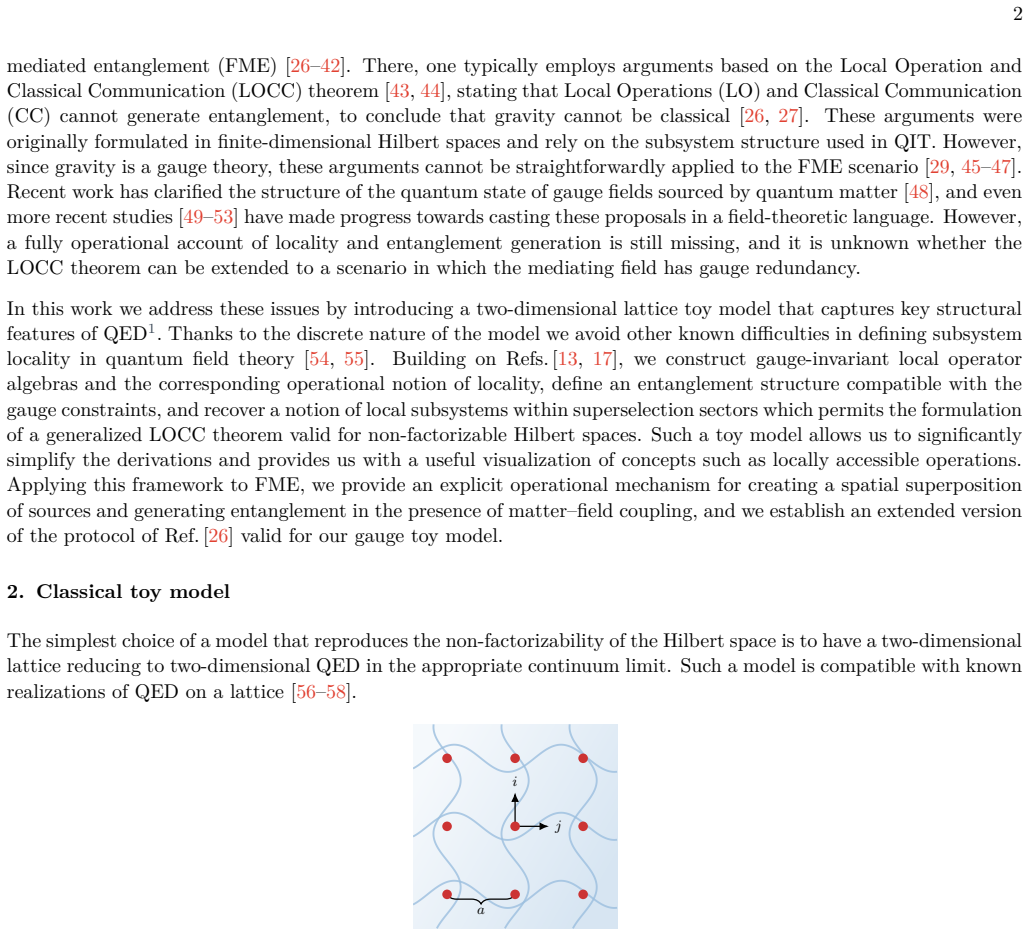
Summary. The paper develops a 2D lattice gauge toy model that mimics key structural features of 2+1D QED, constructs gauge-invariant local operator algebras, and derives two Hilbert-space decompositions (Operational and Split) that provide a sector-wise tensor-product structure in the absence of a global factorization. On this basis the authors state a generalized LOCC theorem and apply it to a field-mediated entanglement (FME) protocol, claiming that the spin entanglement generated in the protocol necessarily arises from non-classical field-mediated interactions. The argument is supported by extensive appendices deriving ground states, dressing operators, and the detailed protocol steps.
Significance. If correct, the paper would be a meaningful advance: it offers an operational notion of locality and entanglement in a constrained gauge-like system, and it would provide a concrete setting in which LOCC-based reasoning, as used in BMV-type gravity experiments, survives the absence of a local tensor product structure. The work is largely self-contained, uses no fitted parameters, and gives detailed derivations in the appendices. The sector-wise extension of LOCC is natural and the explicit construction of dressed source-superposition operations is valuable. However, two load-bearing steps are presently not established: the disentangling transition from Eqs. (54) to (55), and the rigorous status of the Operational Decomposition on which the generalized LOCC theorem rests. These issues prevent the central FME claim from being accepted as it stands.
major comments (3)
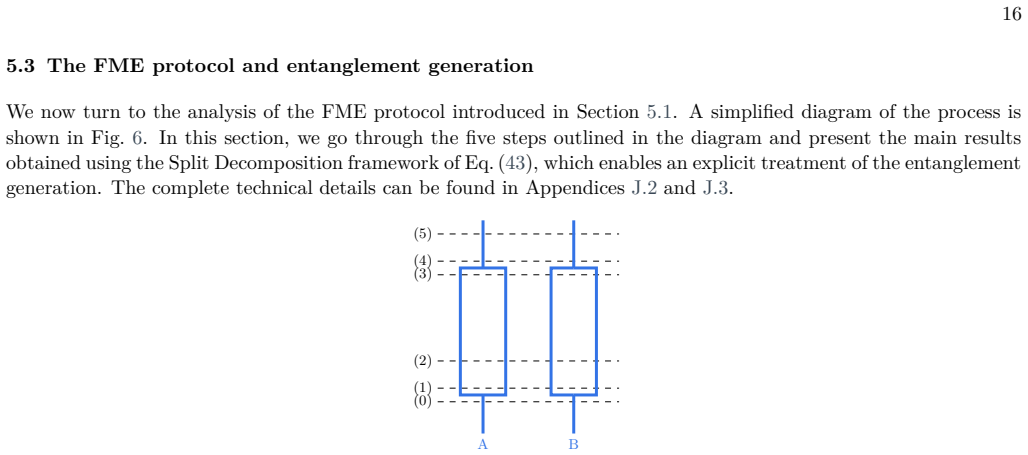
- [Section 5.3, Eqs. (54)-(55)] The transition from Eq. (54) to Eq. (55) is not justified. In Eq. (54) the spin is entangled with branch-dependent field states |ψ'_s0(s)>_F, which App. J.3 defines as W_F(s)|ψ0_s>, four generally distinct displaced Gaussian states. A field-only relaxation is a CPTP map on the field. After tracing the field, spin coherences are bounded by the Gram matrix G_{s,s'} = <ψ'_s0(s)|ψ'_s0(s')>; a CPTP map cannot increase these coherences. Thus a deterministic field-only channel cannot turn the state of Eq. (54) into the pure product form of Eq. (57) unless the branch field states are identical (or a measurement/postselection is added). Consequently the pure spin state |χ> of Eq. (56) and the entanglement increase in Eq. (62) do not follow.
- [Section 4.2, Eq. (45)] The Operational Decomposition, which is the basis for the generalized LOCC theorem, is asserted rather than proven. The text explicitly says that the diagonalization of the center of A_A for unbounded q,p 'could be justified by passing to Weyl operators' and 'we do not focus on this specific construction.' Since Eq. (45) with the block-diagonal algebras Eq. (46) is what allows sector-wise use of the standard LOCC theorem, the main theorem is conditional on a technical assumption whose proof is deferred. The paper should either supply the Type-I/Weyl justification or explicitly state the theorem as conditional on that decomposition.
- [Section 5.4, Eq. (62)] Even granting the Operational Decomposition, the entanglement-increase calculation assumes that the final state is pure in the L-R bipartition and that the field-matter component is exactly |ψ0>_{F,M}. Because of the disentangling issue above, the final spin state may be mixed; in that case H(σ_A) is not the bipartite entanglement of the L-R partition, and Eqs. (62)-(64) do not establish an increase in operationally accessible entanglement. The calculation also depends on uncomputed phases γ, γ', φ, although this alone would be less problematic since the argument only needs some phases that produce entanglement.
minor comments (3)
- [Section 3.2, Eq. (26) vs Appendix K] Eq. (26) states that the continuum limit of D(r-r') is 1/|r-r'|, but Appendix K, Table V, gives D(r-r') ~ -ln|r-r'|, which is the correct 2D Coulomb potential. This inconsistency should be corrected.
- [Throughout] Typos and formatting issues: 'kinematicalal' in the paragraph after Eq. (14), 'arugment' in Section 5.4, and the unnumbered subsection heading 'Introducing the spins' in Section 5.2.
- [Box 4.3] The generalized LOCC theorem is stated in a box but not numbered, making it awkward to reference in later sections. Consider numbering it as a displayed theorem.
Circularity Check
No significant circularity: the central derivation is self-contained and the generalized LOCC theorem is an honest corollary of the standard sector-wise argument.
full rationale
Reviewing the claimed derivation chain, I find no load-bearing step that reduces to its own inputs. The matter-field ground states (Eqs. (19)-(30)) are derived in Appendix G from the discretized Hamiltonian and Gauss constraint via the discrete Fourier transform and harmonic-oscillator solutions; the source-dependent shift is computed, not fitted. The dressing operators U and U' (Eqs. (J40)-(J41), (J50)) are constructed explicitly so that they commute with the constraints and belong to the local algebras, so their locality claim is not definitionally assumed. The Operational and Split Decompositions are derived from diagonalizing the center of explicitly defined local algebras (Appendices H-I); although the Type-I rigor is deferred, this is an acknowledged assumption, not a circular reduction. The Generalized LOCC theorem is presented as the standard LOCC theorem applied sector-wise (Section 4.3): it is a corollary of a known external result rather than a prediction equivalent to its own definition, and the non-trivial content lies in the sector decomposition that makes it applicable. The reliance on Ref. [48], co-authored by F. Giacomini, is not circular under the stated rules: that work is a published, parameter-free derivation and is used mainly for comparison; the ground states in this paper are re-derived internally. No fitted parameter is renamed as a prediction. The skeptic's disentangling-step objection to Eqs. (54)-(55) concerns the dynamical validity of tracing out the field and is a correctness risk, not a circularity. Therefore no specific circular step can be quoted, and the appropriate score is 0.
Axiom & Free-Parameter Ledger
axioms (4)
- domain assumption The physical Hilbert space is obtained by projecting kinematical states onto the zero eigenvalue of first-class constraints using an improper projector and a redefined inner product (Eqs 13-14, footnote 3).
- ad hoc to paper Block-decomposing H_phys as ⊕_K H^K_A ⊗ H^K_B ⊗ H^K_AB follows from diagonalizing the center of the local algebra A_A; the paper explicitly defers the Type-I/Weyl-operator justification for unbounded q,p (Section 4.2).
- domain assumption Matter is modeled by static qubits with total charge conservation imposed as a superselection rule; superposed configurations are allowed only within a fixed particle-number sector (Section 3.1, Appendix F).
- domain assumption After source displacement, the field relaxes to the source-dependent ground state and relaxation phases γ(s) either are negligible or do not change the conclusions (Eqs 50-51, Section 5.3).
read the original abstract
Quantum information has become a powerful tool for probing the structure of quantum field theories, yet its application to gauge theories remains subtle. On the one hand, quantum information theory assumes subsystem locality, i.e.~the factorization of the total Hilbert space into subsystems. On the other hand, gauge constraints prevent the total Hilbert space to decompose into a spacetime-local tensor product structure. Because the Hilbert space structure of gauge theories does not accommodate the subsystem decomposition used in quantum information theory, standard information-theoretic results, such as the Local Operations and Classical Communication (LOCC) theorem, cannot be used straightforwardly in the context of gauge theories. In this work, we bridge this gap in the case of a two-dimensional lattice gauge model that captures key features of electromagnetism. In particular, we construct gauge-invariant local algebras and derive a physically meaningful decomposition of the Hilbert space, providing an operationally consistent notion of locality in the absence of a local tensor-product structure. We apply this framework to field-mediated entanglement protocols relevant to proposed tests of the quantum nature of gravity. We show that the discretized version of electromagnetism satisfies an analogue of the LOCC theorem: entanglement cannot be generated without genuine quantum field interactions, even in the absence of a spacetime-local tensor product factorization of the Hilbert space. This may point towards an operational way to define a subsystem structure for gauge theories.
Figures




Forward citations
Cited by 1 Pith paper
-
Typical entanglement entropy with charge conservation
Typical entanglement entropy with fixed global charge is given by the local thermal entropy at fixed charge density for both U(1) and SU(2) symmetries in the thermodynamic limit.
Reference graph
Works this paper leans on
-
[1]
J. S. Bell. On the Einstein Podolsky Rosen paradox.Physics Physique Fizika, 1:195–200, 1964.doi:10.1103/ PhysicsPhysiqueFizika.1.195
1964
-
[2]
R. S. Ingarden. Quantum information theory.Reports on Mathematical Physics, 10(1):43–72, 1976.doi:https://doi. org/10.1016/0034-4877(76)90005-7. 22
-
[3]
C. H. Bennett and S. J. Wiesner. Communication via one- and two-particle operators on einstein-podolsky-rosen states. Phys. Rev. Lett., 69:2881–2884, 1992.doi:10.1103/PhysRevLett.69.2881
-
[4]
C. H. Bennett, G. Brassard, C. Crépeau, R. Jozsa, A. Peres, and W. K. Wootters. Teleporting an unknown quantum state via dual classical and einstein-podolsky-rosen channels.Physical Review Letters, 70(13):1895–1899, 1993.doi: 10.1103/PhysRevLett.70.1895
-
[5]
A. Peres. Separability criterion for density matrices.Physical Review Letters, 77(8):1413–1415, 1996.doi:10.1103/ PhysRevLett.77.1413
1996
-
[6]
Preskill
J. Preskill. Lecture notes for physics 229: Quantum information and computation. 1998. Caltech, URLhttp://theory. caltech.edu/~preskill/ph229/
1998
-
[7]
M. A. Nielsen and I. L. Chuang.Quantum Computation and Quantum Information. Cambridge University Press, Cam- bridge, 2000
2000
-
[9]
W. Donnelly. Decomposition of entanglement entropy in lattice gauge theory.Phys. Rev. D, 85:085004, 2012.doi: 10.1103/PhysRevD.85.085004
-
[10]
H. Casini, M. Huerta, and J. A. Rosabal. Remarks on entanglement entropy for gauge fields.Phys. Rev. D, 89:085012, 2014.doi:10.1103/PhysRevD.89.085012
-
[11]
S. Ghosh, R. M. Soni, and S. P. Trivedi. On the entanglement entropy for gauge theories.Journal of High Energy Physics, 2015(9), 2015.doi:10.1007/jhep09(2015)069
-
[12]
R. M. Soni and S. P. Trivedi. Aspects of entanglement entropy for gauge theories.Journal of High Energy Physics, 2016(1), 2016.doi:10.1007/jhep01(2016)136
-
[13]
K. Van Acoleyen, N. Bultinck, J. Haegeman, M. Marien, V. B. Scholz, and F. Verstraete. Entanglement of distillation for lattice gauge theories.Physical Review Letters, 117(13), 2016.doi:10.1103/physrevlett.117.131602
-
[14]
V. Panizza, R. Costa de Almeida, and P. Hauke. Entanglement witnessing for lattice gauge theories.Journal of High Energy Physics, 2022(9), 2022.doi:10.1007/jhep09(2022)196
-
[15]
W. Donnelly and A. C. Wall. Entanglement entropy of electromagnetic edge modes.Physical Review Letters, 114(11), 2015.doi:10.1103/physrevlett.114.111603
-
[16]
P. Zanardi, D. A. Lidar, and S. Lloyd. Quantum tensor product structures are observable induced.Phys. Rev. Lett., 92:060402, 2004.doi:10.1103/PhysRevLett.92.060402
-
[17]
E. Bianchi, P. Dona, and R. Kumar. Non-abelian symmetry-resolved entanglement entropy.SciPost Physics, 17(5), 2024. doi:10.21468/scipostphys.17.5.127
-
[18]
H. Casini and M. Huerta. Entanglement entropy for a maxwell field: Numerical calculation on a two-dimensional lattice. Phys. Rev. D, 90:105013, 2014.doi:10.1103/PhysRevD.90.105013
-
[19]
P. Buividovich and M. Polikarpov. Entanglement entropy in gauge theories and the holographic principle for electric strings.Physics Letters B, 670(2):141–145, 2008.doi:https://doi.org/10.1016/j.physletb.2008.10.032
-
[20]
D. Radicevic. Notes on entanglement in abelian gauge theories. arXiv:1404.1391, 2014. URLhttps://arxiv.org/abs/ 1404.1391
Pith/arXiv arXiv 2014
-
[21]
W. Donnelly. Entanglement entropy and nonabelian gauge symmetry.Classical and Quantum Gravity, 31(21):214003, 2014.doi:10.1088/0264-9381/31/21/214003
-
[22]
C. Beem, L. Rastelli, A. Sen, and B. C. van Rees. Resummation and s-duality in n=4 sym.Journal of High Energy Physics, 2015(4):122, 2015.doi:10.1007/JHEP04(2015)122
-
[23]
S. Aoki, T. Iritani, M. Nozaki, T. Numasawa, N. Shiba, and H. Tasaki. On the definition of entanglement entropy in lattice gauge theories.Journal of High Energy Physics, 2015(6):187, 2015.doi:10.1007/JHEP06(2015)187
-
[24]
W. Donnelly and A. C. Wall. Geometric entropy and edge modes of the electromagnetic field.Physical Review D, 94(10), 2016.doi:10.1103/physrevd.94.104053
-
[25]
P. Zanardi. Virtual quantum subsystems.Phys. Rev. Lett., 87:077901, 2001.doi:10.1103/PhysRevLett.87.077901
-
[26]
S. Bose, A. Mazumdar, G. W. Morley, H. Ulbricht, M. Toroš, M. Paternostro, A. A. Geraci, P. F. Barker, M. S. Kim, and G. Milburn. Spin entanglement witness for quantum gravity.Phys. Rev. Lett., 119:240401, 2017.doi:10.1103/ PhysRevLett.119.240401
2017
-
[27]
C. Marletto and V. Vedral. Gravitationally induced entanglement between two massive particles is sufficient evidence of quantum effects in gravity.Phys. Rev. Lett., 119:240402, 2017.doi:10.1103/PhysRevLett.119.240402
-
[28]
T. D. Galley, F. Giacomini, and J. H. Selby. A no-go theorem on the nature of the gravitational field beyond quantum theory.Quantum, 6:779, 2022.doi:10.22331/q-2022-08-17-779
-
[29]
M. J. W. Hall and M. Reginatto. On two recent proposals for witnessing nonclassical gravity.Journal of Physics A: Mathematical and Theoretical, 51(8):085303, 2018.doi:10.1088/1751-8121/aaa734
-
[30]
C. Anastopoulos and B. L. Hu. Probing a gravitational cat state.Classical and Quantum Gravity, 32(16):165022, 2015. doi:10.1088/0264-9381/32/16/165022
-
[31]
A. Belenchia, R. M. Wald, F. Giacomini, E. Castro-Ruiz, Č. Brukner, and M. Aspelmeyer. Quantum superposition of 23 massive objects and the quantization of gravity.Phys. Rev. D, 98:126009, 2018.doi:10.1103/PhysRevD.98.126009
-
[32]
A. Belenchia, R. M. Wald, F. Giacomini, E. Castro-Ruiz, Č. Brukner, and M. Aspelmeyer. Information content of the gravitational field of a quantum superposition.International Journal of Modern Physics D, 28(14):1943001, 2019. doi:10.1142/S0218271819430016
-
[33]
M. Christodoulou and C. Rovelli. On the possibility of laboratory evidence for quantum superposition of geometries. Physics Letters B, 792:64–68, 2019.doi:https://doi.org/10.1016/j.physletb.2019.03.015
-
[34]
R. Howl, V. Vedral, D. Naik, M. Christodoulou, C. Rovelli, and A. Iyer. Non-gaussianity as a signature of a quantum theory of gravity.PRX Quantum, 2:010325, 2021.doi:10.1103/PRXQuantum.2.010325
-
[35]
R. J. Marshman, A. Mazumdar, and S. Bose. Locality and entanglement in table-top testing of the quantum nature of linearized gravity.Physical Review A, 101(5), 2020.doi:10.1103/physreva.101.052110
-
[36]
T. Krisnanda, G. Y. Tham, M. Paternostro, and T. Paterek. Observable quantum entanglement due to gravity.npj Quantum Information, 6(1), 2020.doi:10.1038/s41534-020-0243-y
-
[37]
C. Marletto and V. Vedral. Witnessing nonclassicality beyond quantum theory.Physical Review D, 102(8), 2020.doi: 10.1103/physrevd.102.086012
-
[38]
S. Pal, P. Batra, T. Krisnanda, T. Paterek, and T. S. Mahesh. Experimental localisation of quantum entanglement through monitored classical mediator.Quantum, 5:478, 2021.doi:10.22331/q-2021-06-17-478
-
[39]
A. Kent and D. Pitalúa-García. Testing the nonclassicality of spacetime: What can we learn from bell–bose et al. -marletto- vedral experiments?Physical Review D, 104(12), 2021.doi:10.1103/physrevd.104.126030
-
[40]
D. L. Danielson, G. Satishchandran, and R. M. Wald. Gravitationally mediated entanglement: Newtonian field versus gravitons.Physical Review D, 105(8), 2022.doi:10.1103/physrevd.105.086001
-
[41]
R. Zhou, R. J. Marshman, S. Bose, and A. Mazumdar. Catapulting towards massive and large spatial quantum superpo- sition.Physical Review Research, 4(4), 2022.doi:10.1103/physrevresearch.4.043157
-
[42]
J. Yant and M. Blencowe. Gravitationally induced entanglement in a harmonic trap.Phys. Rev. D, 107:106018, 2023. doi:10.1103/PhysRevD.107.106018. URLhttps://link.aps.org/doi/10.1103/PhysRevD.107.106018
-
[43]
C. H. Bennett, H. J. Bernstein, S. Popescu, and B. Schumacher. Concentrating partial entanglement by local operations. Physical Review A, 53(4):2046–2052, 1996.doi:10.1103/physreva.53.2046
-
[44]
R. Horodecki, P. Horodecki, M. Horodecki, and K. Horodecki. Quantum entanglement.Rev. Mod. Phys., 81:865–942, 2009. doi:10.1103/RevModPhys.81.865
-
[45]
M. Christodoulou, A. Di Biagio, R. Howl, and C. Rovelli. Gravity entanglement, quantum reference systems, degrees of freedom.Classical and Quantum Gravity, 40(4):047001, 2023.doi:10.1088/1361-6382/acb0aa
-
[46]
V. Fragkos, M. Kopp, and I. Pikovski. On inference of quantization from gravitationally induced entanglement.AVS Quantum Science, 4(4):045601, 2022.doi:10.1116/5.0101334
-
[47]
E. Martín-Martínez and T. R. Perche. What gravity mediated entanglement can really tell us about quantum gravity. Physical Review D, 108(10), 2023.doi:10.1103/physrevd.108.l101702. URLhttp://dx.doi.org/10.1103/PhysRevD. 108.L101702
-
[48]
L.-Q. Chen, F. Giacomini, and C. Rovelli. Quantum States of Fields for Quantum Split Sources.Quantum, 7:958, 2023. doi:10.22331/q-2023-03-20-958
-
[49]
S. L. Ludescher, L. D. Loveridge, T. D. Galley, and M. P. Müller. Gravity-mediated entanglement via infinite-dimensional systems. arXiv:2507.13201, 2025. URLhttps://arxiv.org/abs/2507.13201
Pith/arXiv arXiv 2025
-
[50]
J. Yant and M. Blencowe. An operational quantum field theoretic model for gravitationally induced entanglement. arXiv:2503.20855, 2025. URLhttps://arxiv.org/abs/2503.20855
Pith/arXiv arXiv 2025
-
[51]
Aziz and R
J. Aziz and R. Howl. Classical theories of gravity produce entanglement.Nature, 646:813–817, 2025.doi:10.1038/ s41586-025-09595-7. Received 24 September 2024; Accepted 05 September 2025; Published 22 October 2025
2025
-
[52]
M. Christodoulou, A. Di Biagio, M. Aspelmeyer, Č. Brukner, C. Rovelli, and R. Howl. Locally mediated entanglement in linearized quantum gravity.Phys. Rev. Lett., 130:100202, 2023.doi:10.1103/PhysRevLett.130.100202. URLhttps: //link.aps.org/doi/10.1103/PhysRevLett.130.100202
-
[53]
O. Bengyat, A. Di Biagio, M. Aspelmeyer, and M. Christodoulou. Gravity-mediated entanglement between oscillators as quantum superposition of geometries.Phys. Rev. D, 110:056046, 2024.doi:10.1103/PhysRevD.110.056046. URL https://link.aps.org/doi/10.1103/PhysRevD.110.056046
-
[54]
Haag.Local Quantum Physics: Fields, Particles, Algebras
R. Haag.Local Quantum Physics: Fields, Particles, Algebras. Theoretical and Mathematical Physics. Springer Berlin Heidelberg, 1996
1996
-
[55]
R. Brunetti, K. Fredenhagen, P. Imani, and K. Rejzner. The locality axiom in quantum field theory and tensor products of c*-algebras.Reviews in Mathematical Physics, 26(06):1450010, 2014.doi:10.1142/S0129055X1450010X. arXiv:https://doi.org/10.1142/S0129055X1450010X
-
[56]
S. Chandrasekharan and U.-J. Wiese. Quantum link models: A discrete approach to gauge theories.Nuclear Physics B, 492(1):455–471, 1997.doi:https://doi.org/10.1016/S0550-3213(97)80041-7
-
[57]
R. Brower, S. Chandrasekharan, and U.-J. Wiese. Qcd as a quantum link model.Phys. Rev. D, 60:094502, 1999.doi: 10.1103/PhysRevD.60.094502. 24
-
[58]
U.-J. Wiese. Ultracold quantum gases and lattice systems: quantum simulation of lattice gauge theories.Annalen der Physik, 525(10-11):777–796, 2013.doi:https://doi.org/10.1002/andp.201300104
-
[59]
M. Henneaux and C. Teitelboim.Quantization of Gauge Systems, chapter 1. Princeton University Press, Princeton, 1992. doi:10.1515/9780691213866
-
[60]
Fradkin.Quantum Field Theory: An Integrated Approach, chapter 2 and 9
E. Fradkin.Quantum Field Theory: An Integrated Approach, chapter 2 and 9. Princeton University Press, 2021. URL https://books.google.ch/books?id=quEIEAAAQBAJ
2021
-
[61]
Y.Shi. Entanglementinrelativisticquantumfieldtheory.Physical Review D,70(10):105001, 2004.doi:10.1103/PhysRevD. 70.105001
doi:10.1103/physrevd 2004
-
[62]
J. Kijowski, G. Rudolph, and C. Śliwa. On the structure of the observable algebra for qed on the lattice.Letters in Mathematical Physics, 43:299–308, 1998.doi:10.1023/A:1007400816358
-
[63]
J. Kijowski, G. Rudolph, and A. Thielmann. Algebra of observables and charge superselection sectors for qed on the lattice. Communications in Mathematical Physics, 188:535–564, 1997.doi:10.1007/s002200050178
-
[64]
Dereziński and C
J. Dereziński and C. Gérard.Introduction, pp. 49–64. Cambridge Monographs on Mathematical Physics. Cambridge University Press, 2013. URLhttps://www.fuw.edu.pl/~derezins/qft-lectures.pdf
2013
-
[65]
B. C. Hall.Quantum Theory for Mathematicians, volume 267 ofGraduate Texts in Mathematics. Springer New York, 1 edition, 2013.doi:10.1007/978-1-4614-7116-5
-
[66]
R. V. Kadison and J. R. Ringrose.Fundamentals of the Theory of Operator Algebras, Vol. II: Advanced Theory, volume 16 ofGraduate Studies in Mathematics. American Mathematical Society, 1997
1997
-
[67]
H. GRUNDLING and F. LLEDÓ. Local quantum constraints.Reviews in Mathematical Physics, 12(09):1159–1218, 2000. doi:10.1142/S0129055X00000459
-
[68]
O. Bratteli and D. W. Robinson.Operator Algebras and Quantum Statistical Mechanics I. Texts and Monographs in Physics. Springer, 2nd edition, 1987.doi:10.1007/978-3-662-02520-8
-
[69]
Takesaki.Theory of Operator Algebras II, volume 125 ofEncyclopaedia of Mathematical Sciences
M. Takesaki.Theory of Operator Algebras II, volume 125 ofEncyclopaedia of Mathematical Sciences. Springer Berlin, Heidelberg, 1 edition, 2003.doi:10.1007/978-3-662-10451-4
-
[70]
F. J. Murray and J. v. Neumann. On rings of operators.Annals of Mathematics, 37(1):116–229, 1936. URLhttp: //www.jstor.org/stable/1968693
arXiv 1936
-
[71]
A. Vanrietvelde, P. A. Hoehn, F. Giacomini, and E. Castro-Ruiz. A change of perspective: switching quantum reference frames via a perspective-neutral framework.Quantum, 4:225, 2020.doi:10.22331/q-2020-01-27-225
-
[72]
C. M. DeWitt and D. Rickles (editors).The Role of Gravitation in Physics: Report from the 1957 Chapel Hill Conference. Edition Open Access, 2011. URLhttps://edition-open-sources.org/sources/5/
1957
-
[73]
H. D. Zeh. Feynman’s interpretation of quantum theory.European Physical Journal H, 36:63–74, 2011.doi:10.1140/ epjh/e2011-10035-2
2011
-
[74]
S. B. Giddings. Hilbert space structure in quantum gravity: an algebraic perspective.Journal of High Energy Physics, 2015(12):1–21, 2015.doi:10.1007/jhep12(2015)099
-
[75]
M. A. Nielsen and I. L. Chuang.Entropy and information, p. 500–527. Cambridge University Press, 2010
2010
-
[76]
M. M. Wilde.Quantum Information and Entropy, p. 252–291. Cambridge University Press, 2013
2013
-
[77]
W. van Dam and P. Hayden. Universal entanglement transformations without communication.Phys. Rev. A, 67:060302, 2003.doi:10.1103/PhysRevA.67.060302
-
[78]
L. van Luijk, A. Stottmeister, R. F. Werner, and H. Wilming. Relativistic quantum fields are universal entanglement embezzlers. 2024.doi:10.1103/PhysRevLett.133.261602
-
[79]
L.-Q. Chen and F. Giacomini. Quantum effects in gravity beyond the newton potential from a delocalized quantum source. Phys. Rev. X, 15:031063, 2025.doi:10.1103/hl1c-t8z9
-
[80]
Takesaki.Theory of Operator Algebras II
M. Takesaki.Theory of Operator Algebras II. Encyclopaedia of Mathematical Sciences. Springer Berlin Heidelberg, 2002. URLhttps://books.google.at/books?id=-4GyR1VlQz4C
2002
-
[81]
J. Yngvason. The role of type iii factors in quantum field theory.Reports on Mathematical Physics, 55(1):135–147, 2005. doi:10.1016/s0034-4877(05)80009-6
discussion (0)
Sign in with ORCID, Apple, or X to comment. Anyone can read and Pith papers without signing in.