REVIEW 3 major objections 5 minor 2 cited by
Bulk Motions in the Black Hole Jet Sheath as a Candidate for the Comptonizing Corona
T0 review · 3 major / 5 minor · reviewed 2026-08-12 · deepseek-v4-flash
Pith's one-line read The boundary layer between a black hole's jet and its accretion disk—the jet sheath—is proposed as the Comptonizing corona that produces hard X-rays.
desk verdict Solid simulation analysis, but the key ~100 keV bulk temperature claim is likely inflated by shear contamination. read the letter →
The pith
A machine-rendered reading of the paper's core claim, the machinery that carries it, and where it could break.
The reading
What carries the argument
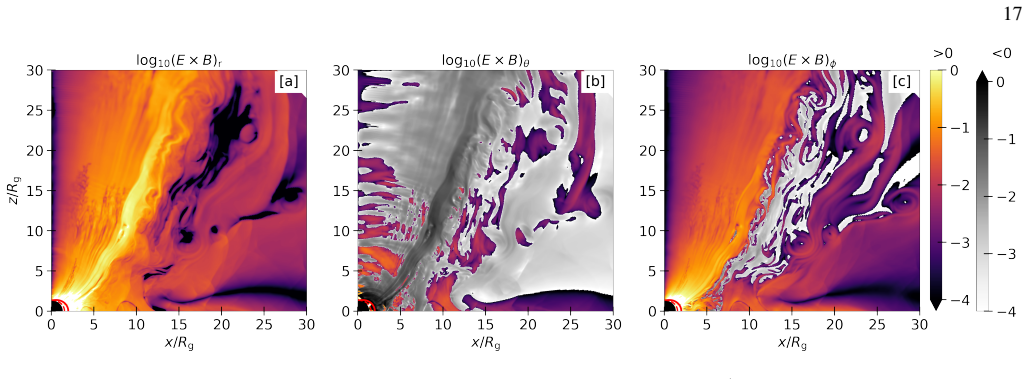
The load-bearing object is the dissipative jet sheath, defined by plasma beta beta > 0.1 and hot magnetization sigma_h > 0.15—more magnetized than the disk but less magnetized than the jet core. The mechanism is cold-chain Comptonization: soft disk photons are upscattered not by hot electrons but by the trans-relativistic stochastic bulk motions of reconnection plasmoids, whose comoving energy distribution the simulation finds resembles a Maxwellian with effective bulk temperature near 100 keV. The argument is carried by two quantitative measurements: the radial Poynting flux in the sheath, which gives about two to three times the jet-core power and a roughly 20% dissipation between 2 and 10 gravitational radii, and the comoving-frame bulk-motion spectra, together with Thomson optical-depth scalings that yield tau ≈ 0.01–0.1 when applied to Cygnus X-1 parameters.
What would settle it
Run a three-dimensional magnetohydrodynamic simulation of the same magnetically arrested state with self-consistent radiation and physical, non-floor densities, and measure the Thomson optical depth across the jet sheath between 2 and 10 gravitational radii; if it falls below about 0.01, or if the comoving bulk-motion energy distribution lacks a Maxwellian-like component near 100 keV, the sheath cannot produce the observed hard X-ray spectra.
Extended reading notes
Core claim
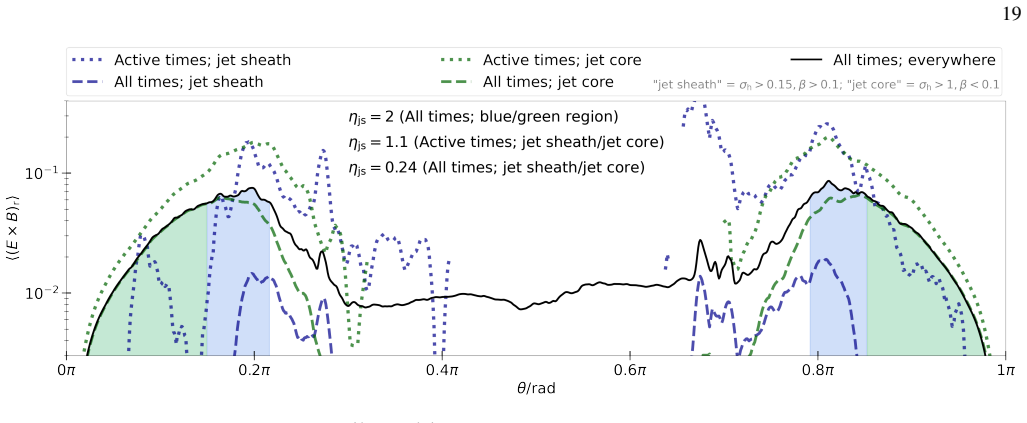
Using a two-dimensional GRRMHD simulation of a magnetically arrested disk around a rapidly spinning black hole, the paper claims that the dissipative jet sheath—the layer between the Poynting-flux jet and the accretion disk, selected by beta > 0.1 and hot magnetization sigma_h > 0.15—is a viable Comptonizing corona. In this layer the time-averaged electromagnetic power is about twice that in the jet core and comparable to the accretion power, with roughly 20% of it dissipated between 2 and 10 gravitational radii via reconnection layers and plasmoid chains. The bulk plasma moves along a nearly paraboloidal surface with radial 4-velocity <Gamma beta_r> ≈ 1.2 ± 0.5, and in the frame moving with the mean velocity the stochastic bulk motions follow a Maxwellian-like distribution with effective bulk temperature of about 100 keV. Scaled to Cygnus X-1 parameters, the Thomson depth across the sheath is estimated at 0.01–0.1 for a pair plasma, enough, the paper argues, for cold-chain Comptonization of soft photons into the hard nonthermal tail.
Load-bearing premise
The mass density in the jet sheath is not controlled by the numerical floor values the simulation uses to keep the plasma density from becoming too small; if it is, the estimated Thomson optical depth of 0.01–0.1 is not physical and the sheath might be too tenuous to Comptonize efficiently.
Editorial extensions
If this is right
- The dissipative jet sheath is an important dissipation site: reconnection layers and plasmoid chains appear copiously, and about 20% of the sheath's electromagnetic power is dissipated between 2 and 10 gravitational radii.
- The electromagnetic power in the jet sheath is about two to three times that in the jet core and comparable to the total accretion power, so it can energetically supply the nonthermal X-ray luminosity of hard-state sources such as Cygnus X-1.
- The stochastic bulk motions in the sheath, viewed in the local mean-velocity frame, resemble a Maxwellian with effective temperature near 100 keV—the value required by cold-chain Comptonization to produce the hard nonthermal X-ray tail.
- The sheath is a paraboloidal trans-relativistic outflow with radial 4-velocity about 1.2, implying the Comptonizing region is not static; this geometry and speed affect the reflection and polarization of the Comptonized X-rays.
- Recurrent reconnection layers in the sheath vary on timescales of roughly 10–100 gravitational radii over the speed of light, matching the fast variability timescales seen from hard-state sources.
Reading between the lines
- If the jet sheath is the corona, the long-known radio–X-ray correlation in hard states would have a single physical anchor: the same Poynting-flux sheath that feeds the jet also supplies the Comptonizing motions, so jet and corona should switch on and off together.
- The model predicts that hard X-ray polarization should be parallel to the disk normal, with a degree that grows with the sheath outflow speed; comparing X-ray polarimetry of Cygnus X-1 with synthetic polarization from these snapshots would test it.
- Because the roughly 100 keV effective temperature comes from bulk motions rather than electron temperature, the spectral cutoff may be relatively insensitive to electron-ion coupling and pair production, unlike thermal coronae.
- A direct next step would be Monte Carlo radiative transfer through these GRRMHD snapshots to produce synthetic hard-state spectra, which would turn the sheath-corona claim into a falsifiable spectral prediction.
Editorial analysis
A structured set of objections, weighed in public.
Referee Report
Summary. The manuscript analyzes a two-dimensional GRRMHD simulation of a magnetically arrested disk around a rapidly spinning black hole and identifies the jet-disk interface (the jet sheath) as a dissipation site. It isolates a 'dissipative jet sheath' using thresholds σ_h > 0.15 and β > 0.1, documents recurrent current sheets and plasmoid chains, and reports that the radial electromagnetic power in the sheath is about twice that in the jet core (η_js ≈ 2), with about 20% of the sheath's electromagnetic power lost between 2 and 10 gravitational radii. The paper further reports trans-relativistic mean bulk motions and a Maxwellian-like distribution of stochastic bulk motions with an effective temperature of about 100 keV when measured in the frame of the mean radial velocity. Scaling to Cygnus X-1 parameters yields a Thomson optical depth of 0.01–0.1 for the sheath, leading the authors to propose the dissipative jet sheath as a viable Comptonizing corona in the cold-chain Comptonization scenario. The paper is transparent about its assumptions and limitations, and it quantifies some definitional sensitivities in the appendices.
Significance. If the central claims withstand scrutiny, this paper provides a valuable bridge between global accretion-jet simulations and local kinetic reconnection studies: it assigns a concrete power budget, location, geometry, and velocity statistics to the putative corona and connects them to testable predictions for reflection, polarization, and X-ray spectral formation. The authors' preceding PIC and radiative-transfer work (SB20, SSB21, SSB23) gives independent support for the cold-chain mechanism, and the paper is careful to distinguish measured simulation quantities from interpretive links. The two load-bearing quantitative claims—the ~100 keV effective bulk temperature and the sheath-to-core power ratio—are, however, sensitive to the frame definition and selection thresholds; those sensitivities must be resolved before the central conclusions can be relied upon. The paper's strengths include the high-resolution resistive-MHD simulation, the clear presentation of method and definitions, and the unusually candid reporting of limitations and definition-dependent alternatives in Appendices B and C.
major comments (3)
- [§3.4, Fig. 9] The central claim that the stochastic bulk motions in the dissipative sheath have an effective temperature of ~100 keV is derived in a frame defined by a single polar-angle- and time-averaged mean velocity at each radius (the mean shown in the left panel of Fig. 8). The dissipative sheath is a thin shear layer: at r=15 Rg its angular thickness is Δθ ≈ 0.07π (Appendix B), and across that width the radial 4-velocity changes from relativistic (jet) to sub-relativistic (disk). Subtracting only the θ-averaged mean leaves the coherent shear profile in the residuals, which alone can produce a broad, Maxwellian-looking histogram and inflate the inferred effective temperature. The paper's own statement that plasmoid motions are 'largely determined by global stresses, rather than by the local reconnection dynamics' (§3.2.1) reinforces that this contamination is not obviously negligible. I ask the authors to recompute Fig. 9 in comoving frames defined with local polar-angle bins (or by otherwise subtracting the local shear profile) and to report how the effective temperature changes; if the 100 keV value is substantially reduced, the observational anchor of the cold-chain interpretation is weakened.
- [§3.3 and Appendix B] The headline result η_js ≈ 2 (electromagnetic power in the sheath relative to the jet core) is obtained with the Poynting-flux width criterion ⟨(E×B)_r⟩ ≥ 0.75 ⟨(E×B)_r⟩_peak. Appendix B shows that with the σ_h/β thresholds used elsewhere in the paper the same ratio is η_js ≈ 1.1 when averaged only over active times and ≈ 0.24 when averaged over all quasi-steady-state times. Because the abstract and §3.3 use η_js ≈ 2 to argue that the sheath power is comparable to the accretion power and twice the core power, this definition sensitivity is load-bearing for the energetic viability claim. Please either adopt and justify one time- and space-averaging convention in the main text (with the sensitivity reported there) or weaken the claim to a range and explain which definition is appropriate for a time-averaged Comptonizing corona.
- [§3.5, Eq. (14)] The electron-proton optical depth τ_e-p ∼ 10^-3–10^-2 is stated, after Eq. (14), to be a reasonable estimate only if the sheath density is not dominated by the GRRMHD algorithm's density floors. Since the optical depth is one of the paper's principal coronal-viability diagnostics, this caveat should be turned into a quantitative test: report the ratio of the physical density to the floor density inside the dissipative-sheath mask as a function of radius (especially in the 2–10 Rg region used for the τ estimates), or perform a floor/resolution variation and show that τ is stable. Without such a check, the quoted optical depth remains an uncontrolled estimate. The paper is transparent about other 2D and non-radiative limitations, which is commendable, but this particular one has a concrete and feasible fix.
minor comments (5)
- [§4, Discussion item 4] The reference list contains a bare '?' between Wong et al. (2021) and Davelaar et al. (2023); this placeholder should be replaced or removed.
- [Fig. 9] Please state explicitly whether the 100 keV and 200 keV Maxwellian curves are fits to the histograms or reference curves; if they are fits, report the fit range and goodness-of-fit, since the 'resembles a Maxwellian' claim is central.
- [§3.3 and Appendix C] The '20% dissipation' between 2 and 10 Rg is a decrease in the radially-outflowing electromagnetic power, not a directly measured local dissipation rate; the text should phrase it as a proxy or lower/upper bound to avoid over-interpretation.
- [Abstract] The abstract's phrase 'about 20% of the sheath power is dissipated between 2 and 10 Rg' could be misread as a direct dissipation measurement; consider matching the more careful wording used in §3.3 and Appendix C.
- [§3.2.1] The statement that plasmoid motion 'is largely determined by global stresses' appears to be in tension with the later interpretation of the same motions as stochastic reconnection products; a sentence reconciling these two descriptions would improve clarity.
Circularity Check
No circularity: all central quantities are measured from the GRRMHD simulation, and the self-cited kinetic PIC results are independent support rather than fitted inputs.
full rationale
The paper's derivation chain is self-contained as a measurement-and-scaling exercise. The dissipative jet sheath is identified by thresholds (β>0.1, σh>0.15) applied to the GRRMHD output; the electromagnetic power, 20% dissipation fraction, trans-relativistic mean 4-velocity, and ~100 keV effective bulk temperature are all computed directly from simulation fields, not fitted to any observed spectrum or to the cold-chain Comptonization requirement. The optical-depth estimates (Eqs. 14 and 16) apply prior analytic scalings (Beloborodov 2017) to measured simulation quantities (ℓB, σc, ξ) with stated caveats about density floors and absent radiative physics, so the estimates are contingent predictions, not identities. The cold-chain Comptonization framework is imported from the authors' own PIC studies (SB20/SSB21/SSB23), but those are independent kinetic simulations with upstream conditions that do not include the present GRRMHD sheath; they provide external support rather than a fitted constraint. The main interpretive caveat—that subtracting only the polar- and time-averaged mean velocity may leave coherent shear in the 'stochastic' residual and inflate kT_eff—is a measurement-validity concern, not a circular reduction; the paper itself acknowledges that sheath motions are largely set by global stresses. A missing reference placeholder appears in §4 point 4 ('?'), but it is unrelated to circularity. Therefore no step reduces by construction to its own input.
Assumptions & free parameters
free parameters (7)
- Hot magnetization threshold sigma_h > 0.15 =
0.15
- Plasma beta threshold beta > 0.1 =
0.1
- Poynting-flux sheath width factor =
0.75
- Current sheet aspect ratio w/r =
0.1
- Fraction f_HE of magnetic energy to high-energy particles =
0.3
- Fraction f_pm of particle energy to e+- rest mass =
0.1
- Accretion efficiency xi =
0.2
assumptions (5)
- domain assumption The Kerr metric and GRMHD equations with uniform resistivity describe the accretion flow and reconnection.
- domain assumption Two-dimensional axisymmetry with phi-invariance captures the relevant jet sheath physics.
- domain assumption A non-radiative simulation approximates the low/hard state inner accretion flow.
- domain assumption Cold-chain Comptonization results from local PIC simulations apply to the global jet sheath.
- domain assumption Numerical density floors in the GRRMHD algorithm do not dominate the sheath density.
Cite this review
Pith. "Pith review of Bulk Motions in the Black Hole Jet Sheath as a Candidate for the Comptonizing Corona." pith.science (2026). https://pith.science/paper/7ZEYH64Y
@misc{pith2026241110662,
  author       = {Pith},
  title        = {Pith review of: Bulk Motions in the Black Hole Jet Sheath as a Candidate for the Comptonizing Corona},
  year         = {2026},
  howpublished = {\url{https://pith.science/paper/7ZEYH64Y}},
  note         = {Machine review of arXiv:2411.10662}
}
abstract
Using two-dimensional general relativistic resistive magnetohydrodynamic simulations, we investigate the properties of the sheath separating the black hole jet from the surrounding medium. We find that the electromagnetic power flowing through the jet sheath is comparable to the overall accretion power of the black hole. The sheath is an important site of energy dissipation as revealed by the copious appearance of reconnection layers and plasmoid chains. About 20% of the sheath power is dissipated between 2 and 10 gravitational radii. The plasma in the dissipative sheath moves along a nearly paraboloidal surface with trans-relativistic bulk motions dominated by the radial component, whose dimensionless 4-velocity is $\sim1.2\pm0.5$. In the frame moving with the mean (radially-dependent) velocity, the distribution of stochastic bulk motions resembles a Maxwellian with an `effective bulk temperature' of $\sim$100 keV. Scaling the global simulation to Cygnus X-1 parameters gives a rough estimate of the Thomson optical depth across the jet sheath $\sim 0.01-0.1$, and it may increase in future magnetohydrodynamic simulations with self-consistent radiative losses. These properties suggest that the dissipative jet sheath may be a viable `coronal' region, capable of upscattering seed soft photons into a hard, nonthermal tail, as seen during the hard states of X-ray binaries and active galactic nuclei.
Figures


Figures from the paper (11 more)




Forward citations
Cited by 2 Pith papers
-
X-ray polarization from accretion disk winds
Single Thomson scattering in equatorial accretion disk winds can explain the high X-ray polarization degrees observed in X-ray binaries and active galactic nuclei.
-
X-ray properties of coronal emission in radio quiet Active Galactic Nuclei
A review of X-ray observations of the corona in radio-quiet AGN, covering its size, geometry, temperature, variability, and empirical relations with the accretion disk and other components.
Reference graph
Works this paper leans on
-
[1]
, " * write output.state after.block = add.period write newline
ENTRY address archivePrefix author booktitle chapter doi edition editor eprint howpublished institution journal key month number organization pages publisher school series title misctitle type volume year version url label extra.label sort.label short.list INTEGERS output.state before.all mid.sentence after.sentence after.block FUNCTION init.state.consts ...
-
[2]
write newline
" write newline "" before.all 'output.state := FUNCTION format.url url empty "" new.block "" url * "" * if FUNCTION format.eprint eprint empty "" archivePrefix empty "" archivePrefix "arXiv" = new.block " " eprint * " " * new.block " " eprint * " " * if if if FUNCTION format.doi doi empty "" " " doi * " " * if FUNCTION format.pid doi empty eprint empty ur...
-
[3]
- [1] #1 = = ^ ^ ^ .\!\!^ d .\!\!^ h .\!\!^ m .\!\!^ s .\!\!^ @mss
thebibliography [1] 20pt to REFERENCES 6pt =0pt 10pt plus 3pt =0pt =0pt =1pt plus 1pt =0pt =0pt -12pt =13pt plus 1pt =20pt =13pt plus 1pt \@M =10000 =-1.0em =0pt =0pt 0pt =0pt =1.0em @enumiv\@empty 10000 10000 `\.\@m \@noitemerr \@latex@warning Empty `thebibliography' environment \@ifnextchar \@reference \@latexerr Missing key on reference command Each re...
2019
-
[4]
Alston , W. N., Fabian , A. C., Kara , E., et al. 2020, Nature Astronomy, 4, 597, 10.1038/s41550-019-1002-x
-
[5]
Arnowitt , R., Deser , S., & Misner , C. W. 1959, Physical Review, 116, 1322, 10.1103/PhysRev.116.1322
-
[6]
Balbus , S. A., & Hawley , J. F. 1991, , 376, 214, 10.1086/170270
doi:10.1086/170270 1991
-
[7]
2018, , 862, 80, 10.3847/1538-4357/aac820
Ball , D., Sironi , L., & \"O zel , F. 2018, , 862, 80, 10.3847/1538-4357/aac820
-
[8]
2017, , 850, 14, 10.3847/1538-4357/aa906a
Beheshtipour , B., Krawczynski , H., & Malzac , J. 2017, , 850, 14, 10.3847/1538-4357/aa906a
Show all 107 references
-
[9]
Beloborodov , A. M. 1998, , 496, L105, 10.1086/311260
1998 doi
- [10]
- [11]
-
[13]
2009, Physics of Plasmas, 16, 112102, 10.1063/1.3264103
Bhattacharjee , A., Huang , Y.-M., Yang , H., & Rogers , B. 2009, Physics of Plasmas, 16, 112102, 10.1063/1.3264103
2009 doi
-
[14]
S., & Blinnikov , S
Bisnovatyi-Kogan , G. S., & Blinnikov , S. I. 1976, Soviet Astronomy Letters, 2, 191. astro-ph/0003275
1976 arXiv
-
[15]
S., & Ruzmaikin , A
Bisnovatyi-Kogan , G. S., & Ruzmaikin , A. A. 1974, , 28, 45, 10.1007/BF00642237
1974 doi
- [16]
-
[17]
D., & Znajek , R
Blandford , R. D., & Znajek , R. L. 1977, , 179, 433
1977
-
[18]
2021, Physical Review Letters, 127, 10.1103/physrevlett.127.055101
Bransgrove, A., Ripperda, B., & Philippov, A. 2021, Physical Review Letters, 127, 10.1103/physrevlett.127.055101
2021 doi
-
[19]
2013, , 428, 71, 10.1093/mnras/sts005
Bucciantini , N., & Del Zanna , L. 2013, , 428, 71, 10.1093/mnras/sts005
2013 doi
- [20]
-
[21]
Cao, Z., Lucchini, M., Markoff, S., Connors, R. M. T., & Grinberg, V. 2021, Monthly Notices of the Royal Astronomical Society, 10.1093/mnras/stab3080
2021 doi
-
[22]
Chandran , B. D. G., Foucart , F., & Tchekhovskoy , A. 2018, JPP, 84, 905840310, 10.1017/S0022377818000387
2018 doi
-
[23]
1960, Proceedings of the National Academy of Science, 46, 253, 10.1073/pnas.46.2.253
Chandrasekhar , S. 1960, Proceedings of the National Academy of Science, 46, 253, 10.1073/pnas.46.2.253
1960 doi
-
[24]
2021, arXiv e-prints, arXiv:2106.15738
Chashkina , A., Bromberg , O., & Levinson , A. 2021, arXiv e-prints, arXiv:2106.15738. 2106.15738
2021 arXiv
-
[25]
2022, Physical Review Letters, 129, 10.1103/physrevlett.129.205101
Crinquand, B., Cerutti, B., Dubus, G., Parfrey, K., & Philippov, A. 2022, Physical Review Letters, 129, 10.1103/physrevlett.129.205101
2022 doi
-
[26]
2023, , 959, L3, 10.3847/2041-8213/ad0b79
Davelaar , J., Ripperda , B., Sironi , L., et al. 2023, , 959, L3, 10.3847/2041-8213/ad0b79
2023 doi
-
[27]
Dexter , J., & Begelman , M. C. 2024, , 528, L157, 10.1093/mnrasl/slad182
2024 doi
-
[28]
Dexter , J., Scepi , N., & Begelman , M. C. 2021, , 919, L20, 10.3847/2041-8213/ac2608
2021 doi
-
[29]
2005, , 433, 604, 10.1038/nature03335
Di Matteo , T., Springel , V., & Hernquist , L. 2005, , 433, 604, 10.1038/nature03335
2005 doi
-
[30]
K., Vaidya , B., & Fendt , C
Dihingia , I. K., Vaidya , B., & Fendt , C. 2022, , 517, 5032, 10.1093/mnras/stac3021
2022 doi
-
[31]
2007, , 15, 1, 10.1007/s00159-007-0006-1
Done , C., Gierli \'n ski , M., & Kubota , A. 2007, , 15, 1, 10.1007/s00159-007-0006-1
2007 doi
-
[32]
2023, , 677, A67, 10.1051/0004-6361/202346781
El Mellah , I., Cerutti , B., & Crinquand , B. 2023, , 677, A67, 10.1051/0004-6361/202346781
2023 doi
-
[33]
C., Lohfink , A., Kara , E., et al
Fabian , A. C., Lohfink , A., Kara , E., et al. 2015, , 451, 4375, 10.1093/mnras/stv1218
2015 doi
-
[34]
P., Belloni , T
Fender , R. P., Belloni , T. M., & Gallo , E. 2004, , 355, 1105, 10.1111/j.1365-2966.2004.08384.x
2004
- [36]
- [37]
-
[38]
C., Chatterjee , K., Ingram , A., & Middleton , M
Fragile , P. C., Chatterjee , K., Ingram , A., & Middleton , M. 2023, , 525, L82, 10.1093/mnrasl/slad099
2023 doi
-
[39]
A., Rosner , R., & Vaiana , G
Galeev , A. A., Rosner , R., & Vaiana , G. S. 1979, , 229, 318, 10.1086/156957
1979 doi
-
[40]
2023, , 130, 115201, 10.1103/PhysRevLett.130.115201
Galishnikova , A., Philippov , A., Quataert , E., et al. 2023, , 130, 115201, 10.1103/PhysRevLett.130.115201
2023 doi
-
[41]
2018, , 478, L132, 10.1093/mnrasl/sly083
Gallo , E., Degenaar , N., & van den Eijnden , J. 2018, , 478, L132, 10.1093/mnrasl/sly083
2018 doi
-
[42]
2005, , 436, 819, 10.1038/nature03879
Gallo , E., Fender , R., Kaiser , C., et al. 2005, , 436, 819, 10.1038/nature03879
2005 doi
-
[43]
P., & Pooley , G
Gallo , E., Fender , R. P., & Pooley , G. G. 2003, , 344, 60, 10.1046/j.1365-8711.2003.06791.x
2003
-
[44]
A., Steiner , J
Garc \' a , J. A., Steiner , J. F., McClintock , J. E., et al. 2015, , 813, 84, 10.1088/0004-637X/813/2/84
2015 doi
-
[45]
2008, , 688, 555, 10.1086/592345
Goodman , J., & Uzdensky , D. 2008, , 688, 555, 10.1086/592345
2008 doi
-
[46]
M., Sironi , L., & Philippov , A
Gro s elj , D., Hakobyan , H., Beloborodov , A. M., Sironi , L., & Philippov , A. 2024, , 132, 085202, 10.1103/PhysRevLett.132.085202
2024 doi
-
[47]
2024, , 527, 6065, 10.1093/mnras/stad3573
Gupta , S., Sridhar , N., & Sironi , L. 2024, , 527, 6065, 10.1093/mnras/stad3573
2024 doi
-
[48]
2021, , 908, 88, 10.3847/1538-4357/abd3a6
Hirotani , K., Krasnopolsky , R., Shang , H., Nishikawa , K.-i., & Watson , M. 2021, , 908, 88, 10.3847/1538-4357/abd3a6
2021 doi
-
[49]
V., Narayan , R., & Abramowicz , M
Igumenshchev , I. V., Narayan , R., & Abramowicz , M. A. 2003, , 592, 1042, 10.1086/375769
2003 doi
-
[50]
2019, The Astrophysical Journal, 883, 69, 10.3847/1538-4357/ab345f
Inda-Koide, M., Koide, S., & Morino, R. 2019, The Astrophysical Journal, 883, 69, 10.3847/1538-4357/ab345f
2019 doi
-
[51]
R., & Motta , S
Ingram , A. R., & Motta , S. E. 2019, , 85, 101524, 10.1016/j.newar.2020.101524
2019
-
[52]
F., Fabian , A
Kara , E., Steiner , J. F., Fabian , A. C., et al. 2019, , 565, 198, 10.1038/s41586-018-0803-x
2019 doi
-
[53]
L., Lohfink , A., & Kara , E
King , A. L., Lohfink , A., & Kara , E. 2017, , 835, 226, 10.3847/1538-4357/835/2/226
2017 doi
-
[54]
2022, Science, 378, 650, 10.1126/science.add5399
Krawczynski , H., Muleri , F., Dov c iak , M., et al. 2022, Science, 378, 650, 10.1126/science.add5399
2022 doi
- [55]
-
[56]
D., Reig , P., & Tsouros , A
Kylafis , N. D., Reig , P., & Tsouros , A. 2023, , 679, A81, 10.1051/0004-6361/202346379
2023 doi
-
[57]
Liska , M. T. P., Musoke , G., Tchekhovskoy , A., Porth , O., & Beloborodov , A. M. 2022, , 935, L1, 10.3847/2041-8213/ac84db
2022 doi
-
[58]
F., Schekochihin , A
Loureiro , N. F., Schekochihin , A. A., & Cowley , S. C. 2007, Physics of Plasmas, 14, 100703, 10.1063/1.2783986
2007 doi
-
[59]
2022, , 517, 5853, 10.1093/mnras/stac2904
Lucchini , M., Ceccobello , C., Markoff , S., et al. 2022, , 517, 5853, 10.1093/mnras/stac2904
2022 doi
-
[61]
2022, , 516, 5907, 10.1093/mnras/stac2634
Marinucci , A., Muleri , F., Dovciak , M., et al. 2022, , 516, 5907, 10.1093/mnras/stac2634
2022 doi
-
[62]
A., & Wilms , J
Markoff , S., Nowak , M. A., & Wilms , J. 2005, , 635, 1203, 10.1086/497628
2005 doi
-
[63]
L., Zdziarski , A
McConnell , M. L., Zdziarski , A. A., Bennett , K., et al. 2002, , 572, 984, 10.1086/340436
2002 doi
- [64]
-
[67]
M., Werner , G
Mehlhaff , J. M., Werner , G. R., Uzdensky , D. A., & Begelman , M. C. 2020, , 498, 799, 10.1093/mnras/staa2346
2020 doi
-
[68]
2022, Nature Astronomy, 6, 577, 10.1038/s41550-022-01617-y
M \'e ndez , M., Karpouzas , K., Garc \' a , F., et al. 2022, Nature Astronomy, 6, 577, 10.1038/s41550-022-01617-y
2022 doi
-
[70]
2001 b , , 328, 958, 10.1046/j.1365-8711.2001.04925.x
---. 2001 b , , 328, 958, 10.1046/j.1365-8711.2001.04925.x
2001
-
[71]
2002, , 332, 165, 10.1046/j.1365-8711.2002.05288.x
---. 2002, , 332, 165, 10.1046/j.1365-8711.2002.05288.x
2002
-
[72]
2023, arXiv e-prints, arXiv:2309.09087
Moscibrodzka , M. 2023, arXiv e-prints, arXiv:2309.09087. 2309.09087
2023 arXiv
-
[73]
V., & Abramowicz , M
Narayan , R., Igumenshchev , I. V., & Abramowicz , M. A. 2003, Publications of the Astr. Society of Japan, 55, L69, 10.1093/pasj/55.6.L69
2003 doi
-
[74]
C., & Farmer , A
Narayan , R., McKinney , J. C., & Farmer , A. J. 2007, , 375, 548, 10.1111/j.1365-2966.2006.11272.x
2007
-
[75]
M., Porth , O., et al
Nathanail , A., Fromm , C. M., Porth , O., et al. 2020, , 495, 1549, 10.1093/mnras/staa1165
2020 doi
-
[76]
M., & Rezzolla , L
Nathanail , A., Mpisketzis , V., Porth , O., Fromm , C. M., & Rezzolla , L. 2022, , 513, 4267, 10.1093/mnras/stac1118
2022 doi
-
[77]
a ttil \
N \"a ttil \"a , J. 2024, Nature Communications, 15, 7026, 10.1038/s41467-024-51257-1
2024 doi
-
[78]
2019, , 629, A61, 10.1051/0004-6361/201935559
Olivares , H., Porth , O., Davelaar , J., et al. 2019, , 629, A61, 10.1051/0004-6361/201935559
2019 doi
-
[79]
2019, Physical Review Letters, 122, 10.1103/physrevlett.122.035101
Parfrey, K., Philippov, A., & Cerutti, B. 2019, Physical Review Letters, 122, 10.1103/physrevlett.122.035101
2019 doi
-
[80]
2017, Computational Astrophysics & Cosmology, 4, 1, 10.1186/s40668-017-0020-2
Porth , O., Olivares , H., Mizuno , Y., et al. 2017, Computational Astrophysics & Cosmology, 4, 1, 10.1186/s40668-017-0020-2
2017 doi
-
[81]
Poutanen , J., Veledina , A., & Beloborodov , A. M. 2023, , 949, L10, 10.3847/2041-8213/acd33e
2023 doi
-
[82]
2018, , 859, 28, 10.3847/1538-4357/aabd36
Qian , Q., Fendt , C., & Vourellis , C. 2018, , 859, 28, 10.3847/1538-4357/aabd36
2018 doi
-
[83]
Qiao , E., & Liu , B. F. 2015, , 448, 1099, 10.1093/mnras/stv085
2015 doi
-
[84]
A., & McClintock , J
Remillard , R. A., & McClintock , J. E. 2006, , 44, 49, 10.1146/annurev.astro.44.051905.092532
2006 arXiv
-
[85]
Ripperda , B., Bacchini , F., & Philippov , A. A. 2020, , 900, 100, 10.3847/1538-4357/ababab
2020 doi
-
[86]
2022, , 924, L32, 10.3847/2041-8213/ac46a1
Ripperda , B., Liska , M., Chatterjee , K., et al. 2022, , 924, L32, 10.3847/2041-8213/ac46a1
2022 doi
-
[87]
2019 a , , 485, 299, 10.1093/mnras/stz387
Ripperda , B., Porth , O., Sironi , L., & Keppens , R. 2019 a , , 485, 299, 10.1093/mnras/stz387
2019 doi
-
[88]
2019 b , , 244, 10, 10.3847/1538-4365/ab3922
Ripperda , B., Bacchini , F., Porth , O., et al. 2019 b , , 244, 10, 10.3847/1538-4365/ab3922
2019 doi
-
[89]
M., Fender , R
Russell , D. M., Fender , R. P., Gallo , E., & Kaiser , C. R. 2007, , 376, 1341, 10.1111/j.1365-2966.2007.11539.x
2007
-
[90]
D., & Krolik , J
Schnittman , J. D., & Krolik , J. H. 2010, , 712, 908, 10.1088/0004-637X/712/2/908
2010 doi
-
[91]
2023, The Astrophysical Journal, 950, 169, 10.3847/1538-4357/acd0b0
Selvi, S., Porth, O., Ripperda, B., et al. 2023, The Astrophysical Journal, 950, 169, 10.3847/1538-4357/acd0b0
2023 doi
-
[92]
Sironi , L., & Beloborodov , A. M. 2020, , 899, 52, 10.3847/1538-4357/aba622
2020 doi
-
[93]
E., & Narayan , R
Sironi , L., Rowan , M. E., & Narayan , R. 2021, , 907, L44, 10.3847/2041-8213/abd9bc
2021 doi
-
[94]
Sridhar , N., Bhattacharyya , S., Chandra , S., & Antia , H. M. 2019, , 487, 4221, 10.1093/mnras/stz1476
2019 doi
-
[95]
A., Steiner , J
Sridhar , N., Garc \' a , J. A., Steiner , J. F., et al. 2020, , 890, 53, 10.3847/1538-4357/ab64f5
2020 doi
-
[96]
Sridhar , N., Sironi , L., & Beloborodov , A. M. 2021, , 507, 5625, 10.1093/mnras/stab2534
2021 doi
- [97]
- [98]
-
[99]
1987, , 227, 403, 10.1093/mnras/227.2.403
Svensson , R. 1987, , 227, 403, 10.1093/mnras/227.2.403
1987 doi
- [100]
-
[101]
1972, , 177, L5, 10.1086/181042
Tananbaum , H., Gursky , H., Kellogg , E., Giacconi , R., & Jones , C. 1972, , 177, L5, 10.1086/181042
1972 doi
-
[102]
Tchekhovskoy , A., Narayan , R., & McKinney , J. C. 2011, , 418, L79, 10.1111/j.1745-3933.2011.01147.x
2011
-
[103]
2022, , 510, 3674, 10.1093/mnras/stab3745
Ursini , F., Matt , G., Bianchi , S., et al. 2022, , 510, 3674, 10.1093/mnras/stab3745
2022 doi
-
[104]
A., Loureiro , N
Uzdensky , D. A., Loureiro , N. F., & Schekochihin , A. A. 2010, Physical Review Letters, 105, 235002, 10.1103/PhysRevLett.105.235002
2010 doi
-
[105]
1959, Sov
Velikhov, E. 1959, Sov. Phys. JETP, 36, 995
1959
-
[106]
Vourellis , C., Fendt , C., Qian , Q., & Noble , S. C. 2019, , 882, 2, 10.3847/1538-4357/ab32e2
2019 doi
-
[107]
2021, , 910, L3, 10.3847/2041-8213/abec79
Wang , J., Mastroserio , G., Kara , E., et al. 2021, , 910, L3, 10.3847/2041-8213/abec79
2021 doi
-
[108]
C., Ramsey , B., O'Dell , S., et al
Weisskopf , M. C., Ramsey , B., O'Dell , S., et al. 2016, in Society of Photo-Optical Instrumentation Engineers (SPIE) Conference Series, Vol. 9905, Space Telescopes and Instrumentation 2016: Ultraviolet to Gamma Ray, ed. J.-W. A. den Herder , T. Takahashi , & M. Bautz , 99051...
2016 doi
-
[109]
R., Uzdensky , D
Werner , G. R., Uzdensky , D. A., Begelman , M. C., Cerutti , B., & Nalewajko , K. 2018, , 473, 4840, 10.1093/mnras/stx2530
2018 doi
-
[110]
N., Du , Y., Prather , B
Wong , G. N., Du , Y., Prather , B. S., & Gammie , C. F. 2021, , 914, 55, 10.3847/1538-4357/abf8b8
2021 doi
-
[111]
A., & Gierli \'n ski , M
Zdziarski , A. A., & Gierli \'n ski , M. 2004, Progress of Theoretical Physics Supplement, 155, 99, 10.1143/PTPS.155.99
2004 doi
-
[112]
A., Lubi \'n ski , P., & Smith , D
Zdziarski , A. A., Lubi \'n ski , P., & Smith , D. A. 1999, , 303, L11, 10.1046/j.1365-8711.1999.02343.x
1999
-
[113]
A., Poutanen , J., Mikolajewska , J., et al
Zdziarski , A. A., Poutanen , J., Mikolajewska , J., et al. 1998, , 301, 435, 10.1046/j.1365-8711.1998.02021.x
1998
Reviewed August 12, 2026 · model on record in the stance chip above.
Discussion (0). Continue with ORCID to comment.