REVIEW 4 major objections 5 minor 8 cited by
Upper limits on dark energy-dark matter interaction from DESI DR2 in a field-theoretic analysis
T0 review · 4 major / 5 minor · reviewed 2026-08-12 · deepseek-v4-flash
Pith's one-line read DESI DR2 data rule out the strong-coupling regime of a field-theoretic dark matter–dark energy interaction, the interaction that would transmute thawing quintessence into freezing, and bound the surviving weak coupling at log λ around −5.5.
desk verdict Field-theoretic DM-DE interaction model with new DESI DR2 limits; background argument solid, perturbation-level limits need validation of the averaging scheme and a specified DM mass. read the letter →
The pith
A machine-rendered reading of the paper's core claim, the machinery that carries it, and where it could break.
The reading
What carries the argument
The machinery is a two-field Lagrangian: an ultralight scalar dark matter field $\chi$ with potential $V_1 = \frac{1}{2}m_\chi^2\chi^2$, a pseudo-Nambu-Goldstone quintessence field $\varphi$ with $V_2 = \mu^{4}(1+\cos(\varphi/F))$, and the interaction $V_{12} = \frac{\lambda}{2}\chi^{2}\varphi^{2}$. Because $\chi$ oscillates far faster than the Hubble rate, the Klein-Gordon equation is recast into averaged variables ($\tilde{\Omega}_\chi$, $\theta$, $y$) so the oscillations are absorbed into $\theta$ and the time-averaged field behaves as pressureless dark matter. The physical switch is the effective mass the interaction gives the quintessence field, $m_\varphi^2 = \lambda\chi^2 - \mu^{4}/F^{2}$: for strong $\lambda$ this becomes positive and drives late-time oscillations of $\varphi$, and the total potential $V_2+V_{12} \simeq 2\mu^{4} + V_0\varphi^{2}$ matches the $\cosh$-type double-exponential potential of scaling-freezing quintessence, the transmutation that DESI rules out. The quantitative work is done by implementing these background and perturbation equations in a Boltzmann solver and MCMC-sampling the four model parameters ($F$, $\varphi_{\rm ini}$, $\mu^{4}$, $\lambda$) together with the standard cosmological parameters against Planck CMB, DESI DR2 BAO and three supernova samples; the perturbation-sector constraints on $\lambda$ are the ones that set the final upper limits.
What would settle it
A decisive check would be to feed the strong-coupling benchmarks ($\lambda \ge 10^{-2}$) directly into the DESI DR2 likelihood using the model's actual distance and power-spectrum predictions, bypassing the fitted $w_0$–$w_a$ compression; if any strongly coupled benchmark landed within $2\sigma$ of the data, the claim that this regime is ruled out would collapse.
Extended reading notes
Core claim
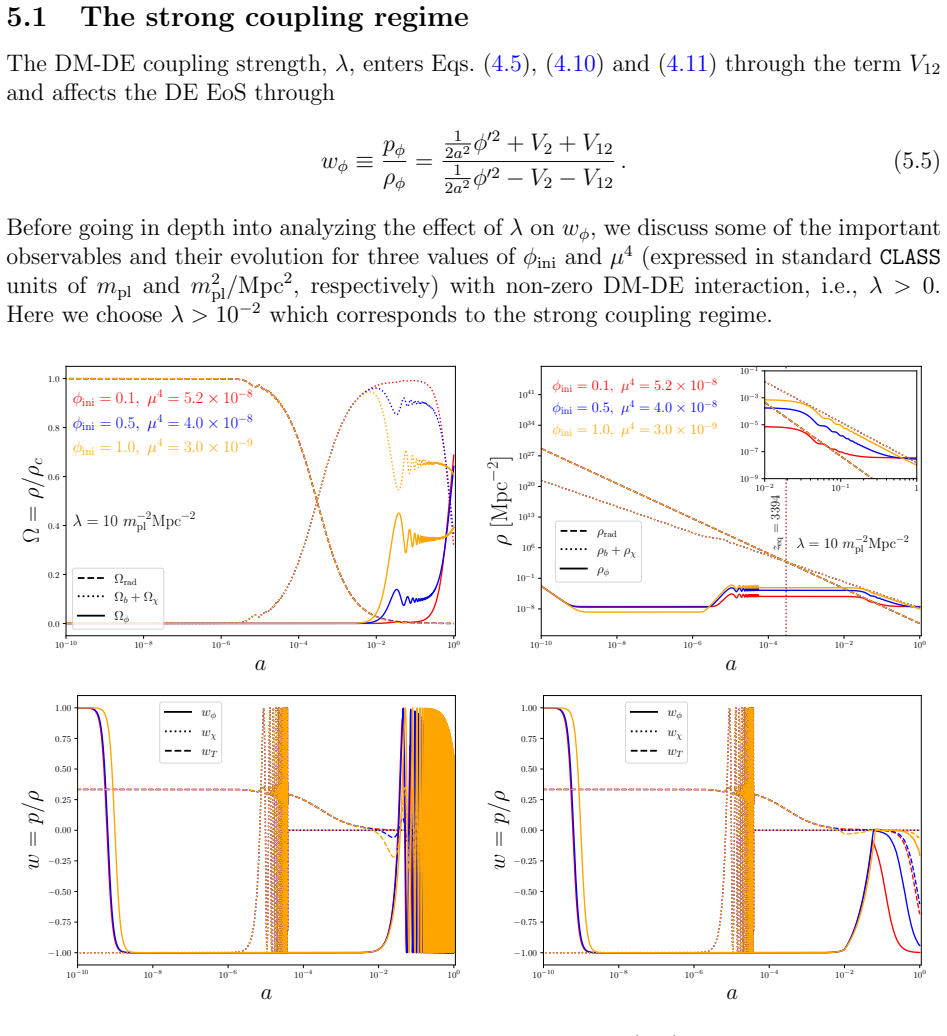
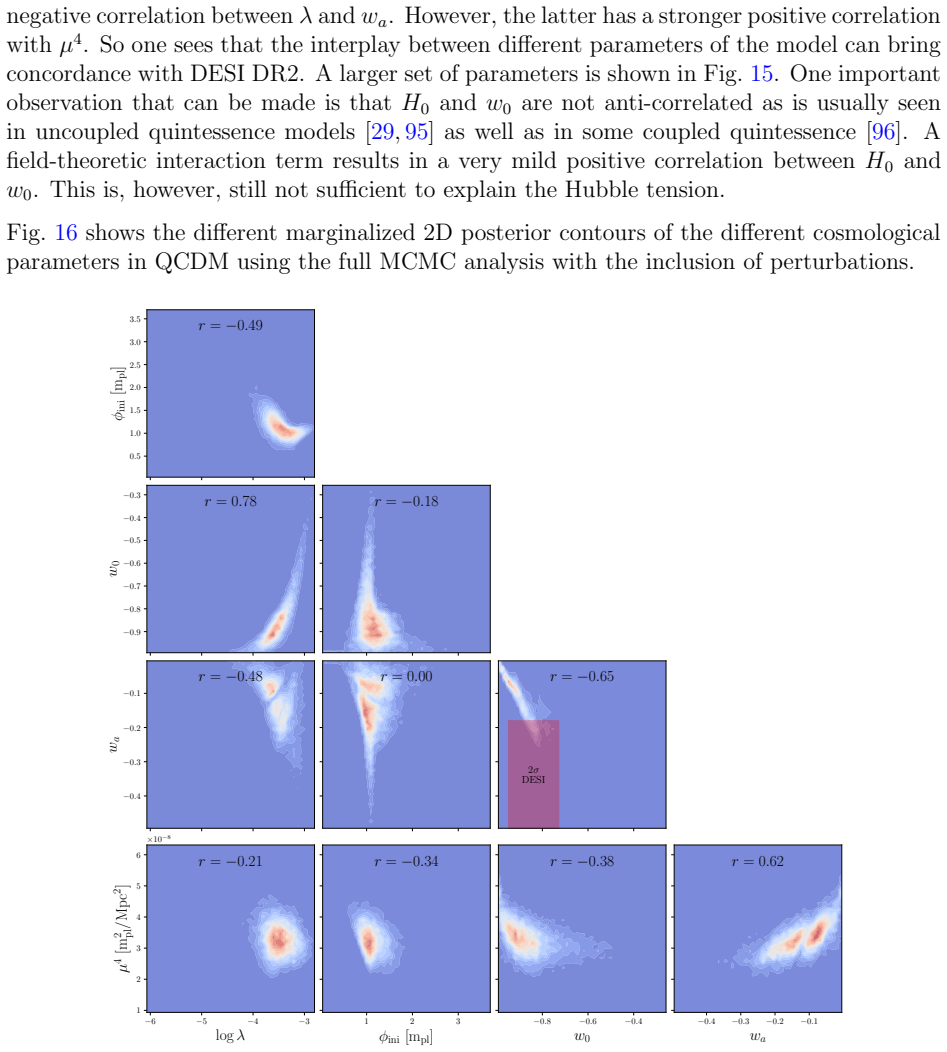
The paper's claim is that a field-theoretically consistent interaction between dark matter and dark energy, $V_{12}=\frac{\lambda}{2}\chi^{2}\varphi^{2}$ between an ultralight scalar DM field $\chi$ and a pseudo-Nambu-Goldstone quintessence field $\varphi$ with $V_{2}=\mu^{4}(1+\cos(\varphi/F))$, produces a dark energy equation of state whose behaviour is controlled by the size of $\lambda$. For strong coupling ($\lambda\ge 10^{-2}$, in units of $m_{\rm pl}^{-2}\,{\rm Mpc}^{-2}$) the interaction gives the quintessence field a positive effective mass late in cosmic history, the total potential rolls into a $\cosh$-like double-exponential shape, and the equation of state transmutes from thawing to scaling freezing; this freezing behaviour conflicts with DESI DR2's preference for $w_0>-1$, $w_a<0$, so the strong-coupling region is excluded. In the weak-coupling regime the thawing character is retained, and a full MCMC analysis against Planck 2018 CMB, DESI DR2 BAO and three supernova samples (PantheonPlus+SH0ES, Union3, DESY5) sets upper limits on the interaction strength: $\log\lambda < -5.49$ to $-5.69$ at 95% CL with perturbations included, compared with $-2.78$ to $-3.26$ from background evolution alone. In the $w_0$–$w_a$ plane $\Lambda$CDM lies inside the $1\sigma$ contour while all best-fit points fall in the fourth quadrant, and the information criteria ($\Delta{\rm DIC}<0$, $\Delta{\rm AIC}>10$) show the data still prefer the non-interacting model.
Load-bearing premise
The load-bearing premise is that the fast-oscillating dark matter field, once time-averaged, behaves exactly like pressureless cold dark matter, and that the perturbation calculation — started from zero perturbations and gauge-fixed by adding a tiny cold dark matter component ($\Omega_{\rm CDM} h^2 = 10^{-5}$) — faithfully represents the model; if either assumption fails, the quoted bounds on the interaction strength could be wrong.
Editorial extensions
If this is right
- The strong-coupling regime ($\lambda \geq 10^{-2}$) is excluded: a dark matter–dark energy interaction strong enough to transmute thawing quintessence into scaling freezing is incompatible with DESI DR2.
- With perturbations included, the surviving interaction strength is bounded by $\log\lambda < -5.49$ to $-5.69$ at 95% CL depending on the supernova sample, roughly two orders of magnitude tighter than the background-only bounds of $-2.78$ to $-3.26$.
- $\Lambda$CDM remains inside the $1\sigma$ contour of the $w_0$–$w_a$ plane, yet the best-fit points for all data combinations lie in the fourth quadrant, leaving room for a mildly evolving dark energy equation of state that never crosses the phantom divide.
- Model comparison by information criteria shows the data prefer the non-interacting model ($\Delta{\rm DIC}<0$; $\Delta{\rm AIC}>10$), so the interaction is constrained rather than required by DESI DR2.
- The model can only moderately ease the Hubble tension ($H_0$ near 69 km/s/Mpc versus the local value of 73.04), while its $S_8$ values agree with recent weak lensing measurements.
Reading between the lines
- Translated out of the model's units ($m_{\rm pl}^{-2}\,{\rm Mpc}^{-2}$) into a dimensionless particle coupling for a given dark matter mass, $\log\lambda \lesssim -5.5$ would put the interaction far beyond any foreseeable laboratory sensitivity; the paper does not perform this translation, but the bound implies that an observable dark matter–dark energy scattering would require physics beyond this
- Because the tightest limits come from the perturbation sector, where the synchronous gauge is fixed by adding a tiny cold dark matter component ($\Omega_{\rm CDM} h^2 = 10^{-5}$), the jump from background bounds ($\log\lambda \lesssim -3$) to perturbation bounds ($\log\lambda \lesssim -5.5$) deserves an independent check in a different gauge or with a treatment that avoids that crutch.
- The feature-importance analysis shows that which parameter drives the fit depends on the supernova calibration, with the coupling $\lambda$ most important for PantheonPlus and the potential scale $F$ for Union3 and DESY5; a consequence left implicit is that the quoted upper limit on $\lambda$ is sensitive to which supernova sample is trusted.
- Re-running the same machinery with a different quintessence potential would test whether the fourth-quadrant preference for $(w_0, w_a)$ is a generic feature of field-theoretic dark matter–dark energy interactions or a particularity of the cosine potential chosen here.
Signed reviews
Editorial analysis
A structured set of objections, weighed in public.
Referee Report
Summary. The paper studies a field-theoretic interacting quintessence-dark matter model (QCDM) with an ultralight scalar dark matter field chi and a quintessence field phi coupled through V_int = (lambda/2) chi^2 phi^2. It argues that fluid-based interacting dark energy-dark matter models are inconsistent with field theory, derives background and perturbation equations, and identifies strong and weak coupling regimes for lambda. Using DESI DR2 w0-wa contours, the paper claims to rule out the strong-coupling region (lambda >~ 10^-2) on the basis of the transmutation of thawing quintessence into freezing quintessence, and then derives upper limits on lambda in the weak-coupling region. A separate CLASS+Cobaya MCMC analysis with Planck, DESI DR2 BAO, and three supernova datasets yields perturbation-level upper limits log lambda < -5.49 and < -5.69 for two of the dataset combinations, with Delta AIC > 10 favoring LambdaCDM in all cases and best-fit w0-wa points lying in the fourth quadrant.
Significance. If the central results hold, the paper provides a useful field-theoretic counterpoint to the common phenomenological interacting-fluid models and delivers quantitative DESI DR2 constraints on a concrete DM-DE interaction. The work has several genuine strengths: the derivation in Section 3 and Appendix A that energy exchange in the fluid picture is inconsistent with a local field theory is explicit and instructive; the background analysis identifies a sharp, physically motivated distinction between strong and weak coupling; and the MCMC analysis uses standard public likelihoods and honestly reports that LambdaCDM is preferred by Delta AIC > 10. The upper limits on lambda, if trustworthy, would be of direct interest for model building. However, the perturbation-level limits in Table 2 rest on an averaged-field treatment and a gauge-fixing workaround that are not validated, and the strong-coupling exclusion depends on an undocumented scan. These load-bearing gaps currently prevent the paper from delivering a fully supported upper-limit claim.
major comments (4)
- [Section 6] The perturbation-level constraints in Table 2 rest on two assumptions that are stated but not validated: (i) that setting chi_1 = chi_1' = 0 and phi_1 = phi_1' = 0 is harmless because the perturbations are 'quickly driven to the attractor solution'; and (ii) that adding a tiny CDM component with Omega_CDM h^2 = 10^-5 fixes the synchronous gauge even though the scalar field has a dynamical equation of state. For a scalar field, zero initial perturbations do not generally eliminate the residual gauge mode in synchronous gauge, and the paper provides no convergence test, no comparison with a different gauge, and no demonstration that the 10^-5 CDM component is negligible for the perturbation likelihood. Without such a check, the limits log lambda < -5.49 and < -5.69 quoted in Table 2 could be biased by the gauge choice or the initialization scheme.
- [Section 5.1] The claim that the strong-coupling region is ruled out is the paper's headline result, but it rests on an undocumented scan. The text says 'We thoroughly checked that no parameter combination can be chosen that will fit the w0 and wa values in the strong coupling regime' (Section 5.1), yet no ranges for F, phi_ini, mu^4, and lambda, no number of sampled points, no fitting criterion, and no treatment of m_chi are given, and no code or data release is provided. The exclusion should either be made reproducible or replaced by a documented MCMC or grid scan over the strong-coupling region; as written, the reader cannot verify the central 'rule out' claim.
- [Section 4] The averaged-variable scheme in Eqs. (4.10)-(4.12) is central to the background and perturbation analysis, but it is not validated against a direct integration of the Klein-Gordon system (4.4)-(4.5) for any parameter set or redshift. In particular, the interaction source terms in Eqs. (4.10)-(4.11) contain oscillatory combinations such as chi' V_12,chi and V_12, and it is not shown that the coarse-grained variables reproduce the time-averaged exact evolution, especially during the epoch when the phi field itself begins to oscillate around a ~ 0.1 (Section 5.1). If this averaging is inaccurate, the fitted w0 and wa values and hence the lambda limits in Table 2 could be biased. A direct-integrator comparison for representative benchmarks is needed.
- [Section 5, Eqs. (5.1)-(5.3)] The dark matter mass m_chi is never specified anywhere in Sections 5-6 or in Table 2, yet the attractor initial conditions in Eqs. (5.1)-(5.3) depend explicitly on m_chi through y_ini = 2 m_chi/H0 a_ini^2 Omega_rad0^{-1/2}. The value of m_chi also controls the oscillation frequency and the validity of the time-averaging approximation. Without specifying m_chi, or demonstrating that all results are independent of it, the physical regime being constrained is not fully defined and the numerical results are not reproducible.
minor comments (5)
- [Section 4] The first sentence refers to a 'flat FLR W metric'; this should be the 'flat FLRW metric'.
- [Section 5.2, Eq. (5.15)] The chi^2 in Eq. (5.15) uses sigma_i, but the uncertainty sigma_i in the fit to w_phi(a) is not defined; please specify how the error band around the model EoS is estimated.
- [Section 6, Eq. (6.1)] The prior ranges for the sampled parameters log mu^4, F, phi_ini, and log lambda are not stated, despite the statement that flat priors are imposed; prior ranges should be given, since they can affect the quoted upper limits on log lambda.
- [Table 2 and Section 6 text] The text 'All three data sets indicate a weak DM-DE coupling' is ambiguous because Table 2 shows four dataset combinations; please specify which three are meant and how the CMB+DESI column, which gives a two-sided log lambda interval rather than an upper limit, is treated.
- [Figures 6 and 9] The color bars for H0 and log lambda in Figures 6 and 9 are very small and difficult to read in the reproduced manuscript; increasing the font size and labeling the units explicitly would improve clarity.
Circularity Check
No significant circularity: the DESI DR2 upper bounds on lambda come from an MCMC over external Planck/DESI/SN likelihoods, and the w0-wa comparisons are forward-model outputs, not fitted inputs.
full rationale
The central claim, that DESI DR2 data exclude the strong-coupling regime and place upper limits on the dark matter-dark energy interaction strength, is not circular. The limits in Table 2 (log lambda below -5.49 to -5.69) come from interfacing CLASS with Cobaya and sampling over Planck, DESI DR2 BAO, and supernova likelihoods; lambda is a sampled parameter constrained by external data, not a fitted quantity relabeled as a prediction. The w0 and wa values are derived parameters: they are obtained by fitting the model's own w_phi(a) to the CPL form via Eqs. (5.12)-(5.14) and then compared with, not fitted to, DESI's w0-wa contours. This is a forward-model prediction and does not reduce to the input. The strong-coupling exclusion likewise follows from computing w_phi(a) for lambda >= 10^-2, fitting Eq. (5.7), and showing the resulting (w0, wa) fall outside DESI's 2-sigma region; the comparison is against external data. The only self-citation is motivational ('Motivated by a previous work [56, 57], where the authors have shown that such a field-theoretic approach can alleviate the H0 tension and resolve the S8 tension'), and the technical machinery, including the averaged variables of Eqs. (4.7)-(4.9), the attractor initial conditions (5.1)-(5.3), and the perturbation attractor [77], is drawn from independent external references. No parameter is defined in terms of the target result, and no load-bearing premise is justified solely by a self-citation. The averaging and synchronous-gauge procedure (Omega_CDM h^2 = 10^-5) is a modeling assumption that could affect the limits, but it is not equivalent to the DESI constraints it is used to derive; at most it is a correctness risk. The score of 2 reflects only the minor, non-load-bearing self-citation in the Introduction, not any reduction of the central claim to its inputs.
Assumptions & free parameters
free parameters (7)
- lambda (dark energy-dark matter interaction strength) =
Upper limits: log lambda < -5.49 (DESY5), < -5.69 (Union3); background-only log lambda < -2.78 to -3.26
- F (quintessence potential scale) =
Posterior ranges, e.g. F > 0.561 m_Pl (CMB+DESI) to 0.51+0.20-0.22 (with DESY5)
- phi_ini (initial quintessence field value) =
Upper limits < 0.157 to < 0.560 m_Pl depending on dataset
- mu^4 (quintessence potential energy scale) =
log mu4 approximately -7.23 to -7.18 in m_Pl^2/Mpc^2
- m_chi (dark matter scalar mass) =
Not specified
- w(a) fit parameters alpha, beta, p, q =
Not tabulated
- Omega_CDM h^2 (gauge-fixing CDM fraction) =
10^-5
assumptions (6)
- standard math FLRW background and linear perturbation theory, as implemented in CLASS, describe the universe.
- domain assumption Rapid oscillations of the chi field time-average to a pressureless CDM fluid, so the averaged variables Eqs. (4.10)-(4.12) capture dark matter evolution.
- domain assumption The interaction term V12 = lambda/2 chi^2 phi^2 is the only dark matter-dark energy coupling, with no other potential terms of comparable importance.
- ad hoc to paper The perturbations chi_1 and phi_1 can be initialized at zero and reach the attractor, and a small CDM component fixes the synchronous gauge despite the non-pressureless scalar.
- ad hoc to paper The fitting functions Eqs. (5.7) and (5.12) faithfully represent the model's equation of state over the range used to extract w0 and wa.
- domain assumption DESI DR2 CPL constraints are a valid target even though the model's equation of state is not CPL; matching w0 and wa from a fit captures the relevant observable.
Cite this review
Pith. "Pith review of Upper limits on dark energy-dark matter interaction from DESI DR2 in a field-theoretic analysis." pith.science (2026). https://pith.science/paper/A2H3GNME
@misc{pith2026241111177,
  author       = {Pith},
  title        = {Pith review of: Upper limits on dark energy-dark matter interaction from DESI DR2 in a field-theoretic analysis},
  year         = {2026},
  howpublished = {\url{https://pith.science/paper/A2H3GNME}},
  note         = {Machine review of arXiv:2411.11177}
}
abstract
One of the important issues both in particle physics and cosmology relates to whether dark energy is a cosmological constant $\Lambda$, or is dynamical in nature such as quintessence. In this work, we discuss a model of quintessence interacting with dark matter and analyze the resulting phenomenology of the dark energy equation of state. We identify two regions where the equation of state behaves differently depending on the size of the dark matter-dark energy interaction strength. We show that the strong coupling region induces a transmutation of quintessence from thawing to freezing. Using the recent data release from the Dark Energy Spectroscopic Instrument (DESI), we rule out this possibility of transmutation and investigate the weak coupling region to derive upper limits on the interaction strength. Our analysis indicates that while $\Lambda$CDM lies within the $1\sigma$ contour in the $w_0$-$w_a$ plane, the best fit points lie in the fourth quadrant and show deviations from the $\Lambda$CDM prediction.
Figures


Figures from the paper (13 more)




Forward citations
Cited by 8 Pith papers
-
Automatic detection of fast oscillations of dark matter scalar field and updated cosmological constraints on QCDM
An automatic algorithm in the CLASS Boltzmann code detects the onset of rapid oscillations in scalar-field dark matter and enables accurate averaging even with dark matter-dark energy interactions; updated QCDM constr...
-
BAO miscalibration cannot rescue late-time solutions to the Hubble tension
Even after rescaling BAO data to prefer H0≈73 km/s/Mpc, none of six tested late-time dark-energy models can resolve the Hubble tension once unanchored SNeIa and CMB geometry are included.
-
A comprehensive numerical study on four categories of holographic dark energy models
Seven holographic dark energy models are constrained with DESI BAO, Planck CMB, and PantheonPlus supernovae; LambdaCDM stays preferred, Ricci dark energy is ruled out, and event-horizon models show large data-set-depe...
-
Cosmology of axion dark energy in supersymmetric models and constraints on high scale parameters
A two-cosine axion dark energy potential fits CMB+BAO+supernova data better than the standard one-cosine potential, while preferring a sub-Planckian decay constant and a feeble dark-matter coupling.
-
Robustness of dark energy phenomenology across different parameterizations
The viability of minimally and non-minimally coupled quintessence models is robust across CPL, JBP, BA, and EXP parameterizations, with all four reproducing the models' predicted observables accurately.
-
Interacting phantom dark energy: new accelerating scaling attractors
Interacting phantom dark energy with two previously underused potentials admits new stable late-time accelerating solutions in which dark matter and dark energy coexist.
-
Topological defects as effective dynamical dark energy
A few percent domain-wall component gives a mild (Δχ² = -1.72) improvement over ΛCDM when fitting DESI DR2 BAO and DESY5 supernovae, but the evidence is inconclusive.
-
Breaking Free from the Swampland of Impossible Universes through the DESI Portal
DESI data indicating evolving dark energy may allow string theory to describe observed universes without violating swampland constraints on constant dark energy.
Reference graph
Works this paper leans on
-
[1]
E. Abdalla, G. Franco Abell´ an, A. Aboubrahim, A. Agnello, O. Akarsu, Y. Akrami, G. Alestas, D. Aloni, L. Amendola and L. A. Anchordoqui,et al.JHEAp34, 49-211 (2022) doi:10.1016/j.jheap.2022.04.002 [arXiv:2203.06142 [astro-ph.CO]]. 33
arXiv 2022
-
[2]
Di Valentinoet al.[CosmoVerse], doi:10.1016/j.dark.2025.101965 [arXiv:2504.01669 [astro-ph.CO]]
E. Di Valentinoet al.[CosmoVerse], doi:10.1016/j.dark.2025.101965 [arXiv:2504.01669 [astro-ph.CO]]
arXiv 2025
-
[3]
A. Pourtsidou, C. Skordis and E. J. Copeland, Phys. Rev. D88, no.8, 083505 (2013) doi:10.1103/PhysRevD.88.083505 [arXiv:1307.0458 [astro-ph.CO]]
arXiv 2013
-
[4]
A. Pourtsidou and T. Tram, Phys. Rev. D94, no.4, 043518 (2016) doi:10.1103/PhysRevD.94.043518 [arXiv:1604.04222 [astro-ph.CO]]
arXiv 2016
-
[5]
M. S. Linton, A. Pourtsidou, R. Crittenden and R. Maartens, JCAP04, 043 (2018) doi:10.1088/1475-7516/2018/04/043 [arXiv:1711.05196 [astro-ph.CO]]
arXiv 2018
-
[6]
F. N. Chamings, A. Avgoustidis, E. J. Copeland, A. M. Green and A. Pourtsidou, Phys. Rev. D101, no.4, 043531 (2020) doi:10.1103/PhysRevD.101.043531 [arXiv:1912.09858 [astro-ph.CO]]
arXiv 2020
-
[7]
S. Pan, W. Yang, E. Di Valentino, E. N. Saridakis and S. Chakraborty, Phys. Rev. D 100, no.10, 103520 (2019) doi:10.1103/PhysRevD.100.103520 [arXiv:1907.07540 [astro- ph.CO]]
arXiv 2019
-
[8]
M. Bonici and N. Maggiore, Eur. Phys. J. C79, no.8, 672 (2019) doi:10.1140/epjc/s10052-019-7198-1 [arXiv:1812.11176 [gr-qc]]
arXiv 2019
Show all 96 references
-
[9]
W. Yang, O. Mena, S. Pan and E. Di Valentino, Phys. Rev. D100, no.8, 083509 (2019) doi:10.1103/PhysRevD.100.083509 [arXiv:1906.11697 [astro-ph.CO]]
2019 arXiv
-
[10]
S. Pan, G. S. Sharov and W. Yang, Phys. Rev. D101, no.10, 103533 (2020) doi:10.1103/PhysRevD.101.103533 [arXiv:2001.03120 [astro-ph.CO]]
2020 arXiv
-
[11]
B. Wang, E. Abdalla, F. Atrio-Barandela and D. Pavon, Rept. Prog. Phys.79, no.9, 096901 (2016) doi:10.1088/0034-4885/79/9/096901 [arXiv:1603.08299 [astro-ph.CO]]
2016 arXiv
-
[12]
B. Wang, E. Abdalla, F. Atrio-Barandela and D. Pav´ on, Rept. Prog. Phys.87, no.3, 036901 (2024) doi:10.1088/1361-6633/ad2527 [arXiv:2402.00819 [astro-ph.CO]]
2024 arXiv
-
[13]
C. G. Boehmer, N. Tamanini and M. Wright, Phys. Rev. D91, no.12, 123002 (2015) doi:10.1103/PhysRevD.91.123002 [arXiv:1501.06540 [gr-qc]]
2015 arXiv
-
[14]
C. G. Boehmer, N. Tamanini and M. Wright, Phys. Rev. D91, no.12, 123003 (2015) doi:10.1103/PhysRevD.91.123003 [arXiv:1502.04030 [gr-qc]]
2015 arXiv
-
[15]
W. J. Potter and S. Chongchitnan, JCAP09, 005 (2011) doi:10.1088/1475- 7516/2011/09/005 [arXiv:1108.4414 [astro-ph.CO]]
2011 arXiv
-
[16]
Di Valentino, A
E. Di Valentino, A. Melchiorri, O. Mena and S. Vagnozzi, Phys. Rev. D101, no.6, 063502 (2020) doi:10.1103/PhysRevD.101.063502 [arXiv:1910.09853 [astro-ph.CO]]
2020 arXiv
-
[17]
Di Valentino, A
E. Di Valentino, A. Melchiorri, O. Mena and S. Vagnozzi, Phys. Dark Univ.30, 100666 (2020) doi:10.1016/j.dark.2020.100666 [arXiv:1908.04281 [astro-ph.CO]]
2020
-
[18]
L. A. Escamilla, O. Akarsu, E. Di Valentino and J. A. Vazquez, JCAP11, 051 (2023) doi:10.1088/1475-7516/2023/11/051 [arXiv:2305.16290 [astro-ph.CO]]. 34
2023 arXiv
-
[19]
Bernui, E
A. Bernui, E. Di Valentino, W. Giar` e, S. Kumar and R. C. Nunes, Phys. Rev. D 107, no.10, 103531 (2023) doi:10.1103/PhysRevD.107.103531 [arXiv:2301.06097 [astro- ph.CO]]
2023 arXiv
-
[20]
W. Yang, S. Pan, O. Mena and E. Di Valentino, JHEAp40, 19-40 (2023) doi:10.1016/j.jheap.2023.09.001 [arXiv:2209.14816 [astro-ph.CO]]
2023 arXiv
-
[21]
Amendola, Phys
L. Amendola, Phys. Rev. D62, 043511 (2000) doi:10.1103/PhysRevD.62.043511 [arXiv:astro-ph/9908023 [astro-ph]]
2000 arXiv
-
[22]
Kase and S
R. Kase and S. Tsujikawa, Phys. Rev. D101, no.6, 063511 (2020) doi:10.1103/PhysRevD.101.063511 [arXiv:1910.02699 [gr-qc]]
2020 arXiv
-
[23]
P´ erez, U
P. P´ erez, U. Nucamendi and R. De Arcia, Eur. Phys. J. C81, no.12, 1063 (2021) doi:10.1140/epjc/s10052-021-09857-4 [arXiv:2104.07690 [gr-qc]]
2021 arXiv
-
[24]
Garcia-Arroyo, L
G. Garcia-Arroyo, L. A. Ure˜ na-L´ opez and J. A. V´ azquez, Phys. Rev. D110, no.2, 023529 (2024) doi:10.1103/PhysRevD.110.023529 [arXiv:2402.08815 [astro-ph.CO]]
2024 arXiv
-
[25]
Beyer, S
J. Beyer, S. Nurmi and C. Wetterich, Phys. Rev. D84, 023010 (2011) doi:10.1103/PhysRevD.84.023010 [arXiv:1012.1175 [astro-ph.CO]]
2011 arXiv
- [26]
-
[27]
van de Bruck, G
C. van de Bruck, G. Poulot and E. M. Teixeira, JCAP07, 019 (2023) doi:10.1088/1475- 7516/2023/07/019 [arXiv:2211.13653 [hep-th]]
2023 arXiv
-
[28]
W. Yang, S. Pan, E. Di Valentino, R. C. Nunes, S. Vagnozzi and D. F. Mota, JCAP 09, 019 (2018) doi:10.1088/1475-7516/2018/09/019 [arXiv:1805.08252 [astro-ph.CO]]
2018 arXiv
-
[29]
B. H. Lee, W. Lee, E. ´O. Colg´ ain, M. M. Sheikh-Jabbari and S. Thakur, JCAP04, no.04, 004 (2022) doi:10.1088/1475-7516/2022/04/004 [arXiv:2202.03906 [astro-ph.CO]]
2022 arXiv
-
[30]
Doran and G
M. Doran and G. Robbers, JCAP06, 026 (2006) doi:10.1088/1475-7516/2006/06/026 [arXiv:astro-ph/0601544 [astro-ph]]
2006 arXiv
-
[31]
Agrawal, F
P. Agrawal, F. Y. Cyr-Racine, D. Pinner and L. Randall, Phys. Dark Univ.42, 101347 (2023) doi:10.1016/j.dark.2023.101347 [arXiv:1904.01016 [astro-ph.CO]]
2023
-
[32]
Vagnozzi, Universe9, no.9, 393 (2023) doi:10.3390/universe9090393 [arXiv:2308.16628 [astro-ph.CO]]
S. Vagnozzi, Universe9, no.9, 393 (2023) doi:10.3390/universe9090393 [arXiv:2308.16628 [astro-ph.CO]]
2023 arXiv
-
[33]
Berezhiani, A
Z. Berezhiani, A. D. Dolgov and I. I. Tkachev, Phys. Rev. D92, no.6, 061303 (2015) doi:10.1103/PhysRevD.92.061303 [arXiv:1505.03644 [astro-ph.CO]]
2015 arXiv
-
[34]
Ibarra, D
A. Ibarra, D. Tran and C. Weniger, Int. J. Mod. Phys. A28, 1330040 (2013) doi:10.1142/S0217751X13300408 [arXiv:1307.6434 [hep-ph]]
2013 arXiv
-
[35]
Aboubrahim, M
A. Aboubrahim, M. Klasen and P. Nath, JCAP04, no.04, 042 (2022) doi:10.1088/1475- 7516/2022/04/042 [arXiv:2202.04453 [astro-ph.CO]]
2022 arXiv
-
[36]
Fernandez-Martinez, M
E. Fernandez-Martinez, M. Pierre, E. Pinsard and S. Rosauro-Alcaraz, Eur. Phys. J. C 81, no.10, 954 (2021) doi:10.1140/epjc/s10052-021-09760-y [arXiv:2106.05298 [hep-ph]]. 35
2021 arXiv
-
[37]
Escudero and S
M. Escudero and S. J. Witte, Eur. Phys. J. C81, no.6, 515 (2021) doi:10.1140/epjc/s10052-021-09276-5 [arXiv:2103.03249 [hep-ph]]
2021 arXiv
-
[38]
Baumann, D
D. Baumann, D. Green, J. Meyers and B. Wallisch, JCAP01, 007 (2016) doi:10.1088/1475-7516/2016/01/007 [arXiv:1508.06342 [astro-ph.CO]]
2016 arXiv
-
[39]
Brust, Y
C. Brust, Y. Cui and K. Sigurdson, JCAP08, 020 (2017) doi:10.1088/1475- 7516/2017/08/020 [arXiv:1703.10732 [astro-ph.CO]]
2017 arXiv
-
[40]
Blinov and G
N. Blinov and G. Marques-Tavares, JCAP09, 029 (2020) doi:10.1088/1475- 7516/2020/09/029 [arXiv:2003.08387 [astro-ph.CO]]
2020 arXiv
-
[41]
T. D. Jacques, L. M. Krauss and C. Lunardini, Phys. Rev. D87, no.8, 083515 (2013) [erratum: Phys. Rev. D88, no.10, 109901 (2013)] doi:10.1103/PhysRevD.87.083515 [arXiv:1301.3119 [astro-ph.CO]]
2013 arXiv
-
[42]
A. J. Cuesta, M. E. G´ omez, J. I. Illana and M. Masip, JCAP04, no.04, 009 (2022) doi:10.1088/1475-7516/2022/04/009 [arXiv:2109.07336 [hep-ph]]
2022 arXiv
-
[43]
Vagnozzi, Phys
S. Vagnozzi, Phys. Rev. D102, no.2, 023518 (2020) doi:10.1103/PhysRevD.102.023518 [arXiv:1907.07569 [astro-ph.CO]]
2020 arXiv
-
[44]
Valiviita, E
J. Valiviita, E. Majerotto and R. Maartens, JCAP07, 020 (2008) doi:10.1088/1475- 7516/2008/07/020 [arXiv:0804.0232 [astro-ph]]
2008 arXiv
-
[45]
M. B. Gavela, D. Hernandez, L. Lopez Honorez, O. Mena and S. Rigolin, JCAP 07, 034 (2009) [erratum: JCAP05, E01 (2010)] doi:10.1088/1475-7516/2009/07/034 [arXiv:0901.1611 [astro-ph.CO]]
2009 arXiv
-
[46]
A. G. Adameet al.[DESI], JCAP02, 021 (2025) doi:10.1088/1475-7516/2025/02/021 [arXiv:2404.03002 [astro-ph.CO]]
2025 arXiv
-
[47]
Abdul Karimet al.[DESI], [arXiv:2503.14738 [astro-ph.CO]]
M. Abdul Karimet al.[DESI], [arXiv:2503.14738 [astro-ph.CO]]
-
[48]
Chevallier and D
M. Chevallier and D. Polarski, Int. J. Mod. Phys. D10, 213-224 (2001) doi:10.1142/S0218271801000822 [arXiv:gr-qc/0009008 [gr-qc]]
2001 arXiv
-
[49]
E. V. Linder, Phys. Rev. Lett.90, 091301 (2003) doi:10.1103/PhysRevLett.90.091301 [arXiv:astro-ph/0208512 [astro-ph]]
2003 arXiv
-
[50]
R. J. Scherrer and A. A. Sen, Phys. Rev. D77, 083515 (2008) doi:10.1103/PhysRevD.77.083515 [arXiv:0712.3450 [astro-ph]]
2008 arXiv
-
[51]
R. R. Caldwell and E. V. Linder, Phys. Rev. Lett.95, 141301 (2005) doi:10.1103/PhysRevLett.95.141301 [arXiv:astro-ph/0505494 [astro-ph]]
2005 arXiv
-
[52]
W. J. Wolf and P. G. Ferreira, Phys. Rev. D108, no.10, 103519 (2023) doi:10.1103/PhysRevD.108.103519 [arXiv:2310.07482 [astro-ph.CO]]
2023 arXiv
-
[53]
W. J. Wolf, C. Garc ´ ıa-Garc ´ ıa, D. J. Bartlett and P. G. Ferreira, Phys. Rev. D110, no.8, 083528 (2024) doi:10.1103/PhysRevD.110.083528 [arXiv:2408.17318 [astro-ph.CO]]. 36
2024 arXiv
-
[54]
P. G. Ferreira and M. Joyce, Phys. Rev. D58, 023503 (1998) doi:10.1103/PhysRevD.58.023503 [arXiv:astro-ph/9711102 [astro-ph]]
1998 arXiv
-
[55]
E. J. Copeland, A. R. Liddle and D. Wands, Phys. Rev. D57, 4686-4690 (1998) doi:10.1103/PhysRevD.57.4686 [arXiv:gr-qc/9711068 [gr-qc]]
1998 arXiv
-
[56]
Aboubrahim and P
A. Aboubrahim and P. Nath, JCAP09, 076 (2024) doi:10.1088/1475-7516/2024/09/076 [arXiv:2406.19284 [astro-ph.CO]]
2024 arXiv
- [57]
-
[58]
Pantazis, S
G. Pantazis, S. Nesseris and L. Perivolaropoulos, Phys. Rev. D93, no.10, 103503 (2016) doi:10.1103/PhysRevD.93.103503 [arXiv:1603.02164 [astro-ph.CO]]
2016 arXiv
-
[59]
Tsujikawa, Class
S. Tsujikawa, Class. Quant. Grav.30, 214003 (2013) doi:10.1088/0264- 9381/30/21/214003 [arXiv:1304.1961 [gr-qc]]
2013 arXiv
-
[60]
M. S. Turner, Phys. Rev. D28, 1243 (1983) doi:10.1103/PhysRevD.28.1243
1983 doi
-
[61]
L. A. Ure˜ na-L´ opez and A. X. Gonzalez-Morales, JCAP07, 048 (2016) doi:10.1088/1475- 7516/2016/07/048 [arXiv:1511.08195 [astro-ph.CO]]
2016 arXiv
-
[62]
D. Blas, J. Lesgourgues and T. Tram, JCAP07, 034 (2011) doi:10.1088/1475- 7516/2011/07/034 [arXiv:1104.2933 [astro-ph.CO]]
2011 arXiv
-
[63]
J. A. Frieman, C. T. Hill, A. Stebbins and I. Waga, Phys. Rev. Lett.75, 2077-2080 (1995) doi:10.1103/PhysRevLett.75.2077 [arXiv:astro-ph/9505060 [astro-ph]]
1995 arXiv
-
[64]
Tada and T
Y. Tada and T. Terada, Phys. Rev. D109, no.12, L121305 (2024) doi:10.1103/PhysRevD.109.L121305 [arXiv:2404.05722 [astro-ph.CO]]
2024 arXiv
-
[65]
Rebou¸ cas, D
J. Rebou¸ cas, D. H. F. de Souza, K. Zhong, V. Miranda and R. Rosenfeld, JCAP02, 024 (2025) doi:10.1088/1475-7516/2025/02/024 [arXiv:2408.14628 [astro-ph.CO]]
2025 arXiv
-
[66]
K. V. Berghaus, J. A. Kable and V. Miranda, Phys. Rev. D110, no.10, 103524 (2024) doi:10.1103/PhysRevD.110.103524 [arXiv:2404.14341 [astro-ph.CO]]
2024 arXiv
-
[67]
W. J. Wolf, P. G. Ferreira and C. Garc ´ ıa-Garc ´ ıa, Phys. Rev. D111, no.4, L041303 (2025) doi:10.1103/PhysRevD.111.L041303 [arXiv:2409.17019 [astro-ph.CO]]
2025 arXiv
-
[68]
I. D. Gialamas, G. H¨ utsi, K. Kannike, A. Racioppi, M. Raidal, M. Vasar and H. Veerm¨ ae, Phys. Rev. D111, no.4, 043540 (2025) doi:10.1103/PhysRevD.111.043540 [arXiv:2406.07533 [astro-ph.CO]]
2025 arXiv
-
[69]
P. G. Ferreira and M. Joyce, Phys. Rev. Lett.79, 4740-4743 (1997) doi:10.1103/PhysRevLett.79.4740 [arXiv:astro-ph/9707286 [astro-ph]]
1997 arXiv
-
[70]
O. F. Ramadan, J. Sakstein and D. Rubin, Phys. Rev. D110, no.4, L041303 (2024) doi:10.1103/PhysRevD.110.L041303 [arXiv:2405.18747 [astro-ph.CO]]
2024 arXiv
-
[71]
Cortˆ es and A
M. Cortˆ es and A. R. Liddle, JCAP12, 007 (2024) doi:10.1088/1475-7516/2024/12/007 [arXiv:2404.08056 [astro-ph.CO]]. 37
2024 arXiv
-
[72]
Shlivko and P
D. Shlivko and P. J. Steinhardt, Phys. Lett. B855, 138826 (2024) doi:10.1016/j.physletb.2024.138826 [arXiv:2405.03933 [astro-ph.CO]]
2024
- [73]
-
[74]
Chen and C
T. Chen and C. Guestrin, doi:10.1145/2939672.2939785 [arXiv:1603.02754 [cs.LG]]
-
[75]
D. J. Spiegelhalter, N. G. Best, B. P. Carlin and A. van der Linde, J. Roy. Statist. Soc. B64, no.4, 583-639 (2002) doi:10.1111/1467-9868.00353
2002
-
[76]
Trotta, Contemp
R. Trotta, Contemp. Phys.49, 71-104 (2008) doi:10.1080/00107510802066753 [arXiv:0803.4089 [astro-ph]]
2008 arXiv
-
[77]
Ballesteros and J
G. Ballesteros and J. Lesgourgues, JCAP10, 014 (2010) doi:10.1088/1475- 7516/2010/10/014 [arXiv:1004.5509 [astro-ph.CO]]
2010 arXiv
-
[78]
Aghanimet al.[Planck], Astron
N. Aghanimet al.[Planck], Astron. Astrophys.641, A6 (2020) [erratum: Astron. As- trophys.652, C4 (2021)] doi:10.1051/0004-6361/201833910 [arXiv:1807.06209 [astro- ph.CO]]
2020 arXiv
-
[79]
Aghanimet al.[Planck], Astron
N. Aghanimet al.[Planck], Astron. Astrophys.641, A1 (2020) doi:10.1051/0004- 6361/201833880 [arXiv:1807.06205 [astro-ph.CO]]
2020 arXiv
-
[80]
Aghanimet al.[Planck], Astron
N. Aghanimet al.[Planck], Astron. Astrophys.641, A5 (2020) doi:10.1051/0004- 6361/201936386 [arXiv:1907.12875 [astro-ph.CO]]
2020 arXiv
-
[81]
Aghanimet al.[Planck], Astron
N. Aghanimet al.[Planck], Astron. Astrophys.641, A8 (2020) doi:10.1051/0004- 6361/201833886 [arXiv:1807.06210 [astro-ph.CO]]
2020 arXiv
-
[82]
Abdul Karimet al.[DESI], doi:10.1103/2wwn-xjm5 [arXiv:2503.14739 [astro- ph.CO]]
M. Abdul Karimet al.[DESI], doi:10.1103/2wwn-xjm5 [arXiv:2503.14739 [astro- ph.CO]]
-
[83]
Brout, D
D. Brout, D. Scolnic, B. Popovic, A. G. Riess, J. Zuntz, R. Kessler, A. Carr, T. M. Davis, S. Hinton and D. Jones,et al.Astrophys. J.938, no.2, 110 (2022) doi:10.3847/1538- 4357/ac8e04 [arXiv:2202.04077 [astro-ph.CO]]
2022 arXiv
-
[84]
A. G. Riess, W. Yuan, L. M. Macri, D. Scolnic, D. Brout, S. Casertano, D. O. Jones, Y. Murakami, L. Breuval and T. G. Brink,et al.Astrophys. J. Lett.934, no.1, L7 (2022) doi:10.3847/2041-8213/ac5c5b [arXiv:2112.04510 [astro-ph.CO]]
2022 arXiv
-
[85]
Rubin, G
D. Rubin, G. Aldering, M. Betoule, A. Fruchter, X. Huang, A. G. Kim, C. Lidman, E. Linder, S. Perlmutter and P. Ruiz-Lapuente,et al.[arXiv:2311.12098 [astro-ph.CO]]
-
[86]
T. M. C. Abbottet al.[DES], Astrophys. J. Lett.973, no.1, L14 (2024) doi:10.3847/2041-8213/ad6f9f [arXiv:2401.02929 [astro-ph.CO]]
2024 arXiv
-
[87]
Torrado and A
J. Torrado and A. Lewis, JCAP05, 057 (2021) doi:10.1088/1475-7516/2021/05/057 [arXiv:2005.05290 [astro-ph.IM]]
2021 arXiv
-
[88]
Lewis and S
A. Lewis and S. Bridle, Phys. Rev. D66, 103511 (2002) doi:10.1103/PhysRevD.66.103511 [arXiv:astro-ph/0205436 [astro-ph]]. 38
2002 arXiv
-
[89]
Lewis, Phys
A. Lewis, Phys. Rev. D87, no.10, 103529 (2013) doi:10.1103/PhysRevD.87.103529 [arXiv:1304.4473 [astro-ph.CO]]
2013 arXiv
-
[90]
R. M. Neal, [arXiv:math/0502099 [math.ST]]
-
[91]
Gelman and D
A. Gelman and D. B. Rubin, Statist. Sci.7, 457-472 (1992) doi:10.1214/ss/1177011136
1992
- [92]
-
[93]
A. H. Wright, B. St¨ olzner, M. Asgari, M. Bilicki, B. Giblin, C. Heymans, H. Hildebrandt, H. Hoekstra, B. Joachimi and K. Kuijken,et al.[arXiv:2503.19441 [astro-ph.CO]]
-
[94]
Akaike, IEEE Trans
H. Akaike, IEEE Trans. Automatic Control19, no.6, 716-723 (1974) doi:10.1109/TAC.1974.1100705
1974
-
[95]
Banerjee, H
A. Banerjee, H. Cai, L. Heisenberg, E. ´O. Colg´ ain, M. M. Sheikh-Jabbari and T. Yang, Phys. Rev. D103, no.8, L081305 (2021) doi:10.1103/PhysRevD.103.L081305 [arXiv:2006.00244 [astro-ph.CO]]
2021 arXiv
-
[96]
S. Das, P. S. Corasaniti and J. Khoury, Phys. Rev. D73, 083509 (2006) doi:10.1103/PhysRevD.73.083509 [arXiv:astro-ph/0510628 [astro-ph]]. 39
2006 arXiv
Reviewed August 12, 2026 · model on record in the stance chip above.
Discussion (0). Continue with ORCID to comment.