SAT-RTS: A systematic framework for tactical knowledge extraction and visualization-based analysis in real-time strategy games
Pith reviewed 2026-06-30 06:00 UTC · model grok-4.3
The pith
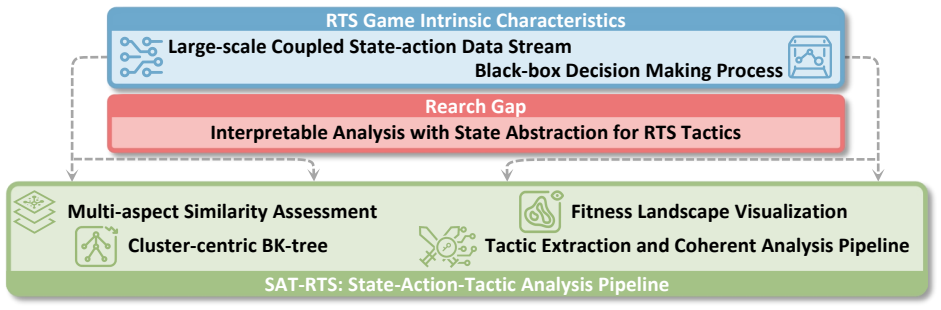
SAT-RTS turns high-dimensional RTS game sequences into hierarchical tactical labels and visualizations that reveal decision drivers.
A machine-rendered reading of the paper's core claim, the machinery that carries it, and where it could break.
Core claim
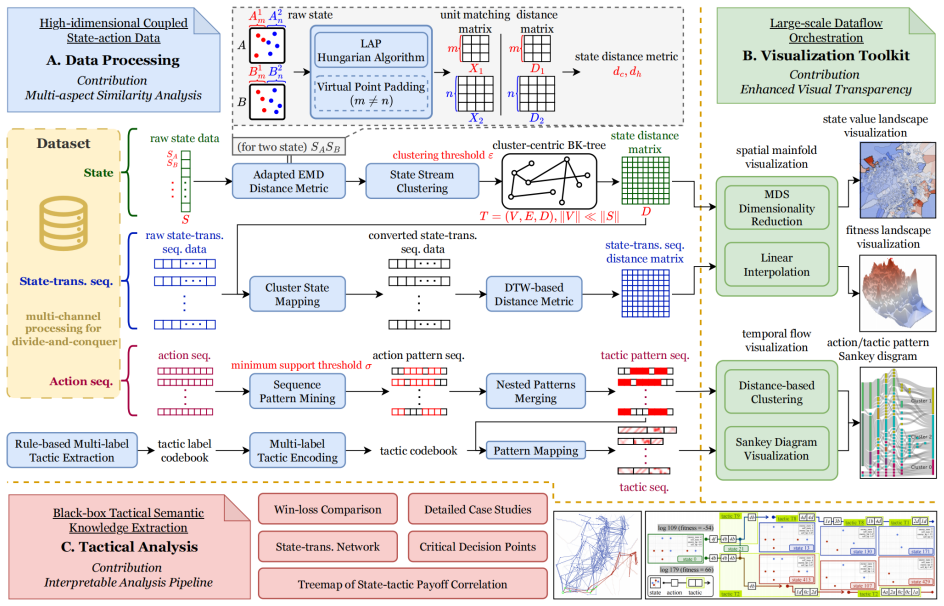
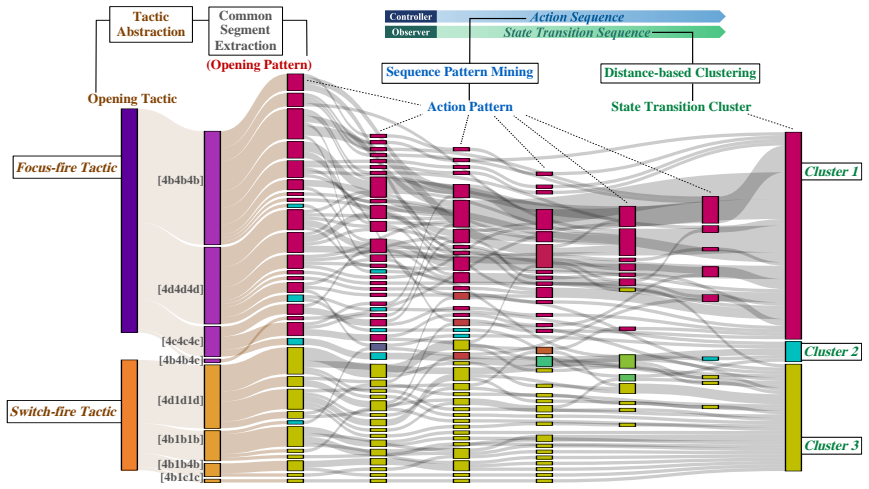
The central claim is that adapting a cluster-centric BK-tree algorithm with specialized multi-aspect distance metrics for state-stream abstraction, paired with a rule-based multi-label extraction step, converts unstructured high-dimensional sequences into discrete interpretable tactical labels; when these steps are integrated into a hierarchical visualization pipeline, the result supplies fitness landscape views that expose the deep-seated drivers of critical decisions in RTS environments.
What carries the argument
The state-action-tactic analysis pipeline (SAT-RTS), which applies a cluster-centric BK-tree with multi-aspect distance metrics to abstract state streams and a rule-based extractor to produce discrete tactical labels from raw sequences.
If this is right
- Analysts obtain concrete fitness-landscape visualizations that map how tactical choices evolve across game states.
- Raw behavioral traces are systematically converted into discrete, queryable tactical categories.
- Processing of continuous real-time data streams becomes feasible while retaining attribution links back to individual decisions.
- The same pipeline supplies a route to compare latent patterns across different learning agents or human players.
Where Pith is reading between the lines
- The abstraction step could be tested on non-RTS sequential domains such as robotic task planning where state-action traces are similarly high-dimensional.
- If the tactical labels prove stable across map variants, they might serve as building blocks for curriculum design in training new agents.
- The visualization layer might be extended to highlight mismatches between learned policies and expert play without requiring new labeled data.
Load-bearing premise
The chosen multi-aspect distance metrics and BK-tree clustering produce state abstractions that keep the actual drivers of decisions intact rather than creating artifacts from the coupled high-dimensional data.
What would settle it
A controlled comparison in which human experts rate the tactical labels and visualizations as no more informative than direct inspection of the original state-action logs on the same set of game replays.
Figures
read the original abstract
Efficient tactical knowledge extraction and analysis in real-time strategy (RTS) games micromanagement are constrained by the high-dimensional coupled state-action sequential data and the black-box decision-making process. Current research rarely provides a hierarchical visualization-based attribution analysis from the perspective of data decoupling and abstraction. To facilitate interpretable tactical knowledge extraction and visualization-based analysis in RTS games, a systematic framework named state-action-tactic analysis pipeline (SAT-RTS) is proposed. To decipher the deep-seated drivers of critical decisions in RTS learning systems, this work integrates interpretable visualization with the automated extraction of latent tactical patterns from high-dimensional sequence data. By adapting a cluster-centric BK-tree algorithm and incorporating specialized distance metrics designed to quantify multi-aspect similarities, the proposed framework facilitates robust state-stream abstraction. Furthermore, a rule-based multi-label extraction method is developed to transform unstructured state-action sequences into discrete and interpretable tactical labels, effectively bridging the gap between raw behavioral data and high-level tactical insights. By holistically integrating these computational methods into a hierarchical visualization-based pipeline, the proposed framework effectively addresses the challenges of processing massive real-time data streams while providing fitness landscape visualizations and analytical insights to decipher deep-seated tactical drivers. Comprehensive experiments demonstrate that the proposed SAT-RTS significantly enhances the interpretability and efficiency of tactical analysis in complex RTS environments.
Editorial analysis
A structured set of objections, weighed in public.
Referee Report
Summary. The manuscript proposes the SAT-RTS framework for tactical knowledge extraction and visualization-based analysis in RTS games. It adapts a cluster-centric BK-tree algorithm with multi-aspect distance metrics to abstract high-dimensional state streams, develops a rule-based multi-label extraction method to convert state-action sequences into discrete tactical labels, and integrates these into a hierarchical visualization pipeline for fitness landscapes and decision-driver analysis. The central claim is that comprehensive experiments show the framework significantly enhances interpretability and efficiency of tactical analysis in complex RTS environments.
Significance. If the empirical claims are substantiated with quantitative evidence, the work could provide a systematic pipeline for decoupling and abstracting coupled sequential data in RTS micromanagement, offering a concrete bridge between raw behavioral traces and interpretable high-level tactics that prior black-box approaches lack.
major comments (1)
- [Abstract] Abstract: The assertion that 'Comprehensive experiments demonstrate that the proposed SAT-RTS significantly enhances the interpretability and efficiency of tactical analysis in complex RTS environments' is unsupported by any reported metrics, baselines, error bars, test environments, RTS scenarios, human-study scores, attribution fidelity measures, runtime numbers, or data-reduction statistics. This is load-bearing because the entire contribution is framed as an empirical advance over existing methods.
Simulated Author's Rebuttal
We thank the referee for the constructive feedback on the abstract. We address the major comment below and will revise the manuscript accordingly.
read point-by-point responses
-
Referee: [Abstract] Abstract: The assertion that 'Comprehensive experiments demonstrate that the proposed SAT-RTS significantly enhances the interpretability and efficiency of tactical analysis in complex RTS environments' is unsupported by any reported metrics, baselines, error bars, test environments, RTS scenarios, human-study scores, attribution fidelity measures, runtime numbers, or data-reduction statistics. This is load-bearing because the entire contribution is framed as an empirical advance over existing methods.
Authors: We agree that the abstract's phrasing overstates the empirical support without referencing specific evidence. The manuscript body describes the RTS test environments and scenarios used for the visualizations and abstraction pipeline, along with qualitative demonstrations of improved interpretability via the hierarchical visualizations. However, the abstract does not include quantitative metrics such as runtime numbers or data-reduction statistics. We will revise the abstract to qualify the claim, explicitly reference the experimental setups from the results section, and remove the unsupported assertion of 'significantly enhances' unless backed by direct comparisons in the text. revision: yes
Circularity Check
No circularity: framework proposal with no self-referential derivations or fitted predictions
full rationale
The paper describes a methodological pipeline (BK-tree clustering with custom distances plus rule-based multi-label extraction) for RTS tactical analysis. No equations, parameters fitted to subsets then re-predicted, or self-citations appear in the provided text. The central claim of 'significant enhancement' is asserted via unspecified experiments rather than being definitionally equivalent to any input. This is the common case of an independent methodological contribution; no load-bearing step reduces to its own inputs by construction.
Axiom & Free-Parameter Ledger
Reference graph
Works this paper leans on
-
[1]
S. Ontañón, G. Synnaeve, A. Uriarte, F. Richoux, D. Churchill, M. Preuss, A survey of real-time strategy game AI research and competition in StarCraft, IEEE Trans. Comput. Intell. AI Games 5 (4) (2013) 293–311. doi:10.1109/TCIAIG.2013.2286295
-
[2]
StarCraft II: A New Challenge for Reinforcement Learning
O. Vinyals, T. Ewalds, S. Bartunov, P. Georgiev, A. S. Vezhnevets, M. Yeo, A. Makhzani, H. Küttler, J. Agapiou, J. Schrittwieser, J. Quan, S. Gaffney, S. Petersen, K. Simonyan, T. Schaul, H. van Hasselt, D. Silver, T. Lillicrap, K. Calderone, P. Keet, A. Brunasso, D. Lawrence, A. Ekermo, J. Repp, R. Tsing, StarCraft II: A new challenge for reinforcement l...
work page internal anchor Pith review Pith/arXiv arXiv doi:10.48550/arxiv.1708.04782 2017
-
[3]
X. Wang, S. Wang, X. Liang, D. Zhao, J. Huang, X. Xu, B. Dai, Q. Miao, Deep reinforcement learning: A survey, IEEE Trans. Neural Netw. Learn. Syst. 35 (4) (2024) 5064–5078.doi:10.1109/TNNLS.2022.3207346
-
[4]
S. Qi, S. Zhang, Q. Wang, J. Zhang, X. Wang, Distributed scalable multi-agent reinforcement learning with intrinsic-episodic dual exploration, Future Gener. Comput. Syst. 175 (2026) 108040. doi:10.1016/j.future. 2025.108040
-
[5]
E. Puiutta, E. M. S. P. Veith, Explainable reinforcement learning: A survey, in: Mach. Learn. Knowl. Extr., 2020, pp. 77–95.doi:10.1007/978-3-030-57321-8_5
-
[6]
Y . Cao, Z. Tian, Z. Liu, N. Jia, X. Liu, Reducing overestimation with attentional multi-agent twin delayed deep deterministic policy gradient, Eng. Appl. Artif. Intell. 146 (2025) 110352. doi:10.1016/j.engappai.2025. 110352
-
[7]
L. Xu, D. Perez-Liebana, A. Dockhorn, Towards applicable state abstractions: A preview in strategy games, in: Multi-Discip. Conf. Reinforc. Learn. Decis. Mak. (RLDM), 2022, pp. 1–7
2022
-
[8]
L. Perkins, Terrain analysis in real-time strategy games: An integrated approach to choke point detection and region decomposition, in: Proc. AAAI Conf. Artif. Intell. Interact. Digit. Entertain., V ol. 6(1), 2010, pp. 168–173. doi:10.1609/aiide.v6i1.12405
-
[9]
Y . Jo, S. Lee, J. Yeom, S. Han, FoX: Formation-aware exploration in multi-agent reinforcement learning, in: Proc. AAAI Conf. Artif. Intell., V ol. 38(12), 2024, pp. 12985–12994.doi:10.1609/aaai.v38i12.29196
-
[10]
Y .-T. Kuan, Y .-S. Wang, J.-H. Chuang, Visualizing real-time strategy games: The example of StarCraft II, in: Proc. 2017 IEEE Conf. Vis. Anal. Sci. Technol. (V AST), 2017, pp. 71–80.doi:10.1109/VAST.2017.8585594
-
[11]
J. Haley, A. Wearne, C. Copland, E. Ortiz, A. Bond, M. van Lent, R. Smith, Cluster analysis of deep embeddings in real-time strategy games, in: Artif. Intell. Mach. Learn. Multi-Dom. Oper. Appl. II, V ol. 11413, 2020, pp. 507–516.doi:10.1117/12.2558105
-
[12]
A. Kozik, T. Machalewski, M. Marek, A. Ochmann, Mimicking playstyle by adapting parameterized behavior trees in RTS games, arXiv preprint arXiv:2111.12144 (2021).doi:10.48550/arXiv.2111.12144
-
[13]
A. Heuillet, F. Couthouis, N. Díaz-Rodríguez, Explainability in deep reinforcement learning, Knowl.-Based Syst. 214 (2021) 106685.doi:10.1016/j.knosys.2020.106685
-
[14]
O. Vinyals, I. Babuschkin, W. M. Czarnecki, M. Mathieu, A. Dudzik, J. Chung, D. H. Choi, R. Powell, T. Ewalds, P. Georgiev, J. Oh, D. Horgan, M. Kroiss, I. Danihelka, A. Huang, L. Sifre, T. Cai, J. P. Agapiou, M. Jaderberg, A. S. Vezhnevets, R. Leblond, T. Pohlen, V . Dalibard, D. Budden, Y . Sulsky, J. Molloy, T. L. Paine, C. Gulcehre, Z. Wang, T. Pfaff,...
-
[15]
TERC: A Transfer Entropy Redundancy Criterion for State Variable Selection in Reinforcement Learning
C. Westphal, S. Hailes, M. Musolesi, Information-theoretic state variable selection for reinforcement learning, arXiv preprint arXiv:2401.11512 (2024).doi:10.48550/arXiv.2401.11512
work page internal anchor Pith review Pith/arXiv arXiv doi:10.48550/arxiv.2401.11512 2024
-
[16]
Z. Wang, C. Wang, X. Xiao, Y . Zhu, P. Stone, Building minimal and reusable causal state abstractions for reinforcement learning, in: Proc. AAAI Conf. Artif. Intell., V ol. 38(14), 2024, pp. 15778–15786.doi:10.1609/ aaai.v38i14.29507
2024
-
[17]
X. Zeng, H. Peng, A. Li, C. Liu, L. He, P. S. Yu, Hierarchical state abstraction based on structural information principles, in: Proc. 32nd Int. Jt. Conf. Artif. Intell., 2023, pp. 4549–4557.doi:10.24963/ijcai.2023/506. 19
-
[18]
R. K. Nayyar, Learning generalizable and composable abstractions for transfer in reinforcement learning, in: Proc. AAAI Conf. Artif. Intell., V ol. 38(21), 2024, pp. 23403–23404.doi:10.1609/aaai.v38i21.30402
-
[19]
A. Dockhorn, R. Kruse, State and action abstraction for search and reinforcement learning algorithms, in: Y . P. Kondratenko, V . Kreinovich, W. Pedrycz, A. Chikrii, A. M. Gil-Lafuente (Eds.), Artif. Intell. Control Decis.-Mak. Syst., V ol. 1087, Springer Nature Switzerland, Cham, 2023, pp. 181–198.doi:10.1007/978-3-031-25759-9_ 9
-
[20]
Mici´c, D
A. Mici´c, D. Arnarsson, V . Jónsson, Developing game AI for the real-time strategy game StarCraft, Ph.D. thesis, Reykjavik University (2011)
2011
-
[21]
G. Synnaeve, P. Bessière, A dataset for StarCraft AI and an example of armies clustering, in: Proc. AAAI Conf. Artif. Intell. Interact. Digit. Entertain., V ol. 8(3), 2012, pp. 25–30.doi:10.1609/aiide.v8i3.12546
-
[22]
M.-J. Kim, D. Lee, J. S. Kim, C. W. Ahn, Surrogate-assisted Monte Carlo Tree Search for real-time video games, Eng. Appl. Artif. Intell. 133 (2024) 108152.doi:10.1016/j.engappai.2024.108152
-
[23]
Y . Li, Y . Fang, Z. Akhtar, Accelerating deep reinforcement learning model for game strategy, Neurocomputing 408 (2020) 157–168.doi:10.1016/j.neucom.2019.06.110
-
[24]
J. Lee, B. Koo, K. Oh, State space optimization using plan recognition and reinforcement learning on RTS game, in: Proc. 7th WSEAS Int. Conf. Artif. Intell. Knowl. Eng. Data Bases, 2008, pp. 165–169
2008
-
[25]
J. R. Mariño, C. F. Toledo, Evolving interpretable strategies for zero-sum games, Appl. Soft Comput. 122 (2022) 108860.doi:10.1016/j.asoc.2022.108860
-
[26]
A. Uriarte, S. Ontanón, Game-tree search over high-level game states in RTS games, in: Proc. AAAI Conf. Artif. Intell. Interact. Digit. Entertain., V ol. 10(1), 2014, pp. 73–79.doi:10.1609/aiide.v10i1.12706
-
[27]
A. Uriarte, S. Ontañón, High-level representations for game-tree search in RTS games, in: Proc. AAAI Conf. Artif. Intell. Interact. Digit. Entertain., V ol. 10(2), 2014, pp. 14–18.doi:10.1609/aiide.v10i2.12734
-
[28]
A. Uriarte, S. Ontañón, Combat models for RTS games, IEEE Trans. Games 10 (1) (2018) 29–41. doi: 10.1109/TCIAIG.2017.2669895
-
[29]
H. Park, K.-J. Kim, MCTS with influence map for general video game playing, in: 2015 IEEE Conf. Comput. Intell. Games (CIG), 2015, pp. 534–535.doi:10.1109/CIG.2015.7317896
-
[30]
L. Zhang, J. Lieffers, A. Pyarelal, Enhancing interpretability in deep reinforcement learning through semantic clustering, arXiv preprint arXiv:2409.17411 (2025).doi:10.48550/arXiv.2409.17411
-
[31]
L. Xu, A. Dockhorn, D. Perez-Liebana, Elastic monte carlo tree search, IEEE Trans. Games 15 (4) (2023) 527–537. doi:10.1109/TG.2023.3282351
-
[32]
L. Xu, D. Perez-Liebana, A. Dockhorn, Strategy game-playing with size-constrained state abstraction, in: Proc. 2024 IEEE Conf. Games (CoG), 2024, pp. 1–8.doi:10.1109/CoG60054.2024.10645643
-
[33]
Wallner, A brief overview of data mining and analytics in games, in: Data Analytics Applications in Gaming and Entertainment, Auerbach Publications, 2019, pp
G. Wallner, A brief overview of data mining and analytics in games, in: Data Analytics Applications in Gaming and Entertainment, Auerbach Publications, 2019, pp. 1–14
2019
-
[34]
R. Metoyer, S. Stumpf, C. Neumann, J. Dodge, J. Cao, A. Schnabel, Explaining how to play real-time strategy games, Knowl.-Based Syst. 23 (4) (2010) 295–301.doi:10.1016/j.knosys.2009.11.006
-
[35]
E. Kleinman, J. Villareale, M. Shergadwala, Z. Teng, A. Bryant, J. Zhu, M. S. El-Nasr, Towards an understanding of how players make meaning from post-play process visualizations, in: Entertain. Comput. – ICEC 2022, 2022, pp. 47–58.doi:10.1007/978-3-031-20212-4_4
-
[36]
T. K. Mathes, J. Inman, A. Colón, S. Khan, CODEX: A cluster-based method for explainable reinforcement learning, arXiv preprint arXiv:2312.04216 (2023).doi:10.48550/arXiv.2312.04216
-
[37]
B. Ingram, C. van Alten, R. Klein, B. Rosman, Generating interpretable play-style descriptions through deep unsupervised clustering of trajectories, IEEE Trans. Games 15 (4) (2023) 507–516. doi:10.1109/TG.2023. 3299074
-
[38]
C. Izumigawa, C. Lucero, L. Nans, K. Frederiksen, O. Hui, I. Enriquez, S. Rothman, R. Iden, Building human- autonomy teaming aids for real-time strategy games, in: Int. Conf. HCI Games, 2020, pp. 117–127. doi: 10.1007/978-3-030-50164-8_8
-
[39]
Keaveney, C
D. Keaveney, C. O’ Riordan, Analysing the fitness landscape of an abstract real-time strategy game, in: Proc. 9th Int. Conf. Intell. Games Simul., 2008, pp. 51–55
2008
-
[40]
G. Wallner, L. Wang, C. Dormann, Visualizing the spatio-temporal evolution of gameplay using storyline visualization: A study with League of Legends, in: Proc. ACM Hum.-Comput. Interact., V ol. 7, 2023, pp. 1002–1024.doi:10.1145/3611058. 20
-
[41]
A. P. Afonso, M. B. Carmo, R. Afonso, VisuaLeague: Visual analytics of multiple games, in: Proc. 2021 25th Int. Conf. Inf. Vis. (IV), 2021, pp. 54–62.doi:10.1109/IV53921.2021.00019
-
[42]
A. Šufliarsky, G. Walllner, S. Kriglstein, Through space and time: Spatio-temporal visualization of MOBA matches, in: Hum.-Comput. Interact. – INTERACT 2023, 2023, pp. 167–189.doi:10.1007/978-3-031-42283-6_9
-
[43]
H. W. Kuhn, The Hungarian method for the assignment problem, Nav. Res. Logist. Q. 2 (1-2) (1955) 83–97. doi:10.1002/nav.3800020109
-
[44]
Burkhard W A, Keller R M, Some approaches to best-match file searching, Commun. ACM 16 (4) (1973) 230–236. doi:10.1145/362003.362025
-
[45]
H. Sakoe, S. Chiba, Dynamic programming algorithm optimization for spoken word recognition, IEEE Trans. Acoust. Speech Signal Process. 26 (1) (1978) 43–49.doi:10.1109/TASSP.1978.1163055
-
[46]
Agrawal, R
R. Agrawal, R. Srikant, Fast algorithms for mining association rules in large databases, in: Proc. 20th Int. Conf. Very Large Data Bases, V ol. 13, 1994, pp. 487–499
1994
-
[47]
Jian Pei, Jiawei Han, B. Mortazavi-Asl, H. Pinto, Qiming Chen, U. Dayal, Mei-Chun Hsu, PrefixSpan: Mining sequential patterns efficiently by prefix-projected pattern growth, in: Proc. 17th Int. Conf. Data Eng., 2001, pp. 215–224.doi:10.1109/icde.2001.914830
-
[48]
Feng Cao, Martin Estert, Weining Qian, Aoying Zhou, Density-based clustering over an evolving data stream with noise, in: Proc. 2006 SIAM Int. Conf. Data Min., 2006, pp. 328–339.doi:10.1137/1.9781611972764.29
-
[49]
J. H. Ward Jr., Hierarchical grouping to optimize an objective function, J. Am. Stat. Assoc. 58 (301) (1963) 236–244.doi:10.1080/01621459.1963.10500845
-
[50]
Y . Diao, C. Li, S. Zeng, S. Yang, C. A. Coello Coello, Nearest-Better Network for Fitness Landscape Analysis of Continuous Optimization Problems, IEEE Trans. Evol. Comput. 29 (5) (2025) 2089–2103. doi:10.1109/TEVC. 2024.3478825. 21 A Supplementary Material for SAT-RTS This document provides supplementary technical evidence for the paper "SAT-RTS: A syste...
discussion (0)
Sign in with ORCID, Apple, or X to comment. Anyone can read and Pith papers without signing in.