REVIEW 3 major objections 6 minor 205 references
A GUI agent trained on real phones, hybrid GUI+CLI actions, and long-horizon RL can match or beat frontier models on everyday device tasks.
Reviewed by Pith at T0; open to challenge. T0 means a machine referee read the full paper against a public rubric. the ladder, T0–T4 →
T0 review · grok-4.5
2026-07-31 14:01 UTC pith:A2U5EOM6
load-bearing objection Solid industrial systems report with real mobile infrastructure and hybrid GUI+CLI; the MobileWorld-Real headline is the softest number, not the whole story. the 3 major comments →
Qwen-UI-Agent Technical Report: Toward Next-Generation Real-World Centric Foundation GUI Agents
The pith
A machine-rendered reading of the paper's core claim, the machinery that carries it, and where it could break.
Core claim
Qwen-UI-Agent shows that a real-world-centric foundation GUI agent—trained with real-device mobile experience, a hybrid GUI+CLI batched action space, an AutoResearch-style data flywheel, scalable online RL, and a proactive cross-platform harness—can set state-of-the-art mobile-use performance and stay competitive with frontier models on computer, browser, and grounding tasks without collapsing into a narrow GUI-only model.
What carries the argument
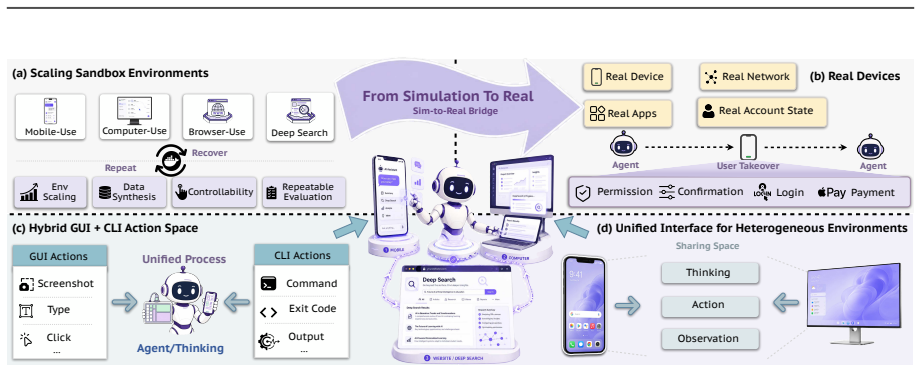
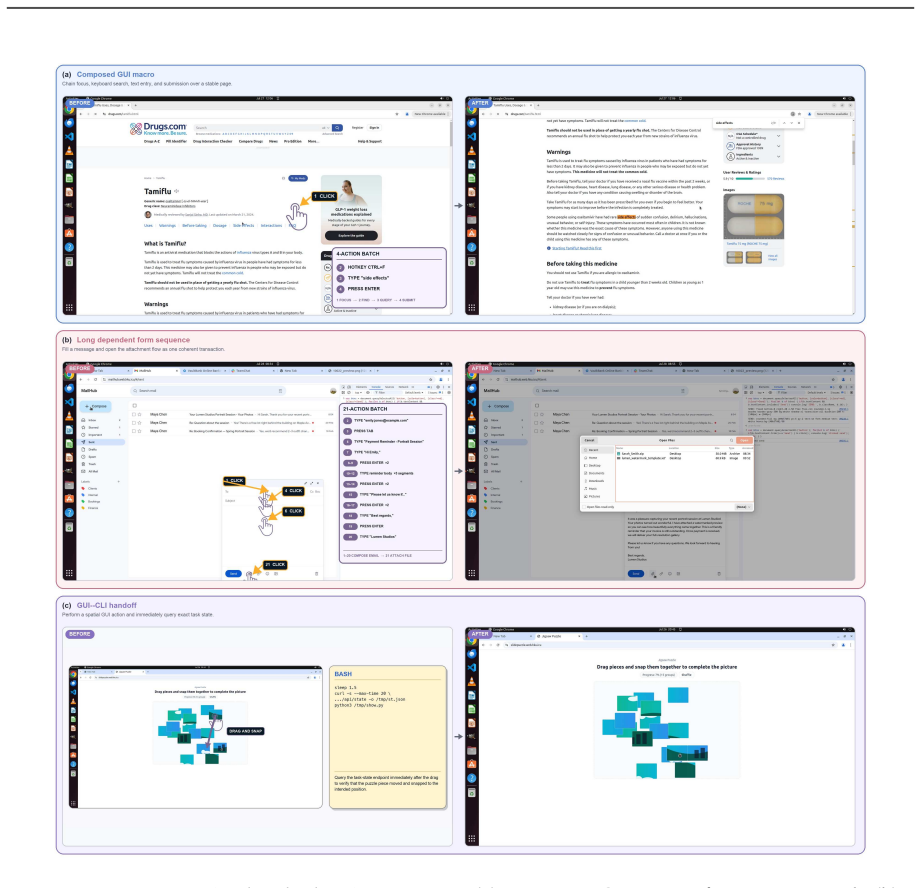
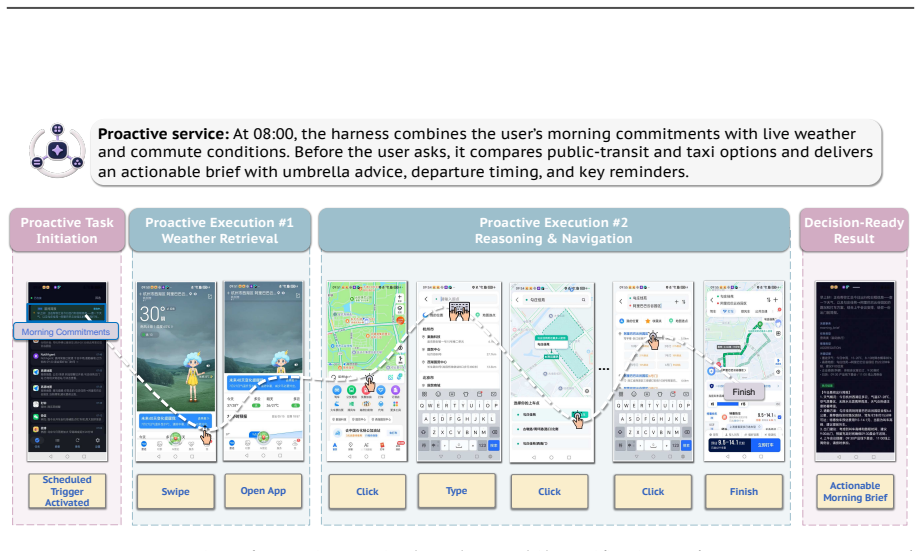
The integrated system: real-device mobile runtime plus scalable sandboxes; unified GUI+CLI and batched actions; agent-driven data flywheel; action RL then verifier-guided online RL on long trajectories; and a harness for notification-triggered proactive service and cross-device stateful workflows.
Load-bearing premise
The headline real-phone wins rest on a majority-vote vision-model judge being accurate enough to separate true task success from model mistakes and live-environment failures across the full comparison.
What would settle it
Have independent human experts re-score the full MobileWorld-Real trajectories for Qwen-UI-Agent and the top closed baselines under the same protocol; if the 92.2% lead shrinks or vanishes once env errors and judge disagreements are settled by people, the central real-device claim fails.
If this is right
- Mobile GUI agents should train and evaluate on physical devices and live apps, not only resettable sandboxes, if real-world reliability is the goal.
- Computer-use agents can cut long trajectories by interleaving CLI with GUI and emitting multi-step batches in one model turn.
- Capability growth can be driven mainly by agents that synthesize tasks, environments, and verifiers and diagnose failures, with humans in an oversight role.
- A thin harness above the policy can turn notifications into proactive multi-step help and keep one workflow alive across phone and desktop.
- Preserving general and agentic skill during GUI post-training is feasible and useful for out-of-distribution real requests.
Where Pith is reading between the lines
- If real-device closed-loop training is the main mobile gap, open agents without physical fleets may keep winning sandboxes and losing on live phones until shared real-device eval becomes standard.
- Batched hybrid actions imply latency and cost gains that matter as much as success rate for products; step-count and wall-clock should become first-class leaderboard metrics.
- Proactive notification harnesses raise a sharper safety and consent problem than reactive agents: false or over-eager interventions could erode trust faster than missed assists.
- The same flywheel-plus-online-RL pattern is a template for other embodied digital agents (IDE, CRM, OS settings) where sim-to-real and long-horizon credit assignment dominate.
Editorial analysis
A structured set of objections, weighed in public.
Referee Report
Summary. This technical report presents Qwen-UI-Agent, a multi-domain foundation GUI agent spanning mobile, computer-use, browser, and DeepSearch. The system co-designs (i) scalable sandboxes plus a real-device mobile runtime (>100 phones, >150 apps), (ii) a unified action space with GUI, CLI, API, ask_user, and batched multi-actions per turn, (iii) an AutoResearch-style agent-driven data flywheel for task/environment/verifier synthesis and failure-driven iteration, (iv) SFT plus Action RL and verifier-guided online RL (GRPO-style) with up to ~10k concurrent environments and trajectories >100 steps, and (v) a harness for notification-driven proactive service and cross-platform workflows. Empirically, the 27B primary model reports SOTA mobile results (82.1% MobileWorld GUI-only, 92.2% MobileWorld-Real, 97.5% AndroidDaily), competitive computer-use (79.5% OSWorld-Verified; 40.0% partial / 13.9% binary on OSWorld-v2), 73.6% WebArena, strong grounding (e.g., 81.5% ScreenSpot-Pro with zoom), and retention of general/agentic capability versus the Qwen base. Behavioral analyses document real-device failure modes, GUI–CLI/batch usage, and RL-induced verification and loop-breaking behaviors.
Significance. If the results hold under fair comparison, this is a substantial systems contribution to GUI agents: it treats real-device execution, hybrid GUI+CLI batching, long-horizon online RL infrastructure, automated data flywheels, and proactive/cross-platform harnesses as first-class co-designed components rather than isolated benchmark tricks. Strengths include breadth of external benchmarks (OSWorld, WebArena, ScreenSpot suite, BrowseComp), explicit behavioral analysis (§4) that goes beyond leaderboard numbers, and transparent limitations on AutoJudge and incomplete 35B CUA/DeepSearch training. The real-device runtime, curriculum online RL, and hybrid action design are practically valuable and likely to influence follow-on work even if individual SOTA margins move. The proactive harness is more qualitative but points at a user-facing direction beyond reactive task completion.
major comments (3)
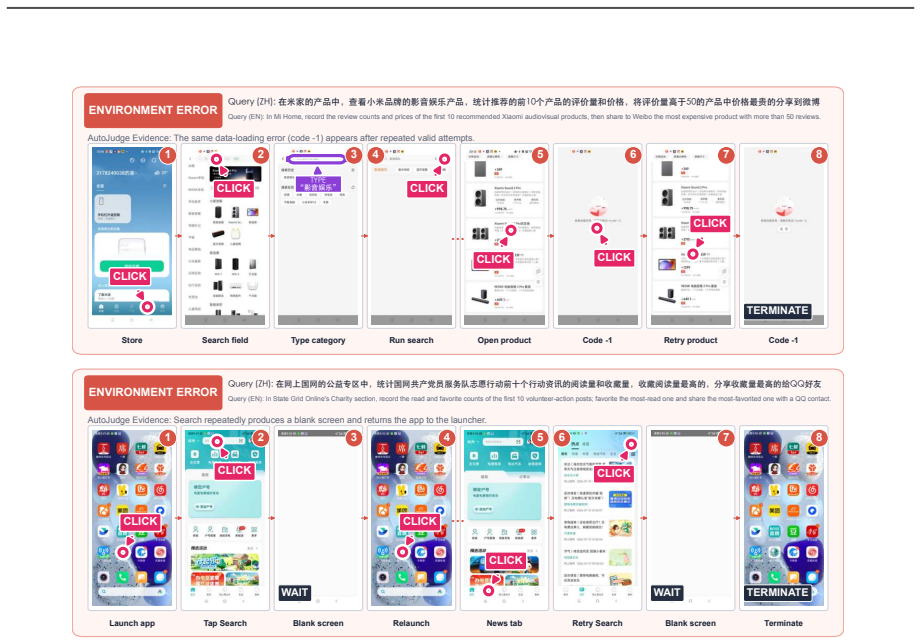
- [§3.2, Table 3, Appendix A.1] §3.2–3.3.1, Table 3, Limitations, Appendix A.1: The headline real-device claim (92.2% MobileWorld-Real, leads of 3.5–7.5 pp over Seed 2.1 Pro / Gemini 3.1 Pro / GPT-5.6 Sol / Opus 4.8) rests on AutoJudge (5-VLM majority; pass/failed/env_error; env_error excluded from the denominator). Expert agreement is 92.8% overall on 666 trajectories, but only 85.7% on model failure and 76.0% on env_error—the boundary that changes both numerator and denominator. Same protocol on all systems does not rule out differential bias (exploration style, trajectory shape, live-app dead ends). Please report: (i) per-model env_error rates and sensitivity of rankings when env_error is counted as failure or when disputed cases are re-labeled by humans; (ii) stratified agreement on non-Qwen trajectories; (iii) bootstrap/CI on Table 3 gaps. Sandbox MobileWorld and AndroidDaily already support a strong mobile story;
- [§3.3.2–3.3.3, Tables 4–7] §3.3.2–3.3.3, Tables 4–7: Several strongest closed-model comparisons mix official numbers with author re-runs (WebArena baselines marked *; OSWorld-v2 action-mode differs single vs batched). For WebArena the authors corrected reference answers/scripts—appropriate, but success rates are then not strictly comparable to uncorrected public numbers. Please add a short protocol appendix: decoding/step budgets, tool access, whether opponents used CLI/batch/API on OSWorld, and side-by-side scores under identical harness. Without this, “competitive with Opus 4.8 / GPT-5.x” on computer/browser is harder to audit than the mobile sandbox result in Table 2.
- [§2.4, §3.4, §4] §2.4–2.5 and §3.4: Central systems claims (Action RL, online RL curriculum, hybrid GUI+CLI, harness) are supported mainly by end-to-end scores plus qualitative/behavioral evidence (§4.2–4.4, Tables 11–13). Table 12 and the verification/false-stop deltas are useful but narrow. Load-bearing ablations are missing or underspecified: SFT-only vs +Action RL vs +Online RL on MobileWorld / OSWorld-Verified; GUI-only vs GUI+CLI on OSWorld; with/without batching (steps and success); harness vs base agent on a small fixed proactive/cross-platform suite with success criteria. Even a compact ablation table would separate infrastructure contribution from scale and data volume.
minor comments (6)
- [§1] Introduction says “five transitions” after listing six key transitions (§1); align the count.
- [§2.4.2] Eq. (5) Action RL reward: define ranges/normalization of C_t, Q_t and default weights (w_type, w_arg, λ_sens, λ_rep); currently not fully specified for reproduction.
- [Abstract, Figure 1] Figure 1 / abstract model names (Opus 4.8, GPT-5.6 Sol, Gemini 3.1 Pro, etc.) should be consistently tied to citations and access dates in tables.
- [§3.3.5, Table 9] Table 9 notes extensive judge/harness substitutions (GPT-5.5, etc.); consider a one-column “delta vs base” summary to make retention vs GUI-specialists easier to read.
- [§2.5, §3.4] Proactive/cross-platform results are demo trajectories (§3.4, Figs. 11–12, 28–29). A small quantitative suite (even N≈20–50 scripted scenarios) would strengthen §2.5 claims without blocking the paper.
- [Abstract, §2.5, Table 6] Minor typos/consistency: “support training” → “supports training” (abstract); “to to actionable” (§2.5); clarify 35A3B vs 35B-A3B naming in Table 6.
Circularity Check
Empirical systems/ML report: no derivation chain; SOTA claims are measured outcomes on held-out and external benchmarks, not quantities forced by construction.
full rationale
Qwen-UI-Agent is a technical report whose load-bearing claims are empirical success rates (MobileWorld 82.1%, MobileWorld-Real 92.2%, AndroidDaily 97.5%, OSWorld-Verified 79.5%, WebArena 73.6%, ScreenSpot-Pro 81.5%, etc.) obtained after SFT, action RL, and online RL. There is no first-principles derivation in which a predicted quantity is algebraically or statistically identical to a fitted input. Training uses agent-synthesized tasks and verifiers and a GRPO-style objective with binary verifier rewards; evaluation is reported on external suites (OSWorld, WebArena, BrowseComp, ScreenSpot family, AndroidDaily, MobileWorld sandbox) plus author-introduced MobileWorld-Real with tasks held out from training. Continuation of MAI-UI and reuse of step-level VLM judges / GRPO variants are ordinary self-citation of prior methods, not uniqueness theorems or ansatz-smuggling that force the headline numbers. AutoJudge’s env_error exclusion and majority-vote protocol raise evaluation-validity risk (judge bias, class confusion on failed vs env_error), but that is not circularity: under a fixed protocol different models still receive different scores, and the metric is not defined to equal a training fit. No self-definitional loop, fitted-input-as-prediction, or renaming of a known law appears in the manuscript.
Axiom & Free-Parameter Ledger
free parameters (5)
- SFT sliding window n=5 with stride 4 =
n=5, overlap=1
- Action RL reward weights (w_type, w_arg, λ_sens, λ_rep) and format gate F_t
- Online RL group size K and active/monitoring curriculum thresholds
- AutoJudge panel size and majority vote (5 VLMs) =
5 judges, majority vote
- Model scale choices (27B primary, 35B-A3B, 4B) =
27B primary
axioms (5)
- domain assumption Real-device interaction distributions are necessary and sufficient to close the mobile sim-to-real gap that sandboxes miss (pop-ups, permissions, CAPTCHAs, super-app UI).
- domain assumption Step-level VLM-as-judge filtering yields SFT signal comparable or better than verifier-selected full trajectories; executable verifiers are reliable enough for online RL outcome rewards.
- domain assumption Group-relative policy optimization on binary terminal rewards, with model-adaptive task curriculum, improves long-horizon GUI decision making without collapsing useful exploration.
- ad hoc to paper Mobile notifications plus affair/event/task memory are an adequate and user-controllable interface for proactive service initiation.
- domain assumption Standard multimodal agent assumptions: screenshots + history suffice for policy πθ; coordinates and bash side effects are faithfully executed by environment adapters.
invented entities (4)
-
MobileWorld-Real benchmark
no independent evidence
-
AutoJudge
independent evidence
-
Proactive harness 'affair' abstraction
no independent evidence
-
Unified hybrid GUI+CLI+API batched action space for Qwen-UI-Agent
independent evidence
read the original abstract
GUI agents have the potential to become a general purpose executor over existing digital devices. To advance them toward real-world use, we envision agents that operate reliably on real devices, execute workflows across platforms, combine GUI interaction with CLI execution, complete long-horizon tasks, proactively initiate useful services, and autonomously improve their capabilities with minimal human effort. Guided by this vision, we present Qwen-UI-Agent, a real-world centric foundation GUI agent spanning mobile, computer-use, web, and DeepSearch environments. Qwen-UI-Agent combines diverse sandbox environments with a large-scale real-device mobile runtime. Its unified action space interleaves GUI operations with CLI execution and generates batched actions in a single model turn. An AutoResearch-style data flywheel uses agents to construct tasks and environments, diagnose failures, and plan subsequent iterations. Online RL supports training on trajectories exceeding 100 turns, with over 10,000 concurrent environments accelerating rollout. A lightweight harness layer supports proactive service initiation and stateful workflows across mobile and computer. Across a broad suite of evaluations, Qwen-UI-Agent sets state-of-the-art performance on mobile-use benchmarks while delivering competitive performance on computer- and browser-use tasks against frontier models, including Opus 4.8, Gemini 3.1 Pro, and GPT-5.6 Sol. On mobile use, it achieves 82.1% on MobileWorld, 92.2% on MobileWorld-Real, and 97.5% on AndroidDaily. On computer use, it achieves 79.5% on OSWorld-Verified and a 40.0% partial-progress score on OSWorld-v2. On browser use and GUI grounding, it achieves 73.6% on WebArena and 81.5% on ScreenSpot-Pro, respectively.
Figures









Reference graph
Works this paper leans on
-
[1]
Introducing Claude Opus 4.8
Anthropic . Introducing Claude Opus 4.8 . https://www.anthropic.com/news/claude-opus-4-8, May 2026. Accessed: 2026-07-19
2026
-
[2]
Apodex-1.0 : A verification-centric agent team for discoverative intelligence
Apodex Team . Apodex-1.0 : A verification-centric agent team for discoverative intelligence. Technical report, Apodex, 2026. URL https://www.apodex.com/blog/apodex-1.0
2026
-
[3]
^2 - Bench : Evaluating conversational agents in a dual-control environment
Victor Barres, Honghua Dong, Soham Ray, Xujie Si, and Karthik Narasimhan. ^2 - Bench : Evaluating conversational agents in a dual-control environment. arXiv preprint arXiv:2506.07982, 2025. URL https://arxiv.org/abs/2506.07982
Pith/arXiv arXiv 2025
-
[4]
ByteDance Seed . Seed2.0 . https://seed.bytedance.com/en/seed2, February 2026 a . Released: 2026-02-14
2026
-
[5]
Seed2.1 officially released: Advancing AI productivity
ByteDance Seed . Seed2.1 officially released: Advancing AI productivity. https://seed.bytedance.com/en/blog/seed2-1-officially-released-advancing-ai-productivity, June 2026 b . Accessed: 2026-07-19
2026
-
[8]
Gemini 3 pro, 2025
Google DeepMind. Gemini 3 pro, 2025. URL https://deepmind.google/models/gemini/pro/
2025
-
[10]
Webevolver: Enhancing web agent self-improvement with co-evolving world model
Tianqing Fang, Hongming Zhang, Zhisong Zhang, Kaixin Ma, Wenhao Yu, Haitao Mi, and Dong Yu. Webevolver: Enhancing web agent self-improvement with co-evolving world model. In Proceedings of the 2025 Conference on Empirical Methods in Natural Language Processing, pp.\ 8970--8986, 2025
2025
-
[11]
Changlong Gao, Zhangxuan Gu, Yulin Liu, Xinyu Qiu, Shuheng Shen, Yue Wen, Tianyu Xia, Zhenyu Xu, Zhengwen Zeng, Beitong Zhou, Xingran Zhou, Weizhi Chen, Sunhao Dai, Jingya Dou, Yichen Gong, Yuan Guo, Zhenlin Guo, Feng Li, Qian Li, Jinzhen Lin, Yuqi Zhou, Linchao Zhu, Liang Chen, Zhenyu Guo, Changhua Meng, and Weiqiang Wang. UI-Venus-1.5 Technical Report ....
arXiv 2026
-
[12]
scrcpy: Display and control your Android device
Genymobile . scrcpy: Display and control your Android device. https://github.com/Genymobile/scrcpy, 2018. Accessed: 2026-07-28
2018
-
[13]
Project mariner
Google . Project mariner. https://labs.google.com/mariner/landing/, 2025
2025
-
[14]
Gemini 3.1 Pro Preview
Google . Gemini 3.1 Pro Preview . https://ai.google.dev/gemini-api/docs/models/gemini-3.1-pro-preview, February 2026 a . Google AI for Developers; accessed: 2026-07-19
2026
-
[15]
Gemini 3.5 Flash
Google . Gemini 3.5 Flash . https://ai.google.dev/gemini-api/docs/models/gemini-3.5-flash, May 2026 b . Google AI for Developers; accessed: 2026-07-19
2026
-
[16]
Webvoyager: Building an end-to-end web agent with large multimodal models, 2024
Hongliang He, Wenlin Yao, Kaixin Ma, Wenhao Yu, Yong Dai, Hongming Zhang, Zhenzhong Lan, and Dong Yu. Webvoyager: Building an end-to-end web agent with large multimodal models, 2024. URL https://arxiv.org/abs/2401.13919
Pith/arXiv arXiv 2024
-
[18]
ToolCUA : Towards optimal GUI -tool path orchestration for computer use agents
Xuhao Hu, Xi Zhang, Haiyang Xu, Kyle Qiao, Jingyi Yang, Xuanjing Huang, Jing Shao, Ming Yan, and Jieping Ye. ToolCUA : Towards optimal GUI -tool path orchestration for computer use agents. arXiv preprint arXiv:2605.12481, 2026. URL https://arxiv.org/abs/2605.12481
Pith/arXiv arXiv 2026
-
[21]
Jina reader: Converting URL s to LLM -friendly input
Jina AI . Jina reader: Converting URL s to LLM -friendly input. https://jina.ai/reader, 2024. Accessed: 2026-07-28
2024
-
[22]
A diagram is worth a dozen images
Aniruddha Kembhavi, Mike Salvato, Eric Kolve, Minjoon Seo, Hannaneh Hajishirzi, and Ali Farhadi. A diagram is worth a dozen images. In European Conference on Computer Vision (ECCV), pp.\ 235--251, 2016. URL https://arxiv.org/abs/1603.07396
Pith/arXiv arXiv 2016
-
[23]
Kimi K2.5 : Visual agentic intelligence
Kimi Team . Kimi K2.5 : Visual agentic intelligence. https://www.kimi.com/blog/kimi-k2-5.html, 2026. Accessed: 2026-07-21
2026
-
[24]
Mobileworld: Benchmarking autonomous mobile agents in agent-user interactive and mcp-augmented environments
Quyu Kong, Xu Zhang, Zhenyu Yang, Nolan Gao, Chen Liu, Panrong Tong, Chenglin Cai, Hanzhang Zhou, Jianan Zhang, Liangyu Chen, et al. Mobileworld: Benchmarking autonomous mobile agents in agent-user interactive and mcp-augmented environments. In Proceedings of the 64th Annual Meeting of the Association for Computational Linguistics (Volume 1: Long Papers),...
2026
-
[25]
PhoneHarness : Harnessing phone-use agents through mixed GUI , CLI , and tool actions
Chenxin Li, Zhengyao Fang, Zhengyang Tang, Pengyuan Lyu, Xingran Zhou, Xin Lai, Fei Tang, Liang Wu, Yiduo Guo, Weinong Wang, Junyi Li, Yi Zhang, Yang Ding, Huawen Shen, Sunqi Fan, Shangpin Peng, Zheng Ruan, Anran Zhang, Benyou Wang, Chengquan Zhang, and Han Hu. PhoneHarness : Harnessing phone-use agents through mixed GUI , CLI , and tool actions. arXiv pr...
arXiv 2026
-
[26]
Screenspot-pro: GUI grounding for professional high-resolution computer use
Kaixin Li, Meng Ziyang, Hongzhan Lin, Ziyang Luo, Yuchen Tian, Jing Ma, Zhiyong Huang, and Tat-Seng Chua. Screenspot-pro: GUI grounding for professional high-resolution computer use. In Workshop on Reasoning and Planning for Large Language Models, 2025 a . URL https://openreview.net/forum?id=XaKNDIAHas
2025
-
[28]
SkillsBench : Benchmarking how well agent skills work across diverse tasks
Xiangyi Li, Wenbo Chen, Yimin Liu, Shenghan Zheng, Xiaokun Chen, Yifeng He, Yubo Li, Bingran You, Haotian Shen, Jiankai Sun, et al. SkillsBench : Benchmarking how well agent skills work across diverse tasks. arXiv preprint arXiv:2602.12670, 2026 b . URL https://arxiv.org/abs/2602.12670
Pith/arXiv arXiv 2026
-
[29]
UI-MOPD : Multi-platform on-policy distillation for continual GUI agent learning
Niu Lian, Alan Chen, Zhehao Yu, Chengzhen Duan, Fazhan Liu, Hui Liu, Pei Fu, Jian Luan, Yaowei Wang, Shu-Tao Xia, and Jinpeng Wang. UI-MOPD : Multi-platform on-policy distillation for continual GUI agent learning. arXiv preprint arXiv:2607.04425, 2026. URL https://arxiv.org/abs/2607.04425
Pith/arXiv arXiv 2026
-
[30]
One forward beats two: Innerzoom for accurate and efficient gui grounding, 2026
Chen Liu, Ling Chen, Hanzhang Zhou, Liangyu Chen, Chenglin Cai, Xin Yu, Steven Hoi, and Yue Wang. One forward beats two: Innerzoom for accurate and efficient gui grounding, 2026. URL https://arxiv.org/abs/2606.30084
Pith/arXiv arXiv 2026
-
[31]
Mike A. Merrill, Alexander G. Shaw, Nicholas Carlini, Boxuan Li, Harsh Raj, Ivan Bercovich, Lin Shi, Jeong Yeon Shin, Thomas Walshe, E. Kelly Buchanan, et al. Terminal-Bench : Benchmarking agents on hard, realistic tasks in command line interfaces. arXiv preprint arXiv:2601.11868, 2026. URL https://arxiv.org/abs/2601.11868
Pith/arXiv arXiv 2026
-
[32]
Playwright: Fast and reliable end-to-end testing for modern web apps
Microsoft . Playwright: Fast and reliable end-to-end testing for modern web apps. https://playwright.dev, 2020. Accessed: 2026-07-28
2020
-
[33]
MiniMax M3 : Frontier coding, 1m context, native multimodality
MiniMax . MiniMax M3 : Frontier coding, 1m context, native multimodality. https://www.minimax.io/blog/minimax-m3, June 2026. Accessed: 2026-07-19
2026
-
[34]
Kimi K2.6 : Advancing open-source coding
Moonshot AI . Kimi K2.6 : Advancing open-source coding. https://www.kimi.com/blog/kimi-k2-6, April 2026. Accessed: 2026-07-19
2026
-
[35]
Rodriguez, Montek Kalsi, Rabiul Awal, Nicolas Chapados, M
Shravan Nayak, Xiangru Jian, Kevin Qinghong Lin, Juan A. Rodriguez, Montek Kalsi, Rabiul Awal, Nicolas Chapados, M. Tamer Özsu, Aishwarya Agrawal, David Vazquez, Christopher Pal, Perouz Taslakian, Spandana Gella, and Sai Rajeswar. Ui-vision: A desktop-centric gui benchmark for visual perception and interaction, 2025. URL https://arxiv.org/abs/2503.15661
Pith/arXiv arXiv 2025
-
[36]
Introducing operator
OpenAI . Introducing operator. https://openai.com/index/introducing-operator/, 2025
2025
-
[37]
GPT-5.5 system card
OpenAI . GPT-5.5 system card. https://deploymentsafety.openai.com/gpt-5-5, April 2026 a . Accessed: 2026-07-19
2026
-
[38]
GPT-5.6 : Frontier intelligence that scales with your ambition
OpenAI . GPT-5.6 : Frontier intelligence that scales with your ambition. https://openai.com/index/gpt-5-6/, July 2026 b . Accessed: 2026-07-20
2026
-
[39]
OpenClaw : Personal ai assistant
OpenClaw Contributors . OpenClaw : Personal ai assistant. GitHub repository, 2026. URL https://github.com/openclaw/openclaw. Accessed: 2026-07-20
2026
-
[40]
Patil, Huanzhi Mao, Fanjia Yan, Charlie Cheng-Jie Ji, Vishnu Suresh, Ion Stoica, and Joseph E
Shishir G. Patil, Huanzhi Mao, Fanjia Yan, Charlie Cheng-Jie Ji, Vishnu Suresh, Ion Stoica, and Joseph E. Gonzalez. The Berkeley function calling leaderboard ( BFCL ): From tool use to agentic evaluation of large language models. In Proceedings of the 42nd International Conference on Machine Learning (ICML), 2025. BFCL-v4 leaderboard: https://gorilla.cs.b...
2025
-
[42]
Qwen3.7-Plus : Multimodal agent intelligence
Qwen Team . Qwen3.7-Plus : Multimodal agent intelligence. https://qwen.ai/blog?id=qwen3.7-plus, May 2026 a . Accessed: 2026-07-19
2026
-
[43]
Qwen3.5 : Towards native multimodal agents, February 2026 b
Qwen Team . Qwen3.5 : Towards native multimodal agents, February 2026 b . URL https://qwen.ai/blog?id=qwen3.5
2026
-
[44]
QwenClawBench : Real-user-distribution benchmark for OpenClaw agents
Qwen Team and Data Team, Alibaba Group . QwenClawBench : Real-user-distribution benchmark for OpenClaw agents. https://github.com/SKYLENAGE-AI/QwenClawBench, April 2026. Accessed: 2026-07-24
2026
-
[46]
Redroid: A multi-arch, gpu-enabled android in cloud container solution
Remote Android Project . Redroid: A multi-arch, gpu-enabled android in cloud container solution. https://github.com/remote-android/redroid-doc, 2024
2024
-
[47]
Ui-tars-1.5
ByteDance Seed. Ui-tars-1.5. https://seed-tars.com/1.5, 2025
2025
-
[48]
Serper: Google search API
Serper . Serper: Google search API . https://serper.dev, 2023. Accessed: 2026-07-28
2023
-
[49]
HyMobileAgent: Data-Environment Co-Scaling for Efficient GUI Agents
Huawen Shen, Zhengyang Tang, Shangpin Peng, Liang Wu, Anran Zhang, Weinong Wang, Yiduo Guo, Chenxin Li, Zhengyao Fang, Yang Ding, Junyi Li, Fei Tang, Zheng Ruan, Yi Zhang, Xingran Zhou, Dingchen Yang, Sunqi Fan, Zhiyi Wan, Han Hu, Xin Lai, Pengyuan Lyu, and Chengquan Zhang. HyMobileAgent: Data-Environment Co-Scaling for Efficient GUI Agents . arXiv prepri...
Pith/arXiv arXiv 2026
-
[51]
Phonebuddy: Training open models for agentic phone use, 2026
Zhengyang Tang, Xin Lai, Pengyuan Lyu, Xinyuan Wang, Tianyi Bai, Chenxin Li, Yiduo Guo, Huawen Shen, Yuxuan Liu, Junyi Li, Zhengyao Fang, Yang Ding, Yi Zhang, Weinong Wang, Xingran Zhou, Liang Wu, Fei Tang, Sunqi Fan, Shangpin Peng, Zheng Ruan, Anran Zhang, Benyou Wang, Ji-Rong Wen, Rui Yan, Chengquan Zhang, and Han Hu. Phonebuddy: Training open models fo...
Pith/arXiv arXiv 2026
-
[53]
CUA-GYM : Scaling verifiable training environments and tasks for computer-use agents
Bowen Wang, Dunjie Lu, Junli Wang, Tianyi Bai, Shixuan Liu, Zhipeng Zhang, Haiquan Wang, Hao Hu, Tianbao Xie, Shuai Bai, Dayiheng Liu, Que Shen, Junyang Lin, and Tao Yu. CUA-GYM : Scaling verifiable training environments and tasks for computer-use agents. arXiv preprint arXiv:2605.25624, 2026. URL https://arxiv.org/abs/2605.25624
Pith/arXiv arXiv 2026
-
[55]
Measuring multimodal mathematical reasoning with MATH-Vision dataset
Ke Wang, Junting Pan, Weikang Shi, Zimu Lu, Mingjie Zhan, and Hongsheng Li. Measuring multimodal mathematical reasoning with MATH-Vision dataset. arXiv preprint arXiv:2402.14804, 2024 a . URL https://arxiv.org/abs/2402.14804
Pith/arXiv arXiv 2024
-
[56]
Charles, Zhilin Yang, and Tao Yu
Xinyuan Wang, Bowen Wang, Dunjie Lu, Junlin Yang, Tianbao Xie, Junli Wang, Jiaqi Deng, Xiaole Guo, Yiheng Xu, Chen Henry Wu, Zhennan Shen, Zhuokai Li, Ryan Li, Xiaochuan Li, Junda Chen, Boyuan Zheng, Peihang Li, Fangyu Lei, Ruisheng Cao, Yeqiao Fu, Dongchan Shin, Martin Shin, Jiarui Hu, Yuyan Wang, Jixuan Chen, Yuxiao Ye, Danyang Zhang, Dikang Du, Hao Hu,...
arXiv 2025
-
[57]
MMLU-Pro : A more robust and challenging multi-task language understanding benchmark
Yubo Wang, Xueguang Ma, Ge Zhang, Yuansheng Ni, Abhranil Chandra, Shiguang Guo, Weiming Ren, Aaran Arulraj, Xuan He, Ziyan Jiang, et al. MMLU-Pro : A more robust and challenging multi-task language understanding benchmark. arXiv preprint arXiv:2406.01574, 2024 b . URL https://arxiv.org/abs/2406.01574
Pith/arXiv arXiv 2024
-
[58]
CharXiv : Charting gaps in realistic chart understanding in multimodal LLMs
Zirui Wang, Mengzhou Xia, Luxi He, Howard Chen, Yitao Liu, Richard Zhu, Kaiqu Liang, Xindi Wu, Haotian Liu, Sadhika Malladi, Alexis Chevalier, Sanjeev Arora, and Danqi Chen. CharXiv : Charting gaps in realistic chart understanding in multimodal LLMs . arXiv preprint arXiv:2406.18521, 2024 c . URL https://arxiv.org/abs/2406.18521
Pith/arXiv arXiv 2024
-
[59]
BrowseComp : A simple yet challenging benchmark for browsing agents
Jason Wei, Zhiqing Sun, Spencer Papay, Scott McKinney, Jeffrey Han, Isa Fulford, Hyung Won Chung, Alex Tachard Passos, William Fedus, and Amelia Glaese. BrowseComp : A simple yet challenging benchmark for browsing agents. arXiv preprint arXiv:2504.12516, 2025. URL https://arxiv.org/abs/2504.12516
Pith/arXiv arXiv 2025
-
[60]
Os-atlas: A foundation action model for generalist gui agents, 2024
Zhiyong Wu, Zhenyu Wu, Fangzhi Xu, Yian Wang, Qiushi Sun, Chengyou Jia, Kanzhi Cheng, Zichen Ding, Liheng Chen, Paul Pu Liang, and Yu Qiao. Os-atlas: A foundation action model for generalist gui agents, 2024. URL https://arxiv.org/abs/2410.23218
Pith/arXiv arXiv 2024
-
[61]
Grok-1.5 vision preview
xAI . Grok-1.5 vision preview. https://x.ai/news/grok-1.5v, 2024. RealWorldQA benchmark released alongside the blog post; dataset at https://huggingface.co/datasets/xai-org/RealworldQA
2024
-
[63]
Osworld: Benchmarking multimodal agents for open-ended tasks in real computer environments, 2024
Tianbao Xie, Danyang Zhang, Jixuan Chen, Xiaochuan Li, Siheng Zhao, Ruisheng Cao, Toh Jing Hua, Zhoujun Cheng, Dongchan Shin, Fangyu Lei, Yitao Liu, Yiheng Xu, Shuyan Zhou, Silvio Savarese, Caiming Xiong, Victor Zhong, and Tao Yu. Osworld: Benchmarking multimodal agents for open-ended tasks in real computer environments, 2024
2024
-
[64]
Scaling computer-use grounding via user interface decomposition and synthesis, 2025
Tianbao Xie, Jiaqi Deng, Xiaochuan Li, Junlin Yang, Haoyuan Wu, Jixuan Chen, Wenjing Hu, Xinyuan Wang, Yuhui Xu, Zekun Wang, Yiheng Xu, Junli Wang, Doyen Sahoo, Tao Yu, and Caiming Xiong. Scaling computer-use grounding via user interface decomposition and synthesis, 2025. URL https://arxiv.org/abs/2505.13227
arXiv 2025
-
[69]
Gta1: Gui test-time scaling agent, 2025 a
Yan Yang, Dongxu Li, Yutong Dai, Yuhao Yang, Ziyang Luo, Zirui Zhao, Zhiyuan Hu, Junzhe Huang, Amrita Saha, Zeyuan Chen, Ran Xu, Liyuan Pan, Caiming Xiong, and Junnan Li. Gta1: Gui test-time scaling agent, 2025 a . URL https://arxiv.org/abs/2507.05791
Pith/arXiv arXiv 2025
-
[71]
Claw-Eval : Towards trustworthy evaluation of autonomous agents
Bowen Ye, Rang Li, Qibin Yang, Yuanxin Liu, Linli Yao, Hanglong Lv, Zhihui Xie, Chenxin An, Lei Li, Lingpeng Kong, Qi Liu, Zhifang Sui, and Tong Yang. Claw-Eval : Towards trustworthy evaluation of autonomous agents. arXiv preprint arXiv:2604.06132, 2026. URL https://arxiv.org/abs/2604.06132
Pith/arXiv arXiv 2026
-
[73]
MMMU-Pro : A more robust multi-discipline multimodal understanding benchmark
Xiang Yue, Tianyu Zheng, Yuansheng Ni, Yubo Wang, Kai Zhang, Shengbang Tong, Yuxuan Sun, Botao Yu, Ge Zhang, Huan Sun, Yu Su, Wenhu Chen, and Graham Neubig. MMMU-Pro : A more robust multi-discipline multimodal understanding benchmark. In Proceedings of the 63rd Annual Meeting of the Association for Computational Linguistics (Volume 1: Long Papers), pp.\ 1...
Pith/arXiv arXiv 2025
-
[74]
GLM-4.7 : Advancing the coding capability
Z.ai . GLM-4.7 : Advancing the coding capability. Z.ai Technical Blog, December 2025. URL https://z.ai/blog/glm-4.7. Released: 2025-12-22; accessed: 2026-07-28
2025
-
[76]
MAI-UI Technical Report: Real-World Centric Foundation GUI Agents
Hanzhang Zhou, Xu Zhang, Panrong Tong, Jianan Zhang, Liangyu Chen, Quyu Kong, Chenglin Cai, Chen Liu, Yue Wang, Jingren Zhou, and Steven Hoi. MAI-UI Technical Report: Real-World Centric Foundation GUI Agents . arXiv preprint arXiv:2512.22047, 2025 a . URL https://arxiv.org/abs/2512.22047
arXiv 2025
-
[78]
BrowseComp-ZH : Benchmarking web browsing ability of large language models in Chinese
Peilin Zhou, Bruce Leon, Xiang Ying, Can Zhang, Yifan Shao, Qichen Ye, Dading Chong, Zhiling Jin, Chenxuan Xie, Meng Cao, Yuxin Gu, Sixin Hong, Jing Ren, Jian Chen, Chao Liu, and Yining Hua. BrowseComp-ZH : Benchmarking web browsing ability of large language models in Chinese . arXiv preprint arXiv:2504.19314, 2025 b . URL https://arxiv.org/abs/2504.19314
Pith/arXiv arXiv 2025
-
[80]
2025 , howpublished =
GPT-5 Model Overview , author =. 2025 , howpublished =
2025
-
[81]
2026 , howpublished =
2026
-
[82]
2025 , howpublished =
2025
-
[83]
2024 , eprint=
Direct Preference Optimization: Your Language Model is Secretly a Reward Model , author=. 2024 , eprint=
2024
-
[84]
arXiv preprint arXiv:2509.02544 , year=
Ui-tars-2 technical report: Advancing gui agent with multi-turn reinforcement learning , author=. arXiv preprint arXiv:2509.02544 , year=
-
[85]
arXiv preprint arXiv:2405.14573 , year=
Androidworld: A dynamic benchmarking environment for autonomous agents , author=. arXiv preprint arXiv:2405.14573 , year=
-
[86]
arXiv preprint arXiv:2508.15144 , year=
Mobile-agent-v3: Fundamental agents for gui automation , author=. arXiv preprint arXiv:2508.15144 , year=
-
[87]
2024 , eprint=
Ponder & Press: Advancing Visual GUI Agent towards General Computer Control , author=. 2024 , eprint=
2024
-
[88]
2025 , eprint=
InfiGUI-R1: Advancing Multimodal GUI Agents from Reactive Actors to Deliberative Reasoners , author=. 2025 , eprint=
2025
-
[89]
2025 , eprint=
UI-Venus Technical Report: Building High-performance UI Agents with RFT , author=. 2025 , eprint=
2025
-
[90]
arXiv preprint arXiv:2507.19478 , year =
MMBench-GUI: Hierarchical Multi-Platform Evaluation Framework for GUI Agents , author =. arXiv preprint arXiv:2507.19478 , year =
-
[91]
2025 , eprint=
LPO: Towards Accurate GUI Agent Interaction via Location Preference Optimization , author=. 2025 , eprint=
2025
-
[92]
2024 , eprint=
ShowUI: One Vision-Language-Action Model for GUI Visual Agent , author=. 2024 , eprint=
2024
-
[93]
2024 , eprint=
Qwen2 Technical Report , author=. 2024 , eprint=
2024
-
[94]
2024 , eprint=
SeeClick: Harnessing GUI Grounding for Advanced Visual GUI Agents , author=. 2024 , eprint=
2024
-
[95]
2025 , url=
The Showdown Computer Control Evaluation Suite , author=. 2025 , url=
2025
-
[96]
2024 , eprint=
OSWorld: Benchmarking Multimodal Agents for Open-Ended Tasks in Real Computer Environments , author=. 2024 , eprint=
2024
-
[97]
2024 , eprint=
OmniACT: A Dataset and Benchmark for Enabling Multimodal Generalist Autonomous Agents for Desktop and Web , author=. 2024 , eprint=
2024
-
[98]
2020 , eprint=
Widget Captioning: Generating Natural Language Description for Mobile User Interface Elements , author=. 2020 , eprint=
2020
-
[99]
AMEX: Android Multi-annotation Expo Dataset for Mobile GUI Agents , url=
Chai, Yuxiang and Huang, Siyuan and Niu, Yazhe and Xiao, Han and Liu, Liang and Wang, Guozhi and Zhang, Dingyu and Ren, Shuai and Li, Hongsheng , year=. AMEX: Android Multi-annotation Expo Dataset for Mobile GUI Agents , url=. doi:10.18653/v1/2025.findings-acl.110 , booktitle=
-
[100]
2025 , eprint=
Scaling Computer-Use Grounding via User Interface Decomposition and Synthesis , author=. 2025 , eprint=
2025
-
[101]
2025 , eprint=
Aguvis: Unified Pure Vision Agents for Autonomous GUI Interaction , author=. 2025 , eprint=
2025
-
[102]
2024 , eprint=
GPT-4o System Card , author=. 2024 , eprint=
2024
discussion (0)
Sign in with ORCID, Apple, or X to comment. Anyone can read and Pith papers without signing in.