REVIEW 3 major objections 3 minor 1 cited by
Current multimodal models fail at spotting changes across paired videos
Reviewed by Pith at T0; open to challenge. T0 means a machine referee read the full paper against a public rubric. the ladder, T0–T4 →
T0 review · deepseek-v4-flash
2026-08-03 14:53 UTC pith:A3YCGTKU
load-bearing objection Useful paired-video benchmark with real novelty; headline gap rests on unverified question answerability and human protocol — fixable, worth reviewing. the 3 major comments →
M³-Verse: A "Spot the Difference" Challenge for Large Multimodal Models
The pith
A machine-rendered reading of the paper's core claim, the machinery that carries it, and where it could break.
Core claim
On its own terms, the paper establishes that state-of-the-art large multimodal models cannot reliably compare two observations of the same scene to identify what changed. With paired egocentric videos of 270 indoor scenes before and after a programmatic change, and 2,932 questions, the best evaluated model reaches 45.14% accuracy versus 89.75% for human evaluators. The benchmark also shows that models are particularly prone to hallucination-type questions, that larger scale does not guarantee better performance, and that converting videos into hierarchical text captions before answering improves inter-state reasoning scores. The paper treats M3-Verse as a shared testbed for a capability exis
What carries the argument
The central object is the paired two-state video: each scene is recorded by an embodied agent exploring it once before and once after an object-level change, so answering inter-state questions requires comparing the two observations rather than recognizing a single state. Questions are generated from simulator metadata through a template pipeline with hierarchical entity grounding to avoid ambiguous references, then filtered in two stages (text-only answerability and multimodal triviality). The proposed HCTR baseline works by turning each video into time-stamped clip captions, summarizing them, and answering from text alone.
Load-bearing premise
The benchmark assumes every question can be answered from the paired videos alone, but the QA pairs come from simulator metadata and the filtering only removes text-answerable questions, never verifying that the correct answer is visually recoverable from the frames.
What would settle it
Give a fresh group of human annotators the same 2,932 questions with access only to the videos and not to any simulator metadata, and compare their accuracy to the reported 89.75%; a significant drop would show that the human baseline and the model gap are partly an artifact of metadata, not pure visual understanding.
If this is right
- If the gap is real, current multimodal models are not reliable for embodied applications where an agent must check what changed after an action.
- The finding that inter-state reasoning improves under hierarchical captioning suggests that explicitly serializing video content into text helps models track change.
- Hallucination-type questions expose a systematic tendency of models to commit to an option even when the correct answer is 'no correct option is listed'.
- Denser frame sampling improves performance, implying state-change perception is partly limited by temporal resolution rather than pure reasoning.
- Model scale alone does not close the gap; architectural and instruction-tuning choices matter more.
Where Pith is reading between the lines
- A key unstated risk is that the ground-truth answers are derived from simulator metadata, and the filtering pipeline only removes questions answerable from text, not questions unanswerable from the video pixels; if many questions ask for metric distances or areas that a first-person video cannot convey, the human baseline may overstate what is visually recoverable.
- The benchmark's release of depth maps, instance masks, and operation logs invites future work that uses these as supervision; a model trained on them might be expected to far exceed the reported 45%.
- The intra-state tasks being harder than inter-state tasks for many models is counterintuitive and may reflect a 'needle in a haystack' localization problem; a fair test of state-change reasoning would be to control for localization difficulty.
- One testable extension: measure human performance on the same videos without any access to simulator metadata or question templates; if human accuracy drops substantially, the benchmark's visual-grounding claim would need qualification.
Editorial analysis
A structured set of objections, weighed in public.
Referee Report
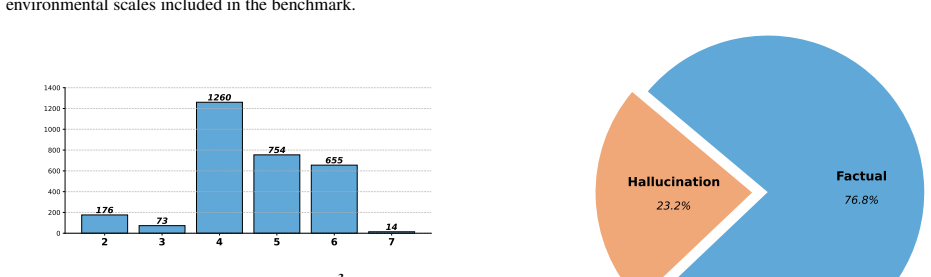
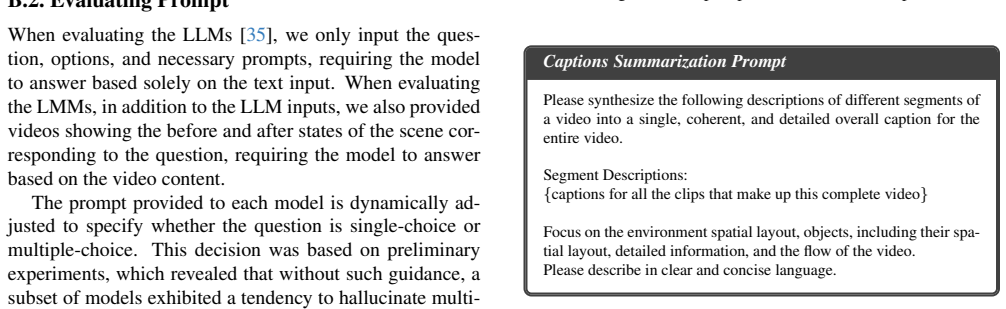
Summary. The paper introduces M3-Verse, a benchmark for multi-state video understanding. For 270 ProcTHOR indoor scenes, the authors create paired egocentric videos of a scene before and after a programmatic state change (540 videos total), and automatically generate 2,932 multiple-choice QA pairs from simulator metadata using template-based generation. The questions are divided into intra-state and inter-state categories, span 50+ subtasks across four capabilities, and include 23.2% hallucination-type questions. After a two-stage LLM/LMM filtering pipeline and human review, the authors evaluate 16 LMMs, 6 text-only LLMs, a random baseline, and a human baseline. The best LMM (GPT-5) reaches 45.14% overall, compared with 89.75% for humans. The paper also proposes Hierarchical Captioning and Text-based Reasoning (HCTR), which improves several base models by converting video QA into caption-based text QA.
Significance. If the benchmark is valid, it fills a real gap: current benchmarks mostly test static or single-state video understanding, while M3-Verse targets the ability to compare two observations of the same scene and reason about state transitions. The construction has notable strengths: answers are grounded in simulator state rather than human annotations; the authors release both the construction pipeline and the full benchmark data; the evaluation covers a wide range of models including text-only controls; and the frame-sampling analysis is a useful sanity check. However, the central claim—that the human–model gap reflects a deficit in multi-state visual reasoning—depends on two unverified assumptions: that every question is visually answerable from the paired videos, and that the human baseline was collected under the same visual-only protocol. The presence of text-only models scoring far above random also indicates possible residual textual leakage. These issues are fixable but load-bearing.
major comments (3)
- [Section 3.2; Appendix A.4; Tables 4–6] The benchmark generation never verifies that the ground-truth answer is visually recoverable from the paired egocentric videos. Stage 1 (Fig. 15) only removes questions answerable from text, question, options, and answer; Stage 2 removes questions a lightweight LMM can answer; neither step checks observability. Many templates in Tables 4–6 ask for quantities that a first-person video cannot reliably support: scene area, room area, metric distances (e.g., 'distance between object1 and object2'), object height/length, room visit counts, exact visit order, and total observation times. If a substantial fraction of the 2,932 questions are not answerable from the provided frames, then low model scores conflate ungroundable queries with failures of state-change reasoning, and the headline human–model gap is not interpretable. I request an observability audit (per-template, with examples) or a r
- [Appendix A.4; Table 2] The human baseline of 89.75% is presented without a protocol. The appendix only says that 12 reviewers were recruited to 're-examine and screen the data' and to 'evaluate human performance,' but does not state whether the reviewers watched the paired videos, whether they had access to simulator metadata or backend logs, what options/format they saw, or how disagreement was resolved. Since the human number anchors the central 'stark performance gap' conclusion, this is load-bearing. The authors should specify the exact human evaluation protocol and, ideally, report a separate visual-only human result collected under the same constraints as the models (same frames, same options, no metadata).
- [Table 2; Appendix A.4 Stage 1] The text-only LLMs perform substantially above random even though Stage 1 is supposed to remove text-answerable questions. For example, Qwen3-14B reaches 33.78% and Qwen3-32B reaches 33.76% versus a random baseline of 24.14% (Table 2). Since these models receive no video input, any above-random accuracy indicates residual textual cues, option-order patterns, or language priors that the vision-free filtering (Fig. 15) did not remove. This weakens the claim that the benchmark isolates visual understanding and the conclusion that 'vision is essential.' I recommend measuring a stronger text-only ceiling (e.g., an LLM prompted with all options and the question, with option order ablated) and reporting per-template leakage statistics.
minor comments (3)
- [Table 2] Model names are inconsistent/misspelled: 'LLaV A-OneVision-1.5-8B' should be 'LLaVA-OneVision-1.5-8B'. Also 'InternVL3.5-2B-Instruct*' etc. are fine, but the footnote markers are not explained in the caption.
- [Section 4.2, finding 6] Typo: 'folllwing' should be 'following'. In Section 4.1 the bullet list contains 'r4we', likely a stray artifact. Please proofread.
- [Section 5; Figures 5–6] The HCTR comparisons may not be apples-to-apples in compute/frame budget. The base models are evaluated with a fixed number of sampled frames (e.g., 200 per video), while HCTR uses clip captions with different and potentially larger total frame usage. Please state the total number of frames consumed by each HCTR variant and, if possible, compare against a base model with matched frame count.
Circularity Check
No circularity: benchmark labels are simulator ground truth, model scores are measured, and the disclosed difficulty filter does not reduce the reported human-model gap to a construction.
full rationale
M3-Verse is a data-construction and evaluation paper, not a derivation of predictions from first principles. QA labels are generated from AI2-THOR/ProcTHOR metadata ('we employ an automated, template-based pipeline to generate QA pairs from the rich scene metadata'), and the reported model scores are empirical measurements against those fixed labels. The two-stage filtering (Appendix A.4) removes text-answerable questions and then questions a lightweight LMM can answer; this is explicitly disclosed dataset curation for difficulty, not a fitted parameter being relabeled as a prediction. The central human-model gap (89.75% vs 45.14%) is not forced by that filter: GPT-5/Gemini were not the filter model, and human accuracy is an external anchor. HCTR is a captioning baseline evaluated against the same fixed ground truth, so its improvement is not circular. There is no load-bearing self-citation chain or imported uniqueness/ansatz. Concerns about whether every question is visually answerable from egocentric video, and about the exact human testing protocol, are benchmark-validity questions, not circular reductions.
Axiom & Free-Parameter Ledger
axioms (3)
- domain assumption AI2-THOR/ProcTHOR synthetic scenes are a valid proxy for real-world visual understanding of state changes.
- domain assumption All 2,932 QA pairs are visually answerable from the paired egocentric videos; objects and attributes referenced in questions are observable in the frames.
- domain assumption The human baseline was obtained under comparable conditions (watching the same videos) without access to ground-truth metadata.
Cite this review
Pith. "Pith review of $M^3-Verse$: A "Spot the Difference" Challenge for Large Multimodal Models." pith.science (2026). https://pith.science/paper/A3YCGTKU
@misc{pith2026251218735,
  author       = {Pith},
  title        = {Pith review of: $M^3-Verse$: A "Spot the Difference" Challenge for Large Multimodal Models},
  year         = {2026},
  howpublished = {\url{https://pith.science/paper/A3YCGTKU}},
  note         = {Machine review of arXiv:2512.18735}
}
read the original abstract
Modern Large Multimodal Models (LMMs) have demonstrated extraordinary ability in static image and single-state spatial-temporal understanding. However, their capacity to comprehend the dynamic changes of objects within a shared spatial context between two distinct video observations, remains largely unexplored. This ability to reason about transformations within a consistent environment is particularly crucial for advancements in the field of spatial intelligence. In this paper, we introduce $M^3-Verse$, a Multi-Modal, Multi-State, Multi-Dimensional benchmark, to formally evaluate this capability. It is built upon paired videos that provide multi-perspective observations of an indoor scene before and after a state change. The benchmark contains a total of 270 scenes and 2,932 questions, which are categorized into over 50 subtasks that probe 4 core capabilities. We evaluate 16 state-of-the-art LMMs and observe their limitations in tracking state transitions. To address these challenges, we further propose a simple yet effective baseline that achieves significant performance improvements in multi-state perception. $M^3-Verse$ thus provides a challenging new testbed to catalyze the development of next-generation models with a more holistic understanding of our dynamic visual world. You can get the construction pipeline from https://github.com/Wal-K-aWay/M3-Verse_pipeline and full benchmark data from https://www.modelscope.cn/datasets/WalKaWay/M3-Verse.
Figures





Forward citations
Cited by 1 Pith paper
-
DiCoBench: Benchmarking Multi-Image Fine-Grained Perception via Differential and Commonality Visual Cues
DiCoBench is a new high-resolution multi-image benchmark exposing large gaps between top MLLMs and human performance (98.3%) on differential and commonality visual cue perception.
Reference graph
Works this paper leans on
-
[1]
Flamingo: a visual language model for few-shot learning.Advances in neural information processing systems, 35:23716–23736,
Jean-Baptiste Alayrac, Jeff Donahue, Pauline Luc, Antoine Miech, Iain Barr, Yana Hasson, Karel Lenc, Arthur Men- sch, Katherine Millican, Malcolm Reynolds, et al. Flamingo: a visual language model for few-shot learning.Advances in neural information processing systems, 35:23716–23736,
-
[2]
Llava-onevision-1.5: Fully open framework for democratized multimodal training
Xiang An, Yin Xie, Kaicheng Yang, Wenkang Zhang, Xiuwei Zhao, Zheng Cheng, Yirui Wang, Songcen Xu, Changrui Chen, Chunsheng Wu, et al. Llava-onevision-1.5: Fully open framework for democratized multimodal training. arXiv preprint arXiv:2509.23661, 2025. 2, 5, 6
Pith/arXiv arXiv 2025
-
[3]
Qwen-vl: A versatile vision-language model for un- derstanding, localization, text reading, and beyond, 2023
Jinze Bai, Shuai Bai, Shusheng Yang, Shijie Wang, Sinan Tan, Peng Wang, Junyang Lin, Chang Zhou, and Jingren Zhou. Qwen-vl: A versatile vision-language model for un- derstanding, localization, text reading, and beyond, 2023. 2
2023
-
[4]
Experience and learning in changing envi- ronments
Culum Brown. Experience and learning in changing envi- ronments. InBehavioural responses to a changing world: mechanisms and consequences, pages 46–62. Oxford Uni- versity Press, 2012. 2
2012
-
[5]
Spatial- rgpt: Grounded spatial reasoning in vision-language mod- els.Advances in Neural Information Processing Systems, 37:135062–135093, 2024
An-Chieh Cheng, Hongxu Yin, Yang Fu, Qiushan Guo, Rui- han Yang, Jan Kautz, Xiaolong Wang, and Sifei Liu. Spatial- rgpt: Grounded spatial reasoning in vision-language mod- els.Advances in Neural Information Processing Systems, 37:135062–135093, 2024. 2, 3
2024
-
[6]
Zixu Cheng, Jian Hu, Ziquan Liu, Chenyang Si, Wei Li, and Shaogang Gong. V-star: Benchmarking video- llms on video spatio-temporal reasoning.arXiv preprint arXiv:2503.11495, 2025. 4
Pith/arXiv arXiv 2025
-
[7]
Procthor: Large-scale embodied ai using procedural generation.Ad- vances in Neural Information Processing Systems, 35:5982– 5994, 2022
Matt Deitke, Eli VanderBilt, Alvaro Herrasti, Luca Weihs, Kiana Ehsani, Jordi Salvador, Winson Han, Eric Kolve, Aniruddha Kembhavi, and Roozbeh Mottaghi. Procthor: Large-scale embodied ai using procedural generation.Ad- vances in Neural Information Processing Systems, 35:5982– 5994, 2022. 4, 1, 2
2022
-
[8]
Mmbench-video: A long-form multi-shot benchmark for holistic video under- standing, 2024
Xinyu Fang, Kangrui Mao, Haodong Duan, Xiangyu Zhao, Yining Li, Dahua Lin, and Kai Chen. Mmbench-video: A long-form multi-shot benchmark for holistic video under- standing, 2024. 4
2024
-
[9]
Video-r1: Reinforcing video reasoning in mllms.arXiv preprint arXiv:2503.21776,
Kaituo Feng, Kaixiong Gong, Bohao Li, Zonghao Guo, Yibing Wang, Tianshuo Peng, Junfei Wu, Xiaoying Zhang, Benyou Wang, and Xiangyu Yue. Video-r1: Reinforcing video reasoning in mllms.arXiv preprint arXiv:2503.21776,
-
[10]
Glm-4.1 v-thinking: Towards versatile multi- modal reasoning with scalable reinforcement learning.arXiv e-prints, pages arXiv–2507, 2025
Wenyi Hong, Wenmeng Yu, Xiaotao Gu, Guo Wang, Guob- ing Gan, Haomiao Tang, Jiale Cheng, Ji Qi, Junhui Ji, Li- hang Pan, et al. Glm-4.1 v-thinking: Towards versatile multi- modal reasoning with scalable reinforcement learning.arXiv e-prints, pages arXiv–2507, 2025. 4
2025
-
[11]
Visualtrans: A benchmark for real-world visual transformation reasoning
Yuheng Ji, Yipu Wang, Yuyang Liu, Xiaoshuai Hao, Yue Liu, Yuting Zhao, Huaihai Lyu, and Xiaolong Zheng. Visualtrans: A benchmark for real-world visual transformation reasoning. arXiv preprint arXiv:2508.04043, 2025. 3, 4
Pith/arXiv arXiv 2025
-
[12]
Ai2-thor: An interactive 3d environment for visual ai.arXiv preprint arXiv:1712.05474,
Eric Kolve, Roozbeh Mottaghi, Winson Han, Eli VanderBilt, Luca Weihs, Alvaro Herrasti, Matt Deitke, Kiana Ehsani, Daniel Gordon, Yuke Zhu, et al. Ai2-thor: An interactive 3d environment for visual ai.arXiv preprint arXiv:1712.05474,
-
[13]
Dingming Li, Hongxing Li, Zixuan Wang, Yuchen Yan, Hang Zhang, Siqi Chen, Guiyang Hou, Shengpei Jiang, Wenqi Zhang, Yongliang Shen, et al. Viewspatial-bench: Evaluating multi-perspective spatial localization in vision- language models.arXiv preprint arXiv:2505.21500, 2025. 2, 3, 4
arXiv 2025
-
[14]
Feng Li, Renrui Zhang, Hao Zhang, Yuanhan Zhang, Bo Li, Wei Li, Zejun Ma, and Chunyuan Li. Llava-next-interleave: Tackling multi-image, video, and 3d in large multimodal models.arXiv preprint arXiv:2407.07895, 2024. 2
Pith/arXiv arXiv 2024
-
[15]
Blip: Bootstrapping language-image pre-training for unified vision-language understanding and generation
Junnan Li, Dongxu Li, Caiming Xiong, and Steven Hoi. Blip: Bootstrapping language-image pre-training for unified vision-language understanding and generation. InInterna- tional conference on machine learning, pages 12888–12900. PMLR, 2022. 2
2022
-
[16]
Videochat: Chat-centric video understanding.arXiv preprint arXiv:2305.06355, 2023
KunChang Li, Yinan He, Yi Wang, Yizhuo Li, Wenhai Wang, Ping Luo, Yali Wang, Limin Wang, and Yu Qiao. Videochat: Chat-centric video understanding.arXiv preprint arXiv:2305.06355, 2023. 2
Pith/arXiv arXiv 2023
-
[17]
Yun Li, Yiming Zhang, Tao Lin, XiangRui Liu, Wenxiao Cai, Zheng Liu, and Bo Zhao. Sti-bench: Are mllms ready for precise spatial-temporal world understanding?arXiv preprint arXiv:2503.23765, 2025. 2, 3, 4
Pith/arXiv arXiv 2025
-
[18]
Describe anything: Detailed localized im- age and video captioning.arXiv preprint arXiv:2504.16072,
Long Lian, Yifan Ding, Yunhao Ge, Sifei Liu, Hanzi Mao, Boyi Li, Marco Pavone, Ming-Yu Liu, Trevor Darrell, Adam Yala, and Yin Cui. Describe anything: Detailed localized im- age and video captioning.arXiv preprint arXiv:2504.16072,
-
[19]
Video-llava: Learning united visual repre- sentation by alignment before projection
Bin Lin, Yang Ye, Bin Zhu, Jiaxi Cui, Munan Ning, Peng Jin, and Li Yuan. Video-llava: Learning united visual repre- sentation by alignment before projection. InProceedings of the 2024 Conference on Empirical Methods in Natural Lan- guage Processing, pages 5971–5984, 2024. 2
2024
-
[20]
JingLi Lin, Chenming Zhu, Runsen Xu, Xiaohan Mao, Xihui Liu, Tai Wang, and Jiangmiao Pang. Ost-bench: Evaluating the capabilities of mllms in online spatio-temporal scene un- derstanding.arXiv preprint arXiv:2507.07984, 2025. 3, 4
arXiv 2025
-
[21]
Visual instruction tuning.Advances in neural information processing systems, 36:34892–34916, 2023
Haotian Liu, Chunyuan Li, Qingyang Wu, and Yong Jae Lee. Visual instruction tuning.Advances in neural information processing systems, 36:34892–34916, 2023. 2
2023
-
[22]
Mmbench: Is your multi-modal model an all-around player? InEuropean conference on computer vi- sion, pages 216–233
Yuan Liu, Haodong Duan, Yuanhan Zhang, Bo Li, Songyang Zhang, Wangbo Zhao, Yike Yuan, Jiaqi Wang, Conghui He, Ziwei Liu, et al. Mmbench: Is your multi-modal model an all-around player? InEuropean conference on computer vi- sion, pages 216–233. Springer, 2024. 4
2024
-
[23]
Video-chatgpt: Towards detailed video un- derstanding via large vision and language models
Muhammad Maaz, Hanoona Rasheed, Salman Khan, and Fahad Khan. Video-chatgpt: Towards detailed video un- derstanding via large vision and language models. InPro- ceedings of the 62nd Annual Meeting of the Association for Computational Linguistics (Volume 1: Long Papers), pages 12585–12602, 2024. 2
2024
-
[24]
Yaning Pan, Zekun Wang, Qianqian Xie, Yongqian Wen, Yuanxing Zhang, Guohui Zhang, Haoxuan Hu, Zhiyu Pan, Yibing Huang, Zhidong Gan, et al. Mt-video-bench: A holistic video understanding benchmark for evaluating multimodal llms in multi-turn dialogues.arXiv preprint arXiv:2510.17722, 2025. 3, 4
arXiv 2025
-
[25]
Minghao Qin, Xiangrui Liu, Zhengyang Liang, Yan Shu, Huaying Yuan, Juenjie Zhou, Shitao Xiao, Bo Zhao, and Zheng Liu. Video-xl-2: Towards very long-video under- standing through task-aware kv sparsification.arXiv preprint arXiv:2506.19225, 2025. 2, 4, 5, 6, 7, 8
Pith/arXiv arXiv 2025
-
[26]
Learning transferable visual models from natural language supervi- sion
Alec Radford, Jong Wook Kim, Chris Hallacy, Aditya Ramesh, Gabriel Goh, Sandhini Agarwal, Girish Sastry, Amanda Askell, Pamela Mishkin, Jack Clark, et al. Learning transferable visual models from natural language supervi- sion. InInternational conference on machine learning, pages 8748–8763. PmLR, 2021. 2
2021
-
[27]
An empirical analysis on spatial reason- ing capabilities of large multimodal models
Fatemeh Shiri, Xiao-Yu Guo, Mona Far, Xin Yu, Reza Haf, and Yuan-Fang Li. An empirical analysis on spatial reason- ing capabilities of large multimodal models. InProceedings of the 2024 Conference on Empirical Methods in Natural Language Processing, pages 21440–21455, 2024. 2, 3, 4
2024
-
[28]
Moviechat: From dense token to sparse memory for long video understanding
Enxin Song, Wenhao Chai, Guanhong Wang, Yucheng Zhang, Haoyang Zhou, Feiyang Wu, Haozhe Chi, Xun Guo, Tian Ye, Yanting Zhang, et al. Moviechat: From dense token to sparse memory for long video understanding. InProceed- ings of the IEEE/CVF Conference on Computer Vision and Pattern Recognition, pages 18221–18232, 2024. 3
2024
-
[29]
Video-mmlu: A massive multi- discipline lecture understanding benchmark, 2025
Enxin Song, Wenhao Chai, Weili Xu, Jianwen Xie, Yuxuan Liu, and Gaoang Wang. Video-mmlu: A massive multi- discipline lecture understanding benchmark, 2025. 6
2025
-
[30]
Weiyun Wang, Zhangwei Gao, Lixin Gu, Hengjun Pu, Long Cui, Xingguang Wei, Zhaoyang Liu, Linglin Jing, Shenglong Ye, Jie Shao, et al. Internvl3. 5: Advancing open-source multimodal models in versatility, reasoning, and efficiency. arXiv preprint arXiv:2508.18265, 2025. 2, 5, 6, 7, 8, 9, 10
Pith/arXiv arXiv 2025
-
[31]
Yi Wang, Xinhao Li, Ziang Yan, Yinan He, Jiashuo Yu, Xi- angyu Zeng, Chenting Wang, Changlian Ma, Haian Huang, Jianfei Gao, et al. Internvideo2. 5: Empowering video mllms with long and rich context modeling.arXiv preprint arXiv:2501.12386, 2025. 4, 5, 6
Pith/arXiv arXiv 2025
-
[32]
Longvlm: Efficient long video understand- ing via large language models
Yuetian Weng, Mingfei Han, Haoyu He, Xiaojun Chang, and Bohan Zhuang. Longvlm: Efficient long video understand- ing via large language models. InEuropean Conference on Computer Vision, pages 453–470. Springer, 2024. 3
2024
-
[33]
Qi Wu, Quanlong Zheng, Yanhao Zhang, Junlin Xie, Jinguo Luo, Kuo Wang, Peng Liu, Qingsong Xie, Ru Zhen, Zhenyu Yang, et al. H2vu-benchmark: A comprehensive benchmark for hierarchical holistic video understanding.arXiv preprint arXiv:2503.24008, 2025. 3, 4
Pith/arXiv arXiv 2025
-
[34]
Weili Xu, Enxin Song, Wenhao Chai, Xuexiang Wen, Tian Ye, and Gaoang Wang. Auroralong: Bringing rnns back to efficient open-ended video understanding.arXiv preprint arXiv:2507.02591, 2025. 4
Pith/arXiv arXiv 2025
-
[35]
Qwen3 technical report.arXiv preprint arXiv:2505.09388, 2025
An Yang, Anfeng Li, Baosong Yang, Beichen Zhang, Binyuan Hui, Bo Zheng, Bowen Yu, Chang Gao, Chengen Huang, Chenxu Lv, et al. Qwen3 technical report.arXiv preprint arXiv:2505.09388, 2025. 5, 6, 7, 8, 9, 10
Pith/arXiv arXiv 2025
-
[36]
Jie Yang, Feipeng Ma, Zitian Wang, Dacheng Yin, Kang Rong, Fengyun Rao, and Ruimao Zhang. Wethink: To- ward general-purpose vision-language reasoning via rein- forcement learning.arXiv preprint arXiv:2506.07905, 2025. 4, 5, 6, 7, 9
Pith/arXiv arXiv 2025
-
[37]
Thinking in space: How mul- timodal large language models see, remember, and recall spaces
Jihan Yang, Shusheng Yang, Anjali W Gupta, Rilyn Han, Li Fei-Fei, and Saining Xie. Thinking in space: How mul- timodal large language models see, remember, and recall spaces. InProceedings of the Computer Vision and Pattern Recognition Conference, pages 10632–10643, 2025. 2, 3, 4
2025
-
[38]
Visual spatial tuning,
Rui Yang, Ziyu Zhu, Yanwei Li, Jingjia Huang, Shen Yan, Siyuan Zhou, Zhe Liu, Xiangtai Li, Shuangye Li, Wenqian Wang, Yi Lin, and Hengshuang Zhao. Visual spatial tuning,
-
[39]
Cambrian-s: Towards spatial super- sensing in video, 2025
Shusheng Yang, Jihan Yang, Pinzhi Huang, Ellis Brown, Zi- hao Yang, Yue Yu, Shengbang Tong, Zihan Zheng, Yifan Xu, Muhan Wang, Daohan Lu, Rob Fergus, Yann LeCun, Li Fei- Fei, and Saining Xie. Cambrian-s: Towards spatial super- sensing in video, 2025. 3
2025
-
[40]
SVBench: A benchmark with temporal multi-turn dialogues for streaming video understanding
Zhenyu Yang, Yuhang Hu, Zemin Du, Dizhan Xue, Sheng- sheng Qian, Jiahong Wu, Fan Yang, Weiming Dong, and Changsheng Xu. SVBench: A benchmark with temporal multi-turn dialogues for streaming video understanding. In The Thirteenth International Conference on Learning Rep- resentations, 2025. 3, 4
2025
-
[41]
Tianyu Yu, Zefan Wang, Chongyi Wang, Fuwei Huang, Wenshuo Ma, Zhihui He, Tianchi Cai, Weize Chen, Yuxiang Huang, Yuanqian Zhao, et al. Minicpm-v 4.5: Cooking effi- cient mllms via architecture, data, and training recipe.arXiv preprint arXiv:2509.18154, 2025. 2, 4, 5, 6
Pith/arXiv arXiv 2025
-
[42]
Boqiang Zhang, Kehan Li, Zesen Cheng, Zhiqiang Hu, Yuqian Yuan, Guanzheng Chen, Sicong Leng, Yuming Jiang, Hang Zhang, Xin Li, et al. Videollama 3: Frontier multi- modal foundation models for image and video understand- ing.arXiv preprint arXiv:2501.13106, 2025. 2, 5, 6, 8
Pith/arXiv arXiv 2025
-
[43]
Hang Zhang, Xin Li, and Lidong Bing. Video-llama: An instruction-tuned audio-visual language model for video un- derstanding.arXiv preprint arXiv:2306.02858, 2023. 2
Pith/arXiv arXiv 2023
-
[44]
Nannan Zhu, Yonghao Dong, Teng Wang, Xueqian Li, Shengjun Deng, Yijia Wang, Zheng Hong, Tiantian Geng, Guo Niu, Hanyan Huang, et al. Cvbench: Evaluating cross- video synergies for complex multimodal understanding and reasoning.arXiv preprint arXiv:2508.19542, 2025. 4 M3-Verse: A “Spot the Difference” Challenge for Large Multimodal Models Supplementary Mat...
arXiv 2025
-
[45]
Integrates all consistent information from the multiple descriptions
-
[46]
Resolves any contradictions by choosing the most frequently mentioned or most detailed information
-
[47]
Fills in missing details by combining information from different descriptions
-
[48]
rectangular
Produces a more complete and reliable description than any individual description Here are the descriptions to consolidate: {descriptions text} Please provide a single consolidated description that is comprehensive, coherent, and incorporates the best information from all descriptions. Focus on physical properties, appearance and distinguishing features. ...
discussion (0)
Sign in with ORCID, Apple, or X to comment. Anyone can read and Pith papers without signing in.