REVIEW 4 major objections 3 minor 49 references
Fractals, non-extensive statistics and QCD
T0 review · 4 major / 3 minor · reviewed 2026-08-14 · deepseek-v4-flash
Pith's one-line read This paper claims that the Tsallis index of QCD is not a free parameter: fractal self-similarity of Yang-Mills vertices fixes 1/(q-1) = (11/3)c1 - (4/3)c2 = 7, so q = 1.14, matching experiment.
desk verdict The q=1.14 prediction rests on an unshown beta-function identity; the fractal-to-Tsallis part is mostly prior work, but the paper deserves refereeing to force the derivation. read the letter →
The pith
A machine-rendered reading of the paper's core claim, the machinery that carries it, and where it could break.
The reading
What carries the argument
The load-bearing object is the self-similarity condition $(4N-5) + \alpha\nu = \alpha$, which says a parton's energy distribution, written in the scale-free variable $\chi = \varepsilon/\Lambda$, is the same function at every level of the fractal structure. Combined with the approximation $(1-\varepsilon/M)^{4N-5} \approx (1+\varepsilon/M)^{-(4N-5)}$, this converts the ideal-gas power law into the q-exponential form with $1/(q-1) = \alpha$. The final step compares the resulting $\beta$ function $\beta = -\frac{1}{16\pi^2}\frac{1}{q-1}g^{\tilde N+1}$, with $\tilde N = 2$, to the one-loop QCD $\beta$ function $\beta_{\rm QCD} = -\frac{g^3}{16\pi^2}\left(\frac{11}{3}c_1 - \frac{4}{3}c_2\right)$, giving $1/(q-1) = 7$.
What would settle it
Measure the Tsallis index from transverse-momentum spectra in a process where the one-loop $\beta$-function coefficient differs from 7, such as a QCD process at very high scale with an effectively different number of flavors or a quenched calculation with $N_f = 0$; if the fitted $q$ remains $1.14$ rather than following $1 + 1/[(11/3)N_c - (2/3)N_f]$, the central identification is wrong. Alternatively, compute truncated $n$-point functions at successive scales on the lattice and test whether $(4N-5) + \alpha\nu = \alpha$ holds.
Extended reading notes
Core claim
The central claim is that renormalizable Yang-Mills field theory generates a fractal-like hierarchy of self-similar vertices, and that this hierarchy is exactly what Tsallis statistics describes. Concretely, the paper obtains $1/(q-1) = (11/3)c_1 - (4/3)c_2$, which for QCD is $7$, so $q = 1 + 1/7 = 1.14$, consistent with $q = 1.14 \pm 0.01$ from experiment. The same derivation yields a fractal (Hausdorff) dimension $D \approx 0.69$, matching intermittency measurements, and a multiplicity law $M \propto E^{1-D} = E^{0.31}$, matching the power-law exponent roughly $0.302$ extracted from proton-proton collisions. In the authors' framing, the q-exponential is not an ad hoc fit function but the effective coupling of the fractal gauge theory.
Load-bearing premise
The argument depends on the assumption that the same scale-free function governs a parton's energy distribution at every level of the fractal hierarchy, together with the approximation that turns $(1-\varepsilon/M)^{4N-5}$ into $(1+\varepsilon/M)^{-(4N-5)}$; if that exponent-matching condition is not exact, the q-exponential form and the $\beta$-function identification do not follow.
Editorial extensions
If this is right
- The Tsallis index $q$ in high-energy fits becomes a derived quantity: for QCD, $q = 1.14$, so long-tail transverse-momentum spectra need no independent non-extensivity parameter.
- The q-exponential acts as an effective coupling in the vertex recursion, suppressing parton energies far above the scale $\lambda$ and favoring configurations with $\varepsilon_5 \approx \varepsilon_6 \approx \lambda/2$.
- The fractal dimension of the Yang-Mills hierarchy is fixed, $D \approx 0.69$, matching the value obtained from intermittency analyses of high-energy distributions.
- Particle multiplicity grows with energy as $M \propto E^{1-D} \approx E^{0.31}$, consistent with the power-law behavior observed in proton-proton collisions.
- For any Yang-Mills theory, the same reasoning determines $q$ from its color and flavor content through the one-loop beta-function coefficient.
Reading between the lines
- A direct test the paper does not report: fitting Tsallis distributions in processes with a different effective number of flavors should shift $q$ according to $1 + 1/[(11/3)N_c - (2/3)N_f]$; for quenched QCD this would give roughly $q \approx 1.09$, not $1.14$.
- Since the one-loop beta function is used, the derivation suggests $q$ may run with resolution scale as the effective degrees of freedom change, an energy-dependent $q$ not worked out in the paper.
- The self-similarity condition $(4N-5) + \alpha\nu = \alpha$ could be checked in a non-perturbative numerical calculation by comparing truncated $n$-point functions at successive scales; if the exponent relation is not scale-independent, the link between $q$ and the beta function would break.
Signed reviews
Editorial analysis
A structured set of objections, weighed in public.
Referee Report
Summary. This paper claims that the scaling properties of Yang-Mills theory produce a self-similar fractal hierarchy of truncated n-point functions, which at high perturbative order can be described by Tsallis non-extensive statistics. The authors derive a q-exponential energy distribution for effective partons, introduce an effective coupling, and compute its beta function. Matching this beta function to the one-loop QCD result gives q=1.14, in agreement with the experimental value 1.14±0.01. The same formalism is then used to obtain a fractal dimension D=0.69 and a multiplicity growth M∼E^0.31, which are compared with intermittency and multiplicity data.
Significance. If the derivation were valid, this would be an important result: it would turn the Tsallis parameter q from a phenomenological fit parameter into a prediction determined by the number of colors and flavors, and it would provide a field-theoretic rationale for power-law tails and intermittency in high-energy collisions. The paper has real strengths: the phase-space density calculation in the appendix leading to Eq. (82) is explicit and correct, and the predicted value q=1.14 is a sharp, falsifiable number. However, the central step connecting the fractal model to the QCD beta function is not derived, and several of the applications rely on algebraic inconsistencies; as it stands the significance is conditional on a major revision of the derivation.
major comments (4)
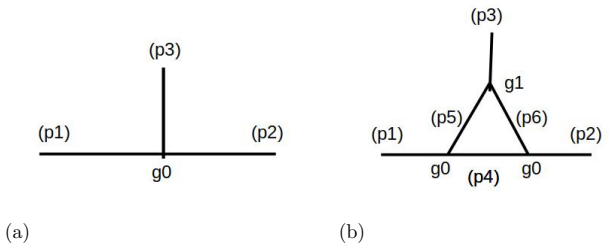
- [Sec. 4, Eqs. (48)-(49)] Eq. (49), which fixes the numerical value of q through the matching with Eq. (50), is asserted rather than derived. Eq. (48) has a right-hand side linear in g and contains no 16π² normalization; if ε5=ε6=λ/2 as used in Fig. 3, the q-exponential factors in Eq. (48) are constants, so the g^{N~+1} term in Eq. (49) cannot be obtained from the preceding formulas. The sentence 'The beta function can be easily calculated' is the only transition between these equations. Since this is the sole point where q=1.14 is obtained, the central claim of the paper is unsupported unless a complete derivation of Eq. (49) is supplied.
- [Sec. 3, Eq. (30)] The self-similarity condition (4N−5)+αν=α is imposed by hand; it is not derived from the renormalization-group equations. This condition is load-bearing because it converts the ideal-gas power law into the q-exponential form and identifies α with 1/(q−1). The parameters N, ν, and α are never connected to QCD parameters, and the final q is fixed only by the later beta-function matching in Sec. 4; thus the claimed first-principles determination of q from field-theory parameters is not established.
- [Sec. 6, Eqs. (55)-(62)] The average energy quoted in Eq. (55) does not follow from the distribution in Eq. (34). For a q-exponential with exponent −1/(q−1), the normalized mean is λ/(3−2q) (for q<3/2), not λ/(2q−1). In addition, the derivation of R=(q−1)/(2q−1) from Eqs. (55)-(57) sets E=λr/(q−1) together with λ/E=r, which are mutually inconsistent except for special values; with the corrected mean, the resulting fractal dimension is not 0.69. The fractal-dimension and multiplicity claims are therefore not supported by the model as presented.
- [Sec. 3, Eq. (24)] The approximation (1−ε²/M²)^{4N−5}≈1 in Eq. (24) is only valid for ε/M≪1, but the resulting power-law distribution is used for all ε up to M and is integrated in Sec. 6. No error estimate is given, and this approximation is one of the steps that turns a polynomial factor into a q-exponential; it needs a controlled justification.
minor comments (3)
- [Throughout] There are numerous typographical errors (e.g., 'cathegory', 'Satandard Model', 'autovectors', 'chech'), and Ref. [11] is left incomplete as 'Phys. Reports 14 (1974) incomplete!!!'. The manuscript needs a careful proofread.
- [Sec. 6] The sentence 'Using the value q−1 = 1.14' should be 'q = 1.14' (or 'q−1 = 0.14'); as written it is inconsistent with the q=1.14 obtained in Sec. 4.
- [Fig. 3] The comparison in Fig. 3 uses G=3.67 and G=752 with no justification for these values; since G and ε0 are free parameters, the agreement shown in the plots is not a predictive test.
Circularity Check
The value q=1.14 is fixed by equating the asserted beta function (49) with the known QCD beta function (50); Eq. (49) is not derived from the fractal formalism, so the central 'prediction' is the input coefficient renamed as q.
-
fitted input called prediction
[Section 4, Eqs. (48)-(53)]
"The beta function can be easily calculated and we get β¯g =− 1/(16π^2) 1/(q−1)g^{N~+1}, and we emphasize that N~ = 2. (49) ... The beta-function for QCD is [31,32] βQCD =− g^3/(16π^2)[11/3 c1 − 4/3 c2]. (50) ... Using Nc = Nf/2 = 3 we get 11/3 c1 − 4/3 c2 = 7, (53) which leads to q = 1.14."
The only numerical value of q comes from equating the coefficient in Eq. (49) with the known 1-loop QCD beta function (50), which gives 1/(q−1)=7. Eq. (49) is asserted ('The beta function can be easily calculated'), not derived: for fixed ε_j, Eq. (48) is linear in g and has no 16π^2 or g^2, so it cannot produce −g^3/[16π^2(q−1)]; if ε_j=λ/2 as in Fig. 3, the q-exponential factors are constants. The self-similarity equations (27)-(34) fix only the functional form [1+(q−1)x]^{-1/(q−1)} and leave α=1/(q−1) as an undetermined function of N and ν. Hence q=1.14 is not a prediction from the fractal parameters; the known QCD beta-function coefficient 7 is re-expressed as 1/(q−1). The agreement with experiment is then a restatement of that chosen coefficient.
full rationale
The central numerical claim q=1.14 reduces to matching the asserted beta function in Eq. (49) to the known QCD beta function in Eq. (50). Eq. (49) is introduced with no computation, and the preceding Eq. (48) does not transparently imply it: the right-hand side of Eq. (48) is linear in g and contains no 16π^2 or g^2, while Eq. (49) has g^{N~+1}=g^3 and 1/(q−1). The earlier self-similarity and recurrence argument (Eqs. (27)-(34)) produces the q-exponential shape but leaves α=1/(q−1) dependent on N and ν, which are never numerically fixed. Therefore the number 1.14 is not obtained from the fractal or field-theory parameters internal to the derivation; it is the known 1-loop QCD beta-function coefficient written as 1/(q−1). This is a load-bearing fitted-input-called-prediction issue rather than a harmless self-citation: the paper's abstract and conclusions advertise q as deduced from field-theory parameters, but the deduction is actually an equation-identification step. I do not count the self-citations to the authors' thermofractal papers [17,18] as circular, since the paper re-derives the q-exponential form from its own self-similarity condition; nor do I count the self-cited experimental q values [33-35] as circular, since they are used only for comparison. The downstream results for the fractal dimension D=0.69 and multiplicity exponent 1−D=0.31 inherit the q value and therefore inherit the same identification problem, but they do not add independent circularity.
Assumptions & free parameters
free parameters (4)
- ν
- G =
G = 3.67 and G = 752 for the plots
- λ (scale per degree of freedom)
- ε0 (inferior energy cutoff)
assumptions (6)
- domain assumption All configurations of partons with the same interaction count are equally probable (microcanonical assumption)
- domain assumption Self-similarity of parton energy distributions at all scales, P(ε/E) ∼ P(E/M) ∼ P(χ)
- domain assumption Exponent matching (4N-5) + αν = α
- domain assumption Approximation (1-ε/M)^(4N-5)(1+ε/M)^(4N-5) ∼ 1
- standard math One-loop QCD beta function is the correct external benchmark
- ad hoc to paper The beta function of the effective coupling in Eq. (49) is valid
invented entities (1)
-
Fractal structure of effective partons (self-similar truncated n-point functions)
independent evidence
Cite this review
Pith. "Pith review of Fractals, non-extensive statistics and QCD." pith.science (2026). https://pith.science/paper/A4YCCE63
@misc{pith2026190808799,
  author       = {Pith},
  title        = {Pith review of: Fractals, non-extensive statistics and QCD},
  year         = {2026},
  howpublished = {\url{https://pith.science/paper/A4YCCE63}},
  note         = {Machine review of arXiv:1908.08799}
}
abstract
In this work we analyse how scaling properties of Yang-Mills field theory manifest as self-similarity of truncated n-point functions by scale evolution. The presence of such structures, which actually behaves as fractals, allow for recurrent non-perturbative calculation of any vertex. Some general properties are indeed independent of the perturbative order, what simplifies the non-perturbative calculations. We show that for sufficiently high perturbative orders a statistical approach can be used, the non extensive statistics is obtained, and the Tsallis index, $q$, is deduced in terms of the field theory parameters. The results are applied to QCD in the one-loop approximation, where $q$ can be calculated, resulting in a good agreement with the value obtained experimentally. We discuss how this approach allows to understand some intriguing experimental findings in high energy collisions, as the behavior of multiplicity against collision energy, long-tail distributions and the fractal dimension observed in intermittency analysis.
Figures


Reference graph
Works this paper leans on
- [1]
- [2]
- [3]
-
[4]
The Fractal Geometry of Nature; WH Freeman: New York, NY, USA, 1983
Mandelbrot, B.B. The Fractal Geometry of Nature; WH Freeman: New York, NY, USA, 1983
work page 1983
-
[5]
G. West, Scale, The Universal Laws of Life, Growth, and Death in Organisms, Cities, and Companies, Penguin Books, 2018 - New York
work page 2018
-
[6]
Falconer, Fractals, a short introduction , Oxford Univ
K. Falconer, Fractals, a short introduction , Oxford Univ. Press, 2013 - Oxford
work page 2013
-
[7]
Tsallis, J
C. Tsallis, J. Stat. Phys. 52 (1988) 479
1988
-
[8]
M. Gell-Mann, C. Tsallis, Nonextensive Entropy: Interdisciplinary Applications , Oxfor University Press, USA, 2004
work page 2004
Show all 49 references
-
[9]
H. D. Politzer, Phys. Reports 14 (1974) 129
1974
-
[10]
Georgi and H
H. Georgi and H. D. Politzer, Phys. Rev. D9 (1974) 416
1974
-
[11]
Gross and F
D. Gross and F. Wilczek, Phys. Reports 14 (1974) incomplete!!!
1974
-
[12]
Gross and F
D. Gross and F. Wilczek, Phys. Rev. D9 (1974) 980
1974
-
[13]
C. G. Callan, Jr., Phys. Rev. D 2 (1970) 1541
1970
-
[14]
Symanzik, Commun
K. Symanzik, Commun. math. Phys. 18 (1970) 227
1970
-
[15]
Symanzik, Commun
K. Symanzik, Commun. math. Phys. 23 (1971) 49
1971
-
[16]
Deppman and E
A. Deppman and E. Megias, Physics 2019, 1, 103-110. 18
2019
-
[17]
Deppman, Phys
A. Deppman, Phys. Rev. D 93 (2016) 054001
2016
-
[18]
Deppman, T
A. Deppman, T. Frederico, E. Meg´ ıas, D. P Menezes, Entropy 20 (2018) 633
2018
-
[19]
Hagedorn, CERN - TH
R. Hagedorn, CERN - TH. 520 65/166/5 (1965)
1965
-
[20]
Hagedorn, Nuovo Cimento Suppl
R. Hagedorn, Nuovo Cimento Suppl. 3 (1965) 147
1965
-
[21]
Deppman, Physica A 391 (2012) 6380
A. Deppman, Physica A 391 (2012) 6380
2012
-
[22]
X. Feal, C. Pajares, C and R.A. Vazquez, Phys. Rev. C 99 (2019) 015205
2019
-
[23]
P. H. G. Cardoso, T. Nunes da Silva, A. Deppman and D. P. Menezes, Eur. Phys. J. A 53, no. 10, 191 (2017)
2017
-
[24]
Meg´ ıas, D
E. Meg´ ıas, D. P. Menezes, and A. Deppman, Physica A 421, 15 (2015)
2015
-
[25]
D. P. Menezes, A. Deppman, E. Meg´ ıas and L. B. Castro, Eur. Phys. J. A 51, no. 12, 155 (2015)
2015
-
[26]
Deppman, Universe 3 (2017) 62
A. Deppman, Universe 3 (2017) 62
2017
-
[27]
Tokarev and I
M. Tokarev and I. Zborovsky, EPJ Web Conf. 141 (2017) 02006
2017
-
[28]
Zborovsk and M.V
I. Zborovsk and M.V. Tokarev, Phys. Rev. D75, (2007) 094008
2007
-
[29]
Wilk and Z
G. Wilk and Z. W lodarczyk, Phys. Lett. B (2013) 163
2013
-
[30]
Yalcin and C
G. Yalcin and C. Beck, Sci. Rep. 8 (2018) 1764
2018
-
[31]
D. J. Gross and F. Wilczek, Phys. Rev. Lett. 30, 1343 (1973)
1973
-
[32]
H. D. Politzer, Phys. Rept. 14, 129 (1974)
1974
-
[33]
Sena and a
I. Sena and a. Deppman, Eur. Phys. J. A 49 (2013) 17
2013
-
[34]
Marques, E
L. Marques, E. Andrade-II and A. Deppman, Phys. Rev. D 87 (2013) 114022
2013
-
[35]
Marques, J
L. Marques, J. Cleymans and A. Deppman, Phys. Rev. D 91 (2015) 054025
2015
-
[36]
van Ritbergen, J
T. van Ritbergen, J. A. M. Vermaseren and S. A. Larin, Phys. Lett. B 400, 379 (1997)
1997
-
[37]
Czakon, Nucl
M. Czakon, Nucl. Phys. B 710, 485 (2005)
2005
-
[38]
Rybczynski, Z
M. Rybczynski, Z. Wlodarczyk and G. Wilk, J. Phys. G 39, 095004 (2012)
2012
-
[39]
Bialas and R
A. Bialas and R. Peschanki, Nucl. Phys. B273 (1986) 703
1986
-
[40]
Bialas and R
A. Bialas and R. Peschanki, Nucl. Phys. B308 (1988) 857
1988
-
[41]
R. C. Hwa, Phys. Rev. D 41 (1990) 1456
1990
-
[42]
Hwa and J
R.C. Hwa and J. Pan, Phys. Rev. D 45 (1992) 1476. 19
1992
-
[43]
Hegyi, Phys
S. Hegyi, Phys. Lett. B 318 (1993) 642
1993
-
[44]
Dremin and R.C
I.M. Dremin and R.C. Hwa, Phys. Rev. D 49 (1994) 5805
1994
-
[45]
Hegyi and T
S. Hegyi and T. Cs¨ org¨ o, Phys. Lett. B 296 (1992) 256
1992
-
[46]
Antoniou, N
N.G. Antoniou, N. Davis and F.K. Diakonos, Phys. Rev. C 93 (2016) 014908
2016
-
[47]
De Wolf, I.M
E.A. De Wolf, I.M. Dremin, W. Kittel, Phys. Rep. 270 (1996) 1-141
1996
-
[48]
Kittel, E.A
W. Kittel, E.A. De Wolf, Soft Multihadron Dynamics (World Scientific, 2005)
2005
-
[49]
Sarkisyan, Aditya Nath Mishra, Raghunath Sahoo and Alexander S
Edward K.G. Sarkisyan, Aditya Nath Mishra, Raghunath Sahoo and Alexander S. Sakharov, Phys. Rev. D 93 (2016) 054046. 20
2016
Reviewed August 14, 2026 · model on record in the stance chip above.
Discussion (0). Continue with ORCID to comment.