Unified Framework for Functional Theories of Quantum Systems
Pith reviewed 2026-06-27 23:03 UTC · model grok-4.3
The pith
A minimal structure of chosen observables and fixed Hamiltonian parts is necessary and sufficient to formulate any functional theory for finite-dimensional quantum systems.
A machine-rendered reading of the paper's core claim, the machinery that carries it, and where it could break.
Core claim
The scope of a functional theory—formed by any generalized choice of basic observables whose expectation values become the reduced variables and by a fixed part of the Hamiltonian that characterises the systems—is necessary and sufficient for the formulation of a functional theory. It permits the definition of the associated universal functionals, the proof of their convexity and differentiability properties, the treatment of representability questions, and the derivation of a Hohenberg-Kohn-type uniqueness result. A purification construction further relates ensemble and weighted-ensemble functionals to their pure-state counterparts.
What carries the argument
The scope, consisting of a choice of basic observables and a fixed part of the Hamiltonian, which supplies the minimal data needed to define universal functionals and prove their structural properties.
If this is right
- Universal functionals can be defined once the scope is fixed.
- Convexity and differentiability properties of the functionals follow directly from the scope.
- Representability questions become well-posed inside the chosen scope.
- A Hohenberg-Kohn-type uniqueness theorem holds for any scope.
- Ensemble and weighted-ensemble functionals are related to the pure-state functional by the purification construction.
Where Pith is reading between the lines
- The same scope construction could be tested on concrete models such as finite Hubbard chains to verify that the uniqueness result produces new constraints on ground-state densities.
- When the observables close under a Lie bracket, the symplectic geometry link suggests that classical limits of the functional theory may be obtained by replacing quantum expectation values with Poisson brackets.
- If the purification step can be shown to exist for a larger class of infinite-dimensional systems, the framework would supply a route to rigorous statements about continuum density-functional theories.
- The unification implies that any new functional theory built on a different but still finite set of observables inherits the convexity and differentiability results without separate proof.
Load-bearing premise
A purification construction exists that relates ensemble and weighted-ensemble functionals to the pure-state variant for the chosen observables and systems.
What would settle it
An explicit set of observables and systems on a finite-dimensional Hilbert space for which no purification map exists that connects the ensemble functionals to the pure-state functional would show that the claimed relations between functional variants fail.
Figures

read the original abstract
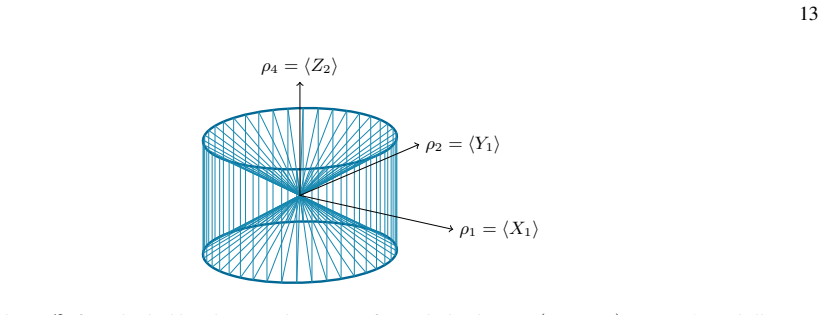
We introduce and study a unified framework for density-functional theory and its variants for quantum systems on finite-dimensional Hilbert spaces. These theories seek to reduce the complexity inherent in the many-body quantum problem by describing ground states through reduced variables. The central ingredients of our unified framework are a generalized choice of basic observables, whose expectation values define precisely those reduced variables, and a fixed part of the Hamiltonian characterizing the class of quantum systems under consideration. It is this minimal structure, which we call the scope of a functional theory, that is necessary and sufficient for the formulation of a functional theory. In particular, it allows one to define the universal functionals, establish their convexity and differentiability properties, address representability questions, and prove a Hohenberg-Kohn-type uniqueness result. A purification construction also relates ensemble and weighted-ensemble functionals to the pure-state variant. Particular emphasis is placed on functional theories with Lie-algebra observable structures, connecting the variational framework to symplectic geometry. The result of this work is a systematic mathematical formulation in which structural results can be proved once and applied across a broad class of finite-dimensional functional theories.
Editorial analysis
A structured set of objections, weighed in public.
Referee Report
Summary. The manuscript introduces a unified framework for density-functional theory and variants on finite-dimensional Hilbert spaces. The central object is the 'scope', consisting of a choice of basic observables (whose expectations are the reduced variables) together with a fixed part of the Hamiltonian. The paper asserts that this minimal structure is necessary and sufficient to define universal functionals, establish their convexity and differentiability, address representability, prove a Hohenberg-Kohn-type uniqueness theorem, and obtain a purification construction that relates ensemble and weighted-ensemble functionals to the pure-state version. Special attention is given to Lie-algebra observable structures, which connect the variational setting to symplectic geometry. The overall aim is a systematic formulation in which structural results can be proved once and applied across a broad class of finite-dimensional functional theories.
Significance. If the derivations are complete, the work supplies a mathematically rigorous unification that identifies the minimal data needed for functional theories and permits general proofs of key properties (convexity, differentiability, HK uniqueness, representability). The explicit link to symplectic geometry for Lie-algebra observables is a genuine strength, offering a geometric perspective that may prove useful beyond the present setting. The finite-dimensional restriction enables clean, non-approximate arguments. These features would make the framework a useful reference for subsequent work on DFT variants and related reduced-density theories.
major comments (2)
- [Abstract] Abstract (paragraph beginning 'It is this minimal structure...'): The claim that the scope alone is sufficient to define the universal functionals and to prove convexity, differentiability, representability and HK uniqueness is asserted without any derivation steps or explicit definitions of the functionals being supplied in the abstract. Because these properties are load-bearing for the unification claim, the manuscript must exhibit the precise definitions and the short derivations that recover the listed properties directly from the scope axioms.
- [Abstract] Abstract (paragraph on purification): The statement that 'a purification construction also relates ensemble and weighted-ensemble functionals to the pure-state variant' is presented as following from the minimal scope. However, the existence of a purification that preserves observable expectations and recovers the ensemble functional as an infimum over pure states is an additional existence result not entailed by the choice of observables and fixed Hamiltonian part alone. For Lie-algebra observable sets the symplectic-geometry connection is invoked, yet no argument is visible showing that this geometry guarantees the required purification map without further assumptions on the observable algebra. This gap directly affects the claimed unification across pure-state and ensemble cases.
minor comments (2)
- The notation used for the universal functionals and for the different variants (pure, ensemble, weighted-ensemble) should be introduced with explicit formulas immediately after the scope is defined, rather than left implicit.
- A short table or diagram summarizing which properties are proved for which variant of the functional (pure-state vs. ensemble) would improve readability.
Simulated Author's Rebuttal
We thank the referee for the careful reading of the manuscript and the constructive comments. We respond to each major comment below.
read point-by-point responses
-
Referee: [Abstract] Abstract (paragraph beginning 'It is this minimal structure...'): The claim that the scope alone is sufficient to define the universal functionals and to prove convexity, differentiability, representability and HK uniqueness is asserted without any derivation steps or explicit definitions of the functionals being supplied in the abstract. Because these properties are load-bearing for the unification claim, the manuscript must exhibit the precise definitions and the short derivations that recover the listed properties directly from the scope axioms.
Authors: The abstract serves as a high-level summary. The scope is defined precisely in Definition 2.1. The universal functional is introduced in Definition 3.1, with convexity established in Theorem 3.2, differentiability in Theorem 3.4, representability addressed in Section 4, and the Hohenberg-Kohn uniqueness in Theorem 4.1. Each of these results is derived directly from the scope axioms in the indicated sections. Full derivations cannot be included in the abstract due to length constraints typical for such summaries; the body of the paper supplies the requested details. revision: no
-
Referee: [Abstract] Abstract (paragraph on purification): The statement that 'a purification construction also relates ensemble and weighted-ensemble functionals to the pure-state variant' is presented as following from the minimal scope. However, the existence of a purification that preserves observable expectations and recovers the ensemble functional as an infimum over pure states is an additional existence result not entailed by the choice of observables and fixed Hamiltonian part alone. For Lie-algebra observable sets the symplectic-geometry connection is invoked, yet no argument is visible showing that this geometry guarantees the required purification map without further assumptions on the observable algebra. This gap directly affects the claimed unification across pure-state and ensemble cases.
Authors: Section 5 develops the purification construction for scopes equipped with Lie-algebra observable structures. Proposition 5.2 identifies the relevant state space with coadjoint orbits, and Theorem 5.3 constructs the purification map that preserves expectations of the basic observables while recovering the ensemble functional as an infimum over pure states. This construction relies on the symplectic geometry induced by the Lie-algebra structure, which is part of the scope for the indicated class of theories. We will revise the abstract to include a brief reference to this theorem and add a clarifying sentence in Section 5 to emphasize the dependence on the Lie-algebra structure. revision: partial
Circularity Check
No circularity: scope definition yields independent structural results
full rationale
The paper starts from standard finite-dimensional quantum mechanics and defines the 'scope' externally as the pair (observables, fixed Hamiltonian part). From this it derives universal functionals, convexity/differentiability properties, representability, and a Hohenberg-Kohn uniqueness theorem. The purification relation is stated as an additional construction that links ensemble to pure-state variants, but the central claims do not reduce by construction to fitted parameters, self-referential definitions, or load-bearing self-citations. The derivation chain remains self-contained against external benchmarks and does not match any enumerated circularity pattern.
Axiom & Free-Parameter Ledger
axioms (2)
- domain assumption Quantum systems under consideration are defined on finite-dimensional Hilbert spaces
- domain assumption A purification construction exists that relates ensemble functionals to pure-state functionals for the chosen observables
invented entities (1)
-
scope of a functional theory
no independent evidence
Reference graph
Works this paper leans on
-
[1]
2017 , publisher=
Foundations of quantum theory: From classical concepts to operator algebras , author=. 2017 , publisher=
2017
-
[2]
and Sternberg, S
Guillemin, V. and Sternberg, S. Symplectic techniques in physics. 1990
1990
-
[3]
2004 , publisher=
Momentum Maps and Hamiltonian Reduction. 2004 , publisher=
2004
-
[4]
2012 , series =
Introduction to Smooth Manifolds , author =. 2012 , series =
2012
-
[5]
E. H. Lieb , journal =. Density Functionals for. 1983 , doi =
1983
-
[6]
Density-functional theory on graphs , author=. J. Chem. Phys. , volume=. 2021 , pages=
2021
-
[7]
Barbu and T
V. Barbu and T. Precupanu , title =
-
[8]
Inhomogeneous electron gas , author=. Phys. Rev. , volume=. 1964 , publisher=
1964
-
[9]
, journal=
Garrigue, L. , journal=. Unique continuation for many-body. 2018 , doi=
2018
-
[10]
Xu, Limin and Mao, Jiahao and Gao, Xingyu and Liu, Zheng , year =. Extensibility of. Adv. Quantum Technol. , publisher =. doi:10.1002/qute.202200041 , number =
-
[11]
1988 , publisher=
Manifolds, Tensor Analysis, and Applications , author=. 1988 , publisher=
1988
-
[12]
On Einstein’s Path: Essays in Honor of Engelbert Schucking , pages=
Geometrical formulation of quantum mechanics , author=. On Einstein’s Path: Essays in Honor of Engelbert Schucking , pages=. 1999 , publisher=
1999
-
[13]
and Spiegel, Daniel and Vishwanath, Ashvin and Hermele, Michael , year =
Wen, Xueda and Qi, Marvin and Beaudry, Agnès and Moreno, Juan and Pflaum, Markus J. and Spiegel, Daniel and Vishwanath, Ashvin and Hermele, Michael , year =. Flow of higher Berry curvature and bulk-boundary correspondence in parametrized quantum systems , volume =. Phys. Rev. B , publisher =. doi:10.1103/physrevb.108.125147 , number =
-
[14]
Dual pairing of symmetry and dynamical groups in physics , author =. Rev. Mod. Phys. , volume =. 2012 , month =. doi:10.1103/RevModPhys.84.711 , url =
-
[15]
Rowe, D. J. and Repka, J. and Carvalho, M. J. , title =. J. Math. Phys. , volume =. 2011 , month =. doi:10.1063/1.3525978 , url =
-
[16]
Refining and relating fundamentals of functional theory , author =. J. Chem. Phys. , pages =
-
[17]
Moment Maps and Combinatorial Invariants of
Guillemin, Victor , year = 1994, publisher =. Moment Maps and Combinatorial Invariants of. doi:10.1007/978-1-4612-0269-1 , url =
-
[18]
Convexity properties of the moment mapping , author =. Invent. Math. , volume = 67, pages =. doi:10.1007/BF01398933 , url =
-
[19]
Atiyah, M. F. , year = 1982, journal =. Convexity and Commuting. doi:https://doi.org/10.1112/blms/14.1.1 , url =
-
[20]
Kirwan, F. , year = 1984, journal =. Convexity properties of the moment mapping,. doi:10.1007/BF01388838 , url =
-
[21]
Altunbulak, M. and Klyachko, A. , year = 2008, journal =. The. doi:10.1007/s00220-008-0552-z , url =
-
[22]
Solving one-body ensemble N-representability problems with spin , volume =
Liebert, Julia and Castillo, Federico and Labbé, Jean-Philippe and Maciazek, Tomasz and Schilling, Christian , year =. Solving one-body ensemble N-representability problems with spin , volume =. doi:10.22331/q-2025-12-02-1921 , journal =
-
[23]
A Spin-Faithful Functional Theory for Strongly Correlated Electrons , author =
-
[24]
, year = 2016, publisher =
Hall, Brian C. , year = 2016, publisher =. Lie Groups,
2016
-
[25]
Toolbox of spin-adapted generalized
Liebert, Julia and Lemke, Yannick and Altunbulak, Murat and Maciazek, Tomasz and Ochsenfeld, Christian and Schilling, Christian , journal =. Toolbox of spin-adapted generalized. 2025 , month =. doi:10.1103/PhysRevResearch.7.023247 , url =
-
[26]
Entropic Density Functional Theory , volume =
Yousefi, Ahmad and Caticha, Ariel , year =. Entropic Density Functional Theory , volume =. Entropy , publisher =. doi:10.3390/e26010010 , number =
-
[27]
and Carter-Fenk, Kevin , keywords =
Zamani, Abdulrahman Y. and Carter-Fenk, Kevin , keywords =. Towards ab initio Realizations of Collins' Conjecture , publisher =. 2025 , copyright =. doi:10.48550/ARXIV.2504.04692 , url =
-
[28]
T>0 ensemble-state density functional theory via Legendre transform , volume =
Eschrig, Helmut , year =. T>0 ensemble-state density functional theory via Legendre transform , volume =. Phys. Rev. B , publisher =. doi:10.1103/physrevb.82.205120 , number =
-
[29]
Wang, Jian and Baerends, Evert Jan , year =. Self-Consistent-Field Method for Correlated Many-Electron Systems with an Entropic Cumulant Energy , volume =. Phys. Rev. Lett. , publisher =. doi:10.1103/physrevlett.128.013001 , number =
-
[30]
and Gunnarsson, O
Schönhammer, K. and Gunnarsson, O. and Noack, R. M. , year =. Density-Functional Theory on a Lattice:. Phys. Rev. B , volume =
-
[31]
, date =
Danskin, John M. , date =. The. SIAM Journal on Applied Mathematics , volume =. 2946123 , eprinttype =
-
[32]
Mixed state representability of entropy-density pairs , volume =
Garrigue, Louis , year =. Mixed state representability of entropy-density pairs , volume =. J. Math. Phys. , publisher =. doi:10.1063/5.0169120 , number =
-
[33]
Seidl, A. and G\". Generalized. Phys. Rev. B , publisher =. 1996 , month = feb, pages =. doi:10.1103/physrevb.53.3764 , number =
-
[34]
Stability of the thermal Hartree-Fock approximation , author=. Ann. Phys. , volume=. 1963 , publisher=
1963
-
[35]
Information entropy as a measure of the correlation energy associated with the cumulant , author=. Phys. Rev. A , volume=. 2021 , publisher=
2021
-
[36]
What can quantum information theory offer to quantum chemistry? , author =. Faraday Discuss. , publisher =. doi:10.1039/D4FD00059E , url =
-
[37]
New Measure of Electron Correlation , author =. Phys. Rev. Lett. , volume =. 2005 , month =. doi:10.1103/PhysRevLett.95.123003 , url =
-
[38]
Properties of Nonfreeness: An Entropy Measure of Electron Correlation , author =. Int. J. Quantum Inf , publisher =
-
[39]
, year = 2022, journal =
Bach, V. , year = 2022, journal =
2022
-
[40]
Bach, V. and Lieb, E.H. and Solovej, J.P. , year = 1994, journal =. Generalized. doi:10.1007/BF02188656 , url =
-
[41]
On Quasifree States of
Araki, Huzihiro , year = 1970, journal =. On Quasifree States of
1970
-
[42]
Ensemble Hartree-Fock theory for excited states , author =
-
[43]
How to Incorporate Symmetries in Functional Theories , author =
-
[44]
Paldus, Josef , title =. J. Chem. Phys. , volume =. 1974 , month =. doi:10.1063/1.1681883 , url =
-
[45]
Variational Principle for Many-Fermion Systems , author =. Phys. Rev. Lett. , volume = 46, pages =. doi:10.1103/PhysRevLett.46.457 , url =
-
[46]
Information theory and statistical mechanics , author=. Phys. Rev. , volume=. 1957 , publisher=
1957
-
[47]
II , author=
Information theory and statistical mechanics. II , author=. Phys. Rev. , volume=. 1957 , publisher=
1957
-
[48]
Entropy is a good approximation to the electronic (static) correlation energy , author=. J. Chem. Phys. , volume=. 2023 , publisher=
2023
-
[49]
and Golden, Sidney and Levy, Mel , year =
Ayers, Paul W. and Golden, Sidney and Levy, Mel , year =. Generalizations of the Hohenberg-Kohn theorem: I. Legendre Transform Constructions of Variational Principles for Density Matrices and Electron Distribution Functions , volume =. J. Chem. Phys. , publisher =. doi:10.1063/1.2006087 , number =
-
[50]
Power functional theory for many-body dynamics , volume =
Schmidt, Matthias , year =. Power functional theory for many-body dynamics , volume =. Reviews of Modern Physics , publisher =. doi:10.1103/revmodphys.94.015007 , number =
-
[51]
Evans, R. , year =. The nature of the liquid-vapour interface and other topics in the statistical mechanics of non-uniform, classical fluids , volume =. Adv. Phys. , publisher =. doi:10.1080/00018737900101365 , number =
-
[52]
, journal=
Watanabe, S. , journal=. 1939 , url=
1939
-
[53]
and Castillo, F
Liebert, J. and Castillo, F. and Labb\'e, J.-P. and Schilling, C. , title =. J. Chem. Theory Comput. , volume =. 2022 , doi =
2022
-
[54]
Schilling, Christian and Pittalis, Stefano , journal =. Ensemble Reduced Density Matrix Functional Theory for Excited States and Hierarchical Generalization of. 2021 , month =. doi:10.1103/PhysRevLett.127.023001 , url =
-
[55]
Structure of Fermion Density Matrices , author =. Rev. Mod. Phys. , volume =. 1963 , month =. doi:10.1103/RevModPhys.35.668 , url =
-
[56]
Rockafellar, R. T. , year=. Convex
-
[57]
1970 , publisher=
Convex Analysis , author=. 1970 , publisher=
1970
-
[58]
Nature communications , volume=
A complete hierarchy for the pure state marginal problem in quantum mechanics , author=. Nature communications , volume=. 2021 , publisher=
2021
-
[59]
Burke, K. and Smith, J. C. and Grabowski, P. E. and Pribram-Jones, A. , year =. Exact conditions on the temperature dependence of density functionals , volume =. Phys. Rev. B , publisher =. doi:10.1103/physrevb.93.195132 , number =
-
[60]
Gutkin, Eugene and Jonckheere, Edmond A. and Karow, Michael , year =. Convexity of the joint numerical range: topological and differential geometric viewpoints , volume =. doi:10.1016/j.laa.2003.06.011 , journal =
-
[61]
Gibney, Daniel and Boyn, Jan-Niklas and Mazziotti, David A. , year =. Universal Generalization of Density Functional Theory for Static Correlation , volume =. Phys. Rev. Lett. , publisher =. doi:10.1103/physrevlett.131.243003 , number =
-
[62]
Gilbert, T. L. , year =. Phys. Rev. B , publisher =. doi:10.1103/physrevb.12.2111 , number =
-
[63]
Quantum , volume=
Geometry of degeneracy in potential and density space , author=. Quantum , volume=. 2023 , publisher=
2023
-
[64]
Constrained search in imaginary time , volume =
Penz, Markus and van Leeuwen, Robert , year =. Constrained search in imaginary time , volume =. Phys. Rev. A , publisher =. doi:10.1103/g4ch-5x8m , number =
-
[65]
Haeser, Gabriel and dos Santos, Daiana Oliveira , title =. 2024 , eprint =. doi:10.48550/ARXIV.2402.05335 , url =
-
[66]
Corso, Thiago Carvalho and Laestadius, Andre , title =. 2025 , eprint =. doi:10.48550/ARXIV.2512.04726 , url =
-
[67]
Bakkestuen, Vebjørn H. and Csirik, Mihály A. and Laestadius, Andre and Penz, Markus , year =. Density-Functional Theory for the. J. Stat. Phys. , publisher =. doi:10.1007/s10955-025-03442-9 , number =
-
[68]
Arbitrary choice of basic variables in density functional theory
Higuchi, Masahiko and Higuchi, Katsuhiko , journal=. Arbitrary choice of basic variables in density functional theory. 2004 , publisher=
2004
-
[69]
Arbitrary choice of basic variables in density functional theory
Higuchi, Katsuhiko and Higuchi, Masahiko , journal=. Arbitrary choice of basic variables in density functional theory. 2004 , publisher=
2004
-
[70]
Thermal-density-functional-theory approach to quantum thermodynamics , volume =
Palamara, Antonio and Plastina, Francesco and Sindona, Antonello and D’Amico, Irene , year =. Thermal-density-functional-theory approach to quantum thermodynamics , volume =. Phys. Rev. A , publisher =. doi:10.1103/physreva.110.062203 , number =
-
[71]
Cancès, Eric and Duez, Théo and van Gog, Jari and Lauritsen, Asbjørn Bækgaard and Lewin, Mathieu and Toulouse, Julien , title =. 2026 , eprint =. doi:10.48550/ARXIV.2601.07719 , url =
work page internal anchor Pith review Pith/arXiv arXiv doi:10.48550/arxiv.2601.07719 2026
-
[72]
2026 , eprint =
Cancès, Eric and Duez, Théo and van Gog, Jari and Lauritsen, Asbjørn Bækgaard and Lewin, Mathieu and Toulouse, Julien , title =. 2026 , eprint =
2026
-
[73]
Density-functional theory in strong magnetic fields , author =. Phys. Rev. Lett. , fjournal =. 1987 , doi =
1987
-
[74]
Current- and spin-density-functional theory for inhomogeneous electronic systems in strong magnetic fields , author =. Phys. Rev. B , fjournal =. 1988 , doi =
1988
-
[75]
Magnetic fields and density functional theory , author=. Adv. Quantum Chem. , volume=. 1990 , doi=
1990
-
[76]
and Kvaal, Simen and Sagvolden, Espen and Ekstr\"
Tellgren, Erik I. and Kvaal, Simen and Sagvolden, Espen and Ekstr\". Choice of basic variables in current-density-functional theory , volume =. Phys. Rev. A , pages =. doi:10.1103/physreva.86.062506 , number =
-
[77]
Penz, Markus and Tellgren, Erik I. and Csirik, Mihály A. and Ruggenthaler, Michael and Laestadius, Andre , year =. The Structure of the Density-Potential Mapping. ACS Phys. Chem. Au , publisher =. doi:10.1021/acsphyschemau.3c00006 , number =
-
[78]
A local exchange-correlation potential for the spin polarized case
Barth, U von and Hedin, L , year =. A local exchange-correlation potential for the spin polarized case. i , volume =. J. Phys. C: Solid State Phys. , publisher =. doi:10.1088/0022-3719/5/13/012 , number =
-
[79]
Gunnarsson, O. and Lundqvist, B. I. , year =. Exchange and correlation in atoms, molecules, and solids by the spin-density-functional formalism , volume =. Phys. Rev. B , publisher =. doi:10.1103/physrevb.13.4274 , number =
-
[80]
Universal variational functionals of electron densities, first-order density matrices, and natural spin-orbitals and solution of the v-representability problem , author=. Proc. Natl. Acad. Sci. U.S.A , volume=. 1979 , url=
1979
discussion (0)
Sign in with ORCID, Apple, or X to comment. Anyone can read and Pith papers without signing in.