Geometric Algebra Meets Cartesian Tensors: Higher-Order Equivariance for Interatomic Potentials
Pith reviewed 2026-06-30 01:43 UTC · model grok-4.3
The pith
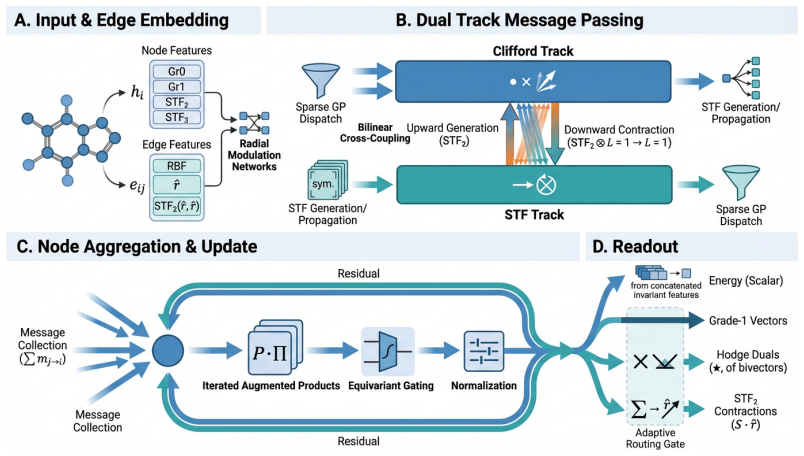
CliffordSTF fixes poor force directions in Clifford-based interatomic potentials by adding closed-form symmetric-traceless tensor tracks at ranks 2 and 3.
A machine-rendered reading of the paper's core claim, the machinery that carries it, and where it could break.
Core claim
The geometric product in Cl(3,0) realises only the L=0 and L=1 irreducible representations, so the per-edge bilinear that drives message passing lacks the symmetric-traceless rank-2 component required for accurate force directions. CliffordSTF restores this component by contracting the Clifford multivector with closed-form symmetric-traceless tensor fields of rank 2 and 3 through a single learned bilinear, producing higher-order equivariance that improves both directional and magnitude accuracy on molecular and catalysis benchmarks.
What carries the argument
CliffordSTF, a bilinear cross-track contraction that couples a Clifford multivector to closed-form symmetric-traceless tensor tracks of rank 2 and 3.
If this is right
- Force direction accuracy on rMD17 rises by an order of magnitude relative to base Clifford models while force MAE drops 15.8 percent and energy MAE drops 10.9 percent.
- CliffordSTF outperforms all CG-free and body-ordered baselines tested, all of which stay below 0.17 cosine similarity.
- On catalysis data the method records the lowest out-of-distribution S2EF energy MAE on OC22 and the lowest in-distribution energy MAE among L greater than or equal to 2 methods on OC22 IS2RE.
- The two STF tracks are complementary; using either alone fails to match the combined performance.
Where Pith is reading between the lines
- The same bilinear contraction pattern could be inserted into other multivector or tensor-product architectures that currently truncate at low angular momentum.
- Because the STF tracks are closed-form and parameter-free, the approach may scale to higher ranks without the combinatorial cost of explicit Clebsch-Gordan tables.
- If the directional gain persists on larger or more disordered systems, the method could reduce the data volume needed to train force fields for catalysis or materials discovery.
Load-bearing premise
The missing symmetric-traceless rank-2 component in the geometric product is the primary reason for poor force directions, and adding the two STF tracks via one bilinear supplies the needed equivariance without harming generalization or stability.
What would settle it
Running the eleven-variant ablation on rMD17 and finding that models using only one STF track or neither track reach force-cosine similarity within 0.05 of the combined CliffordSTF model would falsify the claim that both tracks are required and complementary.
Figures
read the original abstract
$\mathrm{Cl}(3,0)$ interatomic potentials, despite their algebraic elegance, predict force magnitudes accurately but force directions poorly. Across ten rMD17 molecules, every $L \leq 1$ baseline in our twelve-model study attains aggregate force-cosine similarity below $0.25$. The cause is structural. The geometric product of two vectors in $\mathbb{R}^3$ realises only the $L=0$ and $L=1$ components of its irreducible representation content, leaving the symmetric-traceless rank-2 component absent from the per-edge bilinear that drives each message-passing layer. We address this with CliffordSTF, which couples the Clifford multivector to closed-form symmetric-traceless tensor tracks at ranks two and three through bilinear cross-track contractions, using a single learned bilinear and no Clebsch--Gordan tables, Wigner-$D$ matrices, or e3nn calls. On rMD17, CliffordSTF raises aggregate force-cosine similarity from $0.055$ (base Clifford) to $0.551$, an order-of-magnitude relative directional gain, alongside improved magnitude accuracy (force MAE $15.8\%$ lower; energy MAE $10.9\%$ lower). It outperforms all CG-free or body-ordered baselines in our study (all $\leq 0.17$). On catalysis benchmarks, CliffordSTF achieves the best out-of-distribution S2EF energy MAE on OC22 in our experiments, and the best in-distribution energy MAE among $L \geq 2$ methods on OC22 IS2RE. An eleven-variant ablation shows the two tracks are complementary: neither alone matches the combined model.
Editorial analysis
A structured set of objections, weighed in public.
Referee Report
Summary. The manuscript introduces CliffordSTF, an augmentation to Cl(3,0)-based interatomic potentials that couples the multivector representation to closed-form symmetric-traceless (STF) tensor tracks at ranks 2 and 3 through bilinear cross-track contractions. The central claim is that the geometric product realizes only L=0 and L=1 irreps, omitting the STF rank-2 component from per-edge bilinears and thereby causing poor force directions; adding the STF tracks via a single learned bilinear (no CG tables or Wigner-D matrices) restores the missing equivariance. On rMD17 the method raises aggregate force-cosine similarity from 0.055 (base Clifford) to 0.551 while lowering force and energy MAEs; it also reports the best OOD S2EF energy MAE on OC22 among the compared models and the best in-distribution energy MAE among L≥2 methods on OC22 IS2RE. An 11-variant ablation is presented to show complementarity of the two tracks.
Significance. If the reported gains are reproducible, the work supplies a compact, CG-free route to higher-order Cartesian equivariance inside a geometric-algebra message-passing framework. The explicit avoidance of Clebsch–Gordan coefficients and the 11-variant ablation that isolates the contribution of each STF track are concrete strengths that could be useful to practitioners who already employ Clifford multivectors.
major comments (2)
- [Abstract and §3] Abstract and §3 (experimental protocol): aggregate force-cosine similarity, force MAE, and energy MAE are reported without error bars, without specification of random seeds, without explicit data splits for the ten rMD17 molecules, and without the optimizer, learning-rate schedule, or batch size. These omissions are load-bearing for the central empirical claim that the directional improvement is structural rather than an artifact of training details.
- [§2.2] §2.2 (bilinear construction): the single learned bilinear that contracts the Clifford multivector with the STF tracks at ranks 2 and 3 is described only at the level of “closed-form STF tracks … through bilinear cross-track contractions.” The explicit tensor contraction, the rank of the output feature, and the initialization of the bilinear weights are not given; without these equations the claim that the construction supplies the missing STF component without side effects cannot be verified algebraically.
minor comments (1)
- [Figures 2–4] Table captions and axis labels in the rMD17 and OC22 result figures should explicitly state whether the reported metrics are means over the ten molecules or over multiple runs.
Simulated Author's Rebuttal
We thank the referee for the constructive comments. We address both major points below and will revise the manuscript accordingly to enhance reproducibility and algebraic clarity.
read point-by-point responses
-
Referee: [Abstract and §3] Abstract and §3 (experimental protocol): aggregate force-cosine similarity, force MAE, and energy MAE are reported without error bars, without specification of random seeds, without explicit data splits for the ten rMD17 molecules, and without the optimizer, learning-rate schedule, or batch size. These omissions are load-bearing for the central empirical claim that the directional improvement is structural rather than an artifact of training details.
Authors: We agree these details are essential for reproducibility and for confirming that gains are structural. In the revised manuscript we will report error bars over multiple random seeds, list the seeds, specify the exact train/validation/test splits for each of the ten rMD17 molecules, and document the optimizer, learning-rate schedule, and batch size in §3. revision: yes
-
Referee: [§2.2] §2.2 (bilinear construction): the single learned bilinear that contracts the Clifford multivector with the STF tracks at ranks 2 and 3 is described only at the level of “closed-form STF tracks … through bilinear cross-track contractions.” The explicit tensor contraction, the rank of the output feature, and the initialization of the bilinear weights are not given; without these equations the claim that the construction supplies the missing STF component without side effects cannot be verified algebraically.
Authors: We accept that the current description is insufficient for algebraic verification. The revised §2.2 will supply the explicit bilinear contraction (including tensor indices and summation pattern), state the rank of the output feature, and specify the weight-initialization scheme, allowing direct confirmation that the STF components are added without altering lower-order irreps. revision: yes
Circularity Check
No significant circularity
full rationale
The paper constructs CliffordSTF explicitly by coupling Clifford multivectors (L=0,1 from geometric product) to closed-form STF tracks at ranks 2-3 via a single learned bilinear contraction, with no Clebsch-Gordan or Wigner-D machinery. This is a direct algebraic definition, not a reduction of a claimed prediction back to fitted inputs. Performance gains are measured on external benchmarks (rMD17, OC22) with ablations; the structural diagnosis matches the known irrep content of the geometric product and does not rely on self-citation chains or renaming of fitted quantities. The derivation chain is self-contained against external tensor-algebra benchmarks.
Axiom & Free-Parameter Ledger
free parameters (1)
- learned bilinear
axioms (1)
- domain assumption The geometric product of two vectors in R^3 realises only the L=0 and L=1 components of its irreducible representation content.
invented entities (1)
-
CliffordSTF
no independent evidence
Reference graph
Works this paper leans on
-
[1]
Tensor field networks: Rotation- and translation-equivariant neural networks for 3D point clouds
Nathaniel Thomas, Tess Smidt, Steven Kearnes, Lusann Yang, Li Li, Kai Kohlhoff, and Patrick Riley. Tensor field networks: Rotation-and translation-equivariant neural networks for 3d point clouds. arXiv preprint arXiv:1802.08219,
work page internal anchor Pith review Pith/arXiv arXiv
-
[2]
e3nn: Euclidean neural networks.arXiv preprint arXiv:2207.09453,
Mario Geiger and Tess Smidt. e3nn: Euclidean neural networks.arXiv preprint arXiv:2207.09453,
-
[3]
Clifford neural layers for pde modeling.arXiv preprint arXiv:2209.04934,
Johannes Brandstetter, Rianne van den Berg, Max Welling, and Jayesh K Gupta. Clifford neural layers for pde modeling.arXiv preprint arXiv:2209.04934,
-
[4]
10 Johannes Gasteiger, Shankari Giri, Johannes T Margraf, and Stephan Günnemann. Fast and uncertainty-aware directional message passing for non-equilibrium molecules.arXiv preprint arXiv:2011.14115,
-
[5]
Philipp Thölke and Gianni De Fabritiis. Torchmd-net: equivariant transformers for neural network based molecular potentials.arXiv preprint arXiv:2202.02541,
-
[6]
Shengjie Luo, Tianlang Chen, and Aditi S Krishnapriyan. Enabling efficient equivariant operations in the fourier basis via gaunt tensor products.arXiv preprint arXiv:2401.10216,
-
[7]
Clifford-steerable convolutional neural networks.arXiv preprint arXiv:2402.14730,
Maksim Zhdanov, David Ruhe, Maurice Weiler, Ana Lucic, Johannes Brandstetter, and Patrick Forré. Clifford-steerable convolutional neural networks.arXiv preprint arXiv:2402.14730,
-
[8]
Clifford group equivariant simplicial message passing networks.arXiv preprint arXiv:2402.10011,
Cong Liu, David Ruhe, Floor Eijkelboom, and Patrick Forré. Clifford group equivariant simplicial message passing networks.arXiv preprint arXiv:2402.10011,
-
[9]
Xiang Fu, Zhenghao Wu, Wujie Wang, Tian Xie, Sinan Keten, Rafael Gomez-Bombarelli, and Tommi Jaakkola. Forces are not enough: Benchmark and critical evaluation for machine learning force fields with molecular simulations.arXiv preprint arXiv:2210.07237,
-
[10]
URL https://www.worldscientific.com/ doi/abs/10.1142/0270
doi: 10.1142/0270. URL https://www.worldscientific.com/ doi/abs/10.1142/0270. 12 A Supplementary Information A.1 Background onCl(3,0)and the geometric product The real Clifford algebra Cl(3,0) is the eight-dimensional associative unital algebra generated by an orthonormal basis {e1, e2, e3} of R3 subject to eiej +e jei = 2δ ij [Lounesto, 2001, Doran and L...
-
[11]
Under SO(3), ⋆ is equivariant
under which ⋆(u∧v) equals the ordinary cross product u×v . Under SO(3), ⋆ is equivariant. Under O(3), the Hodge dual of a bivector is an axial (pseudo)vector: bivectors are invariant under spatial inversion (eiej →(−e i)(−ej) =e iej), so the Hodge vector inherits parity +1 while a polar vector carries parity−1; see Supplementary A.4. The geometric product...
2003
-
[12]
builds a geometric algebra transformer in the four-dimensional projective algebra Cl(3,0,1) . Under the SO(3) subgroup of its symmetry group, GATr’s hidden multivectors decompose as two copies of L=0 (a scalar and a trivector) and two copies of L=1 (a vector and a bivector, axial under Hodge duality); no L≥2 irrep is represented inside the multivector. Th...
2022
-
[13]
Computing the trace: Uiik =A k −α(3A k +A k +A k) =A k −5αA k =⇒α= 1 5 . More generally, in d dimensions the per-delta first-trace coefficient at rankℓ is 1/(2ℓ+d−4) , which reduces to 1/(2ℓ−1) in d= 3 and yields 1 3 at ℓ=2, 1 5 at ℓ=3, 1 7 at ℓ=4 [Applequist, 1989, Thorne, 1980]. The fully detraced closed form for arbitrary rank is Applequist [1989, Theo...
1989
-
[14]
A.8 Edge embedding Pairwise distances dij =∥r ij∥ are expanded through a bank of Gaussian radial basis functions (RBFs) centred on evenly spaced reference distances between 0 and the cutoff rc, followed by a smooth cosine envelope ϕc(dij) = 1 2[cos(πdij/rc) + 1] that drives edge features smoothly to zero at the cutoff. Two small MLPs map the RBF expansion...
2003
-
[15]
OC22 IS2RE OC22 S2EF OC20 S2EF Model MAE/at (eV/at)e MAE (eV)f MAE (eV/Å)f cos ↑e MAE (eV)f MAE (eV/Å)f cos ↑ CliffordSTF (ours)0.01622.0810.07690.094 1.552 0.0554 0.192 Clifford (ours base) 0.1277 2.564 0.0773 0.091 1.706 0.0556 0.205 EquiformerV2L=20.0094 1.670 0.0717 0.148 1.244 0.0497 0.245 MACEL=20.0779 8.503 0.0829 0.051 4.888 0.0694 0.145 per-targe...
discussion (0)
Sign in with ORCID, Apple, or X to comment. Anyone can read and Pith papers without signing in.