REVIEW 3 major objections 5 minor 83 references
Behavior cloning finetuning erases what a vision-language model knows; this paper shows that distilling from a frozen copy and aligning language with motion-direction labels preserves it and nearly doubles real-robot success.
Reviewed by Pith at T0; open to challenge. T0 means a machine referee read the full paper against a public rubric. the ladder, T0–T4 →
T0 review · deepseek-v4-flash
2026-08-02 05:11 UTC pith:AAJ5LLTZ
load-bearing objection Solid recipe paper: Anchor-Align's two auxiliary losses give consistent gains across sim and real, but the fixed loss weights and a partly circular diagnostic need scrutiny before betting on the exact magnitudes. the 3 major comments →
Generalizable VLA Finetuning via Representation Anchoring and Language-Action Alignment
The pith
A machine-rendered reading of the paper's core claim, the machinery that carries it, and where it could break.
Core claim
Anchor-Align's central claim is that VLA finetuning fails for two separable reasons—unconstrained behavior cloning overwrites pretrained vision-language representations, and co-training supervises language and action on different observations so the two heads can contradict each other—and that both are fixable by reusing supervision already present in the demonstrations. Vision-Language Anchoring adds a per-layer squared-error loss between the trainable backbone's hidden states and those of a frozen copy of the same pretrained VLM, evaluated on every decoder layer and every vision and text token. Language-Action Alignment converts each action chunk into one of six direction words by averagin
What carries the argument
The load-bearing object is the combined loss L = L_action + λ_anchor L_anchor + λ_align L_align. L_anchor is the layer-wise squared Frobenius difference between the hidden states of the trainable backbone and a frozen copy of the pretrained VLM, averaged over all decoder layers; it is what stops the backbone from drifting. L_align is a six-way cross-entropy over motion-direction words (up/down/left/right/forward/backward) derived programmatically from each action chunk by averaging, filtering near-stationary chunks, and selecting the dominant axis and sign; it is applied to the pre-action hidden state of the last instruction token and projected through the frozen language-model head. The act
Load-bearing premise
The load-bearing premise is that a weighted layer-wise pull toward a frozen VLM copy (λ_anchor = 0.1) preserves pretrained semantics without blocking robot-specific adaptation, and that six coarse motion-direction words capture enough of the action to align language with behavior rather than regularizing away control signal.
What would settle it
Sweep λ_anchor from 0 to 1 on a fixed benchmark while measuring both task success and preserved visual-reasoning accuracy; if success peaks only at exactly 0.1 and collapses nearby, or if removing the alignment loss leaves the perceptual-robustness benchmark unchanged, the central causal claim fails. A second check: evaluate the real-robot semantic test with language labels that are action-consistent but not motion-direction words; if the gains vanish, the specific alignment mechanism, not generic language supervision, is what matters.
If this is right
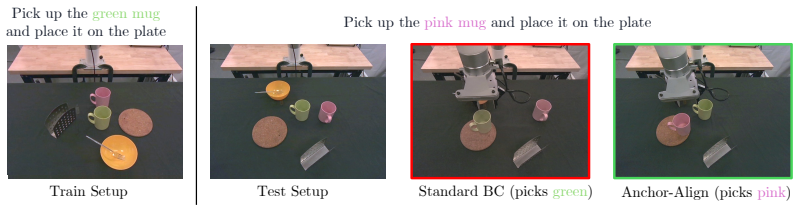
- If the mechanism is right, standard BC's out-of-distribution failures are not irreducible: position-swap success rises from 2.3% to 22.6% with no new data.
- Co-training on web image-text data is not the remedy for forgetting; the co-trained baseline scores near zero on position swap while anchoring retains roughly 70% of pretrained visual-reasoning accuracy.
- Preserving pretrained representations and learning control are compatible, not opposed; the method reaches the highest action decodability while sustaining high language preservation.
- Language-action alignment is causally tied to success: shuffled or meaningless direction labels collapse to baseline, and per-rollout alignment correlates positively with task success.
- The recipe transfers across architectures and action heads: both a regression head and a flow-matching diffusion head show large real-robot gains.
Where Pith is reading between the lines
- Editorial inference: the same two mechanisms suggest a general recipe for any VLM-to-policy adaptation—anchor the backbone to its pretrained copy and co-supervise the language channel with action-derived labels; this could be tested on other robot embodiments and other foundation models.
- Editorial inference: because the paper never sweeps the anchoring weight, the claim that 0.1 is the right balance between preservation and adaptation is untested; a sweep would reveal whether the gains are a narrow tuning artifact or a broad plateau.
- Editorial inference: the six-word vocabulary is coarse by construction; a finer discretization, or continuous language supervision, could either strengthen grounding or over-regularize control, and the paper's own diagnostic framework makes that question directly measurable.
- Editorial inference: the alignment measure itself—frame-level agreement between language and discretized action—could serve as a cheap training-time proxy for out-of-distribution generalization in future VLA work.
Editorial analysis
A structured set of objections, weighed in public.
Referee Report
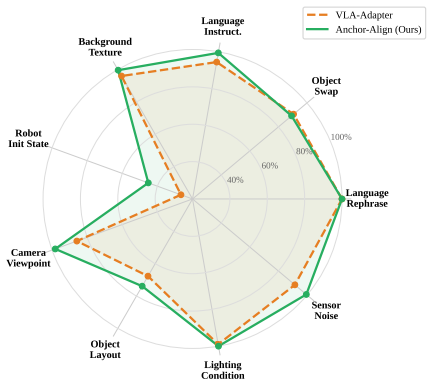
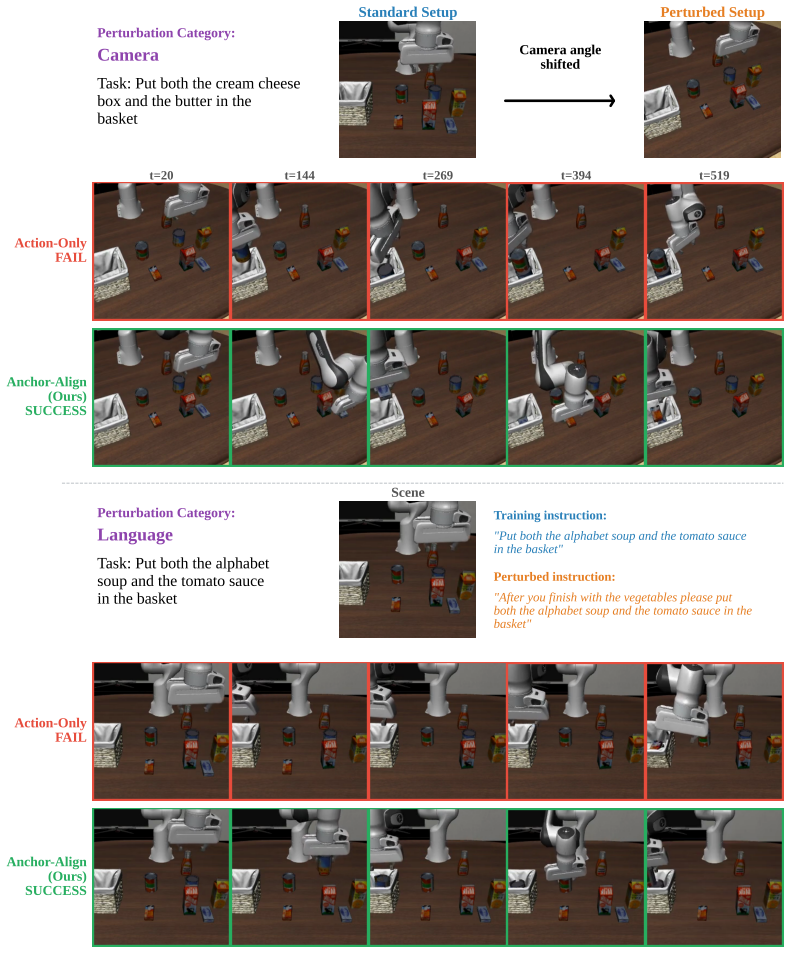
Summary. The paper proposes Anchor-Align, a VLA finetuning recipe that adds two objectives to the standard behavior-cloning loss: (1) Vision-Language Anchoring, a layer-wise distillation of backbone hidden states from a frozen copy of the pretrained VLM, and (2) Language-Action Alignment, a cross-entropy loss that supervises a language-head prediction of a six-way motion-direction label derived programmatically from the continuous action chunk on the same observation. The method is evaluated on LIBERO-PRO, LIBERO-Plus, CALVIN ABC→D, and a physical xArm7 platform, using VLA-Adapter and StarVLA backbones. The central claim is that preserving and aligning pretrained VLM representations during action finetuning improves OOD spatial generalization, perceptual robustness, long-horizon control, and real-robot success without extra data or annotation.
Significance. If the claims hold, this is a practically valuable result: a simple, low-overhead finetuning recipe that improves VLA generalization on multiple external benchmarks and two real-robot action-head architectures. The paper has several genuine strengths: the Shuffle and Scatter controls in Table 4 go beyond typical auxiliary-loss ablations and directly address the 'any auxiliary loss helps' alternative; Appendix C.3 provides five-seed means for the main method and its closest baseline on key axes; the real-robot experiments cover two architecturally distinct backbones; and the training-cost comparison in Table 6 shows the method is cheap relative to co-training. The central idea—that a frozen-teacher distillation loss plus a coarse language-action consistency loss can mitigate catastrophic forgetting without blocking action learning—is plausible and well motivated. However, the evidence for the specific operating point is incomplete: the two loss weights and the stationarity threshold are fixed without a sensitivity analysis, and the language-action alignment diagnostic in Section 4.5 reuses the exact discretization used to generate the training labels, which weakens the mechanistic i
major comments (3)
- [§3.2–3.3, Eqs. (1)–(5), App. B.2] The three hyperparameters λ_anchor=0.1, λ_align=0.02, and τ=0.15 are fixed and no sensitivity study is reported. This matters because L_anchor in Eq. (2) is a sum of per-layer squared Frobenius norms over N×d entries, where N is the number of vision and text tokens; the gradient scale of L_anchor relative to L_action is therefore not set by λ_anchor alone and can vary with sequence length and vision-patch count. The frozen-backbone comparison (43.1% on LIBERO-PRO) brackets the extreme end of the preservation–plasticity trade-off but does not show how close λ_anchor=0.1 is to a stability cliff. I request a sweep over λ_anchor (e.g., 0.01–1), λ_align, and τ on at least LIBERO-PRO position-swap/object-swap and LIBERO-Plus, together with reported gradient norms of the two auxiliary losses relative to the action loss.
- [§4.5, Table 5] The alignment diagnostic uses the same dominant-axis discretization and the same six-word vocabulary that generate the L_align training labels in Sec. 3.3. Comparing the language head's prediction with the policy action discretized into that same label space risks measuring the model's ability to reproduce a training label rather than an independent behavioral consistency. The strong Pearson correlation (r=0.51) between per-rollout alignment and success is interesting, but it should be validated with held-out annotations or a different label axis (e.g., orientation or grasp labels not used during training). At minimum, the paper should state and discuss this circularity explicitly and show alignment on rollouts where the discretization was not used to supervise L_align.
- [Tables 1–2 and Fig. 7] Several headline results are reported from single seeds or from a small number of rollouts. Appendix C.3 gives five-seed means only for Anchor-Align and VLA-Adapter on selected LIBERO axes, not for all baselines in Table 1, and Table 2 (CALVIN) is single-seed. The real-world results in Fig. 7 are based on 20 rollouts per condition, with no confidence intervals or per-condition significance tests. Given the paper's claim of 'consistent improvements' across all benchmarks, I ask for multi-seed results or confidence intervals at least for the central Anchor-Align vs. VLA-Adapter comparison, and for the CALVIN and real-robot headline numbers.
minor comments (5)
- [App. C.3] The text refers to 'the main paper's Tab. 7', but Table 7 is in the appendix; renumber or re-reference. Also, the text says 'mean and variance' while Table 8 reports mean ± standard deviation.
- [Eq. (2)] The notation H_S^u[m] and H_A^u[m] should clarify whether the norm is averaged over unmasked token positions or over all N positions, and whether padding or mask-dependent token counts affect the scale of L_anchor.
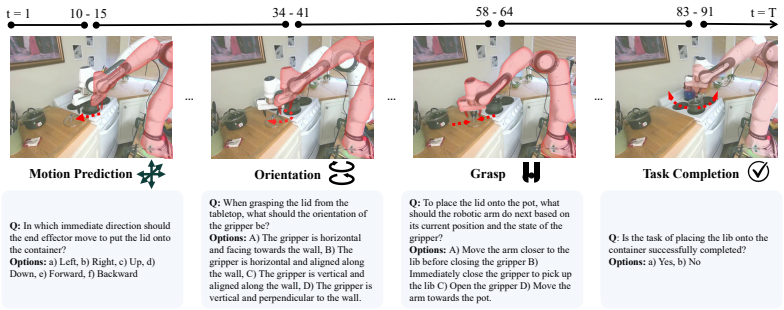
- [Fig. 16 and App. E.2] There are typographical artifacts: 'lib' appears instead of 'lid' and several Unicode soft-hyphen sequences appear as 'uni00A0' in the appendix figures and text.
- [Sec. 3.3] The tie-breaking rule in the direction discretization (x > y > z) is stated only in the appendix, but it is part of the method definition and should appear in the main text or be referenced clearly.
- [Sec. 4.4] Fig. 7 labels the mean with '(± SE)', but no error bars are shown; either add error bars or remove the parenthetical claim.
Circularity Check
Benchmark gains are independent, but two internal diagnostics are defined by the same labels/representations the training losses optimize.
specific steps
-
self definitional
[Sec. 3.3 (Eq. 5) and Sec. 4.5]
"we programmatically convert the continuous action target acont into a motion-direction label alang ... and use this label to supervise the VLM backbone. ... We measure this misalignment by extending the programmatic framework of Sec. 3.3, which converts robot demonstrations into language labels, into a diagnostic tool: at each timestep, we compare the model's language prediction with its discretized policy action."
The L_align objective in Eq. (5) is CE(âlang, alang), where alang is produced by the dominant-axis discretization in Sec. 3.3. The Sec. 4.5 'alignment' metric is the agreement between the language head and the same discretized action label. For Anchor-Align, the language head is directly trained to output alang, and the action head is trained by BC on the same ground-truth actions from which alang is derived. Thus the reported 78.4% alignment is substantially a check that the model reproduces its own training labels, not an independent measurement of cross-head consistency. The diagnostic is informative for co-trained baselines that never saw these labels, but the Anchor-Align number is forced by construction.
-
self definitional
[App. D.3 and Eq. (2)]
"Language preservation, measured with Centered Kernel Alignment (CKA) between the finetuned backbone's text-token hidden states and the pretrained VLM's. ... The per-layer anchoring loss is L_anchor^(u) = ||H_S_u[m] - H_A_u[m]||_F^2."
L_anchor directly minimizes the squared Frobenius distance between the trainable backbone's hidden states and the frozen pretrained VLM's hidden states at every decoder layer. CKA measures geometric similarity between the same two sets of hidden states. Anchor-Align's high CKA (0.91 overall, 0.95 average) is therefore a direct consequence of optimizing the anchoring objective, not an emergent property. The paper's non-circular evidence for preservation is the behavioral GQA curve in Fig. 9, which is measured on an external benchmark; the CKA diagnostic itself is self-definitional.
full rationale
The central claims—LIBERO-PRO/LIBERO-Plus success, CALVIN long-horizon completion, and real-robot gains—are measured on external benchmarks and are not defined by the training losses, so the main derivation is independent. The circularity is confined to two internal diagnostics: the language-action alignment metric reuses the exact discretization/label pipeline that generates L_align, and the CKA language-preservation metric measures the same hidden-state distance that L_anchor explicitly minimizes. These make the reported alignment and CKA numbers partially checks that the model fits its own training targets rather than independent discoveries. The GQA curve and the Shuffle/Scatter controls provide some non-circular support. Self-citations are present but are background/related-work citations and are not load-bearing premises. Weighing the self-referential diagnostics against the independent benchmark results, a score of 4 is appropriate.
Axiom & Free-Parameter Ledger
free parameters (5)
- lambda_anchor =
0.1
- lambda_align =
0.02
- tau (stationarity threshold) =
0.15
- direction label set =
six words: left, right, up, down, forward, backward
- LoRA rank/alpha =
r=64, alpha=128
axioms (6)
- domain assumption Pretrained Qwen2.5-0.5B contains transferable visuospatial and semantic priors.
- domain assumption Layer-wise feature matching to a frozen copy preserves representations without blocking adaptation.
- domain assumption Dominant-axis discretization of action chunks into six direction words is valid supervision.
- domain assumption Frozen LM head remains a good classifier for direction words after LoRA finetuning.
- domain assumption Benchmark OOD perturbations in LIBERO-PRO/Plus/CALVIN are representative of real-world generalization.
- ad hoc to paper Language-action alignment measured by comparing language and discretized action heads reflects meaningful behavioral consistency.
read the original abstract
Finetuning a pretrained vision-language model (VLM) on robot demonstrations via behavior cloning (BC) has become the standard recipe for vision-language-action (VLA) policies. However, BC finetuning progressively overwrites the pretrained representations that support visual and semantic generalization. Co-training on web image-text data, a common remedy, does not prevent this; it applies language and action losses to separate observations, leaving VLAs with language-action misalignment that standard manipulation benchmarks do not expose. We propose Anchor-Align, which augments BC with two objectives: Vision-Language Anchoring distills layer-wise representations from a frozen VLM copy to prevent this drift, while Language-Action Alignment converts each action target into a discrete motion-direction label and jointly trains language and action prediction on the same robot observation. On a physical xArm7 robot, across two widely used VLA architectures, Anchor-Align improves real-robot success on both (28% to 54% and 37% to 60%). At scale in simulation, we demonstrate consistent improvements on OOD perturbations, perceptual robustness, and long-horizon control across LIBERO-PRO, LIBERO-Plus, and CALVIN, respectively, suggesting that preserving pretrained representations and effective action learning are not fundamentally at odds. Project page: anchoralignvla.github.io
Figures








Reference graph
Works this paper leans on
-
[1]
S. Bahl, R. Mendonca, L. Chen, U. Jain, and D. Pathak. Affordances from Human Videos as a Versatile Representation for Robotics. InConference on Computer Vision and Pattern Recognition, 2023
2023
-
[2]
S. Bai, K. Chen, X. Liu, J. Wang, W. Ge, S. Song, K. Dang, et al. Qwen2.5-VL Technical Report.arXiv preprint arXiv:2502.13923, 2025
Pith/arXiv arXiv 2025
-
[3]
J. Bjorck, F. Casta ˜neda, N. Cherniadev, X. Da, R. Ding, L. Fan, et al. GR00T N1: An Open Foundation Model for Generalist Humanoid Robots.arXiv preprint arXiv:2503.14734, 2025
Pith/arXiv arXiv 2025
-
[4]
Black, N
K. Black, N. Brown, D. Driess, A. Esmail, M. Equi, C. Finn, et al.π 0: A Vision-Language- Action Flow Model for General Robot Control. InRobotics: Science and Systems, 2025
2025
-
[5]
Y . Bo, A. Soni, S. Srivastava, and M. Khosla. Evaluating representational similarity measures from the lens of functional correspondence.arXiv preprint arXiv:2411.14633, 2024
arXiv 2024
-
[6]
A. Brohan, N. Brown, J. Carbajal, Y . Chebotar, J. Dabis, C. Finn, K. Gopalakrishnan, K. Haus- man, A. Herzog, J. Hsu, et al. Rt-1: Robotics transformer for real-world control at scale.arXiv preprint arXiv:2212.06817, 2022
Pith/arXiv arXiv 2022
-
[7]
Q. Bu, H. Li, L. Chen, et al. Towards Synergistic, Generalized, and Efficient Dual-System for Robotic Manipulation.arXiv preprint arXiv:2410.08001, 2024
Pith/arXiv arXiv 2024
-
[8]
Q. Bu, Y . Yang, J. Cai, S. Gao, G. Ren, M. Yao, P. Luo, and H. Li. Univla: Learning to act anywhere with task-centric latent actions.arXiv preprint arXiv:2505.06111, 2025
Pith/arXiv arXiv 2025
-
[9]
Cadene, S
R. Cadene, S. Alibert, A. Soare, Q. Gallouedec, A. Zouitine, S. Palma, P. Kooijmans, M. Ar- actingi, M. Shukor, D. Aubakirova, M. Russi, F. Capuano, C. Pascal, J. Choghari, J. Moss, and T. Wolf. LeRobot: State-of-the-art Machine Learning for Real-World Robotics in Pytorch. https://github.com/huggingface/lerobot, 2024
2024
-
[10]
K. Chen, S. Xie, Z. Ma, P. R. Sanketi, and K. Goldberg. Robo2vlm: Visual question answering from large-scale in-the-wild robot manipulation datasets.arXiv preprint arXiv:2505.15517, 2025
Pith/arXiv arXiv 2025
-
[11]
C. Chi, Z. Xu, S. Feng, E. Cousineau, Y . Du, B. Burchfiel, R. Tedrake, and S. Song. Diffusion policy: Visuomotor policy learning via action diffusion.Int. J. Robot. Res., 2023
2023
-
[12]
C. Cui, P. Ding, W. Song, et al. OpenHelix: A Short Survey, Empirical Analysis, and Open- Source Dual-System VLA Model for Robotic Manipulation.arXiv preprint arXiv:2505.03912, 2025. 12
Pith/arXiv arXiv 2025
- [13]
-
[14]
D. Dalal, G. Vashishtha, U. Mishra, J. Kim, M. Kanda, H. Ha, S. Lazebnik, H. Ji, and U. Jain. Constructive Distortion: Improving MLLMs with Attention-Guided Image Warping.arXiv preprint arXiv:2510.09741, 2025
Pith/arXiv arXiv 2025
-
[15]
D. Dalal, M. Kanda, Z. Wang, H. Ji, and U. Jain. Compositional Reasoning via Joint Im- age and Language Decomposition. In V . Demberg, K. Inui, and L. Marquez, editors,Find- ings of the Association for Computational Linguistics: EACL 2026, pages 5753–5775, Ra- bat, Morocco, Mar. 2026. Association for Computational Linguistics. ISBN 979-8-89176- 386-9. doi...
-
[16]
A. Das, S. Datta, G. Gkioxari, S. Lee, D. Parikh, and D. Batra. Embodied question answering. InProceedings of the IEEE conference on computer vision and pattern recognition, pages 1–10, 2018
2018
-
[17]
Dasari, M
S. Dasari, M. K. Srirama, U. Jain, and A. Gupta. An Unbiased Look at Datasets for Visuo- Motor Pre-Training. InConference on Robot Learning, pages 1183–1198, 2023
2023
-
[18]
R. Doshi, H. Walke, O. Mees, S. Dasari, and S. Levine. Scaling cross-embodied learn- ing: One policy for manipulation, navigation, locomotion and aviation.arXiv preprint arXiv:2408.11812, 2024
Pith/arXiv arXiv 2024
-
[19]
Douillard, M
A. Douillard, M. Cord, C. Ollion, T. Robert, and E. Valle. PODNet: Pooled Outputs Distillation for Small-Tasks Incremental Learning. InEuropean Conference on Computer Vision, 2020
2020
-
[20]
D. Driess, F. Xia, M. S. Sajjadi, C. Lynch, A. Chowdhery, B. Ichter, A. Wahid, J. Tompson, Q. Vuong, T. Yu, et al. Palm-e: An embodied multimodal language model.arXiv preprint arXiv:2303.03378, 2023
Pith/arXiv arXiv 2023
-
[21]
D. Driess, J. T. Springenberg, B. Ichter, L. Yu, A. Li-Bell, K. Pertsch, A. Z. Ren, H. Walke, Q. Vuong, L. X. Shi, et al. Knowledge insulating vision-language-action models: Train fast, run fast, generalize better.arXiv preprint arXiv:2505.23705, 2025
Pith/arXiv arXiv 2025
-
[22]
S. Fei, S. Wang, J. Shi, Z. Dai, J. Cai, P. Qian, L. Ji, X. He, S. Zhang, Z. Fei, J. Fu, J. Gong, and X. Qiu. LIBERO-Plus: In-depth Robustness Analysis of Vision-Language-Action Models. arXiv preprint arXiv:2510.13626, 2025
Pith/arXiv arXiv 2025
-
[23]
Florence, C
P. Florence, C. Lynch, A. Zeng, O. A. Ramirez, A. Wahid, L. Downs, A. Wong, J. Lee, I. Mor- datch, and J. Tompson. Implicit behavioral cloning. InConference on Robot Learning, pages 158–168. PMLR, 2022
2022
-
[24]
Q. Gao, X. Pi, K. Liu, J. Chen, R. Yang, X. Huang, X. Fang, L. Sun, G. Kishore, B. Ai, et al. Do vision-language models have internal world models? towards an atomic evaluation.arXiv preprint arXiv:2506.21876, 2025
Pith/arXiv arXiv 2025
- [25]
-
[26]
Gretton, O
A. Gretton, O. Bousquet, A. Smola, and B. Sch ¨olkopf. Measuring Statistical Dependence with Hilbert–Schmidt Norms. InInt. Conf. Algorithmic Learn. Theory, pages 63–77. Springer, 2005
2005
- [27]
-
[28]
G. Hinton, O. Vinyals, and J. Dean. Distilling the Knowledge in a Neural Network.arXiv preprint arXiv:1503.02531, 2015
Pith/arXiv arXiv 2015
-
[29]
E. J. Hu, Y . Shen, P. Wallis, Z. Allen-Zhu, Y . Li, S. Wang, L. Wang, and W. Chen. LoRA: Low-Rank Adaptation of Large Language Models. InICLR, 2022
2022
- [30]
-
[31]
D. A. Hudson and C. D. Manning. Gqa: A new dataset for real-world visual reasoning and compositional question answering. InProceedings of the IEEE/CVF conference on computer vision and pattern recognition, pages 6700–6709, 2019
2019
-
[32]
J. Jang, S. Ye, Z. Lin, J. Xiang, J. Bjorck, Y . Fang, F. Hu, S. Huang, K. Kundalia, Y .-C. Lin, L. Magne, A. Mandlekar, A. Narayan, Y . L. Tan, G. Wang, J. Wang, Q. Wang, Y . Xu, X. Zeng, K. Zheng, R. Zheng, M.-Y . Liu, L. Zettlemoyer, D. Fox, J. Kautz, S. Reed, Y . Zhu, and L. Fan. DreamGen: Unlocking generalization in robot learning through video world...
Pith/arXiv arXiv 2025
-
[33]
X. Jiao, Y . Yin, L. Shang, X. Jiang, X. Chen, L. Li, F. Wang, and Q. Liu. TinyBERT: Distilling BERT for Natural Language Understanding. InFindings of the Association for Computational Linguistics: EMNLP 2020, 2020
2020
-
[34]
N. Kachaev, M. Kolosov, D. Zelezetsky, A. K. Kovalev, and A. I. Panov. Don’t Blind Your VLA: Aligning Visual Representations for OOD Generalization.arXiv preprint arXiv:2510.25616, 2025
arXiv 2025
-
[35]
Karamcheti, S
S. Karamcheti, S. Nair, A. Balakrishna, P. Liang, T. Kollar, and D. Sadigh. Prismatic VLMs: Investigating the Design Space of Visually-Conditioned Language Models. InInternational Conference on Machine Learning, 2024
2024
-
[36]
M. Kim, K. Pertsch, S. Karamcheti, T. Xiao, A. Balakrishna, S. Nair, R. Rafailov, E. Fos- ter, G. Lam, P. Sanketi, Q. Vuong, T. Kollar, B. Burchfiel, R. Tedrake, D. Sadigh, S. Levine, P. Liang, and C. Finn. OpenVLA: An Open-Source Vision-Language-Action Model. InCon- ference on Robot Learning, 2024
2024
-
[37]
M. Kim, C. Finn, and P. Liang. Fine-tuning vision-language-action models: Optimizing speed and success.arXiv preprint arXiv:2502.19645, 2025
Pith/arXiv arXiv 2025
-
[38]
Kirkpatrick, R
J. Kirkpatrick, R. Pascanu, N. Rabinowitz, J. Veness, G. Desjardins, A. A. Rusu, K. Milan, J. Quan, T. Ramalho, A. Grabska-Barwinska, et al. Overcoming Catastrophic Forgetting in Neural Networks.Proceedings of the National Academy of Sciences, 114(13):3521–3526, 2017
2017
-
[39]
Kornblith, M
S. Kornblith, M. Norouzi, H. Lee, and G. Hinton. Similarity of Neural Network Representa- tions Revisited. InInt. Conf. Mach. Learn., pages 3519–3529, 2019
2019
-
[40]
J. Lee, J. Duan, H. Fang, Y . Deng, S. Liu, B. Li, B. Fang, J. Zhang, Y . R. Wang, S. Lee, et al. Molmoact: Action reasoning models that can reason in space.arXiv preprint arXiv:2508.07917, 2025
Pith/arXiv arXiv 2025
-
[41]
Li and D
Z. Li and D. Hoiem. Learning without Forgetting.IEEE Transactions on Pattern Analysis and Machine Intelligence, 40(12):2935–2947, 2017
2017
-
[42]
X. Li, Y . Grandvalet, and F. Davoine. Explicit Inductive Bias for Transfer Learning with Convolutional Networks. InInternational Conference on Machine Learning, 2018. 14
2018
-
[43]
X. Li, M. Liu, H. Zhang, C. Yu, J. Xu, H. Wu, C. Cheang, Y . Jing, W. Zhang, H. Liu, et al. Vision-language foundation models as effective robot imitators.arXiv preprint arXiv:2311.01378, 2023
Pith/arXiv arXiv 2023
-
[44]
X. Li, M. Liu, H. Zhang, C. Yu, J. Xu, H. Wu, C. Cheang, Y . Jing, W. Zhang, H. Liu, H. Li, and T. Kong. Vision-Language Foundation Models as Effective Robot Imitators. InICLR, 2024
2024
-
[45]
S. Li, Y . Gao, D. Sadigh, and S. Song. Unified Video Action Model.arXiv preprint arXiv:2503.00200, 2025
Pith/arXiv arXiv 2025
-
[46]
L. Liebel and M. K ¨orner. Auxiliary tasks in multi-task learning.arXiv preprint arXiv:1805.06334, 2018
Pith/arXiv arXiv 2018
-
[47]
T.-Y . Lin, M. Maire, S. Belongie, J. Hays, P. Perona, D. Ramanan, P. Doll´ar, and C. L. Zitnick. Microsoft coco: Common objects in context. InEuropean conference on computer vision, pages 740–755. Springer, 2014
2014
-
[48]
B. Liu, Y . Zhu, C. Gao, Y . Feng, Q. Liu, Y . Zhu, and P. Stone. LIBERO: Benchmarking Knowledge Transfer for Lifelong Robot Learning. InNeurIPS, 2023
2023
-
[49]
F. Liu, G. Emerson, and N. Collier. Visual Spatial Reasoning.Transactions of the Association for Computational Linguistics, 11, 2023
2023
-
[50]
Majumdar, A
A. Majumdar, A. Ajay, X. Zhang, P. Putta, S. Yenamandra, M. Henaff, S. Silwal, P. Mcvay, O. Maksymets, S. Arnaud, et al. Openeqa: Embodied question answering in the era of foun- dation models. InProceedings of the IEEE/CVF conference on computer vision and pattern recognition, pages 16488–16498, 2024
2024
-
[51]
Mukhoti, Y
J. Mukhoti, Y . Gal, P. H. S. Torr, and P. K. Dokania. Fine-tuning can cripple your foundation model; preserving features may be the solution.Transactions on Machine Learning Research, 2024
2024
-
[52]
S. Nair, A. Rajeswaran, V . Kumar, C. Finn, and A. Gupta. R3M: A universal visual represen- tation for robot manipulation. InConference on Robot Learning, 2022
2022
-
[53]
O’Neill, A
A. O’Neill, A. Rehman, A. Maddukuri, A. Gupta, A. Padalkar, A. Lee, A. Pooley, A. Gupta, A. Mandlekar, A. Jain, et al. Open x-embodiment: Robotic learning datasets and rt-x models: Open x-embodiment collaboration 0. In2024 IEEE International Conference on Robotics and Automation (ICRA), pages 6892–6903. IEEE, 2024
2024
-
[54]
Oquab, T
M. Oquab, T. Darcet, T. Moutakanni, H. V o, M. Szafraniec, V . Khalidov, P. Fernandez, D. Haz- iza, F. Massa, A. El-Nouby, et al. Dinov2: Learning robust visual features without supervision. Transactions on Machine Learning Research, 2024
2024
-
[55]
K. Pertsch, K. Stachowicz, B. Ichter, D. Driess, S. Nair, Q. Vuong, O. Mees, C. Finn, and S. Levine. FAST: Efficient action tokenization for vision-language-action models.arXiv preprint arXiv:2501.09747, 2025
Pith/arXiv arXiv 2025
-
[56]
D. Qu, H. Song, Q. Chen, Z. Chen, X. Gao, X. Ye, Q. Lv, M. Shi, G. Ren, C. Ruan, et al. EO- 1: An Open Unified Embodied Foundation Model for General Robot Control.arXiv preprint arXiv:2508.21112, 2025
arXiv 2025
-
[57]
D. Qu, H. Song, Q. Chen, Y . Yao, X. Ye, Y . Ding, Z. Wang, J. Gu, B. Zhao, D. Wang, et al. Spatialvla: Exploring spatial representations for visual-language-action model.arXiv preprint arXiv:2501.15830, 2025
Pith/arXiv arXiv 2025
-
[58]
Radosavovic, B
I. Radosavovic, B. Shi, L. Fu, K. Goldberg, T. Darrell, and J. Malik. Robot Learning with Sensorimotor Pre-training. InConference on Robot Learning, pages 683–693, 2023. 15
2023
-
[59]
Radosavovic, T
I. Radosavovic, T. Xiao, S. James, P. Abbeel, J. Malik, and T. Darrell. Real-World Robot Learning with Masked Visual Pre-training. InConference on Robot Learning, pages 416–426, 2023
2023
-
[60]
S. Ramos, S. Girgin, L. Hussenot, D. Vincent, H. Yakubovich, D. Toyama, A. Gergely, P. Stanczyk, R. Marinier, J. Harmsen, et al. Rlds: an ecosystem to generate, share and use datasets in reinforcement learning.arXiv preprint arXiv:2111.02767, 2021
Pith/arXiv arXiv 2021
-
[61]
S. Reed, K. Zolna, E. Parisotto, S. G. Colmenarejo, A. Novikov, G. Barth-Maron, M. Gimenez, Y . Sulsky, J. Kay, J. T. Springenberg, et al. A generalist agent.arXiv preprint arXiv:2205.06175, 2022
Pith/arXiv arXiv 2022
-
[62]
Reuss, J
M. Reuss, J. Pari, P. Agrawal, and R. Lioutikov. Efficient Diffusion Transformer Policies with Mixture of Expert Denoisers for Multitask Learning. InICLR, 2025
2025
-
[63]
Rigter, T
M. Rigter, T. Gupta, A. Hilmkil, and C. Ma. A VID: Adapting video diffusion models to world models. InInternational Conference on Learning Representations, 2025
2025
-
[64]
Romero, N
A. Romero, N. Ballas, S. E. Kahou, A. Chassang, C. Gatta, and Y . Bengio. FitNets: Hints for Thin Deep Nets. InInternational Conference on Learning Representations, 2015
2015
-
[65]
S. Routray, H. Pan, U. Jain, S. Bahl, and D. Pathak. ViPRA: Video prediction for robot actions. arXiv preprint arXiv:2511.07732, 2025
arXiv 2025
-
[66]
M. Shukor, D. Aubakirova, F. Capuano, P. Kooijmans, S. Palma, A. Zouitine, M. Aractingi, C. Pascal, M. Russi, and A. Marafioti. SmolVLA: A vision-language-action model for afford- able and efficient robotics.arXiv preprint arXiv:2506.01844, 2025
Pith/arXiv arXiv 2025
-
[67]
Singh, V
A. Singh, V . Natarajan, M. Shah, Y . Jiang, X. Chen, D. Batra, D. Parikh, and M. Rohrbach. Towards vqa models that can read. InProceedings of the IEEE/CVF conference on computer vision and pattern recognition, pages 8317–8326, 2019
2019
-
[68]
W. Song, Z. Zhou, H. Zhao, et al. ReconVLA: Reconstructive Vision-Language-Action Model as Effective Robot Perceiver.arXiv preprint arXiv:2508.10333, 2025
Pith/arXiv arXiv 2025
-
[69]
StarVLA Community. StarVLA: A Lego-like Codebase for Vision-Language-Action Model Developing.arXiv preprint arXiv:2604.05014, 2026
Pith/arXiv arXiv 2026
-
[70]
O. M. Team, D. Ghosh, H. Walke, K. Pertsch, K. Black, O. Mees, S. Dasari, J. Hejna, T. Kreiman, C. Xu, et al. Octo: An open-source generalist robot policy.arXiv preprint arXiv:2405.12213, 2024
Pith/arXiv arXiv 2024
-
[71]
L. Wang, X. Chen, J. Zhao, and K. He. Scaling Proprioceptive-Visual Learning with Hetero- geneous Pre-trained Transformers. InAdvances in Neural Information Processing Systems, 2024
2024
-
[72]
Y . Wang, P. Ding, L. Li, C. Cui, Z. Ge, X. Tong, W. Song, H. Zhao, W. Zhao, P. Hou, et al. Vla- adapter: An effective paradigm for tiny-scale vision-language-action model.arXiv preprint arXiv:2509.09372, 2025
arXiv 2025
-
[73]
J. Wen, Y . Zhu, J. Li, Z. Tang, C. Shen, and F. Feng. Dexvla: Vision-language model with plug-in diffusion expert for general robot control.arXiv preprint arXiv:2502.05855, 2025
Pith/arXiv arXiv 2025
-
[74]
P. Wu, Y . Shentu, Z. Yi, X. Lin, and P. Abbeel. Gello: A general, low-cost, and intuitive teleoperation framework for robot manipulators. In2024 IEEE/RSJ International Conference on Intelligent Robots and Systems (IROS), pages 12156–12163. IEEE, 2024. 16
2024
-
[75]
A. Yang, B. Yang, B. Zhang, B. Hui, B. Zheng, B. Yu, C. Li, D. Liu, F. Huang, H. Wei, H. Lin, J. Yang, J. Tu, J. Zhang, J. Yang, J. Yang, J. Zhou, J. Lin, K. Dang, K. Lu, K. Bao, K. Yang, L. Yu, M. Li, M. Xue, P. Zhang, Q. Zhu, R. Men, R. Lin, T. Li, T. Tang, T. Xia, X. Ren, X. Ren, Y . Fan, Y . Su, Y . Zhang, Y . Wan, Y . Liu, Z. Cui, Z. Zhang, Z. Qiu, e...
Pith/arXiv arXiv 2024
-
[76]
J. Yang, R. Tan, Q. Wu, R. Zheng, B. Peng, Y . Liang, Y . Gu, M. Cai, S. Ye, J. Jang, et al. Magma: A foundation model for multimodal ai agents. InProceedings of the Computer Vision and Pattern Recognition Conference, pages 14203–14214, 2025
2025
-
[77]
Y . Yue, Y . Wang, B. Kang, Y . Han, S. Wang, S. Song, J. Feng, and G. Huang. DeeR-VLA: Dynamic Inference of Multimodal Large Language Models for Efficient Robot Execution. In NeurIPS, 2024
2024
-
[78]
M. Zawalski, W. Chen, K. Pertsch, O. Mees, C. Finn, and S. Levine. Robotic control via embodied chain-of-thought reasoning.arXiv preprint arXiv:2407.08693, 2024
Pith/arXiv arXiv 2024
-
[79]
X. Zhai, B. Mustafa, A. Kolesnikov, and L. Beyer. Sigmoid loss for language image pre- training. InProceedings of the IEEE/CVF international conference on computer vision, pages 11975–11986, 2023
2023
-
[80]
X. Zhou, Y . Xu, G. Tie, Y . Chen, G. Zhang, D. Chu, P. Zhou, and L. Sun. LIBERO-PRO: To- wards Robust and Fair Evaluation of Vision-Language-Action Models Beyond Memorization. arXiv preprint arXiv:2510.03827, 2025
Pith/arXiv arXiv 2025
discussion (0)
Sign in with ORCID, Apple, or X to comment. Anyone can read and Pith papers without signing in.