REVIEW 3 major objections 6 minor 15 references
LENS: Learning Ensemble Confidence from Neural States for Multi-LLM Answer Integration
T0 review · 3 major / 6 minor · reviewed 2026-08-06 · deepseek-v4-flash
Pith's one-line read A per-model confidence probe trained on layer-by-layer answer probabilities beats voting across six QA datasets.
desk verdict A plausible but thinly-evidenced confidence-selection method for LLM ensembles; the headline 'substantial margin' claim is not supported by the reported numbers. read the letter →
The pith
A machine-rendered reading of the paper's core claim, the machinery that carries it, and where it could break.
The reading
What carries the argument
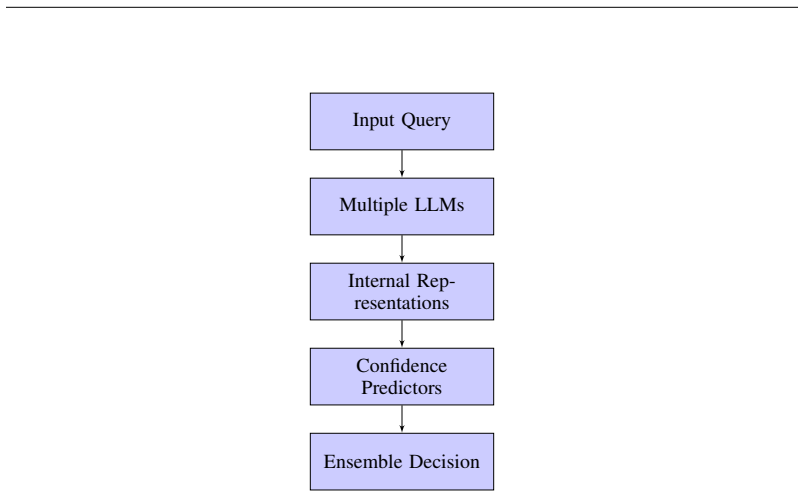
The logit lens: for each transformer layer $l$, the last-token hidden state $H_l$ is passed through LayerNorm and the model's language-modeling head, then softmaxed over the answer choices to give a probability distribution $p_l$. Concatenating these per-layer distributions forms a feature vector $f_i$ for each model $M_i$. A per-model linear probe $P_i(f_i) = \sigma(W_i f_i)$ is trained with binary cross-entropy on whether that model's prediction was correct, yielding a confidence score $c_i$; the final ensemble prediction is $\hat{y} = y_{\arg\max_i c_i}$. This mechanism transfers the burden from model-specific logits to learned, context-dependent confidence estimates that are comparable across architectures.
What would settle it
On fresh random splits of the same datasets, train the per-model linear probes on 250 sampled instances and evaluate on the held-out 250; if the model with the highest learned confidence is not correct more often than the model with the highest raw answer probability across repeated splits, the central claim that internal-state confidence improves ensemble decisions would be falsified.
Extended reading notes
Core claim
The paper's central claim is that a linear confidence predictor trained on layer-wise logit-lens probabilities can estimate a model's confidence in its own prediction well enough to drive ensemble decisions. For each model, the method applies the language-modeling head to every layer's last-token hidden state, softmaxes over the answer choices, concatenates those probability vectors, and trains a sigmoid-linear probe to predict whether the model's answer is correct. At test time, the ensemble simply takes the answer from the model with the highest predicted confidence. The paper reports that this max-confidence rule outperforms majority voting and probability-max baselines on most datasets, with Table 1 showing best accuracy on five of six tasks.
Load-bearing premise
The load-bearing premise is that applying the same kind of logit-lens transformation to each layer of five different large language models produces probability vectors that are comparable across architectures and informative about which model is actually correct; if those features are not comparable or not informative, the trained confidence probes cannot pick a better model than the probability-max baseline.
Editorial extensions
If this is right
- If the central claim holds, internal representations of LLMs can serve as a practical signal for ensemble selection without modifying the base models.
- The method adds only $O(L)$ trainable parameters per model, where $L$ is the number of layers, so it remains feasible even when the constituent models are large.
- The reported results suggest that learned confidence can outperform both majority voting and raw-probability selection on multiple-choice and boolean question-answering tasks.
- Because the confidence predictors are trained per model and per dataset, the approach can be applied to any set of decoder-only pretrained LLMs without task-specific fine-tuning.
Reading between the lines
- Beyond the paper: if confidence is learnable from internal states, a natural extension is to test whether a probe trained on one dataset transfers to another, which the authors list as future work and which would distinguish per-instance reliability from dataset-specific artifacts.
- Beyond the paper: since the features are probabilities over answer-choice tokens, the same pipeline could be adapted to open-ended generation by defining a small candidate set of tokens, creating a testable link between this method and calibration research.
- Beyond the paper: the paper only reports max-confidence selection, so a testable alternative is to use the learned confidences as weights in a soft ensemble; if confidence estimates are well-calibrated, weighted averaging should match or exceed the max rule.
Editorial analysis
A structured set of objections, weighed in public.
Referee Report
Summary. The paper proposes LENS, a method for ensembling decoder-only LLMs by training a lightweight per-model linear confidence predictor on layer-wise logit-lens probability vectors. At inference, the system selects the prediction of the model with the highest predicted confidence. The method is evaluated on six multiple-choice and boolean QA datasets with five open-weight LLMs, comparing against majority voting and probability-max selection. The abstract claims that LENS outperforms traditional ensemble methods by a substantial margin, and Table 1 reports the best accuracy on 5 of 6 datasets, with the paper concluding that internal representations are useful for confidence estimation and ensemble learning.
Significance. If the claimed gains are statistically real, LENS would be a simple and inexpensive contribution: it requires no fine-tuning of base models, adds only O(L) parameters per model, and makes use of otherwise discarded internal representations. The authors are transparent about their training protocol, use a held-out split for the confidence predictors, and describe the model selection procedure. However, the significance of the empirical contribution is currently limited by the small test sets (250 instances per dataset), the absence of any uncertainty quantification or paired significance testing, and the narrow baseline set. These issues are not merely cosmetic: they directly affect whether the abstract's 'substantial margin' claim is supported. The manuscript also contains an explicit self-acknowledged limitation in Section 5, which asks for 'rigorous empirical evaluations' in future work.
major comments (3)
- [§4.4, Table 1] The central claim of a 'substantial margin' over baselines is not supported by the reported numbers. With 250 test instances per dataset, the standard error of an accuracy estimate near 50% is roughly 3.1 percentage points, so the reported gains of 0.8–3.2 points on CoinFlip, PrOntoQA, SWAG, and MathQA are well within sampling noise. Only the BoolQ gain over Majority Vote and the ProofWriter gain over Probability Max exceed 5 points, and no confidence intervals, McNemar tests, bootstrap estimates, or repeated-split variance are provided. The manuscript itself concedes in Section 5 that 'future work could benefit from rigorous empirical evaluations.' To support the abstract's quantitative claim, the authors should add paired significance tests or bootstrap confidence intervals, and ideally report results over multiple random splits.
- [§3.2, Eqs. (1),(2)] The method assumes that applying the language-modeling head to every layer's last-token hidden state and softmaxing over answer choices yields probability vectors that are informative about correctness and comparable across five architectures with different tokenizers, hidden-state normalizations, and layer counts. This assumption is load-bearing for LENS because the confidence predictors are trained on these features, but the paper provides no diagnostic evidence for it. A minimal sanity check would be to report the correlation or AUROC of the per-layer probabilities (or the learned confidence scores) against correctness on the development set, or a calibration analysis for each model; without such evidence, the mechanism by which LENS could improve over probability-max is not established.
- [§4.3] The baseline set is too narrow to support the claim that LENS 'outperforms traditional ensemble methods by a substantial margin.' Majority voting and raw probability max are two simple aggregation rules, but they do not control for the effect of learning a selection rule on held-out data. The authors should add at least one learned baseline that operates on final-layer probabilities or logits (e.g., logistic regression or a small MLP on the probability vector), plus an oracle upper bound that always selects the correct model. This would clarify whether the gains come from internal features specifically or from any learned model-selection procedure.
minor comments (6)
- [§4.2] PrOntoQA is described as a dataset for 'pronoun resolution and contextual understanding,' but PrOntoQA is a proof-based ontology question-answering dataset; the description should be corrected.
- [§4.4] The sentence 'Train-validation split: 80%-20% of the training data' is ambiguous given the preceding description of 250 training and 250 test instances; please clarify whether the validation set is drawn from the 250 training instances and how the best checkpoint is selected.
- [§4.5, Table 1] The text says the Max Confidence method 'consistently outperforms or matches the baseline approaches,' but the ProofWriter row shows Max Confidence at 75.2, below Majority Vote at 75.3; this statement should be rephrased to acknowledge the one exception.
- [Title and author block] The title and author block contain formatting and typographical artifacts, including 'L EARNING', 'A NSWER INTE-GRATION', and an email address that appears as 'sjtu18640985163'; these should be proofread.
- [§2, related work] The citation 'de Caritat Mis et al. (1785)' is an unusual way to reference Condorcet's jury theorem; a standard modern citation would be more appropriate and helpful to readers.
- [§3.3, Eq. (5)] Equation (5) defines the binary cross-entropy loss for a scalar confidence score, but the paper does not discuss how the argmax selection in Eq. (6) behaves if two models receive exactly equal confidence scores; a tie-breaking rule should be stated.
Circularity Check
No circularity: LENS trains confidence predictors on held-out data and evaluates on a separate test split.
full rationale
Walking the derivation chain in Sections 3.2–3.4 and 4.4: the feature vector fi is extracted from each model's own logit-lens probabilities (Eqs. 1–3), the confidence predictor Pi is trained with binary cross-entropy against the indicator that Mi's prediction is correct on a held-out development split (Eq. 5), and the ensemble decision is argmax over predicted confidence (Eq. 6). The paper states: "The test set is used exclusively for final performance evaluation, while the training set (further split into train and validation) is used for confidence predictor training." Thus the confidence score is a fitted model trained to predict correctness, and the reported test accuracy is an out-of-sample evaluation; no equation defines the target in terms of the output, no fitted parameter is renamed as a prediction, and the logit-lens citation (nostalgebraist, 2020) is external and used only to motivate feature extraction, not to supply the paper's empirical claim. The possibility that the final-layer logit-lens probability is one of the features and is related to the Probability Max baseline is not circular: using predictive features in a supervised correctness classifier is standard, and the evaluation is on unseen data. The paper's admission that "future work could benefit from rigorous empirical evaluations" and the small test size without significance testing concern statistical support for the "substantial margin" headline, not circularity. No self-citations, imported uniqueness theorems, or ansatz-smuggling citations appear. Finding: no significant circularity; score 0.
Assumptions & free parameters
free parameters (2)
- W_i (linear confidence predictor weights) =
learned during training, dimension L*K per model
- Training hyperparameters (learning rate 1e-3, batch size 32, 200 epochs, 80/20 split) =
chosen by hand
assumptions (5)
- domain assumption Access to intermediate layer hidden states is available for each model
- domain assumption Logit lens probabilities over choice tokens are a meaningful confidence signal
- domain assumption Correctness on the 250-instance training split is a sufficient training signal for the confidence predictors
- domain assumption Datasets are representative and random sampling is unbiased
- standard math Standard supervised learning assumptions, including i.i.d. train/test splits
Cite this review
Pith. "Pith review of LENS: Learning Ensemble Confidence from Neural States for Multi-LLM Answer Integration." pith.science (2026). https://pith.science/paper/AAPVHBZW
@misc{pith2026250723167,
  author       = {Pith},
  title        = {Pith review of: LENS: Learning Ensemble Confidence from Neural States for Multi-LLM Answer Integration},
  year         = {2026},
  howpublished = {\url{https://pith.science/paper/AAPVHBZW}},
  note         = {Machine review of arXiv:2507.23167}
}
read the original abstract
Large Language Models (LLMs) have demonstrated impressive performance across various tasks, with different models excelling in distinct domains and specific abilities. Effectively combining the predictions of multiple LLMs is crucial for enhancing system robustness and performance. However, existing ensemble methods often rely on simple techniques like voting or logits ensembling, which overlook the varying confidence and reliability of models in different contexts. In this work, we propose LENS (Learning ENsemble confidence from Neural States), a novel approach that learns to estimate model confidence by analyzing internal representations. For each LLM, we train a lightweight linear confidence predictor that leverages layer-wise hidden states and normalized probabilities as inputs. This allows for more nuanced weighting of model predictions based on their context-dependent reliability. Our method does not require modifying the model parameters and requires negligible additional computation. Experimental results on multiple-choice and boolean question-answering tasks demonstrate that LENS outperforms traditional ensemble methods by a substantial margin. Our findings suggest that internal representations provide valuable signals for determining model confidence and can be effectively leveraged for ensemble learning.
Figures
Reference graph
Works this paper leans on
-
[1]
Josh Achiam, Steven Adler, Sandhini Agarwal, Lama Ahmad, Ilge Akkaya, Florencia Leoni Ale- man, Diogo Almeida, Janko Altenschmidt, Sam Altman, Shyamal Anadkat, et al. Gpt-4 technical report. arXiv preprint arXiv:2303.08774,
-
[4]
Discovering latent knowledge in lan- guage models without supervision
Collin Burns, Haotian Ye, Dan Klein, and Jacob Steinhardt. Discovering latent knowledge in lan- guage models without supervision. arXiv preprint arXiv:2212.03827,
-
[5]
Boolq: Exploring the surprising difficulty of natural yes/no questions
Christopher Clark, Kenton Lee, Ming-Wei Chang, Tom Kwiatkowski, Michael Collins, and Kristina Toutanova. Boolq: Exploring the surprising difficulty of natural yes/no questions. arXiv preprint arXiv:1905.10044,
arXiv 1905
-
[7]
Albert Q Jiang, Alexandre Sablayrolles, Arthur Mensch, Chris Bamford, Devendra Singh Chaplot, Diego de las Casas, Florian Bressand, Gianna Lengyel, Guillaume Lample, Lucile Saulnier, et al. Mistral 7b. arXiv preprint arXiv:2310.06825,
-
[10]
Proofwriter: Generating implications, proofs, and abductive statements over natural language
Oyvind Tafjord, Bhavana Dalvi Mishra, and Peter Clark. Proofwriter: Generating implications, proofs, and abductive statements over natural language. arXiv preprint arXiv:2012.13048,
arXiv 2012
-
[11]
Gemini: a family of highly capable multimodal models
Gemini Team, Rohan Anil, Sebastian Borgeaud, Jean-Baptiste Alayrac, Jiahui Yu, Radu Soricut, Johan Schalkwyk, Andrew M Dai, Anja Hauth, Katie Millican, et al. Gemini: a family of highly capable multimodal models. arXiv preprint arXiv:2312.11805,
-
[12]
Llama 2: Open founda- tion and fine-tuned chat models
Hugo Touvron, Louis Martin, Kevin Stone, Peter Albert, Amjad Almahairi, Yasmine Babaei, Niko- lay Bashlykov, Soumya Batra, Prajjwal Bhargava, Shruti Bhosale, et al. Llama 2: Open founda- tion and fine-tuned chat models. arXiv preprint arXiv:2307.09288,
-
[14]
Swag: A large-scale adversarial dataset for grounded commonsense inference
7 Rowan Zellers, Yonatan Bisk, Roy Schwartz, and Yejin Choi. Swag: A large-scale adversarial dataset for grounded commonsense inference. arXiv preprint arXiv:1808.05326,
Show all 15 references
-
[1785]
Llm multi-agent systems: Challenges and open problems
Shanshan Han, Qifan Zhang, Yuhang Yao, Weizhao Jin, Zhaozhuo Xu, and Chaoyang He. Llm multi-agent systems: Challenges and open problems. arXiv preprint arXiv:2402.03578,
-
[2018]
Representation engineering: A top-down approach to ai transparency
Andy Zou, Long Phan, Sarah Chen, James Campbell, Phillip Guo, Richard Ren, Alexander Pan, Xuwang Yin, Mantas Mazeika, Ann-Kathrin Dombrowski, et al. Representation engineering: A top-down approach to ai transparency. arXiv preprint arXiv:2310.01405,
-
[2020]
Abulhair Saparov and He He
URL https://www.alignmentforum.org/posts/AcKRB8wDpdaN6v6ru/ interpreting-gpt-the-logit-lens . Abulhair Saparov and He He. Language models are greedy reasoners: A systematic formal analysis of chain-of-thought. arXiv preprint arXiv:2210.01240,
-
[2021]
Self-consistency improves chain of thought reasoning in language models
Xuezhi Wang, Jason Wei, Dale Schuurmans, Quoc Le, Ed Chi, Sharan Narang, Aakanksha Chowdh- ery, and Denny Zhou. Self-consistency improves chain of thought reasoning in language models. arXiv preprint arXiv:2203.11171,
-
[2022]
Adaptive ensembles of fine-tuned transformers for llm-generated text detection
Zhixin Lai, Xuesheng Zhang, and Suiyao Chen. Adaptive ensembles of fine-tuned transformers for llm-generated text detection. arXiv preprint arXiv:2403.13335,
-
[2023]
Ensemw2s: Can an ensemble of llms be leveraged to obtain a stronger llm?arXiv preprint arXiv:2410.04571,
Aakriti Agrawal, Mucong Ding, Zora Che, Chenghao Deng, Anirudh Satheesh, John Langford, and Furong Huang. Ensemw2s: Can an ensemble of llms be leveraged to obtain a stronger llm?arXiv preprint arXiv:2410.04571,
-
[2024]
Mathqa: Towards interpretable math word problem solving with operation-based for- malisms
Aida Amini, Saadia Gabriel, Peter Lin, Rik Koncel-Kedziorski, Yejin Choi, and Hannaneh Ha- jishirzi. Mathqa: Towards interpretable math word problem solving with operation-based for- malisms. arXiv preprint arXiv:1905.13319,
1905 arXiv
Reviewed August 6, 2026 · model on record in the stance chip above.
Discussion (0). Sign in to comment.