REVIEW 3 major objections 5 minor 2 cited by
AD-GS: Object-Aware B-Spline Gaussian Splatting for Self-Supervised Autonomous Driving
T0 review · 3 major / 5 minor · reviewed 2026-08-06 · deepseek-v4-flash
Pith's one-line read AD-GS claims that an annotation-free model can render dynamic driving scenes as well as tracklet-supervised methods, reporting 29.16 PSNR on KITTI-75% and 33.91 PSNR on Waymo with a B-spline-plus-trigonometric motion model.
desk verdict A solid self-supervised driving-scene renderer with a genuinely novel motion basis, but the reported gains rest on a one-time pseudo-mask split that the paper leaves untested. read the letter →
The pith
A machine-rendered reading of the paper's core claim, the machinery that carries it, and where it could break.
The reading
What carries the argument
The load-bearing object is the learnable motion model for each dynamic Gaussian: a uniform B-spline curve for position, defined by learnable control points and evaluated through a precomputed matrix formulation, together with a B-spline quaternion curve for rotation, both added to trigonometric terms. A B-spline is a piecewise polynomial curve whose value at any time depends only on nearby control points, so optimizing a frame's motion updates only a few control points and gives local fitting, while the trigonometric terms provide global fitting that resists noise from pseudo labels. The second mechanism is the bidirectional temporal visibility mask, which multiplies an object Gaussian's opacity by a Gaussian in time centered at the LiDAR acquisition timestamp, with separate learnable widths for before and after, so that suddenly appearing or disappearing objects do not receive misleading gradients from frames where they are invisible.
What would settle it
A decisive check is to run the released model on a KITTI sequence after changing the object text prompt to a class that excludes the actual moving vehicles; if the pipeline still delivers near-29 PSNR on KITTI-75%, the object/background decomposition is not the source of the reported gains, whereas a sharp drop would confirm that the simplified pseudo segmentation is load-bearing.
Extended reading notes
Core claim
The paper's central discovery is that the two failure modes of self-supervised driving-scene rendering, noisy scene decomposition and inaccurate local motion, can be addressed together without any manual 3D supervision. AD-GS partitions all Gaussians into objects and background using a simplified pseudo 2D segmentation, keeps the background stationary, and deforms object Gaussians over time using learnable B-spline curves combined with trigonometric functions. Each object Gaussian also carries a bidirectional temporal visibility mask centered at the LiDAR acquisition timestamp, which lets the model ignore frames where the object is not actually visible. Combined with flow, inverse-depth, visibility, and rigidity supervision, the model reports state-of-the-art self-supervised results and competitive results against annotation-based systems on KITTI, Waymo, and nuScenes.
Load-bearing premise
The load-bearing premise is that the simplified pseudo 2D segmentation and the LiDAR acquisition timestamp correctly identify which Gaussians are dynamic and when each object is visible, so that the motion model and temporal visibility mask receive a correct separation of moving and static content.
Editorial extensions
If this is right
- A single driving log can be turned into a free-viewpoint, free-time rendering without any manual 3D tracklets, at speeds around 47 FPS on KITTI.
- Two-class decomposition into objects and background is enough to isolate motion while avoiding the noise of fine-grained instance segmentation.
- The combined B-spline and trigonometric motion model captures both global trajectory and local detail, improving PSNR over trigonometric-only rendering by about 2 dB on KITTI-75%.
- Bidirectional temporal visibility masks reduce artifacts when objects appear or disappear, preventing invisible frames from corrupting the motion fit.
- Even with only 25% of KITTI frames for training, the method still improves over self-supervised baselines, suggesting resilience to sparse supervision.
Reading between the lines
- A testable extension beyond the paper: the same two-class, text-prompted decomposition should transfer to other dynamic scene logs with small known sets of moving classes, but the paper only demonstrates urban driving.
- The use of the LiDAR acquisition timestamp as a fixed prompt for visibility turns sensor timing into a free supervisory signal; one could extend it to cameras with rolling shutters, where visibility time varies per row.
- Because the loss ablation shows segmentation guidance is the largest single lever, improving open-vocabulary segmentation quality should push the same architecture closer to or past annotation-dependent models without any change to the motion model.
- The local-fitting argument implies a specific prediction: on objects visible for only a handful of frames, AD-GS should degrade more gracefully than trigonometric-only models, which can be tested directly on very short-lived objects.
Editorial analysis
A structured set of objections, weighed in public.
Referee Report
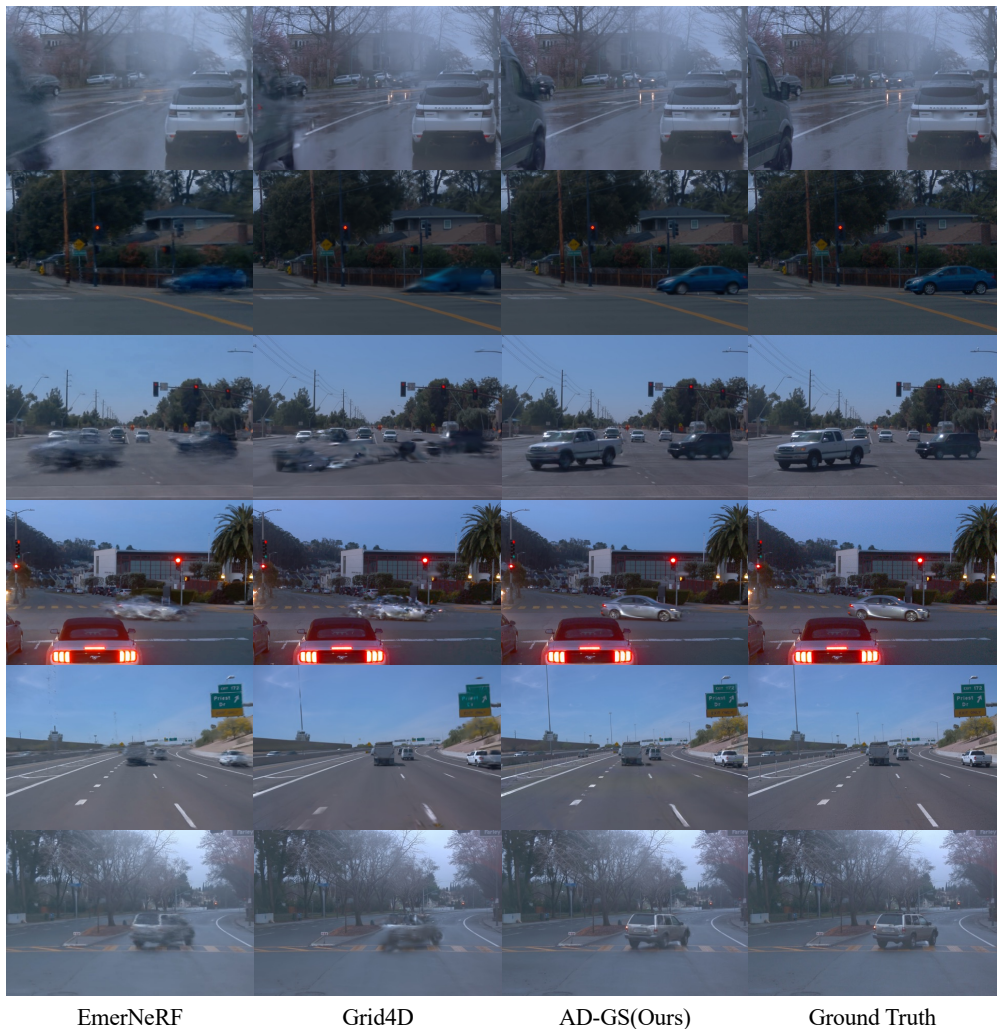
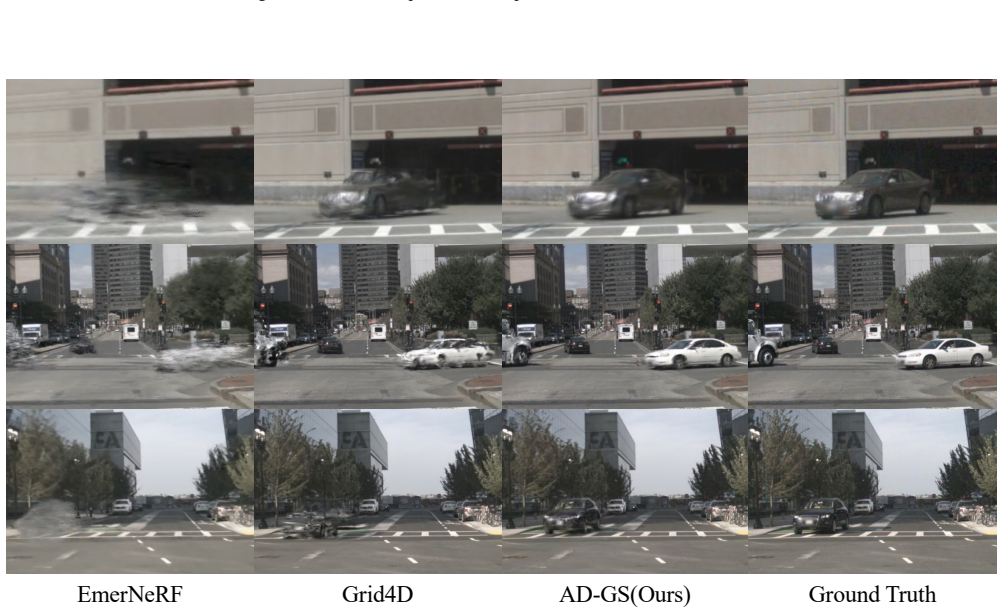
Summary. The paper proposes AD-GS, a Gaussian-splatting framework for dynamic urban scene rendering without manual 3D annotations. LiDAR-initialized Gaussians are partitioned once into object and background components using Grounded-SAM binary masks; object Gaussians are deformed by a combination of B-spline curves, B-spline quaternion curves, and trigonometric functions, and are gated by bidirectional temporal visibility masks; background Gaussians remain geometrically static. Training is self-supervised with image reconstruction, rendered object-mask supervision, optical-flow supervision, inverse-depth supervision, and regularization losses. Experiments on KITTI, Waymo, and nuScenes compare AD-GS with self-supervised baselines (SUDS, EmerNeRF, PVG, Grid4D) and annotation-assisted methods, reporting consistent improvements over the self-supervised baselines and near-parity with supervised StreetGS/4DGF on Waymo.
Significance. If the results hold, AD-GS is a meaningful step toward annotation-free dynamic driving-scene rendering: on KITTI-75% it reports PSNR 29.16 / SSIM 0.920 / LPIPS 0.033 versus PVG's 27.13 / 0.895 / 0.049, and on Waymo it reaches PSNR 33.91, close to StreetGS's 33.97, while remaining real-time. The paper is strong in evaluating on three public benchmarks with held-out frames, including ablations of each loss term and module, and it reports rendering speed. However, the central decomposition into object and background relies on a one-shot pseudo-mask partition whose robustness is not quantified, baseline hyperparameters are not fully controlled on nuScenes, and no error bars or per-sequence results are provided. These points do not invalidate the method but limit the strength of the current claims.
major comments (3)
- [Sec. 3.3 and Sec. A (Supplementary)] The object/background decomposition is decided once at initialization from Grounded-SAM binary masks and is never revised: the attribute-inheritance rule in Sec. A ensures that densified Gaussians keep their parent's label, and Lobj in Eq. (9) only adjusts opacity. Consequently, any dynamic object missed by the hand-written prompt list ('car.bus.truck.van.human', plus 'bike' on nuScenes) or by the mask/projection step is permanently static and is never deformed by Eq. (7). This is load-bearing because the motion model applies only to object Gaussians and the flow supervision in Sec. 3.4 is restricted to the object mask. The paper's own Sec. D acknowledges that low pseudo-label quality produces artifacts (Fig. 10), but no experiment measures how sensitive the reported margins over PVG/EmerNeRF are to this fixed split. Please add a quantitative sensitivity analysis, e.g., train with ground-truth object masks as an oracle, drop individual prompt classes, or corrupt/mask part of the segmentation, and report the resulting PSNR/SSIM/LPIPS on KITTI or Waymo.
- [Supplementary Sec. B (Baseline details)] PVG is evaluated on nuScenes with hyperparameters designed for Waymo, and EmerNeRF's hyperparameters are not described as tuned for nuScenes. Dynamic-scene Gaussian methods are sensitive to sampling densities, deformation network capacity, and opacity thresholds, so the nuScenes comparison in Table 3 is not fully controlled. Since the abstract claims significant improvement over state-of-the-art annotation-free methods, please retune both baselines on nuScenes, or supply a sensitivity analysis showing that the reported numbers are robust to hyperparameter choices, and report the settings used for every dataset.
- [Tables 1-3] The main tables report averages over sequences (3 KITTI logs, 8 Waymo logs, 6 nuScenes logs) without standard deviations or per-sequence numbers. This makes it impossible to judge whether the reported margins, e.g., PSNR 29.16 vs 27.13 on KITTI-75%, are consistent across logs or dominated by a single sequence. Please report per-sequence results and standard deviations for the main comparison tables so that the word 'significantly' in the abstract is supported statistically.
minor comments (5)
- [Sec. 3.3, Eq. (9)] The sentence 'Lobj makes the two Gaussian subsets stayed in their respective areas' is grammatically unclear; please rephrase to say that the loss encourages the subsets to remain in their assigned regions.
- [Abstract and Sec. 3.3] The abstract says the scene is 'automatically segmented', but the segmentation is driven by hand-written text prompts listed in Sec. A; this dependence should be acknowledged in the main text.
- [Conclusion / Supp. Sec. D] The limitations section is relegated to the supplementary material; given its importance for the one-shot segmentation assumption, consider moving a condensed version into the main paper.
- [Sec. 3.1 and Supp. Sec. A] The paper states background Gaussians 'remain stationary' while Eq. (3) deforms color features of all Gaussians; clarify that 'stationary' refers to position and rotation, not appearance.
- [General] No code is released; please include a statement about code availability or provide a reproducibility appendix with the exact training schedules and per-sequence settings.
Circularity Check
No significant circularity: AD-GS's rendering results are evaluated on held-out frames of public benchmarks, and the only self-citation (Grid4D) appears as a baseline and visualization convention, not as load-bearing evidence.
full rationale
The paper's central performance claim is external rather than circular: AD-GS is compared with baselines on held-out test frames of KITTI, Waymo, and nuScenes (Tables 1-3), so the reported PSNR/SSIM/LPIPS values are not produced by the training objective or by the fitted parameters being fed back as the answer. The B-spline-plus-trigonometric motion model (Eq. 7) and the temporal visibility mask (Eq. 10) are optimized on training frames and then evaluated at test timestamps; no equation in the manuscript reduces the test-set metric to a training loss. The object/background partition is a one-time initialization from external Grounded-SAM pseudo masks (Sec. 3.3 and Sec. A), and Lobj is a training loss that aligns the rendered mask to those same pseudo labels; this is a pseudo-label-supervised design choice, not a self-referential derivation, because the claimed novelty is rendering quality, not segmentation prediction. The paper's Section D limitations (artifacts under low pseudo-label quality, failures on briefly visible objects) and the Attribute Inheritance paragraph in Sec. A describe robustness boundaries of this choice, but they do not make the rendering result equivalent to its inputs. The only self-citation is Grid4D [34], which shares authors; it appears as a baseline ('We also include Grid4D [34], a state-of-the-art model for object-level dynamic scene rendering, as a baseline') and as a visualization convention ('we visualize the deformation map mainly following the approach in Grid4D [34]'). This citation is not load-bearing: removing it would not change the comparisons against PVG, EmerNeRF, StreetGS, or 4DGF, and it is not used to justify the motion model or the decomposition. No uniqueness theorem is imported, no fitted parameter is renamed as a prediction, and no ansatz is smuggled in via a self-citation. The score is therefore 2, reflecting only a minor non-load-bearing self-citation.
Assumptions & free parameters
free parameters (5)
- B-spline order k =
6
- Control point count (one per 3 frames) =
n+1 = total_frames/3
- Trigonometric frequency K, L =
6
- Loss weights lambda_c, lambda_d, lambda_f, lambda_obj, lambda_sky, lambda_r, lambda_s =
0.2, 0.1, 0.1, 0.1, 0.05, 0.5, 0.01
- Object class prompts for segmentation =
'car.bus.truck.van.human' (KITTI/Waymo) plus 'bike' (nuScenes)
assumptions (5)
- standard math The 3D Gaussian splatting forward model (Eq. 1 and Eq. 2) and its differentiable rasterizer are correct and applicable to driving scenes.
- standard math Uniform B-spline matrix form (Eq. 5, 6) and quaternion B-spline construction (Eq. 8) are valid for modeling position and rotation deformations.
- domain assumption Pseudo-labels from CoTracker3, DPTv2, and Grounded-SAM are sufficiently accurate to supervise motion, depth, and segmentation.
- ad hoc to paper The LiDAR acquisition timestamp mu_t of each Gaussian is a correct prompt for when the object is visible.
- domain assumption Local rigidity: nearby object Gaussians should have similar deformation and visibility parameters.
invented entities (2)
-
Bidirectional temporal visibility mask on Gaussian opacity
-
Simplified two-class object/background Gaussian decomposition driven by text prompts
Cite this review
Pith. "Pith review of AD-GS: Object-Aware B-Spline Gaussian Splatting for Self-Supervised Autonomous Driving." pith.science (2026). https://pith.science/paper/ABWUOOBS
@misc{pith2026250712137,
  author       = {Pith},
  title        = {Pith review of: AD-GS: Object-Aware B-Spline Gaussian Splatting for Self-Supervised Autonomous Driving},
  year         = {2026},
  howpublished = {\url{https://pith.science/paper/ABWUOOBS}},
  note         = {Machine review of arXiv:2507.12137}
}
read the original abstract
Modeling and rendering dynamic urban driving scenes is crucial for self-driving simulation. Current high-quality methods typically rely on costly manual object tracklet annotations, while self-supervised approaches fail to capture dynamic object motions accurately and decompose scenes properly, resulting in rendering artifacts. We introduce AD-GS, a novel self-supervised framework for high-quality free-viewpoint rendering of driving scenes from a single log. At its core is a novel learnable motion model that integrates locality-aware B-spline curves with global-aware trigonometric functions, enabling flexible yet precise dynamic object modeling. Rather than requiring comprehensive semantic labeling, AD-GS automatically segments scenes into objects and background with the simplified pseudo 2D segmentation, representing objects using dynamic Gaussians and bidirectional temporal visibility masks. Further, our model incorporates visibility reasoning and physically rigid regularization to enhance robustness. Extensive evaluations demonstrate that our annotation-free model significantly outperforms current state-of-the-art annotation-free methods and is competitive with annotation-dependent approaches.
Figures


Figures from the paper (10 more)



Forward citations
Cited by 2 Pith papers
-
From Articulated Kinematics to Routed Visual Control for Action-Conditioned Surgical Video Generation
A kinematic-to-visual lifting paradigm combined with hierarchically routed control generates action-conditioned surgical videos with better faithfulness, fidelity, and efficiency.
-
OmniNWM: Omniscient Driving Navigation World Models
OmniNWM jointly generates long panoramic multi-modal driving videos, controls them precisely via normalized Plücker ray-maps, and derives dense driving rewards from generated 3D occupancy.
Reference graph
Works this paper leans on
-
[1]
nuScenes: A multi- modal dataset for autonomous driving
Holger Caesar, Varun Bankiti, Alex H Lang, Sourabh V ora, Venice Erin Liong, Qiang Xu, Anush Krishnan, Yu Pan, Gi- ancarlo Baldan, and Oscar Beijbom. nuScenes: A multi- modal dataset for autonomous driving. In Proceedings of the IEEE/CVF conference on computer vision and pattern recognition, pages 11621–11631, 2020. 6, 7, 8, 1, 3, 5
work page 2020
-
[2]
Periodic Vibration Gaussian: Dynamic urban scene reconstruction and real-time rendering
Yurui Chen, Chun Gu, Junzhe Jiang, Xiatian Zhu, and Li Zhang. Periodic Vibration Gaussian: Dynamic urban scene reconstruction and real-time rendering. arXiv preprint arXiv:2311.18561, 2023. 2, 3, 4, 6, 7, 8, 1
arXiv 2023
-
[3]
OmniRe: Omni urban scene reconstruction
Ziyu Chen, Jiawei Yang, Jiahui Huang, Riccardo de Lutio, Janick Martinez Esturo, Boris Ivanovic, Or Litany, Zan Go- jcic, Sanja Fidler, Marco Pavone, Li Song, and Yue Wang. OmniRe: Omni urban scene reconstruction. arXiv preprint arXiv:2408.16760, 2024. 1, 2
arXiv 2024
-
[4]
Masked-attention mask transformer for universal image segmentation
Bowen Cheng, Ishan Misra, Alexander G Schwing, Alexan- der Kirillov, and Rohit Girdhar. Masked-attention mask transformer for universal image segmentation. In Proceed- ings of the IEEE/CVF conference on computer vision and pattern recognition, pages 1290–1299, 2022. 3
work page 2022
-
[5]
Dy- namic 3D Gaussian fields for urban areas
Tobias Fischer, Jonas Kulhanek, Samuel Rota Bul`o, Lorenzo Porzi, Marc Pollefeys, and Peter Kontschieder. Dy- namic 3D Gaussian fields for urban areas. arXiv preprint arXiv:2406.03175, 2024. 1, 2, 6, 7, 8
arXiv 2024
-
[6]
Multi-level neural scene graphs for dynamic urban environments
Tobias Fischer, Lorenzo Porzi, Samuel Rota Bulo, Marc Pollefeys, and Peter Kontschieder. Multi-level neural scene graphs for dynamic urban environments. In Proceedings of the IEEE/CVF Conference on Computer Vision and Pattern Recognition, pages 21125–21135, 2024. 1, 2, 6, 7
work page 2024
-
[7]
Vision meets robotics: The KITTI dataset
Andreas Geiger, Philip Lenz, Christoph Stiller, and Raquel Urtasun. Vision meets robotics: The KITTI dataset. The International Journal of Robotics Research , 32(11):1231– 1237, 2013. 6, 7, 8, 1, 2, 3, 5
work page 2013
-
[8]
Co- Tracker3: Simpler and better point tracking by pseudo- labelling real videos
Nikita Karaev, Iurii Makarov, Jianyuan Wang, Natalia Neverova, Andrea Vedaldi, and Christian Rupprecht. Co- Tracker3: Simpler and better point tracking by pseudo- labelling real videos. arXiv preprint arXiv:2410.11831 ,
Show all 45 references
-
[9]
3D Gaussian splatting for real-time radiance field rendering
Bernhard Kerbl, Georgios Kopanas, Thomas Leimk ¨uhler, and George Drettakis. 3D Gaussian splatting for real-time radiance field rendering. ACM Trans. Graph., 42(4):139–1,
-
[10]
A hierarchical 3D Gaussian representation for real-time ren- dering of very large datasets.ACM Transactions on Graphics (TOG), 43(4):1–15, 2024
Bernhard Kerbl, Andreas Meuleman, Georgios Kopanas, Michael Wimmer, Alexandre Lanvin, and George Drettakis. A hierarchical 3D Gaussian representation for real-time ren- dering of very large datasets.ACM Transactions on Graphics (TOG), 43(4):1–15, 2024. 5
2024
-
[11]
A general construction scheme for unit quaternion curves with simple high order derivatives
Myoung-Jun Kim, Myung-Soo Kim, and Sung Yong Shin. A general construction scheme for unit quaternion curves with simple high order derivatives. InProceedings of the 22nd an- nual conference on Computer graphics and interactive tech- niques, pages 369–376, 1995. 4
1995
-
[12]
Segment any- thing
Alexander Kirillov, Eric Mintun, Nikhila Ravi, Hanzi Mao, Chloe Rolland, Laura Gustafson, Tete Xiao, Spencer White- head, Alexander C Berg, Wan-Yen Lo, et al. Segment any- thing. In Proceedings of the IEEE/CVF International Con- ference on Computer Vision, pages 4015–4026, 202...
2023
-
[13]
Imagenet classification with deep convolutional neural net- works
Alex Krizhevsky, Ilya Sutskever, and Geoffrey E Hinton. Imagenet classification with deep convolutional neural net- works. Advances in neural information processing systems , 25, 2012. 6
2012
-
[14]
Panoptic Neural Fields: A semantic object-aware neural scene representation
Abhijit Kundu, Kyle Genova, Xiaoqi Yin, Alireza Fathi, Car- oline Pantofaru, Leonidas J Guibas, Andrea Tagliasacchi, Frank Dellaert, and Thomas Funkhouser. Panoptic Neural Fields: A semantic object-aware neural scene representation. In Proceedings of the IEEE/CVF Conference on...
2022
-
[15]
LiHi-GS: Lidar-supervised Gaussian splat- ting for highway driving scene reconstruction.arXiv preprint arXiv:2412.15447, 2024
Pou-Chun Kung, Xianling Zhang, Katherine A Skinner, and Nikita Jaipuria. LiHi-GS: Lidar-supervised Gaussian splat- ting for highway driving scene reconstruction.arXiv preprint arXiv:2412.15447, 2024. 1
2024
-
[16]
Urban4d: Semantic-guided 4d gaussian splatting for urban scene reconstruction
Ziwen Li, Jiaxin Huang, Runnan Chen, Yunlong Che, Yandong Guo, Tongliang Liu, Fakhri Karray, and Ming- ming Gong. Urban4d: Semantic-guided 4d gaussian splatting for urban scene reconstruction. arXiv preprint arXiv:2412.03473, 2024. 2, 3, 4
2024 arXiv
-
[17]
Grounding dino: Marrying dino with grounded pre-training for open-set object detection
Shilong Liu, Zhaoyang Zeng, Tianhe Ren, Feng Li, Hao Zhang, Jie Yang, Qing Jiang, Chunyuan Li, Jianwei Yang, Hang Su, et al. Grounding dino: Marrying dino with grounded pre-training for open-set object detection. In European Conference on Computer Vision , pages 38–55. Springe...
2024
-
[18]
Smpl: A skinned multi- person linear model
Matthew Loper, Naureen Mahmood, Javier Romero, Gerard Pons-Moll, and Michael J Black. Smpl: A skinned multi- person linear model. In Seminal Graphics Papers: Pushing the Boundaries, Volume 2, pages 851–866. 2023. 2
2023
-
[19]
Nerf: Representing scenes as neural radiance fields for view syn- thesis
Ben Mildenhall, Pratul P Srinivasan, Matthew Tancik, Jonathan T Barron, Ravi Ramamoorthi, and Ren Ng. Nerf: Representing scenes as neural radiance fields for view syn- thesis. Communications of the ACM , 65(1):99–106, 2021. 2
2021
-
[20]
Instant neural graphics primitives with a mul- tiresolution hash encoding
Thomas M ¨uller, Alex Evans, Christoph Schied, and Alexan- der Keller. Instant neural graphics primitives with a mul- tiresolution hash encoding. ACM transactions on graphics (TOG), 41(4):1–15, 2022. 2
2022
-
[21]
RoDUS: Ro- bust decomposition of static and dynamic elements in urban scenes
Thang-Anh-Quan Nguyen, Luis Rold ˜ao, Nathan Piasco, Moussab Bennehar, and Dzmitry Tsishkou. RoDUS: Ro- bust decomposition of static and dynamic elements in urban scenes. In European Conference on Computer Vision, pages 112–130. Springer, 2025. 2, 3, 4
2025
-
[22]
Dinov2: Learning robust visual features without supervision
Maxime Oquab, Timoth ´ee Darcet, Th ´eo Moutakanni, Huy V o, Marc Szafraniec, Vasil Khalidov, Pierre Fernandez, Daniel Haziza, Francisco Massa, Alaaeldin El-Nouby, et al. Dinov2: Learning robust visual features without supervision. arXiv preprint arXiv:2304.07193, 2023. 3
2023 arXiv
-
[23]
Neural scene graphs for dynamic scenes
Julian Ost, Fahim Mannan, Nils Thuerey, Julian Knodt, and Felix Heide. Neural scene graphs for dynamic scenes. In Proceedings of the IEEE/CVF Conference on Computer Vi- sion and Pattern Recognition , pages 2856–2865, 2021. 1, 2
2021
-
[24]
DeSiRe-GS: 4D street Gaussians for static-dynamic decomposition and surface reconstruction for urban driving scenes
Chensheng Peng, Chengwei Zhang, Yixiao Wang, Chenfeng Xu, Yichen Xie, Wenzhao Zheng, Kurt Keutzer, Masayoshi Tomizuka, and Wei Zhan. DeSiRe-GS: 4D street Gaussians for static-dynamic decomposition and surface reconstruction for urban driving scenes. arXiv preprint arXiv:2411.11921,
-
[25]
General matrix representations for B-splines
Kaihuai Qin. General matrix representations for B-splines. In Proceedings Pacific Graphics’ 98. Sixth Pacific Confer- ence on Computer Graphics and Applications (Cat. No. 98EX208), pages 37–43. IEEE, 1998. 4, 1
1998
-
[26]
Grounded SAM: Assembling open-world models for diverse visual tasks
Tianhe Ren, Shilong Liu, Ailing Zeng, Jing Lin, Kunchang Li, He Cao, Jiayu Chen, Xinyu Huang, Yukang Chen, Feng Yan, et al. Grounded SAM: Assembling open-world models for diverse visual tasks. arXiv preprint arXiv:2401.14159 ,
-
[27]
Structure- from-motion revisited
Johannes L Schonberger and Jan-Michael Frahm. Structure- from-motion revisited. In Proceedings of the IEEE con- ference on computer vision and pattern recognition , pages 4104–4113, 2016. 1
2016
-
[28]
Very deep convolutional networks for large-scale image recognition
Karen Simonyan. Very deep convolutional networks for large-scale image recognition. arXiv preprint arXiv:1409.1556, 2014. 6
2014 arXiv
-
[29]
Scalability in perception for autonomous driving: Waymo open dataset
Pei Sun, Henrik Kretzschmar, Xerxes Dotiwalla, Aurelien Chouard, Vijaysai Patnaik, Paul Tsui, James Guo, Yin Zhou, Yuning Chai, Benjamin Caine, et al. Scalability in perception for autonomous driving: Waymo open dataset. In Proceed- ings of the IEEE/CVF conference on computer ...
2020
-
[30]
SplatFlow: Self-supervised dynamic Gaus- sian splatting in neural motion flow field for autonomous driving
Su Sun, Cheng Zhao, Zhuoyang Sun, Yingjie Victor Chen, and Mei Chen. SplatFlow: Self-supervised dynamic Gaus- sian splatting in neural motion flow field for autonomous driving. arXiv preprint arXiv:2411.15482, 2024. 2, 3
2024 arXiv
-
[31]
NeuRAD: Neural rendering for autonomous driving
Adam Tonderski, Carl Lindstr ¨om, Georg Hess, William Ljungbergh, Lennart Svensson, and Christoffer Petersson. NeuRAD: Neural rendering for autonomous driving. In Pro- ceedings of the IEEE/CVF Conference on Computer Vision and Pattern Recognition, pages 14895–14904, 2024. 1, 2
2024
-
[32]
SUDS: Scalable urban dynamic scenes
Haithem Turki, Jason Y Zhang, Francesco Ferroni, and Deva Ramanan. SUDS: Scalable urban dynamic scenes. In Pro- ceedings of the IEEE/CVF Conference on Computer Vision and Pattern Recognition, pages 12375–12385, 2023. 2, 5, 6, 7
2023
-
[33]
MARS: An instance-aware, modu- lar and realistic simulator for autonomous driving
Zirui Wu, Tianyu Liu, Liyi Luo, Zhide Zhong, Jianteng Chen, Hongmin Xiao, Chao Hou, Haozhe Lou, Yuantao Chen, Runyi Yang, et al. MARS: An instance-aware, modu- lar and realistic simulator for autonomous driving. In CAAI International Conference on Artificial Intelligence, pages 3–
-
[34]
Springer, 2023. 1, 2
2023
-
[35]
Grid4D: 4D decomposed hash encoding for high-fidelity dynamic gaus- sian splatting
Jiawei Xu, Zexin Fan, Jian Yang, and Jin Xie. Grid4D: 4D decomposed hash encoding for high-fidelity dynamic gaus- sian splatting. In The Thirty-eighth Annual Conference on Neural Information Processing Systems, 2024. 6, 7, 8, 1, 2, 3
2024
-
[36]
Street Gaussians: Modeling dynamic urban scenes with Gaussian splatting
Yunzhi Yan, Haotong Lin, Chenxu Zhou, Weijie Wang, Haiyang Sun, Kun Zhan, Xianpeng Lang, Xiaowei Zhou, and Sida Peng. Street Gaussians: Modeling dynamic urban scenes with Gaussian splatting. In European Conference on Computer Vision, pages 156–173, 2024. 1, 2, 3, 6, 7, 8
2024
-
[37]
Emernerf: Emergent spatial- temporal scene decomposition via self-supervision
Jiawei Yang, Boris Ivanovic, Or Litany, Xinshuo Weng, Se- ung Wook Kim, Boyi Li, Tong Che, Danfei Xu, Sanja Fidler, Marco Pavone, and Yue Wang. Emernerf: Emergent spatial- temporal scene decomposition via self-supervision. arXiv preprint arXiv:2311.02077, 2023. 2, 6, 8, 1
2023 arXiv
-
[38]
Depth any- thing V2
Lihe Yang, Bingyi Kang, Zilong Huang, Zhen Zhao, Xiao- gang Xu, Jiashi Feng, and Hengshuang Zhao. Depth any- thing V2. arXiv preprint arXiv:2406.09414, 2024. 5
2024 arXiv
-
[39]
UniSim: A neural closed-loop sensor simulator
Ze Yang, Yun Chen, Jingkang Wang, Sivabalan Mani- vasagam, Wei-Chiu Ma, Anqi Joyce Yang, and Raquel Ur- tasun. UniSim: A neural closed-loop sensor simulator. In Proceedings of the IEEE/CVF Conference on Computer Vi- sion and Pattern Recognition , pages 1389–1399, 2023. 1, 2
2023
-
[40]
Differentiable surface splatting for point-based geometry processing
Wang Yifan, Felice Serena, Shihao Wu, Cengiz ¨Oztireli, and Olga Sorkine-Hornung. Differentiable surface splatting for point-based geometry processing. ACM Transactions on Graphics (TOG), 38(6):1–14, 2019. 3
2019
-
[41]
MonoSDF: Exploring monocu- lar geometric cues for neural implicit surface reconstruc- tion
Zehao Yu, Songyou Peng, Michael Niemeyer, Torsten Sat- tler, and Andreas Geiger. MonoSDF: Exploring monocu- lar geometric cues for neural implicit surface reconstruc- tion. Advances in neural information processing systems , 35:25018–25032, 2022. 5
2022
-
[42]
The unreasonable effectiveness of deep features as a perceptual metric
Richard Zhang, Phillip Isola, Alexei A Efros, Eli Shecht- man, and Oliver Wang. The unreasonable effectiveness of deep features as a perceptual metric. In Proceedings of the IEEE conference on computer vision and pattern recogni- tion, pages 586–595, 2018. 6
2018
-
[43]
HUGS: Holistic urban 3D scene understanding via Gaussian splatting
Hongyu Zhou, Jiahao Shao, Lu Xu, Dongfeng Bai, Weichao Qiu, Bingbing Liu, Yue Wang, Andreas Geiger, and Yiyi Liao. HUGS: Holistic urban 3D scene understanding via Gaussian splatting. In Proceedings of the IEEE/CVF Con- ference on Computer Vision and Pattern Recognition, pages ...
2024
-
[44]
DrivingGaussian: Composite Gaussian splatting for surrounding dynamic au- tonomous driving scenes
Xiaoyu Zhou, Zhiwei Lin, Xiaojun Shan, Yongtao Wang, Deqing Sun, and Ming-Hsuan Yang. DrivingGaussian: Composite Gaussian splatting for surrounding dynamic au- tonomous driving scenes. In Proceedings of the IEEE/CVF Conference on Computer Vision and Pattern Recognition , pages...
2024
-
[45]
car.bus.truck.van.human
Matthias Zwicker, Hanspeter Pfister, Jeroen Van Baar, and Markus Gross. Surface splatting. In Proceedings of the 28th annual conference on Computer graphics and interac- tive techniques, pages 371–378, 2001. 3 AD-GS: Object-Aware B-Spline Gaussian Splatting for Self-Supervised...
2001
Reviewed August 6, 2026 · model on record in the stance chip above.
Discussion (0). Sign in to comment.