Diffusiophoretic transport of colloids and emulsions in complex environments
Pith reviewed 2026-07-02 05:01 UTC · model grok-4.3
The pith
Chemical gradients in porous media drive diffusiophoresis that can enhance removal from dead-end pores and alter dispersion by orders of magnitude.
A machine-rendered reading of the paper's core claim, the machinery that carries it, and where it could break.
Core claim
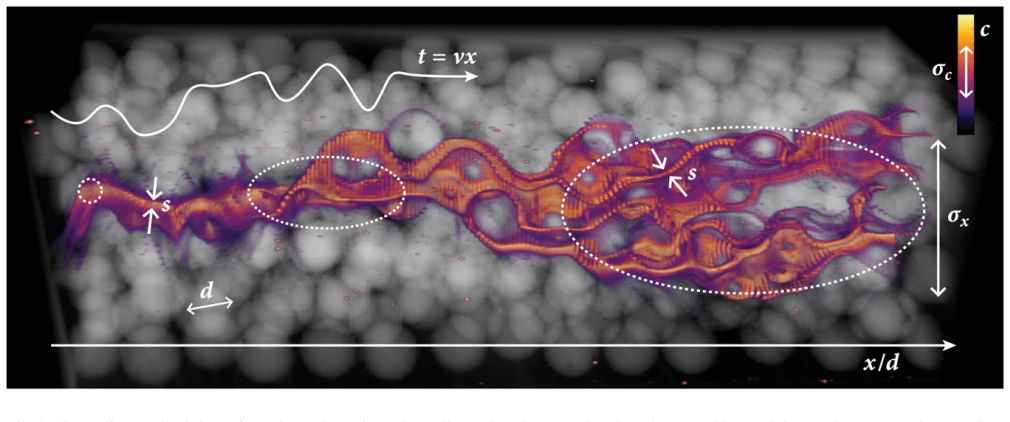
The paper establishes that diffusiophoresis and diffusioosmosis, driven by solute gradients generated, stretched, and dispersed within complex porous geometries, modify colloid and emulsion transport beyond standard hydrodynamic dispersion, surface interactions, straining, deposition, and filtration, with diffuse fronts extending the duration of phoretic forcing in dead-end pores and cross-streamline migration changing breakthrough and dispersion by orders of magnitude.
What carries the argument
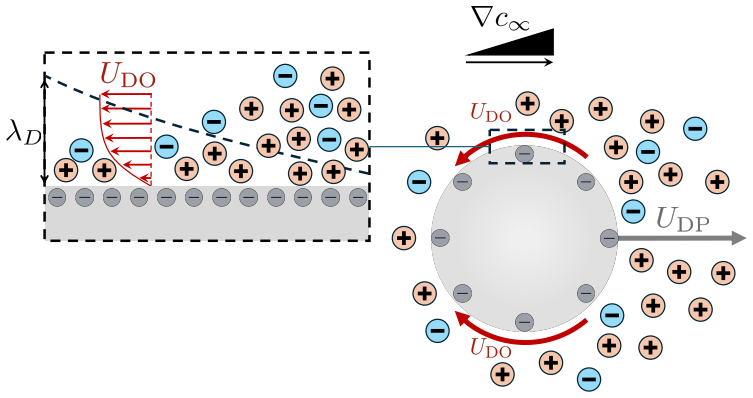
The minimal physicochemical model for diffusiophoresis and diffusioosmosis acting on solute gradients generated and sustained by porous media.
If this is right
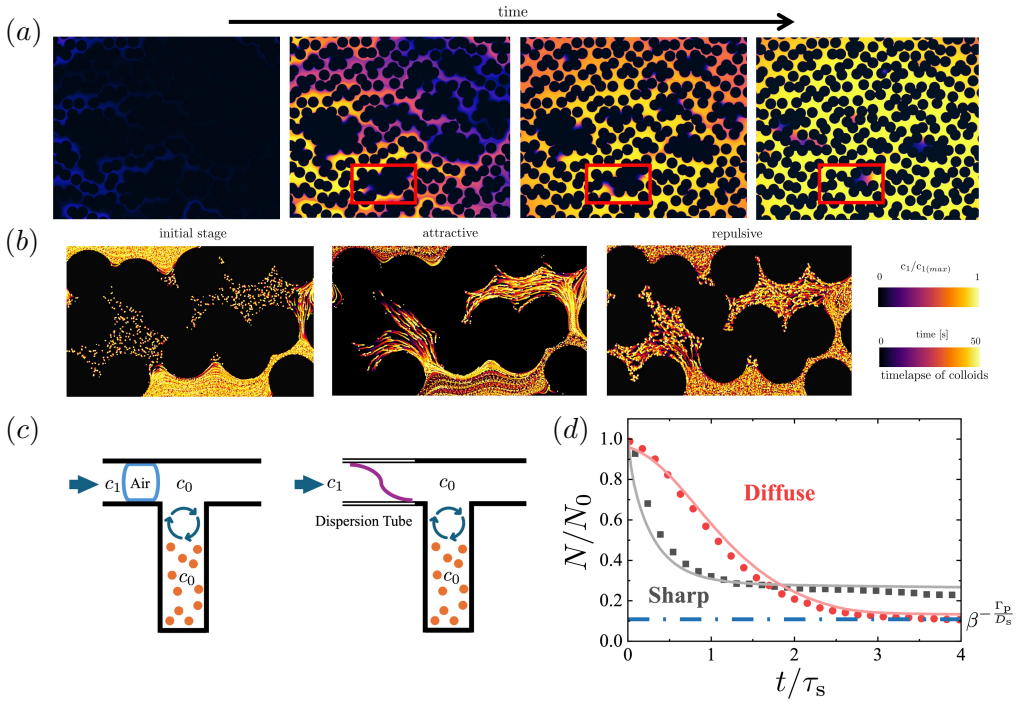
- Diffuse solute fronts enhance phoretic removal from dead-end pores by prolonging the duration of forcing.
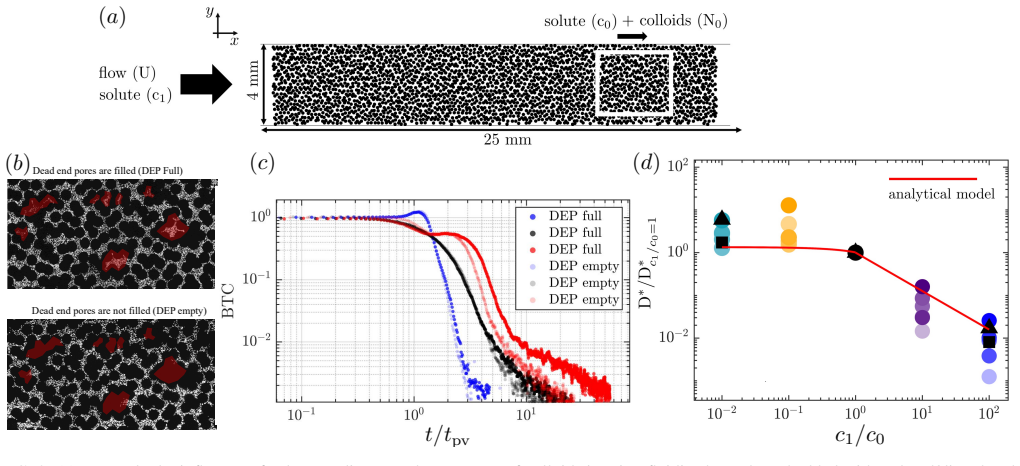
- Cross-streamline migration within flowing pathways changes macroscopic breakthrough and dispersion by orders of magnitude.
- The same mechanisms apply to emulsion droplets in multiphase flows and to confined or living media.
- Porous media exhibit a transition from algebraic mixing in two-dimensional micromodels to chaotic mixing in three-dimensional geometries that affects gradient sustenance.
Where Pith is reading between the lines
- Controlled chemical gradients could improve efficiency in filtration or soil remediation designs.
- Metabolic gradients inside biofilms and tissues may govern particle transport in biological settings.
- Direct comparison of phoretic effects between two-dimensional micromodels and three-dimensional porous media would test the impact of the mixing regime transition.
Load-bearing premise
The minimal physicochemical model for diffusiophoresis and diffusioosmosis together with classical colloid transport descriptions sufficiently captures behavior in complex porous environments without major unmodeled effects from confinement or multiphase interactions.
What would settle it
An experiment in a confined multiphase porous system that shows transport behavior deviating substantially from the predictions of the minimal model would falsify the central assumption.
Figures
read the original abstract
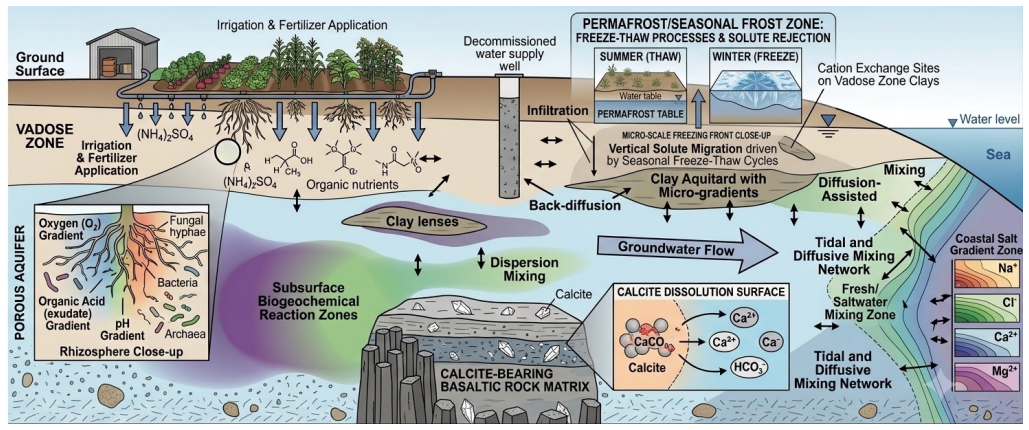
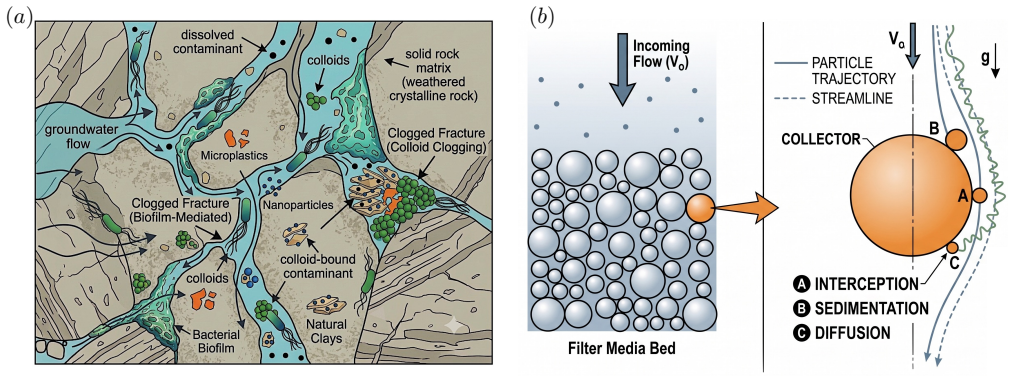
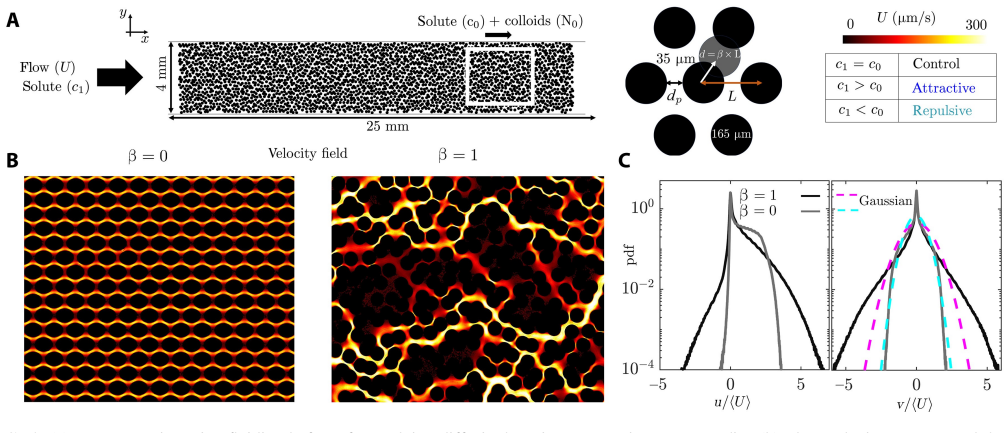
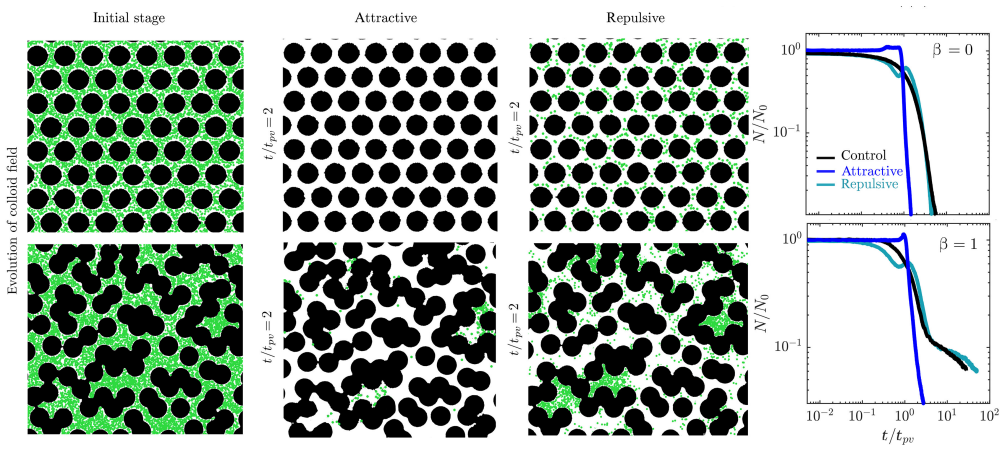
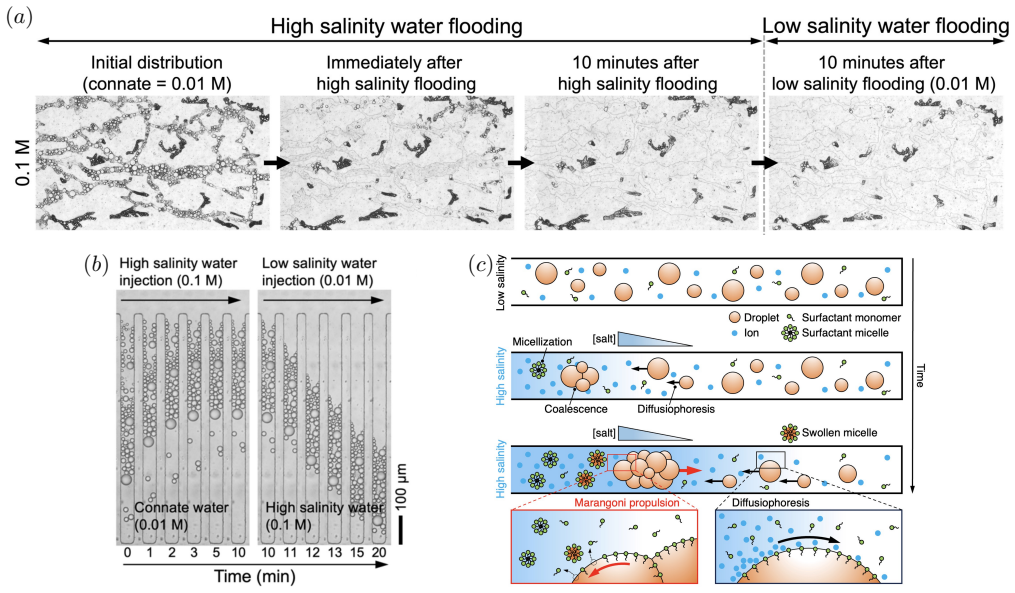
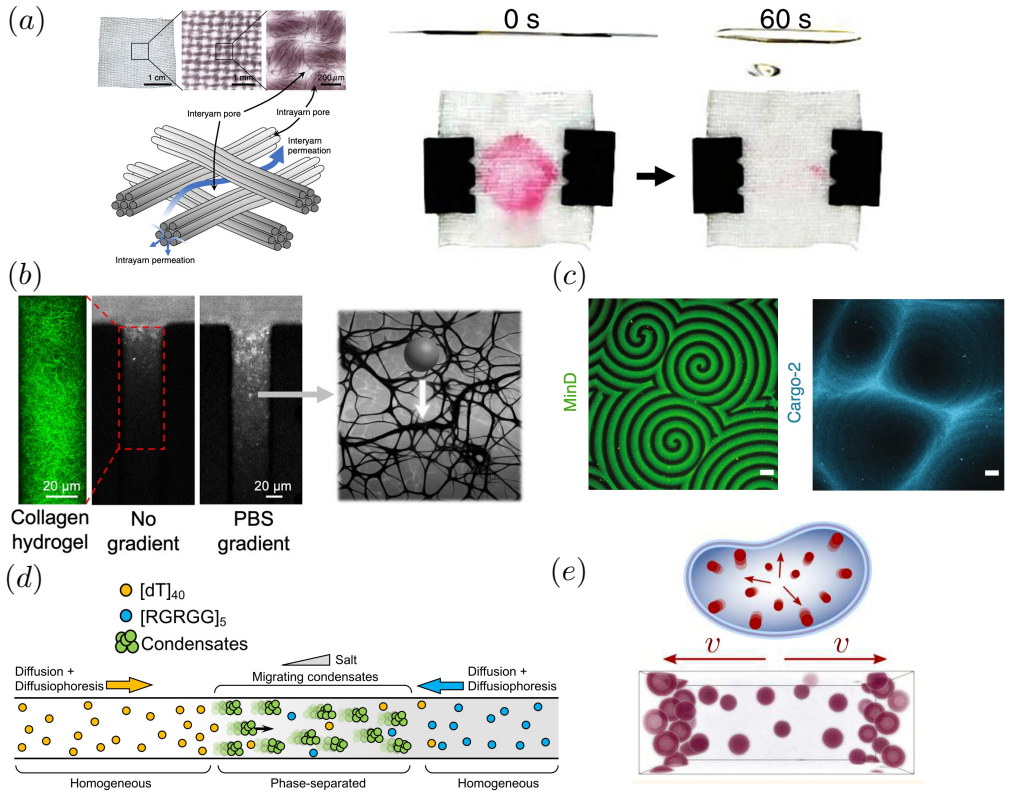
Chemical gradients are ubiquitous in porous and crowded environments, including soils, filters, fabrics, tissues, hydrogels, biofilms and living cells. They arise from displacement fronts, dissolution and precipitation, ion exchange, metabolism, root exudation, evaporation, gas dissolution, freeze--thaw cycles and externally imposed chemical treatments. These gradients can drive colloids, macromolecules and emulsion droplets by diffusiophoresis, while simultaneously driving diffusioosmotic flows along confining surfaces. Classical models of colloid transport in porous media emphasize hydrodynamic dispersion, surface interactions, straining, deposition, detachment and filtration. This chapter places diffusiophoresis within that broader transport framework and reviews how porous media generate, stretch, disperse and sustain the solute gradients that drive phoretic motion. We first discuss sources of chemical gradients and the distinction between spreading and mixing, then summarize classical colloid transport, the minimal physicochemical model for diffusiophoresis and diffusioosmosis, and the experimental platforms used to study these effects. Particular emphasis is placed on recent results showing that diffuse solute fronts can enhance phoretic removal from dead-end pores by prolonging the duration of forcing, and that cross-streamline migration within flowing pathways can change macroscopic breakthrough and dispersion by orders of magnitude. We close by discussing emulsion droplets, multiphase flows, confined and living media, and open problems, including the transition from algebraic mixing in two-dimensional micromodels to chaotic mixing in three-dimensional porous media.
Editorial analysis
A structured set of objections, weighed in public.
Referee Report
Summary. The manuscript is a review chapter that places diffusiophoresis and diffusioosmosis within the classical framework of colloid transport in porous and complex media. It reviews sources of chemical gradients (e.g., displacement fronts, metabolism, evaporation), the distinction between spreading and mixing, classical descriptions of hydrodynamic dispersion, straining, and filtration, the minimal physicochemical model for diffusiophoresis/diffusioosmosis, and experimental platforms. Particular emphasis is given to recent results indicating that diffuse solute fronts prolong the duration of phoretic forcing in dead-end pores and that cross-streamline migration can alter macroscopic breakthrough curves and dispersion by orders of magnitude. The review closes with sections on emulsion droplets, multiphase flows, confined and living media, and open problems including the algebraic-to-chaotic mixing transition from 2D micromodels to 3D porous media.
Significance. If the synthesis holds, the review is significant as an organizing synthesis that connects established colloid-transport models to recent experimental demonstrations of order-of-magnitude phoretic effects. It explicitly credits the recent results on prolonged forcing in dead-end pores and cross-streamline migration, and it flags the 2D-to-3D mixing transition as an open problem. The skeptic concern about unmodeled confinement or multiphase corrections does not land as a load-bearing flaw, because the manuscript presents the minimal model as a starting point and devotes space to the regimes where it may require extension rather than asserting sufficiency without qualification.
Simulated Author's Rebuttal
We thank the referee for their positive assessment of the manuscript, accurate summary of its scope, and recommendation to accept. No major comments were raised.
Circularity Check
Review paper with no new derivations or fitted predictions
full rationale
This is a review article summarizing existing literature on diffusiophoresis and diffusioosmosis in porous media. It does not introduce original derivations, equations, fitted parameters, or predictions that could reduce to inputs by construction. The text explicitly frames itself as placing diffusiophoresis within classical colloid transport frameworks and reviewing sources of gradients and recent results from other studies. No load-bearing claims rely on self-citations that are themselves unverified or on ansatzes smuggled via prior work by the same author. The paper is self-contained as a synthesis against external benchmarks and contains no self-definitional, fitted-input, or uniqueness-imported circularity.
Axiom & Free-Parameter Ledger
Reference graph
Works this paper leans on
-
[1]
Berkowitz, I
B. Berkowitz, I. Dror, S. K. Hansen, and H. Scher, Measure- ments and models of reactive transport in geological media, Reviews of Geophysics54, 930 (2016)
2016
-
[2]
L. Li, K. Maher, A. Navarre-Sitchler, J. Druhan, C. Meile, C. Lawrence, J. Moore, J. Perdrial, P. Sullivan, A. Thomp- son, L. Jin, E. W. Bolton, S. L. Brantley, W. E. Dietrich, K. U. Mayer, C. I. Steefel, A. Valocchi, J. Zachara, B. Kocar, J. Mcintosh, B. M. Tutolo, M. Kumar, E. Sonnenthal, C. Bao, and J. Beisman, Expanding the role of reactive transport ...
2017
-
[3]
Rolle and T
M. Rolle and T. Le Borgne, Mixing and Reactive Fronts in the Subsurface, Reviews in Mineralogy and Geochemistry85, 111 (2019)
2019
-
[4]
A. J. Ladd and P. Szymczak, Reactive flows in porous me- dia: Challenges in theoretical and numerical methods, Annual Review of Chemical and Biomolecular Engineering12, 543 (2021)
2021
-
[5]
Dentz, J
M. Dentz, J. J. Hidalgo, and D. Lester, Mixing in porous media: Concepts and approaches across scales, Transport in Porous Media146, 5 (2023)
2023
-
[6]
C. A. Browne and S. S. Datta, Harnessing elastic instabili- ties for enhanced mixing and reaction kinetics in porous me- dia, Proceedings of the National Academy of Sciences121, e2320962121 (2024)
2024
-
[7]
Sanquer, J
H. Sanquer, J. Heyman, K. Hanna, and T. Le Borgne, Mi- croscale chaotic mixing as a driver for chemical reactions in porous media, Environmental Science & Technology58, 8899 (2024)
2024
-
[8]
Le Borgne and J
T. Le Borgne and J. Heyman, Fluid deformation and mixing in porous media as drivers for chemical and biological processes, Annual Review of Fluid Mechanics58, 443 (2026)
2026
-
[9]
J. F. McCarthy and J. M. Zachara, Subsurface transport of contaminants, Environmental Science & Technology23, 496 (1989)
1989
-
[10]
Kretzschmar, M
R. Kretzschmar, M. Borkovec, D. Grolimund, and M. Elim- elech, Mobile subsurface colloids and their role in contami- nant transport, inAdvances in Agronomy, V ol. 66 (Academic Press, 1999) pp. 121–193
1999
-
[11]
S. A. Bradford, S. R. Yates, M. Bettahar, and J. Simunek, Physical factors affecting the transport and fate of colloids in saturated porous media, Water Resources Research38, 63 (2002)
2002
-
[12]
P. G. Tratnyek and R. L. Johnson, Nanotechnologies for envi- ronmental cleanup, Nano Today1, 44 (2006)
2006
-
[13]
Kanti Sen and K
T. Kanti Sen and K. C. Khilar, Review on subsurface col- loids and colloid-associated contaminant transport in saturated porous media, Advances in Colloid and Interface Science119, 71 (2006)
2006
-
[14]
S. J. Klaine, P. J. J. Alvarez, G. E. Batley, T. F. Fernandes, R. D. Handy, D. Y . Lyon, S. Mahendra, M. J. McLaughlin, and J. R. Lead, Nanomaterials in the environment: Behav- ior, fate, bioavailability, and effects, Environmental Toxicol- ogy and Chemistry27, 1825 (2008)
2008
-
[15]
S. A. Bradford and S. Torkzaban, Colloid transport and re- tention in unsaturated porous media: A review of interface-, collector-, and pore-scale processes and models, Vadose Zone Journal7, 667 (2008)
2008
-
[16]
Weber, A
F.-A. Weber, A. V oegelin, R. Kaegi, and R. Kretzschmar, Con- taminant mobilization by metallic copper and metal sulphide colloids in flooded soil, Nature Geoscience2, 267 (2009)
2009
-
[17]
S. A. Bradford, V . L. Morales, W. Zhang, R. Harvey, A. I. Packman, A. Mohanram, and C. Welty, Transport and fate of microbial pathogens in agricultural settings, Critical Reviews in Environmental Science and Technology43, 775 (2013)
2013
-
[18]
O. S. Pokrovsky, R. M. Manasypov, S. V . Loiko, and L. S. Shi- rokova, Organic and organo-mineral colloids in discontinuous permafrost zone, Geochimica et Cosmochimica Acta188, 1 (2016)
2016
-
[19]
V . L. Morales, M. Dentz, M. Willmann, and M. Holzner, Stochastic dynamics of intermittent pore-scale particle motion in three-dimensional porous media: Experiments and theory, Geophysical Research Letters44, 9361 (2017)
2017
-
[20]
A. A. de Souza Machado, C. W. Lau, J. Till, W. Kloas, A. Lehmann, R. Becker, and M. C. Rillig, Impacts of mi- croplastics on the soil biophysical environment, Environmen- tal Science & Technology52, 9656 (2018)
2018
-
[21]
Aramideh, P
S. Aramideh, P. P. Vlachos, and A. M. Ardekani, Nanoparticle dispersion in porous media in viscoelastic polymer solutions, Journal of Non-Newtonian Fluid Mechanics268, 75 (2019)
2019
-
[22]
Ouyang, W
B. Ouyang, W. Poon, Y .-N. Zhang, Z. P. Lin, B. R. Kingston, A. J. Tavares, Y . Zhang, J. Chen, M. S. Valic, A. M. Syed, P. MacMillan, J. Couture-Sen ´ecal, G. Zheng, and W. C. W. Chan, The dose threshold for nanoparticle tumour delivery, Nature Materials19, 1362 (2020)
2020
-
[23]
MacLeod, H
M. MacLeod, H. P. H. Arp, M. B. Tekman, and A. Jahnke, The global threat from plastic pollution, Science373, 61 (2021)
2021
-
[24]
Mangal, J
D. Mangal, J. C. Palmer, and J. C. Conrad, Nanoparticle dis- persion in porous media: Effects of array geometry and flow orientation, Phys. Rev. E104, 015102 (2021)
2021
-
[25]
Mangal, J
D. Mangal, J. C. Conrad, and J. C. Palmer, Nanoparticle dis- persion in porous media: Effects of hydrodynamic interactions and dimensionality, AIChE Journal67, e17147 (2021)
2021
-
[26]
J. E. Patino, W. P. Johnson, and V . L. Morales, Relating mech- anistic fate with spatial positioning for colloid transport in sur- face heterogeneous porous media, Journal of Colloid and In- terface Science641, 666 (2023)
2023
-
[27]
T. Wu, Z. Yang, R. Hu, and Y .-F. Chen, Three-dimensional visualization reveals pore-scale mechanisms of colloid trans- 19 port and retention in two-phase flow, Environmental Science & Technology57, 1997 (2023)
1997
-
[28]
M. C. Rillig, S. W. Kim, and Y .-G. Zhu, The soil plastisphere, Nature Reviews Microbiology22, 64 (2024)
2024
-
[29]
A. A. Pahlavan, The soil plastisphere: The nexus of microplas- tics, bacteria, and biofilms, InterPore Journal1, IPJ271124 (2024)
2024
-
[30]
Huang, M
X. Huang, M. Auffan, M. J. Eckelman, M. Elimelech, J.-H. Kim, J. Rose, K. Zuo, Q. Li, and P. J. J. Alvarez, Trends, risks and opportunities in environmental nanotechnology, Na- ture Reviews Earth & Environment5, 572 (2024)
2024
-
[31]
J. A. O’Donnell, M. P. Carey, J. C. Koch, C. Baughman, K. Hill, C. E. Zimmerman, P. F. Sullivan, R. Dial, T. Lyons, D. J. Cooper, and B. A. Poulin, Metal mobilization from thaw- ing permafrost to aquatic ecosystems is driving rusting of arc- tic streams, Communications Earth & Environment5, 268 (2024)
2024
-
[32]
Storm and J
R. Storm and J. S. Marshall, Pore-scale modelling of particle transport in a porous bed, Journal of Fluid Mechanics979, A9 (2024)
2024
-
[33]
E. K. Skierszkan, J. W. Dockrey, and M. B. J. Lindsay, Metal mobilization from thawing permafrost is an emergent risk to water resources, ACS ES&T Water5, 20 (2025)
2025
-
[34]
D. Liu, P. R. Johnson, and M. Elimelech, Colloid deposition dynamics in flow-through porous media: Role of electrolyte concentration, Environmental Science & Technology29, 2963 (1995)
1995
-
[35]
P. R. Johnson, N. Sun, and M. Elimelech, Colloid trans- port in geochemically heterogeneous porous media: Modeling and measurements, Environmental Science & Technology30, 3284 (1996)
1996
-
[36]
S. B. Roy and D. A. Dzombak, Chemical factors influencing colloid-facilitated transport of contaminants in porous media, Environmental Science & Technology31, 656 (1997)
1997
-
[37]
Torkzaban, S
S. Torkzaban, S. A. Bradford, and S. L. Walker, Resolving the coupled effects of hydrodynamics and dlvo forces on colloid attachment in porous media,Langmuir, Langmuir23, 9652 (2007)
2007
-
[38]
I. L. Molnar, W. P. Johnson, J. I. Gerhard, C. S. Willson, and D. M. O’Carroll, Predicting colloid transport through satu- rated porous media: A critical review, Water Resources Re- search51, 6804 (2015)
2015
-
[39]
I. L. Molnar, E. Pensini, M. A. Asad, C. A. Mitchell, L. C. Nitsche, L. J. Pyrak-Nolte, G. L. Mi ˜no, and M. M. Krol, Col- loid transport in porous media: A review of classical mech- anisms and emerging topics, Transport in Porous Media130, 129 (2019)
2019
-
[40]
Bizmark, J
N. Bizmark, J. Schneider, R. D. Priestley, and S. S. Datta, Mul- tiscale dynamics of colloidal deposition and erosion in porous media, Science Advances6, eabc2530 (2020)
2020
-
[41]
Mangal, J
D. Mangal, J. C. Conrad, and J. C. Palmer, Nanoparticle dis- persion in porous media: Effects of attractive particle-media interactions, Phys. Rev. E105, 055102 (2022)
2022
-
[42]
W. K. Darko, D. Mangal, J. C. Conrad, and J. C. Palmer, Par- ticle dispersion through porous media with heterogeneous at- tractions, Soft Matter20, 837 (2024)
2024
-
[43]
J. L. Anderson, Colloid transport by interfacial forces, Annu. Rev. Fluid Mech.21, 61 (1989)
1989
-
[44]
Velegol, A
D. Velegol, A. Garg, R. Guha, A. Kar, and M. Kumar, Origins of concentration gradients for diffusiophoresis, Soft Matter12, 4686 (2016)
2016
-
[45]
Marbach and L
S. Marbach and L. Bocquet, Osmosis, from molecular insights to large-scale applications, Chem. Soc. Rev.48, 3102 (2019)
2019
-
[46]
Shim, Diffusiophoresis, diffusioosmosis, and microflu- idics: Surface-flow-driven phenomena in the presence of flow, Chemical Reviews122, 6986 (2022)
S. Shim, Diffusiophoresis, diffusioosmosis, and microflu- idics: Surface-flow-driven phenomena in the presence of flow, Chemical Reviews122, 6986 (2022)
2022
-
[47]
J. T. Ault and S. Shin, Physicochemical hydrodynamics of particle diffusiophoresis driven by chemical gradients, Annual Review of Fluid Mechanics57, 227 (2025)
2025
-
[48]
N. Shi, A. a. Fattah, and T. M. Squires, Generalized, concep- tually unified theory of linear phoretic drift and osmotic slip, Phys. Rev. Fluids10, 043701 (2025)
2025
-
[49]
Abecassis, C
B. Abecassis, C. Cottin-Bizonne, C. Ybert, A. Ajdari, and L. Bocquet, Boosting migration of large particles by solute contrasts, Nature Materials7, 785 (2008)
2008
-
[50]
Palacci, B
J. Palacci, B. Ab ´ecassis, C. Cottin-Bizonne, C. Ybert, and L. Bocquet, Colloidal motility and pattern formation un- der rectified diffusiophoresis, Phys. Rev. Lett.104, 138302 (2010)
2010
-
[51]
Palacci, C
J. Palacci, C. Cottin-Bizonne, C. Ybert, and L. Bocquet, Os- motic traps for colloids and macromolecules based on loga- rithmic sensing in salt taxis, Soft Matter8, 980 (2012)
2012
-
[52]
Yadav, J
V . Yadav, J. D. Freedman, M. Grinstaff, and A. Sen, Bone- crack detection, targeting, and repair using ion gradients, Angewandte Chemie International Edition52, 10997 (2013)
2013
-
[53]
Florea, S
D. Florea, S. Musa, J. M. R. Huyghe, and H. M. Wyss, Long- range repulsion of colloids driven by ion exchange and diffu- siophoresis, Proceedings of the National Academy of Sciences 111, 6554 (2014)
2014
-
[54]
R. Guha, X. Shang, A. L. Zydney, D. Velegol, and M. Kumar, Diffusiophoresis contributes significantly to colloidal fouling in low salinity reverse osmosis systems, Journal of Membrane Science479, 67 (2015)
2015
-
[55]
Chiang and D
T.-Y . Chiang and D. Velegol, Multi-ion diffusiophoresis, Jour- nal of Colloid and Interface Science424, 120 (2014)
2014
-
[56]
N. Shi, R. Nery-Azevedo, A. I. Abdel-Fattah, and T. M. Squires, Diffusiophoretic focusing of suspended colloids, Phys. Rev. Lett.117, 258001 (2016)
2016
-
[57]
S. Shin, E. Um, B. Sabass, J. T. Ault, M. Rahimi, P. B. Warren, and H. A. Stone, Size-dependent control of colloid transport via solute gradients in dead-end channels, Proceedings of the National Academy of Sciences113, 257 (2016)
2016
-
[58]
J. T. Ault, P. B. Warren, S. Shin, and H. A. Stone, Diffusio- phoresis in one-dimensional solute gradients, Soft Matter13, 9015 (2017)
2017
-
[59]
Nery-Azevedo, A
R. Nery-Azevedo, A. Banerjee, and T. M. Squires, Diffu- siophoresis in ionic surfactant gradients, Langmuir33, 9694 (2017)
2017
-
[60]
J. T. Ault, S. Shin, and H. A. Stone, Diffusiophoresis in narrow channel flows, J. Fluid Mech.854, 420 (2018)
2018
-
[61]
Battat, J
S. Battat, J. T. Ault, S. Shin, S. Khodaparast, and H. A. Stone, Particle entrainment in dead-end pores by diffusiophoresis, Soft Matter15, 3879 (2019)
2019
-
[62]
Gupta, B
A. Gupta, B. Rallabandi, and H. A. Stone, Diffusiophoretic and diffusioosmotic velocities for mixtures of valence- asymmetric electrolytes, Phys. Rev. Fluids4, 043702 (2019)
2019
-
[63]
J. L. Wilson, S. Shim, Y . E. Yu, A. Gupta, and H. A. Stone, Diffusiophoresis in multivalent electrolytes, Langmuir36, 7014 (2020)
2020
-
[64]
Gupta, S
A. Gupta, S. Shim, and H. A. Stone, Diffusiophoresis: from dilute to concentrated electrolytes, Soft Matter16, 6975 (2020)
2020
-
[65]
Singh, G
N. Singh, G. T. Vladisavljevi ´c, F. m. c. Nadal, C. Cottin- Bizonne, C. Pirat, and G. Bolognesi, Reversible trapping of colloids in microgrooved channels via diffusiophoresis under steady-state solute gradients, Phys. Rev. Lett.125, 248002 (2020). 20
2020
-
[66]
H. Tan, A. Banerjee, N. Shi, X. Tang, A. Abdel-Fattah, and T. M. Squires, A two-step strategy for delivering particles to targets hidden within microfabricated porous media, Science Advances7, eabh0638 (2021)
2021
-
[67]
B. M. Alessio, S. Shim, E. Mintah, A. Gupta, and H. A. Stone, Diffusiophoresis and diffusioosmosis in tandem: Two- dimensional particle motion in the presence of multiple elec- trolytes, Phys. Rev. Fluids6, 054201 (2021)
2021
-
[68]
Jotkar and L
M. Jotkar and L. Cueto-Felgueroso, Particle separation through diverging nanochannels via diffusiophoresis and dif- fusioosmosis, Phys. Rev. Appl.16, 064067 (2021)
2021
-
[69]
B. M. Alessio, S. Shim, A. Gupta, and H. A. Stone, Diffusioosmosis-driven dispersion of colloids: a taylor disper- sion analysis with experimental validation, Journal of Fluid Mechanics942, A23 (2022)
2022
-
[70]
S. Shim, J. K. Nunes, G. Chen, and H. A. Stone, Diffusio- phoresis in the presence of a ph gradient, Phys. Rev. Fluids7, 110513 (2022)
2022
-
[71]
Chakra, N
A. Chakra, N. Singh, G. T. Vladisavljevi´c, F. Nadal, C. Cottin- Bizonne, C. Pirat, and G. Bolognesi, Continuous manipulation and characterization of colloidal beads and liposomes via dif- fusiophoresis in single- and double-junction microchannels, ACS Nano17, 14644 (2023)
2023
-
[72]
Akdeniz, J
B. Akdeniz, J. A. Wood, and R. G. H. Lammertink, Diffusio- phoresis and diffusio-osmosis into a dead-end channel: Role of the concentration-dependence of zeta potential, Langmuir 39, 2322 (2023)
2023
-
[73]
S. Lee, J. Lee, and J. T. Ault, The role of variable zeta po- tential on diffusiophoretic and diffusioosmotic transport, Col- loids and Surfaces A: Physicochemical and Engineering As- pects659, 130775 (2023)
2023
-
[74]
R. E. Migacz, G. Durey, and J. T. Ault, Convection rolls and three-dimensional particle dynamics in merging solute streams, Phys. Rev. Fluids8, 114201 (2023)
2023
-
[75]
Liu and A
H. Liu and A. A. Pahlavan, Diffusioosmotic reversal of col- loidal focusing direction in a microfluidic t-junction, Phys. Rev. Lett.134, 098201 (2025)
2025
-
[76]
Chakra, C
A. Chakra, C. Puijk, G. T. Vladisavljevi ´c, C. Cottin-Bizonne, C. Pirat, and G. Bolognesi, Surface chemistry-based contin- uous separation of colloidal particles via diffusiophoresis and diffusioosmosis, Journal of Colloid and Interface Science693, 137577 (2025)
2025
-
[77]
Villermaux, Mixing versus stirring, Annual Review of Fluid Mechanics51, 245 (2019)
E. Villermaux, Mixing versus stirring, Annual Review of Fluid Mechanics51, 245 (2019)
2019
-
[78]
Alipour, Y
M. Alipour, Y . Li, H. Liu, and A. A. Pahlavan, Diffusio- phoretic transport of colloids in porous media, Science Ad- vances12, eady9874 (2026)
2026
-
[79]
P. G. Saffman, A theory of dispersion in a porous medium, Journal of Fluid Mechanics6, 321 (1959)
1959
-
[80]
D. L. Koch and J. F. Brady, Dispersion in fixed beds, Journal of Fluid Mechanics154, 399 (1985)
1985
discussion (0)
Sign in with ORCID, Apple, or X to comment. Anyone can read and Pith papers without signing in.