REVIEW 2 major objections 2 minor 2 cited by
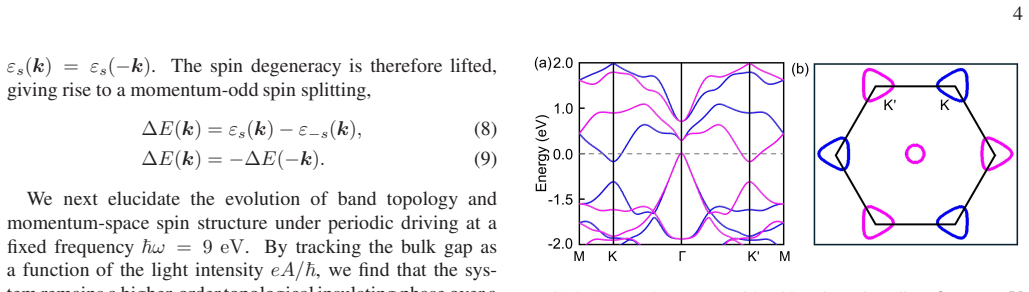
Periodic driving with circularly polarized light realizes an odd-parity altermagnetic higher-order topological insulator in the Cr₂CH₂ monolayer.
Reviewed by Pith at T0; open to challenge. T0 means a machine referee read the full paper against a public rubric. the ladder, T0–T4 →
T0 review · grok-4.3
2026-05-25 05:52 UTC pith:AG5WLGZB
load-bearing objection The paper shows Floquet driving with circular light turns the equilibrium C3-protected AFM HOTI in Cr2CH2 into an odd-parity altermagnetic version with surviving corner states, but the abstract leaves open whether the effective Hamiltonian was checked for preserved symmetry indicator. the 2 major comments →
Floquet-Engineered Odd-Parity Altermagnetic Higher-Order Topology in a Two-Dimensional Antiferromagnet Cr₂CH₂
The pith
A machine-rendered reading of the paper's core claim, the machinery that carries it, and where it could break.
Core claim
In equilibrium, the Cr₂CH₂ monolayer is a two-dimensional antiferromagnetic higher-order topological insulator protected by C₃ rotational symmetry, as indicated by the symmetry indicator χ^(3) = {-2,1} and the presence of robust corner states. Application of circularly polarized light induces a transition to an f-wave altermagnetic state characterized by the symmetry [C₂ || 3-bar_001] and odd-parity spin splitting. The C₃-protected corner states remain intact despite substantial Floquet-induced band renormalization, and increasing the light intensity drives the system into an altermagnetic semimetallic state.
What carries the argument
The C₃ rotational symmetry that continues to protect corner states after Floquet driving induces f-wave altermagnetic order with odd-parity spin splitting.
Load-bearing premise
The circularly polarized driving field leaves C₃ rotational symmetry unbroken and the equilibrium symmetry indicator continues to protect the corner states after band renormalization.
What would settle it
A calculation or measurement showing that the corner states gap out or move away from zero energy at moderate driving strengths where the symmetry indicator χ^(3) changes.
If this is right
- The altermagnetic higher-order topology survives Floquet-induced band renormalization over a broad range of driving strengths.
- Odd-parity spin splitting emerges in the f-wave altermagnetic state under circularly polarized light.
- Increasing light intensity drives a transition from the altermagnetic HOTI to an altermagnetic semimetal.
- A direct connection is established between magnetism and topology in a periodically driven antiferromagnetic system.
Where Pith is reading between the lines
- This Floquet approach could be tested in other C₃-symmetric two-dimensional antiferromagnets to induce similar altermagnetic higher-order topology.
- Optical control of the transition between the topological and semimetallic regimes may allow tunable spin and topological transport.
- Scanning tunneling spectroscopy under illumination could directly image whether the corner states remain localized at moderate driving strengths.
Editorial analysis
A structured set of objections, weighed in public.
Referee Report
Summary. The manuscript claims that circularly polarized light driving induces an odd-parity altermagnetic higher-order topological insulator phase in the Cr₂CH₂ monolayer. In equilibrium the system is a C₃-protected AFM HOTI with symmetry indicator χ^(3) = {-2,1} and corner states; under Floquet driving it acquires f-wave altermagnetism with symmetry [C₂ || 3-bar_001] while the C₃-protected corner states remain intact over a broad range of driving amplitudes before the system evolves into an altermagnetic semimetal at high intensity.
Significance. If the central claim is substantiated, the work establishes a concrete route to Floquet-engineer coupled altermagnetic and higher-order topological order in a 2D antiferromagnet, providing a dynamical handle on spin-split topology and corner-state transport. The use of symmetry indicators together with explicit Floquet renormalization constitutes a strength that could be extended to other magnetic 2D materials.
major comments (2)
- [Abstract / Floquet-driven phase section] Abstract and the section on the Floquet-driven phase: the assertion that C₃-protected corner states remain intact requires explicit verification that the symmetry indicator χ^(3) = {-2,1} is preserved (or recomputed) on the effective Floquet Hamiltonian; the text states that the driven system develops symmetry [C₂ || 3-bar_001] and reports band renormalization, but does not confirm that the C₃ eigenvalues of the occupied bands or the indicator itself remain unchanged across the reported driving strengths.
- [Floquet effective Hamiltonian section] Section describing the effective Hamiltonian under CPL: it is not shown whether the time-periodic drive introduces additional terms that reduce the little-group symmetry at the high-symmetry points relevant to χ^(3), which would undermine the claim that the equilibrium topological protection automatically carries over.
minor comments (2)
- [Methods / Figure captions] Figure captions and methods: numerical details on the Floquet-mode truncation, the strength of the vector potential, and the k-mesh used for corner-state calculations should be stated explicitly to allow reproduction of the reported robustness range.
- [Symmetry analysis section] Notation: the relation between the equilibrium χ^(3) indicator and the odd-parity spin splitting in the driven f-wave state could be clarified with a short table comparing the relevant irreps before and after driving.
Simulated Author's Rebuttal
We thank the referee for the positive assessment of our work and for the detailed comments that help improve the manuscript. We address each major comment below.
read point-by-point responses
-
Referee: [Abstract / Floquet-driven phase section] Abstract and the section on the Floquet-driven phase: the assertion that C₃-protected corner states remain intact requires explicit verification that the symmetry indicator χ^(3) = {-2,1} is preserved (or recomputed) on the effective Floquet Hamiltonian; the text states that the driven system develops symmetry [C₂ || 3-bar_001] and reports band renormalization, but does not confirm that the C₃ eigenvalues of the occupied bands or the indicator itself remain unchanged across the reported driving strengths.
Authors: We agree with the referee that explicitly recomputing the symmetry indicator for the Floquet Hamiltonian would provide stronger confirmation. In the revised manuscript, we have added calculations of the C₃ eigenvalues and the symmetry indicator χ^(3) for the effective Hamiltonian at representative driving amplitudes. The indicator remains {-2,1} in the regime where corner states are present, confirming preservation of the topological protection. We have included these results in a new figure and accompanying text in the Floquet-driven phase section. revision: yes
-
Referee: [Floquet effective Hamiltonian section] Section describing the effective Hamiltonian under CPL: it is not shown whether the time-periodic drive introduces additional terms that reduce the little-group symmetry at the high-symmetry points relevant to χ^(3), which would undermine the claim that the equilibrium topological protection automatically carries over.
Authors: The circularly polarized light drive is chosen to respect the C₃ rotational symmetry of the lattice, and the effective Hamiltonian is derived via the Magnus expansion up to second order, which preserves the relevant symmetries. However, to directly address this concern, we have added an analysis of the little-group representations at the high-symmetry points (Γ, K, K') for the Floquet Hamiltonian, showing that the C₃ eigenvalues are unchanged. This is now detailed in the revised section on the effective Hamiltonian. revision: yes
Circularity Check
No significant circularity; derivation is self-contained via symmetry analysis and Floquet application.
full rationale
The paper applies equilibrium symmetry indicator χ^(3) = {-2,1} under C3 protection to the driven system, then reports that C3-protected corner states remain intact after Floquet renormalization by circularly polarized light. No quoted step reduces a prediction to a fitted input by construction, invokes a self-citation as the sole load-bearing justification, or renames a known result. The central claim rests on explicit symmetry analysis of the effective Hamiltonian and numerical preservation of corner states across driving strengths, which are independent of the target result itself.
Axiom & Free-Parameter Ledger
axioms (2)
- domain assumption Cr₂CH₂ monolayer is a 2D AFM HOTI protected by C₃ rotational symmetry characterized by symmetry indicator χ^(3) = {-2,1}
- domain assumption Floquet driving with CPL induces an f-wave altermagnetic state governed by symmetry [C₂||3̄₀₀₁] with odd-parity spin splitting
read the original abstract
Periodic driving provides a platform to dynamically tailor quantum states of matter, yet its impact on symmetry-protected topological phases remains incompletely understood. Here, we demonstrate that periodic driving enables the realization of an odd-parity altermagnetic (AM) higher-order topological insulator (HOTI) phase in the Cr$_2$CH$_2$ monolayer. In equilibrium, Cr$_2$CH$_2$ is a 2D antiferromagnetic (AFM) HOTI protected by $\mathcal C_3$ rotational symmetry, characterized by a symmetry indicator $\chi^{(3)}$ = $\{-2,1\}$ and robust corner states. Under circularly polarized light (CPL), the system develops a f-wave altermagnetic state governed by the symmetry $[C_{2}||\overline{3}_{001}]$ with odd-parity spin splitting. Despite substantial Floquet-induced band renormalization, the $\mathcal C_3$-protected corner states remain intact over a broad range of driving strengths, highlighting the altermagnetic higher-order topology under Floquet driving. As the light intensity increases, the system gradually evolves into an altermagnetic semimetallic state. These results establish a direct connection between magnetism and topology in a periodically driven AFM system, offering a route toward the control of coupled spin and topological transport.
Figures


Lean theorems connected to this paper
-
IndisputableMonolith/Foundation/AlexanderDuality.leanalexander_duality_circle_linking echoes?
echoesECHOES: this paper passage has the same mathematical shape or conceptual pattern as the Recognition theorem, but is not a direct formal dependency.
the C₃-protected corner states remain intact... symmetry indicator χ^(3)={−2,1}
What do these tags mean?
- matches
- The paper's claim is directly supported by a theorem in the formal canon.
- supports
- The theorem supports part of the paper's argument, but the paper may add assumptions or extra steps.
- extends
- The paper goes beyond the formal theorem; the theorem is a base layer rather than the whole result.
- uses
- The paper appears to rely on the theorem as machinery.
- contradicts
- The paper's claim conflicts with a theorem or certificate in the canon.
- unclear
- Pith found a possible connection, but the passage is too broad, indirect, or ambiguous to say the theorem truly supports the claim.
Forward citations
Cited by 2 Pith papers
-
Nonrelativistic Spin-Orbit-Coupling Effects in Odd-Parity Coplanar Magnets
Bilayer odd-parity coplanar magnets constructed from altermagnets realize tunable nonrelativistic SOC spin textures equivalent to relativistic counterparts.
-
Parity-selective spin splitting in coplanar antiferromagnets via bichromatic driving
In a bilayer coplanar antiferromagnet, ω–2ω bichromatic light generates odd- and mixed-parity spin splittings, while n≥3 harmonics yield only even-parity states.
Reference graph
Works this paper leans on
-
[1]
T. Jungwirth, X. Marti, P . Wadley, and J. Wunderlich, Nat. Nan- otechnol. 11, 231 (2016)
work page 2016
-
[2]
T. Jungwirth, J. Sinova, A. Manchon, X. Marti, J. Wunderl ich, and C. Felser, Nat. Phys. 14, 200 (2018)
work page 2018
- [3]
-
[4]
K. Olejn´ ık, T. Seifert, Z. Kaˇ spar, V . Nov´ ak, P . Wadley, R. P . Campion, M. Baumgartner, P . Gambardella, P . Nˇ emec, J. Wun- derlich, J. Sinova, P . Kuˇ zel, M. M¨ uller, T. Kampfrath, and T. Jungwirth, Sci. Adv. 4, eaar3566 (2018)
work page 2018
-
[5]
P . Tang, Q. Zhou, G. Xu, and S.-C. Zhang, Nat. Phys. 12, 1100 (2016)
work page 2016
- [6]
-
[7]
D.-F. Shao, G. Gurung, S.-H. Zhang, and E. Y . Tsymbal, Phy s. Rev. Lett. 122, 077203 (2019)
work page 2019
-
[8]
C. Niu, H. Wang, N. Mao, B. Huang, Y . Mokrousov, and Y . Dai, Phys. Rev. Lett. 124, 066401 (2020)
work page 2020
- [9]
-
[10]
H. Isshiki, N. Budai, A. Kobayashi, R. Uesugi, T. Higo, S. Nakatsuji, and Y . Otani, Phys. Rev. Lett. 132, 216702 (2024)
work page 2024
- [11]
-
[12]
L. ˇSmejkal, Y . Mokrousov, B. Yan, and A. H. MacDonald, Nat. Phys. 14, 242 (2018)
work page 2018
-
[13]
H. Jani, J. Harrison, S. Hooda, S. Prakash, P . Nandi, J. H u, Z. Zeng, J.-C. Lin, C. Godfrey, G. j. Omar, T. A. Butcher, J. Raabe, S. Finizio, A. V .-Y . Thean, A. Ariando, and P . G. Radaelli, Nat. Mater. 23, 619 (2024)
work page 2024
- [14]
- [15]
-
[16]
L. Bai, W. Feng, S. Liu, L. ˇSmejkal, Y . Mokrousov, and Y . Yao, Adv. Funct. Mater. 34, 2409327 (2024)
work page 2024
-
[17]
C. Song, H. Bai, Z. Zhou, L. Han, H. Reichlova, J. H. Dil, J . Liu, X. Chen, and F. Pan, Nat. Rev. Mater. 10, 473 (2025)
work page 2025
- [18]
-
[19]
J. Krempask´ y, L. ˇSmejkal, S. W. D’Souza, M. Hajlaoui, G. Springholz, K. Uhl´ ıˇ rov´ a, F. Alarab, P . C. Constantino u, V . Strocov, D. Usanov, W. R. Pudelko, R. Gonz´ alez-Hern´ andez, A. Birk Hellenes, Z. Jansa, H. Reichlov´ a, Z.ˇSob´ aˇ n, R. D. Gon- zalez Betancourt, P . Wadley, J. Sinova, D. Kriegner, J. Min´ ar, J. H. Dil, and T. Jungwirth, Nat...
work page 2024
-
[20]
O. Fedchenko, J. Min´ ar, A. Akashdeep, S. W. D’Souza, D.V asi- lyev, O. Tkach, L. Odenbreit, Q. Nguyen, D. Kutnyakhov, N. Wind, L. Wenthaus, M. Scholz, K. Rossnagel, M. Hoesch, M. Aeschlimann, B. Stadtm¨ uller, M. Kl¨ aui, G. Sch¨ onhense, T. Jungwirth, A. B. Hellenes, G. Jakob, L. ˇSmejkal, J. Sinova, and H.-J. Elmers, Sci. Adv. 10, eadj4883 (2024)
work page 2024
- [21]
-
[22]
T. Zhu, D. Zhou, H. Wang, S.-H. Wei, and J. Ruan, Phys. Rev . Lett. 136, 126704 (2026)
work page 2026
-
[23]
Y . Tian, C.-H. Zhao, C.-B. Wang, B. Zhang, X. Kong, and W.-J. Gong, arXiv:2603.11483 (2026)
-
[24]
L. ˇSmejkal, A. Marmodoro, K.-H. Ahn, R. Gonz´ alez- Hern´ andez, I. Turek, S. Mankovsky, H. Ebert, S. W. D’Souza, O. ˇSipr, J. Sinova, and T. Jungwirth, Phys. Rev. Lett. 131, 256703 (2023)
work page 2023
-
[25]
S. Lee, S. Lee, S. Jung, J. Jung, D. Kim, Y . Lee, B. Seok, J.Kim, B. G. Park, L. ˇSmejkal, C.-J. Kang, and C. Kim, Phys. Rev. Lett. 132, 036702 (2024)
work page 2024
-
[26]
S. Reimers, L. Odenbreit, L. ˇSmejkal, V . N. Strocov, P . Con- stantinou, A. B. Hellenes, R. Jaeschke Ubiergo, W. H. Campos , V . K. Bharadwaj, A. Chakraborty, T. Denneulin, W. Shi, R. E. Dunin-Borkowski, S. Das, M. Kl¨ aui, J. Sinova, and M. Jour- dan, Nat. Commun. 15, 2116 (2024)
work page 2024
-
[27]
O. J. Amin, A. Dal Din, E. Golias, Y . Niu, A. Zakharov, S. C. Fromage, C. J. B. Fields, S. L. Heywood, R. B. Cousins, F. Maccherozzi, J. Krempask´ y, J. H. Dil, D. Kriegner, B. Ki- raly, R. P . Campion, A. W. Rushforth, K. W. Edmonds, S. S. Dhesi, L. ˇSmejkal, T. Jungwirth, and P . Wadley, Nature 636, 348 (2024)
work page 2024
-
[28]
Y . Zhu, T. Chen, Y . Li, L. Qiao, X. Ma, C. Liu, T. Hu, H. Gao, and W. Ren, Nano Lett. 24, 472 (2024)
work page 2024
-
[29]
Gonz´ alez-Hern´ andez, L.ˇSmejkal, K
R. Gonz´ alez-Hern´ andez, L.ˇSmejkal, K. V´ yborn´ y, Y . Yahagi, J. Sinova, T. Jungwirth, and J. ˇZelezn´ y, Phys. Rev. Lett.126, 127701 (2021)
work page 2021
-
[30]
Z. Feng, X. Zhou, L. ˇSmejkal, L. Wu, Z. Zhu, H. Guo, R. Gonz´ alez-Hern´ andez, X. Wang, H. Yan, P . Qin, X. Zhang, H. Wu, H. Chen, Z. Meng, L. Liu, Z. Xia, J. Sinova, T. Jung- wirth, and Z. Liu, Nat. Electron. 5, 735 (2022)
work page 2022
-
[31]
C.-T. Liao, Y .-C. Wang, Y .-C. Tien, S.-Y . Huang, and D. Q u, Phys. Rev. Lett. 133, 056701 (2024)
work page 2024
- [32]
-
[33]
Y .-X. Li, Y . Liu, and C.-C. Liu, Phys. Rev. B 109, L201109 (2024)
work page 2024
-
[34]
J. Wang, X. Yang, Z. Yang, J. Lu, P . Ho, W. Wang, Y . S. Ang, Z. Cheng, and S. Fang, Adv. Funct. Mater. 36, 2505145 (2026)
work page 2026
-
[35]
A. G´ omez-Le´ on and G. Platero, Phys. Rev. Lett. 110, 200403 (2013)
work page 2013
- [36]
- [37]
-
[38]
M. S. Rudner and N. H. Lindner, Nat. Rev. Phys. 2, 229 (2020)
work page 2020
-
[39]
H. Liu, H. Cao, and S. Meng, Prog. Surf. Sci 98, 100705 (2023)
work page 2023
- [40]
- [41]
-
[42]
X. Wan, Z. Ning, D.-H. Xu, R. Wang, and B. Zheng, Phys. Rev . B 109, 085148 (2024)
work page 2024
- [43]
-
[44]
Y . H. Wang, H. Steinberg, P . Jarillo-Herrero, and N. Ged ik, Science 342, 453 (2013)
work page 2013
-
[45]
J. W. McIver, B. Schulte, F. U. Stein, T. Matsuyama, G. Jo tzu, G. Meier, and A. Cavalleri, Nat. Phys. 16, 38 (2020)
work page 2020
-
[46]
S. Zhou, C. Bao, B. Fan, H. Zhou, Q. Gao, H. Zhong, T. Lin, H. Liu, P . Y u, P . Tang, S. Meng, W. Duan, and S. Zhou, Nature 614, 75 (2023)
work page 2023
-
[47]
F. Schindler, A. M. Cook, M. G. V ergniory, Z. Wang, S. S. Parkin, B. A. Bernevig, and T. Neupert, Sci. Adv. 4, eaat0346 (2018)
work page 2018
-
[48]
Y . Ren, Z. Qiao, and Q. Niu, Phys. Rev. Lett. 124, 166804 (2020)
work page 2020
- [49]
- [50]
-
[51]
Y . Xu, Z. Song, Z. Wang, H. Weng, and X. Dai, Phys. Rev. Lett. 122, 256402 (2019)
work page 2019
-
[52]
C. Chen, Z. Song, J.-Z. Zhao, Z. Chen, Z.-M. Y u, X.-L. She ng, and S. A. Yang, Phys. Rev. Lett. 125, 056402 (2020)
work page 2020
-
[53]
X. Wang, X.-P . Li, J. Li, C. Xie, J. Wang, H. Y uan, W. Wang, Z. Cheng, Z.-M. Y u, and G. Zhang, Adv. Funct. Mater. 33, 2304499 (2023)
work page 2023
-
[54]
R. Li, N. Mao, X. Wu, B. Huang, Y . Dai, and C. Niu, Nano Lett. 23, 91 (2023). 6
work page 2023
- [55]
- [56]
-
[57]
J. P . Perdew, K. Burke, and M. Ernzerhof, Phys. Rev. Lett . 77, 3865 (1996)
work page 1996
-
[58]
G. Pizzi, V . Vitale, R. Arita, S. Bl¨ ugel, F. Freimuth, G. G´ eranton, M. Gibertini, D. Gresch, C. Johnson, T. Koret- sune, J. Iba˜ nez-Azpiroz, H. Lee, J.-M. Lihm, D. Marchand, A. Marrazzo, Y . Mokrousov, J. I. Mustafa, Y . Nohara, Y . No- mura, L. Paulatto, S. Ponc´ e, T. Ponweiser, J. Qiao, F. Th¨ ol e, S. S. Tsirkin, M. Wierzbowska, N. Marzari, D. V...
work page 2020
-
[59]
M. Wang, S. Li, Y . Wang, X. Dong, F. Li, W. Ji, and C. Zhang, Phys. Rev. B 112, 174414 (2025)
work page 2025
-
[60]
W. A. Benalcazar, T. Li, and T. L. Hughes, Phys. Rev. B 99, 245151 (2019)
work page 2019
-
[61]
F. Schindler, M. Brzezi´ nska, W. A. Benalcazar, M. Irao la, A. Bouhon, S. S. Tsirkin, M. G. V ergniory, and T. Neupert, Phys. Rev. Res. 1, 033074 (2019)
work page 2019
-
[62]
T. Li, P . Zhu, W. A. Benalcazar, and T. L. Hughes, Phys. Re v. B 101, 115115 (2020)
work page 2020
discussion (0)
Sign in with ORCID, Apple, or X to comment. Anyone can read and Pith papers without signing in.