REVIEW 5 major objections 5 minor 1 cited by
You Only Crash Once v2: Perceptually Consistent Strong Features for One-Stage Domain Adaptive Detection of Space Terrain
T0 review · 5 major / 5 minor · reviewed 2026-08-10 · deepseek-v4-flash
Pith's one-line read Adding perceptual consistency and strong feature filtering to similarity-based alignment lets lightweight one-stage YOLO detectors adapt from synthetic to real space terrain without target labels, with mAP gains over 31%.
desk verdict Useful UDA engineering for space terrain, but the '31% over YOCOv1' headline is contradicted by the paper's own tables and needs recalibration. read the letter →
The pith
A machine-rendered reading of the paper's core claim, the machinery that carries it, and where it could break.
The reading
What carries the argument
The load-bearing mechanism is the pairing of Perceptual Consistency with Strong Feature Filtering. Perceptual Consistency is a regularization loss that takes the pre-regression instance features produced by YOLO's large, medium, and small detection heads and penalizes their L1 distance between source and target, with weights favoring the smaller spatial resolutions; this disciplines multi-scale feature drift during adversarial alignment. Strong Feature Filtering computes channel attention weights via global average pooling and a one-dimensional convolution, sorts the channels, and keeps the top 50% before instance embeddings are built, so that later clustering and contrastive steps see only the strongest, most terrain-representative channels. The framework also keeps the global adversarial alignment with a gradient reversal layer and explores instance clustering variants and feature clustering variants such as K-Means and pixel top-k attention pooling.
What would settle it
Re-run the Moon adaptation using a complete hand-labeled crater set, or a subset whose labels are verified complete, and compare PC SFF against ViSGA and Source Only; if the rankings change or the gap collapses, the claimed real-world UDA advantage on lunar data is not established.
Extended reading notes
Core claim
The central claim of YOCOv2 is that visual similarity-based alignment can be made reliable for one-stage detectors in space terrain by regularizing the pre-regression instance features at all three YOLO scales with an L1 loss weighted toward small scales, and by suppressing weak, ambiguous channels before building instance embeddings so that clustering or contrastive matching groups only perceptually strong terrain features. This combination, called PC SFF, is reported to beat the original ViSGA instance clustering and YOCOv1's intra-feature clustering across most configurations, with the headline gain of nearly 31% observed on Sim Asteroid with YOLO 8-S under contrastive instance clustering (53.0 versus 22.1 mAP@0.5). The paper further claims that the method transfers to real mission imagery, reducing false detections on Mars, asteroid, and lunar scenes, and that the YOLO variants used are fast enough for onboard spacecraft hardware.
Load-bearing premise
The lunar evaluation assumes the crater catalog used as ground truth is complete enough to rank detectors, but the paper shows it misses craters that the detectors find, so Moon mAP scores are understated for every method.
Editorial extensions
If this is right
- If the central claim holds, onboard spacecraft can use synthetic-to-real UDA with YOLO nano, small, and medium variants, since these run in under a second on the tested flight-like processor platform and adapt without target labels.
- The 31% figure comes from the best configuration on Sim Asteroid, which suggests the method's clearest advantage appears in single-class, texture-repetitive scenes; the multi-class Mars gains are more modest but consistent.
- Perceptual Consistency alone, and even pixel top-k attention pooling, outperforms the full PC SFF combination in some architectures, so the paper's own tables indicate the two modules are complementary rather than individually necessary.
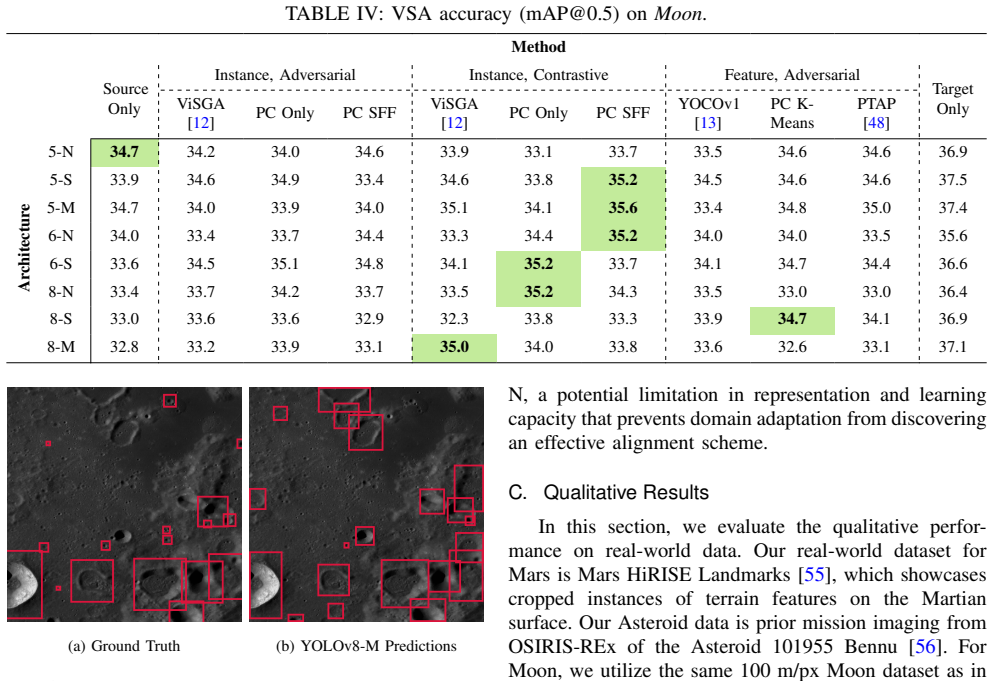
- On the Moon, all UDA methods land near 33 to 35 mAP while the fully supervised target-only oracle reaches only about 36 to 37 mAP, so the lunar experiment chiefly confirms that a resolution domain gap exists rather than cleanly ranking the UDA methods.
- The paper's qualitative results show that source-only training produces many false detections on real mission imagery, and the proposed method reduces those false detections while retaining correct ones, which is the practical outcome that matters for landing and hazard avoidance.
Reading between the lines
- The headline 'upwards of 31%' rests on a single best-cell comparison on Sim Asteroid with YOLO 8-S under contrastive instance clustering; across the full tables the median advantage of PC SFF over ViSGA is much smaller, so the strength of the central claim depends on how representative that best cell is.
- Because the incomplete lunar crater catalog depresses Moon mAP, a fair lunar comparison might actually be more favorable to strong detectors than the tables show, since the paper's own figure suggests predictions contain craters the labels missed.
- The channel-ranking idea behind Strong Feature Filtering is architecture-agnostic, so a natural testable extension is to attach PC plus SFF to other one-stage detectors on terrestrial UDA benchmarks and ablate the top-K threshold; the paper only tests a 50% threshold.
- The paper's correlation of method family with environment type, where contrastive instance clustering does well on multi-class Mars while feature clustering wins some single-class asteroid cases, suggests that a per-mission VSA selector could be learned or chosen rather than fixed.
Editorial analysis
A structured set of objections, weighed in public.
Referee Report
Summary. This manuscript proposes YOCOv2, an unsupervised domain adaptation (UDA) extension for one-stage YOLO detectors aimed at detecting terrain on Mars, the Moon, and asteroids. It generalizes the prior YOCOv1 architecture by adding a Perceptual Consistency (PC) loss that aligns multi-scale instance features and by introducing Strong Feature Filtering (SFF) and PTAP-based feature selection to make visual-similarity clustering more robust. The paper evaluates 11 loss configurations across 8 YOLO variants on six datasets (Sim Mars, Sim Asteroid, Moon), reports mAP@0.5, performs hardware latency benchmarks on a Zynq/Edge TPU platform, and shows qualitative results on HiRISE, OSIRIS-REx, and lunar imagery. The central claim, repeated in the abstract and conclusion, is that the method improves UDA accuracy by more than 31% compared with YOCOv1 and terrestrial state-of-the-art.
Significance. The proposed pipeline is a reasonable extension of visual similarity-based alignment to one-stage YOLO detectors: the PC term is a natural multi-scale feature-matching regularizer, and the SFF/PTAP mechanisms target a real difficulty in celestial imagery, namely ambiguous feature clusters in texture-poor scenes. If the quantitative claims survive proper evaluation, the method would be a useful step toward onboard UDA for terrain detection. The hardware benchmarking on a Zynq/Edge TPU platform is concrete and relevant to the stated real-time deployment goal, and the breadth of the ablation across three environments and eight YOLO variants is a clear strength. The paper also promises open-source code and datasets. However, the headline result as stated is not supported by the evidence in the paper, and the evaluation lacks multiple seeds and external baselines, so the significance currently rests on a much narrower, and partly contradicted, comparison.
major comments (5)
- [Abstract; Section IV-B4; Table III] The abstract and Section V claim "improvements upwards of 31% compared with YOCOv1 and terrestrial state-of-the-art." The only concrete evidence cited in Section IV-B4 is the Sim Asteroid / YOLO 8-S / Instance Contrastive cell, where ViSGA scores 22.1 and PC SFF scores 53.0. That is a 30.9 mAP-point gain over ViSGA, not over YOCOv1; the same Table III row lists YOCOv1 at 56.1 mAP, which is 3.1 points above PC SFF. The headline as written is therefore contradicted by the paper's own table. Please re-report this result as an absolute-point improvement over the ViSGA baseline in that cell, and either provide a head-to-head comparison with YOCOv1 or revise the abstract and conclusion to match the actual evidence.
- [Section IV-B; Tables II-IV] No standard UDA object detector from the terrestrial literature is evaluated. The comparisons in Tables II-IV are restricted to Source Only, Target Only, and internal ablations (ViSGA, PC Only, PC SFF, YOCOv1, PC K-Means, PTAP). Consequently, the "terrestrial state-of-the-art" portion of the headline claim is not operationalized and is unsupported. Please add at least one or two established UDA object detection baselines (e.g., DA-Faster R-CNN variants, SWDA, AT, or a one-stage UDA detector) on the same datasets, or restrict the claim to "compared with the evaluated baselines."
- [Tables II-IV; Section IV-B2] All quantitative results are single-run mAP values with no seeds, error bars, or significance tests. The headline 30.9-point cell in Table III is one configuration among many, and many adjacent entries differ by only 1-3 mAP points, so it is impossible to assess whether the advantages of PC SFF are reliable. Please run at least three seeds per configuration, report mean +/- standard deviation (or confidence intervals), and state whether differences are statistically significant.
- [Section IV-B5; Figure 5; Table IV] The Moon evaluation is explicitly acknowledged to be compromised by incomplete ground truth: Section IV-B5 states that the Robbins database does not label every crater, and Figure 5 shows a baseline prediction set that visually exceeds the ground truth. This systematically depresses all Moon mAP values and makes cross-method rankings in Table IV unreliable, yet Moon is one of the three environments used to support the general claim. Please either restrict the Moon evaluation to frames with verified/complete labels, use a curated subset with complete annotation, or relegate Moon results to qualitative/auxiliary evidence and remove them from the quantitative support of the central claim.
- [Section III-C; Section IV-B2] The proposed modules rely on several hand-set hyperparameters: the agglomerative clustering merging threshold (0.1), the Top-K / top-50% selection threshold for SFF and PTAP, and K=2 for K-Means. No sensitivity analysis is provided. Because SFF and PC are the paper's main contributions, the robustness of the reported gains to these choices should be demonstrated, or at least the values should be justified from validation data rather than presented as fixed constants.
minor comments (5)
- [Section IV-C] The word "Adverarial" is misspelled twice in the qualitative-experiment descriptions; please correct it to "Adversarial."
- [Table I] The CPU latency column is nearly constant (22.2-23.1 ms) across models with very different parameter and FLOP counts; please clarify what hardware/software path this column measures and why it does not scale with model size.
- [Section IV-B4; Table III] The sentence "PC SFF technique outperforms the traditional ViSGA approach in instance clustering methods, surpassing it in four of eight cases" is ambiguous: in Table III, PC SFF beats ViSGA in 11 of 16 cells if both adversarial and contrastive instance settings are counted, but in only 5 of 8 cells in the contrastive-only setting. Please state exactly which comparison set is being described.
- [Section III-C2] The description of hierarchical clustering as "dynamically assigns cluster centers" is imprecise, since agglomerative clustering with a fixed merging threshold still depends on the chosen distance threshold; please define the clustering procedure and threshold selection precisely.
- [Section III-C3] The PTAP selection in Equation (8) is described in words but not fully tied to the Top-K channel selection used for SFF; please provide a precise definition of the set K and how the top-k pixel-wise selection is performed.
Circularity Check
No significant circularity; the derivation chain is self-contained, while the headline 31% claim is internally inconsistent with Table III (a correctness issue, not a circularity issue).
full rationale
The paper's learning objective (Eq. 1) combines the standard YOLO supervised loss with global adversarial alignment (Eqs. 2-3) and instance-level contrastive or adversarial losses (Eqs. 5-6); mAP is measured after training and never appears in any loss, so no definitional circularity is present. The proposed Perceptual Consistency loss (Eq. 4) is an L1 multi-scale feature-matching regularizer adapted from cited prior work, and Strong Feature Filtering (Eqs. 7-8) is a channel-attention top-K selection operation; neither is defined in terms of the reported mAP or of YOCOv1's success. The reliance on the authors' own YOCOv1 as a baseline is normal in an incremental research line, and the paper reports concrete YOCOv1 numbers in Tables II-IV rather than treating it as an unverified premise. The abstract and conclusion claim 'improvements upwards of 31% compared with YOCOv1,' but the only cited supporting cell (Sim Asteroid, YOLO 8-S, Instance Contrastive) shows PC SFF at 53.0 versus ViSGA at 22.1, while Table III lists YOCOv1 at 56.1 on the same cell; this is an internal quantitative inconsistency and an unsupported 'terrestrial state-of-the-art' claim, not a circular derivation. No step in the claimed derivation chain is equivalent to its own input by construction.
Assumptions & free parameters
free parameters (4)
- SFF/PTAP top-K threshold =
50%
- Agglomerative clustering threshold =
0.1
- K-Means cluster count =
2
- PC scale weights =
w_i=2^{3-i}
assumptions (5)
- domain assumption Labeled source and unlabeled target imagery come from the same semantic categories and are style-similar enough for feature alignment to transfer.
- domain assumption Blender-generated Sim Mars and Sim Asteroid scenes are representative of real Mars and asteroid surfaces.
- domain assumption Instance-level features extracted from YOLO detection heads encode terrain-relevant visual similarity.
- domain assumption Robbins Moon Crater Database provides complete enough ground truth for mAP evaluation.
- standard math Adversarial domain confusion (GRL) and contrastive feature matching improve object detection in one-stage detectors.
Cite this review
Pith. "Pith review of You Only Crash Once v2: Perceptually Consistent Strong Features for One-Stage Domain Adaptive Detection of Space Terrain." pith.science (2026). https://pith.science/paper/AGNMO3DR
@misc{pith2026250113725,
  author       = {Pith},
  title        = {Pith review of: You Only Crash Once v2: Perceptually Consistent Strong Features for One-Stage Domain Adaptive Detection of Space Terrain},
  year         = {2026},
  howpublished = {\url{https://pith.science/paper/AGNMO3DR}},
  note         = {Machine review of arXiv:2501.13725}
}
read the original abstract
The in-situ detection of planetary, lunar, and small-body surface terrain is crucial for autonomous spacecraft applications, where learning-based computer vision methods are increasingly employed to enable intelligence without prior information or human intervention. However, many of these methods remain computationally expensive for spacecraft processors and prevent real-time operation. Training of such algorithms is additionally complex due to the scarcity of labeled data and reliance on supervised learning approaches. Unsupervised Domain Adaptation (UDA) offers a promising solution by facilitating model training with disparate data sources such as simulations or synthetic scenes, although UDA is difficult to apply to celestial environments where challenging feature spaces are paramount. To alleviate such issues, You Only Crash Once (YOCOv1) has studied the integration of Visual Similarity-based Alignment (VSA) into lightweight one-stage object detection architectures to improve space terrain UDA. Although proven effective, the approach faces notable limitations, including performance degradations in multi-class and high-altitude scenarios. Building upon the foundation of YOCOv1, we propose novel additions to the VSA scheme that enhance terrain detection capabilities under UDA, and our approach is evaluated across both simulated and real-world data. Our second YOCO rendition, YOCOv2, is capable of achieving state-of-the-art UDA performance on surface terrain detection, where we showcase improvements upwards of 31% compared with YOCOv1 and terrestrial state-of-the-art. We demonstrate the practical utility of YOCOv2 with spacecraft flight hardware performance benchmarking and qualitative evaluation of NASA mission data.
Figures


Figures from the paper (5 more)



Forward citations
Cited by 1 Pith paper
-
Domain Adaptation and Multi-view Attention for Learnable Landmark Tracking with Sparse Data
A two-page poster restates the authors' prior YOCO and MARs methods for onboard landmark tracking and claims superior performance without providing new evidence.
Reference graph
Works this paper leans on
-
[1]
D. A. Lorenz et al. Lessons learned from osiris-rex autonomous navigation using natural feature tracking In 2017 IEEE Aerospace Conference . IEEE, 2017, pp. 1–12
work page 2017
-
[2]
C. Norman et al. Autonomous navigation performance using natural feature tracking during the osiris-rex touch-and-go sample collection event The Planetary Science Journal , vol. 3, no. 5, p. 101, 2022
work page 2022
-
[3]
C. A. Wright, J. Van Eepoel, A. Liounis, M. Shoemaker, K. De- Weese, and K. Getzandanner Relative terrain imaging navigation (retina) tool for the asteroid redirect robotic mission (arrm) In Guidance and Control Conference , no. AAS 16-084, 2016
work page 2016
-
[4]
A. E. Johnson et al. Mars 2020 lander vision system flight performance In AIAA SciTech 2022 F orum, 2022, p. 1214
work page 2020
-
[5]
J. Goodwill et al. Nasa SpaceCube Edge TPU SmallSat Card for Autonomous Operations and Onboard Science-Data Analysis Small Satellite Conference , 2021
work page 2021
-
[6]
T. Chase Jr, J. Goodwill, K. Dantu, and C. Wilson Profiling vision-based deep learning architectures on nasa spacecube platforms In 2024 IEEE Aerospace Conference , 2024, pp. 1–16
work page 2024
-
[7]
T. Chase Jr and K. Dantu Mars: Multi-view attention regularizations for patch-based fea- ture recognition of space terrain In European Conference on Computer Vision . Springer, 2025, pp. 219–239
work page 2025
-
[8]
R. Giubilato, W. Sturzl, A. Wedler, and R. Triebel Challenges of slam in extremely unstructured environments: The dlr planetary stereo, solid-state lidar, inertial dataset IEEE Robotics and Automation Letters , vol. 7, pp. 8721–8728, 2022
work page 2022
Show all 56 references
-
[9]
Giubilato, C
R. Giubilato, C. L. Gentil, M. Vayugundla, M. J. Schuster, T. Vidal- Calleja, and R. Triebel Gpgm-slam: a robust slam system for unstructured planetary environments with gaussian process gradient maps arXiv preprint arXiv:2109.06596 , 2021
2021 arXiv
-
[10]
C. L. Gentil, M. Vayugundla, R. Giubilato, W. Sturzl, T. Vidal- Calleja, and R. Triebel Gaussian process gradient maps for loop-closure detection in unstructured planetary environments 2020 IEEE/RSJ International Conference on Intelligent Robots and Systems (IROS) , pp. 1895–1...
2020
-
[11]
C. Gnam, T. Chase Jr, K. Dantu, and J. L. Crassidis Efficient feature matching and mapping for terrain relative navigation using hypothesis gating In AIAA SCITECH 2022 F orum , 2022, p. 2513
2022
-
[12]
Rezaeianaran, R
F. Rezaeianaran, R. Shetty, R. Aljundi, D. O. Reino, S. Zhang, and B. Schiele Seeking similarities over differences: Similarity-based domain alignment for adaptive object detection In Proceedings of the IEEE/CVF International Conference on Computer Vision, 2021, pp. 9204–9213
2021
-
[13]
Chase Jr, C
T. Chase Jr, C. Gnam, J. Crassidis, and K. Dantu You only crash once: Improved object detection for real-time, sim-to-real hazardous terrain detection and classification for autonomous planetary landings arXiv preprint arXiv:2303.04891 , 2023
2023 arXiv
-
[14]
Emami, G
E. Emami, G. Bebis, A. Nefian, and T. Fong Automatic crater detection using convex grouping and convo- lutional neural networks In Advances in Visual Computing: 11th International Sympo- sium, ISVC 2015, Las V egas, NV , USA, December 14-16, 2015, Proceedings, Part II 11 . Spr...
2015
-
[15]
Rolen and S
A. Rolen and S. Singh Autonomous navigation via a cascading cnn framework lever- aging synthetic terrain images In International Symposium on Visual Computing . Springer, 2023, pp. 529–540
2023
-
[16]
Silburt et al
A. Silburt et al. Lunar crater identification via deep learning Icarus, vol. 317, pp. 27–38, 2019
2019
-
[17]
D. M. DeLatte, S. T. Crites, N. Guttenberg, E. J. Tasker, and T. Yairi Segmentation convolutional neural networks for automatic crater detection on mars IEEE Journal of Selected Topics in Applied Earth Observations and Remote Sensing , vol. 12, no. 8, pp. 2944–2957, 2019
2019
-
[18]
D. Chen, F. Hu, P. T. Mathiopoulos, Z. Zhang, and J. Peethambaran Mc-unet: Martian crater segmentation at semantic and instance levels using u-net-based convolutional neural network Remote Sensing , vol. 15, no. 1, p. 266, 2023
2023
-
[19]
L. M. Downes, T. J. Steiner, and J. P. How Lunar terrain relative navigation using a convolutional neural network for visual crater detection In 2020 American Control Conference (ACC) . IEEE, 2020, pp. 4448–4453
2020
-
[20]
L. M. Downes, T. J. Steiner, and J. P. How Neural network approach to crater detection for lunar terrain relative navigation Journal of Aerospace Information Systems , vol. 18, no. 7, pp. 391–403, 2021
2021
-
[21]
Fairweather, A
J. Fairweather, A. Lagain, K. Servis, G. Benedix, S. Kumar, and P. Bland Automatic mapping of small lunar impact craters using lro-nac images Earth and Space Science , vol. 9, no. 7, p. e2021EA002177, 2022
2022
-
[22]
C. Zou, J. Lai, Y . Liu, F. Cui, Y . Xu, and L. Qiao Small lunar crater identification and age estimation in chang’e-5 landing area based on improved faster r-cnn Icarus, vol. 410, p. 115909, 2024
2024
-
[23]
Del Prete, A
R. Del Prete, A. Saveriano, and A. Renga A deep learning-based crater detector for autonomous vision- based spacecraft navigation In 2022 IEEE 9th International Workshop on Metrology for AeroSpace (MetroAeroSpace). IEEE, 2022, pp. 231–236
2022
-
[24]
Gao and S
A. Gao and S. Zhou Feature density based terrain hazard detection for planetary landing IEEE Transactions on Aerospace and Electronic Systems , vol. 54, no. 5, pp. 2411–2420, 2018
2018
-
[25]
Li and C.-Y
W. Li and C.-Y . Hsu Automated terrain feature identification from remote sensing imagery: a deep learning approach International Journal of Geographical Information Science , vol. 34, no. 4, pp. 637–660, 2020
2020
-
[26]
G. A. Landis et al. Mission incredible: A titan sample return using in-situ propel- lants In AIAA SciTech 2022 F orum, 2022, p. 1570
2022
-
[27]
S. M. MacKenzie et al. The enceladus orbilander mission concept: Balancing return and resources in the search for life The Planetary Science Journal , vol. 2, no. 2, p. 77, 2021
2021
-
[28]
Y . Liu, J. Wang, C. Huang, Y . Wu, Y . Xu, and X. Cao Mlfa: Towards realistic test time adaptive object detection by multi-level feature alignment IEEE Transactions on Image Processing , 2024
2024
-
[29]
Triantafyllidou, S
D. Triantafyllidou, S. Parisot, A. Leonardis, and S. McDonagh Improving object detection via local-global contrastive learning arXiv preprint arXiv:2410.05058 , 2024
2024 arXiv
-
[30]
Z. Qiao, D. Shi, S. Jin, Y . Shi, Z. Wang, and C. Qiu Chase Jr Et al.: You Only Crash Once v2 11 Jfdi: Joint feature differentiation and interaction for domain adaptive object detection Neural Networks , vol. 180, p. 106682, 2024
2024
-
[31]
Chen et al
J. Chen et al. Cross domain object detection via multi-granularity confidence alignment based mean teacher arXiv preprint arXiv:2407.07780 , 2024
2024 arXiv
-
[32]
Ashraf, K
T. Ashraf, K. Rangarajan, M. Gambhir, R. Gauba, and C. Arora D-master: Mask annealed transformer for unsupervised domain adaptation in breast cancer detection from mammograms In International Conference on Medical Image Computing and Computer-Assisted Intervention . Springer, ...
2024
-
[33]
Li et al
H. Li et al. React: Remainder adaptive compensation for domain adaptive object detection IEEE Transactions on Image Processing , 2024
2024
-
[34]
Gerster, H
R. Gerster, H. Caesar, M. Rapp, A. Wolpert, and M. Teutsch Ossa: Unsupervised one-shot style adaptation arXiv preprint arXiv:2410.00900 , 2024
2024 arXiv
-
[35]
R. Chen, D. Lv, L. Dai, L. Jin, and Z. Xiang Advmix: Adversarial mixing strategy for unsupervised domain adaptive object detection Electronics, vol. 13, no. 4, p. 685, 2024
2024
-
[36]
Wei and Q
J. Wei and Q. Wang Tri-flow-yolo: Counter helps to improve cross-domain object detection Heliyon, 2024
2024
-
[37]
Jiang et al
Z. Jiang et al. Inter-domain invariant cross-domain object detection using style and content disentanglement for in-vehicle images Remote Sensing , vol. 16, no. 2, p. 304, 2024
2024
-
[38]
Y . Bai, C. Liu, R. Yang, and X. Li Misalignment-resistant domain adaptive learning for one-stage object detection Knowledge-Based Systems , p. 112605, 2024
2024
-
[39]
A. U. Rehman and I. Gallo Cross-pollination of knowledge for object detection in domain adaptation for industrial automation International Journal of Intelligent Robotics and Applications , pp. 1–19, 2024
2024
-
[40]
J. Jin, E. Jeong, J. Cho, and Y .-G. Kim Self-supervised domain adaptation for 6dof pose estimation IEEE Access , 2024
2024
-
[41]
Y . Ma, L. Chai, L. Jin, and J. Yan Hierarchical alignment network for domain adaptive object detection in aerial images ISPRS Journal of Photogrammetry and Remote Sensing , vol. 208, pp. 39–52, 2024
2024
-
[42]
Jocher et al
G. Jocher et al. ultralytics/yolov5: v6. 1-tensorrt, tensorflow edge tpu and open- vino export and inference Zenodo, 2022
2022
-
[43]
Li et al
C. Li et al. Yolov6: A single-stage object detection framework for industrial applications arXiv preprint arXiv:2209.02976 , 2022
2022 arXiv
-
[44]
Varghese and M
R. Varghese and M. Sambath Yolov8: A novel object detection algorithm with enhanced performance and robustness In 2024 International Conference on Advances in Data En- gineering and Intelligent Computing Systems (ADICS) . IEEE, 2024, pp. 1–6
2024
-
[45]
Ganin and V
Y . Ganin and V . Lempitsky Unsupervised domain adaptation by backpropagation In International conference on machine learning . PMLR, 2015, pp. 1180–1189
2015
-
[46]
Bruls, H
T. Bruls, H. Porav, L. Kunze, and P. Newman The right (angled) perspective: Improving the understanding of road scenes using boosted inverse perspective mapping In 2019 IEEE Intelligent V ehicles Symposium (IV). IEEE, 2019, pp. 302–309
2019
-
[47]
Wang, M.-Y
T.-C. Wang, M.-Y . Liu, J.-Y . Zhu, A. Tao, J. Kautz, and B. Catan- zaro High-resolution image synthesis and semantic manipulation with conditional gans In Proceedings of the IEEE conference on computer vision and pattern recognition, 2018, pp. 8798–8807
2018
-
[48]
M. Ki, Y . Uh, J. Choe, and H. Byun Contrastive attention maps for self-supervised co-localization In Proceedings of the IEEE/CVF International Conference on Computer Vision, 2021, pp. 2803–2812
2021
-
[49]
Lin Network in network arXiv preprint arXiv:1312.4400 , 2013
M. Lin Network in network arXiv preprint arXiv:1312.4400 , 2013
2013 arXiv
-
[50]
T. Chen, C. Luo, and L. Li Intriguing properties of contrastive losses Advances in Neural Information Processing Systems , vol. 34, pp. 11 834–11 845, 2021
2021
-
[51]
Brewer et al
C. Brewer et al. Nasa spacecube intelligent multi-purpose system for enabling remote sensing, communication, and navigation in mission architectures In Small Satellite Conference 2020 , no. SSC20-VI-07, 2020
2020
-
[52]
Speyerer, M
E. Speyerer, M. Robinson, B. Denevi, L. S. Team et al. Lunar reconnaissance orbiter camera global morphological map of the moon In 42nd annual lunar and planetary science conference , no. 1608, 2011, p. 2387
2011
-
[53]
S. J. Robbins A new global database of lunar impact craters¿ 1–2 km: 1. crater locations and sizes, comparisons with published databases, and global analysis Journal of Geophysical Research: Planets , vol. 124, no. 4, pp. 871–892, 2019
2019
-
[54]
Jocher, J
G. Jocher, J. Qiu, and A. Chaurasia Ultralytics YOLO Jan. 2023. [Online]. Available: https://github.com/ultralytics/ ultralytics
2023
-
[55]
Doran, S
G. Doran, S. Lu, L. Mandrake, and K. Wagstaff Mars orbital image (hirise) labeled data set version 3 NASA: Washington, DC, USA , vol. 6, p. 2, 2019
2019
-
[56]
Rizk et al
B. Rizk et al. Ocams: the osiris-rex camera suite Space Science Reviews , vol. 214, pp. 1–55, 2018. 12 IEEE TRANSACTIONS ON AEROSPACE AND ELECTRONIC SYSTEMS VOL. XX, No. XX XXXXX 2024
2018
Reviewed August 10, 2026 · model on record in the stance chip above.
Discussion (0). Continue with ORCID to comment.