From Prediction Uncertainty to Conformalized Distance Fields for Safe Motion Planning
Pith reviewed 2026-07-02 11:27 UTC · model grok-4.3
The pith
Functional conformal prediction on the full distance field yields a uniform, distribution-free safety bound for trajectories.
A machine-rendered reading of the paper's core claim, the machinery that carries it, and where it could break.
Core claim
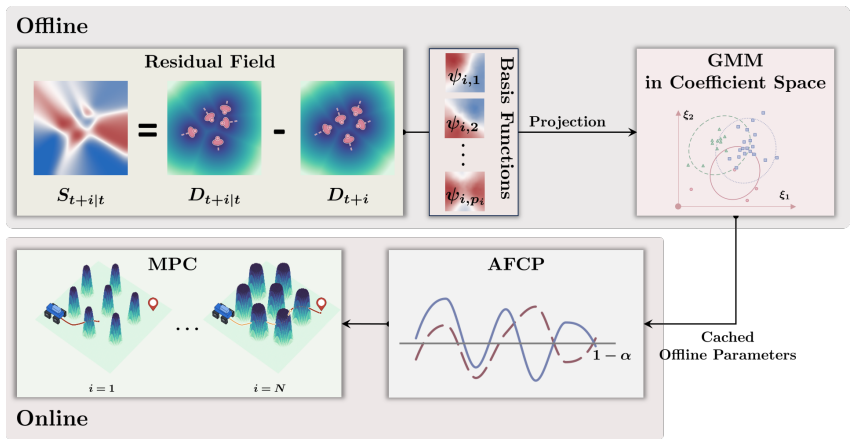
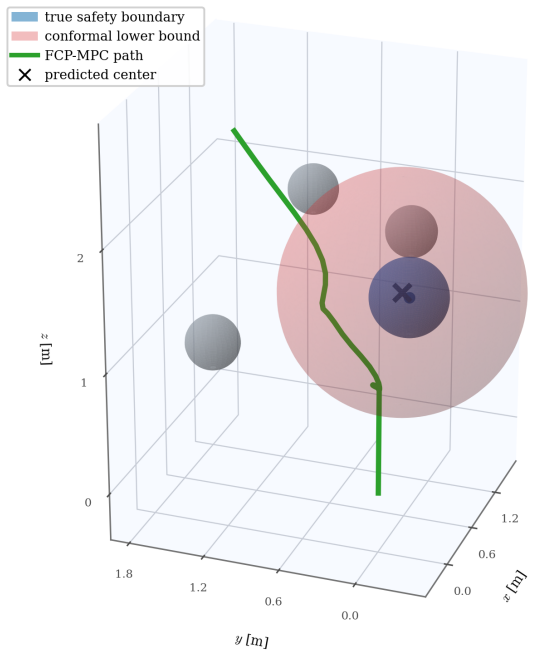
The functional conformal prediction framework conformalizes the predicted distance field at once to obtain a field-level lower bound. Safety follows uniformly because any trajectory satisfying the constraint is certified safe, independent of how the control space is sampled. The bound is constructed offline via functional PCA and Gaussian-mixture inductive conformal prediction on the low-dimensional coefficients, then updated online by a lightweight adaptive procedure that maintains coverage under distribution shift.
What carries the argument
Functional conformal prediction (FCP) applied directly to the residual distance field, which is made decomposable in coefficient space by its empirically low-rank and approximately time-invariant structure.
If this is right
- Any trajectory obeying the conformalized field constraint is certified safe regardless of sampling density.
- Per-step computation stays largely independent of the number of dynamic obstacles.
- Long-run field coverage is retained under distribution shift via the adaptive online update.
- The resulting FCP-MPC reaches goals in dense 3D scenes where pointwise conformal baselines become overly conservative or computationally prohibitive.
Where Pith is reading between the lines
- The low-rank decomposition could be reused to conformalize other predicted spatial quantities such as velocity or cost fields.
- The uniform safety property independent of sampling may allow direct substitution into continuous optimization planners.
- The adaptive functional update could be extended to handle non-stationary obstacle dynamics beyond the tested pedestrian and quadrotor cases.
Load-bearing premise
The residual distance field must be empirically low-rank and approximately time-invariant so the conformal bound can be decomposed in coefficient space.
What would settle it
A test set in which the empirical coverage of the field-level lower bound falls below the nominal target level would falsify the distribution-free safety claim.
Figures



read the original abstract
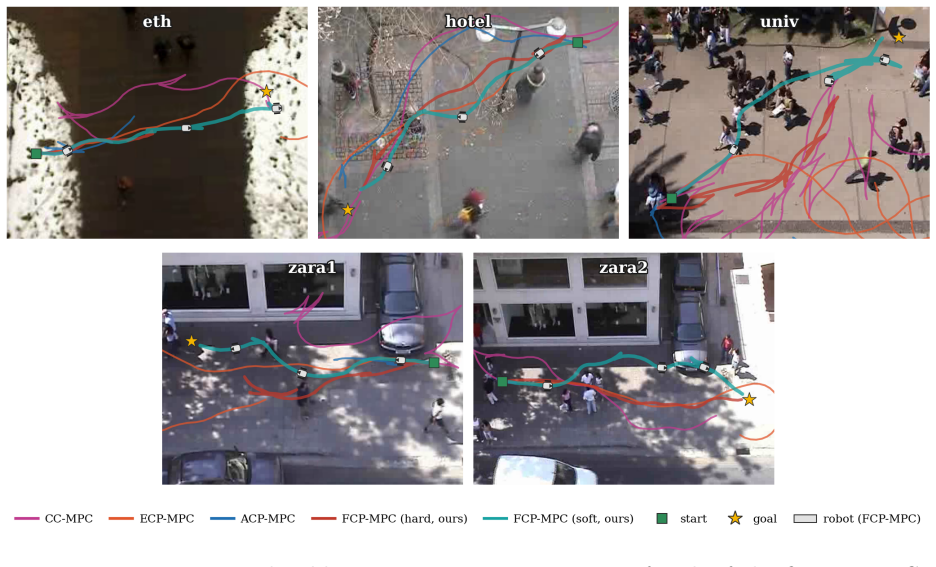
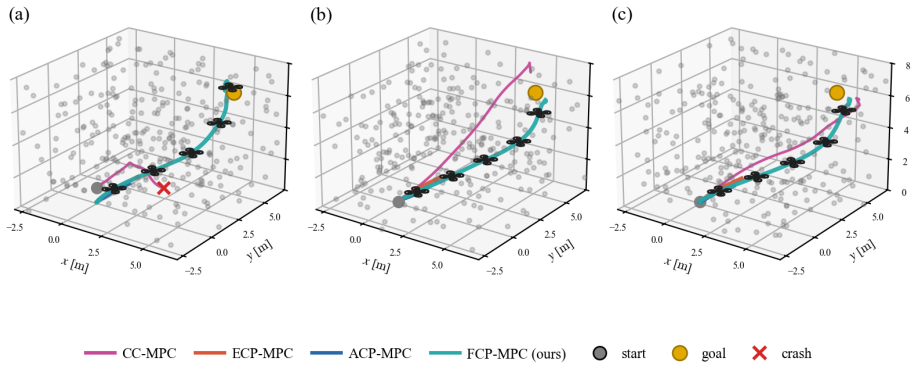
Safe motion planning in dynamic environments requires reasoning about the uncertainty in predicted obstacle motion without sacrificing real-time performance. Existing conformal approaches conformalize a scalar score that aggregates per-obstacle prediction errors, losing spatial coherence and scaling poorly with scene density. We instead conformalize the entire predicted distance field at once. This functional conformal prediction (FCP) framework yields a distribution-free, field-level lower bound, from which safety follows uniformly: any trajectory satisfying the resulting constraint is certified safe, independent of how the control space is sampled. The key enabler is that the residual distance field is empirically low-rank and approximately time-invariant, which makes the bound decomposable in coefficient space. An envelope is fitted offline via functional PCA and a Gaussian-mixture inductive conformal procedure, then refined online by a lightweight adaptive functional conformal (AFCP) update on a low-dimensional vector. This keeps the per-step cost largely insensitive to obstacle count and retains long-run field coverage under distribution shift. We embed the envelope as a tightened safety constraint in a sampling-based model predictive controller, FCP-MPC. On the ETH--UCY pedestrian benchmarks and a dense 3D quadrotor task with up to 280 dynamic obstacles, FCP-MPC attains a favorable balance of safety, feasibility, and efficiency, reaching goals where pointwise and egocentric conformal baselines become too conservative or too expensive, while keeping per-step computation far below online uncertainty-reasoning baselines.
Editorial analysis
A structured set of objections, weighed in public.
Referee Report
Summary. The paper proposes a functional conformal prediction (FCP) framework to obtain a distribution-free, field-level lower bound on predicted distance fields for safe motion planning. It exploits an empirical low-rank and approximately time-invariant structure of the residual distance field to enable offline functional PCA plus GMM inductive conformal prediction, followed by a lightweight adaptive functional conformal (AFCP) online update; the resulting envelope is embedded as a tightened constraint in sampling-based MPC (FCP-MPC). Experiments on ETH-UCY pedestrian data and a dense 3D quadrotor scenario with up to 280 obstacles report favorable safety-feasibility-efficiency trade-offs relative to pointwise and egocentric conformal baselines.
Significance. If the low-rank/time-invariance approximation error can be controlled and the conformal coverage transfers to the true field, the approach supplies a uniform safety certificate independent of control-space sampling density while keeping per-step cost largely insensitive to obstacle count. This addresses a practical limitation of scalar conformal methods in dense dynamic scenes and demonstrates concrete gains on standard benchmarks.
major comments (2)
- [Abstract] Abstract: the distribution-free field-level lower bound and uniform safety claim for arbitrary trajectories rest on the statement that 'the residual distance field is empirically low-rank and approximately time-invariant, which makes the bound decomposable in coefficient space.' No quantification of truncation or time-invariance error is supplied; if this error is non-negligible in regions that affect collision checking, the conformal coverage guarantee applies only to the projected field and the safety certificate is no longer distribution-free.
- [Abstract] Abstract: the claim that 'long-run field coverage under distribution shift' is retained by the AFCP update is stated without reference to a theorem or lemma establishing that the adaptive procedure preserves marginal coverage when the low-rank decomposition is only approximate.
minor comments (1)
- The abstract asserts that per-step computation remains 'far below online uncertainty-reasoning baselines,' but does not indicate whether this comparison includes the offline PCA/GMM fitting cost amortized over the run.
Simulated Author's Rebuttal
We thank the referee for the careful reading and constructive major comments. We address each point below and will incorporate revisions to strengthen the error analysis and theoretical support for the coverage claims.
read point-by-point responses
-
Referee: [Abstract] Abstract: the distribution-free field-level lower bound and uniform safety claim for arbitrary trajectories rest on the statement that 'the residual distance field is empirically low-rank and approximately time-invariant, which makes the bound decomposable in coefficient space.' No quantification of truncation or time-invariance error is supplied; if this error is non-negligible in regions that affect collision checking, the conformal coverage guarantee applies only to the projected field and the safety certificate is no longer distribution-free.
Authors: We agree that the current manuscript presents the low-rank and time-invariance properties empirically without quantitative error bounds, which leaves open the possibility that coverage holds only for the projected field. In the revision we will add a dedicated subsection (and corresponding appendix figures) that reports (i) the cumulative explained variance from functional PCA truncation on both the ETH-UCY and quadrotor datasets and (ii) the L2 norm of the time-invariance residual over sliding windows. These metrics will be evaluated specifically in the vicinity of obstacle surfaces to confirm that approximation error remains negligible where collision checking occurs. The safety certificate will be restated to apply to trajectories that satisfy the conformal envelope on the low-rank reconstruction, with the added error analysis bounding the difference to the true field. revision: yes
-
Referee: [Abstract] Abstract: the claim that 'long-run field coverage under distribution shift' is retained by the AFCP update is stated without reference to a theorem or lemma establishing that the adaptive procedure preserves marginal coverage when the low-rank decomposition is only approximate.
Authors: The manuscript asserts long-run coverage retention via the AFCP update but does not supply a formal lemma that accounts for inexact low-rank decomposition. We will add a short lemma in the appendix that decomposes the coverage gap into the standard inductive conformal deviation plus an additive term controlled by the approximation error (already quantified in the new error analysis). The lemma will show that marginal coverage is retained asymptotically whenever the approximation error is bounded, thereby justifying the distribution-shift claim under the empirically observed conditions. revision: yes
Circularity Check
No significant circularity detected
full rationale
The derivation applies standard conformal prediction theory to coefficients obtained from an empirical functional PCA decomposition. The low-rank and time-invariance properties are presented explicitly as empirical observations that enable the decomposition, not as results derived from the safety bound itself. No equation reduces the field-level lower bound to a fitted parameter or self-citation by construction, and the coverage guarantee remains distribution-free under the stated procedure. The chain is therefore self-contained against external conformal prediction results.
Axiom & Free-Parameter Ledger
free parameters (2)
- number of functional PCA components
- GMM mixture components and conformal quantile
axioms (2)
- domain assumption Residual distance field is empirically low-rank and approximately time-invariant
- standard math Standard conformal prediction coverage guarantees apply to the functional setting after PCA projection
Reference graph
Works this paper leans on
-
[1]
Chance-constrained optimal path planning with obstacles,
L. Blackmore, M. Ono, and B. C. Williams, “Chance-constrained optimal path planning with obstacles,”IEEE Transactions on Robotics, vol. 27, no. 6, pp. 1080–1094, 2011
work page 2011
-
[2]
Risk-aware motion planning and control using cvar- constrained optimization,
A. Hakobyan, G. C. Kim, and I. Yang, “Risk-aware motion planning and control using cvar- constrained optimization,”IEEE Robotics and Automation letters, vol. 4, no. 4, pp. 3924–3931, 2019
work page 2019
-
[3]
STEP: Stochastic traversability evaluation and planning for risk-aware off-road navigation,
D. D. Fan, K. Otsu, Y. Kubo, A. Dixit, J. Burdick, and A.-A. Agha-Mohammadi, “STEP: Stochastic traversability evaluation and planning for risk-aware off-road navigation,”Robotics: Science and Systems XVII, 2021
work page 2021
-
[4]
A. Hakobyan and I. Yang, “Wasserstein distributionally robust motion control for collision avoidance using conditional value-at-risk,”IEEE Transactions on Robotics, vol. 38, no. 2, pp. 939–957, 2021
work page 2021
-
[5]
V. Vovk, A. Gammerman, and G. Shafer,Algorithmic Learning in a Random World. Springer, 2005
work page 2005
-
[6]
Conformal prediction: A gentle introduction,
A. N. Angelopoulos and S. Bates, “Conformal prediction: A gentle introduction,”Foundations and Trends in Machine Learning, vol. 16, no. 4, pp. 494–591, 2023
work page 2023
-
[7]
Adaptive conformal inference under distribution shift,
I. Gibbs and E. Cand` es, “Adaptive conformal inference under distribution shift,” inAdvances in Neural Information Processing Systems, vol. 34, 2021, pp. 1660–1672
work page 2021
-
[8]
Safe planning in dynamic envi- ronments using conformal prediction,
L. Lindemann, M. Cleaveland, G. Shim, and G. J. Pappas, “Safe planning in dynamic envi- ronments using conformal prediction,”IEEE Robotics and Automation Letters, vol. 8, no. 8, pp. 5116–5123, 2023
work page 2023
-
[9]
Adaptive conformal prediction for motion planning among dynamic agents,
A. Dixit, L. Lindemann, S. X. Wei, M. Cleaveland, G. J. Pappas, and J. W. Burdick, “Adaptive conformal prediction for motion planning among dynamic agents,” inProceedings of The 5th Annual Learning for Dynamics and Control Conference, vol. 211, 2023, pp. 300–314
work page 2023
-
[10]
Z. Mei, A. Dixit, M. Booker, E. Zhou, M. Storey-Matsutani, A. Z. Ren, O. Shorinwa, and A. Majumdar, “Perceive with confidence: Statistical safety assurances for navigation with learning-based perception,”The International Journal of Robotics Research, vol. 45, no. 6, pp. 938–967, 2025
work page 2025
-
[11]
Conformal deci- sion theory: Safe autonomous decisions from imperfect predictions,
J. Lekeufack, A. N. Angelopoulos, A. Bajcsy, M. I. Jordan, and J. Malik, “Conformal deci- sion theory: Safe autonomous decisions from imperfect predictions,” inIEEE International Conference on Robotics and Automation, 2024, pp. 11 668–11 675
work page 2024
-
[12]
Safe, out-of-distribution-adaptive MPC with conformalized neural network ensembles,
J. L. Contreras, O. Shorinwa, and M. Schwager, “Safe, out-of-distribution-adaptive MPC with conformalized neural network ensembles,” inProceedings of The 7th Annual Learning for Dynamics and Control Conference, 2025
work page 2025
-
[13]
Safe planning in unknown environments using conformalized semantic maps,
D. S. Sundarsingh, Y. Li, T. Tang, G. J. Pappas, N. Atanasov, and Y. Kantaros, “Safe planning in unknown environments using conformalized semantic maps,”IEEE Robotics and Automation Letters, vol. 11, no. 4, pp. 4921–4928, 2026
work page 2026
-
[14]
Simultaneous localiza- tion, mapping and moving object tracking,
C.-C. Wang, C. Thorpe, S. Thrun, M. Hebert, and H. Durrant-Whyte, “Simultaneous localiza- tion, mapping and moving object tracking,”The International Journal of Robotics Research, vol. 26, no. 9, pp. 889–916, 2007
work page 2007
-
[15]
Bayesian occupancy filtering for multitarget tracking: An automotive application,
C. Cou´ e, C. Pradalier, C. Laugier, T. Fraichard, and P. Bessi` ere, “Bayesian occupancy filtering for multitarget tracking: An automotive application,”The International Journal of Robotics Research, vol. 25, no. 1, pp. 19–30, 2006
work page 2006
-
[16]
Modeling and tracking the driving environment with a particle-based occupancy grid,
R. Danescu, F. Oniga, and S. Nedevschi, “Modeling and tracking the driving environment with a particle-based occupancy grid,”IEEE Transactions on Intelligent Transportation Systems, vol. 12, no. 4, pp. 1331–1342, 2011
work page 2011
-
[17]
G. Tanzmeister, J. Thomas, D. Wollherr, and M. Buss, “Grid-based mapping and tracking in dynamic environments using a uniform evidential environment representation,” inIEEE International Conference on Robotics and Automation, 2014, pp. 6090–6095
work page 2014
-
[18]
A random finite set approach for dynamic occupancy grid maps with real-time application,
D. Nuss, S. Reuter, M. Thom, T. Yuan, G. Krehl, M. Maile, A. Gern, and K. Dietmayer, “A random finite set approach for dynamic occupancy grid maps with real-time application,”The International Journal of Robotics Research, vol. 37, no. 8, pp. 841–866, 2018
work page 2018
-
[19]
Continuous occupancy mapping in dynamic environments using particles,
G. Chen, W. Dong, P. Peng, J. Alonso-Mora, and X. Zhu, “Continuous occupancy mapping in dynamic environments using particles,”IEEE Transactions on Robotics, vol. 40, pp. 64–84, 2023
work page 2023
-
[20]
DeepSDF: Learning con- tinuous signed distance functions for shape representation,
J. J. Park, P. Florence, J. Straub, R. Newcombe, and S. Lovegrove, “DeepSDF: Learning con- tinuous signed distance functions for shape representation,” inProceedings of the IEEE/CVF Conference on Computer Vision and Pattern Recognition, 2019, pp. 165–174
work page 2019
-
[21]
iSDF: Real-time neural signed distance fields for robot perception,
J. Ortiz, A. Clegg, J. Dong, E. Sucar, D. Novotny, M. Zollhoefer, and M. Mukadam, “iSDF: Real-time neural signed distance fields for robot perception,” inProceedings of Robotics: Sci- ence and Systems, New York City, NY, USA, Jun. 2022
work page 2022
-
[22]
KinectFusion: Real-time dense surface mapping and tracking,
R. A. Newcombe, S. Izadi, O. Hilliges, D. Molyneaux, D. Kim, A. J. Davison, P. Kohli, J. Shotton, S. Hodges, and A. Fitzgibbon, “KinectFusion: Real-time dense surface mapping and tracking,” inIEEE International Symposium on Mixed and Augmented Reality, 2011, pp. 127–136
work page 2011
-
[23]
Trajectron++: Dynamically- feasible trajectory forecasting with heterogeneous data,
T. Salzmann, B. Ivanovic, P. Chakravarty, and M. Pavone, “Trajectron++: Dynamically- feasible trajectory forecasting with heterogeneous data,” inEuropean Conference on Computer Vision, 2020, pp. 683–700
work page 2020
-
[24]
Probabilistic collision checking with chance constraints,
N. E. Du Toit and J. W. Burdick, “Probabilistic collision checking with chance constraints,” IEEE Transactions on Robotics, vol. 27, no. 4, pp. 809–815, 2011
work page 2011
-
[25]
Robot motion planning in dynamic, uncertain environments,
——, “Robot motion planning in dynamic, uncertain environments,”IEEE Transactions on Robotics, vol. 28, no. 1, pp. 101–115, 2011
work page 2011
-
[26]
Optimization-based collision avoidance,
X. Zhang, A. Liniger, and F. Borrelli, “Optimization-based collision avoidance,”IEEE Trans- actions on Control Systems Technology, vol. 29, no. 3, pp. 972–983, 2020
work page 2020
-
[27]
Computing large convex regions of obstacle-free space through semidefinite programming,
R. Deits and R. Tedrake, “Computing large convex regions of obstacle-free space through semidefinite programming,” inAlgorithmic Foundations of Robotics XI: Selected Contributions of the Eleventh International Workshop on the Algorithmic Foundations of Robotics, 2015, pp. 109–124
work page 2015
-
[28]
Collision-free encoding for chance-constrained nonconvex path planning,
M. da Silva Arantes, C. F. M. Toledo, B. C. Williams, and M. Ono, “Collision-free encoding for chance-constrained nonconvex path planning,”IEEE Transactions on Robotics, vol. 35, no. 2, pp. 433–448, 2019
work page 2019
-
[29]
A. Hakobyan and I. Yang, “Distributionally robust optimization with unscented transform for learning-based motion control in dynamic environments,” inIEEE International Conference on Robotics and Automation, 2023, pp. 3225–3232
work page 2023
-
[30]
——, “Distributionally robust risk map for learning-based motion planning and control: A semidefinite programming approach,”IEEE Transactions on Robotics, vol. 39, no. 1, pp. 718– 737, 2022
work page 2022
-
[31]
A conformal prediction approach to explore functional data,
J. Lei, A. Rinaldo, and L. Wasserman, “A conformal prediction approach to explore functional data,”Annals of Mathematics and Artificial Intelligence, vol. 74, no. 1–2, pp. 29–43, 2015
work page 2015
-
[32]
Egocentric conformal prediction for safe and efficient navigation in dynamic cluttered environments,
J. Shin, J. Lee, and I. Yang, “Egocentric conformal prediction for safe and efficient navigation in dynamic cluttered environments,” inIEEE Conference on Decision and Control, 2025, pp. 4910–4917
work page 2025
-
[33]
Frontier-based exploration using multiple robots,
B. Yamauchi, “Frontier-based exploration using multiple robots,” inProceedings of the Second International Conference on Autonomous Agents, 1998, pp. 47–53
work page 1998
-
[34]
AgentFormer: Agent-aware transformers for socio-temporal multi-agent forecasting,
Y. Yuan, X. Weng, Y. Ou, and K. M. Kitani, “AgentFormer: Agent-aware transformers for socio-temporal multi-agent forecasting,” inProceedings of the IEEE/CVF International Conference on Computer Vision, 2021, pp. 9813–9823
work page 2021
-
[35]
HiVT: Hierarchical vector transformer for multi- agent motion prediction,
Z. Zhou, L. Ye, J. Wang, K. Wu, and K. Lu, “HiVT: Hierarchical vector transformer for multi- agent motion prediction,” inProceedings of the IEEE/CVF Conference on Computer Vision and Pattern Recognition, 2022, pp. 8823–8833
work page 2022
-
[36]
Y. Fu, Q. Yan, L. Wang, K. Li, and R. Liao, “MoFlow: One-step flow matching for human trajectory forecasting via implicit maximum likelihood estimation based distillation,” inPro- ceedings of the Computer Vision and Pattern Recognition Conference, 2025, pp. 17 282–17 293
work page 2025
-
[37]
KoopCast: Trajectory forecasting via Koopman operators,
J. Lee, J. Shin, G. Kim, J. Han, and I. Yang, “KoopCast: Trajectory forecasting via Koopman operators,” inIEEE International Conference on Robotics and Automation, 2026
work page 2026
-
[38]
A. Lerner, Y. Chrysanthou, and D. Lischinski, “Crowds by example,” inComputer Graphics Forum, vol. 26, no. 3. Wiley Online Library, 2007, pp. 655–664
work page 2007
-
[39]
You’ll never walk alone: Modeling social behavior for multi-target tracking,
S. Pellegrini, A. Ess, K. Schindler, and L. Van Gool, “You’ll never walk alone: Modeling social behavior for multi-target tracking,” inProceedings of the IEEE/CVF International Conference on Computer Vision, 2009, pp. 261–268
work page 2009
-
[40]
Information theoretic MPC for model-based reinforcement learning,
G. Williams, N. Wagener, B. Goldfain, P. Drews, J. M. Rehg, B. Boots, and E. A. Theodorou, “Information theoretic MPC for model-based reinforcement learning,” inInternational Con- ference on Robotics and Automation (ICRA), 2017, pp. 1714–1721
work page 2017
-
[41]
Inevitable collision states — a step towards safer robots?
T. Fraichard and H. Asama, “Inevitable collision states — a step towards safer robots?” Advanced Robotics, vol. 18, no. 10, pp. 1001–1024, 2004
work page 2004
-
[42]
Feasibility issues in linear model predictive control,
P. O. M. Scokaert and J. B. Rawlings, “Feasibility issues in linear model predictive control,” AIChE Journal, vol. 45, no. 8, pp. 1649–1659, 1999
work page 1999
-
[43]
Soft constraints and exact penalty functions in model predictive control,
E. C. Kerrigan and J. M. Maciejowski, “Soft constraints and exact penalty functions in model predictive control,” inProceedings of the UKACC International Conference on Control, 2000
work page 2000
-
[44]
J. Nocedal and S. J. Wright,Numerical Optimization, 2nd ed., ser. Springer Series in Opera- tions Research and Financial Engineering. Springer, 2006
work page 2006
-
[45]
J. Panerati, H. Zheng, S. Zhou, J. Xu, A. Prorok, and A. P. Schoellig, “Learning to fly—a gym environment with PyBullet physics for reinforcement learning of multi-agent quadcopter control,” inIEEE/RSJ International Conference on Intelligent Robots and Systems, 2021, pp. 7512–7519
work page 2021
discussion (0)
Sign in with ORCID, Apple, or X to comment. Anyone can read and Pith papers without signing in.