REVIEW 3 major objections 6 minor 66 references
NeuRN: Neuro-inspired Domain Generalization for Image Classification
T0 review · 3 major / 6 minor · reviewed 2026-08-15 · deepseek-v4-flash
Pith's one-line read The paper proposes NeuRN, a neuro-inspired preprocessing layer that normalizes local patch contrast, and claims it improves domain generalization in most CNN, ViT, and NAS-derived image classifiers it tested.
desk verdict Large empirical sweep of a cheap normalization layer, but the headline claim of broad domain-generalization gains is not supported by the paper's own table, and the method is underspecified. read the letter →
The pith
A machine-rendered reading of the paper's core claim, the machinery that carries it, and where it could break.
The reading
What carries the argument
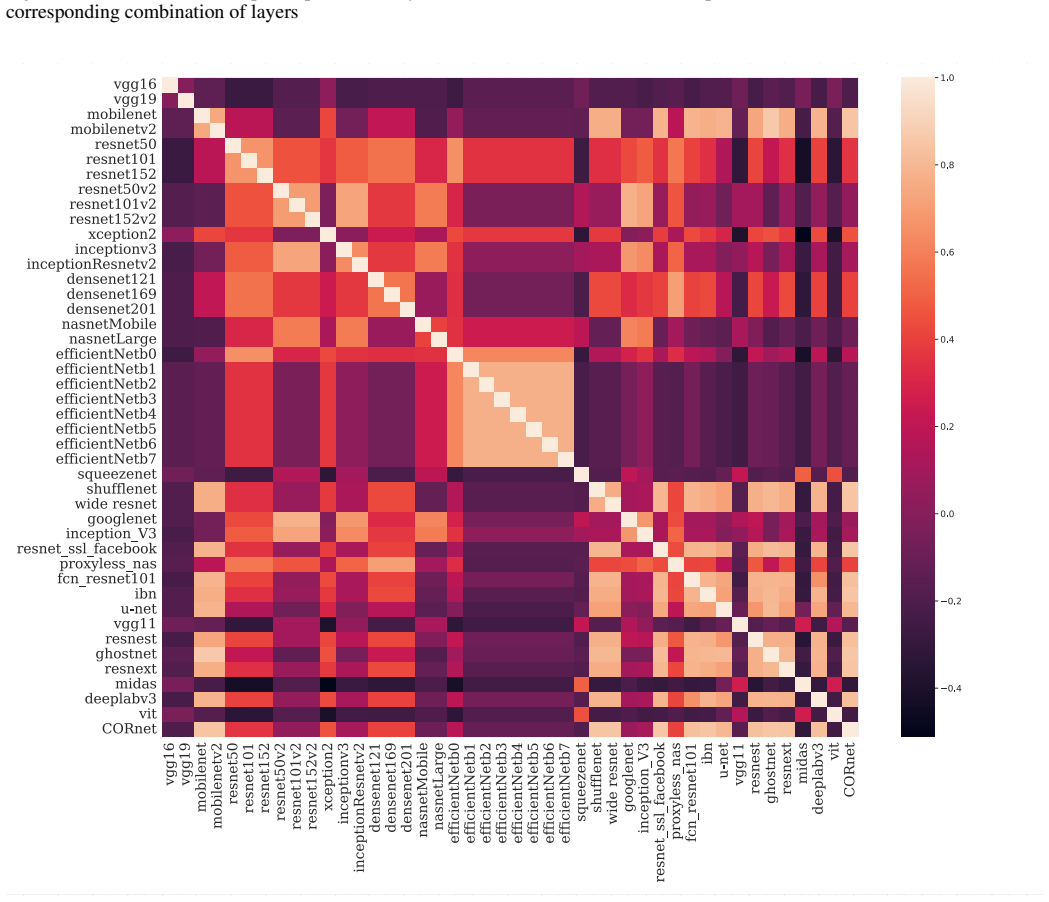
The central object is the NeuRN preprocessing transform, a pixel-wise local standard-deviation normalization: each pixel of the input is replaced by $I_a = 1/(c\,\sigma_{p_k})$, where $\sigma_{p_k}$ is the standard deviation of the $k\times k$ patch around the pixel and $c=\max(\sigma)$. Conceptually this encodes local contrast and suppresses absolute intensity, which is what the paper means by a domain-agnostic representation; the design is inspired by divisive normalization and Winner-Takes-All behavior in visual cortex neurons. The second supporting mechanism is the Needleman-Wunsch sequence-alignment score, which linearizes each DNN into a string of layer types and aligns pairs of such strings with match scores and gap penalties to produce a similarity index; this index is used to cluster 44 architectures and choose the 12 models evaluated with NeuRN.
What would settle it
Run the NeuRN transform exactly as written on a single MNIST image with a uniform border: for a patch entirely inside the border, $\sigma_{p_k}=0$, making $I_a=1/0$ undefined; since the paper specifies neither an epsilon for flat patches nor the scope of $c=\max(\sigma)$, the reported accuracies are not reproducible as stated. A consistency check that fixes these choices and reruns the Table 1 transfers would settle whether the gains are real.
Extended reading notes
Core claim
On its own terms, the paper's central claim is that NeuRN produces a domain-agnostic feature representation, and that models trained on that representation generalize better to unseen target domains. For an input image $I \in \mathbb{R}^{W\times H\times C}$, NeuRN computes, for each pixel, the standard deviation $\sigma_{p_k}$ of the $k\times k$ patch centered at that pixel, and outputs $I_a = 1/(c\,\sigma_{p_k})$ with $c=\max(\sigma)$. Experiments in Table 1 compare fine-tuned DNNs with and without this preprocessing on MNIST, SVHN, USPS, and MNIST-M across 12 source-to-target transfers; representative reported gains include ShuffleNet on M to MM rising from 14.1% to 71.1% and SPOS on MM to S rising from 25.6% to 69.0%, while some transfers show drops. The paper also claims that Needleman-Wunsch alignment of layer sequences gives a meaningful architecture-similarity measure that clusters related models and supports shortlisting 12 representative architectures from 44.
Load-bearing premise
The load-bearing premise is that the transform $I_a = 1/(c\,\sigma_{p_k})$ is an actually computable image representation: the paper does not state the patch size $k$, does not say whether $c=\max(\sigma)$ is taken over one image, a batch, or the whole dataset, and gives no epsilon for patches with zero variance, so on images with flat regions the operation as written divides by zero.
Editorial extensions
If this is right
- Adding NeuRN as a preprocessing layer raises source-only accuracy on most of the 12 digit-transfer tasks for most of the 12 architectures in Table 1, including large gains such as ShuffleNet on M to MM (14.1% to 71.1%) and SPOS on MM to S (25.6% to 69.0%).
- Improvements appear across CNNs, a Vision Transformer, and NAS-derived models, supporting the paper's claim that the benefit is architecture-agnostic rather than tied to one network family.
- In the appendix, NeuRN integration raises the average pairwise functional similarity of the models from about 0.7 to 0.8, which the paper interprets as NeuRN harmonizing model behavior.
- The Needleman-Wunsch similarity measure, if valid, gives a reusable way to select a small representative set of DNNs from a large pool for benchmarking.
- Not all transfers improve; some accuracies drop, so the paper itself frames the effect as needing further investigation.
Reading between the lines
- Since the paper tests only digit datasets (MNIST, SVHN, USPS, MNIST-M), an extension I would draw is to test NeuRN on natural-image domain shifts such as ImageNet variants or medical imaging to see whether local-contrast normalization transfers to higher-resolution domains; the paper lists resource constraints as the current limitation.
- Read as a contrast-normalization mechanism, NeuRN resembles global-contrast or style-normalization preprocessing that strips absolute intensity and color statistics; if that reading is right, it should be stackable with data augmentation and invariant-feature methods rather than a competitor to them.
- The N-W architecture-similarity score could be used beyond model selection, for example to predict which architecture pairs transfer best or to weight ensemble members; the paper does not test those uses.
Signed reviews
Editorial analysis
A structured set of objections, weighed in public.
Referee Report
Summary. The manuscript proposes NeuRN, a preprocessing layer that maps each input image to a representation based on local standard deviations, motivated by divisive normalization and winner-take-all mechanisms in the visual cortex. The authors integrate NeuRN into 12 shortlisted DNNs plus two NAS-derived architectures and evaluate source-only domain generalization on MNIST, SVHN, USPS, and MNIST-M, reporting per-task accuracies in Table 1. As a second contribution, they adapt the Needleman-Wunsch sequence alignment algorithm to quantify architectural similarity among 44 DNNs and use this to select a representative subset of models. The paper claims that NeuRN broadly improves domain generalization across architectures, while acknowledging in the conclusion that tests on additional high-resolution datasets were not performed due to resource limits.
Significance. If the NeuRN claims were established, an architecture-agnostic preprocessing transform that improves source-only domain generalization would be a useful and inexpensive contribution, and the neuroscience connection would be of interest to the broader DNN robustness community. The N-W-based architecture similarity analysis is a reasonable idea for selecting diverse models, and the breadth of tested architectures (CNNs, ViT, NAS) is a strength. However, the headline claim is not supported by the reported evidence: the transform is underspecified and not reproducible, Table 1 contains large accuracy drops that are not analyzed, and no error bars, repeated seeds, or significance tests are provided. The paper is better read as an exploratory study than as a demonstration of broad applicability; in its current form the significance is limited.
major comments (3)
- [Methods: Neural Response Normalization] The definition of Ia is not computable as written. The formula Ia = 1/(c·σpk) requires three unspecified quantities: the patch size k is never stated; the scope of c = max(σ) is not defined (per image, per batch, or per dataset); and no epsilon or floor is given for the case σpk = 0, which occurs in flat regions of digit images. Because NeuRN is the central proposed method, this underspecification prevents reproduction of Table 1 and makes the reported numbers unverifiable.
- [Table 1 / Experiments & Results] Table 1 does not support the claim of broad applicability. Several architectures suffer large losses: DenseNet121 drops from 74.3 to 26.4 on M→U, ResNet50V2 drops from 78.7 to 31.4 on M→U, Xception drops from 77.8 to 31.8 on MM→U, and VGG19 drops from 66.2 to 48.4 on U→M. The paper reports only the number of tasks improved for each model, never the mean or median delta, the spread of deltas, error bars, repeated seeds, or a paired test across the 12 tasks. Win counting can mask large negative effects, and the phrase 'significant improvement' is used without any statistical support. Establishing broad applicability requires showing that the typical effect is positive and that losses are not catastrophic, not merely that more than half of the tasks improve.
- [Appendix: DNNs' architectural and functional similarity] The appendix states that 'NeuRN consistently enhances model performance across a variety of domain transfer tasks' and that the enhancement 'does not disproportionately favor one model over another.' This is directly contradicted by Table 1, which shows large negative deltas for several models (for example, DenseNet121 M→U and ResNet50V2 M→U) and highly uneven gains across architectures. This internal inconsistency is a load-bearing problem because the functional-similarity analysis is offered as auxiliary evidence for the main claim.
minor comments (6)
- [Methods: Neural Response Normalization] In the expression for σpk, the subscript is written as 'p,k' in the summation 'i,j∈p,k'; this appears to be a typo for 'i,j∈pk'.
- [Methods: Needleman-Wunsch algorithm] The scoring parameters are specified inconsistently: the recurrence section describes match score s = 2 and gap penalty d = -2, while the later application says a match score of 4 and vertical/horizontal dissimilarity of -1; the manuscript should state which scoring scheme produced Figure 1 and the shortlist.
- [References] Two references are incomplete: 'Zhang, Ragab, and Sagarna' has no conference or journal, and 'Veerabadran, Raina, and Sa' has no publication details; these must be completed or removed.
- [Experiments & Results] No random seeds or number of repetitions are reported, so the absence of error bars cannot be interpreted as stability; even a single-seed comparison should be accompanied by a statement of variance across seeds or a justification for not reporting it.
- [Table 1 caption] The phrase 'close to benchmark results' is undefined; the benchmark accuracy to which the bold-and-underlined entries are compared should be explicitly named.
- [Experiments & Results: Similarity across DNN architectures] The N-W-based shortlisting is not validated: the paper provides no quantitative evidence that the 12 selected models are representative of the 44-model pool, and no comparison with simpler selection criteria or alternative similarity measures.
Circularity Check
No significant circularity: NeuRN is an independently specified preprocessing transform, and its reported benefits are empirical comparisons against baseline models.
full rationale
The paper's claimed derivation chain is not circular. The NeuRN transform, Ia = 1/(c * sigma_pk) with c = max(sigma), is defined in the Methods section from local patch statistics and is not fitted to any target dataset or to the reported accuracies. Its effect is evaluated by comparing each baseline DNN with the same DNN preceded by this fixed preprocessing layer, which is a standard empirical protocol rather than a prediction forced by construction. The invocations of the authors' prior WTA work (Iqbal et al. 2024) and other neuroscience references are motivational and are not used as load-bearing evidence that NeuRN improves accuracy; the performance claim rests on the measured results in Table 1. The Needleman-Wunsch architecture-similarity analysis is also independent of the experimental outcomes, since model selection is based on layer sequences rather than accuracy. Even though the paper's evidence is arguably weak or mixed, with some architectures degrading on particular transfer tasks, that is a correctness or significance concern, not a circularity concern. No fitted parameter is renamed as a prediction, no uniqueness theorem is imported from the authors' prior work, and no internal equation reduces the central claim to its own input. Therefore no circular step can be exhibited from the text, and the honest finding is a score of 0.
Assumptions & free parameters
free parameters (3)
- patch size k
- scope of scaling constant c
- N-W scoring parameters =
match 4, gap -1 (alternatively 2/-2 in Eq. 1)
assumptions (3)
- domain assumption Source-only training on MNIST-scale digit datasets is a meaningful test of domain generalization.
- domain assumption Pretrained ImageNet weights transfer to the four digit datasets after fine-tuning.
- ad hoc to paper The neurobiological WTA/divisive normalization inspiration justifies the specific formula.
Cite this review
Pith. "Pith review of NeuRN: Neuro-inspired Domain Generalization for Image Classification." pith.science (2026). https://pith.science/paper/AGXI4WQ4
@misc{pith2026250506881,
  author       = {Pith},
  title        = {Pith review of: NeuRN: Neuro-inspired Domain Generalization for Image Classification},
  year         = {2026},
  howpublished = {\url{https://pith.science/paper/AGXI4WQ4}},
  note         = {Machine review of arXiv:2505.06881}
}
read the original abstract
Domain generalization in image classification is a crucial challenge, with models often failing to generalize well across unseen datasets. We address this issue by introducing a neuro-inspired Neural Response Normalization (NeuRN) layer which draws inspiration from neurons in the mammalian visual cortex, which aims to enhance the performance of deep learning architectures on unseen target domains by training deep learning models on a source domain. The performance of these models is considered as a baseline and then compared against models integrated with NeuRN on image classification tasks. We perform experiments across a range of deep learning architectures, including ones derived from Neural Architecture Search and Vision Transformer. Additionally, in order to shortlist models for our experiment from amongst the vast range of deep neural networks available which have shown promising results, we also propose a novel method that uses the Needleman-Wunsch algorithm to compute similarity between deep learning architectures. Our results demonstrate the effectiveness of NeuRN by showing improvement against baseline in cross-domain image classification tasks. Our framework attempts to establish a foundation for future neuro-inspired deep learning models.
Figures


Figures from the paper (1 more)
Reference graph
Works this paper leans on
-
[1]
Ben-David, S.; Blitzer, J.; Crammer, K.; Kulesza, A.; Pereira, F.; and Vaughan, J. W. 2010. A theory of learning from different domains. In Proceedings of the 27th International Conference on Machine Learning (ICML-10), 101--108. ACM
work page 2010
-
[2]
A.; Dogan, U.; Lee, G.; and Scott, C
Blanchard, G.; Deshmukh, A. A.; Dogan, U.; Lee, G.; and Scott, C. 2021. Domain generalization by marginal transfer learning. Journal of Machine Learning Research, 22(145): 1--41
work page 2021
- [3]
-
[4]
Cadena, S. A.; Denfield, G. H.; Walker, E. Y.; Gatys, L. A.; Tolias, A. S.; Bethge, M.; and Ecker, A. S. 2019 a . Deep convolutional models improve predictions of macaque V1 responses to natural images. PLoS computational biology, 15(4): e1006897
work page 2019
-
[5]
Cadena, S. A.; Sinz, F. H.; Muhammad, T.; Froudarakis, E.; Cobos, E.; Walker, E. Y.; Reimer, J.; Bethge, M.; Tolias, A. S.; and Ecker, A. S. 2019 b . How well do deep neural networks trained on object recognition characterize the mouse visual system
work page 2019
-
[6]
Cadieu, C. F.; Hong, H.; Yamins, D. L.; Pinto, N.; Ardila, D.; Solomon, E. A.; Majaj, N. J.; and DiCarlo, J. J. 2014. Deep neural networks rival the representation of primate IT cortex for core visual object recognition. PLoS Computational Biology, 10(12): e1003963
work page 2014
-
[7]
Chen, K.; Zhuang, D.; and Chang, J. M. 2022. Discriminative adversarial domain generalization with meta-learning based cross-domain validation. Neurocomputing, 467: 418--426
work page 2022
-
[8]
Chollet, F. 2017. Xception: Deep Learning with Depthwise Separable Convolutions. In 2017 IEEE Conference on Computer Vision and Pattern Recognition (CVPR), 1800--1807
work page 2017
Show all 66 references
-
[9]
Conwell, C.; et al. 2021. Neural Regression, Representational Similarity, Model Zoology & Neural Taskonomy at Scale in Rodent Visual Cortex. In NeurIPS Proceedings
2021
-
[10]
Das, A.; and Ray, S. 2021. Effect of Cross-Orientation Normalization on Different Neural Measures in Macaque Primary Visual Cortex. Cerebral Cortex Communications, 2(1): tgab009
2021
-
[11]
Dosovitskiy, A.; et al. 2021. An Image is Worth 16x16 Words: Transformers for Image Recognition at Scale. In Proceedings of the International Conference on Learning Representations (ICLR)
2021
-
[12]
Ganin, Y.; Ustinova, E.; Ajakan, H.; Germain, P.; Larochelle, H.; Laviolette, F.; Marchand, M.; and Lempitsky, V. 2015. Domain-Adversarial Training of Neural Networks
2015
-
[13]
Gao, R.; Zou, H.; and Duan, Z. 2023. CVSNet: A Computer Implementation for Central Visual System of The Brain. arXiv:2305.19492
2023 arXiv
-
[14]
Goodfellow, I.; Bengio, Y.; and Courville, A. 2016. Deep Learning. MIT Press
2016
-
[15]
Guo, C.; Pleiss, G.; Sun, Y.; and Weinberger, K. Q. 2019. Single path one-shot neural architecture search with uniform sampling
2019
-
[16]
He, K.; Zhang, X.; Ren, S.; and Sun, J. 2015. Deep Residual Learning for Image Recognition. arXiv:1512.03385
2015 arXiv
-
[17]
He, K.; Zhang, X.; Ren, S.; and Sun, J. 2016. Deep Residual Learning for Image Recognition. In 2016 IEEE Conference on Computer Vision and Pattern Recognition (CVPR), 770--778
2016
-
[18]
G.; Zhu, M.; Chen, B.; Kalenichenko, D.; Wang, W.; Weyand, T.; Andreetto, M.; and Adam, H
Howard, A. G.; Zhu, M.; Chen, B.; Kalenichenko, D.; Wang, W.; Weyand, T.; Andreetto, M.; and Adam, H. 2017. MobileNets: Efficient Convolutional Neural Networks for Mobile Vision Applications. Cite arxiv:1704.04861
2017 arXiv
-
[19]
Huang, G.; Liu, Z.; van der Maaten, L.; and Weinberger, K. Q. 2018. Densely Connected Convolutional Networks. arXiv:1608.06993
2018 arXiv
-
[20]
Hull, J. J. 1994. A database for handwritten text recognition research. IEEE Transactions on pattern analysis and machine intelligence, 16(5): 550--554
1994
-
[21]
M.; and Jang, H
Iqbal, A.; Dong, P.; Kim, C. M.; and Jang, H. 2019. Decoding Neural Responses in Mouse Visual Cortex through a Deep Neural Network. In 2019 International Joint Conference on Neural Networks (IJCNN), 1--7. IEEE
2019
-
[22]
J.; Fishell, G.; and Honnuraiah, S
Iqbal, A.; Mahmood, H.; Stuart, G. J.; Fishell, G.; and Honnuraiah, S. 2024. Biologically Realistic Computational Primitives of Neocortex Implemented on Neuromorphic Hardware Improve Vision Transformer Performance. bioRxiv. This article is a preprint and has not been certified...
2024
-
[23]
Jarrett, K.; Kavukcuoglu, K.; Ranzato, M.; and LeCun, Y. 2009. What is the best multi-stage architecture for object recognition? 2009 IEEE 12th International Conference on Computer Vision, 2146--2153
2009
-
[24]
Jin, X.; Lan, C.; Zeng, W.; and Chen, Z. 2021. Style normalization and restitution for domain generalization and adaptation. IEEE Transactions on Multimedia
2021
-
[25]
Krizhevsky, A.; Sutskever, I.; and Hinton, G. 2012. ImageNet Classification with Deep Convolutional Neural Networks. In Neural Information Processing Systems, volume 25
2012
-
[26]
L.; and DiCarlo, J
Kubilius, J.; Schrimpf, M.; Nayebi, A.; Bear, D.; Yamins, D. L.; and DiCarlo, J. J. 2018. CORnet: Modeling the Neural Mechanisms of Core Object Recognition. bioRxiv
2018
-
[27]
LeCun, Y.; Cortes, C.; and Burges, C. 2010. MNIST Handwritten Digit Database
2010
-
[28]
Li, H.; Wang, Y.; Wan, R.; Wang, S.; Li, T.-Q.; and Kot, A. C. 2020. Domain generalization for medical imaging classification with linear-dependency regularization. In Conference on Neural Information Processing Systems (NeurIPS)
2020
-
[29]
Li, Y.; Yosinski, J.; Clune, J.; Lipson, H.; and Hopcroft, J. 2015. Convergent Learning: Do different neural networks learn the same representations? In Proceedings of the 1st International Workshop on Feature Extraction: Modern Questions and Challenges at NIPS 2015, volume 44...
2015
-
[30]
Li, Z.; et al. 2019. Learning from brains how to regularize machines. In Advances in Neural Information Processing Systems 32 (NeurIPS 2019)
2019
-
[31]
Likic, V. 2008. The Needleman-Wunsch algorithm for sequence alignment. Lecture given at the 7th Melbourne Bioinformatics Course, Bi021 Molecular Science and Biotechnology Institute, University of Melbourne
2008
-
[32]
Mahajan, D.; Tople, S.; and Sharma, A. 2021. Domain generalization using causal matching. In International Conference on Machine Learning (ICML)
2021
-
[33]
H.; et al
Marshel, J. H.; et al. 2011. Functional specialization of seven mouse visual cortical areas. Neuron, 72(6): 1040--1054
2011
-
[34]
G.; Raeder, T.; Alaiz-Rodr ' guez, R.; Chawla, N
Moreno-Torres, J. G.; Raeder, T.; Alaiz-Rodr ' guez, R.; Chawla, N. V.; and Herrera, F. 2012. A unifying view on dataset shift in classification. Pattern Recognition, 45(1): 327--336
2012
-
[35]
A.; and Doretto, G
Motiian, S.; Piccirilli, M.; Adjeroh, D. A.; and Doretto, G. 2017. Unified deep supervised domain adaptation and generalization. In International Conference on Computer Vision (ICCV), 5715--5725
2017
-
[36]
Muandet, K.; Balduzzi, D.; and Sch \"o lkopf, B. 2013. Domain generalization via invariant feature representation. In International Conference on Machine Learning (ICML)
2013
-
[37]
H.; and Kovashka, A
Nazari, N. H.; and Kovashka, A. 2020. Domain generalization using shape representation. In European Conference on Computer Vision (ECCV), 666--670
2020
-
[38]
Netzer, Y.; Wang, T.; Coates, A.; Bissacco, A.; Wu, B.; and Ng, A. Y. 2011. Reading Digits in Natural Images with Unsupervised Feature Learning. In NIPS Workshop on Deep Learning and Unsupervised Feature Learning
2011
-
[39]
Recht, B.; Roelofs, R.; Schmidt, L.; and Shankar, V. 2019. Do imagenet classifiers generalize to imagenet? In International Conference on Machine Learning, 5401--5410
2019
-
[40]
Sandler, M.; Howard, A.; Zhu, M.; Zhmoginov, A.; and Chen, L.-C. 2018. MobileNetV2: Inverted Residuals and Linear Bottlenecks. In Proceedings of the IEEE Conference on Computer Vision and Pattern Recognition (CVPR)
2018
-
[41]
Sawada, T.; and Petrov, A. 2016. Emulating and predicting physiological results of neurons in the primary visual cortex (V1) based on the divisive normalization model. Journal of Vision, 16(12): 958
2016
-
[42]
B.; Kar, K.; Bashivan, P.; Prescott-Roy, J.; Schmidt, K.; Yamins, D
Schrimpf, M.; Kubilius, J.; Hong, H.; Majaj, N.; Rajalingham, R.; Issa, E. B.; Kar, K.; Bashivan, P.; Prescott-Roy, J.; Schmidt, K.; Yamins, D. L.; and DiCarlo, J. J. 2018. Brain-Score: Which Artificial Neural Network for Object Recognition is most Brain-Like? bioRxiv
2018
-
[43]
Segu, M.; Tonioni, A.; and Tombari, F. 2020. Batch normalization embeddings for deep domain generalization. arXiv preprint arXiv:2011.12672
2020 arXiv
-
[44]
Shi, J.; Shea-Brown, E.; and Buice, M. 2019. Comparison against task driven artificial neural networks reveals functional properties in mouse visual cortex. Advances in Neural Information Processing Systems, 32
2019
-
[45]
Shi, J.; et al. 2022. MouseNet: A biologically constrained convolutional neural network model for the mouse visual cortex. PLOS Computational Biology
2022
-
[46]
Simonyan, K.; and Zisserman, A. 2015. Very Deep Convolutional Networks for Large-Scale Image Recognition. In 3rd International Conference on Learning Representations (ICLR 2015), 1--14
2015
-
[47]
Szegedy, C.; Vanhoucke, V.; Ioffe, S.; Shlens, J.; and Wojna, Z. 2015. Rethinking the Inception Architecture for Computer Vision. arXiv:1512.00567
2015 arXiv
-
[48]
Tan, M.; and Le, Q. V. 2019. EfficientNet: Rethinking Model Scaling for Convolutional Neural Networks. In Proceedings of the 36th International Conference on Machine Learning, ICML 2019, 6105--6114
2019
-
[49]
Taori, R.; Dave, A.; Shankar, V.; Carlini, N.; Recht, B.; and Schmidt, L. 2020. Measuring robustness to natural distribution shifts in image classification. In Advances in Neural Information Processing Systems, volume 33, 10581--10591
2020
-
[50]
N.; Kaiser, .; and Polosukhin, I
Vaswani, A.; Shazeer, N.; Parmar, N.; Uszkoreit, J.; Jones, L.; Gomez, A. N.; Kaiser, .; and Polosukhin, I. 2017. Attention is all you need. In Proceedings of the 31st International Conference on Neural Information Processing Systems (NIPS'17), 6000--6010. Curran Associates Inc
2017
-
[51]
Veerabadran, V.; Raina, R.; and Sa, V. D. ???? Bio-inspired learnable divisive normalization for ANNs. No additional publication details available
-
[52]
Wang, B.; Lapata, M.; and Titov, I. 2021. Meta-learning for domain generalization in semantic parsing. In Proceedings of the North American Chapter of the Association for Computational Linguistics (NAACL)
2021
-
[53]
Wang, J.; Lan, C.; Liu, C.; Ouyang, Y.; Qin, T.; Lu, W.; Chen, Y.; Zeng, W.; and Yu, P. S. 2022. Generalizing to Unseen Domains: A Survey on Domain Generalization. arXiv:2103.03097
2022 arXiv
-
[54]
Wang, Z.; Loog, M.; and van Gemert, J. 2020. Respecting domain relations: Hypothesis invariance for domain generalization. arXiv preprint arXiv:2010.07591
2020 arXiv
-
[55]
Xu, K.; Zhang, L.; Li, Z.; Qin, Z.; Li, J.; and Hu, Y. 2021. AutoFormer: Searching Transformers for Visual Recognition
2021
-
[56]
L.; Hong, H.; Cadieu, C
Yamins, D. L.; Hong, H.; Cadieu, C. F.; Solomon, E. A.; Seibert, D.; and DiCarlo, J. J. 2014. Performance-optimized hierarchical models predict neural responses in higher visual cortex. Proceedings of the National Academy of Sciences of the United States of America, 111(23): 8...
2014
-
[57]
A.; Maunsell, J
Zayyad, Z. A.; Maunsell, J. H. R.; and MacLean, J. N. 2023. Normalization in mouse primary visual cortex. bioRxiv. The complete version history of this preprint is available at bioRxiv
2023
-
[58]
Not Provided
Zhang, W.; Ragab, M.; and Sagarna, R. Not Provided. Robust domain-free domain generalization. Missing Conference/Journal
-
[59]
Zhang, X.; Zhou, X.; Lin, M.; and Sun, J. 2018. ShuffleNet: An Extremely Efficient Convolutional Neural Network for Mobile Devices. In Proceedings of the IEEE/CVF Conference on Computer Vision and Pattern Recognition (CVPR)
2018
-
[60]
Zhao, Y.; Zhong, Z.; Yang, F.; Luo, Z.; Lin, Y.; Li, S.; and Sebe, N. 2021. Learning to generalize unseen domains via memory-based multi-source meta-learning for person re-identification. In Proceedings of the IEEE/CVF Conference on Computer Vision and Pattern Recognition (CVP...
2021
-
[61]
Zhou, K.; Liu, Z.; Qiao, Y.; Xiang, T.; and Loy, C. C. 2022. Domain Generalization: A Survey. IEEE Transactions on Pattern Analysis and Machine Intelligence, 1–20
2022
-
[62]
Zoph, B.; and Le, Q. V. 2017. Neural Architecture Search with Reinforcement Learning
2017
-
[63]
Zoph, B.; Vasudevan, V.; Shlens, J.; and Le, Q. V. 2018. Learning Transferable Architectures for Scalable Image Recognition. arXiv:1707.07012
2018 arXiv
-
[64]
, " * write output.state after.block = add.period write newline
ENTRY address archivePrefix author booktitle chapter edition editor eid eprint howpublished institution isbn journal key month note number organization pages publisher school series title type volume year label extra.label sort.label short.list INTEGERS output.state before.all...
-
[65]
write newline
" write newline "" before.all 'output.state := FUNCTION n.dashify 't := "" t empty not t #1 #1 substring "-" = t #1 #2 substring "--" = not "--" * t #2 global.max substring 't := t #1 #1 substring "-" = "-" * t #2 global.max substring 't := while if t #1 #1 substring * t #2 gl...
-
[66]
U 7 KjD _C朱 |rrr(IԨ-H[ ̧=MΊD ق E8h ZxTW1e&< j Qy@8h Z 8_T #56j3v#<Y[y -hA h Z#5 U oW兛 R5SdlyҶ\5'т -hŅ2w6thh V q z*ރkт
document figures/0000775000000000000000000000000015010046416011217 5ustar rootrootfigures/figure_1.pdf0000664000000000000000002505015615010046416013431 0ustar rootroot 7 0 obj << /Type /XObject /Subtype /Image /Width 132 /Height 132 /ColorSpace /DeviceRGB /BitsPerComponent 8 /...
Reviewed August 15, 2026 · model on record in the stance chip above.
Discussion (0). Continue with ORCID to comment.