REVIEW 4 major objections 5 minor 43 references
Domain Gating Ensemble Networks for AI-Generated Text Detection
T0 review · 4 major / 5 minor · reviewed 2026-08-15 · deepseek-v4-flash
Pith's one-line read A domain-gating ensemble of ten 1.8B detectors, routed by a domain classifier, reports higher average AUROC than a 32B dense model on both MAGE and RAID while activating 5.4B parameters at inference.
desk verdict DoGEN is a clean, modular domain-gating ensemble with honest internal experiments, but the SOTA and OOD claims outrun the evidence in the paper's own tables. read the letter →
The pith
A machine-rendered reading of the paper's core claim, the machinery that carries it, and where it could break.
The reading
What carries the argument
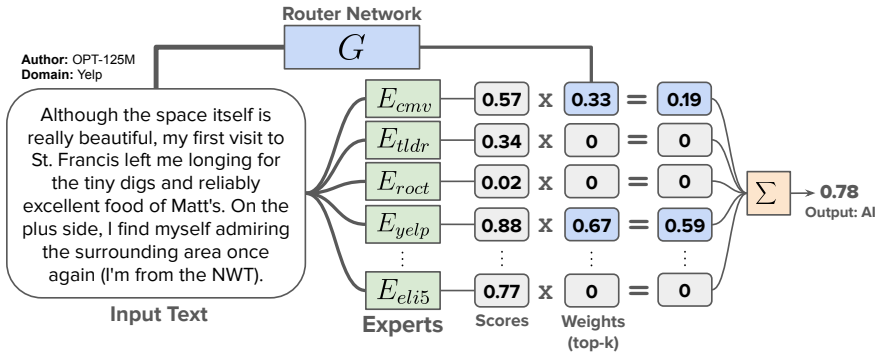
The central object is the Domain Gating Ensemble Network (DoGEN): ten expert detectors $E_i$, each a Qwen1.5-1.8B with a binary classification head fine-tuned on a single MAGE domain, and a router $G$ that maps a document to a probability distribution over the ten domains via $p_i(x) = \exp(w_i^\top \phi(x)) / \sum_j \exp(w_j^\top \phi(x))$. At inference the router keeps the top $k=2$ experts, renormalizes their probabilities, and computes the final score $s^{(k)}(x) = \sum_{i \in I_k} w_i E_i(x)$ with $w_i = p_i / \sum_{j \in I_k} p_j$. The mechanism works because experts specialize: the router learns to trust a specialist when the input matches its domain, and on unseen domains it selects the experts whose training domains are closest. The paper reports a Pearson correlation of 0.64 between an expert's standalone AUROC on RAID and the average gate weight assigned to it, supporting the claim that routing weight tracks expert usefulness.
What would settle it
A reader could check whether, on dialog_sum documents, the router assigns the highest weights to the hswag and eli5 experts, which score 0.962 and 0.956 standalone AUROC on that domain; if the router does not, the failure is routing, and if it does, the weighted combination is dragging performance down. Either observation would settle whether the transfer assumption holds for structurally novel domains.
Extended reading notes
Core claim
The paper claims that ensembling domain specialists with a domain-classification router yields a detector that is both highly accurate in-domain and unusually robust out-of-domain. Each expert is a Qwen1.5-1.8B model fine-tuned on one of MAGE's ten training domains; the router is another Qwen1.5-1.8B model fine-tuned to classify documents into those ten domains. At inference the router's softmax probabilities select the top two experts, and the final score is the weighted sum of their outputs. DoGEN's reported AUROC on the MAGE test set is 97.60 on average, and on RAID's non-adversarial set it is 95.81, compared with 95.20 and 94.73 respectively for the 32B dense baseline. The paper also reports that on MAGE's four unseen domains DoGEN trails the 32B model, attributing the gap to structurally novel inputs such as dialogue in dialog_sum and to GPT-4 paraphrased data.
Load-bearing premise
The method assumes that a router trained only to name the ten training domains will assign useful weights for documents from domains it has never seen, because experts trained on similar-looking domains will still detect AI text in those new domains.
Editorial extensions
If this is right
- A detector can match or beat a 32B dense model on both in-domain and out-of-domain benchmarks while activating only two 1.8B experts plus a 1.8B router, about 5.4B parameters in total.
- Because experts are trained independently, adding a new domain such as dialog_sum only requires training one new expert and retraining the router, not retraining the entire ensemble.
- Router quality drives generalization: on RAID, experts with higher standalone AUROC receive higher average gate weights, so the ensemble's out-of-domain strength depends on the router recognizing which specialists are trustworthy.
- Per-domain class balancing during expert training matters; the paper reports per-domain balancing outperforms global or unbalanced training for both in-domain and out-of-domain detection.
- The state-of-the-art claim is qualified to average performance: on MAGE's unseen domains DoGEN trails the 32B model, notably on dialog_sum (45.64 versus 90.50), so the advantage is not uniform across every domain.
Reading between the lines
- One natural extension is to replace the router's domain-identity objective with a reliability objective that predicts each expert's expected AUROC on the input; this might improve domains like dialog_sum where the domain label is uninformative but some experts still perform well.
- The fixed top-$k=2$ strategy is a design choice; on inputs where the router is uncertain, forcing two experts can include a poor specialist, so an adaptive $k$ based on router entropy is a testable extension the paper does not explore.
- The modularity result has a deployment reading: a production detector could be extended incrementally as new generators and genres appear, with the cost of one expert plus a router retrain per new domain, rather than a full retrain of a dense model.
Signed reviews
Editorial analysis
A structured set of objections, weighed in public.
Referee Report
Summary. The paper proposes DoGEN (Domain Gating Ensemble Networks), a method for AI-generated text detection that combines N domain-specific expert detectors with a learned router that classifies each input document into one of N training domains. The router's softmax probabilities are used to weight the top-k expert scores, with k=2 at inference. The authors fine-tune 10 Qwen1.5-1.8B experts on the 10 MAGE training domains plus a Qwen1.5-1.8B router, and compare against Qwen1.5 dense baselines (1.8B and 32B), a Qwen1.5-MoE model, equal-vote and logistic-regression ensembles, and joint-training variants. Evaluation is on MAGE (10 in-domain and 4 held-out domains) and the RAID benchmark's non-adversarial subset, with AUROC as the primary metric. The abstract claims state-of-the-art in-domain detection and that DoGEN outperforms models twice its size on out-of-domain detection; the results tables show DoGEN besting the Qwen32B baseline on the aggregate MAGE 'all' column and on RAID, while being below Qwen32B on all four MAGE held-out domains individually.
Significance. The core idea of using a domain classifier to gate expert detectors is a plausible and modular approach to domain adaptation for machine-text detection, and the paper makes a positive practical contribution by releasing code and trained models. The internal comparisons among the in-house baselines are coherent, and the experiment design (per-domain balancing, same hyperparameters, controlled parameter counts) is careful. However, the headline claims go beyond the evidence: no published third-party detectors are included, so 'state-of-the-art' is ungrounded; and the paper's own cleanest out-of-domain test (MAGE held-out domains) contradicts the claimed superiority over larger models. The RAID results, while positive, rest on benchmarks with substantial domain and generator overlap with MAGE. If the claims are carefully narrowed and external baselines are added, the method would be a useful contribution.
major comments (4)
- [§5, Table 1] The abstract's claim that DoGEN outperforms models twice its size on out-of-domain detection is contradicted by the paper's own MAGE held-out results. In Table 1, DoGEN is below Qwen32B on all four unseen domains: cnn 78.98 vs 93.52, dialog_sum 45.64 vs 90.50, imdb 84.93 vs 93.89, and pubmed 79.10 vs 90.97. The aggregate 'all' column averages these losses with the ten in-domain columns and therefore does not support a broad out-of-domain statement. The OOD claim should be either restricted to RAID or revised to acknowledge the failure on MAGE held-out domains.
- [§4.4, Tables 1 and 2] The 'state-of-the-art' claim in the abstract is not supported because every baseline in the comparison is trained or constructed in-house (Qwen dense variants, Qwen-MoE, equal/weighted votes, joint-training variants). No published detectors such as Fast-DetectGPT, RADAR, Binoculars, or Ghostbuster are evaluated. A state-of-the-art claim requires comparison with established detectors on the same benchmarks; otherwise the paper can only claim superiority over its own baselines.
- [§5 and Appendices B.3-B.4] The RAID benchmark is not a clean out-of-domain test for this method. Appendix B.3 states that six of the eight RAID domains (abstracts, books, news, reddit, wiki, reviews) share sources with MAGE, and Appendix B.4 notes that text-davinci-002 and gpt-3.5-turbo appear as generators in both datasets. The positive RAID result therefore largely reflects near-domain and near-generator overlap, not robust generalization to genuinely unseen distributions. The paper should either evaluate on a truly disjoint benchmark or explicitly temper the out-of-domain generalization claim.
- [Appendix C] The supporting evidence for the routing mechanism is a between-expert correlation (Pearson ρ=0.64 between average gate weight and expert AUROC on RAID). This aggregate correlation does not demonstrate per-example routing quality, which is the load-bearing mechanism behind the method's supposed transfer benefit. A more direct test would compare top-2 routing accuracy against random or uniform expert selection, or report whether the router assigns higher probability to experts that are individually correct on each example.
minor comments (5)
- [§4.4] In the Qwen1.5-MoE description, 'chose it model' should read 'chose this model'.
- [Appendix B.3] The cross-reference is wrong: 'In Table 9 we list the domains present in the RAID dataset' should point to Table 10, which actually contains domain descriptions; Table 9 lists generators.
- [Table 10] The source for Reviews is listed as 'imbd.com'; the correct domain is IMDb, so the spelling should be 'imdb.com'.
- [Tables 1 and 2] No error bars, confidence intervals, or significance tests are reported for any AUROC differences. Given that several aggregate differences are small (e.g., 95.81 vs 94.73 on RAID), the paper should at least report whether the differences are stable across seeds or subsets.
- [Appendix D.1] The discussion of paraphrased test settings (gpt4_para and human_para) is valuable, but the reader is left without a table or metric showing the full per-setting breakdown for all baselines; Table 14 covers only four domains and not the full comparison. Adding the full setting-level results would make the analysis more complete.
Circularity Check
No circularity: DoGEN's experts and router are trained on MAGE and evaluated on held-out benchmarks; the OOD claim is overbroad but not a circular derivation.
full rationale
The derivation chain is self-contained. DoGEN fine-tunes N=10 expert detectors, one per MAGE training domain, and a domain-classification router G (Eq. 1-2) trained with cross-entropy on oracle MAGE domain labels (Eq. 3). At inference the final score is a top-k weighted sum of expert scores (Eq. 4-5); no parameter is fitted to RAID or to the target AUROC claims. The in-domain MAGE result is an empirical evaluation on the same benchmark used for training, and the RAID result is an evaluation on a held-out benchmark; neither quantity is defined in terms of the other, and no fitted constant is renamed as a prediction. The only self-citation (RAID, Dugan et al. 2024) supplies the evaluation benchmark, not an unverified premise or a uniqueness theorem, and the paper's Appendices B.3 and B.4 candidly document domain and generator overlap between MAGE and RAID, which undercuts the strength of the 'out-of-domain' label but does not make the derivation circular. The absence of published external detectors (e.g., Fast-DetectGPT, RADAR, Binoculars) is a completeness or overclaim concern, not a circularity concern.
Assumptions & free parameters
free parameters (1)
- top-k number of active experts =
2
assumptions (3)
- domain assumption Oracle domain labels from MAGE are a sufficient routing signal, and each document can be assigned to one of ten domains.
- domain assumption Specialists trained on single MAGE domains transfer to sufficiently similar unseen domains.
- domain assumption The non-adversarial subset of RAID is a fair out-of-domain test bed.
Cite this review
Pith. "Pith review of Domain Gating Ensemble Networks for AI-Generated Text Detection." pith.science (2026). https://pith.science/paper/AIGHHOMC
@misc{pith2026250513855,
  author       = {Pith},
  title        = {Pith review of: Domain Gating Ensemble Networks for AI-Generated Text Detection},
  year         = {2026},
  howpublished = {\url{https://pith.science/paper/AIGHHOMC}},
  note         = {Machine review of arXiv:2505.13855}
}
read the original abstract
As state-of-the-art language models continue to improve, the need for robust detection of machine-generated text becomes increasingly critical. However, current state-of-the-art machine text detectors struggle to adapt to new unseen domains and generative models. In this paper we present DoGEN (Domain Gating Ensemble Networks), a technique that allows detectors to adapt to unseen domains by ensembling a set of domain expert detector models using weights from a domain classifier. We test DoGEN on a wide variety of domains from leading benchmarks and find that it achieves state-of-the-art performance on in-domain detection while outperforming models twice its size on out-of-domain detection. We release our code and trained models to assist in future research in domain-adaptive AI detection.
Figures


Reference graph
Works this paper leans on
-
[1]
online" 'onlinestring :=
ENTRY address archivePrefix author booktitle chapter edition editor eid eprint eprinttype howpublished institution journal key month note number organization pages publisher school series title type volume year doi pubmed url lastchecked label extra.label sort.label short.list INTEGERS output.state before.all mid.sentence after.sentence after.block STRING...
-
[2]
write newline
" write newline "" before.all 'output.state := FUNCTION n.dashify 't := "" t empty not t #1 #1 substring "-" = t #1 #2 substring "--" = not "--" * t #2 global.max substring 't := t #1 #1 substring "-" = "-" * t #2 global.max substring 't := while if t #1 #1 substring * t #2 global.max substring 't := if while FUNCTION word.in bbl.in capitalize " " * FUNCT...
-
[3]
Mervat Abassy, Kareem Elozeiri, Alexander Aziz, Minh Ngoc Ta, Raj Vardhan Tomar, Bimarsha Adhikari, Saad El Dine Ahmed, Yuxia Wang, Osama Mohammed Afzal, Zhuohan Xie, Jonibek Mansurov, Ekaterina Artemova, Vladislav Mikhailov, Rui Xing, Jiahui Geng, Hasan Iqbal, Zain Muhammad Mujahid, Tarek Mahmoud, Akim Tsvigun, and 5 others. 2024. https://doi.org/10.1865...
-
[4]
Harika Abburi, Kalyani Roy, Michael Suesserman, Nirmala Pudota, Balaji Veeramani, Edward Bowen, and Sanmitra Bhattacharya. 2023. https://aclanthology.org/2023.gem-1.32/ A simple yet efficient ensemble approach for AI -generated text detection . In Proceedings of the Third Workshop on Natural Language Generation, Evaluation, and Metrics (GEM), pages 413--4...
work page 2023
-
[5]
Shifali Agrahari, Prabhat Mishra, and Sujit Kumar. 2025. https://aclanthology.org/2025.genaidetect-1.43/ Random at G en AI detection task 3: A hybrid approach to cross-domain detection of machine-generated text with adversarial attack mitigation . In Proceedings of the 1stWorkshop on GenAI Content Detection (GenAIDetect), pages 365--370, Abu Dhabi, UAE. I...
work page 2025
-
[6]
Amrita Bhattacharjee, Tharindu Kumarage, Raha Moraffah, and Huan Liu. 2023. https://doi.org/10.18653/v1/2023.ijcnlp-main.40 C on DA : Contrastive domain adaptation for AI -generated text detection . In Proceedings of the 13th International Joint Conference on Natural Language Processing and the 3rd Conference of the Asia-Pacific Chapter of the Association...
-
[7]
Amrita Bhattacharjee, Raha Moraffah, Joshua Garland, and Huan Liu. 2024. https://arxiv.org/abs/2403.15690 Eagle: A domain generalization framework for ai-generated text detection . Preprint, arXiv:2403.15690
arXiv 2024
-
[8]
Sid Black, Stella Biderman, Eric Hallahan, Quentin Anthony, Leo Gao, Laurence Golding, Horace He, Connor Leahy, Kyle McDonell, Jason Phang, Michael Pieler, Jonathan Tow, Ben Wang, and Samuel Weinbach. 2022. Gpt-neox-20b: An open-source autoregressive language model. arXiv preprint arXiv:2204.06745
arXiv 2022
Show all 43 references
-
[9]
Tom B. Brown, Benjamin Mann, Nick Ryder, Melanie Subbiah, Jared Kaplan, Prafulla Dhariwal, Arvind Neelakantan, Pranav Shyam, Girish Sastry, Amanda Askell, Sandhini Agarwal, Ariel Herbert-Voss, Gretchen Krueger, Tom Henighan, Rewon Child, Aditya Ramesh, Daniel M. Ziegler, Jeffr...
2020
-
[10]
Dai, Adam Roberts, Francois Chollet, and Quoc V
Hyung Won Chung, Le Hou, Shayne Longpre, Barret Zoph, Tao Yu, Felipe Such, Xin Li, Jacob Austin, Andrew M. Dai, Adam Roberts, Francois Chollet, and Quoc V. Le. 2022. Scaling instruction-finetuned language models. arXiv preprint arXiv:2210.11416
2022 arXiv
-
[11]
Elizabeth Clark, Tal August, Sofia Serrano, Nikita Haduong, Suchin Gururangan, and Noah A. Smith. 2021. https://doi.org/10.18653/v1/2021.acl-long.565 All that ' s ` human ' is not gold: Evaluating human evaluation of generated text . In Proceedings of the 59th Annual Meeting o...
2021 doi
-
[12]
NLP Team Cohere. 2024. https://cohere.com/models/command World-class ai, at your command . Accessed: 2024-02-02
2024
-
[13]
Liam Dugan, Alyssa Hwang, Filip Trhl \'i k, Andrew Zhu, Josh Magnus Ludan, Hainiu Xu, Daphne Ippolito, and Chris Callison-Burch. 2024. https://doi.org/10.18653/v1/2024.acl-long.674 RAID : A shared benchmark for robust evaluation of machine-generated text detectors . In Proceed...
2024 doi
-
[14]
Liam Dugan, Daphne Ippolito, Arun Kirubarajan, and Chris Callison-Burch. 2020. https://doi.org/10.18653/v1/2020.emnlp-demos.25 R o FT : A tool for evaluating human detection of machine-generated text . In Proceedings of the 2020 Conference on Empirical Methods in Natural Langu...
2020 doi
-
[15]
Liam Dugan, Daphne Ippolito, Arun Kirubarajan, Sherry Shi, and Chris Callison-Burch. 2023. https://doi.org/10.1609/aaai.v37i11.26501 Real or fake text? investigating human ability to detect boundaries between human-written and machine-generated text . In Proceedings of the Thi...
2023 doi
-
[16]
Bradley Emi and Max Spero. 2024. https://arxiv.org/abs/2402.14873 Technical report on the pangram ai-generated text classifier . Preprint, arXiv:2402.14873
2024 arXiv
-
[17]
Jiayi Gui, Baitong Cui, Xiaolian Guo, Ke Yu, and Xiaofei Wu. 2025. https://aclanthology.org/2025.coling-main.625/ AIDER : a robust and topic-independent framework for detecting AI -generated text . In Proceedings of the 31st International Conference on Computational Linguistic...
2025
-
[18]
Julian Hazell. 2023. Large language models can be used to effectively scale spear phishing campaigns. arXiv preprint arXiv:2305.06972
2023 arXiv
-
[19]
Xiaomeng Hu, Pin-Yu Chen, and Tsung-Yi Ho. 2023. https://arxiv.org/abs/2307.03838 Radar: Robust ai-text detection via adversarial learning . Preprint, arXiv:2307.03838
2023 arXiv
-
[20]
Albert Q. Jiang, Alexandre Sablayrolles, Arthur Mensch, Chris Bamford, Devendra Singh Chaplot, Diego de las Casas, Florian Bressand, Gianna Lengyel, Guillaume Lample, Lucile Saulnier, Lélio Renard Lavaud, Marie-Anne Lachaux, Pierre Stock, Teven Le Scao, Thibaut Lavril, Thomas ...
2023 arXiv
-
[21]
Saman Sarker Joy and Tanusree Das Aishi. 2023. https://aclanthology.org/2023.alta-1.21/ Feature-level ensemble learning for robust synthetic text detection with D e BERT a V 3 and XLM - R o BERT a . In Proceedings of the 21st Annual Workshop of the Australasian Language Techno...
2023
-
[22]
Zhixin Lai, Xuesheng Zhang, and Suiyao Chen. 2024. https://doi.org/10.1109/IJCNN60899.2024.10651296 Adaptive ensembles of fine-tuned transformers for llm-generated text detection . In 2024 International Joint Conference on Neural Networks (IJCNN), pages 1--7
2024
-
[23]
Yafu Li, Qintong Li, Leyang Cui, Wei Bi, Zhilin Wang, Longyue Wang, Linyi Yang, Shuming Shi, and Yue Zhang. 2024. https://doi.org/10.18653/v1/2024.acl-long.3 MAGE : Machine-generated text detection in the wild . In Proceedings of the 62nd Annual Meeting of the Association for ...
2024 doi
-
[24]
Vijini Liyanage and Davide Buscaldi. 2023. https://aclanthology.org/2023.alta-1.11/ An ensemble method based on the combination of transformers with convolutional neural networks to detect artificially generated text . In Proceedings of the 21st Annual Workshop of the Australa...
2023
-
[25]
Brady D Lund, Ting Wang, Nishith Reddy Mannuru, Bing Nie, Somipam Shimray, and Ziang Wang. 2023. Chatgpt and a new academic reality: Artificial intelligence-written research papers and the ethics of the large language models in scholarly publishing. Journal of the Association ...
2023
-
[26]
Dominik Macko, Robert Moro, Adaku Uchendu, Jason Lucas, Michiharu Yamashita, Mat \'u s Pikuliak, Ivan Srba, Thai Le, Dongwon Lee, Jakub Simko, and Maria Bielikova. 2023. https://doi.org/10.18653/v1/2023.emnlp-main.616 MULTIT u DE : Large-scale multilingual machine-generated te...
2023 doi
-
[27]
Dianhui Mao, Denghui Zhang, Ao Zhang, and Zhihua Zhao. 2025. https://doi.org/10.1109/ICASSP49660.2025.10888686 Mlsdet: Multi-llm statistical deep ensemble for chinese ai-generated text detection . In ICASSP 2025 - 2025 IEEE International Conference on Acoustics, Speech and Sig...
2025
-
[28]
NLP Team MosaicML. 2023. www.mosaicml.com/blog/mpt-30b Introducing mpt-30b: Raising the bar for open-source foundation models . Accessed: 2023-06-22
2023
-
[29]
Duke Nguyen, Khaing Myat Noe Naing, and Aditya Joshi. 2023. https://aclanthology.org/2023.alta-1.22/ Stacking the odds: Transformer-based ensemble for AI -generated text detection . In Proceedings of the 21st Annual Workshop of the Australasian Language Technology Association,...
2023
-
[30]
Ivan Ong and Boon King Quek. 2024. https://arxiv.org/abs/2406.12570 Applying ensemble methods to model-agnostic machine-generated text detection . Preprint, arXiv:2406.12570
2024 arXiv
-
[31]
OpenAI. 2022. https://openai.com/blog/chatgpt ChatGPT: Optimizing Language Models for Dialogue
2022
-
[32]
OpenAI. 2023. https://arxiv.org/abs/2303.08774 Gpt-4 technical report . Preprint, arXiv:2303.08774
2023 arXiv
-
[33]
Long Ouyang, Jeffrey Wu, Xu Jiang, Diogo Almeida, Carroll Wainwright, Pamela Mishkin, Chong Zhang, Sandhini Agarwal, Katarina Slama, Alex Ray, and 1 others. 2022. Training language models to follow instructions with human feedback. Advances in Neural Information Processing Sys...
2022
-
[34]
Qwen Team . 2024. https://qwenlm.github.io/blog/qwen-moe/ Qwen1.5-moe: Matching 7b model performance with 1/3 activated parameters"
2024
-
[35]
Alec Radford, Jeff Wu, Rewon Child, David Luan, Dario Amodei, and Ilya Sutskever. 2019. Language models are unsupervised multitask learners
2019
-
[36]
Victor Sanh, Albert Webson, Colin Raffel, Stephen H. Bach, Lintang Sutawika, Zaid Alyafeai, Antoine Chaffin, Arnaud Stiegler, Teven Le Scao, Arun Raja, Manan Dey, M Saiful Bari, Canwen Xu, Urmish Thakker, Shanya Sharma, Eliza Szczechla, Taewoon Kim, Gunjan Chhablani, Nihal Vem...
2022
-
[37]
Giovanni Spitale, Nikola Biller-Andorno, and Federico Germani. 2023. https://doi.org/10.1126/sciadv.adh1850 Ai model gpt-3 (dis)informs us better than humans . Science Advances, 9(26):eadh1850
2023 doi
-
[38]
Hugo Touvron, Thibaut Lavril, Gautier Izacard, Xavier Martinet, Marie-Anne Lachaux, Timothée Lacroix, Baptiste Rozière, Naman Goyal, Eric Hambro, Faisal Azhar, Aurelien Rodriguez, Armand Joulin, Edouard Grave, and Guillaume Lample. 2023. Llama: Open and efficient foundation la...
2023 arXiv
-
[39]
Vivek Verma, Eve Fleisig, Nicholas Tomlin, and Dan Klein. 2024. https://doi.org/10.18653/v1/2024.naacl-long.95 Ghostbuster: Detecting text ghostwritten by large language models . In Proceedings of the 2024 Conference of the North American Chapter of the Association for Computa...
2024 doi
-
[40]
Yuxia Wang, Jonibek Mansurov, Petar Ivanov, jinyan su, Artem Shelmanov, Akim Tsvigun, Osama Mohammed Afzal, Tarek Mahmoud, Giovanni Puccetti, Thomas Arnold, Chenxi Whitehouse, Alham Fikri Aji, Nizar Habash, Iryna Gurevych, and Preslav Nakov. 2024 a . https://aclanthology.org/2...
2024
-
[41]
Yuxia Wang, Jonibek Mansurov, Petar Ivanov, Jinyan Su, Artem Shelmanov, Akim Tsvigun, Chenxi Whitehouse, Osama Mohammed Afzal, Tarek Mahmoud, Toru Sasaki, Thomas Arnold, Alham Aji, Nizar Habash, Iryna Gurevych, and Preslav Nakov. 2024 b . https://aclanthology.org/2024.eacl-lon...
2024
-
[42]
Aohan Zeng, Xiao Liu, Zhengxiao Du, Zihan Wang, Haiyang Xu, Xiao Cheng, Shaohan Huang, Wenhui Wang, Furu Wei, Huadong Chen, Lidong Zhou, Zhifang Sui, Daxin Jiang, and Ming Zhou. 2022. Glm-130b: An open bilingual pre-trained model. arXiv preprint arXiv:2210.02414
2022 arXiv
-
[43]
Susan Zhang, Stephen Roller, Naman Goyal, Mikel Artetxe, Moya Chen, Shuohui Chen, Christopher Dewan, Mona Diab, Xian Li, Xi Victoria Lin, Todor Mihaylov, Myle Ott, Sam Shleifer, Kurt Shuster, Daniel Simig, Punit Singh Koura, Anjali Sridhar, Tianlu Wang, and Luke Zettlemoyer. 2...
2022 arXiv
Reviewed August 15, 2026 · model on record in the stance chip above.
Discussion (0). Continue with ORCID to comment.