REVIEW 3 major objections 1 cited by
Adding Kuramoto oscillatory phase states to Vision Transformers improves training, parameter, and data efficiency through synchronization-driven structure learning.
Reviewed by Pith at T0; open to challenge. T0 means a machine referee read the full paper against a public rubric. the ladder, T0–T4 →
T0 review · grok-4.5
2026-07-13 00:09 UTC pith:AIY26FRP
load-bearing objection Clean neuro-inspired idea (Kuramoto phases on ViTs) with efficiency and structure claims, but only the abstract is here so the causal story cannot be audited yet. the 3 major comments →
Kuramoto Oscillatory Phase Encoding: Neuro-inspired Synchronization for Improved Learning Efficiency
The pith
A machine-rendered reading of the paper's core claim, the machinery that carries it, and where it could break.
Core claim
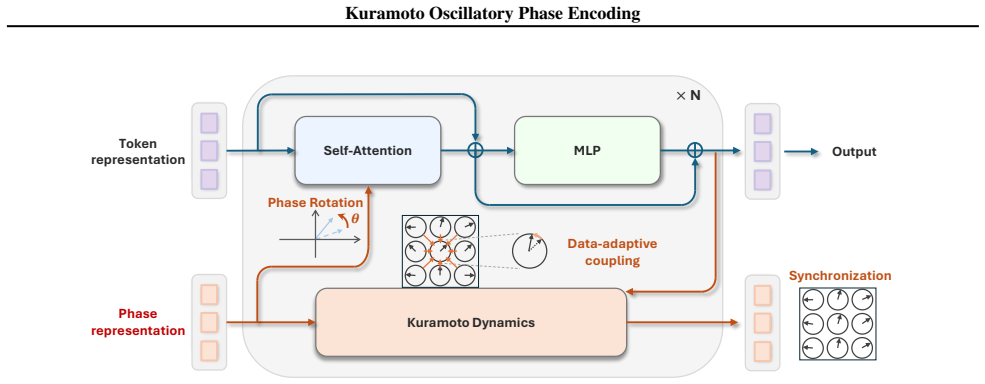
Kuramoto oscillatory Phase Encoding (KoPE) supplies Vision Transformers with an additional, continuously evolving phase variable whose coupling induces synchronization; the resulting dynamics improve training, parameter, and data efficiency by accelerating structure learning and attention concentration, with measurable gains on semantic/panoptic segmentation, language-aligned representation, and few-shot ARC-AGI reasoning.
What carries the argument
KoPE: an auxiliary Kuramoto phase state attached to each token that evolves by continuous phase coupling and modulates attention, thereby driving synchronization-enhanced structure learning.
Load-bearing premise
The reported efficiency and concentration gains truly come from Kuramoto-style synchronization rather than from extra capacity, incidental regularization, or unstated training differences.
What would settle it
Train matched Vision Transformers with and without KoPE under identical parameter budgets, optimizers, and data; if the phase-coupled models show no faster attention concentration (measured by entropy or attention-map sparsity) and no accuracy gains on the reported structure-sensitive tasks, the central claim fails.
If this is right
- Vision models can reach target performance with fewer epochs, fewer parameters, or less labeled data when equipped with KoPE.
- Tasks that require binding or coherent structure (segmentation, panoptic understanding, abstract visual reasoning) become measurably easier.
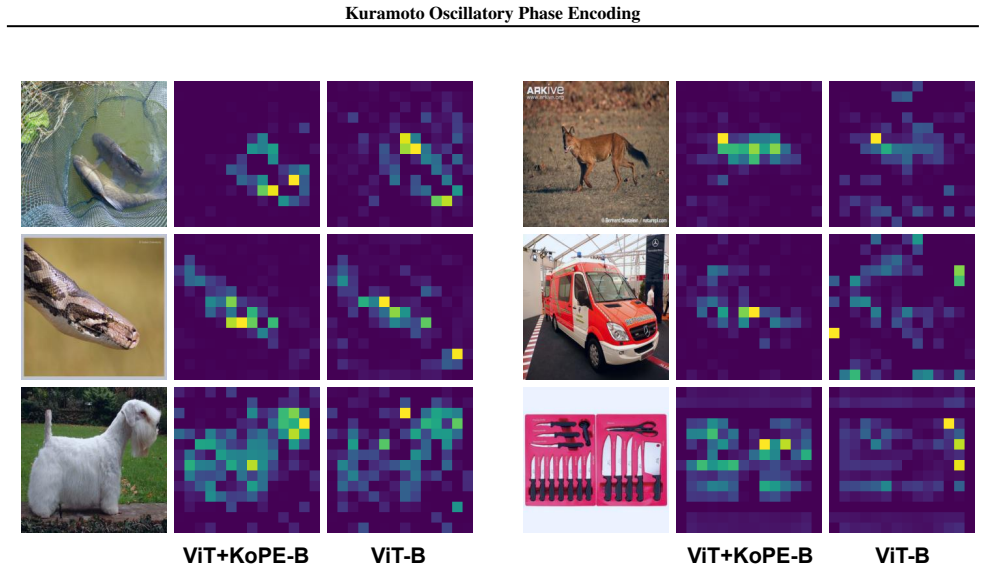
- Attention maps concentrate earlier in training, providing a diagnostic signature of the mechanism.
- Synchronization can be treated as a drop-in inductive bias for other transformer-style architectures beyond pure vision.
Where Pith is reading between the lines
- If phase coupling is the true driver, similar continuous oscillators could improve efficiency in language or multimodal transformers that also rely on long-range binding.
- A controlled ablation that freezes the phase variables or replaces Kuramoto coupling with random noise would cleanly separate synchronization from capacity effects.
- The same mechanism may help few-shot abstract reasoning by providing an internal “binding” signal that reduces the need for massive pre-training data.
Editorial analysis
A structured set of objections, weighed in public.
Referee Report
Summary. The manuscript proposes Kuramoto oscillatory Phase Encoding (KoPE), an additional evolving phase state attached to Vision Transformers that implements a neuro-inspired Kuramoto-style synchronization mechanism. From the abstract, the central claims are that KoPE improves training, parameter, and data efficiency of vision models via synchronization-enhanced structure learning; that it helps on structured tasks (semantic/panoptic segmentation, vision–language representation alignment, and few-shot ARC-AGI abstract reasoning); and that theoretical analysis plus empirical checks suggest KoPE accelerates attention concentration. Code is stated to be available. The provided materials contain only the abstract and title metadata; the body (methods, equations, experiments, theory) is not present in the review packet.
Significance. If the load-bearing causal claim holds—that continuous Kuramoto phase coupling supplies a genuine synchronization inductive bias that accelerates attention concentration and structure learning beyond matched capacity or regularization side-effects—then the work would be a meaningful, scalable neuro-inspired contribution to efficient ViTs and structured visual reasoning. Public code would further strengthen reproducibility. Significance cannot be assessed beyond the abstract-level assertion until the phase-update equations, attention coupling, matched ablations, and theory are available for audit.
major comments (3)
- The review packet contains only the abstract; the full manuscript body (methods, equations, figures, tables, theory) is absent. Load-bearing claims—training/parameter/data efficiency gains, synchronization-driven structure learning, accelerated attention concentration, and task benefits—cannot be audited. A complete manuscript is required before any accept/reject decision on the science.
- Abstract claim that gains come from 'synchronization-enhanced structure learning' and accelerated attention concentration requires, at minimum: (i) explicit phase-update / Kuramoto coupling equations and how phase enters attention; (ii) matched-capacity and non-oscillatory controls (e.g., K=0, frozen phases, random phases, extra non-phase channels); (iii) training-hyperparameter controls. Without these, efficiency improvements remain consistent with capacity or regularization artifacts. These elements are not present in the provided text.
- The asserted theoretical link that KoPE accelerates attention concentration is not inspectable (no derivation, assumptions, or empirical verification protocol in the packet). That link is central to the efficiency narrative and must be stated and checked in the full paper.
Circularity Check
No circularity found: abstract proposes KoPE as an inductive bias and reports external-task gains; no derivation equates outputs to inputs by construction.
full rationale
Only the abstract is available in the provided source (full manuscript body is blank). The abstract introduces Kuramoto oscillatory Phase Encoding as an additional evolving phase state on Vision Transformers, claims efficiency and structure-learning benefits, and mentions theoretical analysis plus empirical verification of accelerated attention concentration. These are standard method-plus-evaluation claims. There are no equations, fitted parameters re-labeled as predictions, uniqueness theorems, self-citation load-bearing premises, or ansatz smuggled via prior author work that would make a claimed result identical to its inputs by construction. External-task results (segmentation, vision-language alignment, ARC-AGI) are independent of any internal definitional loop. Per the analyzer rules, absence of a quotable reduction yields score 0 and empty steps; the paper is self-contained against external benchmarks in the material given.
Axiom & Free-Parameter Ledger
free parameters (2)
- Kuramoto coupling / phase-update hyperparameters (unspecified)
- Phase-channel capacity and integration schedule (unspecified)
axioms (3)
- domain assumption Kuramoto-type coupled oscillators are an appropriate model of useful phase synchronization for discrete token representations in Vision Transformers.
- ad hoc to paper Joint rate-and-phase dynamics can improve structure learning and attention concentration beyond activation-only Transformers under standard vision training.
- domain assumption Feature binding / flexible coordination via oscillatory synchronization is a useful inductive bias for semantic segmentation, panoptic segmentation, vision-language alignment, and ARC-AGI-style reasoning.
invented entities (1)
-
Kuramoto oscillatory Phase Encoding (KoPE)
no independent evidence
read the original abstract
Spatiotemporal neural dynamics and oscillatory synchronization are widely implicated in biological information processing and have been hypothesized to support flexible coordination such as feature binding. By contrast, most deep learning architectures represent and propagate information through activation values, neglecting the joint dynamics of rate and phase. In this work, we introduce Kuramoto oscillatory Phase Encoding (KoPE) as an additional, evolving phase state to Vision Transformers, incorporating a neuro-inspired synchronization mechanism to advance learning efficiency. We show that KoPE can improve training, parameter, and data efficiency of vision models through synchronization-enhanced structure learning. Moreover, KoPE benefits tasks requiring structured understanding, including semantic and panoptic segmentation, representation alignment with language, and few-shot abstract visual reasoning (ARC-AGI). Theoretical analysis and empirical verification further suggest that KoPE can accelerate attention concentration for learning efficiency. These results indicate that synchronization can serve as a scalable, neuro-inspired mechanism for advancing state-of-the-art neural network models. Code is avaliable at https://github.com/microsoft/Neuro-inspired_Phase_Encoding.
Figures



Forward citations
Cited by 1 Pith paper
-
Winfree Oscillatory Neural Network
WONN is a new oscillatory neural network based on generalized Winfree dynamics that scales competitively to ImageNet-1K and reaches 80.1% accuracy on Maze-hard with 1% of prior model parameters.
Reference graph
Works this paper leans on
-
[1]
write newline
" write newline "" before.all 'output.state := FUNCTION n.dashify 't := "" t empty not t #1 #1 substring "-" = t #1 #2 substring "--" = not "--" * t #2 global.max substring 't := t #1 #1 substring "-" = "-" * t #2 global.max substring 't := while if t #1 #1 substring * t #2 global.max substring 't := if while FUNCTION format.date year duplicate empty "emp...
discussion (0)
Sign in with ORCID, Apple, or X to comment. Anyone can read and Pith papers without signing in.