REVIEW 4 major objections 5 minor 2 cited by
PIORS: Personalized Intelligent Outpatient Reception based on Large Language Model with Multi-Agents Medical Scenario Simulation
T0 review · 4 major / 5 minor · reviewed 2026-08-12 · deepseek-v4-flash
Pith's one-line read A 7B-parameter receptionist fine-tuned on service-flow-simulated dialogues outperforms GPT-4o and other baselines in simulated outpatient triage, information gathering, and efficiency.
desk verdict A plausible simulation-based training pipeline for outpatient reception, but the claim that PIORS-Nurse beats GPT-4o only holds inside a closed simulation loop; the paper deserves review if the claims are dialed back. read the letter →
The pith
A machine-rendered reading of the paper's core claim, the machinery that carries it, and where it could break.
The reading
What carries the argument
The machinery has two layers. At the system level, PIORS pairs PIORS-Nurse, built from interaction, query-generation, and summarization modules, with HospInfo-Assistant, which turns natural-language requests into hospital-information-system API calls so the nurse can access patient archives and administrative information. At the data level, SFMSS is the generative engine: a nurse simulator chooses among seven pre-defined actions through a three-step pipeline of action decision, reflection with supervisor feedback, and response generation; a patient simulator samples nine real demographic and Big Five personality attributes and plays one of five patient actions; and a supervisor agent monitors dialogue quality and tracks which patient-profile facts have been gathered, feeding the nurse suggestions. The product is SFMSS-CD, 2,400 goal-oriented conversations that encode the service flow of a real outpatient encounter, and it is what turns the 7B base model into PIORS-Nurse.
What would settle it
Run a held-out evaluation with real outpatient conversations: record actual patient-nurse interactions at a hospital, have PIORS-Nurse and GPT-4o triage the same written or spoken complaints, and compare their recommended departments against the department a physician actually assigns; then check whether PIORS-Nurse's accuracy lead over GPT-4o persists on human-generated complaints rather than simulator-generated ones.
Extended reading notes
Core claim
The central claim is that service-flow awareness, not model scale or raw medical knowledge, is what a reception-nurse LLM lacks. PIORS-Nurse, a Qwen2-7B-Instruct model fine-tuned on 2,400 simulated first-visit and follow-up conversations generated by SFMSS plus 1,000 general-domain samples, ranks first on every automatic metric: highest department-recommendation accuracy (0.822 versus 0.717 for GPT-4o), highest Info Score for gathering symptoms and history (3.01 versus 2.16 on a 5-point scale), and the shortest average turn length (139.54 characters versus 207.98 for GPT-4o). In blind human studies, 15 users and 15 clinical experts rated it as better or comparable to GPT-4o and to a service-flow-ablated nurse in more than 81% of pairwise comparisons, and 12 of 15 experts judged it the best overall. The authors interpret this as evidence that embedding triage workflow, action constraints, and supervisory feedback into simulated training data transfers patient-interaction skills that knowledge-centric medical LLMs lack.
Load-bearing premise
The simulated patients generated by SFMSS behave enough like real patients that the quality measured on these generated conversations, including GPT-4o's scores, will transfer to a real outpatient reception desk; the paper itself says the system was not validated in real clinical environments.
Editorial extensions
If this is right
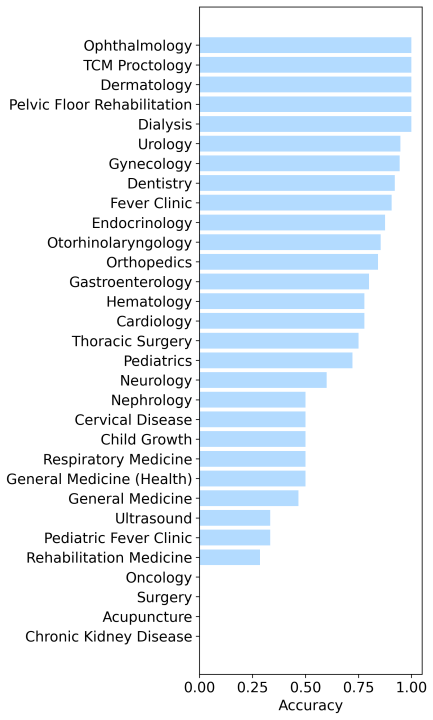
- In automatic evaluation, PIORS-Nurse ranks first on every metric: department-guidance accuracy 0.822 versus 0.717 for GPT-4o, Info Score 3.01 versus 2.16, and average turn length 139.54 characters versus 207.98 for GPT-4o.
- Blind human evaluation gives PIORS-Nurse a win-or-tie rate above 90% against GPT-4o and above 81% against a fine-tuned service-flow-ablated nurse, and 12 of 15 clinical experts rate it the best overall.
- Because the nurse writes a structured pre-diagnosis summary into the hospital information system, doctors receive symptom and history information before the consultation, which the paper argues can reduce physician workload and speed up outpatient visits.
- The agent design with separate interaction, query-generation, and summarization modules can be extended to report explanation, outpatient flow management, and post-consultation follow-up without retraining the whole system.
- The SFMSS framework can generate goal-oriented training data for both first visits and follow-up visits from a modest seed set of 2,400 records covering 36 departments, suggesting a data-efficient route to adapting the system to new departments or hospitals.
Reading between the lines
- The closed-loop design is the main reason to hesitate before extrapolating the reported margins: the same simulator generates training and test conversations and also supplies the patient profiles that human judges role-play, so part of PIORS-Nurse's advantage may be learning the simulator's conventions rather than general triage skill.
- If the advantage survives real-world testing, the recipe generalizes well beyond reception: any structured intake conversation with a defined flow, an information-gathering goal, and a handoff artifact, such as insurance intake, mental-health triage, or telehealth pre-screening, could be converted into simulated training data with a comparable action space and supervisor agent.
- The personality-simulation component could be repurposed as a test harness: generate deliberately difficult patients, such as those with high neuroticism, low health literacy, or frequent topic changes, and benchmark a nurse model's accuracy and empathy under pressure before deployment, something a static question-answer set cannot do.
- A 7B local model that can query a hospital information system suggests a practical privacy argument: patient data can stay inside the hospital rather than being sent to a closed external API, which may matter more for adoption than raw accuracy.
Signed reviews
Editorial analysis
A structured set of objections, weighed in public.
Referee Report
Summary. The paper presents PIORS, an LLM-based outpatient reception system that combines a fine-tuned nurse agent with a hospital information system (HIS), and SFMSS, a multi-agent simulation framework that generates structured medical dialogues. The nurse agent (PIORS-Nurse) is fine-tuned on Qwen2-7B using SFMSS-generated conversations and general instruction data. The authors evaluate PIORS-Nurse against GPT-4o, Qwen2-7B, Llama3-8B, HuatuoGPT2-13B, and a service-flow-ablated variant using automatic metrics (department-guiding accuracy, Info Score, Overall Score, turn count/length) and human evaluations with 15 users and 15 clinical experts. They report that PIORS-Nurse outperforms all baselines, including GPT-4o, on all automatic metrics and achieves win-or-tie rates above 81% in pairwise human comparisons. The paper claims that PIORS is integrated into real outpatient reception and that PIORS-Nurse outperforms the current state-of-the-art model in that setting.
Significance. If the reported results hold in real clinical deployments, PIORS would be a valuable contribution to hospital workflow and to the application of LLMs in Chinese outpatient settings. The paper has genuine strengths: it uses real outpatient records from a public hospital, defines a clinically motivated action space with expert input, provides a concrete fine-tuning recipe, and reports multiple evaluation dimensions instead of a single metric. The GitHub repository and demo are also positive. However, the central empirical claim currently rests on a closed evaluation loop: SFMSS generates both the training dialogues and the test dialogues, GPT-4o both generates training data and assigns the Info and Overall scores, and human raters role-play the same simulated patient profiles. The paper's own Limitations section concedes that the simulated conversations may deviate from human-to-human interactions and that PIORS has not been validated in real clinical environments. These concessions are in tension with the abstract's claim of integration into 'real outpatient reception setting.' The external validity of the headline result is therefore not established by the evidence presented.
major comments (4)
- [Abstract and Limitations] The abstract and Section 1 state that PIORS is 'integrated ... into real outpatient reception setting' and that results demonstrate better 'real scenarios' performance, but the Limitations section explicitly states that 'PIORS have not been validated in real clinical environments' and that 'simulated patient-nurse conversations may deviate from human-to-human interactions.' These statements directly contradict the framing of the central claim. The authors should either provide real-world deployment/validation evidence or reframe all claims as simulation-based results, removing the real-world superiority claim over GPT-4o.
- [Sections 4.2, 5.1, and 5.2] The evaluation is closed-loop. SFMSS-CD (the training corpus, Section 4.2) and the automatic evaluation dialogues (Section 5.1) are both generated by the same SFMSS patient simulator, and the Info Score and Overall Score are assigned by GPT-4o (Section 5.2), which also generated the training data. This means the reported advantages over GPT-4o on Info and Overall scores may reflect the fine-tuned model's fit to the simulator and to GPT-4o's scoring preferences rather than genuine clinical quality. The department-accuracy metric is anchored to physician labels, but it is computed on simulated dialogues, so it does not break the loop. To support the central claim, the authors should add at least one evaluation component that uses real patient interactions or external expert-graded dialogues, and should report how automatic scores correlate with expert judgments.
- [Section 6 and Table 2] The user study and expert evaluation use the same 20 SFMSS-generated patient profiles, with participants role-playing those simulated patients. The only evidence that the simulator is a valid stand-in for real patients is the expert fidelity rating in Table 2, which shows that even for PIORS-Nurse only 37.7% of dialogues were rated 'Extremely High' (indistinguishable from human), and 15.3% were rated Moderate or Low. This is weak support for the claim that the human-preference results transfer to real outpatient reception. The authors should report fidelity ratings per model and per participant, and discuss how the sizable non-high proportion affects the external validity of the user study.
- [Table 1 and Section 6] No statistical significance testing or confidence intervals are reported for any of the core comparisons. For example, the accuracy gap between PIORS-Nurse (0.822) and the SF-ablated nurse (0.786) or GPT-4o (0.717) could be within noise, especially given the modest sample sizes (500 test records for automatic evaluation, 15 users, 15 experts). The claim that PIORS-Nurse 'outperforms all baselines' should be supported by paired tests or confidence intervals, at least for the human evaluations and the fine-tuned baseline comparisons.
minor comments (5)
- [Section 1] Typo: 'immerse burden' should be 'immense burden'.
- [Section 1] Typo: 'Futher details' should be 'Further details'.
- [Section 2.1] Typo: 'chief complient' should be 'chief complaint'.
- [Section 4.2] Duplicated word: 'two distinct action space descriptions for for the nurse' should read 'for the nurse'.
- [Section 2.4] The HospInfo-Assistant uses 'GPT-4-turbo' here but other parts refer to GPT-4o; please clarify which model is used for this component.
Circularity Check
Closed-loop evaluation: SFMSS generates both training and test dialogues, and GPT-4o is simultaneously profile generator, patient simulator, and judge; only department accuracy is externally anchored.
-
self definitional
[Section 4.2 (SFMSS-CD) and Section 5.1 (Evaluation Pipeline)]
"We utilize SFMSS, based on GPT-4o, to construct a simulated conversation dataset for outpatient reception, named SFMSS-CD. ... First, prompt the selected model to play the role of nurse, then interact with the patient simulator defined in SFMSS under the outpatient reception scenario and derive the simulated dialogue."
PIORS-Nurse is fine-tuned on SFMSS-CD, i.e., dialogues generated by SFMSS with GPT-4o playing both nurse and patient. The automatic evaluation then re-uses the same SFMSS patient simulator, with the same profile-generation and action-space mechanics, to produce the test dialogues. Thus the test distribution is the training distribution by construction, and the headline claim that PIORS-Nurse outperforms GPT-4o is measured inside the same simulation framework that produced the training data. Department accuracy is anchored to real doctor labels, which partially breaks the loop, but the dialogue environment, Info Score, and Overall Score all remain internal to SFMSS.
-
fitted input called prediction
[Section 3.3 (Patient simulator) and Section 5.2 (Info Score / Overall Score)]
"We prompt GPT-4o to generate a patient profile that covers the patient’s information, personality traits and behavioral preferences with natural language. ... we introduce Info Score for information gathering, and prompt GPT-4o as evaluator to provide a 5-point score, given the true patient profile for reference."
The 'true patient profile' used as the reference for the Info Score is itself generated by GPT-4o, the same model that acts as the patient simulator and that generated the SFMSS-CD training dialogues. GPT-4o is also the evaluator that assigns Info Score and Overall Score. Therefore the metric measures how completely PIORS-Nurse recovers a GPT-4o-authored profile, judged by GPT-4o. Since PIORS-Nurse was trained on GPT-4o-generated conversations, high Info and Overall scores can reflect stylistic mimicry of GPT-4o rather than clinically validated information gathering; the target and the grader are the same system that produced the training signal.
1 more flagged steps
-
other
[Section 6.1 (User Study) and Limitations]
"Each participant was assigned to simulate the 20 patients sequentially based on given profiles and engage in conversations with PIORS-Nurse, GPT-4o, and baseline, respectively."
The user study uses real human raters, but those raters role-play the same simulated patient profiles generated by SFMSS/GPT-4o, so the human preference evidence is still collected inside the simulation world. The paper's Limitations concede this explicitly: 'The simulated patient-nurse conversations may deviate from human-to-human interactions and require further validation. Additionally, PIORS have not been validated in real clinical environments.' The human judgments are not fully circular because they are independent human opinions, but they do not break the closed loop between the SFMSS-generated training data and the SFMSS-generated evaluation scenarios.
full rationale
The central performance evidence for PIORS-Nurse is generated and judged inside the same SFMSS ecosystem. SFMSS creates the training dialogues (SFMSS-CD) using GPT-4o as nurse and patient simulators; the automatic evaluation then uses the same SFMSS patient simulator to create test dialogues; and GPT-4o—the same model that generated profiles and training dialogues—provides the Info Score and Overall Score. The human user study also asks participants to role-play the same simulated patient profiles, and the expert fidelity ratings, while useful, assess simulated patients rather than real clinical encounters. The paper itself limits the conclusion by stating that simulated conversations 'may deviate from human-to-human interactions' and that PIORS has 'not been validated in real clinical environments.' This makes the headline claim of superiority over GPT-4o in outpatient reception partially self-referential rather than independently established. The result is not fully circular: department recommendation accuracy is compared against ground-truth labels written by human doctors, and the user/expert comparisons are blind human judgments that could have favored the baselines. These independent anchors keep the circularity score at 5 rather than higher, but the main ecological claim rests on a closed simulation loop.
Assumptions & free parameters
assumptions (5)
- domain assumption Simulated patient-nurse dialogues are a valid proxy for real outpatient reception.
- domain assumption GPT-4o can reliably score information gathering and overall quality.
- domain assumption Department labels in the historical outpatient records are correct ground truth.
- domain assumption The Kaggle Big Five questionnaire distribution approximates the Chinese outpatient population.
- domain assumption The HIS integration and HospInfo-Assistant work as described.
invented entities (3)
-
SFMSS patient simulator
-
Service-flow action space
-
HospInfo-Assistant
Cite this review
Pith. "Pith review of PIORS: Personalized Intelligent Outpatient Reception based on Large Language Model with Multi-Agents Medical Scenario Simulation." pith.science (2026). https://pith.science/paper/AJZGXEIR
@misc{pith2026241113902,
  author       = {Pith},
  title        = {Pith review of: PIORS: Personalized Intelligent Outpatient Reception based on Large Language Model with Multi-Agents Medical Scenario Simulation},
  year         = {2026},
  howpublished = {\url{https://pith.science/paper/AJZGXEIR}},
  note         = {Machine review of arXiv:2411.13902}
}
read the original abstract
In China, receptionist nurses face overwhelming workloads in outpatient settings, limiting their time and attention for each patient and ultimately reducing service quality. In this paper, we present the Personalized Intelligent Outpatient Reception System (PIORS). This system integrates an LLM-based reception nurse and a collaboration between LLM and hospital information system (HIS) into real outpatient reception setting, aiming to deliver personalized, high-quality, and efficient reception services. Additionally, to enhance the performance of LLMs in real-world healthcare scenarios, we propose a medical conversational data generation framework named Service Flow aware Medical Scenario Simulation (SFMSS), aiming to adapt the LLM to the real-world environments and PIORS settings. We evaluate the effectiveness of PIORS and SFMSS through automatic and human assessments involving 15 users and 15 clinical experts. The results demonstrate that PIORS-Nurse outperforms all baselines, including the current state-of-the-art model GPT-4o, and aligns with human preferences and clinical needs. Further details and demo can be found at https://github.com/FudanDISC/PIORS
Figures


Figures from the paper (9 more)


Forward citations
Cited by 2 Pith papers
-
AI4Research: A Survey of Artificial Intelligence for Scientific Research
A survey that organizes AI-for-research work into five tasks, comprehension, survey, discovery, writing, and peer review, and compiles associated tools and benchmarks.
-
From Individual to Society: A Survey on Social Simulation Driven by Large Language Model-based Agents
A structured survey that categorizes LLM-based social simulation into individual, scenario, and society simulation, with associated methods, benchmarks, and observed trends.
Reference graph
Works this paper leans on
-
[1]
AI@Meta. 2024. https://github.com/meta-llama/llama3/blob/main/MODEL_CARD.md Llama 3 model card
2024
-
[2]
Zhijie Bao, Wei Chen, Shengze Xiao, Kuang Ren, Jiaao Wu, Cheng Zhong, Jiajie Peng, Xuanjing Huang, and Zhongyu Wei. 2023. http://arxiv.org/abs/2308.14346 DISC - MedLLM : Bridging General Large Language Models and Real - World Medical Consultation . arXiv preprint. ArXiv:2308.14346 [cs]
arXiv 2023
-
[3]
Junying Chen, Xidong Wang, Anningzhe Gao, Feng Jiang, Shunian Chen, Hongbo Zhang, Dingjie Song, Wenya Xie, Chuyi Kong, Jianquan Li, et al. 2023. https://arxiv.org/abs/2311.09774 Huatuogpt-ii, one-stage training for medical adaption of llms . arXiv preprint arXiv:2311.09774
arXiv 2023
-
[4]
Wei Chen, Zhiwei Li, Hongyi Fang, Qianyuan Yao, Cheng Zhong, Jianye Hao, Qi Zhang, Xuanjing Huang, Jiajie Peng, and Zhongyu Wei. 2022 a . https://doi.org/10.1093/bioinformatics/btac817 A benchmark for automatic medical consultation system: frameworks, tasks and datasets . Bioinformatics, 39(1)
-
[5]
Wei Chen, Cheng Zhong, Jiajie Peng, and Zhongyu Wei. 2022 b . https://doi.org/10.1093/bioinformatics/btac744 Dxformer: a decoupled automatic diagnostic system based on decoder–encoder transformer with dense symptom representations . Bioinformatics, 39(1)
-
[6]
Zhihao Fan, Jialong Tang, Wei Chen, Siyuan Wang, Zhongyu Wei, Jun Xi, Fei Huang, and Jingren Zhou. 2024. http://arxiv.org/abs/2402.09742 AI Hospital : Benchmarking Large Language Models in a Multi -agent Medical Interaction Simulator . arXiv preprint. ArXiv:2402.09742 [cs]
arXiv 2024
-
[7]
Weihao Gao, Zhuo Deng, Zhiyuan Niu, Fuju Rong, Chucheng Chen, Zheng Gong, Wenze Zhang, Daimin Xiao, Fang Li, Zhenjie Cao, Zhaoyi Ma, Wenbin Wei, and Lan Ma. 2023. http://arxiv.org/abs/2306.12174 OphGLM : Training an Ophthalmology Large Language -and- Vision Assistant based on Instructions and Dialogue . arXiv preprint. ArXiv:2306.12174 [cs]
arXiv 2023
-
[8]
Tiffany H. Kung, Morgan Cheatham, Arielle Medenilla, Czarina Sillos, Lorie De Leon, Camille Elepaño, Maria Madriaga, Rimel Aggabao, Giezel Diaz-Candido, James Maningo, and Victor Tseng. 2023. https://doi.org/10.1371/journal.pdig.0000198 Performance of ChatGPT on USMLE : Potential for AI -assisted medical education using large language models . PLOS Digita...
Show all 41 references
-
[9]
Petrucka
Abukari Kwame and Pammla M. Petrucka. 2021. https://doi.org/10.1186/s12912-021-00684-2 A literature-based study of patient-centered care and communication in nurse-patient interactions: barriers, facilitators, and the way forward . BMC Nursing, 20(1)
2021 doi
-
[10]
Truong, and Alex Mariakakis
Brenna Li, Ofek Gross, Noah Crampton, Mamta Kapoor, Saba Tauseef, Mohit Jain, Khai N. Truong, and Alex Mariakakis. 2024 a . https://doi.org/10.1145/3613904.3641913 Beyond the waiting room: Patient’s perspectives on the conversational nuances of pre-consultation chatbots . In P...
2024
- [11]
- [12]
-
[13]
Yusheng Liao, Yutong Meng, Yuhao Wang, Hongcheng Liu, Yanfeng Wang, and Yu Wang. 2024. http://arxiv.org/abs/2403.08495 Automatic Interactive Evaluation for Large Language Models with State Aware Patient Simulator . arXiv preprint. ArXiv:2403.08495 [cs]
2024 arXiv
-
[14]
Ian Litchfield, Nicola Gale, Michael Burrows, and Sheila Greenfield. 2017. https://doi.org/10.3399/bjgp17x693401 The future role of receptionists in primary care . British Journal of General Practice, 67(664):523–524
2017 doi
- [15]
-
[16]
Lei Liu, Xiaoyan Yang, Junchi Lei, Xiaoyang Liu, Yue Shen, Zhiqiang Zhang, Peng Wei, Jinjie Gu, Zhixuan Chu, Zhan Qin, and Kui Ren. 2024 b . http://arxiv.org/abs/2406.03712 A Survey on Medical Large Language Models : Technology , Application , Trustworthiness , and Future Dire...
2024 arXiv
-
[17]
Zhengliang Liu, Tianyang Zhong, Yiwei Li, Yutong Zhang, Yi Pan, Zihao Zhao, Peixin Dong, Chao Cao, Yuxiao Liu, Peng Shu, Yaonai Wei, Zihao Wu, Chong Ma, Jiaqi Wang, Sheng Wang, Mengyue Zhou, Zuowei Jiang, Chunlin Li, Jason Holmes, Shaochen Xu, Lu Zhang, Haixing Dai, Kai Zhang,...
2023
-
[18]
Miao, Eduardo Rodriguez Almaraz, Madhumita Sushil, Atul J
Nikita Mehandru, Brenda Y. Miao, Eduardo Rodriguez Almaraz, Madhumita Sushil, Atul J. Butte, and Ahmed Alaa. 2024. https://doi.org/10.1038/s41746-024-01083-y Evaluating large language models as agents in the clinic . npj Digital Medicine, 7(1):84
2024 doi
- [19]
-
[20]
NHC. 2018. Analysis Report of National Health Services Survey in China. People's Medical Publishing House
2018
-
[21]
National Health Commission of the PRC. 2024. http://www.nhc.gov.cn/guihuaxxs/s3585u/202408/6c037610b3a54f6c8535c515844fae96.shtml 2023 statistical bulletin on the development of health and health services in china . http://www.nhc.gov.cn/guihuaxxs/s3585u/202408/6c037610b3a54f6...
2024
-
[22]
OpenAI. 2024. https://platform.openai.com/docs/models/gpt-4o-mini Gpt-4o-2024-05-13
2024
-
[23]
Khaled Saab, Tao Tu, Wei-Hung Weng, Ryutaro Tanno, David Stutz, Ellery Wulczyn, Fan Zhang, Tim Strother, Chunjong Park, Elahe Vedadi, Juanma Zambrano Chaves, Szu-Yeu Hu, Mike Schaekermann, Aishwarya Kamath, Yong Cheng, David G. T. Barrett, Cathy Cheung, Basil Mustafa, Anil Pal...
2024 arXiv
-
[24]
Samuel Schmidgall, Rojin Ziaei, Carl Harris, Eduardo Reis, Jeffrey Jopling, and Michael Moor. 2024. http://arxiv.org/abs/2405.07960 AgentClinic : a multimodal agent benchmark to evaluate AI in simulated clinical environments . arXiv preprint. ArXiv:2405.07960 [cs]
2024 arXiv
-
[25]
Sharkiya
Samer H. Sharkiya. 2023. https://doi.org/10.1186/s12913-023-09869-8 Quality communication can improve patient-centred health outcomes among older patients: a rapid review . BMC Health Services Research, 23(1)
2023 doi
-
[26]
Sara Mahdavi, Joelle Barral, Dale Webster, Greg S
Karan Singhal, Tao Tu, Juraj Gottweis, Rory Sayres, Ellery Wulczyn, Le Hou, Kevin Clark, Stephen Pfohl, Heather Cole-Lewis, Darlene Neal, Mike Schaekermann, Amy Wang, Mohamed Amin, Sami Lachgar, Philip Mansfield, Sushant Prakash, Bradley Green, Ewa Dominowska, Blaise Aguera y ...
2023 arXiv
-
[27]
Ethan Waisberg, Joshua Ong, Nasif Zaman, Sharif Amit Kamran, Prithul Sarker, Alireza Tavakkoli, and Andrew G. Lee. 2023. https://doi.org/10.1038/s41433-023-02595-9 GPT -4 for triaging ophthalmic symptoms . Eye
2023 doi
-
[28]
Peixing Wan, Zigeng Huang, Wenjun Tang, Yulan Nie, Dajun Pei, Shaofen Deng, Jing Chen, Yizhi Zhou, Hongru Duan, Qingyu Chen, and Erping Long. 2024. https://doi.org/10.1038/s41591-024-03148-7 Outpatient reception via collaboration between nurses and a large language model: a ra...
2024 doi
-
[29]
Lei Wang, Chen Ma, Xueyang Feng, Zeyu Zhang, Hao Yang, Jingsen Zhang, Zhiyuan Chen, Jiakai Tang, Xu Chen, Yankai Lin, Wayne Xin Zhao, Zhewei Wei, and Ji-Rong Wen. 2024 a . https://doi.org/10.1007/s11704-024-40231-1 A Survey on Large Language Model based Autonomous Agents . Fro...
2024 arXiv
-
[30]
Lei Wang, Chen Ma, Xueyang Feng, Zeyu Zhang, Hao Yang, Jingsen Zhang, Zhiyuan Chen, Jiakai Tang, Xu Chen, Yankai Lin, Wayne Xin Zhao, Zhewei Wei, and Jirong Wen. 2024 b . https://doi.org/10.1007/s11704-024-40231-1 A survey on large language model based autonomous agents . Fron...
2024 doi
-
[31]
Chiu, Jiayin Zhi, Shaun M
Ruiyi Wang, Stephanie Milani, Jamie C. Chiu, Jiayin Zhi, Shaun M. Eack, Travis Labrum, Samuel M. Murphy, Nev Jones, Kate Hardy, Hong Shen, Fei Fang, and Zhiyu Zoey Chen. 2024 c . http://arxiv.org/abs/2405.19660 PATIENT -\ Psi \ : Using Large Language Models to Simulate Patient...
2024 arXiv
-
[32]
Zhongyu Wei, Qianlong Liu, Baolin Peng, Huaixiao Tou, Ting Chen, Xuanjing Huang, Kam-fai Wong, and Xiangying Dai. 2018. https://doi.org/10.18653/v1/P18-2033 Task-oriented dialogue system for automatic diagnosis . In Proceedings of the 56th Annual Meeting of the Association for...
2018 doi
-
[33]
Yihang Xiao, Jinyi Liu, Yan Zheng, Xiaohan Xie, Jianye Hao, Mingzhi Li, Ruitao Wang, Fei Ni, Yuxiao Li, Jintian Luo, Shaoqing Jiao, and Jiajie Peng. 2024. https://doi.org/10.1101/2024.05.13.593861 Cellagent: An llm-driven multi-agent framework for automated single-cell data analysis
2024 doi
-
[34]
An Yang, Baosong Yang, Binyuan Hui, Bo Zheng, Bowen Yu, Chang Zhou, Chengpeng Li, Chengyuan Li, Dayiheng Liu, Fei Huang, Guanting Dong, Haoran Wei, Huan Lin, Jialong Tang, Jialin Wang, Jian Yang, Jianhong Tu, Jianwei Zhang, Jianxin Ma, Jin Xu, Jingren Zhou, Jinze Bai, Jinzheng...
2024 arXiv
-
[35]
Smith, Christopher Parisien, Colin Compas, Cheryl Martin, Anthony B
Xi Yang, Aokun Chen, Nima PourNejatian, Hoo Chang Shin, Kaleb E. Smith, Christopher Parisien, Colin Compas, Cheryl Martin, Anthony B. Costa, Mona G. Flores, Ying Zhang, Tanja Magoc, Christopher A. Harle, Gloria Lipori, Duane A. Mitchell, William R. Hogan, Elizabeth A. Shenkman...
2022 doi
- [36]
- [37]
-
[38]
Lulu Zhao, Weihao Zeng, Xiaofeng Shi, Hua Zhou, Donglin Hao, and Yonghua Lin. 2024. http://arxiv.org/abs/2406.12182 Aqulia- Med LLM : Pioneering Full - Process Open - Source Medical Language Models . arXiv preprint. ArXiv:2406.12182 [cs]
2024 arXiv
-
[39]
Cheng Zhong, Kangenbei Liao, Wei Chen, Qianlong Liu, Baolin Peng, Xuanjing Huang, Jiajie Peng, and Zhongyu Wei. 2022. https://doi.org/10.1093/bioinformatics/btac408 Hierarchical reinforcement learning for automatic disease diagnosis . Bioinformatics, 38(16):3995–4001
2022 doi
-
[40]
online" 'onlinestring :=
ENTRY address archivePrefix author booktitle chapter edition editor eid eprint eprinttype howpublished institution journal key month note number organization pages publisher school series title type volume year doi pubmed url lastchecked label extra.label sort.label short.list...
-
[41]
write newline
" write newline "" before.all 'output.state := FUNCTION n.dashify 't := "" t empty not t #1 #1 substring "-" = t #1 #2 substring "--" = not "--" * t #2 global.max substring 't := t #1 #1 substring "-" = "-" * t #2 global.max substring 't := while if t #1 #1 substring * t #2 gl...
Reviewed August 12, 2026 · model on record in the stance chip above.
Discussion (0). Continue with ORCID to comment.