REVIEW 3 major objections 4 minor 63 references
Constraints on maximum neutron star mass from proto-neutron star evolution
T0 review · 3 major / 4 minor · reviewed 2026-08-07 · deepseek-v4-flash
Pith's one-line read Hyperons in a neutron star core cap its mass near 2.2 solar masses.
desk verdict Competent hyperonic EOS study with a plausible delayed-collapse story, but the 2.15–2.2 M⊙ ceiling is one fixed-coupling RMF family's envelope, not a robust bound, and the abstract's numbers don't agree with the paper's own tables. read the letter →
The pith
A machine-rendered reading of the paper's core claim, the machinery that carries it, and where it could break.
The reading
What carries the argument
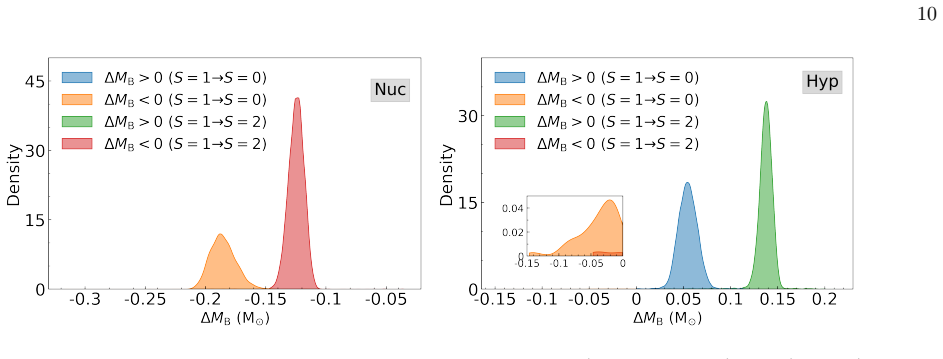
The machinery is a finite-temperature relativistic mean-field equation of state, built from a Bayesian-inferred zero-temperature ensemble of 18,000 nucleonic and 18,000 hyperonic EOSs, extended to $\beta$-equilibrated matter at fixed temperature, fixed entropy, and fixed lepton fraction. The load-bearing comparison is between the maximum baryonic mass at each proto-neutron star stage, trapped neutrinos, deleptonized warm matter, and cold matter, computed from the same EOS set; when a baryonic mass supported at the trapped-neutrino stage has no stable solution after deleptonization, the star is predicted to collapse. The thermal adiabatic index $\Gamma_{\rm Th}$ is used to show how hyperon onset redistributes thermal energy and softens pressure support.
What would settle it
A confirmed neutron star with gravitational mass above 2.2 solar masses whose thermal, radius, or post-merger behavior requires a hyperonic core would directly contradict the paper's ceiling. Alternatively, a hyperonic relativistic mean-field calculation with more repulsive hyperon couplings that still satisfies the two-solar-mass lower bound and produces stable configurations above 2.2 solar masses would show the ceiling is an artifact of the chosen coupling ratios.
Extended reading notes
Core claim
On the paper's own terms, the central discovery is a mass ceiling with a physical cause: hyperon onset softens the equation of state, and during deleptonization the maximum supportable baryonic mass drops by about 0.1 solar masses. Comparing three snapshots of proto-neutron star evolution, trapped neutrinos with entropy per baryon $S=1$ and lepton fraction $Y_{\rm lep}=0.4$, neutrino-free matter at $S=2$, and cold $\beta$-equilibrated matter at $S=0$, shows that hyperonic stars that could exist in the trapped stage have no stable cold counterpart at the same baryonic mass once they exceed roughly 2.2 solar masses. The result is presented as a model-based prediction from an 18,000-equation ensemble, not a rigorous theorem, with the paper's own caveat that only a full evolution simulation can give more concrete conclusions.
Load-bearing premise
Everything rests on the ensemble's hyperon couplings being fixed to equal the nucleon couplings for the $\sigma$, omega, and rho mesons, and to zero for the strange $\sigma$* and phi mesons, with the phi and $\sigma$* couplings set equal to the omega and $\sigma$ ones; if real hyperon couplings are more repulsive, or the ensemble misses viable hyperonic equations of state, the 2.15 to 2.2 solar mass ceiling could move.
Editorial extensions
If this is right
- A neutron star weighing more than about 2.2 solar masses, if confirmed, would indicate that hyperons are absent from its core, or that the hyperon couplings considered here are too soft.
- Hyperonic proto-neutron stars near the trapped-neutrino maximum mass should undergo delayed collapse to low-mass black holes, potentially explaining ceased neutrino signals and some gamma-ray bursts.
- The nucleonic ensemble keeps maximum masses near 2.4 to 2.5 solar masses, so observed masses between 2.2 and 2.4 solar masses sit in a diagnostic window separating the two scenarios.
- The thermal adiabatic index for hyperonic matter shows a large spread at $T=10$ MeV near hyperon onset, which would affect supernova and merger simulations that rely on a constant $\Gamma$ law.
Reading between the lines
- Inference: if the ceiling survives variations of hyperon couplings, pulsar timing of the most massive neutron stars (around 2.1 to 2.3 solar masses) becomes a sharper hyperon detector than any laboratory strangeness measurement.
- Inference: dark matter accumulation in proto-neutron star cores, which the paper suggests would raise baryon density and hyperon abundance, could lower the collapse threshold below 2.2 solar masses; that would make the mass ceiling environment-dependent and testable via population studies.
- Inference: one could test the mechanism directly by computing the same three-stage baryonic-mass comparison for ensembles with repulsive hyperon couplings, or for quark-matter and kaon-condensate EOSs; if those also show a deleptonization-driven drop, delayed collapse is a generic feature of exotic cores, not a hyperon-specific accident.
Editorial analysis
A structured set of objections, weighed in public.
Referee Report
Summary. The paper studies finite-temperature, beta-equilibrated equations of state (EOS) for proto-neutron stars (PNSs), using relativistic mean-field (RMF) models with nucleonic and hyperonic degrees of freedom. Two Bayesian-inferred ensembles of 18,000 EOS each, one nucleonic and one hyperonic, are extended to finite temperature, entropy, and lepton fraction. The authors compute thermal properties (notably the thermal adiabatic index Gamma_Th), mass-radius relations, maximum gravitational and baryonic masses under trapped-neutrino and deleptonized conditions, and the distribution of baryonic mass differences between PNS snapshots. The main headline claim is that, if hyperons are present, the maximum NS mass is of order 2.15--2.2 solar masses, and that an observed NS with mass above 2.2 solar masses would indicate the absence of hyperons in its core.
Significance. The work applies standard RMF and TOV machinery to a question with astrophysical relevance: whether hyperonic PNSs are metastable and can undergo delayed collapse to a black hole during deleptonization. The paper provides useful quantitative information, including 90% confidence intervals for maximum masses, radii, and central energy densities for both nucleonic and hyperonic ensembles, and a parametric fit for Gamma_Th in the nucleonic case. However, the central claim as stated is not established as a robust bound. The headline 'cannot exceed about 2.2 solar masses' is a posterior predictive from one specific EOS prior with fixed hyperon couplings, and the paper's own tables contain conflicting statistical summaries. The underlying calculation is sound, but the inference drawn from it is broader than the evidence supports.
major comments (3)
- [Abstract and Sec. IV] The headline claim that hyperonic NSs cannot exceed about 2.2 solar masses is not consistently supported by the presented numbers. Table I gives the hyperonic median maximum gravitational mass at S=0 as 2.024 solar masses with a 90% CI of [2.002, 2.083] solar masses; Table II lists the ensemble maximum for the same case as 2.24 solar masses; the abstract quotes 2.15 solar masses and Sec. IV quotes 2.2 solar masses. These are three different statistical objects, and the quoted values are neither the median nor the upper CI limit of the maximum-mass distribution, while they lie below the ensemble maximum. The phrase 'cannot exceed' should be replaced with an explicit statement of the ensemble-specific posterior predictive, such as 'in this EOS ensemble, hyperonic maximum masses are below about 2.24 solar masses with a median near 2.02 solar masses.'
- [Sec. II, after Eq. (9)] The hyperonic EOS ensemble is constructed with fixed hyperon-meson coupling ratios: x_{jN}=1 for j=sigma,omega,rho, x_{jN}=0 for j=sigma*,phi, and g_phi=g_omega, g_sigma*=g_sigma. These choices set the softening at hyperon onset and therefore directly control the maximum mass ceiling. No marginalization over hyperon couplings is performed, even though hypernuclear data leave a range of viable couplings. More repulsive omega-Lambda coupling or nonzero phi repulsion would delay the hyperon softening and could move the ceiling upward. The central claim should be framed as conditional on these fixed ratios, and a sensitivity study over hyperon couplings is needed to support any statement about hyperonic matter in general.
- [Sec. III, end (Fig. 5 and surrounding text)] The conclusion that hyperonic PNSs with gravitational mass beyond 2.2 solar masses at stage (i) (S=1, Y_lep=0.4) become unstable during deleptonization is inferred from comparing maximum masses of independent static configurations at different snapshots, not from following a fixed-baryonic-mass trajectory through the evolution. The authors themselves state that 'only a simulation of the evolution may give more concrete conclusions.' The Sec. IV assertion that such objects may be black holes, and that an observation above 2.2 solar masses indicates the absence of hyperons, goes beyond what a static comparison of maximum masses can establish. The claim should be reframed as a dynamical hypothesis requiring time-dependent confirmation.
minor comments (4)
- [Eq. (26)] Please clarify the notation in the Gamma_Th parametrization: the expression reads Gamma_nuc_Th(n_B,T) = a + b \cdot c^{n_B} \cdot \rho^{T d}; is \rho equal to n_B, and are the units consistent? With c=0.0022, the factor c^{n_B} is extremely small for n_B ~ 0.5 fm^-3, so please verify the formula and the fitted coefficients, and also state the density and temperature ranges in the same notation as the formula.
- [Abstract and Sec. IV] There are minor grammatical issues in the central statements: 'can not exceed' should be 'cannot exceed', and 'can indirectly indicates' should be 'can indirectly indicate'.
- [Sec. III and Sec. IV] The text says at T=10 MeV the hyperonic Gamma_Th band 'has a width ≳1.5' above the hyperon onset density, while the preceding discussion and Fig. 1 show 90% CI bands with much smaller width; please reconcile these statements and make the relation between the text and the figure explicit.
- [Sec. I] The phrase 'χeffective field theory' should read 'chiral effective field theory'.
Circularity Check
No circularity: the ~2.2 M⊙ hyperon ceiling is a model-dependent posterior envelope of the authors' ensemble, not an input refitted as a prediction.
full rationale
The paper's central claim—that a neutron star with hyperons cannot exceed about 2.2 M⊙—is a posterior predictive derived from an explicit relativistic mean-field ensemble, not a quantity that was fitted and then renamed as a prediction. The ensemble was built from external inputs: chiral EFT neutron-matter constraints, saturation properties, and the lower bound M_max > 2.0 M⊙. The hyperon couplings are fixed by stated assumptions (x_jN = 1 for σ, ω, ρ; g_φ = g_ω; g_σ* = g_σ), openly attributed to Ref. [41], and are not adjusted to reproduce the 2.2 M⊙ ceiling. The ceiling is therefore a consequence of hyperon-induced softening within that model family, not an identity with the imposed 2.0 M⊙ lower bound. Self-citations such as Refs. [36], [41], and [42] supply the prior EOS framework and coupling choices, but the finite-temperature PNS calculation and the delayed-collapse analysis are new applications; the central result is not contained in those citations by construction. The paper's own caveat that 'only a simulation of the evolution may give more concrete conclusions' and the discrepancy between the abstract's 2.2 M⊙ wording and Table II's hyperonic maximum of 2.34 M⊙ in the trapped-neutrino stage are correctness/scope concerns, not evidence that the derivation reduces to its inputs. No equation or fitted parameter in the paper makes the claimed upper bound equivalent to the input constraints, so no circular step can be exhibited.
Assumptions & free parameters
free parameters (3)
- Nucleonic RMF couplings (posterior samples from Ref. [36]) =
not given in paper (18000 samples each set)
- Hyperon coupling ratios x_{σY}, x_{ωY}, x_{ρY}, x_{σ*Y}, x_{φY} =
x_{jN}=1 for σ,ω,ρ; x_{jN}=0 for σ*,φ; g_φ=g_ω; g_σ*=g_σ
- ΓTh parametrization coefficients a, b, c, d =
a=1.3665, b=11.9638, c=0.0022, d=0.0867
assumptions (4)
- domain assumption The RMF mean-field approximation with nonlinear meson self-interactions describes dense hadronic matter.
- domain assumption Beta-equilibrium with trapped neutrinos (Ylep=0.4, S=1) and neutrino-free matter (S=2, T=0) can be treated as three static snapshots of PNS evolution.
- ad hoc to paper The Bayesian EOS posterior from Ref. [36] represents the space of viable neutron star equations of state.
- domain assumption Hyperon-meson couplings follow SU(6)-type symmetry relations (xσY=xωY=xρY=1, gφ=gω, gσ*=gσ).
Cite this review
Pith. "Pith review of Constraints on maximum neutron star mass from proto-neutron star evolution." pith.science (2026). https://pith.science/paper/AKT4MBA3
@misc{pith2026250518888,
  author       = {Pith},
  title        = {Pith review of: Constraints on maximum neutron star mass from proto-neutron star evolution},
  year         = {2026},
  howpublished = {\url{https://pith.science/paper/AKT4MBA3}},
  note         = {Machine review of arXiv:2505.18888}
}
abstract
A proto-neutron star (PNS) gets formed after a successful supernova when the stellar remnant decouples from the ejecta. In this study, we explore a relativistic framework for the finite-temperature $\beta$-equilibrium limit of equation of state (EOS), constrained via a Bayesian inference methodology. The EOS is constrained by minimal approximations on a few nuclear saturation properties, low-density pure neutron matter constraints from chiral effective field theory, and a neutron star (NS) maximum mass greater than 2.0 $M_{\odot}$. Two sets of EOS derived from the relativistic mean field model for nucleonic and hyperonic matter constrained by a Bayesian inference calculation at the zero temperature limit are used. The thermal adiabatic index ($\Gamma_{\rm Th}$) is calculated as a function of the baryonic density across several temperatures for both the sets. Our results suggest that the maximum NS mass is of the order of 2.15 $M_\odot$ if hyperons are present. In addition, the present study suggests that an observation of NS with mass larger than $2.2\ M_{\odot}$ can indirectly indicates the absence of hyperons in its core. The deleptonization of hyperonic PNS reduces the stellar maximum mass rendering the PNS exceeding the zero temperature maximum stellar (baryonic) mass limit becomes metastable which is prone to collapse into a black hole while PNS below such a mass threshold evolves to a stable NS.
Figures


Figures from the paper (3 more)


Reference graph
Works this paper leans on
-
[36]
D. Kumar and P. K. Sahu, Constraining the neutron star equation of state by including the isoscalar-vector and isovector-vector coupling using the Bayesian analy- sis, arXiv.2505.02618 10.48550/arXiv.2505.02618 (2025), arXiv:2505.02618 [nucl-th]
work page Pith review arXiv doi:10.48550/arxiv.2505.02618 2025
- [41]
-
[1]
A. Burrows and J. M. Lattimer, The birth of neutron stars, Astrophys. J. 307, 178 (1986)
work page 1986
-
[2]
J. A. Pons, S. Reddy, M. Prakash, J. M. Lattimer, and J. A. Miralles, Evolution of protoneutron stars, Astro- phys. J. 513, 780 (1999), arXiv:astro-ph/9807040
arXiv 1999
-
[3]
K. Sumiyoshi, S. Yamada, and H. Suzuki, Dynamics and neutrino signal of black hole formation in nonrotating failed supernovae. i. equation of state dependence, As- trophys. J. 667, 382 (2007)
work page 2007
- [4]
-
[5]
T. Fischer, S. Whitehouse, A. Mezzacappa, F.-K. Thiele- mann, and M. Liebendorfer, The neutrino signal from protoneutron star accretion and black hole formation, As- tronomy & Astrophysics 499, 1 (2009), arXiv:0809.5129 [astro-ph]
arXiv 2009
-
[6]
M. Shibata and K. Taniguchi, Coalescence of Black Hole- Neutron Star Binaries, Living Rev.Rel. 14, 6 (2011)
work page 2011
Show all 63 references
-
[7]
O’Connor and C
E. O’Connor and C. D. Ott, Black Hole Formation in Failing Core-Collapse Supernovae, Astrophys. J. 730, 70 (2011), arXiv:1010.5550 [astro-ph.HE]
2011 arXiv
-
[8]
Hempel, T
M. Hempel, T. Fischer, J. Schaffner-Bielich, and M. Liebend¨ orfer, New Equations of State in Simulations of Core-collapse Supernovae, Astrophys. J.48, 70 (2012)
2012
-
[9]
A. W. Steiner, M. Hempel, and T. Fischer, CORE- COLLAPSE SUPERNOV A EQUATIONS OF STATE BASED ON NEUTRON STAR OBSER V ATIONS, The Astrophysical Journal 774, 17 (2013)
2013
-
[10]
Mezzacappa, E
A. Mezzacappa, E. J. Lentz, S. W. Bruenn, W. R. Hix, O. E. B. Messer, E. Endeve, J. M. Blondin, J. A. Harris, P. Marronetti, K. N. Yakunin, and E. J. Lingerfelt, A Neutrino-Driven Core Collapse Supernova Explosion of a 15 M Star, arXiv e-prints , arXiv:1507.05680 (2015), arXiv...
2015 arXiv
-
[11]
Rosswog, The multi-messenger picture of compact bi- nary mergers, Int
S. Rosswog, The multi-messenger picture of compact bi- nary mergers, Int. J. Mod. Phys. D 24, 1530012 (2015), arXiv:1501.02081 [astro-ph.HE]
2015 arXiv
-
[12]
Baiotti and L
L. Baiotti and L. Rezzolla, Binary neutron star mergers: a review of Einstein’s richest laboratory, Rep.Prog. Phys. 80, 096901 (2017), arXiv:1607.03540 [gr-qc]
2017 arXiv
-
[13]
E. P. O’Connor and S. M. Couch, Exploring Fundamen- tally Three-dimensional Phenomena in High-fidelity Sim- ulations of Core-collapse Supernovae, Astrophys. J. 865, 81 (2018), arXiv:1807.07579 [astro-ph.HE]
2018 arXiv
-
[14]
Burrows, D
A. Burrows, D. Radice, D. Vartanyan, H. Nagakura, M. A. Skinner, and J. C. Dolence, The overarching frame- work of core-collapse supernova explosions as revealed by 3D FORNAX simulations, Mon. Not. Royal Astr. Soc. 491, 2715 (2020), arXiv:1909.04152 [astro-ph.HE]
2020 arXiv
-
[15]
M. Ruiz, A. Tsokaros, and S. L. Shapiro, Magnetohy- drodynamic simulations of binary neutron star mergers in general relativity: Effects of magnetic field orienta- tion on jet launching, Phys. Rev. D 101, 064042 (2020), arXiv:2001.09153 [astro-ph.HE]
2020 arXiv
-
[16]
Kunkel, S
S. Kunkel, S. Wystub, and J. Schaffner-Bielich, Deter- mining the minimal mass of a proto-neutron star with chirally constrained nuclear equations of state, Phys. Rev. C 111, 035807 (2025), arXiv:2411.14930 [nucl-th]
2025 arXiv
-
[17]
Prakash, I
M. Prakash, I. Bombaci, M. Prakash, P. J. Ellis, J. M. Lattimer, and R. Knorren, Composition and struc- ture of protoneutron stars, Phys. Rept. 280, 1 (1997), arXiv:nucl-th/9603042
1997 arXiv
-
[18]
Janka, Explosion Mechanisms of Core-Collapse Su- pernovae, Ann
H.-T. Janka, Explosion Mechanisms of Core-Collapse Su- pernovae, Ann. Rev. Nucl. Part. Sci. 62, 407 (2012), arXiv:1206.2503 [astro-ph.SR]
2012 arXiv
-
[19]
Bauswein, H
A. Bauswein, H. T. Janka, K. Hebeler, and A. Schwenk, Equation-of-state dependence of the gravitational-wave signal from the ring-down phase of neutron-star mergers, Phys. Rev. D 86, 063001 (2012), arXiv:1204.1888 [astro- ph.SR]
2012 arXiv
-
[20]
K¨ oppel, L
S. K¨ oppel, L. Bovard, and L. Rezzolla, A general- relativistic determination of the threshold mass to prompt collapse in binary neutron star mergers, The As- trophysical Journal 872, L16 (2019)
2019
-
[21]
Bauswein, S
A. Bauswein, S. Blacker, V. Vijayan, N. Stergioulas, K. Chatziioannou, J. A. Clark, N.-U. F. Bastian, D. B. Blaschke, M. Cierniak, and T. Fischer, Equation of state constraints from the threshold binary mass for prompt collapse of neutron star mergers, Phys. Rev. Lett. 125, 14...
2020
-
[22]
Preau, A
E. Preau, A. Pascal, J. Novak, and M. Oertel, What can be learned from a proto-neutron star’s mass and radius?, Mon. Not. Roy. Astron. Soc. 505, 939 (2021), arXiv:2102.05923 [astro-ph.HE]
2021 arXiv
-
[23]
A. R. Raduta, F. Nacu, and M. Oertel, Equations of state for hot neutron stars, Eur. Phys. J. A 57, 329 (2021), arXiv:2109.00251 [nucl-th]
2021 arXiv
-
[24]
G. F. Burgio, H. J. Schulze, I. Vidana, and J. B. Wei, Neutron stars and the nuclear equation of state, Prog. Part. Nucl. Phys. 120, 103879 (2021), arXiv:2105.03747 [nucl-th]
2021 arXiv
-
[25]
C. A. Raithel, F. Ozel, and D. Psaltis, Finite-temperature extension for cold neutron star equations of state, Astro- phys. J. 875, 12 (2019), arXiv:1902.10735 [astro-ph.HE]
2019 arXiv
-
[26]
Franzon, V
B. Franzon, V. Dexheimer, and S. Schramm, Inter- nal composition of proto-neutron stars under strong magnetic fields, Phys. Rev. D 94, 044018 (2016), arXiv:1606.04843 [astro-ph.HE]
2016 arXiv
-
[27]
Rabhi and C
A. Rabhi and C. Providencia, Dense stellar matter with trapped neutrinos under strong magnetic fields, J. Phys. G 37, 075102 (2010), arXiv:0909.1116 [nucl-th]
2010 arXiv
-
[28]
Rabhi, P
A. Rabhi, P. K. Panda, and C. Providencia, Warm and dense stellar matter under strong magnetic fields, Phys. Rev. C 84, 035803 (2011), arXiv:1105.0254 [nucl-th]
2011 arXiv
-
[29]
Keil and H
W. Keil and H. T. Janka, Hadronic phase transitions at supranuclear densities and the delayed collapse of newly formed neutron stars, Astron. Astrophys. 296, 145 (1995)
1995
-
[30]
Vidana, I
I. Vidana, I. Bombaci, A. Polls, and A. Ramos, Microscopic study of neutrino trapping in hyperon 12 stars, Astron. Astrophys. 399, 687 (2003), arXiv:astro- ph/0209068
2003
-
[31]
G. E. Brown and H. Bethe, A Scenario for a large number of low mass black holes in the galaxy, Astrophys. J. 423, 659 (1994)
1994
-
[32]
Oertel, M
M. Oertel, M. Hempel, T. Kl¨ ahn, and S. Typel, Equa- tions of state for supernovae and compact stars, Rev. Mod. Phys. 89, 015007 (2017), arXiv:1610.03361 [astro- ph.HE]
2017 arXiv
-
[33]
Martinez-Pinedo, T
G. Martinez-Pinedo, T. Fischer, A. Lohs, and L. Huther, Charged-current weak interaction processes in hot and dense matter and its impact on the spectra of neutrinos emitted from proto-neutron star cooling, Phys. Rev. Lett. 109, 251104 (2012), arXiv:1205.2793 [astro-ph.HE]
2012 arXiv
-
[34]
Nakazato and H
K. Nakazato and H. Suzuki, Cooling timescale for pro- toneutron stars and properties of nuclear matter: Effec- tive mass and symmetry energy at high densities, Astro- phys. J. 878, 25 (2019), arXiv:1905.00014 [astro-ph.HE]
2019 arXiv
-
[35]
Reddy, M
S. Reddy, M. Prakash, J. M. Lattimer, and J. A. Pons, Effects of strong and electromagnetic correlations on neu- trino interactions in dense matter, Phys. Rev. C 59, 2888 (1999), arXiv:astro-ph/9811294
1999 arXiv
-
[37]
Galeazzi, W
F. Galeazzi, W. Kastaun, L. Rezzolla, and J. A. Font, Im- plementation of a simplified approach to radiative trans- fer in general relativity, Phys. Rev. D 88, 064009 (2013), arXiv:1306.4953 [gr-qc]
2013 arXiv
-
[38]
Schenke, S
B. Schenke, S. Jeon, and C. Gale, Anisotropic flow in√s = 2.76 TeV Pb+Pb collisions at the LHC, Phys. Lett. B 702, 59 (2011), arXiv:1102.0575 [hep-ph]
2011 arXiv
-
[39]
Alqahtani, M
M. Alqahtani, M. Nopoush, R. Ryblewski, and M. Strick- land, (3+1)D Quasiparticle Anisotropic Hydrodynam- ics for Ultrarelativistic Heavy-Ion Collisions, Phys. Rev. Lett. 119, 042301 (2017), arXiv:1703.05808 [nucl-th]
2017 arXiv
-
[40]
Boguta and A
J. Boguta and A. R. Bodmer, Relativistic Calculation of Nuclear Matter and the Nuclear Surface, Nucl. Phys. A 292, 413 (1977)
1977
-
[42]
Malik, M
T. Malik, M. Ferreira, M. B. Albino, and C. Providˆ encia, Spanning the full range of neutron star properties within a microscopic description, Phys. Rev. D 107, 103018 (2023), arXiv:2301.08169 [nucl-th]
2023 arXiv
-
[43]
A. Gal, E. V. Hungerford, and D. J. Millener, Strangeness in nuclear physics, Rev. Mod. Phys. 88, 035004 (2016), arXiv:1605.00557 [nucl-th]
2016 arXiv
-
[44]
Weissenborn, D
S. Weissenborn, D. Chatterjee, and J. Schaffner-Bielich, Hyperons and massive neutron stars: the role of hyperon potentials, Nucl. Phys. A 881, 62 (2012), arXiv:1111.6049 [astro-ph.HE]
2012 arXiv
-
[45]
Fortin, C
M. Fortin, C. Providˆ encia, A. R. Raduta, F. Gulminelli, J. L. Zdunik, P. Haensel, and M. Bejger, Neutron star radii and crusts: Uncertainties and unified equations of state, Phys. Rev. C 94, 035804 (2016)
2016
-
[46]
Fortin, A
M. Fortin, A. R. Raduta, S. Avancini, and C. Providˆ encia, Relativistic hypernuclear compact stars with calibrated equations of state, Phys. Rev. D 101, 034017 (2020), arXiv:2001.08036 [hep-ph]
2020 arXiv
-
[47]
J. R. Stone, V. Dexheimer, P. A. M. Guichon, A. W. Thomas, and S. Typel, Equation of state of hot dense hyperonic matter in the Quark–Meson-Coupling (QMC- A) model, Mon. Not. Roy. Astron. Soc. 502, 3476 (2021), arXiv:1906.11100 [nucl-th]
2021 arXiv
-
[48]
Fortin, M
M. Fortin, M. Oertel, and C. Providˆ encia, Hyperons in hot dense matter: what do the constraints tell us for equation of state?, Publ. Astron. Soc. Austral. 35, 44 (2018), arXiv:1711.09427 [astro-ph.HE]
2018 arXiv
-
[49]
Core Research Grant (CRG/2022/000663)
within the FSU2H model and in Ref. [23] for the models in the CompOSE database. The fast decrease of Γ th is related to the onset of hyperons: the thermal energy is distributed by a larger number of degrees of freedom and the pressure suffers a strong softening. The increase o...
2022
-
[50]
Kochankovski, A
H. Kochankovski, A. Ramos, and L. Tolos, Equa- tion of state for hot hyperonic neutron star matter, Mon. Not. Roy. Astron. Soc. 517, 507 (2022), [Erratum: Mon.Not.Roy.Astron.Soc. 518, 6376], arXiv:2206.11266 [astro-ph.HE]
2022 arXiv
-
[51]
Bhowmick, M
B. Bhowmick, M. Bhattacharya, A. Bhattacharyya, and G. Gangopadhyay, Massive neutron stars with a hyper- onic core: A case study with the IUFSU relativistic effective interaction, Phys. Rev. C 89, 065806 (2014), arXiv:1403.0341 [nucl-th]
2014 arXiv
-
[52]
Steiner, M
A. Steiner, M. Prakash, and J. M. Lattimer, Quark- hadron phase transitions in young and old neutron stars, Phys. Lett. B 486, 239 (2000), arXiv:nucl-th/0003066
2000 arXiv
-
[53]
J.-B. Wei, G. F. Burgio, A. R. Raduta, and H. J. Schulze, Hot neutron stars and their equation of state, Phys. Rev. C 104, 065806 (2021), arXiv:2112.05323 [nucl-th]
2021 arXiv
-
[54]
B. P. Abbott et al. (LIGO Scientific, Virgo), GW170817: Measurements of neutron star radii and equation of state, Phys. Rev. Lett. 121, 161101 (2018), arXiv:1805.11581 [gr-qc]
2018 arXiv
-
[55]
M. C. Miller et al., PSR J0030+0451 Mass and Radius from N ICERData and Implications for the Properties of Neutron Star Matter, Astrophys. J. Lett. 887, L24 (2019), arXiv:1912.05705 [astro-ph.HE]
2019 arXiv
-
[56]
M. C. Miller et al., The Radius of PSR J0740+6620 from NICER and XMM-Newton Data, Astrophys. J. Lett. 918, L28 (2021), arXiv:2105.06979 [astro-ph.HE]
2021 arXiv
-
[57]
T. E. Riley et al., A N ICERView of PSR J0030+0451: Millisecond Pulsar Parameter Estimation, Astrophys. J. Lett. 887, L21 (2019), arXiv:1912.05702 [astro-ph.HE]
2019 arXiv
-
[58]
Bombaci, The maximum mass of a neutron star., As- tronomy and Astrophysics 305, 871 (1996)
I. Bombaci, The maximum mass of a neutron star., As- tronomy and Astrophysics 305, 871 (1996)
1996
-
[59]
Dessart, A
L. Dessart, A. Burrows, E. Livne, and C. Ott, The Proto- neutron Star Phase of the Collapsar Model and the Route to Long-soft Gamma-ray Bursts and Hypernovae, Astro- phys. J. Lett. 673, L43 (2008), arXiv:0710.5789 [astro- ph]
2008 arXiv
-
[60]
Berezhiani, I
Z. Berezhiani, I. Bombaci, A. Drago, F. Frontera, and A. Lavagno, Gamma-ray bursts from delayed collapse of neutron stars to quark matter stars, Astrophys. J. 586, 1250 (2003), arXiv:astro-ph/0209257
2003 arXiv
-
[61]
Bombaci and B
I. Bombaci and B. Datta, Conversion of neutron stars to strange stars as the central engine of gamma-ray bursts, Astrophys. J. Lett. 530, L69 (2000), arXiv:astro- ph/0001478
2000
-
[62]
Kalogera and G
V. Kalogera and G. Baym, The maximum mass of a neutron star, Astrophys. J. Lett. 470, L61 (1996), arXiv:astro-ph/9608059
1996 arXiv
-
[63]
N. K. Glendenning, Prompt subsidence of a protoneutron star into a black hole, Astrophys. J. 448, 797 (1995)
1995
Reviewed August 7, 2026 · model on record in the stance chip above.
Discussion (0). Sign in to comment.