REVIEW 3 major objections 5 minor 12 references
ExoPhoto: A Database of Temperature-Dependent Photodissociation Cross Sections
T0 review · 3 major / 5 minor · reviewed 2026-08-07 · deepseek-v4-flash
Pith's one-line read ExoPhoto compiles temperature-dependent photodissociation cross sections for 20 molecules into the ExoMol framework, merging quantum-mechanical calculations and UV absorption measurements into a unified data format for modeling hot…
desk verdict A useful, well-structured compilation of temperature-dependent photodissociation data, but the 'high-accuracy' label overstates what the experimental half actually delivers. read the letter →
The pith
A machine-rendered reading of the paper's core claim, the machinery that carries it, and where it could break.
The reading
What carries the argument
The load-bearing mechanism is the ExoMol data structure itself: a master .all.json file, per-isotopologue .pdef.json definition files, optional .model files, and .photo files with columns for wavelength (nm) and total cross section ($cm^{2}$ per molecule), optionally followed by partial cross sections per dissociative channel. For calculated diatomics, cross sections come from time-independent quantum-mechanical solutions of the nuclear Schrödinger equation using potential energy curves and transition dipole moments, with the Duo variational program (ExoMol) or grid-based continuum methods (PhoMol, UGAMOP), followed by Gaussian smoothing and Boltzmann averaging over rovibrational states. Experimental entries are far-UV photoabsorption spectra from two measurement programs, which the paper equates with photodissociation cross sections, acknowledging this yields an upper limit.
What would settle it
Measure quantum yields for a representative molecule such as CO2 at 1630 K or H2O at 1773 K by detecting dissociation products (for instance, O atoms or OH) as a function of wavelength, and compare the product-derived photodissociation cross section with the ExoPhoto absorption-based values; if yields fall clearly below unity in the far-UV, rates computed from ExoPhoto's experimental entries overestimate actual photolysis.
Extended reading notes
Core claim
ExoPhoto is a working database that demonstrates that photodissociation cross sections from three theory groups and two experimental programs can be recast into one ExoMol-style format for 20 molecules spanning diatomics, triatomics, and larger species. The paper's central claim is that this unification solves a practical bottleneck: previously, a modeller needing temperature-dependent photodissociation data had to chase datasets across the Leiden, MPI-Mainz, UGAMOP, PhoMol, and EXACT resources, with inconsistent temperature coverage and file formats. ExoPhoto provides, per isotopologue, a .photo file for each temperature, partial cross sections for outgoing electronic channels where available, and JSON definition files carrying metadata such as wavelength range, temperatures, pressures, and versioning. The paper argues that this structure, together with short-UV coverage and explicit temperature dependence, directly supports reliable computation of photodissociation rates in photon-rich environments such as the upper atmospheres of hot exoplanets.
Load-bearing premise
The experimental half of the database assumes that every UV photon absorbed breaks a bond, meaning that measured photoabsorption cross sections are treated exactly as photodissociation cross sections; the paper acknowledges this yields an upper limit that may overestimate true photodissociation rates.
Editorial extensions
If this is right
- Modellers can now compute photodissociation rates for 20 molecules with temperature coverage up to 10,000 K and wavelengths down to about 50 nm, including species relevant to hot exoplanet and cool star atmospheres.
- The unified format with one .photo file per temperature makes it straightforward to insert ExoPhoto data into existing atmospheric codes without reformatting or reconciling heterogeneous sources.
- For HCl and HF, the independent ExoMol and PhoMol calculations agree well, so users can combine PhoMol's short-wavelength coverage with ExoMol's broader isotopologue coverage.
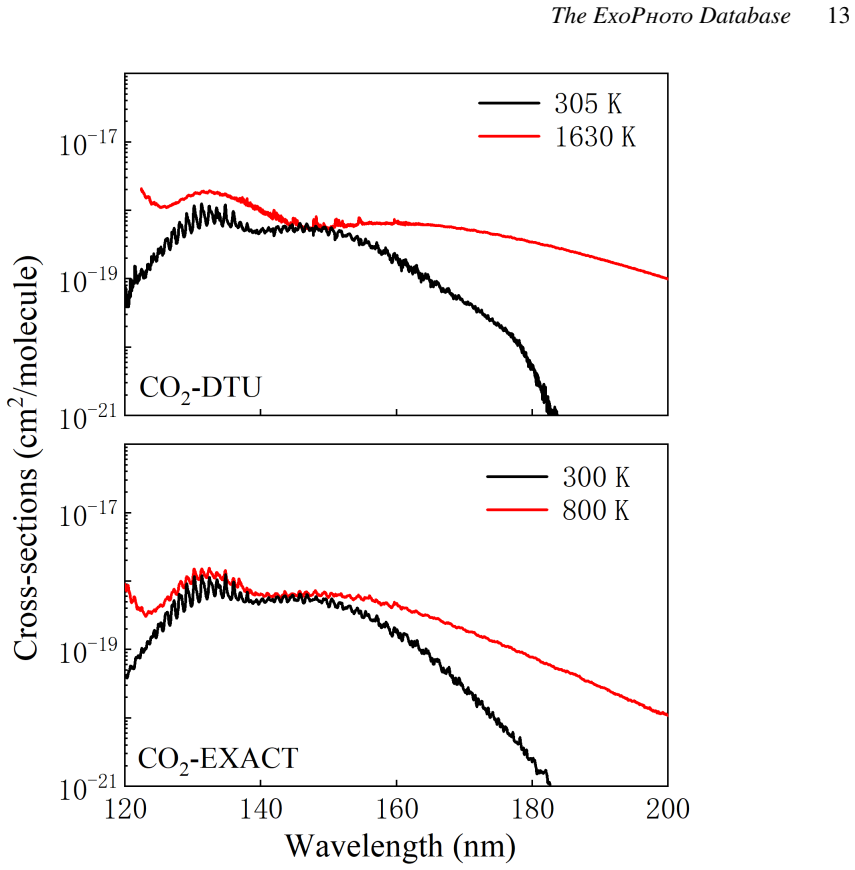
- The experimental datasets provide high-temperature absorption cross sections (up to roughly 1773 K) for CO, CO2, H2O, SO2, C2H2, C2H4, H2CO, and NH3, directly extending the temperature range of previously cold-only measurements.
- The JSON-based structure and versioning support automated downloads and updates, making the database a stable foundation for future additions such as non-LTE cross sections and new molecules.
Reading between the lines
- Because the experimental entries are UV photoabsorption cross sections equated with photodissociation, ExoPhoto's experimental half likely overestimates true photolysis rates for those eight molecules; a future companion dataset of measured quantum yields would let users correct for this.
- The same file structure could be extended to include quantum yields and branching ratios as first-class columns, turning the database from cross-section lookup into a direct input for photochemical yield calculations.
- The push to short UV wavelengths (below 100 nm) targets radiation fields from active M-dwarf stars, so one testable consequence is that hot-Jupiter photochemical models using ExoPhoto should show stronger photolytic destruction of water, CO2, and NH3 than models using low-temperature data from the Leiden or MPI-Mainz atlases.
- The temperature-dependent shift of dissociation thresholds means that cold-cloud approximations become increasingly unreliable above roughly 1000 K, so ExoPhoto provides a quantitative handle on just how much photodissociation rates rise in hot atmospheres.
Editorial analysis
A structured set of objections, weighed in public.
Referee Report
Summary. The paper presents ExoPhoto, an extension of the ExoMol database that supplies temperature- and wavelength-resolved photodissociation cross sections for 20 molecules (28 isotopologues), drawing on theoretical models from ExoMol, UGAMOP, and PhoMol and experimental measurements from DTU and EXACT. It describes the database structure, file naming conventions, the .photo file format, JSON definition files, spectroscopic model files, and the master file, with examples for HCl and CS. The stated goal is to fill the need for high-accuracy, temperature-dependent photodissociation data toward short-UV wavelengths for applications such as exoplanet and planetary atmosphere modeling.
Significance. If the data are usable at the claimed accuracy, ExoPhoto is a valuable community resource: it unifies scattered theoretical and experimental datasets into a consistent, machine-readable ExoMol-compatible format, adds temperature coverage beyond existing databases such as Leiden and MPI-Mainz, includes previously unpublished DTU measurements, and provides branching ratios/quantum yields for selected species. The infrastructure contributions are concrete and reproducible, with versioning and a documented API. However, the 'high-accuracy' characterization is not uniformly supported: 8 of the 20 molecules are represented by UV photoabsorption cross sections that are equated to photodissociation cross sections, several PhoMol theoretical entries omit predissociation, and no uncertainty estimates are provided. These issues do not negate the database's usefulness as a compilation, but they do mean the central claim needs qualification and targeted metadata improvements.
major comments (3)
- [Section 2, Table 1] The abstract and title characterize ExoPhoto as providing 'high-accuracy, temperature-dependent photodissociation cross sections,' but for 8 of the 20 molecules (CO, CO2, H2O, SO2, C2H2, C2H4, H2CO, NH3) Table 1 lists experimental data that Section 2 explicitly identifies as UV photoabsorption cross sections, stating that equating them with photodissociation 'yields an upper limit and may lead to a slight overestimation of the true photodissociation cross section.' For species with photodissociation quantum yields below unity, photolysis rates computed from these files will be systematically too high, so the entries are not the quantity promised by the title. The database should either relabel these files as photoabsorption/upper-limit cross sections in the abstract, .photo file headers, and master file metadata, or provide quantum-yield data and a quantitative estimate of the resulting error. This issue affects the central claim and should be fixed before publication.
- [Sections 2.1.3, 2.1.9, 2.1.10, 2.1.12] Several PhoMol theoretical entries omit predissociation. The paper notes for AlH (Section 2.1.3) that including predissociation 'is likely to significantly increase the photodissociation cross section at long wavelengths,' and similar caveats are given for MgO (Section 2.1.9) and NaO (Section 2.1.10); O2 (Section 2.1.12) is also restricted to direct continuum dissociation. Thus, for these molecules the .photo files are not complete photodissociation cross sections near threshold, and the 'high-accuracy' claim cannot be evaluated for them. The database should flag every dataset that excludes predissociation, and where possible provide a bound on the missing contribution or a comparison with measurements or calculations that include predissociation.
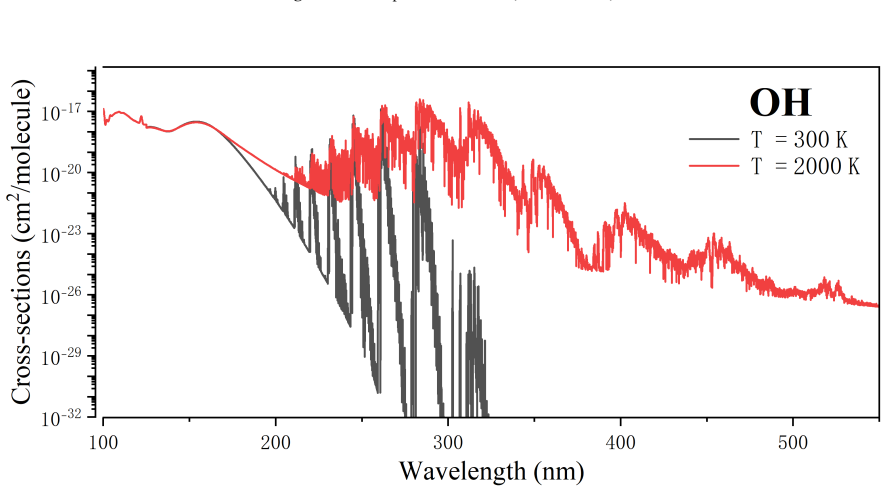
- [Section 3, Tables 3 and 5] No uncertainty information is provided for any dataset in the .photo files or the .pdef.json metadata, despite the 'high-accuracy' claim. The experimental data even contain negative values (Section 2), and the theoretical entries depend on model choices (PECs, DMCs, Gaussian smoothing, basis sets) whose accuracy is not quantified. A database designed for quantitative photochemical modeling should include at least per-dataset uncertainty estimates or a clear statement of accuracy benchmarks; for example, the validation of OH against the Leiden database (Section 2.1.11) and the claimed 'very good agreement' between ExoMol and PhoMol for HCl/HF (Section 2.1.6) are not quantified. Without such information, users cannot determine whether the 'high-accuracy' promise is met or how much the absorption-equals-dissociation and no-predissociation approximations affect individual entries.
minor comments (5)
- [Section 2.1.6] The text contains typographical errors in temperature ranges: '10 0000,000 K' should read '10 000 K' and '10 00,000 K' should read '10 000 K'; the same issue appears as '100000000 K' in Section 2.1.8.
- [Section 3.2] The word 'photodissociaition' is misspelled in the sentence describing temperature- and pressure-dependent cross sections.
- [Table 7] The dataset identifier 'PHOTO-PhoMol_HCl' for 1H-35Cl is inconsistent with the 'PhoMol' identifier used in Table 1 and in the file-naming examples; this should be standardized throughout.
- [Table 6] The statement that 'each isotopologue has a unique InChI and InChIKey' is contradicted by the table, which gives the same InChIKey for general HCl and 1H35Cl; if this is intentional because the InChIKey ignores the isotopic layer, the text should say so explicitly, since the database uses InChIKey as a metadata field.
- [Section 2.1.6] The sentence 'those interested in short wavelengths it will need to use the PhoMol results' is ungrammatical and should be rewritten; in addition, the 'very good agreement' between ExoMol and PhoMol is stated without a quantitative comparison, which would be useful given the high-accuracy claim.
Circularity Check
No circularity found: ExoPhoto is a compilation database; its acknowledged photoabsorption-to-photodissociation approximation is a scientific limitation, not a circular derivation.
full rationale
This paper is a database compilation and does not present a derivation chain whose outputs are forced by fitted inputs or by definition. The central claim is that ExoPhoto organizes existing calculated and measured cross sections into a uniform, temperature-resolved format. No new parameter is fitted, no equation links an output to an input by construction, and no 'prediction' is drawn from data that were used to define it. The paper's dependence on earlier work by ExoMol, PhoMol, and UGAMOP authors is a matter of data provenance, not circularity: the underlying calculations were published separately and, where noted, validated against independent sources (e.g., OH cross sections tested against the Leiden database). The one substantive approximation, equating UV photoabsorption cross sections with photodissociation cross sections for the experimental entries, is explicitly disclosed in Section 2 as yielding an upper limit and potentially overestimating photodissociation rates. That is an acknowledged scientific limitation affecting accuracy, not a circular reduction of a claimed result to its own inputs. Similarly, the omission of predissociation in some PhoMol entries is stated as an incompleteness in the underlying models, not as a covert reuse of the database's own output. Under the hard rules, none of these observations supports a circularity finding, so the appropriate score is 0.
Assumptions & free parameters
assumptions (2)
- domain assumption Experimental UV photoabsorption cross sections are equal to photodissociation cross sections, yielding an upper limit.
- domain assumption Local thermal equilibrium (LTE) and a Boltzmann population distribution apply to the calculated temperature-dependent cross sections.
Cite this review
Pith. "Pith review of ExoPhoto: A Database of Temperature-Dependent Photodissociation Cross Sections." pith.science (2026). https://pith.science/paper/ALWEHKY6
@misc{pith2026250522576,
  author       = {Pith},
  title        = {Pith review of: ExoPhoto: A Database of Temperature-Dependent Photodissociation Cross Sections},
  year         = {2026},
  howpublished = {\url{https://pith.science/paper/ALWEHKY6}},
  note         = {Machine review of arXiv:2505.22576}
}
read the original abstract
We present the ExoPhoto database (https://exomol.com/exophoto/), an extension of the ExoMol database, specifically developed to address the growing need for high-accuracy, temperature-dependent photodissociation cross section data towards short-UV wavelengths. ExoPhoto combines theoretical models from three major computational databases (ExoMol, UGAMOP and PhoMol) and experimental datasets from two experimental groups, providing extensive wavelength and temperature coverage. ExoPhoto currently includes photodissociation data for 20 molecules: AlH, HCl, HF, MgH, OH, NaO, MgO, O2, AlCl, AlF, CS, HeH+, CO, CO2, H2O, SO2, C2H2, C2H4, H2CO, and NH3, derived from theoretical models and supported by experimental data from 5 databases. ExoPhoto also includes detailed data on branching ratios and quantum yields for selected datasets. The data structure of ExoPhoto follows the ExoMol framework, with a consistent naming convention and hierarchical JSON-based organization. Photodissociation cross sections are stored in a set of .photo files which provide data as a function of wavelength with one file for each target molecule temperature. Future developments aim to include more photodissociation cross section data and to provide data for molecules in non-local thermodynamic equilibrium (non-LTE). These will expand the utility of ExoPhoto for advanced astrophysical, planetary modeling and industrial applications.
Figures


Figures from the paper (18 more)





Reference graph
Works this paper leans on
-
[1]
Albert, D., Antony, B., Ba, Y. A., Babikov, Y. L., Bollard, P., Boudon, V., Delahaye, F., Del Zanna, G., Dimitrijević, M. S., Drouin, B. J., Dubernet, M.-L., Duensing, F., Emoto, M., Endres, C., Fazliev, A. Z., Glorian, J.-M., Gordon, I. E., Gratier, P., Hill, C., Jevremović, D., Joblin, C., Kwon, D.-H., Kochanov, R. V., Krishnakumar, E., Leto, G., Loboda...
work page 2020
-
[7]
ExoMol photodissociation cross sections I – HCl and HF,MNRAS,514, 4413–4425. Pezzella,M.,Mitev,G.,Yurchenko,S.N.,Tennyson,J.,&Mitrushchenkov,A.O.,2024.Atime-independent,variationalmethodforstudyingthephotodissociation of triatomic molecules,Phys. Chem. Chem. Phys.,26, 27519–27529. RASTI000, 1–26 (2025) 26Q.-H. Ni et al. Qin, Z., Bai, T., & Liu, L., 2021a....
work page 2025
-
[9]
The 2024 release of the ExoMol database: molecular line lists for exoplanet and other hot atmospheres,J. Quant. Spectrosc. Radiat. Transf.,326, 109083. UGA,
work page 2024
-
[12]
ExoMol line lists – LIV. Empirical line lists for AlH and AlD and Emission spectroscopy of AlD in𝐴1Π(𝑣=0,1,2),MNRAS,527, 9736–9756. This paper has been typeset from a TEX/LATEX file prepared by the author. RASTI000, 1–26 (2025)
work page 2025
-
[77]
Venot,O.,Bénilan,Y.,Fray,N.,Gazeau,M.-C.,Lefèvre,F.,Es-sebbar,E.,Hébrard,E.,Schwell,M.,Bahrini,C.,Montmessin,F.,etal.,2018. VUV-absorption cross section of carbon dioxide from 150 to 800 K and applications to warm exoplanetary atmospheres,A&A,609, A34. Venot O. et al.,
work page 2018
- [148]
-
[2003]
Django web framework,URL http://www. djangoproject. com. Hrodmarsson,H.&VanDishoeck,E.,2023.Photodissociationandphotoionizationofmoleculesofastronomicalinterest-UpdatestotheLeidenphotodissociation and photoionization cross section database,AA,675, A25. Huebner, W. F. & Mukherjee, J.,
work page 2023
-
[2007]
Broussard,W.,Schwieterman,E.W.,Ranjan,S.,Sousa-Silva,C.,Fateev,A.,&Reinhard,C.T.,2024
Glossary of terms used in photochemistry, (iupac recommendations 2006),Pure and Applied Chemistry,79(3), 293–465. Broussard,W.,Schwieterman,E.W.,Ranjan,S.,Sousa-Silva,C.,Fateev,A.,&Reinhard,C.T.,2024. TheImpactofExtendedH 2OCrossSectionsonTemperate Anoxic Planet Atmospheres: Implications for Spectral Characterization of Habitable Worlds,ApJ,967,
work page 2006
Show all 12 references
-
[2014]
Uhlikova, T., Yurchenko, S
Molecular Opacity Project Database,https://sites.physast.uga.edu/ugamop/, Accessed: 2024-11-21. Uhlikova, T., Yurchenko, S. N., Perri, A. N., Tennyson, J., & Kim, G.-S.,
2024
-
[2022]
Pezoa,F.,Reutter,J.L.,Suarez,F.,Ugarte,M.,&Vrgoč,D.,2016
AlH lines in the blue spectrum of Proxima Centauri,MNRAS,516, 5655–5673. Pezoa,F.,Reutter,J.L.,Suarez,F.,Ugarte,M.,&Vrgoč,D.,2016. FoundationsofJSONschema,inProceedings of the 25th international conference on World Wide Web, pp. 263–273. Pezzella, M., Yurchenko, S. N., & Tennyson, J.,
2016
-
[2024]
goldbook
Inchi software downloads, Accessed: 2024-12-29. IUPAC,2006. Compendiumofchemicalterminology,2nded.(the"goldbook"):branchingfraction,https://doi.org/10.1351/goldbook.B00725,Online corrected version: 2006–; Accessed: 2024-05-05. Keller-Rudek, H., Moortgat, G. K., Sander, R., & S...
2024 doi
-
[2025]
Gay,C.,Abel,N.,Porter,R.,Stancil,P.,Ferland,G.J.,Shaw,G.,VanHoof,P.,&Williams,R.,2012
High-temperoature measurements of acetylene VUV absorption cross sections and application to warm exoplanet atmospheres,A&A,693, A82. Gay,C.,Abel,N.,Porter,R.,Stancil,P.,Ferland,G.J.,Shaw,G.,VanHoof,P.,&Williams,R.,2012. RovibrationallyResolvedDirectPhotodissociationthrough th...
2012
Reviewed August 7, 2026 · model on record in the stance chip above.
Discussion (0). Sign in to comment.