REVIEW 3 major objections 6 minor 51 references
Active particles that temporarily close the bonds they traverse can diffuse faster the more persistent their motion, in contrast to the usual crowding slowdown.
Reviewed by Pith at T0; open to challenge. T0 means a machine referee read the full paper against a public rubric. the ladder, T0–T4 →
T0 review · deepseek-v4-flash
2026-08-03 04:27 UTC pith:ANHLZAG4
load-bearing objection The paper's new mechanism—trail-mediated blocking opposed to steric blocking—is plausible and interesting, but the supporting Appendix A control is not airtight and the simulations lack error bars. the 3 major comments →
Transport Properties of Active Particles Moving on Adjustable Networks
The pith
A machine-rendered reading of the paper's core claim, the machinery that carries it, and where it could break.
Core claim
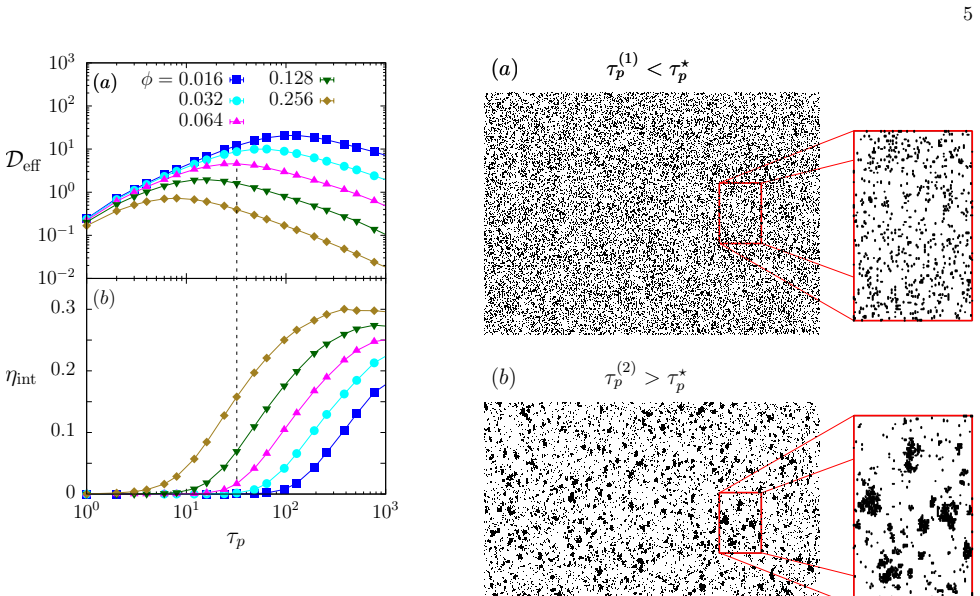
The central claim is that when particles leave temporary closed bonds in their wake, the effective diffusion coefficient can grow monotonically with persistence time, in sharp contrast to the familiar non-monotonic dependence caused by clustering under excluded-volume interactions. In the high-persistence limit, particles blocked by closed tracks are released when the tracks heal, whereas particles trapped inside clusters stay trapped longer as persistence increases. Because the two blocking channels respond oppositely to persistence, the optimal persistence time that maximizes diffusion shifts: raising density pushes it down, while raising healing time pushes it up. The paper supports this
What carries the argument
The key mechanism is the trail-mediated bond blockade: each bond traversed by a particle switches to a closed state for a characteristic healing time, and no particle, including the one that closed it, may cross a closed bond. On the triangular lattice, run-and-tumble motion with persistence time drives an adjustable network whose blocked-bond density is set by the competition between healing and traversal. The paper separates two blocking channels — excluded volume at occupied sites and closed bonds — and attributes the opposite diffusion trends to their different dependence on persistence: cluster interiors trap particles for a time set by the persistence time, while closed bonds obstruct
Load-bearing premise
The monotonic increase of diffusion with persistence for trail blocking is demonstrated only in a model variant where multiple particles may occupy the same site; if that increase is an artifact of the shared sites rather than a property of closed-bond blocking, the explanation for why the optimal persistence time rises with healing time collapses.
What would settle it
Run the no-steric model with a rule that lets particles pass through occupied sites without sharing them, such as a direct swap or a ghost move, so the excluded-volume channel is removed while multiple occupancy is not. If the effective diffusion coefficient no longer increases monotonically with persistence time, the trail-blocking mechanism is not the cause.
If this is right
- If trail blocking acts alone, the effective diffusion coefficient increases monotonically with persistence time for all healing times studied, as shown in the no-steric variant of the model.
- At sufficiently high persistence, steric blocking dominates, and diffusion becomes essentially independent of the healing time.
- The optimal persistence time scales with density as a power law in the fixed-network limit, with an exponent near one, and rises with healing time when trails persist.
- Transport in self-remodeling media can be tuned by the healing time: slower healing moves the diffusion maximum to longer persistence.
Where Pith is reading between the lines
- Editorial inference: a testable extension is to measure the fraction of blocking events caused by closed bonds versus occupied sites in the full model; the paper's explanation predicts the closed-bond fraction dominates near the shifted optimum and decays at high persistence.
- Editorial inference: the same mechanism should produce a non-monotonic dependence of the spreading rate on healing time at fixed persistence, since very short healing recovers fixed-network behavior and very long healing suppresses motion.
- Editorial inference: if the monotonic trail-blocking trend is generic, it suggests that trail deposition in biological systems could act as a transport accelerator rather than only as a trap, for example enabling persistent cells to navigate through self-modified extracellular networks.
Editorial analysis
A structured set of objections, weighed in public.
Referee Report
Summary. The paper studies a lattice model of run-and-tumble particles on a triangular network. A particle that traverses a bond closes it; closed bonds block all particles and reopen after healing time tau_h. Particles also obey excluded volume. In the fixed-network limit (tau_h=1) the simulations reproduce the known nonmonotonic D_eff(tau_p) and show an empirical scaling collapse with a fitted exponent lambda approximately 1. For adjustable networks, the paper argues via a no-steric variant (Appendix A) that closed-bond blocking alone makes D_eff increase monotonically with tau_p, opposite to the steric mechanism, and that the competition shifts the optimal persistence time tau_p* upward with tau_h. The central claim is this qualitative contrast between the two blocking mechanisms and the resulting dependence of tau_p* on density and healing time.
Significance. If the central claim holds, it is significant: it identifies a transport signature that distinguishes self-generated topological disorder from ordinary excluded-volume interactions, with potential relevance to trail-forming microswimmers, migrating cells, and adaptive network materials. The model is minimal, the simulations are large-scale (L=1024, up to ~3e5 particles), and the scaling collapse is a useful compact representation of the fixed-network data. The main weakness is that the mechanistic separation is asserted rather than validated, and the quantitative support lacks error bars; the result is therefore plausible but not yet fully established.
major comments (3)
- [Appendix A; Sec. IV B] The no-steric model does not cleanly isolate trail blocking. Allowing sigma_i in {0,...,N_p} changes the effective local density and the correlation between particles and closed bonds; particles can pile up and collectively probe the same bond set, so the bond-closure statistics differ from the single-occupancy system. The text asserts that this suppresses the clustering-induced blocking mechanism, but no validation is given that the monotonic increase of D_eff(tau_p) in Fig. 8 is intrinsic to closed-bond blocking rather than an artifact of multi-occupancy. This monotonicity is the key input to the explanation of why tau_p* increases with tau_h (Fig. 6); Fig. 6c alone is a single state point and does not supply the full D_eff(tau_p) curve. I recommend testing the no-steric model against single-occupancy simulations at very low phi, or providing an independent argument.
- [Section III; Figs. 2-8] No figure shows error bars, although the text states that 5-10 independent realizations are used. The central qualitative claims--monotonic increase of D_eff with tau_p in the no-steric model (Fig. 8), the location of tau_p* (Figs. 2, 5, 6), and the scaling collapse (Fig. 4)--are quantitative statements that need at least representative error bars or a typical-uncertainty statement. In Fig. 8 the differences between tau_h curves at high phi can be small; without error bars the monotonicity claim is not testable.
- [Eq. (3); Fig. 4] The 'theoretical prediction' tau_p* ~ phi^{-lambda} is not independent: lambda is chosen to achieve the best collapse of the same simulated data in Fig. 4a. The agreement in Fig. 4b is therefore a consistency check, not a test. Please either fit lambda to a subset of densities and test on the remaining ones, or clearly label Eq. (3) as an empirical scaling relation.
minor comments (6)
- [Appendix A] The sentence before Fig. 8 gives phi=0.016 for panel (a), while the Fig. 8 caption says phi=0.064; one of these is wrong.
- [Sec. IV B (Fig. 6)] In the discussion of lines A and B, 'tau_h^{(B)} > tau_h^{(A)}' should read 'tau_p^{(B)} > tau_p^{(A)}'; the quantities being compared are persistence times, not healing times.
- [Section II] Typo: 'persistance time' should be 'persistence time'.
- [Section III] The Monte Carlo update order (random sequential vs. parallel double-buffered) is not specified; this is needed for reproducibility.
- [Section III] The stated upper persistence time tau_p=1000 is comparable to L=1024, so the claim that particles do not travel distances comparable to the system size is borderline; clarify the finite-size criterion or use larger L.
- [Eq. (1)] The formula for eta_int is hard to parse in the typeset version; please write it with explicit sums over particles and define N_alpha clearly.
Circularity Check
The τ_p* ∼ ϕ^{-λ} 'prediction' is obtained by fitting λ to the same D_eff data, so its agreement in Fig. 4b is a consistency check rather than an independent theoretical prediction; the main simulation findings are otherwise self-contained.
specific steps
-
fitted input called prediction
[Sec. IV A, Eqs. (2)-(3), Fig. 4]
"all curves seem to have same shape in a log-log scale, which suggests that Deff follows a simple scaling form, Deff = ϕ^{−λ}F(τpϕ^λ) ... so that we can derive a simple estimate for τp∗ ... → τp∗ ∼ ϕ^{−λ}. ... Figure 4a shows a scaling collapse plot ... The exponent λ≈1 is chosen to yield the best collapse of the data. ... Figure 4b shows ... solid red line shows the best fit using our theoretical prediction for τp∗ ∼ ϕ^{−λ}. Notice that there is excellent agreement between the direct calculation of τp∗ ... and our theoretical prediction in Eq. (3)."
The exponent λ is not independently predicted; it is chosen to give the best collapse of the same Deff(τp, ϕ) curves shown in Fig. 4a. Under the assumed scaling form Eq. (2), the maximum of every collapsed curve occurs at a fixed value x* = τp*ϕ^λ, so τp* ∝ ϕ^{-λ} is mathematically equivalent to the collapse condition itself. Therefore the excellent agreement in Fig. 4b between directly computed τp* values and Eq. (3) is a restatement of the fitting procedure, not an independent theoretical prediction. The underlying simulation data and the qualitative transport conclusions are not themselves circular; only the label 'theoretical prediction' for Eq. (3) overstates what is a consistency check.
full rationale
The paper's central transport claims are based on direct GPU Monte Carlo simulations of a defined lattice model, with measured diffusion coefficients, cluster fractions, and blocked-particle densities reported from the dynamics. Those results are self-contained and not obtained by fitting a theory to itself. The one genuinely circular element is the scaling analysis in Sec. IV A: Eq. (2) is an empirical scaling ansatz, λ is fitted to collapse the same Deff data, and Eq. (3) then follows by locating the maximum of the collapsed master curve. Calling the resulting τp* ∼ ϕ^{-λ} relation a 'theoretical prediction' and showing agreement with τp* values from those same curves is a fitted-input-called-prediction pattern: the agreement is built into the collapse. There is no load-bearing self-citation chain or uniqueness-imported-from-authors issue here; the references to the authors' prior work are contextual rather than used to force the central result. Appendix A's no-steric model is a possible modeling weakness (multi-occupancy may not cleanly isolate trail blocking), but that is a validity concern about an assumption, not a circular reduction: the model's monotonic D_eff(τp) is directly simulated rather than derived from the conclusion. Overall, the central phenomenology survives as independent simulation evidence, but the scaling 'prediction' inflates a consistency check, giving a partial circularity score of 4.
Axiom & Free-Parameter Ledger
free parameters (1)
- scaling exponent λ =
≈1
axioms (4)
- ad hoc to paper The no-steric model (multiple occupancy allowed) faithfully represents the trail-blocking mechanism in isolation.
- ad hoc to paper Scaling form D_eff = φ^{-λ} F(τ_p φ^{λ}) holds for the simulated densities.
- ad hoc to paper The two blocking mechanisms (steric and trail) contribute additively to the dependence of D_eff on τ_p, so that the shift in τ_p* is due to redistribution between them.
- domain assumption Periodic boundary conditions with τ_p ≤ 1000 avoid finite-size artifacts for L=1024.
Cite this review
Pith. "Pith review of Transport Properties of Active Particles Moving on Adjustable Networks." pith.science (2026). https://pith.science/paper/ANHLZAG4
@misc{pith2026260204732,
  author       = {Pith},
  title        = {Pith review of: Transport Properties of Active Particles Moving on Adjustable Networks},
  year         = {2026},
  howpublished = {\url{https://pith.science/paper/ANHLZAG4}},
  note         = {Machine review of arXiv:2602.04732}
}
read the original abstract
Active adaptive matter has attracted considerable interest due to its rich, largely unexplained dynamics and its relevance to a wide range of synthetic and biological materials. An important subclass of such systems consists of active particles that can remodel the network in which they move. Here, we introduce a minimal yet versatile model of active particles moving on an adjustable network. In this model, particles undergo discrete run-and-tumble motion along the links of a triangular lattice and leave behind a trail of temporarily blocked links. These closed links cannot be traversed by other particles and reopen only after a characteristic healing time. The resulting trail-mediated blocking mechanism is fundamentally distinct from more familiar interactions such as excluded-volume effects. In the high-persistence limit, we find a qualitative contrast between the two mechanisms: while steric blocking leads to reduced diffusivity with increasing persistence, trail-induced blocking causes diffusivity to increase monotonically. We characterize this fundamental difference and the associated, unexpected transport properties, and discuss potential applications of our findings.
Figures



Reference graph
Works this paper leans on
-
[1]
Ramaswamy, The mechanics and statistics of active matter, Annu
S. Ramaswamy, The mechanics and statistics of active matter, Annu. Rev. Condens. Matter Phys.1, 323 (2010)
2010
-
[2]
M. C. Marchetti, J.-F. Joanny, S. Ramaswamy, T. B. Liverpool, J. Prost, M. Rao, and R. A. Simha, Hydrody- namics of soft active matter, Reviews of modern physics 85, 1143 (2013)
2013
-
[3]
Elgeti, R
J. Elgeti, R. G. Winkler, and G. Gompper, Physics of mi- croswimmers—single particle motion and collective be- havior: a review, Reports on progress in physics78, 056601 (2015)
2015
-
[4]
Bechinger, R
C. Bechinger, R. Di Leonardo, H. L¨ owen, C. Reichhardt, G. Volpe, and G. Volpe, Active particles in complex and crowded environments, Reviews of modern physics88, 045006 (2016)
2016
-
[5]
Te Vrugt and R
M. Te Vrugt and R. Wittkowski, Metareview: a survey of active matter reviews, The European Physical Journal E48, 12 (2025)
2025
-
[6]
Gompper, R
G. Gompper, R. G. Winkler, T. Speck, A. Solon, C. Nar- dini, F. Peruani, H. L¨ owen, R. Golestanian, U. B. Kaupp, L. Alvarez,et al., The 2020 motile active mat- ter roadmap, Journal of Physics: Condensed Matter32, 193001 (2020)
2020
-
[7]
M. te Vrugt, B. Liebchen, and M. E. Cates, What ex- actly is ’active matter’ ? (2025), arXiv:2507.21621 [cond- mat.soft]
Pith/arXiv arXiv 2025
-
[8]
Sagu´ es Mestre,Colloidal Active Matter: Concepts, Ex- perimental Realizations, and Models(CRC Press, 2022)
F. Sagu´ es Mestre,Colloidal Active Matter: Concepts, Ex- perimental Realizations, and Models(CRC Press, 2022)
2022
-
[9]
Escobar, R
A. Escobar, R. Reyes-Aguilar, C. Vidales-Hern´ andez, J. Carrillo-Estrada, and F. Donado, Effect of particle con- centration on the persistence of motion in active matter systems, Physica A: Statistical Mechanics and its Appli- cations659, 130344 (2025)
2025
-
[10]
E. Agoritsas and P. K. Morse, Memory formation in dense persistent active matter (2024), arXiv:2403.11701 [cond-mat.soft]
Pith/arXiv arXiv 2024
-
[11]
H. H. Wensink and H. L¨ owen, Aggregation of self- propelled colloidal rods near confining walls, Phys. Rev. E78, 031409 (2008)
2008
-
[12]
Theurkauff, C
I. Theurkauff, C. Cottin-Bizonne, J. Palacci, C. Ybert, and L. Bocquet, Dynamic clustering in active colloidal suspensions with chemical signaling, Physical review let- ters108, 268303 (2012)
2012
-
[13]
Caprini, D
L. Caprini, D. Breoni, A. Ldov, C. Scholz, and H. L¨ owen, Dynamical clustering and wetting phenomena in inertial active matter, Communications Physics7, 343 (2024)
2024
-
[14]
L´ evay, A
S. L´ evay, A. Katona, H. L¨ owen, R. Cruz Hidalgo, and I. Zuriguel, Cluster dynamics in macroscopic photoactive particles, Physical Review Letters135, 098301 (2025)
2025
-
[15]
M. E. Cates and J. Tailleur, Motility-induced phase sepa- ration, Annu. Rev. Condens. Matter Phys.6, 219 (2015)
2015
-
[16]
Palacci, S
J. Palacci, S. Sacanna, A. P. Steinberg, D. J. Pine, and P. M. Chaikin, Living crystals of light-activated colloidal surfers, Science339, 936 (2013)
2013
-
[17]
Buttinoni, J
I. Buttinoni, J. Bialk´ e, F. K¨ ummel, H. L¨ owen, C. Bechinger, and T. Speck, Dynamical clustering and phase separation in suspensions of self-propelled colloidal particles, Phys. Rev. Lett.110, 238301 (2013)
2013
-
[18]
Kurzthaler, S
C. Kurzthaler, S. Mandal, T. Bhattacharjee, H. L¨ owen, S. S. Datta, and H. A. Stone, A geometric criterion for the optimal spreading of active polymers in porous media, Nature communications12, 7088 (2021)
2021
-
[19]
V. E. Debets, X. M. De Wit, and L. M. Janssen, Cage length controls the nonmonotonic dynamics of ac- tive glassy matter, Physical Review Letters127, 278002 (2021)
2021
-
[20]
Martens, L
K. Martens, L. Angelani, R. Di Leonardo, and L. Boc- quet, Probability distributions for the run-and-tumble bacterial dynamics: An analogy to the lorentz model, The European Physical Journal E35, 84 (2012)
2012
-
[21]
Levis and L
D. Levis and L. Berthier, Clustering and heterogeneous dynamics in a kinetic monte carlo model of self-propelled hard disks, Phys. Rev. E89, 062301 (2014)
2014
-
[22]
Soto and R
R. Soto and R. Golestanian, Run-and-tumble dynamics in a crowded environment: Persistent exclusion process for swimmers, Phys. Rev. E89, 012706 (2014)
2014
-
[23]
A. P. Solon and J. Tailleur, Flocking with discrete sym- metry: The two-dimensional active ising model, Physical Review E92, 042119 (2015)
2015
-
[24]
Scandolo, J
M. Scandolo, J. Pausch, and M. E. Cates, Active ising models of flocking: a field-theoretic approach, The Euro- pean Physical Journal E46, 103 (2023)
2023
-
[25]
Bandyopadhyay, S
S. Bandyopadhyay, S. Chatterjee, A. K. Dutta, M. Kar- makar, H. Rieger, and R. Paul, Ordering kinetics in the active ising model, Physical Review E109, 064143 9 (2024)
2024
-
[26]
Dittrich, T
F. Dittrich, T. Speck, and P. Virnau, Critical behavior in active lattice models of motility-induced phase sepa- ration, The European Physical Journal E44, 53 (2021)
2021
-
[27]
S. A. Loos, S. H. Klapp, and T. Martynec, Long-range order and directional defect propagation in the nonre- ciprocal xy model with vision cone interactions, Physical review letters130, 198301 (2023)
2023
-
[28]
C. Jin, C. Kr¨ uger, and C. C. Maass, Chemotaxis and au- tochemotaxis of self-propelling droplet swimmers, Pro- ceedings of the National Academy of Sciences114, 5089 (2017)
2017
-
[29]
D. Bi, J. Lopez, J. M. Schwarz, and M. L. Manning, A density-independent rigidity transition in biological tis- sues, Nature Physics11, 1074 (2015)
2015
-
[30]
D. Bi, X. Yang, M. C. Marchetti, and M. L. Manning, Motility-driven glass and jamming transitions in biolog- ical tissues, Phys. Rev. X6, 021011 (2016)
2016
-
[31]
C. P. Goodrich, A. J. Liu, and S. R. Nagel, The principle of independent bond-level response: Tuning by pruning to exploit disorder for global behavior, Phys. Rev. Lett. 114, 225501 (2015)
2015
-
[32]
D. R. Reid, N. Pashine, J. M. Wozniak, H. M. Jaeger, A. J. Liu, S. R. Nagel, and J. J. de Pablo, Auxetic metamaterials from disordered networks, Proceedings of the National Academy of Sciences115, E1384 (2018), https://www.pnas.org/doi/pdf/10.1073/pnas.1717442115
-
[33]
D. B. Liarte, O. Stenull, and T. C. Lubensky, Multi- functional twisted kagome lattices: Tuning by pruning mechanical metamaterials, Phys. Rev. E101, 063001 (2020)
2020
-
[34]
J. W. Rocks, N. Pashine, I. Bischofberger, C. P. Goodrich, A. J. Liu, and S. R. Nagel, Designing allostery- inspired response in mechanical networks, Proceedings of the National Academy of Sciences114, 2520 (2017), https://www.pnas.org/doi/pdf/10.1073/pnas.1612139114
-
[35]
J. W. Rocks, H. Ronellenfitsch, A. J. Liu, S. R. Nagel, and E. Katifori, Limits of multifunction- ality in tunable networks, Proceedings of the National Academy of Sciences116, 2506 (2019), https://www.pnas.org/doi/pdf/10.1073/pnas.1806790116
-
[36]
Stern, D
M. Stern, D. Hexner, J. W. Rocks, and A. J. Liu, Su- pervised learning in physical networks: From machine learning to learning machines, Phys. Rev. X11, 021045 (2021)
2021
-
[37]
V. F. Hagh, S. R. Nagel, A. J. Liu, M. L. Manning, and E. I. Corwin, Transient learning degrees of freedom for introducing function in materials, Proceedings of the National Academy of Sciences119, e2117622119 (2022), https://www.pnas.org/doi/pdf/10.1073/pnas.2117622119
-
[38]
S. Dillavou, B. D. Beyer, M. Stern, A. J. Liu, M. Z. Miskin, and D. J. Durian, Machine learn- ing without a processor: Emergent learning in a nonlinear analog network, Proceedings of the Na- tional Academy of Sciences121, e2319718121 (2024), https://www.pnas.org/doi/pdf/10.1073/pnas.2319718121
-
[39]
T. Hain, C. Santangelo, and M. L. Manning, Optimiz- ing properties on the critical rigidity manifold of under- constrained central-force networks, Phys. Rev. E111, 015418 (2025)
2025
-
[40]
Stern and A
M. Stern and A. Murugan, Learning without neurons in physical systems, Annual Review of Condensed Matter Physics14, 417 (2023)
2023
-
[41]
L. Tr¨ oger, F. Goirand, and K. Alim, Size-dependent self-avoidance enables superdiffusive migration in macroscopic unicellulars, Proceedings of the Na- tional Academy of Sciences121, e2312611121 (2024), https://www.pnas.org/doi/pdf/10.1073/pnas.2312611121
-
[42]
J. L. Silverberg, A. R. Barrett, M. Das, P. B. Petersen, L. J. Bonassar, and I. Cohen, Structure-function rela- tions and rigidity percolation in the shear properties of articular cartilage, Biophysical journal107, 1721 (2014)
2014
-
[43]
T. W. Jackson, J. Michel, P. Lwin, L. A. Fortier, M. Das, L. J. Bonassar, and I. Co- hen, Structural origins of cartilage shear me- chanics, Science Advances8, eabk2805 (2022), https://www.science.org/doi/pdf/10.1126/sciadv.abk2805
-
[44]
Alternative lattice geometries, including square and hon- eycomb lattices, yield the same qualitative phenomenol- ogy
-
[45]
Bandini, D
G. Bandini, D. Venturelli, S. A. Loos, A. Jelic, and A. Gambassi, The xy model with vision cone: non- reciprocal vs. reciprocal interactions, Journal of Statis- tical Mechanics: Theory and Experiment2025, 053205 (2025)
2025
-
[46]
Y. Avni, M. Fruchart, D. Martin, D. Seara, and V. Vitelli, Nonreciprocal ising model, Physical Review Letters134, 117103 (2025)
2025
-
[47]
Martin, D
D. Martin, D. Seara, Y. Avni, M. Fruchart, and V. Vitelli, Transition to collective motion in nonrecip- rocal active matter: Coarse graining agent-based models into fluctuating hydrodynamics, Physical Review X15, 041015 (2025)
2025
-
[48]
Khasseh, S
R. Khasseh, S. Wald, R. Moessner, C. A. Weber, and M. Heyl, Active quantum flocks, Physical Review Letters 135, 248302 (2025)
2025
-
[49]
Sanders and E
J. Sanders and E. Kandrot,CUDA by example: an intro- duction to general-purpose GPU programming(Addison- Wesley Professional, 2010)
2010
-
[50]
NVIDIA, CUDA toolkit documentation (2026)
2026
-
[51]
M. F. Sykes and J. W. Essam, Exact critical percolation probabilities for site and bond problems in two dimen- sions, Journal of Mathematical Physics5, 1117 (1964)
1964
discussion (0)
Sign in with ORCID, Apple, or X to comment. Anyone can read and Pith papers without signing in.