REVIEW 3 major objections 5 minor 30 references
Scoop-and-Toss: Dynamic Object Collection for Quadrupedal Systems
T0 review · 3 major / 5 minor · reviewed 2026-08-07 · deepseek-v4-flash
Pith's one-line read This paper claims that a quadruped with only passive add-ons, a leg scoop and a back tray, can learn to toss objects into the tray, and a meta-policy lets it collect scattered objects without extra actuators.
desk verdict Clever passive add-on idea with a genuine object-count inconsistency in the headline result; worth sending to review, but that inconsistency needs fixing first. read the letter →
The pith
A machine-rendered reading of the paper's core claim, the machinery that carries it, and where it could break.
The reading
What carries the argument
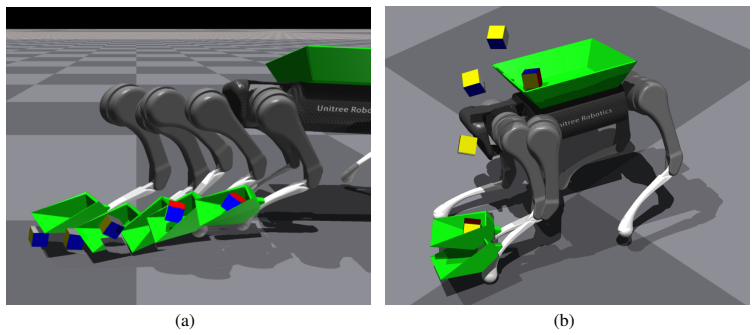
The central object is the multiplicative toss reward $r_{\text{toss}} = w_1 h_{\text{obj}} \exp(-w_2 d_{\text{obj}})$, which couples lift height to tray proximity so that a high toss that misses the tray scores worse than a modest toss into it; together with a binary load bonus, this single term produces the entire scoop-and-toss behavior. Around it sits a three-level hierarchy: the scoop-and-toss expert and the approach expert (whose velocity-tracking reward is taken from [17]) are trained separately, then a meta-policy trained on the accumulated load bonus chooses which expert runs at each timestep, always aiming at the nearest uncollected object. The only hardware changes are passive add-ons: a 200 g scoop of roughly 13.5 cm × 16.5 cm × 7.5 cm attached at about $135^\circ$ to a calf link, and a 400 g tray on the back. The final mechanism is Skill Transition-Based Initialization (STI), in which each expert is fine-tuned starting from states sampled during the other expert's rollouts; the ablations show this step is what lets the meta-policy switch without collapsing to a single expert.
What would settle it
Build the 3D-printed scoop and tray, run the published policies on a physical quadruped with known object positions, and measure load success; if real-robot frontal load rates fall far below the simulated 97–99% (or multi-object performance far below 7.22 per episode), the simulation's contact model is the failing link. A cheaper pre-hardware check is to re-run the same training in a second simulator with different friction and restitution parameters, since the reward and hierarchy stay fixed while only the contact physics change.
Extended reading notes
Core claim
The core discovery is that a single reward of the form $r_{\text{toss}} = w_1 h_{\text{obj}} \exp(-w_2 d_{\text{obj}})$ — rewarding the object's height while exponentially penalizing its distance from the tray center — makes a fluid scoop-and-toss behavior emerge from one policy, with no engineered scooping and tossing phases. With a load bonus and a curriculum that gradually expands the object's initial sampling radius, this expert reaches 97–99% load success for objects in the frontal sectors, drops to roughly half that for the rear blind zone between 135° and 225°, and generalizes to unseen objects, including a 220 g cube-shaped can (93% load success), though a mug with a handle collapses to 11%. A second expert learns goal-directed approach from a velocity-tracking reward, and a meta-policy trained on an accumulated bonus $b_{\text{load objs}} = 100 \times N_{\text{loaded objs}}$ learns when to switch, loading 7.22 objects per 100-second episode in a ten-object scene. The decisive ablations are that removing the STI transition fine-tuning or the accumulated bonus makes the meta-policy collapse to approach-only with zero loads, while the scoop-only expert alone loads just 2.17 objects.
Load-bearing premise
The reported success rates rest on the assumption that the simulator's contact and dynamics for the scoop, the objects, and the tray faithfully match a real robot; the paper reports no hardware tests and itself flags perception noise, actuation delay, and domain transfer as open issues.
Editorial extensions
If this is right
- Dynamic object collection joins locomotion as a skill a quadruped's own legs can supply, without the weight, cost, and complexity of a mounted arm or actuated gripper.
- The reward recipe — height multiplied by an exponential closeness term, plus a curriculum on initial distance and a load bonus — is a transferable pattern for other flick-and-catch tasks, since the paper shows it needs no phase decomposition.
- The ablations show that in a hierarchical locomotion-manipulation system the transition handling is decisive: without the STI fine-tuning or the accumulated bonus, the meta-policy silently degrades to pure approach and loads nothing.
- The rear-sector results bound the approach's geometry: a single leg scoop has an inherent blind zone of roughly 90–135° behind the robot, leaving navigation with the job of reorienting before every scooped pickup.
- Generalization to unseen objects is partial and shape-driven: the 220 g cube-shaped can keeps 93% load success, the rounded bucket drops to 87%, and the handle-carrying mug collapses to 11%, which is a concrete prior for choosing real-world objects.
Reading between the lines
- Because the policies receive exact object positions, the narrowest path from these results to a deployable robot is to add a perception module and test whether the same reward survives noisy estimates; the exponential distance term $\exp(-w_2 d_{\text{obj}})$ is exactly the part that noisy distances would distort.
- The curriculum expands the sampling radius but never the angle, which may explain why the rear blind zone persists; an angular curriculum oversampling the 135–225° sector could plausibly close that gap with no mechanical change.
- The mug's handle failure suggests that scoop-and-toss works best for objects that roll or slide stably on the scoop; estimating shape properties from observation — which the paper lists as missing — is the most direct route to reliable real-world collection.
- Because the framework never grasps, the tossing expert is a generic 'flick object toward a goal' primitive that could be ported to other legged platforms or to tasks such as debris clearing and ball gathering, simply by redefining the goal volume that the load bonus tests.
Editorial analysis
A structured set of objections, weighed in public.
Referee Report
Summary. The paper proposes Scoop-and-Toss, a hierarchical reinforcement-learning framework that lets a quadruped robot collect scattered objects using only passive add-ons: a scoop attached to one leg and a collection tray on its back. Two expert policies are trained separately, one for scoop-and-toss manipulation and one for approaching target objects, and a meta-policy learns to switch between them to collect multiple objects in a scene. The authors report high success rates for the scoop-and-toss policy in frontal and side directions, moderate success in rear directions, generalization to several unseen object shapes, reward-design ablations supporting the necessity of the main reward terms, and a multi-object experiment in which the meta-policy loads on average 7.22 objects per 100-second episode. The paper clearly states that all experiments were performed in the Isaac Gym simulator and that no physical-hardware validation has been conducted.
Significance. If the reported results hold, the paper makes a useful contribution to legged loco-manipulation by showing that dynamic object collection can be achieved with passive mechanical add-ons and learned hierarchical policies, avoiding the complexity and cost of additional actuators. The reward design, the two-stage expert-then-meta training, and the STI-based transition fine-tuning are sensible and are supported by ablation studies. The paper is transparent about its simulation-only evaluation and about the assumptions of accurate object positions, static objects, and flat terrain. However, the central quantitative claim in the multi-object experiment is currently undermined by an internal inconsistency in the number of objects in the environment, and the lack of any variance or seed information makes it difficult to assess the reliability of the reported means. The significance of the contribution is therefore conditional on resolving the object-count discrepancy and on providing more robust statistical reporting.
major comments (3)
- [Section 3.3, Section 4.3, Table 4, Appendix E] There is a direct internal inconsistency in the number of objects used in the multi-object evaluation. Section 3.3 states that the training environment includes "five cube-shaped objects randomly placed within a 5-meter radius," and Appendix E repeats that the environment is initialized "with the five cube-shaped objects." Section 4.3, however, states that evaluation was performed "in a multi-object environment with the ten cube-shaped objects randomly placed within a 5-meter radius," and Table 4 reports an average of 7.22 loaded objects per episode. If the environment truly contains only five objects, the maximum possible average is 5.0, making the 7.22 result arithmetically impossible. This is a load-bearing inconsistency in the headline quantitative claim, and it must be resolved by correcting the environment description or by reporting evaluation results from the same environment configuration used in training and in the appendix.
- [Section 4.3, Table 4] The multi-object experiments are reported as aggregate means over 100 episodes without any measure of variance, number of random seeds, or per-seed breakdown. Given the stark differences in Table 4 — for example, 7.22 loaded objects for the baseline versus 0 for both the No STI and No Extra Bonus variants — the reader cannot tell whether the baseline result is a stable property of the method or an artifact of a single training run. Reporting standard deviations, confidence intervals, or results over multiple seeds with different random initializations is necessary to support the quantitative claims, especially because the paper does not provide code or trained policy checkpoints for reproducibility.
- [Section 6] The authors correctly acknowledge that all evaluations were conducted in simulation and that hardware deployment would require addressing perception noise, actuation delay, and domain transfer. This is an honest limitation, but the abstract and conclusion use language such as "demonstrates" and "enables" without explicitly qualifying that the demonstration is purely simulation-based. Given that the model uses privileged state information, including accurate object positions (Appendix A), the claims should be tempered to state clearly that the demonstrated feasibility is in simulation, not on a physical robot. This is not a request for new experiments, but a request for wording that matches the evidence.
minor comments (5)
- [Section 4.2] In the sentence "The Toss Height remained relatively stable (0.75–0.86,m) across all angular sectors," there is a typographical error: the comma before "m" should be removed or replaced with correct formatting, e.g., "0.75–0.86 m."
- [Section 4.2, Table 2] The sentence beginning "As shown in Table 2, The potted meat can..." has an unnecessary capital letter after the comma; it should read "the potted meat can."
- [Section 3.2] The definition of the approach reward in Equation (3) would benefit from a brief explanation of why the velocity-tracking term uses the unit vector from the scoop to the object rather than from the robot base, since the scoop is mounted on the leg and may not share the base frame orientation. This is not a technical error but would aid clarity.
- [Section 4.3] The claim that "the policy effectively collapsed to using only pi_approach" is stated for both the No STI and No Extra Bonus variants, but the mechanism is described only qualitatively. A sentence or figure showing the distribution of expert selections over time would make this explanation more convincing.
- [References] Reference [34] is cited for STI but is described only as an arXiv preprint with a 2025 date; if it has since appeared in a peer-reviewed venue, the published version should be cited.
Circularity Check
No equation-level circularity: the empirical RL pipeline is self-contained, with one minor load-bearing self-citation (STI imported from the authors' own preprint) and a separate 5-vs-10 object-count inconsistency that is a correctness defect, not circularity.
-
self citation load bearing
[Section 3.2 (Fine-Tuning for Smooth Policy Transitions), Section 4.3 Table 4, Reference [34]]
"To reduce abrupt behavior when switching between the two expert policies during meta-policy execution, we apply the Skill Transition-Based Initialization (STI) method proposed in [34]. ... In contrast, both the No STI and No Extra Bonus variants failed to load any objects."
Reference [34] (PhysicsFC, arXiv:2504.21216) is a preprint authored by the same group, sharing co-author Yoonsang Lee with the present paper. Table 4 shows STI is load-bearing for the central multi-object result: removing it collapses loaded objects from 7.22 to 0. Thus the headline claim rests on a transition-stabilizing method whose only external provenance is the authors' own unverified preprint. This is not a by-construction equation-level reduction, because the paper re-describes and re-implements STI in Appendix D and tests it in its own ablation, so the in-paper experiment carries most of the evidential weight.
full rationale
This paper is an empirical reinforcement-learning study, not a derivation, so most circularity categories do not apply. The expert policies are optimized against hand-written rewards (Equations 1 and 3) and the meta-policy against an accumulated load bonus (Equation 4); the headline metric 'loaded objects' is the very quantity that bonus maximizes. Reporting performance on the optimized objective is standard RL evaluation, not a fitted input renamed as a prediction. The genuinely independent content is substantial: single-object directional success rates (Table 1), reward ablations that honestly fail (Table 3, with 'No Height Reward' and 'No ExpDist' giving 0% load success), generalization to unseen object types with a candid negative result (mug at 11% load success, Table 2), and the hierarchy-versus-expert comparison (7.22 vs 2.17 objects, Table 4). These results are not forced by construction. One self-referential element is flagged: the STI fine-tuning that Table 4 shows to be load-bearing (without it the meta-policy loads 0 objects) is imported from reference [34], a preprint by the same group (co-author Yoonsang Lee); because the mechanism is re-implemented in Appendix D and ablated in-paper, this is a provenance self-citation rather than a by-construction reduction, and it is assessed at score 2. Separately, the manuscript is internally inconsistent about the evaluation environment: Appendix E and Section 3.3 state five objects, while Section 4.3 and Table 4 state ten objects and report a 7.22-object average, which is arithmetically impossible under five objects; this is a correctness defect that must be resolved before the headline claim can be assessed, but it is not circularity. Section 6 honestly limits the claims to simulation with privileged state, which lowers transfer confidence but does not create circularity. Overall, no prediction in the paper reduces to its inputs by construction, and the central claims have substantial independent empirical content.
Assumptions & free parameters
free parameters (5)
- Reward weight set for π_scoop_toss =
w1=30, w2=4, bload=100
- Reward weight set for π_approach =
w3=3.5, w4=1, w5=1
- Regularization weights w6, w7, w8 =
π_scoop_toss: -1e-3, -1e-4, -3e-5; π_approach: -1e-2, -3e-3, -1e-5
- Desired approach speed vdes =
0.3 m/s
- Add-on geometry and mass =
Scoop 13.5x16.5x7.5 cm, 200 g; Tray 29x29x7 cm, 400 g
assumptions (6)
- domain assumption Isaac Gym simulator [33] accurately models rigid-body contacts and dynamics of the scoop, objects, and tray.
- domain assumption Policies receive accurate object positions as privileged state.
- domain assumption The environment is static and flat during training and evaluation.
- domain assumption PPO with the specified network architecture and hyperparameters converges to a near-optimal policy for the reward.
- domain assumption The STI method from [34] is applicable and beneficial for transition fine-tuning.
- ad hoc to paper The hand-designed reward terms are sufficient to induce the desired scoop-and-toss behavior.
invented entities (2)
-
Scoop add-on
-
Collection tray
Cite this review
Pith. "Pith review of Scoop-and-Toss: Dynamic Object Collection for Quadrupedal Systems." pith.science (2026). https://pith.science/paper/APZZ5IND
@misc{pith2026250609406,
  author       = {Pith},
  title        = {Pith review of: Scoop-and-Toss: Dynamic Object Collection for Quadrupedal Systems},
  year         = {2026},
  howpublished = {\url{https://pith.science/paper/APZZ5IND}},
  note         = {Machine review of arXiv:2506.09406}
}
read the original abstract
Quadruped robots have made significant advances in locomotion, extending their capabilities from controlled environments to real-world applications. Beyond movement, recent work has explored loco-manipulation using the legs to perform tasks such as pressing buttons or opening doors. While these efforts demonstrate the feasibility of leg-based manipulation, most have focused on relatively static tasks. In this work, we propose a framework that enables quadruped robots to collect objects without additional actuators by leveraging the agility of their legs. By attaching a simple scoop-like add-on to one leg, the robot can scoop objects and toss them into a collection tray mounted on its back. Our method employs a hierarchical policy structure comprising two expert policies-one for scooping and tossing, and one for approaching object positions-and a meta-policy that dynamically switches between them. The expert policies are trained separately, followed by meta-policy training for coordinated multi-object collection. This approach demonstrates how quadruped legs can be effectively utilized for dynamic object manipulation, expanding their role beyond locomotion.
Figures


Reference graph
Works this paper leans on
-
[1]
Learning agile and dynamic motor skills for legged robots
J. Hwangbo, J. Lee, A. Dosovitskiy, D. Bellicoso, V . Tsounis, V . Koltun, and M. Hutter. Learn- ing agile and dynamic motor skills for legged robots.Science Robotics, 4(26), Jan. 2019. ISSN 2470-9476. doi:10.1126/scirobotics.aau5872. URL http://arxiv.org/abs/1901.08652
work page Pith review arXiv 2019
-
[2]
T. Haarnoja, S. Ha, A. Zhou, J. Tan, G. Tucker, and S. Levine. Learning to walk via deep reinforcement learning. In Robotics: Science and Systems XV , 2019. doi:10.15607/RSS.2019. XV .011. URLhttps://doi.org/10.15607/RSS.2019.XV.011
-
[3]
J. Lee, J. Hwangbo, L. Wellhausen, V . Koltun, and M. Hutter. Learning quadrupedal lo- comotion over challenging terrain. Science Robotics , 5(47), Oct. 2020. ISSN 2470-9476. doi:10.1126/scirobotics.abc5986. URL https://robotics.sciencemag.org/content/ 5/47/eabc5986. Publisher: Science Robotics Section: Research Article
-
[4]
A. Kumar, Z. Fu, D. Pathak, and J. Malik. RMA: rapid motor adaptation for legged robots. In Robotics: Science and Systems XVII , 2021. doi:10.15607/RSS.2021.XVII.011. URL https: //doi.org/10.15607/RSS.2021.XVII.011
-
[5]
T. Miki, J. Lee, J. Hwangbo, L. Wellhausen, V . Koltun, and M. Hutter. Learning robust perceptive locomotion for quadrupedal robots in the wild. Science Robotics , 7(62), Jan
-
[6]
Y . Cheng, H. Liu, G. Pan, H. Liu, and L. Ye. Quadruped robot traversing 3d complex en- vironments with limited perception. In IEEE/RSJ International Conference on Intelligent Robots and Systems, IROS 2024 , pages 9074–9081. IEEE, 2024. doi:10.1109/IROS58592. 2024.10801507. URL https://doi.org/10.1109/IROS58592.2024.10801507
arXiv 2024
-
[10]
Y . Ma, F. Farshidian, T. Miki, J. Lee, and M. Hutter. Combining Learning-Based Locomotion Policy With Model-Based Manipulation for Legged Mobile Manipulators. IEEE Robotics and Automation Letters , 7(2):2377–2384, Apr. 2022. ISSN 2377-3766. doi:10.1109/LRA. 2022.3143567. URL https://ieeexplore.ieee.org/document/9684679/?arnumber= 9684679. Conference Name...
arXiv 2022
-
[11]
Z. Fu, X. Cheng, and D. Pathak. Deep Whole-Body Control: Learning a Unified Policy for Manipulation and Locomotion. In Proceedings of The 6th Conference on Robot Learn- ing, pages 138–149. PMLR, Mar. 2023. URL https://proceedings.mlr.press/v205/ fu23a.html. ISSN: 2640-3498
work page 2023
Show all 30 references
-
[14]
Tsvetkov and S
Y . Tsvetkov and S. Ramamoorthy. A Novel Design and Evaluation of a Dactylus-Equipped Quadruped Robot for Mobile Manipulation. In 2022 IEEE/RSJ International Conference on Intelligent Robots and Systems (IROS), pages 1633–1638, Oct. 2022. doi:10.1109/IROS47612. 2022.9982229. U...
2022
-
[16]
Zhuang, Z
Z. Zhuang, Z. Fu, J. Wang, C. Atkeson, S. Schwertfeger, C. Finn, and H. Zhao. Robot parkour learning. In Conference on Robot Learning (CoRL) , 2023
2023
-
[17]
Cheng, K
X. Cheng, K. Shi, A. Agarwal, and D. Pathak. Extreme parkour with legged robots. arXiv preprint arXiv:2309.14341, 2023
2023 arXiv
-
[20]
X. B. Peng, E. Coumans, T. Zhang, T. E. Lee, J. Tan, and S. Levine. Learning agile robotic locomotion skills by imitating animals. In Robotics: Science and Systems XVI , 2020. doi: 10.15607/RSS.2020.XVI.064. URL https://doi.org/10.15607/RSS.2020.XVI.064
2020 doi
-
[21]
C. D. Bellicoso, K. Kr ¨amer, M. St ¨auble, D. Sako, F. Jenelten, M. Bjelonic, and M. Hut- ter. ALMA - Articulated Locomotion and Manipulation for a Torque-Controllable Robot. In 2019 International Conference on Robotics and Automation (ICRA) , pages 8477–8483, May 2019. doi:1...
2019
-
[22]
Zimmermann, R
S. Zimmermann, R. Poranne, and S. Coros. Go Fetch! - Dynamic Grasps using Boston Dynam- ics Spot with External Robotic Arm. In 2021 IEEE International Conference on Robotics and Automation (ICRA) , pages 4488–4494, May 2021. doi:10.1109/ICRA48506.2021.9561835. URL https://ieee...
2021
-
[23]
Mittal, D
M. Mittal, D. Hoeller, F. Farshidian, M. Hutter, and A. Garg. Articulated Object Interac- tion in Unknown Scenes with Whole-Body Mobile Manipulation. In 2022 IEEE/RSJ In- ternational Conference on Intelligent Robots and Systems (IROS) , pages 1647–1654, Oct
2022
-
[24]
Sleiman, F
J.-P. Sleiman, F. Farshidian, and M. Hutter. Versatile multicontact planning and control for legged loco-manipulation. Science Robotics , 8(81):eadg5014, Aug. 2023. doi:10.1126/ scirobotics.adg5014. URL https://www.science.org/doi/10.1126/scirobotics. adg5014. Publisher: Ameri...
2023 doi
-
[25]
URL https://ieeexplore.ieee.org/ document/9981779/?arnumber=9981779
doi:10.1109/IROS47612.2022.9981779. URL https://ieeexplore.ieee.org/ document/9981779/?arnumber=9981779. ISSN: 2153-0866
2022
-
[26]
A. Rigo, M. Hu, S. K. Gupta, and Q. Nguyen. Hierarchical Optimization-based Control for Whole-body Loco-manipulation of Heavy Objects. In 2024 IEEE International Conference on Robotics and Automation (ICRA) , pages 15322–15328, May 2024. doi:10.1109/ICRA57147. 2024.10611656. U...
2024
-
[27]
Ferrolho, V
H. Ferrolho, V . Ivan, W. Merkt, I. Havoutis, and S. Vijayakumar. RoLoMa: robust loco- manipulation for quadruped robots with arms. Autonomous Robots, 47(8):1463–1481, Dec
-
[28]
Y . Ji, G. B. Margolis, and P. Agrawal. DribbleBot: Dynamic Legged Manipulation in the Wild. In 2023 IEEE International Conference on Robotics and Automation (ICRA) , pages 5155– 5162, May 2023. doi:10.1109/ICRA48891.2023.10160325. URL https://ieeexplore. ieee.org/document/10160325
2023
-
[29]
Huang, Z
X. Huang, Z. Li, Y . Xiang, Y . Ni, Y . Chi, Y . Li, L. Yang, X. B. Peng, and K. Sreenath. Creating a Dynamic Quadrupedal Robotic Goalkeeper with Reinforcement Learning. In 2023 IEEE/RSJ International Conference on Intelligent Robots and Systems (IROS) , pages 2715–2722, Oct
2023
-
[30]
Portela, G
T. Portela, G. B. Margolis, Y . Ji, and P. Agrawal. Learning Force Control for Legged Manipu- lation, May 2024. URL http://arxiv.org/abs/2405.01402. arXiv:2405.01402 [cs]
2024 arXiv
-
[31]
Huang, Q
X. Huang, Q. Liao, Y . Ni, Z. Li, L. Smith, S. Levine, X. B. Peng, and K. Sreenath. HiLMa-Res: A General Hierarchical Framework via Residual RL for Combining Quadrupedal Locomotion and Manipulation. In 2024 IEEE/RSJ International Conference on Intelligent Robots and Systems (I...
2024
-
[32]
P. Arm, M. Mittal, H. Kolvenbach, and M. Hutter. Pedipulate: Enabling Manipulation Skills using a Quadruped Robot’s Leg. In 2024 IEEE International Conference on Robotics and Automation (ICRA), pages 5717–5723, May 2024. doi:10.1109/ICRA57147.2024.10611307. URL https://ieeexpl...
2024
-
[33]
URL https://ieeexplore.ieee.org/ document/10341936/authors#authors
doi:10.1109/IROS55552.2023.10341936. URL https://ieeexplore.ieee.org/ document/10341936/authors#authors. ISSN: 2153-0866
2023
-
[35]
Schulman, F
J. Schulman, F. Wolski, P. Dhariwal, A. Radford, and O. Klimov. Proximal Policy Optimiza- tion Algorithms. arXiv:1707.06347 [cs], Aug. 2017. URL http://arxiv.org/abs/1707. 06347. arXiv: 1707.06347. A Expert Policy Input and Output Specifications Both expert policies, πscoop to...
2017 arXiv
-
[37]
Makoviychuk, L
V . Makoviychuk, L. Wawrzyniak, Y . Guo, M. Lu, K. Storey, M. Macklin, D. Hoeller, N. Rudin, A. Allshire, A. Handa, and G. State. Isaac gym: High performance gpu-based physics simula- tion for robot learning, 2021
2021
-
[38]
M. Kim, E. Jung, and Y . Lee. Physicsfc: Learning user-controlled skills for a physics-based football player controller, 2025. URL https://arxiv.org/abs/2504.21216. 12
2025 arXiv
-
[2022]
URL https://www.science.org/doi/10.1126/ scirobotics.abk2822
doi:10.1126/scirobotics.abk2822. URL https://www.science.org/doi/10.1126/ scirobotics.abk2822. Publisher: American Association for the Advancement of Science
-
[2023]
doi:10.1007/s10514-023-10146-0
ISSN 1573-7527. doi:10.1007/s10514-023-10146-0. URL https://doi.org/10. 1007/s10514-023-10146-0
Reviewed August 7, 2026 · model on record in the stance chip above.
Discussion (0). Sign in to comment.