REVIEW 3 major objections 4 minor 52 references
A Unified Discrete and Continuous Theory of Core-Halo Complexity Maximizers
T0 review · 3 major / 4 minor · reviewed 2026-08-01 · deepseek-v4-flash
Pith's one-line read Maximizing generalized statistical complexity forces a two-level core–halo form on every probability distribution, discrete or continuous.
desk verdict The continuous theorem is false (the functional is unbounded), the discrete proof misses boundary faces, but the variational machinery is clean and potentially salvageable. read the letter →
The pith
A machine-rendered reading of the paper's core claim, the machinery that carries it, and where it could break.
The reading
What carries the argument
The load-bearing object is the unified stationary equation f(x) = ln x + A_q x^{q−1} − B_q x^{2q−1} + C = 0, identical for discrete weights and continuous densities, with A_q and B_q determined by escort moments. Its unimodal shape (exactly one critical point) limits it to at most two positive roots; the paper's root-count and boundary arguments then force exactly two. The second key tool is the envelope-theorem reduction: after eliminating normalization, only the core multiplicity m (or measure M) is free, and the derivative dΦ*/dm collapses to the kernel R_1 + 2(q−1)R_q − (2q−1)R_{2q}, where R_k(τ) = (τ^k − 1)/(m τ^k + N − m) and τ = w_c/w_h > 1. Since R_k increases with k, this kernel is
What would settle it
Compute Φ for the boundary vector (0.6, 0.4, 0) with N = 3, q = 2. If Φ = H_1 − 2 ln P_2 + ln P_4 exceeds the value at the claimed one-core maximizer, then the theorem's assertion that every global maximizer has the two-level all-positive form is refuted for this case.
Extended reading notes
Core claim
The paper constructs C_q from the Hill number e^{H_1} and the escort information energy P_{2q}/(P_q)^2, takes its logarithm to obtain Φ = H_1 + (2q−2)H_q − (2q−1)H_{2q}, and derives a common Euler–Lagrange equation ln x + A_q x^{q−1} − B_q x^{2q−1} + C = 0 for both discrete masses and continuous densities. Shape analysis shows this equation has at most two positive roots; the paper argues that the zero-root and one-root cases are impossible, so exactly two levels w_h < w_c (or ρ_h < ρ_c) are forced on every stationary solution. The remaining freedom is the multiplicity m of the core. Applying the envelope theorem, the optimized complexity decreases monotonically with m, so the global maximum
Load-bearing premise
The argument excluding the zero-root case assumes that, without interior stationary points, the maximum of Φ must lie on a boundary point with Φ = 0 because the only boundary configurations considered are the uniform and Dirac distributions; boundary points with a zero component and unequal nonzero weights are not analyzed and can have positive Φ.
Editorial extensions
If this is right
- If correct, every discrete maximum-complexity state is exactly one dominant probability over N−1 equal smaller ones, never a richer hierarchy.
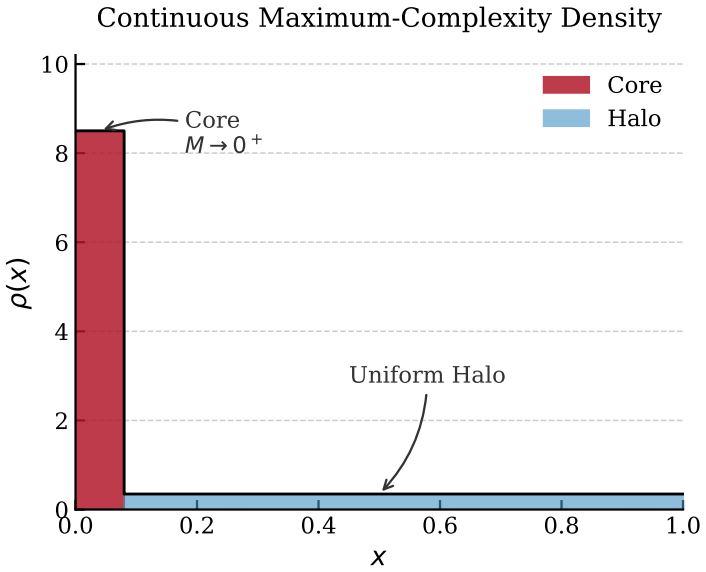
- The continuous analogue says maximum-complexity densities are piecewise constant with two levels: a concentrated core of vanishing measure sitting on a uniform halo.
- The two-root theorem unifies discrete and continuous optimization into a single variational problem, so structural results transfer between the settings.
- The deformation parameter q acts as a heterogeneity control: larger q widens the core–halo gap while preserving the two-level form.
- Because the ordinary LMC complexity appears as a particular member of the same family, its known core–halo maximizer becomes part of a continuous family with identical geometry.
Reading between the lines
- The same two-level logic likely extends to other complexity measures built from a concave entropy multiplied by a homogeneous convex concentration term; the paper only demonstrates it for the H_1–Rényi family.
- The minimal-measure continuous core suggests that in finite numerical approximations the maximizer will appear as a single grid cell spike; the paper leaves this discretization effect unexplored.
- The monotonic decrease in core multiplicity is consistent with a majorization-ordering characterization: distributions with a more spread core are always less complex, a lattice structure the paper does not develop.
- If the variational framework is applied to Tsallis or other generalized entropies, a natural conjecture is that a two-level or two-scale maximizer persists; this extension is not tested here.
Editorial analysis
A structured set of objections, weighed in public.
Referee Report
Summary. The paper introduces a generalized statistical complexity C_q = e^{H_1} P_{2q}/(P_q)^2, equivalently Φ = H_1 + (2q-2)H_q - (2q-1)H_{2q}, for q>1, and studies its maximization over finite discrete probability simplices and over continuous probability densities. The central claims are: (i) every stationary solution of the Euler–Lagrange equation has exactly two probability levels (a core and a halo); (ii) the global maximum is attained by a single core in the discrete case (m=1) and by an infinitesimal core in the continuous case (M→0^+); and (iii) this gives an exact unified discrete–continuous theory. The proofs proceed by analyzing the transcendental stationary equation f(x)=ln x + A_q x^{q-1} - B_q x^{2q-1} + C=0, excluding zero- and one-root cases, reducing to two-level distributions, and then applying an envelope-theorem monotonicity argument to a universal rational kernel.
Significance. If correct, the result would be a clean and sweeping structural statement: complexity maximizers of this family are always core–halo distributions, independent of the probability space. The manuscript has some genuine strengths: the variational derivation is self-contained, the discrete and continuous equations are shown to have the same algebraic form, no empirically fitted parameters enter, and the envelope-theorem reduction to a ratio formulation is explicitly carried out with symbolic verification noted for the algebra. These features make the paper easy to read and the intended argument transparent. However, the central mathematical claims are not supported. The continuous theorem is false as stated because the functional is unbounded above on the admitted class of densities, and the discrete proof relies on an incorrect boundary analysis. These are not local gaps but problems with the main theorems, despite the paper's expository virtues.
major comments (3)
- [§5.4–§6.1] The exclusion of the zero-root case is invalid. §6.1 argues that if no interior stationary point exists, then the maximum lies on the boundary and, because §5.4 computed only the uniform and Dirac configurations, concludes Φ_max=0. But the boundary of the simplex contains many other points. For N=3, q=2, W=(0.6,0.4,0) gives Φ≈0.118>0, greater than both boundary values computed in §5.4. Thus the assertion 'one obtains Φ_max=0' is false, and the contradiction used to prove N_r≠0 collapses. The same type of boundary oversight affects the one-root exclusion in §6.2, because a boundary point can have some zero coordinates and only one positive root among the non-zero components. This gap is load-bearing for the two-root theorem and hence for Theorem 1.
- [§8, Theorem 2] The continuous theorem is false as stated. On Ω=[0,1], fix α∈(0,1) and define the normalized two-level density ρ_a(x)=α/a on [0,a], ρ_a(x)=(1-α)/(1-a) on (a,1]. For q>1, as a→0, P_q ∼ α^q a^{1-q}, P_{2q} ∼ α^{2q} a^{1-2q}, and H_1 = H_bin(α) + α ln a + O(1). Therefore ln C_q = H_bin(α) + (α-1) ln a + O(1). Since α<1, this tends to +∞. Hence the functional is unbounded above on the class of normalized densities, so no global maximizer exists. The paper's conclusion in §7.6 and Theorem 2 that the maximum is attained at 'minimal core measure, M→0^+' describes an unattained infimum, not a maximizer. This is a counterexample to the theorem, not merely a missing detail.
- [§7–§8] Even for the discrete problem, the proof that global maximizers have the two-level m=1 form is incomplete. Section 7 maximizes only over the interior stationary two-level family after the two-root theorem. If the boundary analysis in §6.1 fails, a global maximizer could sit on a boundary face and need not satisfy the interior stationary equation at all. The monotonicity argument for Φ^*(m) therefore only concerns a restricted family and does not by itself rule out boundary maxima. A complete proof would need to handle boundary faces, or show that a boundary maximizer can be perturbed into the interior with higher Φ. As written, Theorem 1 relies on an unproved and, with the current boundary treatment, false premise.
minor comments (4)
- [§3.3 Eq. (3.3.4)] The entropy representation is correct only if H_{2q} denotes the Rényi entropy of order 2q, not the Rényi entropy of order 2 evaluated on P_q. The paper should state this explicitly in the notation section, because a reader can easily mistake H_{2q} for a second-order entropy.
- [Table of Contents / §6] The table of contents says Section 6 addresses the continuous case, but Section 6 is primarily about the discrete exclusion principle; the continuous analogue appears later in Appendix B.5. This mismatch should be corrected.
- [§5.4] The 'concentrated density limit' discussion says the divergences 'cancel exactly' as ρ_ε→δ. The claim is not generally true: the limit depends on the shape of the approaching sequence. For the two-level family in the major comment above, the limit is +∞ when α<1. The text should either avoid this assertion or restrict it to a precise class of approximating sequences.
- [Throughout] Several equations contain stray commas in integrals, e.g. '∫ ρ(x) lnρ(x), dx' in §4.2. These are harmless but should be cleaned up.
Circularity Check
No significant circularity: the result is derived from explicit variational calculus and is not equivalent to its inputs by construction.
full rationale
The derivation chain is self-contained. The functional Φ is defined as log C_q (Secs. 3.2–3.4), not as an independent object whose optimization is assumed to reproduce the claim; the Euler–Lagrange equation (4.3.8) is obtained by direct differentiation of that functional under normalization. The two-level/multiplicity conclusions follow from a root-counting argument and an envelope-theorem monotonicity computation, not from assuming the core–halo answer. No parameter is fitted to data, no prediction is a renamed fit, and there are no self-citations: the references to LMC, Rényi, Onicescu, and related work are background and are not used as a load-bearing uniqueness theorem. The zero-root exclusion in Sec. 6.1 relies on an incomplete boundary analysis, and the continuous case is challenged by unboundedness of the functional, but these are mathematical gaps/counterexamples rather than circular reductions: the paper does not define its inputs in terms of its outputs, and the claimed maximizer structure is not enforced by definition or by an imported self-referential theorem. Therefore the circularity score is 0.
Assumptions & free parameters
free parameters (1)
- deformation parameter q =
q > 1 (arbitrary)
assumptions (4)
- domain assumption q > 1 for the main theorems
- domain assumption Continuous entropy is the differential Shannon/Rényi entropy with respect to Lebesgue measure, without a reference scale
- ad hoc to paper Boundary of the simplex has zero complexity except at uniform and Dirac configurations
- standard math Standard theorems: Lagrange multipliers, Rolle, IVT, envelope theorem
Cite this review
Pith. "Pith review of A Unified Discrete and Continuous Theory of Core-Halo Complexity Maximizers." pith.science (2026). https://pith.science/paper/AUA3UGPI
@misc{pith2026260717907,
  author       = {Pith},
  title        = {Pith review of: A Unified Discrete and Continuous Theory of Core-Halo Complexity Maximizers},
  year         = {2026},
  howpublished = {\url{https://pith.science/paper/AUA3UGPI}},
  note         = {Machine review of arXiv:2607.17907}
}
read the original abstract
The maximization of statistical complexity has long been associated with the emergence of probability distributions lying between perfect order and complete disorder. While previous studies have shown that complexity-maximizing distributions exhibit a two-level structure in finite discrete systems, an analogous unified treatment for both discrete and continuous probability spaces has remained unavailable. In this work, we develop a general variational framework for a generalized statistical complexity constructed from Shannon and Renyi entropies. We derive a common stationary equation governing both discrete probability masses and continuous probability densities and prove that every stationary solution necessarily possesses exactly two probability levels, establishing a universal core-halo structure. We further demonstrate that the optimization problem reduces to a single multiplicity parameter and prove that the global complexity maximum is attained by the smallest admissible core, corresponding to a single dominant state in the discrete case and an infinitesimal core in the continuous limit. These results provide a complete analytical characterization of the complexity-maximizing distributions and reveal a common mathematical structure underlying complexity optimization in both discrete and continuous settings. The framework establishes a unified foundation for generalized statistical complexity with potential applications in statistical mechanics, information theory, and the analysis of complex systems.
Figures

Reference graph
Works this paper leans on
-
[1]
Schr¨ odinger E 1944What is Life? The Physical Aspect of the Living Cell(Cambridge University Press)
-
[2]
Wiener N 1948Cybernetics: Or Control and Communication in the Animal and the Machine(MIT Press)
-
[3]
Prigogine I 1978Science201777–785
-
[4]
Haken H 1977Synergetics: An Introduction(Springer)
-
[5]
Kolmogorov A N 1965Problems of Information Transmission11–7
-
[6]
Solomonoff R J 1964Information and Control71–22, 224–254
-
[7]
Chaitin G J 1966Journal of the ACM13547–569
-
[8]
Lempel A and Ziv J 1976IEEE Transactions on Information Theory2275–81
Show all 52 references
-
[9]
Crutchfield J P and Young K 1989Physical Review Letters63105–108
-
[10]
Bennett C H 1988In The Universal Turing Machine: A Half-Century Survey (ed. R. Herken) 227–257
-
[11]
Gell-Mann M and Lloyd S 2004In Nonextensive Entropy: Interdisciplinary Applications387–398
-
[12]
Shannon C E 1948Bell System Technical Journal27379–423, 623–656
-
[13]
1(University of California Press) pp 547–561
R´ enyi A 1961 On measures of entropy and informationProceedings of the Fourth Berkeley Sympo- sium on Mathematical Statistics and Probability, Vol. 1(University of California Press) pp 547–561
1961
-
[14]
Tsallis C 1988Journal of Statistical Physics52479–487
-
[15]
Hill M O 1973Ecology54427–432
-
[16]
Petz D 1986Reports on Mathematical Physics2357–65
-
[17]
Rajagopal A K and Abe S 1999Physical Review Letters832875–2878 65
-
[18]
Onicescu O 1966Comptes Rendus Hebdomadaires des S´ eances de l’Acad´ emie des Sciences, S´ erie A 263841–842
-
[19]
Beck C and Sch¨ ogl F 1993Thermodynamics of Chaotic Systems: An Introduction(Cambridge University Press) standard reference for escort probability distributions
-
[20]
L´ opez-Ruiz R, Mancini H L and Calbet X 1995Physics Letters A209321–326
-
[21]
Anteneodo C and Plastino ´A R 1996Physics Letters A223348–354
-
[22]
Calbet X and L´ opez-Ruiz R 2001Physical Review E63066116
-
[23]
Calbet X and L´ opez-Ruiz R 2007Physica A382523–530
-
[24]
Calbet X and L´ opez-Ruiz R 2009Physica A3884364–4378
-
[25]
Plastino ´A R and Wedemann R S 2025Suplemento de la Revista Mexicana de F ´ ısica
-
[26]
Chatzisavvas K C, Moustakidis C C and Panos C P 2005Journal of Chemical Physics123174111
-
[27]
Sa˜ nudo J and L´ opez-Ruiz R 2008Physics Letters A3725283–5286
-
[28]
Moustakidis C C, Chatzisavvas K C, Nikolaidis N and Panos C P 2012International Journal of Applied Mathematics and Statistics26
-
[29]
Sa˜ nudo J and L´ opez-Ruiz R 2008Journal of Physics A41265303
-
[30]
L´ opez-Ruiz R, Nagy´A, Romera E and Sa˜ nudo J 2009Journal of Mathematical Physics50123528
-
[31]
Mart ´ ın M T, Plastino´A R and Rosso O A 2006Physica A369439–462
-
[32]
Rosso O A, Larrondo H A, Martin M T, Plastino A and Fuentes M A 2007Physical Review Letters 99154102
-
[33]
Catal´ an R G, Garay J and L´ opez-Ruiz R 2002Physical Review E66011102
-
[34]
S´ anchez-Moreno P, Angulo J C and Dehesa J S 2014The European Physical Journal D68212
-
[35]
Mart ´ ın M T, Plastino´A R and Plastino ´A 2000Physica A275262–271
-
[36]
Shiner J S, Davison M and Landsberg P T 1999Physical Review E591459–1464
-
[37]
Pipek J and Varga I 1992Physical Review A463148–3163
-
[38]
Varga I and Pipek J 2003Physical Review E68026202
-
[39]
de Moivre A 1733 Approximatio ad summam terminorum binomii (a+b)n in seriem expansi Privately printed supplement toMiscellanea Analyticaenglish translation later incorporated intoThe Doctrine of Chances(1738)
-
[40]
Tsallis C, Mendes R S and Plastino A R 1998Physica A: Statistical Mechanics and its Applications 261534–554
-
[41]
Gelfand I M and Fomin S V 1963Calculus of Variations(Prentice-Hall)
-
[42]
Cover T M and Thomas J A 2006Elements of Information Theory2nd ed (Wiley-Interscience)
-
[43]
Bertsekas D P 1996Constrained Optimization and Lagrange Multiplier Methods(Athena Scientific)
-
[44]
Hardy G H, Littlewood J E and P´ olya G 1952Inequalities2nd ed (Cambridge University Press) classical reference for weighted-average / convex-combination inequalities of the type used in Sec. 7.6
-
[45]
5-6 and App
Rudin W 1976Principles of Mathematical Analysis3rd ed (McGraw-Hill) standard reference for Rolle’s theorem, the Intermediate Value Theorem, and continuity/differentiability arguments used throughout Sec. 5-6 and App. B
-
[46]
Boyd S and Vandenberghe L 2004Convex Optimization(Cambridge University Press)
-
[47]
Rockafellar R T 1970Convex Analysis(Princeton University Press)
-
[48]
Milgrom P and Segal I 2002Econometrica70583–601 66
-
[49]
Samuelson P A 1947Foundations of Economic Analysis(Harvard University Press) classical origin of the envelope theorem for parameterized optimization problems
-
[50]
Afriat S N 1971SIAM Journal on Applied Mathematics20343–357
-
[51]
Marshall A W, Olkin I and Arnold B C 2011Inequalities: Theory of Majorization and Its Applica- tions2nd ed (Springer)
-
[52]
Bhatia R 1997Matrix Analysis(Springer) contains standard treatment of Schur-convexity relevant to majorization-theoretic reformulations of the core-halo results 67
Reviewed August 1, 2026 · model on record in the stance chip above.
Discussion (0). Continue with ORCID to comment.