REVIEW 2 major objections 7 minor 3 cited by
DSDrive: Distilling Large Language Model for Lightweight End-to-End Autonomous Driving with Unified Reasoning and Planning
T0 review · 2 major / 7 minor · reviewed 2026-08-15 · deepseek-v4-flash
Pith's one-line read A 1-billion-parameter driving model out-scores a 7-billion-parameter rival in closed-loop tests after reasoning distillation.
desk verdict A genuinely novel reasoning-to-planning distillation for 1B AD models, but the closed-loop evidence is single-run and the text overstates the tables. read the letter →
The pith
A machine-rendered reading of the paper's core claim, the machinery that carries it, and where it could break.
The reading
What carries the argument
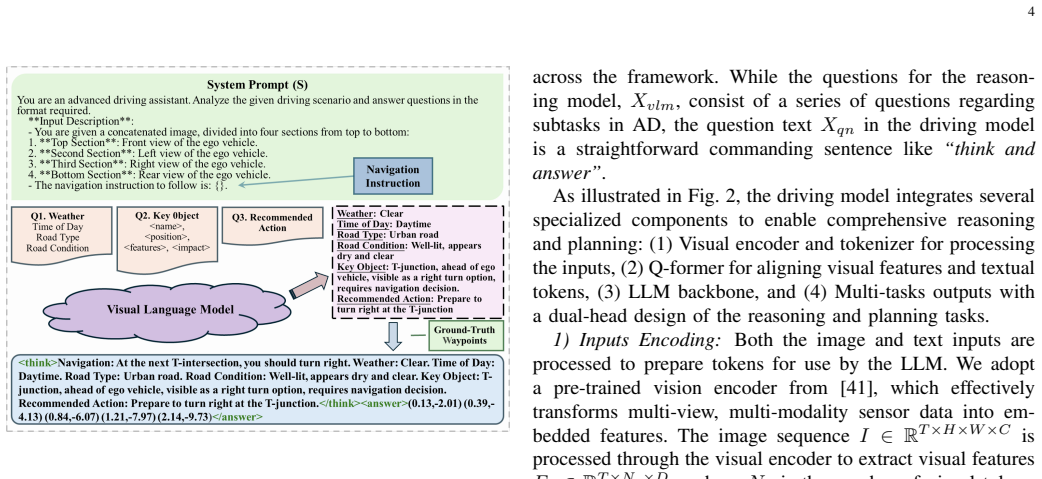
The load-bearing mechanism is the waypoint-driven dual-head coordination module. It restructures the distillation dataset so each think-and-answer chain ends with the ground-truth future waypoints, making trajectory prediction the terminal step of the reasoning process. The driving model then has two heads over the same LLM hidden states: a chain-of-thought answer head built with Qwen2-style decoder layers and an MLP waypoint head, trained jointly with a weighted loss on waypoints, answer tokens, and end-state classification. This makes reasoning and planning share one objective and allows a compact 1-billion-parameter LLaMA model to absorb reasoning capabilities from Qwen2.5-VL-max.
What would settle it
Run DSDrive and LMDrive (LLaVA-7B) on the same LangAuto-Short routes for several independent CARLA episodes and compare the distribution of Driving Scores; if DSDrive's mean does not clearly exceed the 7B baseline's mean beyond the run-to-run spread, the claimed outperformance is not established.
Extended reading notes
Core claim
The central claim is that knowledge distillation from a large vision-language model into a compact language model, combined with a waypoint-driven dual-head architecture, lets a 1-billion-parameter model perform closed-loop end-to-end driving on par with or better than a 7-billion-parameter system. In CARLA LangAuto evaluations, DSDrive with LLaMA-1B achieves a Driving Score of 29.57 versus LMDrive's 28.51 on long routes and 62.05 versus 45.03 on short routes, while using roughly 8 GB of peak memory compared with about 14 GB for the larger baseline. The reasoning head and the planning head share the same hidden states and are both supervised by ground-truth waypoints, which the paper argues aligns semantic reasoning with numerical trajectory planning. Ablation results comparing CoT-only, ground-truth-only, and the full dual-task design support the conclusion that both the distilled reasoning and the waypoint anchoring contribute to the gain.
Load-bearing premise
The central claim depends on the single-run closed-loop scores in Table II being reproducible, because the paper does not report repeated runs, random seeds, or variance in the stochastic CARLA simulator.
Editorial extensions
If this is right
- Compact LLMs can inherit reasoning skills from larger VLMs through structured chain-of-thought distillation, reducing the deployment cost of interpretable autonomous driving.
- Reasoning and planning can be aligned by anchoring the reasoning output to the planned trajectory, so explanations are tied to actual vehicle behavior rather than being detached text.
- DSDrive's closed-loop scores on the LangAuto short and long routes suggest that distilled reasoning transfers to navigation behavior, not just to language quality.
- Peak memory around 8 GB, versus about 14 GB for a 7B baseline, moves LLM-based end-to-end driving closer to embedded platforms with limited computational resources.
- The higher lane-deviation counts reported for DSDrive indicate a known trade-off: route-completion gains come with lateral-instability costs that need targeted improvement.
Reading between the lines
- If the reported short-route gap of 62.05 versus 45.03 survives repeated runs with multiple seeds, it would suggest that the reasoning head acts as a regularizer for the planner beyond simple imitation learning.
- A natural testable extension is to apply the same distillation recipe to smaller or larger student backbones, such as 0.5B or 3B models, to see whether the reasoning gain scales with student capacity.
- The principle of making the final plan the terminal reasoning token may generalize beyond driving to other sequential decision tasks where the output can be expressed as a trajectory or plan.
- Running the same closed-loop benchmark with variance reporting would transform the current point estimates into a statistically grounded comparison, which the paper does not provide.
Signed reviews
Editorial analysis
A structured set of objections, weighed in public.
Referee Report
Summary. DSDrive is an end-to-end autonomous driving system that uses a compact 1B-parameter LLM as its backbone, trained via knowledge distillation from a large VLM (Qwen2.5-VL-max) that generates chain-of-thought reasoning answers. The proposed framework also includes a waypoint-driven dual-head coordination module intended to align the reasoning and planning tasks by embedding ground-truth waypoints into the textual reasoning answers and having both heads share the same hidden states. The model processes multi-view images, LiDAR, navigation instructions, and outputs waypoints, reasoning text, and an end-state indicator. Experiments in the CARLA simulator on the LangAuto benchmark compare DSDrive against LMDrive with LLaVA-7B and LLaMA-1B backbones, as well as against two ablations. The authors report that DSDrive achieves comparable or better Driving Score and Route Completion than LMDrive LLaVA-7B on LangAuto-Long and LangAuto-Short while using less memory and similar inference time, and that the dual-head coordination design improves performance over the ablations. The paper claims that this demonstrates the feasibility of lightweight LLM-based end-to-end driving with interpretable reasoning.
Significance. If the performance claims hold, DSDrive would be a valuable contribution: it shows that reasoning distillation from a large VLM can transfer chain-of-thought capabilities to a 1B-parameter driving model, improving closed-loop planning while keeping memory and latency low, and it offers an interpretable reasoning stream. The idea of embedding waypoints into the reasoning answer to create a shared objective is a reasonable and potentially effective mechanism for aligning high-level text with low-level control. The closed-loop evaluation on the external CARLA LangAuto benchmark is a strength because it avoids circular reasoning, and the comparison with an established baseline (LMDrive) is appropriate. However, the current evidence is conditional: the central comparison rests on unrepeated point estimates, and the ablation claims are overstated, so the significance is not yet fully established.
major comments (2)
- [IV.B, Table II] The closed-loop evaluation in Table II is reported as single point estimates with no standard deviation, confidence interval, or number of repeated runs, and no random seeds are given. CARLA is stochastic in vehicle spawns, traffic-light timing, and pedestrian behavior; the paper also does not specify route composition (number of routes per town, episodes per route, traffic/weather variations). Given this, the headline claim in the abstract that DSDrive 'outperforms in many key metrics' is not supported by the data: DSDrive's IS is lower than LMDrive LLaVA-7B on LangAuto-Long (0.77 vs 0.80) and LangAuto-Short (0.81 vs 0.84), and its DS/RC are lower on LangAuto-Tiny (60.67/72.53 vs 61.91/73.19). Even the large LangAuto-Short margin could shrink or disappear under reseeding. Because the central distillation claim rests on this comparison, the authors should add repeated runs with multiple seeds and report variance, and adjust their conclusions accordingly.
- [IV.D, Table III] The text states 'our method beats the two ablatives with higher DS, RC, and IS,' but Table III contradicts this: on LangAuto-Tiny, Dual-task RC (54.50) is lower than GT-only (55.83); on LangAuto-Short, Dual-task IS (0.85) is lower than GT-only (0.86). In addition, the two ablations ('CoT only' and 'GT only') change the training dataset, not the architecture of the dual-head coordination module; therefore the experiment validates the dataset design (presence or absence of VLM answers and waypoint text), not the claimed contribution of the dual-head coordination mechanism itself. The section's conclusion overstates what the ablation shows.
minor comments (7)
- [I] In the Introduction, 'of of E2E AD' contains a duplicated preposition; it should read 'of E2E AD'.
- [IV.D] The heading and body text use 'ablatives' where the intended word is 'ablations'.
- [Table II] The model name 'LLaV A-7B' appears with a stray space in several places; it should be 'LLaVA-7B'.
- [III.A] Qwen2.5-VL-max is described as 'open-sourced,' but according to the Qwen2.5-VL technical report, the 'max' variant is a proprietary/large-scale model, not openly released; please correct or clarify the model availability.
- [IV.A.2] The LangAuto benchmark route composition (e.g., number of routes per town, episodes per route, traffic settings) is not specified; a reference to the original benchmark protocol or a detailed description should be added so the evaluation is reproducible.
- [IV.C.3] The comparison with Qwen2.5-VL-7B in Fig. 7 is based on a few handpicked examples; if retained, please provide quantitative reasoning-quality metrics over a fixed set of scenarios to support the claim that DSDrive does not fall short.
- [IV.E] The inference-time and memory measurements lack hardware/software specifications (GPU model, batch size, precision); please report them for reproducibility.
Circularity Check
No significant circularity: external CARLA LangAuto benchmark supports the central driving claim; self-citations are contextual only.
full rationale
The paper's central quantitative claim is closed-loop driving performance on the CARLA LangAuto benchmark (Table II), which is an external simulator benchmark with scores computed from route completion, infraction, and driving score. The derivation chain is: Qwen2.5-VL-max generates structured CoT reasoning data; ground-truth waypoints are appended to the reasoning template; the compact LLaMA-1B model is trained with a joint loss (Eq. 3: waypoint L1, answer cross-entropy, end-state cross-entropy); the resulting policy is then deployed in CARLA and scored. No parameter is fitted to the benchmark and then reported as a prediction; the benchmark scores are not recomputed from the training targets by construction. The dual-head module does embed ground-truth waypoints into both the reasoning and planning targets, so the observed agreement between the two heads in Fig. 8 is a designed property rather than an emergent empirical discovery, but the paper's headline claim of driving performance rests on external closed-loop scores, not on this agreement. Self-citations ([7], [8], [18], [20]) appear in related-work or introductory context and do not carry the load of the closed-loop result. The lack of repeated runs, seeds, or variance in Table II is a reproducibility/statistical concern, not a circularity concern. Therefore no circular step is identified.
Assumptions & free parameters
free parameters (1)
- loss weights lambda_1, lambda_2, lambda_3 =
not reported
assumptions (5)
- domain assumption Qwen2.5-VL-max produces correct and complete chain-of-thought labels for driving scenes.
- domain assumption Supervised imitation of teacher chain-of-thought tokens transfers reasoning ability to a 1B student.
- domain assumption CARLA LangAuto closed-loop scores are stable and representative with no repeated runs.
- domain assumption Teacher-forcing training on ground-truth answer tokens generalizes to autoregressive inference.
- domain assumption The pretrained vision encoder and LLaMA-1B backbone provide sufficient representations for both reasoning and planning.
Cite this review
Pith. "Pith review of DSDrive: Distilling Large Language Model for Lightweight End-to-End Autonomous Driving with Unified Reasoning and Planning." pith.science (2026). https://pith.science/paper/AUF2KNS6
@misc{pith2026250505360,
  author       = {Pith},
  title        = {Pith review of: DSDrive: Distilling Large Language Model for Lightweight End-to-End Autonomous Driving with Unified Reasoning and Planning},
  year         = {2026},
  howpublished = {\url{https://pith.science/paper/AUF2KNS6}},
  note         = {Machine review of arXiv:2505.05360}
}
read the original abstract
We present DSDrive, a streamlined end-to-end paradigm tailored for integrating the reasoning and planning of autonomous vehicles into a unified framework. DSDrive leverages a compact LLM that employs a distillation method to preserve the enhanced reasoning capabilities of a larger-sized vision language model (VLM). To effectively align the reasoning and planning tasks, a waypoint-driven dual-head coordination module is further developed, which synchronizes dataset structures, optimization objectives, and the learning process. By integrating these tasks into a unified framework, DSDrive anchors on the planning results while incorporating detailed reasoning insights, thereby enhancing the interpretability and reliability of the end-to-end pipeline. DSDrive has been thoroughly tested in closed-loop simulations, where it performs on par with benchmark models and even outperforms in many key metrics, all while being more compact in size. Additionally, the computational efficiency of DSDrive (as reflected in its time and memory requirements during inference) has been significantly enhanced. Evidently thus, this work brings promising aspects and underscores the potential of lightweight systems in delivering interpretable and efficient solutions for AD.
Figures


Figures from the paper (4 more)


Forward citations
Cited by 3 Pith papers
-
NetRoller: Interfacing General and Specialized Models for End-to-End Autonomous Driving
A three-stage adapter extracts early hidden-state features from a driving LLM and injects them into a VAD-based planner, reporting a 16.7% lower collision rate and 12.5% better trajectory similarity on nuScenes.
-
Large Foundation Models for Trajectory Prediction in Autonomous Driving: A Comprehensive Survey
A structured survey of LLM-based trajectory prediction methods, organized into trajectory-language mapping, multimodal fusion, and constraint-based reasoning, with benchmarks, metrics, and future directions.
-
VLM-UDMC: VLM-Enhanced Unified Decision-Making and Motion Control for Urban Autonomous Driving
VLM-UDMC uses a vision-language model to switch safety cost functions in a model predictive controller and a multi-kernel LSTM to predict traffic trajectories, reporting improved urban driving metrics in CARLA and cam...
Reference graph
Works this paper leans on
-
[1]
Deep Learning-Based Vehicle Behavior Prediction for Autonomous Driving Applications: A Review,
S. Mozaffari, O. Y . Al-Jarrah, M. Dianati, P. Jennings, and A. Mouzaki- tis, “Deep Learning-Based Vehicle Behavior Prediction for Autonomous Driving Applications: A Review,” IEEE Transactions on Intelligent Transportation Systems, vol. 23, no. 1, pp. 33–47, 2020
work page 2020
-
[2]
Milestones in Autonomous Driving and Intelligent Vehicles: Survey of Surveys,
L. Chen, Y . Li, C. Huang, B. Li, Y . Xing, D. Tian, L. Li, Z. Hu, X. Na, Z. Li et al., “Milestones in Autonomous Driving and Intelligent Vehicles: Survey of Surveys,” IEEE Transactions on Intelligent Vehicles , vol. 8, no. 2, pp. 1046–1056, 2022
work page 2022
-
[3]
J. Guo, U. Kurup, and M. Shah, “Is it safe to drive? an overview of factors, metrics, and datasets for driveability assessment in autonomous driving,” IEEE Transactions on Intelligent Transportation Systems , vol. 21, no. 8, pp. 3135–3151, 2019
work page 2019
-
[4]
Deep Learning for Safe Autonomous Driving: Current Challenges and Future Directions,
K. Muhammad, A. Ullah, J. Lloret, J. Del Ser, and V . H. C. De Al- buquerque, “Deep Learning for Safe Autonomous Driving: Current Challenges and Future Directions,” IEEE Transactions on Intelligent Transportation Systems, vol. 22, no. 7, pp. 4316–4336, 2020
work page 2020
-
[5]
Anthropic, “Claude 3.5 Sonnet,” https://www.anthropic.com/news/ claude-3.5-sonnet, Jul. 2024, [Computer software]
work page 2024
-
[6]
J. Achiam, S. Adler, S. Agarwal, L. Ahmad, I. Akkaya, F. L. Aleman, D. Almeida, J. Altenschmidt, S. Altman, S. Anadkat et al. , “GPT-4 Technical Report,” arXiv preprint arXiv:2303.08774 , 2023
arXiv 2023
-
[7]
H. Liu, R. Yao, W. Liu, Z. Huang, S. Shen, and J. Ma, “CoDriveVLM: VLM-Enhanced Urban Cooperative Dispatching and Motion Planning for Future Autonomous Mobility on Demand Systems,” arXiv preprint arXiv:2501.06132, 2025
arXiv 2025
-
[8]
VLM-E2E: Enhancing End-to-End Autonomous Driving with Multimodal Driver Attention Fusion,
P. Liu, H. Liu, H. Liu, X. Liu, J. Ni, and J. Ma, “VLM-E2E: Enhancing End-to-End Autonomous Driving with Multimodal Driver Attention Fusion,” arXiv preprint arXiv:2502.18042 , 2025
arXiv 2025
Show all 46 references
-
[9]
Multimodal End-to-End Autonomous Driving,
Y . Xiao, F. Codevilla, A. Gurram, O. Urfalioglu, and A. M. L ´opez, “Multimodal End-to-End Autonomous Driving,” IEEE Transactions on Intelligent Transportation Systems, vol. 23, no. 1, pp. 537–547, 2020
2020
-
[10]
Reason2Drive: Towards Interpretable and Chain-Based Reasoning for Autonomous Driving,
M. Nie, R. Peng, C. Wang, X. Cai, J. Han, H. Xu, and L. Zhang, “Reason2Drive: Towards Interpretable and Chain-Based Reasoning for Autonomous Driving,” in European Conference on Computer Vision , 2024, pp. 292–308
2024
-
[11]
Edge intelligence in intelligent transportation systems: A survey,
T. Gong, L. Zhu, F. R. Yu, and T. Tang, “Edge intelligence in intelligent transportation systems: A survey,” IEEE Transactions on Intelligent Transportation Systems, vol. 24, no. 9, pp. 8919–8944, 2023
2023
-
[12]
Vision Language Models in Autonomous Driving: A Survey and Outlook,
X. Zhou, M. Liu, E. Yurtsever, B. L. Zagar, W. Zimmer, H. Cao, and A. C. Knoll, “Vision Language Models in Autonomous Driving: A Survey and Outlook,” IEEE Transactions on Intelligent Vehicles , 2024
2024
-
[13]
DeepSeek-R1: Incentivizing Reason- ing Capability in LLMs via Reinforcement Learning,
D. Guo, D. Yang, H. Zhang, J. Song, R. Zhang, R. Xu, Q. Zhu, S. Ma, P. Wang, X. Bi et al. , “DeepSeek-R1: Incentivizing Reason- ing Capability in LLMs via Reinforcement Learning,” arXiv preprint arXiv:2501.12948, 2025
2025 arXiv
-
[14]
Eureka: Human-Level Reward Design via Coding Large Language Models,
Y . J. Ma, W. Liang, G. Wang, D.-A. Huang, O. Bastani, D. Jayara- man, Y . Zhu, L. Fan, and A. Anandkumar, “Eureka: Human-Level Reward Design via Coding Large Language Models,” arXiv preprint arXiv:2310.12931, 2023
2023 arXiv
-
[15]
Driving with LLMs: Fusing Object-Level Vector Modality for Explainable Autonomous Driving,
L. Chen, O. Sinavski, J. H ¨unermann, A. Karnsund, A. J. Willmott, D. Birch, D. Maund, and J. Shotton, “Driving with LLMs: Fusing Object-Level Vector Modality for Explainable Autonomous Driving,” in 2024 IEEE International Conference on Robotics and Automation , 2024, pp. 14 0...
2024
-
[16]
DriveMM: All-in-One Large Multimodal Model for Au- tonomous Driving,
Z. Huang, C. Feng, F. Yan, B. Xiao, Z. Jie, Y . Zhong, X. Liang, and L. Ma, “DriveMM: All-in-One Large Multimodal Model for Au- tonomous Driving,” arXiv preprint arXiv:2412.07689 , 2024
2024 arXiv
-
[17]
Rethinking Closed-Loop Training for Autonomous Driving,
C. Zhang, R. Guo, W. Zeng, Y . Xiong, B. Dai, R. Hu, M. Ren, and R. Urtasun, “Rethinking Closed-Loop Training for Autonomous Driving,” in European Conference on Computer Vision , 2022, pp. 264– 282
2022
-
[18]
Integrating Decision-Making Into Differentiable Optimization Guided Learning for End-to-End Planning of Autonomous Vehicles,
W. Liu, Y . Song, C. Meng, Z. Huang, H. Liu, C. Lv, and J. Ma, “Integrating Decision-Making Into Differentiable Optimization Guided Learning for End-to-End Planning of Autonomous Vehicles,” arXiv preprint arXiv:2412.01234, 2024
2024 arXiv
-
[19]
ActiveAD: Planning-Oriented Active Learning for End-to-End Autonomous Driv- ing,
H. Lu, X. Jia, Y . Xie, W. Liao, X. Yang, and J. Yan, “ActiveAD: Planning-Oriented Active Learning for End-to-End Autonomous Driv- ing,” arXiv preprint arXiv:2403.02877 , 2024
2024 arXiv
-
[20]
CALMM-Drive: Confidence-aware autonomous driving with large mul- timodal model,
R. Yao, Y . Wang, H. Liu, R. Yang, Z. Peng, L. Zhu, and J. Ma, “CALMM-Drive: Confidence-aware autonomous driving with large mul- timodal model,” arXiv preprint arXiv:2412.04209 , 2024
2024 arXiv
-
[21]
ST-P3: End-to- End Vision-Based Autonomous Driving via Spatial-Temporal Feature Learning,
S. Hu, L. Chen, P. Wu, H. Li, J. Yan, and D. Tao, “ST-P3: End-to- End Vision-Based Autonomous Driving via Spatial-Temporal Feature Learning,” in European Conference on Computer Vision, 2022, pp. 533– 549
2022
-
[22]
Planning-Oriented Autonomous Driving,
Y . Hu, J. Yang, L. Chen, K. Li, C. Sima, X. Zhu, S. Chai, S. Du, T. Lin, W. Wang et al. , “Planning-Oriented Autonomous Driving,” in Proceedings of the IEEE/CVF Conference on Computer Vision and Pattern Recognition, 2023, pp. 17 853–17 862
2023
-
[23]
DriveTransformer: Unified Trans- former for Scalable End-to-End Autonomous Driving,
X. Jia, J. You, Z. Zhang, and J. Yan, “DriveTransformer: Unified Trans- former for Scalable End-to-End Autonomous Driving,” arXiv preprint arXiv:2503.07656, 2025
2025 arXiv
-
[24]
Think Twice Before Driving: Towards Scalable Decoders for End-to-End Autonomous Driving,
X. Jia, P. Wu, L. Chen, J. Xie, C. He, J. Yan, and H. Li, “Think Twice Before Driving: Towards Scalable Decoders for End-to-End Autonomous Driving,” in Proceedings of the IEEE/CVF Conference on Computer Vision and Pattern Recognition , 2023, pp. 21 983–21 994
2023
-
[25]
Goal-oriented Autonomous Driving,
Y . Hu, J. Yang, L. Chen, K. Li, C. Sima, X. Zhu, S. Chai, S. Du, T. Lin, W. Wang, L. Lu, X. Jia, Q. Liu, J. Dai, Y . Qiao, and H. Li, “Goal-oriented Autonomous Driving,” 2022
2022
-
[26]
COOPERNAUT: End- to-End Driving With Cooperative Perception for Networked Vehicles,
J. Cui, H. Qiu, D. Chen, P. Stone, and Y . Zhu, “COOPERNAUT: End- to-End Driving With Cooperative Perception for Networked Vehicles,” in Proceedings of the IEEE/CVF Conference on Computer Vision and Pattern Recognition, 2022, pp. 17 252–17 262
2022
-
[27]
Rea- sonNet: End-to-End Driving With Temporal and Global Reasoning,
H. Shao, L. Wang, R. Chen, S. L. Waslander, H. Li, and Y . Liu, “Rea- sonNet: End-to-End Driving With Temporal and Global Reasoning,” in Proceedings of the IEEE/CVF Conference on Computer Vision and Pattern Recognition, 2023, pp. 13 723–13 733
2023
-
[28]
V AD: Vectorized Scene Representation for Efficient Autonomous Driving,
B. Jiang, S. Chen, Q. Xu, B. Liao, J. Chen, H. Zhou, Q. Zhang, W. Liu, C. Huang, and X. Wang, “V AD: Vectorized Scene Representation for Efficient Autonomous Driving,” in Proceedings of the IEEE/CVF International Conference on Computer Vision , 2023, pp. 8340–8350
2023
-
[29]
V ADv2: End-to-End Vectorized Autonomous Driving via Probabilistic Planning,
S. Chen, B. Jiang, H. Gao, B. Liao, Q. Xu, Q. Zhang, C. Huang, W. Liu, and X. Wang, “V ADv2: End-to-End Vectorized Autonomous Driving via Probabilistic Planning,” arXiv preprint arXiv:2402.13243 , 2024
2024 arXiv
-
[30]
ChauffeurNet: Learning to Drive by Imitating the Best and Synthesizing the Worst,
M. Bansal, A. Krizhevsky, and A. Ogale, “ChauffeurNet: Learning to Drive by Imitating the Best and Synthesizing the Worst,” arXiv preprint arXiv:1812.03079, 2018
2018 arXiv
-
[31]
PLUTO: Pushing the Limit of Imitation Learning-based Planning for Autonomous Driving,
J. Cheng, Y . Chen, and Q. Chen, “PLUTO: Pushing the Limit of Imitation Learning-based Planning for Autonomous Driving,” arXiv preprint arXiv:2404.14327, 2024
2024 arXiv
-
[32]
Imitation Is Not Enough: Robustifying Imitation with Reinforcement Learning for Challenging Driving Scenarios,
Y . Lu, J. Fu, G. Tucker, X. Pan, E. Bronstein, R. Roelofs, B. Sapp, B. White, A. Faust, S. Whiteson et al. , “Imitation Is Not Enough: Robustifying Imitation with Reinforcement Learning for Challenging Driving Scenarios,” in 2023 IEEE/RSJ International Conference on Intellige...
2023
-
[33]
RAG-Driver: Generalisable Driving Explanations with Retrieval-Augmented In-Context Learning in Multi-Modal Large Lan- guage Model,
J. Yuan, S. Sun, D. Omeiza, B. Zhao, P. Newman, L. Kunze, and M. Gadd, “RAG-Driver: Generalisable Driving Explanations with Retrieval-Augmented In-Context Learning in Multi-Modal Large Lan- guage Model,” arXiv preprint arXiv:2402.10828 , 2024
2024
-
[34]
AlphaDrive: Un- leashing the Power of VLMs in Autonomous Driving via Reinforcement Learning and Reasoning,
B. Jiang, S. Chen, Q. Zhang, W. Liu, and X. Wang, “AlphaDrive: Un- leashing the Power of VLMs in Autonomous Driving via Reinforcement Learning and Reasoning,” arXiv preprint arXiv:2503.07608 , 2025
2025 arXiv
-
[35]
PRIMEDrive-CoT: A Precognitive Chain-of-Thought Framework for Uncertainty-Aware Object Interaction in Driving Scene Scenario,
S. Mandalika, A. Nambiar et al. , “PRIMEDrive-CoT: A Precognitive Chain-of-Thought Framework for Uncertainty-Aware Object Interaction in Driving Scene Scenario,” arXiv preprint arXiv:2504.05908 , 2025
2025 arXiv
-
[36]
GPT-Driver: Learning to Drive with GPT,
J. Mao, Y . Qian, J. Ye, H. Zhao, and Y . Wang, “GPT-Driver: Learning to Drive with GPT,” arXiv preprint arXiv:2310.01415 , 2023
2023 arXiv
-
[37]
DriveLM: Driving with Graph Visual Question Answering,
C. Sima, K. Renz, K. Chitta, L. Chen, H. Zhang, C. Xie, J. Beißwenger, P. Luo, A. Geiger, and H. Li, “DriveLM: Driving with Graph Visual Question Answering,” in European Conference on Computer Vision , 2024, pp. 256–274
2024
-
[38]
VLP: Vision Language Planning for Autonomous Driving,
C. Pan, B. Yaman, T. Nesti, A. Mallik, A. G. Allievi, S. Velipasalar, and L. Ren, “VLP: Vision Language Planning for Autonomous Driving,” in Proceedings of the IEEE/CVF Conference on Computer Vision and Pattern Recognition, 2024, pp. 14 760–14 769
2024
-
[39]
WiseAD: Knowledge Augmented End-to-End Autonomous Driving with Vision-Language Model,
S. Zhang, W. Huang, Z. Gao, H. Chen, and C. Lv, “WiseAD: Knowledge Augmented End-to-End Autonomous Driving with Vision-Language Model,” arXiv preprint arXiv:2412.09951 , 2024
2024 arXiv
-
[40]
Sce2DriveX: A Generalized MLLM Framework for Scene-to-Drive Learning,
R. Zhao, Q. Yuan, J. Li, H. Hu, Y . Li, C. Zheng, and F. Gao, “Sce2DriveX: A Generalized MLLM Framework for Scene-to-Drive Learning,” arXiv preprint arXiv:2502.14917 , 2025. 13
2025 arXiv
-
[41]
LMDrive: Closed-Loop End-to-End Driving with Large Language Models,
H. Shao, Y . Hu, L. Wang, G. Song, S. L. Waslander, Y . Liu, and H. Li, “LMDrive: Closed-Loop End-to-End Driving with Large Language Models,” in Proceedings of the IEEE/CVF Conference on Computer Vision and Pattern Recognition , 2024, pp. 15 120–15 130
2024
-
[42]
Senna: Bridging Large Vision- Language Models and End-to-End Autonomous Driving,
B. Jiang, S. Chen, B. Liao, X. Zhang, W. Yin, Q. Zhang, C. Huang, W. Liu, and X. Wang, “Senna: Bridging Large Vision- Language Models and End-to-End Autonomous Driving,” arXiv preprint arXiv:2410.22313, 2024
2024 arXiv
-
[43]
Qwen2.5-VL Technical Report,
S. Bai, K. Chen, X. Liu, J. Wang, W. Ge, S. Song, K. Dang, P. Wang, S. Wang, J. Tang et al., “Qwen2.5-VL Technical Report,” arXiv preprint arXiv:2502.13923, 2025
2025 arXiv
-
[44]
The Llama 3 Herd of Models,
A. Grattafiori, A. Dubey, A. Jauhri, A. Pandey, A. Kadian, A. Al-Dahle, A. Letman, A. Mathur, A. Schelten, A. Vaughan et al. , “The Llama 3 Herd of Models,” arXiv preprint arXiv:2407.21783 , 2024
2024 arXiv
-
[45]
BLIP-2: Bootstrapping Language- Image Pre-training with Frozen Image Encoders and Large Language Models,
J. Li, D. Li, S. Savarese, and S. Hoi, “BLIP-2: Bootstrapping Language- Image Pre-training with Frozen Image Encoders and Large Language Models,” in International Conference on Machine Learning , 2023, pp. 19 730–19 742
2023
-
[46]
CARLA: An Open Urban Driving Simulator,
A. Dosovitskiy, G. Ros, F. Codevilla, A. Lopez, and V . Koltun, “CARLA: An Open Urban Driving Simulator,” in Conference on Robot Learning, 2017, pp. 1–16
2017
Reviewed August 15, 2026 · model on record in the stance chip above.
Discussion (0). Continue with ORCID to comment.