REVIEW 4 major objections 5 minor 24 references
Inside a chess AI, correct moves often appear in intermediate layers, then get overridden in the final output.
Reviewed by Pith at T0; open to challenge. T0 means a machine referee read the full paper against a public rubric. the ladder, T0–T4 →
The paper demonstrates non-monotonic move-policy dynamics in a chess transformer, but its abstract claims a causal safety-prior override result that never appears in the body.
T0 review reviewed 2026-08-05 challenge →
load-bearing objection The body is a solid descriptive logit-lens study of Leela Chess Zero, but the front abstract claims a steering experiment and a 61.7% recovery rate that appear nowhere in the text. the 4 major comments →
The Algorithm Is Not the Behavior: Learned Priors Override Look-Ahead in a Chess-Playing Neural Network
The pith
A machine-rendered reading of the paper's core claim, the machinery that carries it, and where it could break.
The reading
Core claim
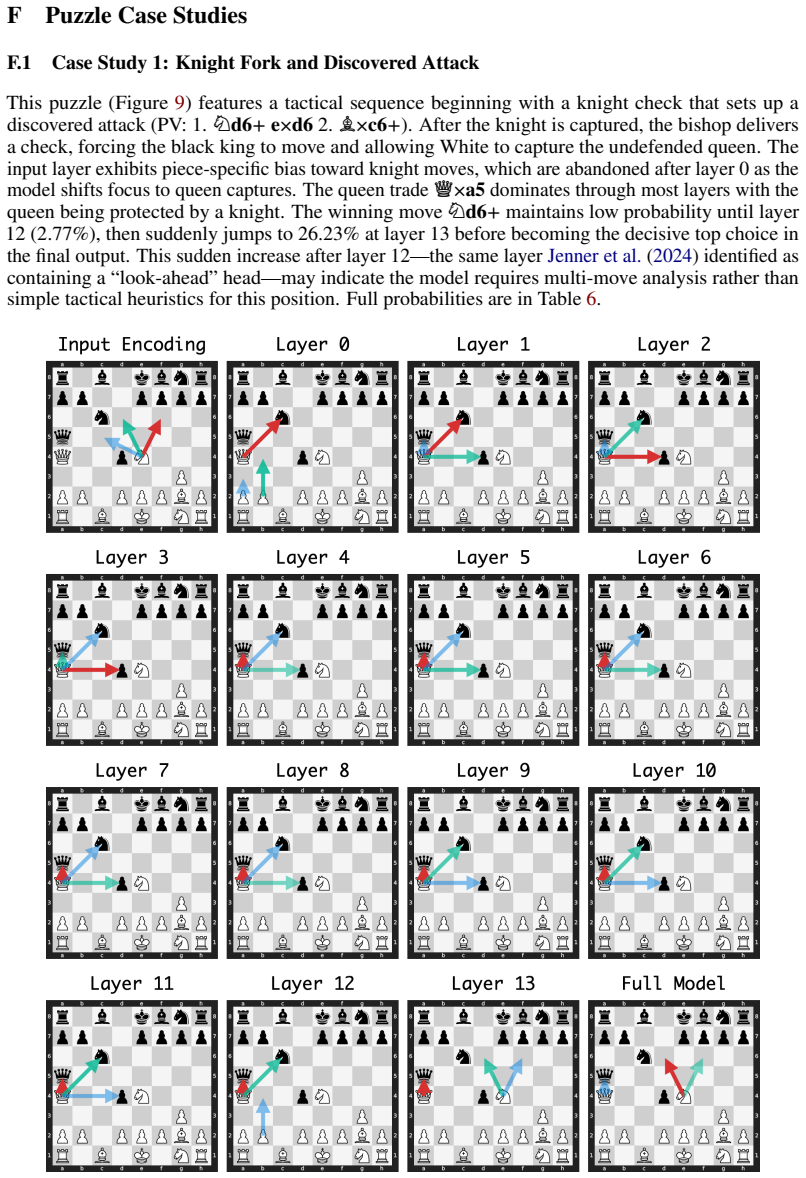
On the paper's own terms, the discovery is that the Leela Chess Zero policy network frequently computes the correct puzzle solution early in its forward pass and then throws it away. The claimed mechanism is not a failure of look-ahead: replicating prior analyses shows the winning continuation's future moves remain represented, causally important, and linearly decodable in later layers. Rather, the late layers shift the policy toward safe play, and this learned prior overrides the already-computed winning move. The paper presents 'forgotten puzzles' as evidence that a model can internally solve a problem and still output the wrong answer, since the final policy's argmax differs from the move
What carries the argument
The key technical instrument is a Post-LN extension of the logit lens: a zero-ablation forward pass that sets all attention and feed-forward sublayer outputs beyond layer k to zero, while preserving DeepNorm scaling, layer-normalization parameters, and recomputed normalization statistics, then projects the truncated representation through the policy head. This yields a layer-by-layer policy distribution, letting the authors ask what the network would output if it stopped at each depth. The lens defines the 'forgotten puzzles' phenomenon: a puzzle is forgotten when an intermediate layer's argmax is the correct move but the final output picks something else. The paper's causal evidence comes f
Load-bearing premise
The load-bearing premise is that the Post-LN zero-ablation logit lens faithfully reveals what the network computes at layer k; if this projection is not faithful, the 'forgotten puzzles' are measurement artifacts.
What would settle it
Take the puzzles classified as 'forgotten' and test whether the intermediate-layer argmax actually influences the final output through a causal intervention that does not rely on the lens, for example patching the layer-k representation into the final layers via activation replacement. If no such influence exists, the phenomenon is an artifact of the projection. Alternatively, a genuinely truncated network that never computes later layers should solve the same puzzles at the rate the lens predicts; if it does not, the lens is unfaithful.
If this is right
- The final policy can fail to solve puzzles that an intermediate layer had already solved correctly, so the network's final failure is not evidence that the computation never happened.
- The learned look-ahead mechanism identified in prior work is still active and correct in the forgotten-puzzle positions; the override happens downstream of the look-ahead computation.
- Move rankings remain poorly correlated with the final output until very late in the network, so intermediate layers are not simply converging on the final answer but are actively reevaluating options.
- Steering the policy away from late-layer safe-play preferences recovers 61.7% of forgotten puzzles, indicating the override is caused by a learned safety prior rather than by a corrupted algorithm.
- The overall monotonic increase in playing strength across layers coexists with non-monotonic policy trajectories, separating capability growth from how the model decides.
Where Pith is reading between the lines
- If the logit lens is faithful, the same 'forgotten solution' pattern may appear in other game-playing and planning networks with Post-LN or DeepNorm architectures, and the safety-prior override might generalize beyond chess.
- The 61.7% recovery rate, if confirmed, suggests a practical intervention: steering against a late-layer bias could improve a model's worst-case performance without retraining—but the remaining 38.3% implies other mechanisms also contribute.
- The paper's stance implies that behavioral success (higher Elo, puzzle-solving) is an unreliable proxy for whether a network has computed the 'right' answer; interpretability metrics based on intermediate decoding may be a better predictor of latent capability than final outputs.
- A testable extension is to apply the same Post-LN logit lens to other Post-LN transformer tasks, such as code or math, to see whether 'forgotten correct answers' are a general iterative-inference phenomenon or specific to adversarially tactical settings like chess puzzles.
Editorial analysis
A structured set of objections, weighed in public.
Referee Report
Summary. The paper studies the 15-layer Post-LN transformer policy network of Leela Chess Zero. It extends the logit lens to this architecture by zero-ablating sublayer outputs beyond a given layer while preserving DeepNorm and LayerNorm scaling, and then uses the resulting layer-wise policies to measure puzzle-solving accuracy, tournament playing strength, Lichess ratings, and distributional metrics such as Jensen-Shannon divergence, entropy, and Kendall's tau. The body reports monotonic improvement in playing strength and puzzle-solving ability across layers, alongside non-monotonic policy trajectories: correct puzzle solutions sometimes appear in intermediate layers but are absent from the final policy ("forgotten puzzles"). The front-matter abstract and title go further, claiming that late layers prioritize safe play over aggression, that steering against this preference recovers 61.7% of forgotten puzzles, and that this provides causal evidence that learned safety priors override algorithmically computed look-ahead. The body, however, contains only descriptive observations and no steering experiment or operationalization of a safety prior.
Significance. If the descriptive findings are robust, the paper makes a useful contribution to mechanistic interpretability: it provides the first Post-LN logit-lens extension for a strong chess transformer, documents non-smooth policy trajectories that contrast with language-model behavior, and connects intermediate-layer policies to puzzle-solving and playing-strength metrics. The authors ship code and make extensive empirical efforts, including a 27,200-game internal tournament, real Lichess deployment, and detailed case studies. The paper also builds on and engages with the independent look-ahead findings of Jenner et al. (2024). However, the advertised causal claim about safety priors overriding look-ahead is not supported by the body, and the intermediate-layer observations are only as strong as the zero-ablation projection used to define them. The descriptive core is promising, but the manuscript currently overstates its own evidence.
major comments (4)
- [Title and front-matter Abstract] The title and abstract assert a causal result: late-layer safety priors override computed look-ahead, with a steering intervention recovering 61.7% of forgotten puzzles. I could not find this steering experiment, the 61.7% recovery rate, or any operationalization of a 'safety prior' anywhere in Sections 3, 4, or Appendices A-F. The body's own abstract is weaker and only claims that 'correct puzzle solutions that are discovered early but subsequently discarded.' This is load-bearing: the advertised central claim is not evidenced by the manuscript. Either the steering experiment must be added and the safety prior precisely defined, or the title and abstract must be revised to state the descriptive finding.
- [Appendix A.2/A.4 and §3.2] The existence of 'forgotten puzzles' is defined entirely by the Post-LN zero-ablation logit lens: sublayer outputs beyond layer k are zeroed, LayerNorm biases are ablated, and normalization statistics are recomputed. The manuscript validates intermediate policies by showing they play chess, but playing strength does not establish that the intermediate argmax corresponds to a computation the intact network actually performs at that layer. Appendix A.4 itself acknowledges that bias terms cannot be disentangled and that 'it is not clear how to disentangle these functions empirically.' This is a load-bearing premise. Please provide a faithfulness check (e.g., comparison with a tuned/affine lens, causal interventions, or robustness of the main metrics to the beta-ablation choice) or explicitly frame 'forgotten puzzles' as properties of the zero-ablation counterfactual model.
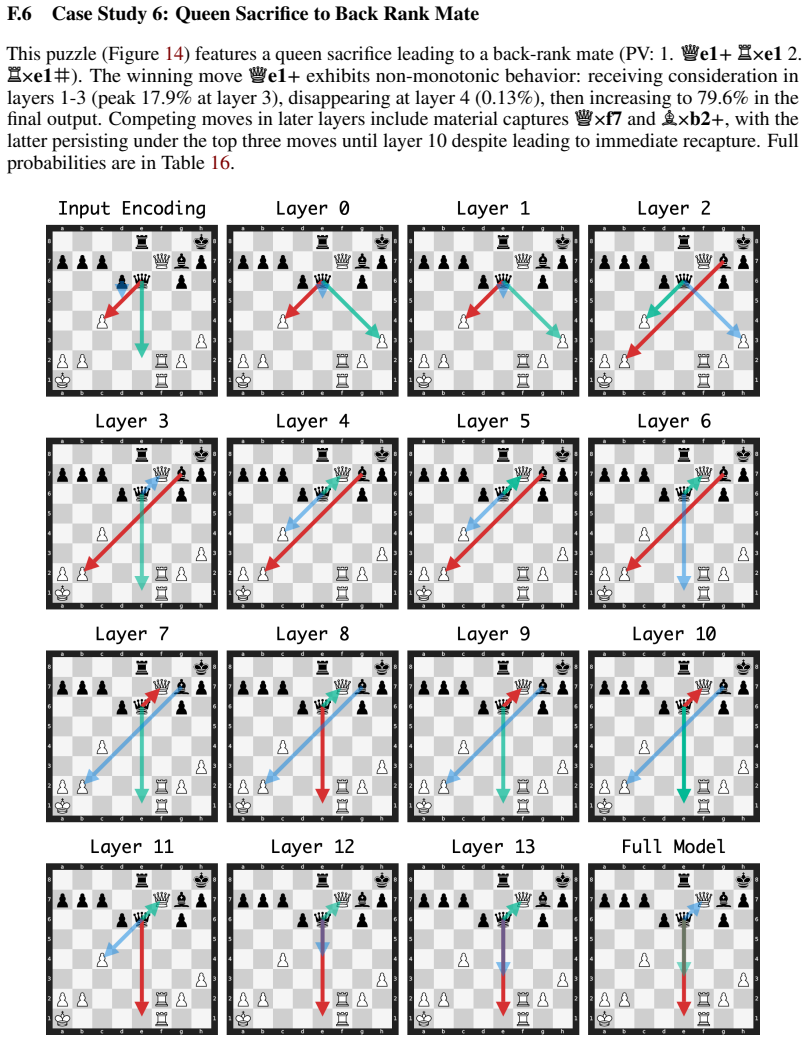
- [Abstract and §4] The claim that 'look-ahead operates normally' on forgotten puzzles is not demonstrated in the body. The abstract says future moves of the correct continuation are represented, causally important, and linearly decodable, but the main text does not report these analyses. Appendix F mentions Jenner et al. only in a single case study. A systematic replication on the forgotten-puzzle set is needed to support the claim that the algorithm itself is not failing.
- [§3.2 and Figure 3] The definitions of 'cumulative discoveries,' 'converged solutions,' and 'first discoveries' are not rigorous enough to support the quantitative claim that 'the final cumulative solve rate exceeds the final layer's performance.' For example, a puzzle is counted as 'discovered' at layer k if the argmax at that layer solves it, but no threshold is given for how long a solution must persist to be 'converged,' and no error bars or significance tests are reported. Please define these metrics precisely and report variability across puzzle subsets.
minor comments (5)
- [General] The full-text title ('Iterative Inference in a Chess-Playing Neural Network') differs from the arXiv title ('The Algorithm Is Not the Behavior: Learned Priors Override Look-Ahead in a Chess-Playing Neural Network'). This should be reconciled.
- [Figure 1 caption and §2.3] The Figure 1 caption says the correct move 'only emerges as a plausible candidate in the middle layers before becoming the decisive top choice in the final output,' but Appendix E shows it was already the top choice at layer 5 and then lost the top position. The caption should be adjusted to match the full trajectory.
- [Appendix A.3] The notation for elementwise multiplication is inconsistent: the text says 'J denotes element-wise multiplication,' but the equations use ⊙. Please unify.
- [Appendix C.2] The GPT-2 comparison lacks details on the number of prompts, sampling temperature, and whether the Pile subset is fixed across models. This makes the comparison hard to reproduce.
- [Appendix F.5] Typo: 'sacrifical' should be 'sacrificial.'
Circularity Check
No significant circularity; the body's observations are self-contained probes of a fixed public model, and the steering/safety-prior claims are absent from the body rather than circular.
full rationale
This paper reports layer-wise policy measurements obtained by extending the logit lens to a Post-LN transformer (Leela Chess Zero). The core observations—monotonic playing strength, non-monotonic policy trajectories, and 'forgotten puzzles'—are direct comparisons between a zero-ablated truncated network and the full network's policy head. No parameter is fitted to the target conclusion, no quantity is renamed as a prediction after being used as a fit, and no load-bearing argument reduces to a self-citation. The only prior-work anchor, Jenner et al. (2024), is external and independently published; the paper's reference to the L12H12 look-ahead head is used as an interpretive link, not as a derivational premise that forces the result. The main weakness is that the front abstract and title assert a steering intervention, a 61.7% recovery rate, and a causal 'safety prior' override, none of which appear in the body or appendices. That is a substantive evidentiary mismatch, but it is not circularity: an absent claim cannot be a derivation that reduces to its own inputs. The load-bearing methodological assumption is that the Post-LN zero-ablation logit lens faithfully reveals internal computation. The paper itself flags this in Appendix A.4 ('it's not clear how to disentangle these functions empirically given current interpretability techniques'). That is a measurement-validity limitation, not a circular derivation. The term 'forgotten puzzles' is operationally defined by the lens and then measured, but defining an observed phenomenon does not make the subsequent empirical claims equivalent to the definition. Since the derivation chain is self-contained against a fixed public model and the stated limitations are explicitly acknowledged, the appropriate circularity score is 0.
Axiom & Free-Parameter Ledger
axioms (4)
- domain assumption Zero ablation of all sublayer outputs after layer k yields a faithful policy projection for Post-LN transformers.
- ad hoc to paper LayerNorm biases can be set to zero for layers beyond k without changing the qualitative policy trajectory.
- domain assumption The puzzle principal variations from Ruoss et al. (2024) are the correct ground truth for puzzle solution.
- domain assumption Intermediate-policy playing strength is a valid proxy for loss reduction during iterative inference.
invented entities (1)
-
Safety prior (safety-prior override)
no independent evidence
Cite this review
Pith. "Pith review of The Algorithm Is Not the Behavior: Learned Priors Override Look-Ahead in a Chess-Playing Neural Network." pith.science (2026). https://pith.science/paper/AUHIDRKV
@misc{pith2026250821380,
  author       = {Pith},
  title        = {Pith review of: The Algorithm Is Not the Behavior: Learned Priors Override Look-Ahead in a Chess-Playing Neural Network},
  year         = {2026},
  howpublished = {\url{https://pith.science/paper/AUHIDRKV}},
  note         = {Machine review of arXiv:2508.21380}
}
read the original abstract
Recent mechanistic work has uncovered learned algorithms within neural networks, from modular arithmetic to search and planning in game-playing agents. But does algorithmic structure guarantee algorithmic behavior? We investigate this in Leela Chess Zero, the strongest neural chess engine, where prior work identified learned look-ahead. By extending the logit lens to its move-selecting policy network, we discover that correct puzzle solutions-including immediate checkmates-often appear in intermediate layers but are systematically overridden in the final output, a phenomenon we term "forgotten puzzles". Replicating prior analyses on these positions, we find that look-ahead operates normally-future moves of the correct continuation are represented, causally important, and linearly decodable-ruling out a failure of the algorithm itself. Instead, late layers increasingly shift toward prioritizing safe play over aggression. To test whether this shift drives the override, we steer the model against these preferences and recover 61.7% of forgotten puzzles, providing causal evidence that safety priors override algorithmically computed solutions. These findings demonstrate that algorithmic structure does not guarantee algorithmic behavior: a model can internally solve a problem and still output the wrong answer.
Figures




Reference graph
Works this paper leans on
-
[1]
Eliciting latent predictions from transformers with the tuned lens, 2023
Nora Belrose, Igor Ostrovsky, Lev McKinney, Zach Furman, Logan Smith, Danny Halawi, Stella Biderman, and Jacob Steinhardt. Eliciting latent predictions from transformers with the tuned lens, 2023. URL https://arxiv.org/abs/2303.08112
Pith/arXiv arXiv 2023
-
[2]
Whole-history rating: A bayesian rating system for players of time-varying strength
R \' e mi Coulom. Whole-history rating: A bayesian rating system for players of time-varying strength. In Computers and Games, 2008
work page 2008
-
[3]
Discussion on layer normalization in transformer architecture
dje\ dev. Discussion on layer normalization in transformer architecture. Forum post on Lc0 community chat, 2025. URL https://lc0.org/chat. Accessed: 2025-08-17
work page 2025
-
[4]
The pile: An 800gb dataset of diverse text for language modeling, 2020
Leo Gao, Stella Biderman, Sid Black, Laurence Golding, Travis Hoppe, Charles Foster, Jason Phang, Horace He, Anish Thite, Noa Nabeshima, Shawn Presser, and Connor Leahy. The pile: An 800gb dataset of diverse text for language modeling, 2020. URL https://arxiv.org/abs/2101.00027
Pith/arXiv arXiv 2020
-
[5]
Residual connections encourage iterative inference, 2018
Stanisław Jastrzębski, Devansh Arpit, Nicolas Ballas, Vikas Verma, Tong Che, and Yoshua Bengio. Residual connections encourage iterative inference, 2018. URL https://arxiv.org/abs/1710.04773
Pith/arXiv arXiv 2018
-
[6]
Evidence of learned look-ahead in a chess-playing neural network, 2024
Erik Jenner, Shreyas Kapur, Vasil Georgiev, Cameron Allen, Scott Emmons, and Stuart Russell. Evidence of learned look-ahead in a chess-playing neural network, 2024. URL https://arxiv.org/abs/2406.00877
Pith/arXiv arXiv 2024
-
[7]
The remarkable robustness of llms: Stages of inference?, 2025
Vedang Lad, Jin Hwa Lee, Wes Gurnee, and Max Tegmark. The remarkable robustness of llms: Stages of inference?, 2025. URL https://arxiv.org/abs/2406.19384
Pith/arXiv arXiv 2025
- [8]
-
[9]
Leela Chess Zero team . A standard dataset, 2018. URL https://lczero.org/blog/2018/09/a-standard-dataset/. Accessed: 2025-08-20
work page 2018
-
[10]
How well do Lc0 networks compare to the greatest transformer network from DeepMind ?, 2024
lepned. How well do Lc0 networks compare to the greatest transformer network from DeepMind ?, 2024. URL https://lczero.org/blog/2024/02/how-well-do-lc0-networks-compare-to-the-greatest-transformer-network-from-deepmind/
work page 2024
-
[11]
Lichess bot: A bridge between lichess api and chess engines
Lichess Bot Devs . Lichess bot: A bridge between lichess api and chess engines. https://github.com/lichess-bot-devs/lichess-bot, 2025. Accessed: 2025-08-18
work page 2025
-
[12]
Lichess: Free online chess, 2025
Lichess.org. Lichess: Free online chess, 2025. URL https://lichess.org. Accessed: 2025-08-18
work page 2025
-
[13]
Encyclopaedia of Chess Openings
Aleksandar Matanovi\' c . Encyclopaedia of Chess Openings. Batsford Limited, 1978
work page 1978
-
[14]
Acquisition of chess knowledge in alphazero
Thomas McGrath, Andrei Kapishnikov, Nenad Tomašev, Adam Pearce, Martin Wattenberg, Demis Hassabis, Been Kim, Ulrich Paquet, and Vladimir Kramnik. Acquisition of chess knowledge in alphazero. Proceedings of the National Academy of Sciences, 119 0 (47), November 2022. ISSN 1091-6490. doi:10.1073/pnas.2206625119. URL http://dx.doi.org/10.1073/pnas.2206625119
-
[15]
How to dissect a muppet: The structure of transformer embedding spaces, 2022
Timothee Mickus, Denis Paperno, and Mathieu Constant. How to dissect a muppet: The structure of transformer embedding spaces, 2022. URL https://arxiv.org/abs/2206.03529
Pith/arXiv arXiv 2022
-
[16]
Mish: A self regularized non-monotonic activation function, 2020
Diganta Misra. Mish: A self regularized non-monotonic activation function, 2020. URL https://arxiv.org/abs/1908.08681
Pith/arXiv arXiv 2020
-
[17]
Transformer progress, February 2024
Daniel Monroe. Transformer progress, February 2024. URL https://lczero.org/blog/2024/02/transformer-progress/. Accessed: 2025-08-17
work page 2024
-
[18]
Interpreting gpt: the logit lens, 2020
nostalgebraist. Interpreting gpt: the logit lens, 2020. URL https://www.lesswrong.com/posts/AcKRB8wDpdaN6v6ru/interpreting-gpt-the-logit-lens
work page 2020
-
[19]
Language models are unsupervised multitask learners
Alec Radford, Jeffrey Wu, Rewon Child, David Luan, Dario Amodei, and Ilya Sutskever. Language models are unsupervised multitask learners. https://openai.com/research/language-unsupervised, 2019. OpenAI Blog
work page 2019
-
[20]
Prajit Ramachandran, Barret Zoph, and Quoc V. Le. Searching for activation functions, 2017. URL https://arxiv.org/abs/1710.05941
Pith/arXiv arXiv 2017
-
[21]
Lewis, Joel Veness, and Tim Genewein
Anian Ruoss, Grégoire Delétang, Sourabh Medapati, Jordi Grau-Moya, Li Kevin Wenliang, Elliot Catt, John Reid, Cannada A. Lewis, Joel Veness, and Tim Genewein. Amortized planning with large-scale transformers: A case study on chess, 2024. URL https://arxiv.org/abs/2402.04494
Pith/arXiv arXiv 2024
-
[22]
A general reinforcement learning algorithm that masters chess, shogi, and go through self-play
David Silver, Thomas Hubert, Julian Schrittwieser, Ioannis Antonoglou, Matthew Lai, Arthur Guez, Marc Lanctot, Laurent Sifre, Dharshan Kumaran, Thore Graepel, et al. A general reinforcement learning algorithm that masters chess, shogi, and go through self-play. Science, 362 0 (6419): 0 1140--1144, 2018
2018
-
[23]
Ashish Vaswani, Noam Shazeer, Niki Parmar, Jakob Uszkoreit, Llion Jones, Aidan N Gomez, ukasz Kaiser, and Illia Polosukhin. Attention is all you need. In Advances in neural information processing systems, volume 30, pages 5998--6008, 2017
work page 2017
-
[24]
Deepnet: Scaling transformers to 1,000 layers, 2022
Hongyu Wang, Shuming Ma, Li Dong, Shaohan Huang, Dongdong Zhang, and Furu Wei. Deepnet: Scaling transformers to 1,000 layers, 2022. URL https://arxiv.org/abs/2203.00555
Pith/arXiv arXiv 2022
This paper was first reviewed by deepseek-v4-flash on August 5, 2026.
discussion (0)
Sign in with ORCID, Apple, or X to comment. Anyone can read and Pith papers without signing in.