REVIEW 3 major objections 5 minor 88 references
Entanglement entropy of fermions in a strange metal
T0 review · 3 major / 5 minor · reviewed 2026-08-15 · deepseek-v4-flash
Pith's one-line read In the large-N one-dimensional Yukawa-SYK strange metal, the fermionic second Rényi entropy obeys a CFT-like crossover formula with effective central charge c_eff about 1.56 and a finite entanglement length ℓ0.
desk verdict First controlled-looking fermionic Rényi computation for a 1D Yukawa-SYK strange metal, but the 'exact' numbers rest on an uncontrolled homogeneous-parameter approximation that should be fixed or softened. read the letter →
The pith
A machine-rendered reading of the paper's core claim, the machinery that carries it, and where it could break.
The reading
What carries the argument
The load-bearing machinery is the imaginary-time path-integral representation of the subsystem Rényi entropy. The reduced density matrix squared, $\mathrm{Tr}[\rho_{Af}^2]$, is rewritten through fermionic displacement operators and auxiliary Grassmann sources; integrating out the sources produces a local kick self-energy that couples the two entanglement replicas at an imaginary time $\tau_0$ and acts only inside the subregion $A$. In the $N \to \infty$ limit the disorder-averaged path integral is evaluated at the saddle point in terms of the local collective Green's functions $G$ and $D$, with self-energies $\Sigma = g^2 G D$ and $\Pi = -g^2 G G$, giving coupled equations solved numerically with a recursive Green's function method. The second piece is the scaling ansatz $S_{Af}^{(2)}(L_A,T) = f_L(L_A/\ell(T)) + d_L(T)$, which collapses the numerical entropy data for different $L_A$ and $T$ onto one curve; fitting that curve to the CFT form $f(x) = (c_{\mathrm{eff}}/4)\ln[\sinh(x)]$ extracts $c_{\mathrm{eff}}$ and $\ell(T)$, whose zero-temperature intercept $1/\ell_0$ is interpreted as the fermion-boson entanglement length.
What would settle it
Solve the large-N saddle-point equations for the second Rényi entropy without the homogeneous, time-independent approximation for the boson mass and order parameter, and check whether $S_{Af}^{(2)}(L_A,T)$ still fits $(c_{\mathrm{eff}}/4)\ln[\sinh(L_A/\ell(T))]$ with $1/\ell_0 \simeq 0.16$; if the fit changes substantially, the central scaling claim is an artifact of the approximation.
Extended reading notes
Core claim
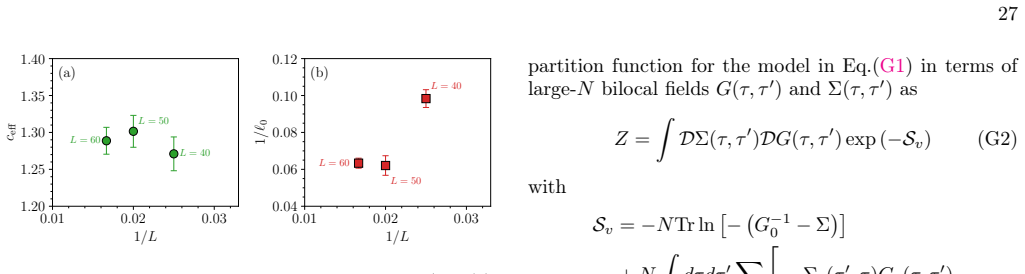
The paper's discovery is that the fermionic second Rényi entropy $S_{Af}^{(2)}(L_A,T)$ of the 1D Yukawa-SYK model obeys the universal crossover formula $S_{Af}^{(2)} \simeq (c_{\mathrm{eff}}/4) \ln[\sinh(L_A/\ell(T))]$ for the strange metal at $\gamma = \gamma_c$ and for Fermi-liquid states $\gamma > \gamma_c$. The inverse length scale follows $1/\ell(T) = a_\ell T + 1/\ell_0$, with a finite zero-temperature intercept $1/\ell_0 \simeq 0.16$ at $\gamma = \gamma_c$ and $\simeq 0.06$ for $\gamma/\gamma_c = 1.84$. The extracted effective central charge is $c_{\mathrm{eff}} \simeq 1.56$ at criticality and $\simeq 1.30$ in that Fermi liquid, both larger than the free-fermion value $c = 1$. At $T=0$, the formula gives a logarithmic growth $(c_{\mathrm{eff}}/4)\ln(L_A/\ell_0)$ for $L_A \lesssim \ell_0$, and a volume-law term $(c_{\mathrm{eff}}/4)(L_A/\ell_0)$ for $L_A \gtrsim \ell_0$; the paper attributes the volume law to fermion-boson entanglement inside the subregion, while the same formula also contains the thermal linear-in-$L_A$ contribution at finite temperature.
Load-bearing premise
The load-bearing premise is that the bosonic mass and order parameter can be set to their homogeneous, time-independent equilibrium values even though the entanglement kick in the path integral breaks spatial and temporal translation invariance, and the paper does not estimate the error introduced by this approximation.
Editorial extensions
If this is right
- At $T=0$, a subregion smaller than $\ell_0$ shows logarithmic inter-subregion entanglement with prefactor $c_{\mathrm{eff}}/4$, about $0.39$ at the strange-metal quantum critical point.
- For subregions larger than $\ell_0$, the entropy crosses over to the volume-law term $(c_{\mathrm{eff}}/4)(L_A/\ell_0)$, so the CFT-like logarithm is cut off at $\ell_0$.
- At finite temperature the same formula contains the thermal entropy contribution $(c_{\mathrm{eff}} a_\ell/4) T L_A$, which dominates for large $L_A$; thus the entire entropy-to-entanglement crossover is encoded in one scaling curve.
- The enhanced $c_{\mathrm{eff}}$ is tied to the bosonic contribution to the linear-$T$ thermal entropy, and the paper predicts both $c_{\mathrm{eff}} \to 1$ and $1/\ell_0 \to 0$ deep in the Fermi-liquid regime ($\gamma \to \infty$).
- Because $1/\ell_0$ is a finite $T=0$ intercept, it gives a quantitative measure of the local fermion-boson entanglement strength, extractable from the slope of $S_{Af}^{(2)}$ with $L_A$ at low temperatures.
Reading between the lines
- Beyond the paper: computing the second Rényi entropy of the full subregion containing both fermions and bosons would test whether the logarithmic term persists without the $\ell_0$ cutoff, which would cleanly separate inter-subregion from intra-subregion entanglement.
- Beyond the paper: the ratio $c_{\mathrm{eff}}/\ell_0$ is extracted more robustly than either parameter alone, so it is a natural quantity to compare across other fermion-boson SYK-type models.
- Beyond the paper: tracking $c_{\mathrm{eff}}(\gamma)$ and $1/\ell_0(\gamma)$ as $\gamma \to \gamma_c^+$ may reveal power-law behavior controlled by the vanishing boson mass $M(0)$, suggesting a scaling collapse close to the quantum critical point.
- Beyond the paper: the numerical study covers $L=40$–$60$ and $T \gtrsim 0.03$; pushing the same recursive Green's function method to larger $L$ and lower $T$ would test whether the extracted $c_{\mathrm{eff}}$ and $1/\ell_0$ remain stable toward the thermodynamic limit.
Signed reviews
Editorial analysis
A structured set of objections, weighed in public.
Referee Report
Summary. The paper studies the second Rényi entropy of a fermionic spatial subregion in a large-N 1D Yukawa-SYK model. The authors first characterize the equilibrium phase diagram through the large-N saddle-point equations, identifying a quantum critical point at which the bosons become critical and the fermions acquire a non-Fermi-liquid self-energy proportional to the square root of frequency. They then employ an imaginary-time path-integral representation of the subsystem Rényi entropy, derive large-N saddle-point equations for the replicated entanglement path integral, and solve them numerically for a chain of length L=50 at temperatures T≈0.05–0.12. The main finding is a universal scaling collapse of the fermionic second Rényi entropy as a function of L_A/ℓ(T), with 1/ℓ(T)=a_ℓ T+1/ℓ_0 and a finite zero-temperature intercept 1/ℓ_0. The collapsed curve is fitted by a CFT-like formula (c_eff/4) ln sinh(L_A/ℓ(T)), yielding c_eff≈1.56 at the strange-metal QCP and c_eff≈1.30 in the Fermi liquid, with 1/ℓ_0≈0.16 and 0.06 respectively. The authors interpret the finite 1/ℓ_0 as a volume-law contribution from intra-subregion fermion-boson entanglement and argue that the CFT-like form captures crossovers among logarithmic entanglement, volume-law entanglement, and thermal entropy.
Significance. If the central computation is correct, this would be a rare exact large-N example of entanglement entropy in a non-Fermi-liquid strange metal, providing a concrete demonstration of an emergent length scale ℓ_0 and an effective central charge c_eff that differs from the free-fermion value. The paper has notable strengths: the method is benchmarked against the correlation-matrix result for free fermions with excellent agreement; the scaling collapse is verified for multiple temperatures and subsystem sizes; the ratio c_eff/ℓ(T) extracted from the full-system fermionic entropy agrees with the scaling-analysis and direct CFT fits; and the system-size dependence of c_eff and 1/ℓ_0 for L=40–60 is explicitly checked. The physical picture of intra-subregion fermion-boson entanglement producing a volume-law term is interesting and potentially important for strange-metal entanglement phenomenology. However, the advertised exactness of the large-N computation is compromised by an admitted approximation in the entanglement path integral, and the T→0 extraction relies on a scaling ansatz whose functional form overlaps with the CFT formula being tested.
major comments (3)
- [Section V, Eqs. (33b)–(34) and Sec. IV, Eq. (7)] The claim that the second Rényi entropy is computed exactly in the large-N limit is not established because the spherical constraint is not imposed inside the replicated entanglement path integral. The manuscript states in Sec. V that the entanglement kick term breaks space and time translation invariance and that r0 and λ should in principle become space- and time-dependent, but then freezes them to their homogeneous equilibrium values from Eqs. (7). This is an uncontrolled O(1) error: the constraint term is O(N) in the action, so an O(1) violation of D_{r,αα}(τ,τ+)+r0^2 = 1/γ at the saddle point changes the per-flavor entropy by O(1). The headline deviations from the free-fermion result, c_eff−1≈0.56 and 1/ℓ_0≈0.16, are both O(1), so they could be dominated by this approximation. The free-fermion benchmark in Sec. VIA does not test the constraint because there is no boson in that limit. Please provide either a self-consistent solution of the inhomogeneous saddle-point equations or a controlled estimate of the error from freezing r0 and m_b^2.
- [Section VIB and Appendix E, Eqs. (41)–(42), Fig. 14] The T→0 entanglement properties are not directly computed; they are extracted from finite-T data using the scaling ansatz of Eq. (41), in which f_L, d_L, and 1/ℓ(T) are parametrized by polynomials, and the collapsed curve is then fitted to the CFT-like form Eq. (42). Because c_eff, s_ℓ, b, and 1/ℓ_0 are fitting parameters, the comparison with the CFT formula is partly circular. The internal consistency check is incomplete: direct CFT fits to S_Af^(2)(L_A,T) in Appendix E yield a temperature-dependent c_eff(T), with c_eff≈1.3 at the lowest accessible temperature for the strange metal, whereas the scaling analysis gives 1.56, and the paper does not quantify whether this discrepancy is within the systematic errors of either procedure. A derivation of 1/ℓ(T) and c_eff from the large-N equations, or at least a quantitative explanation of the difference between the two fitting methods, would be needed to support the central claim.
- [Section VI.B, Fig. 3 and Appendix D] The numerical extrapolation to the continuum limit δτ→0 is performed by a linear fit through only three values of δτ, and the paper reports no error estimate for this extrapolation beyond the fit uncertainties. Since the final S_Af^(2) curves in Fig. 3 are the input to the scaling collapse, any systematic error in the δτ→0 limit propagates directly into c_eff and 1/ℓ_0. Moreover, the temperature window T≈0.05–0.12 is relatively high compared with the boson mass scale near the QCP, and no data are shown for the ordered phase because the extrapolation fails there. The authors should state the systematic uncertainty in the extrapolated quantities and, ideally, demonstrate convergence by using more δτ values for at least one representative temperature and γ.
minor comments (5)
- [Abstract] The phrase "aneffective central charge" in the abstract contains a spacing typo; it should read "an effective central charge."
- [Section VIA1, text after Eq. (41)] The sentence "without relying on the CFT expression [Eq.(35)]" appears to cite the wrong equation: Eq. (35) is the Rényi action difference, not the CFT crossover formula. The intended reference is presumably Eq. (39) or Eq. (42).
- [Fig. 3 caption] The caption mentions a "purple square" for the zero-temperature intercept but the inset markers are shown in blue/magenta tones; please ensure the color references match the figure.
- [Notation throughout] The symbol β is used both for inverse temperature and, in some equations, for an entanglement-replica index. This conflation is confusing, especially in Sec. V and the Supplemental Material; please use a separate symbol for the replica index.
- [Appendix D] The linear extrapolation is shown for only three δτ values in the inset of Fig. 13(a). Please specify the range of δτ and the number of points used for each extrapolation, and state whether a quadratic fit was tested.
Circularity Check
Partial circularity: c_eff and ℓ0 are fit parameters of the CFT-like scaling ansatz, though the finite-T saddle-point computation is independent.
-
fitted input called prediction
[Sec. VIA1 (Eq. (41)) and Sec. VIB2 (Eqs. (42)-(44))]
"In our numerical scaling analysis, f_L(x), d_L(T) and 1/ℓ(T) are taken as polynomials of their arguments for the range of finite temperatures (T̸=0) that we consider. The coefficients of the polynomials are used as fitting parameters to collapse the data... the universal scaling curves fL(LA/ℓ(T)) [Eq.(41)] for both the strange metal and Fermi liquid regimes are well fitted ... by a CFT-like form of the scaling function in Eq.(42), but by replacing c with a prefactor ceff."
The scaling ansatz (41) supplies the functional form, and c_eff, s_ell, b, and ell(T) are obtained by fitting the collapsed data, not by solving the large-N second Renyi equations (34). Equation (44) then 'predicts' S_Af^(2)(L_A,T=0) ~ (c_eff/4) ln(L_A/ell0), but this is just the small-argument limit of the same fitted CFT-like formula (42) combined with the fitted form 1/ell(T)=a_ell T+1/ell0. Hence the headline numbers c_eff=1.56 and 1/ell0=0.16 are fit outputs, and the T=0 logarithmic and volume-law statements are imposed by the ansatz rather than derived from the microscopic large-N saddle point. The finite-T values of S_Af from Eqs. (34)-(35) and the free-fermion benchmark are independent content, so the circularity is partial rather than total.
full rationale
The paper's large-N computation of the finite-temperature second Rényi entropy S_Af^(2)(L_A,T) is not circular: Eqs. (34)-(35) define a self-consistent saddle-point problem, and the method is benchmarked against the exact free-fermion correlation-matrix result, recovering c approximately equal to 1. The circular element enters when these computed numbers are turned into a claim about T=0 entanglement: the scaling ansatz (41) is adopted, f_L, d_L, and 1/ell(T) are fitted polynomials, and the universal curve is then fitted to the CFT-like form (42) with c_eff, s_ell, b as free parameters. The resulting effective central charge and finite intercept 1/ell0, and the logarithmic law for L_A << ell0, are therefore properties of the fitted ansatz, not independent predictions of the large-N equations. This is a genuine case of a fitted parametrization being presented as a derived scaling result, though it is partially mitigated by the independent cross-check S_f(L)=S_Af(L_A=L), which verifies the c_eff/ell(T) combination, and by the nontrivial data collapse. I also note the manuscript explicitly acknowledges an uncontrolled approximation: the entanglement kick term breaks space-time translation invariance, yet r0 and the Lagrange-multiplier/mass parameter are frozen to their homogeneous equilibrium values, making the 'exact in large-N' claim a correctness risk rather than a circularity. Overall, the central claim has independent computational content, but its headline CFT parameters are fit outputs, giving a partial circularity score of 4.
Assumptions & free parameters
free parameters (5)
- c_eff =
1.56 (γ/γc=1); 1.30 (γ/γc=1.84)
- 1/ℓ0 =
0.16 (γ/γc=1); 0.06 (γ/γc=1.84)
- a_ℓ =
not quoted; slope of 1/ℓ1(T) versus T in Fig. 3 insets
- s_ℓ and b =
not quoted; fit parameters in Eq. (42)
- d_L(T) coefficients =
temperature-dependent polynomial coefficients
assumptions (6)
- standard math Large-N saddle-point limit with replica trick and replica-symmetric, diagonal ansatz
- domain assumption Spherical constraint on the bosonic fields with tuning parameter γ, with m_b adjusted to satisfy it
- domain assumption O(N) symmetry breaking with the condensate along one component r0 and Ohmic dissipation-induced long-range order in 1D
- domain assumption Luttinger theorem holds and Fermi points remain at non-interacting values across the phase diagram
- ad hoc to paper Scaling ansatz Eq. (41) with polynomial parameterizations of f_L, d_L, and 1/ℓ(T), with θ=0 and f_L(x≫1)∼x
- ad hoc to paper Homogeneous, time-independent r0 and m_b in the entanglement path integral despite the kick breaking translation invariance
invented entities (1)
-
fermion-boson entanglement length scale ℓ0
Cite this review
Pith. "Pith review of Entanglement entropy of fermions in a strange metal." pith.science (2026). https://pith.science/paper/AYFATIZJ
@misc{pith2026260804098,
  author       = {Pith},
  title        = {Pith review of: Entanglement entropy of fermions in a strange metal},
  year         = {2026},
  howpublished = {\url{https://pith.science/paper/AYFATIZJ}},
  note         = {Machine review of arXiv:2608.04098}
}
abstract
The subsystem-size dependence of ground-state entanglement entropy and its crossover to thermal entropy as a function of temperature are well understood for one-dimensional (1D) gapless systems described by conformal field theory (CFT), and for free fermions with a Fermi surface in any dimension. However, little is known about the entanglement entropy for gapless fermionic systems without quasi-particles, such as a strange metal. Here we study the entanglement entropy of fermions in a solvable large-$N$ 1D lattice model akin to the Yukawa-Sachdev-Ye-Kitaev (Yukawa SYK) model. In this model, two Fermi points are coupled to scalar bosons via spatially random Yukawa interactions, providing a solvable model of a strange metal when the bosons become critical at a quantum critical point. We exactly compute the second R\'{e}nyi entropy of fermions in a spatial subregion in this model. Our results unravel crucial role of intra-subregion entanglement between fermionic and bosonic degrees of freedom along with the inter-subregion entanglement in understanding the ground states of such strongly coupled fermion-boson systems. We show that the crossover from thermal entropy to entanglement entropy, is captured by a single scaling ansatz, that collapses the second R\'{e}nyi entropy of fermions for different subregion sizes and temperatures into a single universal curve. We further show that the universal scaling curve for the critical strange metal is well described by the standard CFT formula, albeit with an effective central charge substantially larger than the non-interacting value.
Figures


Figures from the paper (13 more)




Reference graph
Works this paper leans on
-
[1]
Boson mass and low-temperature phase diagram Since the effective dissipativeO(N)model provides a good description of the low-temperature properties of the bosonic degrees of freedom in the 1D Yukawa-SYK model, we first use Eqs.(11) and (7f) for a fixedκto obtain the zero-temperature properties. At zero tem- peratureT= 0, we convert Matsubara summations in...
-
[2]
2Γ +κ+ 2 p M 2(0) + Γ(Γ +κ) 2M(0) +κ # −ln
Fermionic Self energy From Eq.(7c), the fermion self energy can be written as Σ(iωn) =g 2r2 0G(iωn) +g 2 1 β X m G(iωn + iΩm) ˜D(iΩm). (B12) 2 Fermionic Self energy 21 0.8 1.0 1.2 1.4 γ/γc 0.00 0.02 0.04 0.06 0.08 0.10 0.12 0.14 0.16 T/t TF ∼ M(0) 1.0 1.2 1.4 1.6 1.8 2.0 2.2 2.4 2.6 α = d log[M 2(T) − M 2(0)] d logT FIG. 10.Phase diagram of dissipativeO(N...
-
[3]
Laflorencie, Quantum entanglement in condensed matter systems, Physics Reports646, 1 (2016), quantum entanglement in condensed matter systems
N. Laflorencie, Quantum entanglement in condensed matter systems, Physics Reports646, 1 (2016), quantum entanglement in condensed matter systems
2016
-
[4]
Kitaev and J
A. Kitaev and J. Preskill, Topological entanglement en- tropy, Phys. Rev. Lett.96, 110404 (2006)
2006
-
[5]
Jiang, Z
H.-C. Jiang, Z. Wang, and L. Balents, Identifying topo- logical order by entanglement entropy, Nature Physics8, 902 (2012)
2012
-
[6]
Calabrese and J
P. Calabrese and J. Cardy, Entanglement entropy and quantum field theory, Journal of Statistical Mechanics: Theory and Experiment2004, P06002 (2004)
2004
-
[7]
B. Swingle and T. Senthil, Universal crossovers between entanglement entropy and thermal entropy, Phys. Rev. B87, 045123 (2013)
work page 2013
-
[8]
V. E. Korepin, Universality of entropy scaling in one di- mensional gapless models, Phys. Rev. Lett.92, 096402 (2004)
2004
Show all 88 references
-
[9]
Giamarchi,Quantum Physics in One Dimension(Ox- ford University Press, 2003)
T. Giamarchi,Quantum Physics in One Dimension(Ox- ford University Press, 2003)
2003
-
[10]
Gioev and I
D. Gioev and I. Klich, Entanglement entropy of fermions in any dimension and the widom conjecture, Phys. Rev. Lett.96, 100503 (2006)
2006
-
[11]
Swingle, Entanglement entropy and the fermi surface, Phys
B. Swingle, Entanglement entropy and the fermi surface, Phys. Rev. Lett.105, 050502 (2010)
2010
-
[12]
W. Li, L. Ding, R. Yu, T. Roscilde, and S. Haas, Scaling behavior of entanglement in two- and three-dimensional free-fermion systems, Phys. Rev. B74, 073103 (2006)
2006
-
[13]
Swingle, Conformal field theory approach to fermi liq- uids and other highly entangled states, Phys
B. Swingle, Conformal field theory approach to fermi liq- uids and other highly entangled states, Phys. Rev. B86, 035116 (2012)
2012
-
[14]
Swingle, Rényi entropy, mutual information, and fluc- tuation properties of fermi liquids, Phys
B. Swingle, Rényi entropy, mutual information, and fluc- tuation properties of fermi liquids, Phys. Rev. B86, 045109 (2012)
2012
-
[15]
McMinis and N
J. McMinis and N. M. Tubman, Renyi entropy of the interacting fermi liquid, Phys. Rev. B87, 081108 (2013)
2013
-
[16]
W. Ding, A. Seidel, and K. Yang, Entanglement entropy of fermi liquids via multidimensional bosonization, Phys. Rev. X2, 011012 (2012)
2012
-
[17]
S. Bera, A. Haldar, and S. Banerjee, Dynamical mean- field theory for rényi entanglement entropy and mutual information in the hubbard model, Phys. Rev. B109, 035156 (2024)
2024
-
[18]
Sachdev,Quantum Phases of Matter(Cambridge Uni- versity Press, 2023)
S. Sachdev,Quantum Phases of Matter(Cambridge Uni- versity Press, 2023)
2023
-
[19]
S. Sachdev, Quantum statistical mechanics of the sachdev-ye-kitaev model and charged black holes, In- ternational Journal of Modern Physics B38, 2430003 (2024), https://doi.org/10.1142/S0217979224300032
2024 doi
-
[20]
Sachdev and J
S. Sachdev and J. Ye, Gapless spin-fluid ground state in a random quantum heisenberg magnet, Phys. Rev. Lett. 70, 3339 (1993)
1993
-
[21]
Kitaev, A simple model of quantum holography, http://online.kitp.ucsb.edu/online/entangled15/ kitaev/(2015), kITP program: Entanglement in Strongly-Correlated Quantum Matter
A. Kitaev, A simple model of quantum holography, http://online.kitp.ucsb.edu/online/entangled15/ kitaev/(2015), kITP program: Entanglement in Strongly-Correlated Quantum Matter
2015
-
[22]
Sachdev, Bekenstein-hawking entropy and strange metals, Phys
S. Sachdev, Bekenstein-hawking entropy and strange metals, Phys. Rev. X5, 041025 (2015)
2015
-
[23]
Maldacena and D
J. Maldacena and D. Stanford, Remarks on the sachdev- ye-kitaev model, Phys. Rev. D94, 106002 (2016). 30
2016
-
[24]
Chowdhury, A
D. Chowdhury, A. Georges, O. Parcollet, and S. Sachdev, Sachdev-ye-kitaev models and beyond: Window into non-fermi liquids, Rev. Mod. Phys.94, 035004 (2022)
2022
-
[25]
Banerjee and E
S. Banerjee and E. Altman, Solvable model for a dynam- ical quantum phase transition from fast to slow scram- bling, Phys. Rev. B95, 134302 (2017)
2017
-
[26]
Esterlis and J
I. Esterlis and J. Schmalian, Cooper pairing of incoherent electrons: An electron-phonon version of the sachdev-ye- kitaev model, Phys. Rev. B100, 115132 (2019)
2019
-
[27]
E.E.Aldape, T.Cookmeyer, A.A.Patel,andE.Altman, Solvable theory of a strange metal at the breakdown of a heavy fermi liquid, Phys. Rev. B105, 235111 (2022)
2022
-
[28]
Song, C.-M
X.-Y. Song, C.-M. Jian, and L. Balents, Strongly corre- lated metal built from sachdev-ye-kitaev models, Phys. Rev. Lett.119, 216601 (2017)
2017
-
[29]
C.-M. Jian, Z. Bi, and C. Xu, Model for continuous thermal metal to insulator transition, Phys. Rev. B96, 115122 (2017)
2017
-
[30]
Haldar and V
A. Haldar and V. B. Shenoy, Strange half-metals and mott insulators in sachdev-ye-kitaev models, Phys. Rev. B98, 165135 (2018)
2018
-
[31]
Haldar, S
A. Haldar, S. Banerjee, and V. B. Shenoy, Higher- dimensional sachdev-ye-kitaev non-fermi liquids at lif- shitz transitions, Phys. Rev. B97, 241106 (2018)
2018
-
[32]
Chowdhury, Y
D. Chowdhury, Y. Werman, E. Berg, and T. Senthil, Translationally invariant non-fermi-liquid metals with critical fermi surfaces: Solvable models, Phys. Rev. X 8, 031024 (2018)
2018
-
[33]
J. Kim, E. Altman, and X. Cao, Dirac fast scramblers, Phys. Rev. B103, L081113 (2021)
2021
-
[34]
A. A. Patel, H. Guo, I. Esterlis, and S. Sachdev, Universal theory of strange metals from spatially random interactions, Science381, 790 (2023), https://www.science.org/doi/pdf/10.1126/science.abq6011
2023 doi
-
[35]
Esterlis, H
I. Esterlis, H. Guo, A. A. Patel, and S. Sachdev, Large- ntheory of critical fermi surfaces, Phys. Rev. B103, 235129 (2021)
2021
-
[36]
C. Li, D. Valentinis, A. A. Patel, H. Guo, J. Schmalian, S. Sachdev, and I. Esterlis, Strange metal and supercon- ductor in the two-dimensional yukawa-sachdev-ye-kitaev model, Phys. Rev. Lett.133, 186502 (2024)
2024
-
[37]
H. Guo, A. A. Patel, I. Esterlis, and S. Sachdev, Large-n theory of critical fermi surfaces. ii. conductivity, Phys. Rev. B106, 115151 (2022)
2022
-
[38]
H. Guo, D. Valentinis, J. Schmalian, S. Sachdev, and A. A. Patel, Cyclotron resonance and quantum oscilla- tions of critical fermi surfaces, Phys. Rev. B109, 075162 (2024)
2024
-
[39]
A. A. Patel, P. Lunts, and S. Sachdev, Localization of overdampedbosonicmodesandtransportinstrangemet- als, Proceedings of the National Academy of Sciences 121, e2402052121 (2024)
2024
-
[40]
A. A. Patel, P. Lunts, and M. S. Albergo, Strange metals and planckian transport in a gapless phase from spatially random interactions, Phys. Rev. X15, 031064 (2025)
2025
-
[41]
Lunts, A
P. Lunts, A. A. Patel, and S. Sachdev, Thermopower across fermi-volume-changing quantum phase transitions without translational symmetry breaking, Phys. Rev. B 111, 245151 (2025)
2025
-
[42]
P. A. Lee, N. Nagaosa, and X.-G. Wen, Doping a mott in- sulator: Physics of high-temperature superconductivity, Reviews of Modern Physics78, 17 (2006)
2006
-
[43]
Hänggi and G.-L
P. Hänggi and G.-L. Ingold, Quantum brownian mo- tion and the third law of thermodynamics (2006), arXiv:quant-ph/0601056 [quant-ph]
2006 arXiv
-
[44]
Hänggi, G.-L
P. Hänggi, G.-L. Ingold, and P. Talkner, Finite quantum dissipation: the challenge of obtaining specific heat, New Journal of Physics10, 115008 (2008)
2008
-
[45]
Haldar, S
A. Haldar, S. Bera, and S. Banerjee, Rényi entangle- ment entropy of fermi and non-fermi liquids: Sachdev- ye-kitaev model and dynamical mean field theories, Phys. Rev. Res.2, 033505 (2020)
2020
-
[46]
Chakraborty and R
A. Chakraborty and R. Sensarma, Renyi entropy of in- teracting thermal bosons in the large-napproximation, Phys. Rev. A104, 032408 (2021)
2021
-
[47]
Chakraborty and R
A. Chakraborty and R. Sensarma, Nonequilibrium dy- namics of renyi entropy for bosonic many-particle sys- tems, Phys. Rev. Lett.127, 200603 (2021)
2021
-
[48]
Moitra and R
S. Moitra and R. Sensarma, Building entanglement entropy out of correlation functions for interacting fermions, Phys. Rev. B108, 174309 (2023)
2023
-
[49]
K. E. Cahill and R. J. Glauber, Density operators for fermions, Phys. Rev. A59, 1538 (1999)
1999
-
[50]
Sachdev,Quantum Phase Transitions, 2nd ed
S. Sachdev,Quantum Phase Transitions, 2nd ed. (Cam- bridge University Press, Cambridge, UK, 2011)
2011
-
[51]
G. W. Ford and R. F. O’Connell, Quantum thermody- namic functions for an oscillator coupled to a heat bath, Phys. Rev. B75, 134301 (2007)
2007
-
[52]
M. B. Hastings, I. González, A. B. Kallin, and R. G. Melko, Measuring renyi entanglement entropy in quan- tum monte carlo simulations, Phys. Rev. Lett.104, 157201 (2010)
2010
-
[53]
Humeniuk and T
S. Humeniuk and T. Roscilde, Quantum monte carlo cal- culationofentanglementrényientropiesforgenericquan- tum systems, Phys. Rev. B86, 235116 (2012)
2012
-
[54]
Grover, Entanglement of interacting fermions in quan- tum monte carlo calculations, Phys
T. Grover, Entanglement of interacting fermions in quan- tum monte carlo calculations, Phys. Rev. Lett.111, 130402 (2013)
2013
-
[55]
F. F. Assaad, T. C. Lang, and F. Parisen Toldin, En- tanglement spectra of interacting fermions in quantum monte carlo simulations, Phys. Rev. B89, 125121 (2014)
2014
-
[56]
Broecker and S
P. Broecker and S. Trebst, Rényi entropies of interact- ing fermions from determinantal quantum monte carlo simulations, Journal of Statistical Mechanics: Theory and Experiment2014, P08015 (2014)
2014
-
[57]
Wang and M
L. Wang and M. Troyer, Renyi entanglement entropy of interacting fermions calculated using the continuous- timequantummontecarlomethod,Phys.Rev.Lett.113, 110401 (2014)
2014
-
[58]
F. F. Assaad, Stable quantum monte carlo simulations for entanglement spectra of interacting fermions, Phys. Rev. B91, 125146 (2015)
2015
-
[59]
D’Emidio, Entanglement entropy from nonequilibrium work, Phys
J. D’Emidio, Entanglement entropy from nonequilibrium work, Phys. Rev. Lett.124, 110602 (2020)
2020
-
[60]
Casini and M
H. Casini and M. Huerta, Entanglement entropy in free quantum field theory, Journal of Physics A: Mathemati- cal and Theoretical42, 504007 (2009)
2009
-
[61]
Sachdev, Strange metals and black holes: in- sights from the Sachdev-Ye-Kitaev model, arXiv e-prints , arXiv:2305.01001 (2023), arXiv:2305.01001 [cond- mat.str-el]
S. Sachdev, Strange metals and black holes: in- sights from the Sachdev-Ye-Kitaev model, arXiv e-prints , arXiv:2305.01001 (2023), arXiv:2305.01001 [cond- mat.str-el]
2023 arXiv
-
[62]
A. C. Potter, Boundary-law scaling of entanglement en- tropy in diffusive metals (2014), arXiv:1408.1094 [cond- mat.str-el]
2014 arXiv
-
[63]
Pouranvari, Y
M. Pouranvari, Y. Zhang, and K. Yang, Entanglement area law in disordered free fermion anderson model in one, two, and three dimensions, Advances in Condensed Matter Physics2015, 397630 (2015). 31
2015
-
[64]
Widom,On a Class of Integral Operators with Dis- continuous Symbol(1982)
H. Widom,On a Class of Integral Operators with Dis- continuous Symbol(1982)
1982
-
[65]
Leschke, A
H. Leschke, A. V. Sobolev, and W. Spitzer, Scaling of rényi entanglement entropies of the free fermi-gas ground state: A rigorous proof, Phys. Rev. Lett.112, 160403 (2014)
2014
-
[66]
McMinis and N
J. McMinis and N. M. Tubman, Renyi entropy of the interacting fermi liquid, Phys. Rev. B87, 081108(R) (2013)
2013
-
[67]
Zhang, T
Y. Zhang, T. Grover, and A. Vishwanath, Entanglement entropy of critical spin liquids, Phys. Rev. Lett.107, 067202 (2011)
2011
-
[68]
Shao, E.-A
J. Shao, E.-A. Kim, F. D. M. Haldane, and E. H. Rezayi, Entanglement entropy of theν= 1/2composite fermion non-fermi liquid state, Phys. Rev. Lett.114, 206402 (2015)
2015
-
[69]
Voinea, S
C. Voinea, S. Pu, A. C. Balram, and Z. Papić, Entangle- ment scaling and charge fluctuations in a fermi liquid of composite fermions, Phys. Rev. B111, 115119 (2025)
2025
-
[70]
R. V. Mishmash and O. I. Motrunich, Entanglement en- tropy of composite fermi liquid states on the lattice: In support of the widom formula, Phys. Rev. B94, 081110(R) (2016)
2016
-
[71]
Sachdev and D
S. Sachdev and D. Chowdhury, The novel metallic states of the cuprates: Topological fermi liquids and strange metals, Progress of Theoretical and Experimen- tal Physics2016, 12C102 (2016)
2016
-
[72]
Watanabe and A
H. Watanabe and A. Vishwanath, Criterion for stabil- ity of goldstone modes and fermi liquid behavior in a metalwithbrokensymmetry,ProceedingsoftheNational Academy of Sciences111, 16314 (2014)
2014
-
[73]
M. R. Norman and C. Pépin, The electronic nature of high temperature cuprate superconductors, Reports on Progress in Physics66, 1547 (2003)
2003
-
[74]
Islam, R
R. Islam, R. Ma, P. M. Preiss, M. E. Tai, A. Lukin, M. Rispoli, and M. Greiner, Measuring entanglement en- tropy in a quantum many-body system, Nature528, 77 (2015)
2015
-
[75]
Bałut, X
D. Bałut, X. Guo, N. de Vries, D. Chaudhuri, B. Brad- lyn, P. Abbamonte, and P. W. Phillips, Quantum fisher information reveals uv-ir mixing in the strange metal, Physica C: Superconductivity and its Applications635, 1354750 (2025)
2025
-
[76]
Mazza, S
F. Mazza, S. Biswas, X. Yan, A. Prokofiev, P. Stef- fens, Q. Si, F. F. Assaad, and S. Paschen, Quantum fisher information in a strange metal, Nature Physics 10.1038/s41567-026-03298-0 (2026)
2026 doi
-
[77]
Hauke, M
P. Hauke, M. Heyl, L. Tagliacozzo, and P. Zoller, Mea- suring multipartite entanglement via dynamic suscepti- bilities, Nature Physics12, 778 (2016)
2016
-
[78]
Y. Gu, A. Lucas, and X.-L. Qi, Spread of entanglement in a sachdev-ye-kitaev chain, Journal of High Energy Physics2017, 120 (2017). 1 Supplemental Material for Entanglement entropy of fermions in a strange metal Santanu Singh1, Surajit Bera2, Chenyuan Li3, Subir Sachdev4, Sumi...
2017
-
[79]
For each value ofγin the range of interest, we scan over the temperatureT̸= 0, from high to low
Solution of imaginary-time large-Nsaddle-point equations We solve the large-Nsaddle-point Eqs.(7) through numerical iterations. For each value ofγin the range of interest, we scan over the temperatureT̸= 0, from high to low. At each temperature, we start with an initial guess ...
-
[79]
For each value ofγin the range of interest, we scan over the temperatureT̸= 0, from high to low
Solution of imaginary-time large-Nsaddle-point equations We solve the large-Nsaddle-point Eqs.(7) through numerical iterations. For each value ofγin the range of interest, we scan over the temperatureT̸= 0, from high to low. At each temperature, we start with an initial guess ...
-
[80]
(7a), (7b), (7c), (7d)] for the retarded functionsG R(ω)andD R(Ω), obtained through analytical continuations,iωn →ω+ i0 + andiΩ m →Ω + i0+
Solution of the real-frequency large-Nsaddle-point equations WeuseM 2(T)(andhencem 2 b(T))determinedself-consistentlyfromtheabovesolutionoftheimaginary-timesaddle- point Eqs.(7) for eachγandT, to solve the real-frequency saddle-point equations [Eqs. (7a), (7b), (7c), (7d)] for...
-
[80]
(7a), (7b), (7c), (7d)] for the retarded functionsGR(ω)andD R(Ω), obtained through analytical continuations,iωn→ω+ i0 + andiΩ m→Ω + i0+
Solution of the real-frequency large-Nsaddle-point equations WeuseM 2(T)(andhencem 2 b(T))determinedself-consistentlyfromtheabovesolutionoftheimaginary-timesaddle- point Eqs.(7) for eachγandT, to solve the real-frequency saddle-point equations [Eqs. (7a), (7b), (7c), (7d)] for...
-
[81]
We divide the time interval[0, β)intoNτ segments such thatβ=N τ δτ
Imaginary-time discretization To solve the saddle-point Eqs.(34) in imaginary timeτwithout the invariance of the time-translation, we discretize the saddle-point equations in imaginary time. We divide the time interval[0, β)intoNτ segments such thatβ=N τ δτ. 1 Imaginary-time d...
-
[81]
We divide the time interval[0,β)intoNτ segments such thatβ=N τδτ
Imaginary-time discretization To solve the saddle-point Eqs.(34) in imaginary timeτwithout the invariance of the time-translation, we discretize the saddle-point equations in imaginary time. We divide the time interval[0,β)intoNτ segments such thatβ=N τδτ. 1 Imaginary-time dis...
-
[82]
L”), i.e.,Rof the preceding section, and add one layer (system “S
Recursive Green’s function method The most computationally demanding part of solving the entanglement large-Nequations is the inversion ofG−1 andD −1, matrices of dimension∼LN τ ×LN τ, to obtainGandDvia Eq.(S2.8) for a system sizeL. A direct inversion with the large-Nself-cons...
-
[82]
L”), i.e.,Rof the preceding section, and add one layer (system “S
Recursive Green’s function method The most computationally demanding part of solving the entanglement large-Nequations is the inversion ofG−1 andD −1, matrices of dimension∼LN τ×LN τ, to obtainGandDvia Eq.(S2.8) for a system sizeL. A direct inversion with the large-Nself-consi...
Reviewed August 15, 2026 · model on record in the stance chip above.
Discussion (0). Continue with ORCID to comment.