Impact of the Einstein Telescope's duty cycle on the estimation of binary black holes parameters
Pith reviewed 2026-06-26 20:13 UTC · model grok-4.3
The pith
The nested triangular Einstein Telescope design yields tighter constraints on binary black hole luminosity distance and source-frame masses than the two L-shaped detectors when realistic duty cycles are modeled.
A machine-rendered reading of the paper's core claim, the machinery that carries it, and where it could break.
Core claim
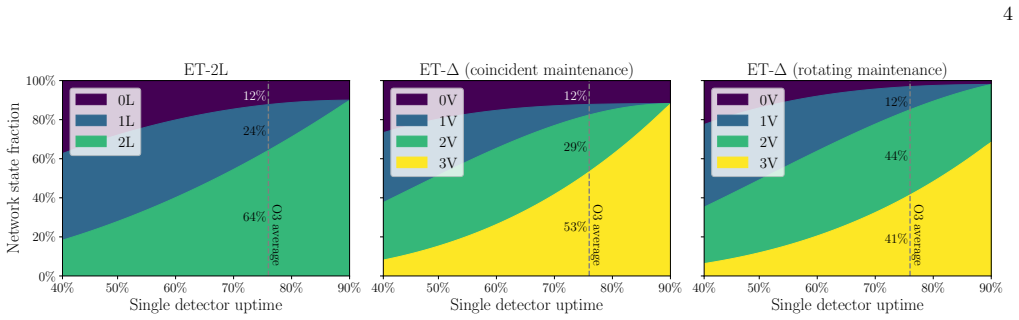
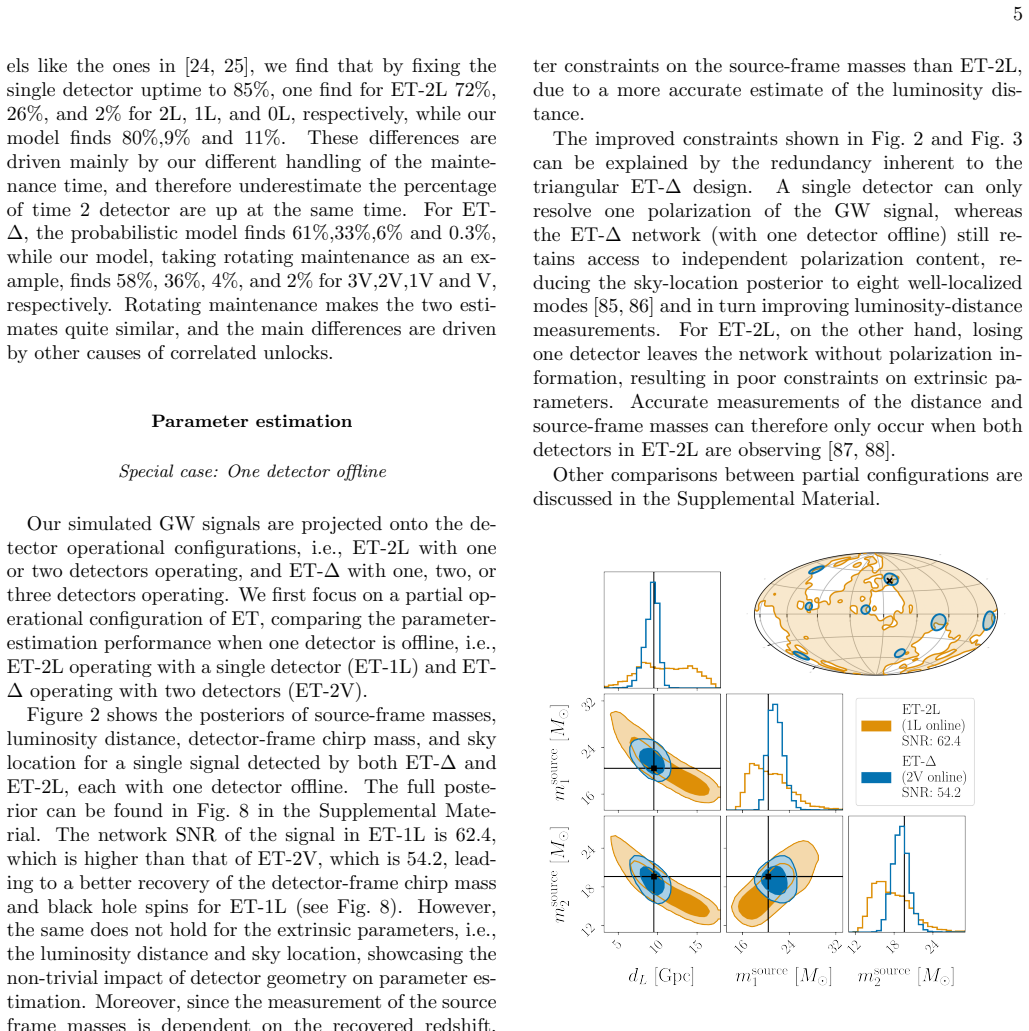
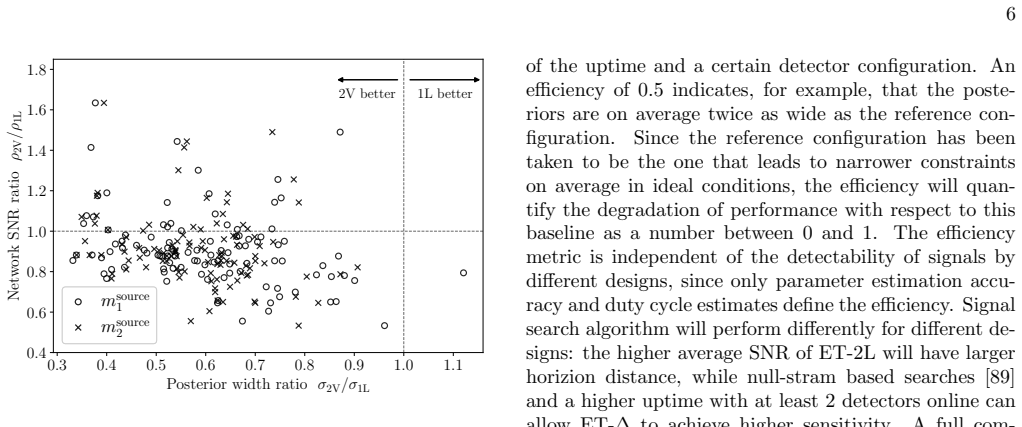
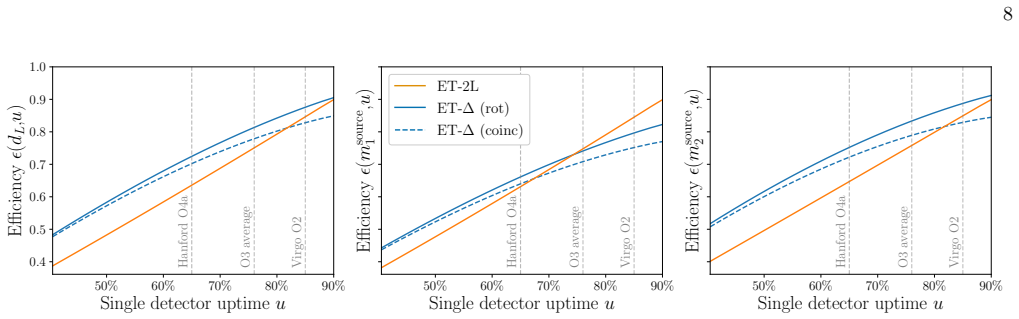
The redundancy inherent in the ET-Δ design enables it to maintain at least two operational detectors for the majority of the observing time, whereas the ET-2L configuration is often limited to a single detector. Crucially, during partial network operation, ET-Δ often outperforms ET-2L, and the increased multi-detector uptime translates into tighter constraints on the luminosity distance and source-frame component masses. Notably, this remains true even when gravitational-wave events have a lower signal-to-noise ratio in ET-Δ than in ET-2L.
What carries the argument
Duty cycle modeled via continuous-time Markov chains applied to full Bayesian parameter estimation of binary black hole signals in the two ET geometries.
If this is right
- ET-Δ provides tighter posterior constraints on luminosity distance and source-frame component masses compared to ET-2L under partial network operation.
- The advantage of multi-detector uptime outweighs differences in per-event signal-to-noise ratio for these parameters.
- Different maintenance strategies tested still show the redundancy benefit of the triangular configuration.
- Parameter estimation improves when at least two detectors operate simultaneously for most observing time.
Where Pith is reading between the lines
- Similar duty cycle considerations could influence design decisions for other future gravitational wave detectors.
- The findings suggest prioritizing geometric redundancy in network layouts to maximize science return from uptime.
- Validation of the Markov chain downtime model against current detector statistics would strengthen the case for one geometry over the other.
Load-bearing premise
The continuous-time Markov chain models of detector uptime and maintenance strategies accurately capture the real operational behavior of the Einstein Telescope.
What would settle it
Observing the actual duty cycles of a built Einstein Telescope and re-running parameter estimation on real binary black hole events to check if the triangular design indeed delivers the predicted tighter constraints.
Figures
read the original abstract
The geometry of the Einstein Telescope, the proposed next-generation European gravitational-wave observatory, is yet to be finalized. Two competing designs are under consideration: a nested triangular configuration (ET-{\Delta}) and two separated L-shaped detectors (ET-2L). Extensive prior comparisons of ET designs established the scientific landscape using the Fisher-information-matrix formalism and identified that duty-cycle-induced single-detector operation is precisely the regime where this approximation becomes less reliable, underscoring the need for a refined, principled treatment of the duty cycle. In this manuscript, we build on that foundation by revisiting the comparison with full Bayesian parameter estimation of gravitational-wave signals from binary black-hole mergers, projected onto a simulated Einstein Telescope that incorporates a refined duty cycle modelled via continuous-time Markov chains and testing different detector maintenance strategies. We find that the redundancy inherent in the ET-{\Delta} design enables it to maintain at least two operational detectors for the majority of the observing time, whereas the ET-2L configuration is often limited to a single detector. Crucially, we show that, during partial network operation, ET-{\Delta} often outperforms ET-2L, and that the increased multi-detector uptime translates into tighter constraints on the luminosity distance and source-frame component masses. Notably, this remains true even when gravitational-wave events have a lower signal-to-noise ratio in ET-{\Delta} than in ET-2L.
Editorial analysis
A structured set of objections, weighed in public.
Referee Report
Summary. The paper compares the triangular ET-Δ and two-L ET-2L designs for the Einstein Telescope using full Bayesian parameter estimation on simulated binary black hole signals. A duty cycle is modeled via continuous-time Markov chains with several maintenance strategies. The central claim is that ET-Δ maintains higher multi-detector uptime due to its redundancy, yielding tighter posteriors on luminosity distance and source-frame component masses during partial-network operation, even when individual events have lower SNR than in ET-2L.
Significance. If the duty-cycle model is representative, the work supplies a concrete, simulation-based argument for preferring the redundant ET-Δ geometry when parameter estimation (rather than detection) is the figure of merit. It improves on prior Fisher-matrix studies by employing full Bayesian recovery and by explicitly testing maintenance policies, thereby quantifying how uptime fractions translate into measurable gains on d_L and m1, m2.
major comments (1)
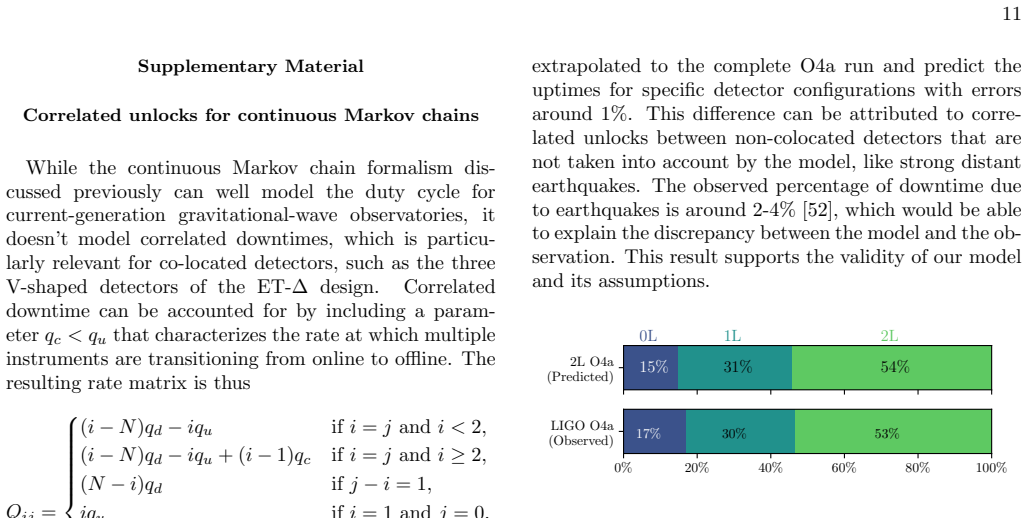
- [§3] §3 (duty-cycle model): the continuous-time Markov chain transition rates and the specific maintenance strategies are not calibrated against published downtime statistics from LIGO/Virgo. Because the headline result—that ET-Δ outperforms ET-2L in partial operation—rests entirely on the uptime ordering produced by this model, an uncalibrated choice of rates constitutes a load-bearing assumption; different failure/repair statistics could reverse the ordering while leaving the Bayesian pipeline unchanged.
Simulated Author's Rebuttal
We thank the referee for the constructive comment on the duty-cycle model. We address the point below and will revise the manuscript to strengthen the analysis.
read point-by-point responses
-
Referee: [§3] §3 (duty-cycle model): the continuous-time Markov chain transition rates and the specific maintenance strategies are not calibrated against published downtime statistics from LIGO/Virgo. Because the headline result—that ET-Δ outperforms ET-2L in partial operation—rests entirely on the uptime ordering produced by this model, an uncalibrated choice of rates constitutes a load-bearing assumption; different failure/repair statistics could reverse the ordering while leaving the Bayesian pipeline unchanged.
Authors: We agree that the transition rates were chosen on the basis of plausible order-of-magnitude estimates rather than a direct fit to published LIGO/Virgo downtime statistics, and that this choice is load-bearing for the quantitative comparison. In the revised manuscript we will (i) extract published uptime and maintenance statistics from LIGO and Virgo observing runs, (ii) recalibrate the continuous-time Markov chain rates to those data, and (iii) repeat the full set of Bayesian injections under the calibrated rates. We will also add a brief sensitivity study in which the rates are varied by factors of two around the calibrated values to confirm that the relative multi-detector uptime ordering between ET-Δ and ET-2L is robust. revision: yes
Circularity Check
No circularity: forward simulations of signals and Bayesian recovery
full rationale
The paper models detector duty cycles via continuous-time Markov chains, tests maintenance strategies, injects binary black hole signals into simulated ET networks, and recovers parameters with full Bayesian inference. All reported advantages of ET-Δ over ET-2L (tighter d_L and source-frame mass posteriors during partial uptime) are direct numerical outputs of these independent simulations. No equations define a quantity in terms of itself, no fitted parameters are relabeled as predictions, and no load-bearing premise reduces to a self-citation chain. The referenced prior Fisher-matrix studies supply context only; the present results stand on the new simulation pipeline.
Axiom & Free-Parameter Ledger
Reference graph
Works this paper leans on
-
[1]
B. P. Abbott et al. (LIGO Scientific, Virgo), Phys. Rev. Lett.116, 061102 (2016), 1602.03837
Pith/arXiv arXiv 2016
-
[2]
B. P. Abbott et al. (LIGO Scientific, Virgo), Phys. Rev. Lett.116, 241102 (2016), 1602.03840
Pith/arXiv arXiv 2016
-
[3]
B. P. Abbott et al. (LIGO Scientific, Virgo), Phys. Rev. D100, 104036 (2019), 1903.04467
Pith/arXiv arXiv 2019
-
[4]
R. Abbott et al. (LIGO Scientific, VIRGO, KAGRA), Phys. Rev. D112, 084080 (2025), 2112.06861
Pith/arXiv arXiv 2025
-
[5]
R. Abbott et al. (LIGO Scientific, Virgo), Phys. Rev. D 103, 122002 (2021), 2010.14529
Pith/arXiv arXiv 2021
-
[6]
A. G. Abac et al. (LIGO Scientific, Virgo, KAGRA), Phys. Rev. Lett.136, 041403 (2026), 2509.08099
Pith/arXiv arXiv 2026
-
[7]
A. G. Abac et al. (LIGO Scientific, VIRGO, KAGRA) (2026), 2603.19019
Pith/arXiv arXiv 2026
-
[8]
B. P. Abbott et al. (LIGO Scientific, Virgo), Phys. Rev. Lett.121, 161101 (2018), 1805.11581
Pith/arXiv arXiv 2018
-
[9]
B. P. Abbott et al. (LIGO Scientific, Virgo, 1M2H, Dark Energy Camera GW-E, DES, DLT40, Las Cumbres Ob- servatory, VINROUGE, MASTER), Nature551, 85 (2017), 1710.05835
Pith/arXiv arXiv 2017
-
[10]
R. Abbott et al. (LIGO Scientific, Virgo, KAGRA), As- trophys. J.949, 76 (2023), 2111.03604
arXiv 2023
-
[11]
A. G. Abac et al. (LIGO Scientific, VIRGO, KAGRA) (2025), 2508.18083
Pith/arXiv arXiv 2025
-
[12]
A. G. Abac et al. (LIGO Scientific, VIRGO, KAGRA) (2025), 2508.18082
Pith/arXiv arXiv 2025
-
[13]
A. G. Abac et al. (LIGO Scientific, VIRGO, KAGRA) (2025), 2509.04348
Pith/arXiv arXiv 2025
-
[14]
A. G. Abac et al. (LIGO Scientific, VIRGO, KAGRA) (2026), 2605.27225
Pith/arXiv arXiv 2026
-
[15]
S. Hild, S. Chelkowski, and A. Freise (2008), 0810.0604
Pith/arXiv arXiv 2008
-
[16]
S. Hild et al., Class. Quant. Grav.28, 094013 (2011), 1012.0908
Pith/arXiv arXiv 2011
-
[17]
Punturo et al., Class
M. Punturo et al., Class. Quant. Grav.27, 194002 (2010)
2010
-
[18]
D. Reitze et al., Bull. Am. Astron. Soc.51, 035 (2019), 1907.04833
Pith/arXiv arXiv 2019
- [19]
- [20]
- [21]
- [22]
-
[23]
S. Borhanian and B. S. Sathyaprakash, Phys. Rev. D 110, 083040 (2024), 2202.11048
arXiv 2024
-
[24]
Branchesi et al., JCAP07, 068 (2023), 2303.15923
M. Branchesi et al., JCAP07, 068 (2023), 2303.15923
Pith/arXiv arXiv 2023
- [25]
-
[26]
E. D. Hall and M. Evans, Class. Quant. Grav.36, 225002 (2019), 1902.09485
arXiv 2019
-
[27]
S. Bhagwat, C. Pacilio, P. Pani, and M. Mapelli, Phys. Rev. D108, 043019 (2023), 2304.02283
arXiv 2023
-
[28]
G. Franciolini, F. Iacovelli, M. Mancarella, M. Mag- giore, P. Pani, and A. Riotto, Phys. Rev. D108, 043506 (2023), 2304.03160
arXiv 2023
- [29]
-
[30]
M. Maggiore, F. Iacovelli, E. Belgacem, M. Mancarella, and N. Muttoni, Class. Quant. Grav.42, 215004 (2025), 2411.05754
arXiv 2025
-
[31]
F. Iacovelli, E. Belgacem, M. Maggiore, M. Mancarella, and N. Muttoni, JCAP10, 085 (2024), 2408.14946
arXiv 2024
-
[32]
A. Pedrotti, M. Mancarella, J. Bel, and D. Gerosa (2025), 2504.10482
Pith/arXiv arXiv 2025
-
[33]
A. Begnoni, S. Anselmi, M. Pieroni, A. Renzi, and A. Ricciardone (2025), 2506.21530
Pith/arXiv arXiv 2025
-
[34]
V. De Renzis, F. Iacovelli, D. Gerosa, M. Mancar- ella, and C. Pacilio, Phys. Rev. D111, 044048 (2025), 2410.17325
arXiv 2025
-
[35]
E. Loffredo et al., Astron. Astrophys.697, A36 (2025), 2411.02342
Pith/arXiv arXiv 2025
-
[36]
A. Colombo, O. S. Salafia, G. Ghirlanda, F. Iacovelli, M. Mancarella, F. S. Broekgaarden, L. Nava, B. Gia- comazzo, and M. Colpi, Astron. Astrophys.704, A260 (2025), 2503.00116
arXiv 2025
-
[37]
A. Begnoni, W. Del Pozzo, M. Pegorin, J. Pomper, and A. Ricciardone (2025), 2511.07520
arXiv 2025
-
[38]
D. Nanadoumgar-Lacroze, N. Muttoni, M. Maggiore, and M. Mancarella (2026), 2603.19377
arXiv 2026
-
[39]
Capote, W
E. Capote, W. Jia, N. Aritomi, M. Nakano, V. Xu, R. Abbott, I. Abouelfettouh, R. X. Adhikari, A. Ananyeva, S. Appert, et al., Phys. Rev. D111, 062002 (2025)
2025
- [40]
-
[41]
C. L. Rodriguez, B. Farr, W. M. Farr, and I. Mandel, Phys. Rev. D88, 084013 (2013), 1308.1397
Pith/arXiv arXiv 2013
- [42]
-
[43]
F. Iacovelli, M. Mancarella, S. Foffa, and M. Maggiore, Astrophys. J. Supp.263, 2 (2022), 2207.06910
arXiv 2022
-
[44]
U. Dupletsa, J. Harms, K. K. Y. Ng, J. Tissino, F. San- toliquido, and A. Cozzumbo, Phys. Rev. D111, 024036 (2025), 2404.16103
Pith/arXiv arXiv 2025
-
[45]
F. Santoliquido, J. Tissino, U. Dupletsa, M. Branchesi, and J. Harms (2025), 2512.20699
Pith/arXiv arXiv 2025
-
[46]
F. Acernese et al. (Virgo), Class. Quant. Grav.40, 185006 (2023), 2210.15633
arXiv 2023
-
[47]
ET Steering Committee, Tech. Rep. ET-0007A- 20, ET collaboration (2020), https://apps.et- gw.eu/tds/?content=3&r=16984
2020
-
[48]
J. Aasi et al. (LIGO Scientific), Class. Quant. Grav.32, 074001 (2015), 1411.4547
Pith/arXiv arXiv 2015
-
[49]
LIGO Collaboration, Timeline O4a LIGO, https://gwosc.org/timeline/show/O4a_16KHZ_R1/ H1_DATA*L1_DATA/1368195220/21260798/, accessed 27th of September 2025
arXiv 2025
-
[50]
F. Acernese et al. (Virgo), Class. Quant. Grav.39, 235009 (2022), 2203.04014
arXiv 2022
-
[51]
T. M. Liggett, Continuous time Markov processes: an introduction, Graduate studies in mathematics 113 (American Math. 10 Soc., 2010), ISBN 978-0-8218-4949-1
2010
-
[52]
Acernese et al
F. Acernese et al. (Virgo) (in preparation), in prepara- tion
-
[53]
A. Freise, S. Chelkowski, S. Hild, W. Del Pozzo, A. Per- reca, and A. Vecchio, Class. Quant. Grav.26, 085012 (2009), 0804.1036
Pith/arXiv arXiv 2009
-
[54]
ETO Design Task Force, Tech. Rep. EDMS: 3373921, ET collaboration (2025), https://edms.cern.ch/document/3373921
arXiv 2025
-
[55]
Fiori et al., Galaxies8, 82 (2020)
I. Fiori et al., Galaxies8, 82 (2020)
2020
-
[56]
Boschi et al.,https://logbook.virgo-gw.eu/ virgo/?r=44268(2019), Virgo logbook entry
V. Boschi et al.,https://logbook.virgo-gw.eu/ virgo/?r=44268(2019), Virgo logbook entry
2019
-
[57]
Fiori et al.,https://logbook.virgo-gw.eu/virgo/ ?r=46055(2019), Virgo logbook entry
I. Fiori et al.,https://logbook.virgo-gw.eu/virgo/ ?r=46055(2019), Virgo logbook entry
2019
- [58]
-
[59]
T. Regimbau et al., Phys. Rev. D86, 122001 (2012), 1201.3563
Pith/arXiv arXiv 2012
-
[60]
J. Veitch and A. Vecchio, Phys. Rev. D81, 062003 (2010), 0911.3820
Pith/arXiv arXiv 2010
-
[61]
J. Veitch et al., Phys. Rev. D91, 042003 (2015), 1409.7215
Pith/arXiv arXiv 2015
-
[62]
C. Garc´ ıa-Quir´ os, M. Colleoni, S. Husa, H. Estell´ es, G. Pratten, A. Ramos-Buades, M. Mateu-Lucena, and R. Jaume, Phys. Rev. D102, 064002 (2020), 2001.10914
arXiv 2020
-
[63]
R. Abbott et al. (LIGO Scientific, Virgo), Phys. Rev. D 102, 043015 (2020), 2004.08342
arXiv 2020
-
[64]
P. B. Graff, A. Buonanno, and B. S. Sathyaprakash, Phys. Rev. D92, 022002 (2015), 1504.04766
Pith/arXiv arXiv 2015
-
[65]
C. Kalaghatgi, M. Hannam, and V. Raymond, Phys. Rev. D101, 103004 (2020), 1909.10010
arXiv 2020
-
[66]
S. Fairhurst, C. Mills, M. Colpi, R. Schneider, A. Sesana, A. Trinca, and R. Valiante, Mon. Not. Roy. Astron. Soc.529, 2116 (2024), 2310.18158
arXiv 2024
- [67]
-
[68]
I. C. F. Wong, P. T. H. Pang, M. Wils, F. Cireddu, W. Del Pozzo, and T. G. F. Li, Phys. Rev. D111, 044046 (2025), 2407.08728
arXiv 2025
-
[69]
F. Cireddu, M. Wils, I. C. F. Wong, P. T. H. Pang, T. G. F. Li, and W. Del Pozzo, Phys. Rev. D110, 104060 (2024), 2312.14614
arXiv 2024
-
[70]
J. Liu, A. Vajpeyi, R. Meyer, K. Janssens, J. E. Lee, P. Maturana-Russel, N. Christensen, and Y. Liu, Phys. Rev. D111, 062003 (2025), 2409.13224
arXiv 2025
-
[71]
I. Caporali, G. Capurri, W. Del Pozzo, A. Ricciardone, and L. Valbusa Dall’Armi, Phys. Rev. D112, 022005 (2025), 2501.09057
arXiv 2025
-
[72]
J. S. Speagle, Mon. Not. Roy. Astron. Soc.493, 3132 (2020), 1904.02180
Pith/arXiv arXiv 2020
-
[73]
S. Koposov, J. Speagle, K. Barbary, G. Ash- ton, E. Bennett, J. Buchner, C. Scheffler, B. Cook, C. Talbot, J. Guillochon, et al., joshspeagle/dynesty: v2.1.4 (2024), URLhttps: //doi.org/10.5281/zenodo.12537467
-
[74]
G. Ashton et al., Astrophys. J. Suppl.241, 27 (2019), 1811.02042
Pith/arXiv arXiv 2019
-
[75]
I. M. Romero-Shaw et al., Mon. Not. Roy. Astron. Soc. 499, 3295 (2020), 2006.00714
Pith/arXiv arXiv 2020
-
[76]
W. M. Farr, Technical Report LIGO-T1400460, LIGO Scientific Collaboration (2014), lIGO Document Control Center, URLhttps://dcc.ligo.org/LIGO-T1400460/ public
2014
-
[77]
L. P. Singer and L. R. Price, Phys. Rev. D93, 024013 (2016), 1508.03634
Pith/arXiv arXiv 2016
-
[78]
E. Thrane and C. Talbot, Publ. Astron. Soc. Austral. 36, e010 (2019), 1809.02293
arXiv 2019
-
[79]
P. A. R. Ade et al. (Planck), Astron. Astrophys.594, A13 (2016), 1502.01589
Pith/arXiv arXiv 2016
-
[80]
N. J. Cornish (2010), 1007.4820
Pith/arXiv arXiv 2010
discussion (0)
Sign in with ORCID, Apple, or X to comment. Anyone can read and Pith papers without signing in.