REVIEW 3 major objections 6 minor 85 references
Post-training language models with continuous physics rewards lets one policy write accurate multi-PDE solvers, and a smaller trained model can beat prompting a much larger frontier model.
Reviewed by Pith at T0; open to challenge. T0 means a machine referee read the full paper against a public rubric. the ladder, T0–T4 →
T0 review · grok-4.5
2026-07-14 11:25 UTC pith:B23UHDYW
load-bearing objection Solid multi-PDE RL post-training paper: continuous physics rewards beat binary validity and can make a small coder model beat frontier prompting on in-distribution solver generation; transfer is real but selective. the 3 major comments →
Reinforcement Learning with Verifiable Physics: Post-training LLMs with Continuous Rewards
The pith
A machine-rendered reading of the paper's core claim, the machinery that carries it, and where it could break.
Core claim
The paper establishes that Reinforcement Learning with Verifiable Physics (RLVP)—post-training a single language-model policy with a hybrid binary–continuous verifier that multiplies program validity by function-space trajectory accuracy and PDE-residual consistency—substantially improves multi-PDE solver code generation. Across model scales, RLVP raises pass@1 and pass@8 and drives median best-of-8 nRMSE to about 6×10^{-4} on eight seen families spanning hyperbolic, parabolic, elliptic, and incompressible-flow systems; a smaller RLVP-trained model outperforms prompting a frontier model under the same direct-generation protocol; and the policy shows selective zero-shot transfer to held-out P
What carries the argument
The hybrid RLVP reward R = V · R_traj · R_phys. Validity V is a hard gate (executes, correct shape, finite values). Continuous factors are expected pass probabilities under exponential tolerances on normalized space-time L2 trajectory error and reference-relative residual error. After supervised fine-tuning on a multi-PDE solver bank, GRPO uses group-relative advantages from this reward to shift probability toward programs that are both executable and physically accurate.
Load-bearing premise
The method assumes that continuous scores against hidden numerical reference trajectories and residuals, with fixed exponential temperatures and a fixed success error threshold, measure true physical correctness rather than closeness to particular reference solvers, grids, and operator combinations.
What would settle it
Run the same GRPO setup with validity-only reward versus full continuous physics reward under matched seeds and rollouts: if validity-only matches or beats full RLVP on median best-of-8 nRMSE and held-out transfer, continuous physics is not the driver; or re-evaluate RLVP solvers on new grids, parameters, and independent reference solvers outside the paper’s suite—if high training scores collapse while validity stays high, the signal is overfit to the hidden references.
If this is right
- A single post-trained policy can serve multiple PDE families instead of specializing one model per equation.
- Continuous physical accuracy rewards improve solution quality and cross-PDE transfer beyond binary execution feedback alone.
- Smaller verifier-trained models can outperform larger static frontier models on in-distribution PDE solver generation under direct generation.
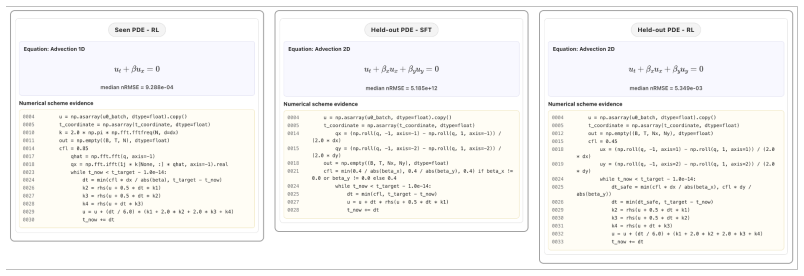
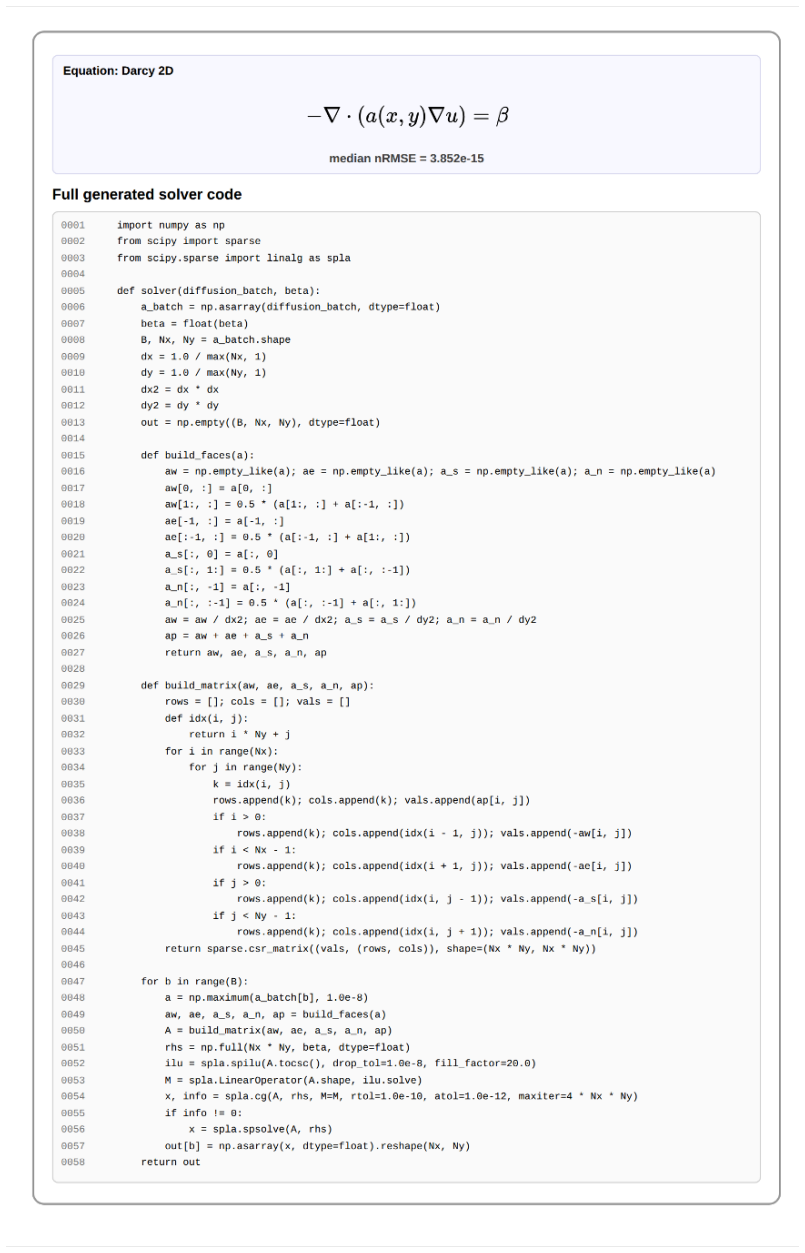
- Trained policies recombine numerical motifs (stencils, CFL substepping, RK schemes, boundary handling) into solvers for related unseen PDEs.
- Future solver-writing systems should put more weight on parameter updates from verifiable physics feedback, not only on inference-time prompting and debugging.
Where Pith is reading between the lines
- The same hybrid continuous-verifier pattern may transfer to other scientific code tasks that admit graded residual or conservation-error signals, such as molecular-dynamics integrators or finite-element assembly.
- If motif recombination is the transfer mechanism, expanding the solver bank with more operator types could widen zero-shot coverage without a proportional increase in training PDE families.
- Reference-relative rewards may under-reward stylistically different solvers that still satisfy the PDE better than the hidden reference on new instances.
- Combining RLVP with retrieval, debugging loops, or verifier-guided search—settings the paper leaves for future work—could compound the amortized gains isolated under direct generation.
Editorial analysis
A structured set of objections, weighed in public.
Referee Report
Summary. The paper introduces RLVP, a GRPO-based post-training method that adapts LLMs to generate numerical PDE solver code using a hybrid verifier: binary execution validity gates multiplied by continuous rewards for function-space trajectory error (R_traj) and reference-relative residual consistency (R_phys). After SFT on a multi-scheme solver bank spanning eight PDE families (hyperbolic, parabolic, elliptic, incompressible flow), a single policy is trained jointly and evaluated by pass@k and best-of-k nRMSE against hidden numerical references. Across 3B/7B/14B Qwen2.5-Coder models, RLVP substantially improves over base and SFT checkpoints on seen PDEs, can outperform static prompting of larger frontier models under the same direct-generation protocol, and yields selective gains on held-out PDEs that recombine trained numerical motifs. An ablation shows that adding R_traj improves accuracy beyond validity-only RL.
Significance. If the results hold under broader scrutiny, this is a clear and timely contribution: it moves scientific code generation from inference-time scaffolding to amortized post-training with graded physical feedback, and it is among the first multi-PDE RLVR pipelines with continuous rather than binary verifiers. Strengths include a carefully documented solver bank with self-convergence and MMS checks, controlled Base/SFT/RLVP comparisons at three scales, frontier baselines under a matched protocol, a validity-only ablation, and an intended open release of the verifier environment and recipes. The practical claim that a smaller post-trained model can beat frontier prompting on in-distribution solver generation is well supported and of real interest to scientific computing and LLM post-training communities.
major comments (3)
- §3.5 Eqs. (3)–(5) and Appendix A fix T_traj=0.05, T_phys=2.0, and the success threshold nRMSE≤10^{-2} without sensitivity analysis. These free parameters define both the dense training signal and the pass@k metric. Because the central claim is that continuous physics rewards (not just validity) drive gains, the paper should report at least a limited sweep or robustness check on T_traj (and preferably T_phys and the success threshold) for the 7B model on seen and held-out aggregates; otherwise it is hard to know how much of Table 1 and Figs. 8–9 depends on this particular temperature/threshold choice.
- §4.3 and Appendix F present compositionality and zero-shot transfer as recombination of stencils, CFL control, and time-stepping motifs. The quantitative gains on held-out PDEs are real, but the strongest cases (heat ⊂ reaction–diffusion; 2D advection as a 1D lift; ARD as advection+reaction+diffusion) sit inside the trained operator algebra, while KdV, Darcy–reaction, and advection–diffusion remain weak (Table 16). The abstract and contribution list should more tightly match this selectivity. Please either (i) add a controlled motif-ablation or feature-frequency analysis that separates recombination from generic code quality, or (ii) explicitly frame transfer as selective numerical-motif reuse rather than broad physics internalization.
- §3.5 Eq. (1) and Eq. (4): L_traj is measured only against the environment’s fixed numerical references, and R_phys is reference-relative. This is a legitimate RLVR design, but it leaves open whether the policy is learning scheme-agnostic physical correctness or matching reference-solver idiosyncrasies (numerical diffusion, projection residuals, CFL patterns). A load-bearing check for the “verifiable physics” claim would be evaluation under a changed reference family, grid family, or residual discretization not used in training—at least for one or two PDEs—or an explicit limitation stating that rewards are reference-anchored and transfer is within a related numerical-methods neighborhood.
minor comments (6)
- Figure 2 and Table 1: clarify whether Claude Sonnet 4.5 and other API baselines used identical system/user prompt constraints (NumPy/SciPy only, fixed interface) as the local models; any prompt mismatch would weaken the “smaller model beats frontier” comparison.
- §4.2: Incompressible Navier–Stokes is the clear capacity bottleneck (only 14B RLVP succeeds strongly). A short discussion of why projection structure is harder to learn from the current bank would help readers set expectations.
- Related Work: CodePDE and SciML-agent systems are cited; a short explicit contrast on compute amortization (post-training once vs. per-query refinement) would sharpen positioning without new experiments.
- Appendix C’s exponential-tolerance derivation is useful; cross-reference it more clearly from §3.5 so readers see that R_traj is an expected-pass probability, not an ad-hoc soft score.
- Typos/clarity: “DeepSeek V4 Flash” labeling in Table 1 should be double-checked against the actual API model name; ensure consistent PDE naming (e.g., reaction_diffusion1d vs. Reaction Diffusion 1D) between tables and figures.
- Figure 11 (solver component frequencies) is informative; reporting sample sizes and a simple statistical comparison (RLVP vs SFT) would make the motif-reuse narrative less anecdotal.
Circularity Check
No load-bearing circular derivation: RLVP optimizes execution-grounded rewards against hidden numerical references and evaluates on held-out cases/PDEs; standard RLVR, not prediction-by-construction.
full rationale
This paper’s central chain is methodological and empirical, not a first-principles derivation that reduces to its inputs. SFT warm-starts on a curated multi-PDE solver bank; GRPO then updates a policy using R(y,c)=V·R_traj·R_phys (Eq. 5), where V is hard executability and R_traj/R_phys are continuous scores from function-space error and reference-relative residual consistency on hidden instances (Eqs. 1–4; §3.5). Evaluation uses fixed test cases and 10 held-out PDE families never used as SFT targets or RL prompts (§4.1, §4.3). Training on a metric and reporting the same metric on disjoint cases is ordinary RLVR, not self-definitional circularity: the policy is not forced to reproduce a fitted scalar or a quantity defined from the evaluation labels. Appendix C’s exponential-tolerance reading of R_traj is a re-interpretation of the soft reward as an expected binary pass probability, not a claim that a prediction equals a fit. Author self-citations appear only in related SciML context (e.g., physics-constrained generative models) and do not underwrite uniqueness or force the RLVP design. The skeptic concern that dense rewards may overfit reference-solver idiosyncrasies or operator-recombination structure is a generalization/correctness risk, not a circular reduction (no Eq. X ≡ Eq. Y by construction). Mild residual risk only: rewards and success thresholds are defined relative to the same class of numerical references used for grading, so reported nRMSE gains partly measure what was optimized—but held-out PDEs and parameter/IC splits keep this from being tautological. Score 1 reflects that mild coupling without any exhibited circular step.
Axiom & Free-Parameter Ledger
free parameters (5)
- T_traj (trajectory reward temperature)
- T_phys (residual reward temperature)
- success_nrmse_threshold
- KL coefficient β and GRPO/LoRA optimization hyperparameters
- Prompt-form sampling weights (0.5/0.35/0.15)
axioms (5)
- domain assumption Group-relative policy optimization with token-mean advantages and KL anchor to an SFT reference is a valid post-training method for code-generating policies.
- domain assumption Normalized L2 trajectory error against a hidden numerical reference is a sufficient proxy for physical solver quality across the studied PDE families.
- ad hoc to paper An exponential distribution over acceptance tolerances yields an appropriate dense RLVR-style pass probability for continuous diagnostics.
- domain assumption Teacher solvers in the curated bank are numerically adequate warm-start targets (self-convergence/MMS/cross-checks suffice).
- standard math Standard finite-difference/volume/spectral numerical analysis results used in the solver bank are reliable background.
invented entities (2)
-
RLVP hybrid verifier (V · R_traj · R_phys)
no independent evidence
-
Multi-PDE solver-bank + joint post-training recipe across eight families
no independent evidence
Cite this review
Pith. "Pith review of Reinforcement Learning with Verifiable Physics: Post-training LLMs with Continuous Rewards." pith.science (2026). https://pith.science/paper/B23UHDYW
@misc{pith2026260710474,
  author       = {Pith},
  title        = {Pith review of: Reinforcement Learning with Verifiable Physics: Post-training LLMs with Continuous Rewards},
  year         = {2026},
  howpublished = {\url{https://pith.science/paper/B23UHDYW}},
  note         = {Machine review of arXiv:2607.10474}
}
read the original abstract
Partial differential equations (PDEs) are foundational to modeling in science and engineering, but constructing reliable numerical solvers remains labor-intensive, demanding expert knowledge of discretization schemes, stability conditions, and boundary treatments. Recent work has begun to frame PDE solving as a code-generation task for large language models (LLMs), yet existing approaches operate primarily at inference time: relying on prompting, debugging, self-refinement, and test-time scaling rather than adapting the model itself. In parallel, reinforcement learning with verifiable rewards has emerged as a post-training paradigm for code and math reasoning, but its verifiers are typically binary: a compiler runs, or a test passes. Such signals discard the graded structure of scientific correctness, where two solvers may both execute and yet differ in solution accuracy by orders of magnitude. In this work, we introduce RLVP: Reinforcement Learning with Verifiable Physics, an RL post-training framework for multi-PDE solver code generation. RLVP addresses this verifiability gap with a hybrid verifier: hard program-validity checks ensure executability, while continuous physics rewards score function-space accuracy and PDE-residual consistency. A single policy is post-trained across diverse PDE families spanning hyperbolic, parabolic, elliptic, and incompressible-flow systems. RLVP improves over both pre-trained and supervised-only baselines on PDE benchmarks, and shows zero-shot improvement transfer to held-out PDEs. We show that a smaller LLM post-trained with RLVP can outperform prompting a frontier model on in-distribution PDE solver generation. The trained policy shows evidence of compositionality in numerical motifs: it recombines stencils, time-stepping schemes, and boundary-handling primitives learned from the PDEs used in training into generated solvers for unseen PDE problems.
Figures






Reference graph
Works this paper leans on
-
[1]
American Mathematical Society, 2 edition, 2010
Lawrence C Evans.Partial Differential Equations. American Mathematical Society, 2 edition, 2010
2010
-
[2]
Cambridge university press, 2002
Randall J LeVeque.Finite volume methods for hyperbolic problems, volume 31. Cambridge university press, 2002
2002
-
[3]
Springer, 1994
Alfio Quarteroni and Alberto Valli.Numerical approximation of partial differential equations. Springer, 1994
1994
-
[4]
SIAM, 2000
Lloyd N Trefethen.Spectral methods in MATLAB. SIAM, 2000
2000
-
[5]
SIAM, 1998
Uri M Ascher and Linda R Petzold.Computer methods for ordinary differential equations and differential-algebraic equations. SIAM, 1998
1998
-
[6]
Evaluating large language models trained on code.arXiv preprint arXiv:2107.03374, 2021
Mark Chen, Jerry Tworek, Heewoo Jun, Qiming Yuan, Henrique Ponde De Oliveira Pinto, Jared Kaplan, Harri Edwards, Yuri Burda, Nicholas Joseph, Greg Brockman, et al. Evaluating large language models trained on code.arXiv preprint arXiv:2107.03374, 2021
Pith/arXiv arXiv 2021
-
[7]
Measuring coding challenge competence with apps.arXiv preprint arXiv:2105.09938, 2021
Dan Hendrycks, Steven Basart, Saurav Kadavath, Mantas Mazeika, Akul Arora, Ethan Guo, Collin Burns, Samir Puranik, Horace He, Dawn Song, et al. Measuring coding challenge competence with apps.arXiv preprint arXiv:2105.09938, 2021
Pith/arXiv arXiv 2021
-
[8]
Program synthesis with large language models.arXiv preprint arXiv:2108.07732, 2021
Jacob Austin, Augustus Odena, Maxwell Nye, Maarten Bosma, Henryk Michalewski, David Dohan, Ellen Jiang, Carrie Cai, Michael Terry, Quoc Le, et al. Program synthesis with large language models.arXiv preprint arXiv:2108.07732, 2021
Pith/arXiv arXiv 2021
-
[9]
Coderl: Mastering code generation through pretrained models and deep reinforcement learning
Hung Le, Yue Wang, Akhilesh Deepak Gotmare, Silvio Savarese, and Steven Chu Hong Hoi. Coderl: Mastering code generation through pretrained models and deep reinforcement learning. Advances in Neural Information Processing Systems, 35:21314–21328, 2022
2022
-
[10]
Narasimhan, and Yuan Cao
Shunyu Yao, Jeffrey Zhao, Dian Yu, Nan Du, Izhak Shafran, Karthik R. Narasimhan, and Yuan Cao. ReAct: Synergizing reasoning and acting in language models. InThe Eleventh International Conference on Learning Representations, ICLR 2023, Kigali, Rwanda, May 1-5,
2023
-
[11]
URLhttps://openreview.net/forum?id=WE_vluYUL-X
OpenReview.net, 2023. URLhttps://openreview.net/forum?id=WE_vluYUL-X
2023
-
[12]
Jonas Gehring, Kunhao Zheng, Jade Copet, Vegard Mella, Quentin Carbonneaux, Taco Cohen, and Gabriel Synnaeve. Rlef: Grounding code llms in execution feedback with reinforcement learning.arXiv preprint arXiv:2410.02089, 2024
Pith/arXiv arXiv 2024
-
[13]
Codepde: An inference framework for llm-driven PDE solver generation
Shanda Li, Tanya Marwah, Junhong Shen, Weiwei Sun, Andrej Risteski, Yiming Yang, and Ameet Talwalkar. Codepde: An inference framework for llm-driven PDE solver generation. Trans. Mach. Learn. Res., 2026. URLhttps://openreview.net/forum?id=eG3Qy5Oux6
2026
-
[14]
Sciml agents: Write the solver, not the solution
Saarth Gaonkar, Xiang Zheng, Haocheng Xi, Rishabh Tiwari, Kurt Keutzer, Dmitriy Morozov, Michael W Mahoney, and Amir Gholami. Sciml agents: Write the solver, not the solution. arXiv preprint arXiv:2509.09936, 2025
Pith/arXiv arXiv 2025
-
[15]
Jianda Du, Youran Sun, and Haizhao Yang. Autonumerics: An autonomous, pde-agnostic multi-agent pipeline for scientific computing.arXiv preprint arXiv:2602.17607, 2026
arXiv 2026
-
[16]
All-fem: Agentic large language models fine-tuned for finite element methods.Computer Methods in Applied Mechanics and Engineering, 457:118985, 2026
Rushikesh Deotale, Adithya Srinivasan, Mahmoud Golestanian, Yuan Tian, Tianyi Zhang, Pavlos Vlachos, and Hector Gomez. All-fem: Agentic large language models fine-tuned for finite element methods.Computer Methods in Applied Mechanics and Engineering, 457:118985, 2026
2026
-
[17]
Jianming Liu, Ren Zhu, Jian Xu, Kun Ding, Xu-Yao Zhang, Gaofeng Meng, and Cheng-Lin Liu. Pde-agent: A toolchain-augmented multi-agent framework for pde solving.arXiv preprint arXiv:2512.16214, 2025
arXiv 2025
-
[18]
Qingpo Wuwu, Chonghan Gao, Tianyu Chen, Yihang Huang, Yuekai Zhang, Jianing Wang, Jianxin Li, Haoyi Zhou, and Shanghang Zhang. Pinnsagent: Automated pde surrogation with large language models.arXiv preprint arXiv:2501.12053, 2025. 11
Pith/arXiv arXiv 2025
-
[19]
Charlie Snell, Jaehoon Lee, Kelvin Xu, and Aviral Kumar. Scaling llm test-time compute opti- mally can be more effective than scaling model parameters.arXiv preprint arXiv:2408.03314, 2024
Pith/arXiv arXiv 2024
-
[20]
Yangzhen Wu, Zhiqing Sun, Shanda Li, Sean Welleck, and Yiming Yang. Inference scaling laws: An empirical analysis of compute-optimal inference for problem-solving with language models.arXiv preprint arXiv:2408.00724, 2024
Pith/arXiv arXiv 2024
-
[21]
Zhihong Shao, Peiyi Wang, Qihao Zhu, Runxin Xu, Junxiao Song, Xiao Bi, Haowei Zhang, Mingchuan Zhang, Y . K. Li, Y . Wu, and Daya Guo. DeepSeekMath: Pushing the limits of mathematical reasoning in open language models, 2024. URL https://arxiv.org/abs/ 2402.03300
Pith/arXiv arXiv 2024
-
[22]
Daya Guo, Dejian Yang, Haowei Zhang, Junxiao Song, Peiyi Wang, Qihao Zhu, Runxin Xu, Ruoyu Zhang, Shirong Ma, Xiao Bi, Xiaokang Zhang, Xingkai Yu, Yu Wu, Z. F. Wu, Zhibin Gou, Zhihong Shao, Zhuoshu Li, Ziyi Gao, Aixin Liu, Bing Xue, Bingxuan Wang, Bochao Wu, Bei Feng, Chengda Lu, Chenggang Zhao, Chengqi Deng, Chong Ruan, Damai Dai, Deli Chen, Dongjie Ji, ...
-
[23]
Solving math word problems with process- and outcome-based feedback, 2022
Jonathan Uesato, Nate Kushman, Ramana Kumar, Francis Song, Noah Siegel, Lisa Wang, Antonia Creswell, Geoffrey Irving, and Irina Higgins. Solving math word problems with process- and outcome-based feedback, 2022. URLhttps://arxiv.org/abs/2211.14275
Pith/arXiv arXiv 2022
-
[24]
Efficient memory management for large language model serving with pagedattention
Woosuk Kwon, Zhuohan Li, Siyuan Zhuang, Ying Sheng, Lianmin Zheng, Cody Hao Yu, Joseph Gonzalez, Hao Zhang, and Ion Stoica. Efficient memory management for large language model serving with pagedattention. InProceedings of the 29th symposium on operating systems principles, pages 611–626, 2023
2023
-
[25]
Hybridflow: A flexible and efficient rlhf framework
Guangming Sheng, Chi Zhang, Zilingfeng Ye, Xibin Wu, Wang Zhang, Ru Zhang, Yanghua Peng, Haibin Lin, and Chuan Wu. Hybridflow: A flexible and efficient rlhf framework. In Proceedings of the Twentieth European Conference on Computer Systems, pages 1279–1297, 2025
2025
-
[26]
Minyang Tian, Luyu Gao, Shizhuo Dylan Zhang, Xinan Chen, Cunwei Fan, Xuefei Guo, Roland Haas, Pan Ji, Kittithat Krongchon, Yao Li, Shengyan Liu, Di Luo, Yutao Ma, Hao Tong, Kha Trinh, Chenyu Tian, Zihan Wang, Bohao Wu, Yanyu Xiong, Shengzhu Yin, Minhui Zhu, Kilian 12 Lieret, Yanxin Lu, Genglin Liu, Yufeng Du, Tianhua Tao, Ofir Press, Jamie Callan, Eliu A....
-
[27]
Foam-agent: Towards automated intelligent cfd workflows.arXiv preprint arXiv:2505.04997, 2025
Ling Yue, Nithin Somasekharan, Tingwen Zhang, Yadi Cao, Zhangze Chen, Shimin Di, and Shaowu Pan. Foam-agent: Towards automated intelligent cfd workflows.arXiv preprint arXiv:2505.04997, 2025
arXiv 2025
-
[28]
Openfoamgpt: A retrieval-augmented large language model (llm) agent for openfoam-based computational fluid dynamics.Physics of Fluids, 37(3), 2025
Sandeep Pandey, Ran Xu, Wenkang Wang, and Xu Chu. Openfoamgpt: A retrieval-augmented large language model (llm) agent for openfoam-based computational fluid dynamics.Physics of Fluids, 37(3), 2025
2025
-
[29]
Metaopenfoam: an llm-based multi-agent framework for cfd.arXiv preprint arXiv:2407.21320, 2024
Yuxuan Chen, Xu Zhu, Hua Zhou, and Zhuyin Ren. Metaopenfoam: an llm-based multi-agent framework for cfd.arXiv preprint arXiv:2407.21320, 2024
Pith/arXiv arXiv 2024
-
[30]
Mooseagent: A llm based multi-agent framework for automating moose simulation, 2025
Tao Zhang, Zhenhai Liu, Yong Xin, and Yongjun Jiao. Mooseagent: A llm based multi-agent framework for automating moose simulation, 2025. URL https://arxiv.org/abs/2504. 08621
2025
-
[31]
Jingquan Wang, Andrew Negrut, Harry Zhang, Khailanii Slaton, Shu Wang, Radu Serban, Jinlong Wu, and Dan Negrut. Chronollm: customizing language models for physics-based simulation code generation.Multibody System Dynamics, Feb 2026. ISSN 1573-272X. doi: 10.1007/s11044-026-10152-x
-
[32]
Xin He, Liangliang You, Hongduan Tian, Bo Han, Ivor Tsang, and Yew-Soon Ong. Lang- pinn: From language to physics-informed neural networks via a multi-agent framework.arXiv preprint arXiv:2510.05158, 2025
arXiv 2025
-
[33]
Feabench: Evaluating language models on multiphysics reasoning ability
Nayantara Mudur, Hao Cui, Subhashini Venugopalan, Paul Raccuglia, Michael P Brenner, and Peter Norgaard. Feabench: Evaluating language models on multiphysics reasoning ability. arXiv preprint arXiv:2504.06260, 2025
Pith/arXiv arXiv 2025
-
[34]
Mihir Prabhudesai, Aryan Satpathy, Yangmin Li, Zheyang Qin, Nikash Bhardwaj, Amir Zadeh, Chuan Li, Katerina Fragkiadaki, and Deepak Pathak. Solving physics olympiad via reinforce- ment learning on physics simulators.arXiv preprint arXiv:2604.11805, 2026
Pith/arXiv arXiv 2026
-
[35]
Mauricio Soroco, Jialin Song, Mengzhou Xia, Kye Emond, Weiran Sun, and Wuyang Chen. Pde- controller: Llms for autoformalization and reasoning of pdes.arXiv preprint arXiv:2502.00963, 2025
Pith/arXiv arXiv 2025
-
[36]
Knut-Andreas Lie, Olav Møyner, Elling Svee, and Jakob Torben. Agentic scientific simulation: Execution-grounded model construction and reconstruction.arXiv preprint arXiv:2603.00214, 2026
arXiv 2026
-
[37]
DAPO: An open-source LLM reinforcement learning system at scale
Qiying Yu, Zheng Zhang, Ruofei Zhu, Yufeng Yuan, Xiaochen Zuo, YuYue, Weinan Dai, Tiantian Fan, Gaohong Liu, Juncai Liu, LingJun Liu, Xin Liu, Haibin Lin, Zhiqi Lin, Bole Ma, Guangming Sheng, Yuxuan Tong, Chi Zhang, Mofan Zhang, Ru Zhang, Wang Zhang, Hang Zhu, Jinhua Zhu, Jiaze Chen, Jiangjie Chen, Chengyi Wang, Hongli Yu, Yuxuan Song, Xiangpeng Wei, Hao ...
2025
-
[38]
Group sequence policy optimization, 2025
Chujie Zheng, Shixuan Liu, Mingze Li, Xiong-Hui Chen, Bowen Yu, Chang Gao, Kai Dang, Yuqiong Liu, Rui Men, An Yang, Jingren Zhou, and Junyang Lin. Group sequence policy optimization, 2025. URLhttps://arxiv.org/abs/2507.18071
Pith/arXiv arXiv 2025
-
[39]
Stepcoder: improving code generation with reinforcement learning from compiler feedback
Shihan Dou, Yan Liu, Haoxiang Jia, Enyu Zhou, Limao Xiong, Junjie Shan, Caishuang Huang, Xiao Wang, Xiaoran Fan, Zhiheng Xi, et al. Stepcoder: improving code generation with reinforcement learning from compiler feedback. InProceedings of the 62nd Annual Meeting of the Association for Computational Linguistics (Volume 1: Long Papers), pages 4571–4585, 2024. 13
2024
-
[40]
Reinforcement learning for machine learning engineering agents, 2025
Sherry Yang, Joy He-Yueya, and Percy Liang. Reinforcement learning for machine learning engineering agents, 2025. URLhttps://arxiv.org/abs/2509.01684
Pith/arXiv arXiv 2025
-
[41]
Mehul Damani, Isha Puri, Stewart Slocum, Idan Shenfeld, Leshem Choshen, Yoon Kim, and Jacob Andreas. Beyond binary rewards: Training lms to reason about their uncertainty.arXiv preprint arXiv:2507.16806, 2025
Pith/arXiv arXiv 2025
-
[42]
Maziar Raissi, Paris Perdikaris, and George E Karniadakis. Physics-informed neural networks: A deep learning framework for solving forward and inverse problems involving nonlinear partial differential equations.Journal of Computational physics, 378:686–707, 2019
2019
-
[43]
Zongyi Li, Nikola Kovachki, Kamyar Azizzadenesheli, Burigede Liu, Kaushik Bhattacharya, Andrew Stuart, and Anima Anandkumar. Fourier neural operator for parametric partial differen- tial equations.arXiv preprint arXiv:2010.08895, 2020
Pith/arXiv arXiv 2010
-
[44]
Learning nonlinear operators via deeponet based on the universal approximation theorem of operators
Lu Lu, Pengzhan Jin, Guofei Pang, Zhongqiang Zhang, and George Em Karniadakis. Learning nonlinear operators via deeponet based on the universal approximation theorem of operators. Nature machine intelligence, 3(3):218–229, 2021
2021
-
[45]
Towards long rollout of neural operators with local attention and flow matching-inspired correction: An example in frontal polymerization pdes
Pengfei Cai, Sulin Liu, Qibang Liu, Philippe Geubelle, and Rafael Gomez-Bombarelli. Towards long rollout of neural operators with local attention and flow matching-inspired correction: An example in frontal polymerization pdes. NeurIPS 2024 Workshop on Machine Learning and the Physical Sciences, 2024. URLhttps://neurips.cc/virtual/2024/100099
2024
-
[46]
Pdebench: An extensive benchmark for scientific machine learning.Advances in neural information processing systems, 35:1596–1611, 2022
Makoto Takamoto, Timothy Praditia, Raphael Leiteritz, Daniel MacKinlay, Francesco Alesiani, Dirk Pflüger, and Mathias Niepert. Pdebench: An extensive benchmark for scientific machine learning.Advances in neural information processing systems, 35:1596–1611, 2022
2022
-
[47]
Diffusionpde: Generative pde-solving under partial observation.Advances in Neural Information Processing Systems, 37: 130291–130323, 2024
Jiahe Huang, Guandao Yang, Zichen Wang, and Jeong Joon Park. Diffusionpde: Generative pde-solving under partial observation.Advances in Neural Information Processing Systems, 37: 130291–130323, 2024
2024
-
[48]
Jan-Hendrik Bastek, WaiChing Sun, and Dennis M. Kochmann. Physics-informed diffusion models, 2024. URLhttps://arxiv.org/abs/2403.14404
Pith/arXiv arXiv 2024
-
[49]
Utkarsh Utkarsh, Pengfei Cai, Alan Edelman, Rafael Gomez-Bombarelli, and Christopher Vin- cent Rackauckas. Physics-constrained flow matching: Sampling generative models with hard constraints.arXiv preprint arXiv:2506.04171, 2025
arXiv 2025
-
[50]
Utkarsh Utkarsh, Danielle C Maddix, Ruijun Ma, Michael W Mahoney, and Yuyang Wang. End-to-end probabilistic framework for learning with hard constraints.arXiv preprint arXiv:2506.07003, 2025
arXiv 2025
-
[51]
Long Ouyang, Jeff Wu, Xu Jiang, Diogo Almeida, Carroll L. Wainwright, Pamela Mishkin, Chong Zhang, Sandhini Agarwal, Katarina Slama, Alex Ray, John Schulman, Jacob Hilton, Fraser Kelton, Luke Miller, Maddie Simens, Amanda Askell, Peter Welinder, Paul Christiano, Jan Leike, and Ryan Lowe. Training language models to follow instructions with human feedback,...
Pith/arXiv arXiv 2022
-
[52]
Qwen2.5-Coder technical report.arXiv preprint arXiv:2409.12186, 2024
Binyuan Hui, Jian Yang, Zeyu Cui, Jiaxi Yang, Dayiheng Liu, Lei Zhang, Tianyu Liu, Jiajun Zhang, Bowen Yu, Keming Lu, Kai Dang, Yang Fan, Yichang Zhang, An Yang, Rui Men, Fei Huang, Bo Zheng, Yibo Miao, Shanghaoran Quan, Yunlong Feng, Xingzhang Ren, Xu- ancheng Ren, Jingren Zhou, and Junyang Lin. Qwen2.5-Coder technical report.arXiv preprint arXiv:2409.12...
Pith/arXiv arXiv 2024
-
[53]
Hu, Yelong Shen, Phillip Wallis, Zeyuan Allen-Zhu, Yuanzhi Li, Shean Wang, Lu Wang, and Weizhu Chen
Edward J. Hu, Yelong Shen, Phillip Wallis, Zeyuan Allen-Zhu, Yuanzhi Li, Shean Wang, Lu Wang, and Weizhu Chen. LoRA: Low-rank adaptation of large language models. 2021. URLhttps://arxiv.org/abs/2106.09685
Pith/arXiv arXiv 2021
-
[54]
A model for fast computer simulation of waves in excitable media.Physica D: Nonlinear Phenomena, 49(1-2):61–70, 1991
Dwight Barkley. A model for fast computer simulation of waves in excitable media.Physica D: Nonlinear Phenomena, 49(1-2):61–70, 1991. 14
1991
-
[55]
Finite difference method for numerical computation of discontinuous solutions of the equations of fluid dynamics.Matematiˇ ceskij sbornik, 47(3): 271–306, 1959
Sergei K Godunov and Ihor Bohachevsky. Finite difference method for numerical computation of discontinuous solutions of the equations of fluid dynamics.Matematiˇ ceskij sbornik, 47(3): 271–306, 1959
1959
-
[56]
Towards the ultimate conservative difference scheme
Bram Van Leer. Towards the ultimate conservative difference scheme. v. a second-order sequel to godunov’s method.Journal of computational Physics, 32(1):101–136, 1979
1979
-
[57]
New high-resolution central schemes for nonlinear conservation laws and convection–diffusion equations.Journal of computational physics, 160 (1):241–282, 2000
Alexander Kurganov and Eitan Tadmor. New high-resolution central schemes for nonlinear conservation laws and convection–diffusion equations.Journal of computational physics, 160 (1):241–282, 2000
2000
-
[58]
Toro.Riemann Solvers and Numerical Methods for Fluid Dynamics
Eleuterio F. Toro.Riemann Solvers and Numerical Methods for Fluid Dynamics. Springer Berlin, Heidelberg, 3 edition, 2009. ISBN 978-3-540-25202-3. doi: 10.1007/b79761
doi:10.1007/b79761 2009
-
[59]
Strong stability-preserving high-order time discretization methods.SIAM review, 43(1):89–112, 2001
Sigal Gottlieb, Chi-Wang Shu, and Eitan Tadmor. Strong stability-preserving high-order time discretization methods.SIAM review, 43(1):89–112, 2001
2001
-
[60]
On the construction and comparison of difference schemes.SIAM journal on numerical analysis, 5(3):506–517, 1968
Gilbert Strang. On the construction and comparison of difference schemes.SIAM journal on numerical analysis, 5(3):506–517, 1968
1968
-
[61]
Implicit-explicit runge-kutta methods for time-dependent partial differential equations.Applied Numerical Mathematics, 25(2-3): 151–167, 1997
Uri M Ascher, Steven J Ruuth, and Raymond J Spiteri. Implicit-explicit runge-kutta methods for time-dependent partial differential equations.Applied Numerical Mathematics, 25(2-3): 151–167, 1997
1997
-
[62]
Fourth-order time-stepping for stiff pdes.SIAM Journal on Scientific Computing, 26(4):1214–1233, 2005
Aly-Khan Kassam and Lloyd N Trefethen. Fourth-order time-stepping for stiff pdes.SIAM Journal on Scientific Computing, 26(4):1214–1233, 2005
2005
-
[63]
Alexandre Joel Chorin. The numerical solution of the Navier–Stokes equations for an incom- pressible fluid.Bulletin of the American Mathematical Society, 73(6):928–931, 1967. doi: 10.1090/S0002-9904-1967-11853-6
-
[64]
Wellesley-Cambridge Press, 1986
Gilbert Strang.Introduction to Applied Mathematics. Wellesley-Cambridge Press, 1986
1986
-
[65]
Scipy 1.0: fundamental algorithms for scientific computing in python.Nature methods, 17(3):261–272, 2020
Pauli Virtanen, Ralf Gommers, Travis E Oliphant, Matt Haberland, Tyler Reddy, David Courna- peau, Evgeni Burovski, Pearu Peterson, Warren Weckesser, Jonathan Bright, et al. Scipy 1.0: fundamental algorithms for scientific computing in python.Nature methods, 17(3):261–272, 2020
2020
-
[66]
On the elimination of aliasing in finite-difference schemes by filtering high-wavenumber components.Journal of Atmospheric Sciences, 28(6):1074–1074, 1971
Steven A Orszag. On the elimination of aliasing in finite-difference schemes by filtering high-wavenumber components.Journal of Atmospheric Sciences, 28(6):1074–1074, 1971
1971
-
[67]
Semi-lagrangian integration schemes for atmospheric models—a review.Monthly weather review, 119(9):2206–2223, 1991
Andrew Staniforth and Jean Côté. Semi-lagrangian integration schemes for atmospheric models—a review.Monthly weather review, 119(9):2206–2223, 1991
1991
-
[68]
SIAM, 2007
Randall J LeVeque.Finite difference methods for ordinary and partial differential equations: steady-state and time-dependent problems. SIAM, 2007
2007
-
[69]
The calculation of the interaction of non-stationary shock waves and obstacles.USSR Computational Mathematics and Mathematical Physics, 1(2):304–320, 1962
Vladimir Vasil’evich Rusanov. The calculation of the interaction of non-stationary shock waves and obstacles.USSR Computational Mathematics and Mathematical Physics, 1(2):304–320, 1962
1962
-
[70]
Systems of conservation laws.Communications on Pure and Applied Mathematics, 13:217–237, 1960
Peter Lax and Burton Wendroff. Systems of conservation laws.Communications on Pure and Applied Mathematics, 13:217–237, 1960. doi: 10.1002/cpa.3160130205
-
[71]
The effect of viscosity in hypervelocity impact cratering.Journal of spacecraft and rockets, 40(5):757–763, 2003
Robert W MacCormack. The effect of viscosity in hypervelocity impact cratering.Journal of spacecraft and rockets, 40(5):757–763, 2003
2003
-
[72]
Springer, 2003
Willem H Hundsdorfer, Jan G Verwer, and WH Hundsdorfer.Numerical solution of time- dependent advection-diffusion-reaction equations, volume 33. Springer, 2003
2003
-
[73]
Finite volume methods.Handbook of numerical analysis, 7:713–1018, 2000
Robert Eymard, Thierry Gallouët, and Raphaèle Herbin. Finite volume methods.Handbook of numerical analysis, 7:713–1018, 2000
2000
-
[74]
Methods of conjugate gradients for solving linear systems.Journal of research of the National Bureau of Standards, 49(6):409–436, 1952
Magnus R Hestenes, Eduard Stiefel, et al. Methods of conjugate gradients for solving linear systems.Journal of research of the National Bureau of Standards, 49(6):409–436, 1952. 15
1952
-
[75]
SIAM, 2003
Yousef Saad.Iterative methods for sparse linear systems. SIAM, 2003
2003
-
[76]
Joel H Ferziger, Milovan Peri´c, and Robert L Street.Computational methods for fluid dynamics. Springer, 4 edition, 2020. doi: 10.1007/978-3-319-99693-6
-
[77]
Approximate riemann solvers, parameter vectors, and difference schemes.Journal of computational physics, 43(2):357–372, 1981
Philip L Roe. Approximate riemann solvers, parameter vectors, and difference schemes.Journal of computational physics, 43(2):357–372, 1981
1981
-
[78]
Information theory and statistical mechanics.Physical review, 106(4):620, 1957
Edwin T Jaynes. Information theory and statistical mechanics.Physical review, 106(4):620, 1957
1957
-
[79]
Academic Press, 11 edition, 2014
Sheldon M Ross.Introduction to Probability Models. Academic Press, 11 edition, 2014
2014
-
[80]
Equation of state calculations by fast computing machines.The journal of chemical physics, 21(6):1087–1092, 1953
Nicholas Metropolis, Arianna W Rosenbluth, Marshall N Rosenbluth, Augusta H Teller, and Edward Teller. Equation of state calculations by fast computing machines.The journal of chemical physics, 21(6):1087–1092, 1953
1953
discussion (0)
Sign in with ORCID, Apple, or X to comment. Anyone can read and Pith papers without signing in.