REVIEW 3 major objections 5 minor 65 references
Extended Effective Field Theory of Dark Energy: Ghost Condensate Dark Energy with Sextic Dispersion Relation in de Sitter Spacetime
T0 review · 3 major / 5 minor · reviewed 2026-08-09 · deepseek-v4-flash
Pith's one-line read A sextic ghost condensate dark energy model predicts that the gravitational potential around matter is corrected by terms sourced by the matter density itself, and that gravitational wave speed becomes frequency dependent.
desk verdict The GW speed calculation is clean, but the density-dependent Newtonian potential does not follow from the equations as written; the scalar sector needs a proper sourced derivation before the central claim can be trusted. read the letter →
The pith
A machine-rendered reading of the paper's core claim, the machinery that carries it, and where it could break.
The reading
What carries the argument
The central object is the unitary-gauge action for the sextic ghost condensate, Eq. (2.1), with extrinsic-curvature derivative operators $\sigma_i$; the term $\sigma_1\gamma^{ij}\nabla_i K_{lr}\nabla_j K^{lr}$ is the one that generates the sixth-order dispersion relation $\omega^2=(S_1/M^4)(k^6-\mu^2 k^4)$ in the Newtonian limit and, via the Einstein equations, the sixth-order radial equation for $\Phi_{\rm GC}$ whose source depends on $\rho$ and its derivatives. The same operator controls the tensor-perturbation kinetic term $-\frac{\sigma_1}{2}\int dt\,d^3x\,a^3 a^{-2}(\partial_k\dot H_{ij})^2$, producing the momentum-dependent gravitational wave speed. The combination of these operators with the Einstein-Hilbert action is what converts the ghost condensate into a modified-gravity theory with the claimed observable signatures.
What would settle it
Measure the gravitational potential around a dense spherical source at the distance scale $M_{\rm Pl}/M^2$ and look for the damped oscillations predicted by Eq. (2.27); their absence, or a potential that strictly follows the Newtonian $1/r$ profile with no density-sourced correction, would falsify the sextic ghost condensate prediction. A broadband gravitational-wave observation yielding a frequency-independent $c_T$ at momenta where $|\sigma_1|k^2/M_{\rm Pl}^2$ is of order one would also rule out the predicted frequency dependence.
Extended reading notes
Core claim
The central claim is that the sextic ghost condensate, whose action adds the operator $\gamma^{ij}\nabla_i K_{lr}\nabla_j K^{lr}$ with coefficient $\sigma_1$ to the unitary-gauge action, is a viable dark energy model that modifies gravity in a way qualitatively different from the well-studied quartic ghost condensate. The authors obtain the full equation for the gravitational potential $\Phi$ sourced by matter, and show that the ghost-condensate part $\Phi_{\rm GC}$ obeys a sixth-order radial equation whose right-hand side contains $\rho$, $\partial_t\rho$, and $X\partial_X\rho$. At late times, when the potential is time-independent, the solution exhibits oscillatory modulations on the distance scale $r_c\sim M_{\rm Pl}/M^2$ and the instability time scale $\Upsilon^{-1}\sim M_{\rm Pl}^3/M^4$, then approaches $1/r$ at large distances. For tensor perturbations, the same $\sigma_1$ operator changes the propagation speed to $c_T^2=(1-4\sigma_1 k^2/M_{\rm Pl}^2)^{-1}$, making gravitational wave speed momentum dependent and requiring $\sigma_1\le 0$ for subluminal propagation.
Load-bearing premise
The load-bearing assumption is that the two gravitational potentials $\Phi$ and $\Psi$ are equal throughout; the paper's own off-diagonal equations admit solutions where they differ even without anisotropic stress, and the derived potential equation uses the equal branch.
Editorial extensions
If this is right
- The Newtonian potential around a matter source in a sextic ghost condensate carries damped oscillations at distance $\sim M_{\rm Pl}/M^2$, with an associated time scale $\sim M_{\rm Pl}^3/M^4$, before settling to $1/r$ at large radii.
- The correction to the potential is sourced by the local matter density and its derivatives, so a time-dependent or spatially clumpy source leaves a different gravitational signature than in the quartic ghost condensate or general relativity.
- Gravitational wave speed is frequency dependent, $c_T^2=(1-4\sigma_1 k^2/M_{\rm Pl}^2)^{-1}$, with sizable deviations from $c$ only for $k\sim M_{\rm Pl}/\sqrt{|\sigma_1|}$ and with $\sigma_1\le 0$ for subluminal propagation.
- Existing GW170817 bounds on $c_T$ translate into the constraints $|\sigma_1|\lesssim 10^{69}$ at $f\sim 10$ Hz and $|\sigma_1|\lesssim 10^{63}$ at $f\sim 10$ kHz, so the model is observationally allowed for large $\sigma_1$.
- The same effective field theory may admit $\Phi\neq\Psi$ even with no anisotropic stress, a branch the paper identifies but leaves for future work.
Reading between the lines
- Editorial extension: The paper's own Eq. (2.15) leaves open $\Phi\neq\Psi$; if the alternate branch is physical, the claimed $\Phi_{\rm GC}$ equation (2.19) is not the governing one, and the oscillatory signature could be absent or altered. A numerical evolution of the full system off the $\Phi=\Psi$ branch would settle whether the prediction is robust.
- Editorial extension: Because the potential correction is sourced by $\rho$ and its derivatives, high-density or strongly clustered regions should show a larger relative deviation from the Newtonian potential at the predicted scale, which could be searched for in weak-lensing or satellite dynamics if the scale $M_{\rm Pl}/M^2$ is observationally accessible.
- Editorial extension: The frequency-dependent $c_T$ implies that a single broadband gravitational-wave event could test the model without a counterpart, because a dispersion-like signature would violate the constant-$c_T$ template used in standard analyses; current LIGO/Virgo data already bound $\sigma_1$.
- Editorial extension: The paper treats de Sitter as the background; a worthwhile extension is to matter-dominated or slow-roll backgrounds, where the $\rho$-dependent source would act during structure formation and could leave a scale-dependent growth signature.
Editorial analysis
A structured set of objections, weighed in public.
Referee Report
Summary. This paper studies a ghost condensate model with a sixth-order dispersion relation, written in unitary gauge with higher-derivative curvature operators, coupled to gravity in a de Sitter background. The authors derive the equations of motion for the scalar perturbation π and the gravitational potentials Φ and Ψ, obtain a homogeneous sixth-order equation for Φ, and then decompose Φ into a Newtonian part and a ghost-condensate correction. They claim that this correction satisfies a source equation whose right-hand side depends explicitly on the matter density, leading to oscillatory behaviour on a characteristic distance scale and a time scale. They also compute the speed of gravitational waves and find a momentum-dependent modification. The paper includes numerical solutions in two figures and concludes with a discussion of future directions.
Significance. If the central claim were established, the paper would provide a distinctive and falsifiable signature of sextic ghost condensate dark energy: a matter-density-dependent modification of the Newtonian potential with oscillations on scales M_Pl/M^2 and a frequency-dependent gravitational wave speed parameterized by σ1. The derivation from an explicit action and the explicit, if lengthy, equations of motion are commendable, and the c_T prediction is concrete. However, the main derivation has a serious gap: the matter source is inserted through a decomposition of the vacuum equation rather than through a sourced Einstein equation, so the headline result is not currently supported. The paper also relies on hand-picked boundary conditions and an unexamined branch choice Φ=Ψ; these issues would need to be addressed before the results can be accepted.
major comments (3)
- [Section 2, Eqs. (2.19) and (2.23)] Equation (2.19) for Φ is derived from the vacuum equations of motion (2.8), which contain no matter source. When nonrelativistic matter is present, the linearized Einstein equations include T_μν; the correct equation for Φ is inhomogeneous. The paper instead defines Φ_N via the standard Poisson equation (2.22) and substitutes Φ = Φ_N + Φ_GC into the homogeneous equation (2.19). The right-hand side of (2.23) is therefore -L(Φ_N), where L is the vacuum differential operator, not the matter source of the modified theory. This does not establish that Φ_GC depends on ρ; it only shows that if one forces Φ_N to obey the GR Poisson equation, the leftover satisfies a driven equation by a particular combination of Φ_N. A proper derivation must start from the sourced Einstein equations and specify how the ghost-condensate stress-energy combines with T_μν.
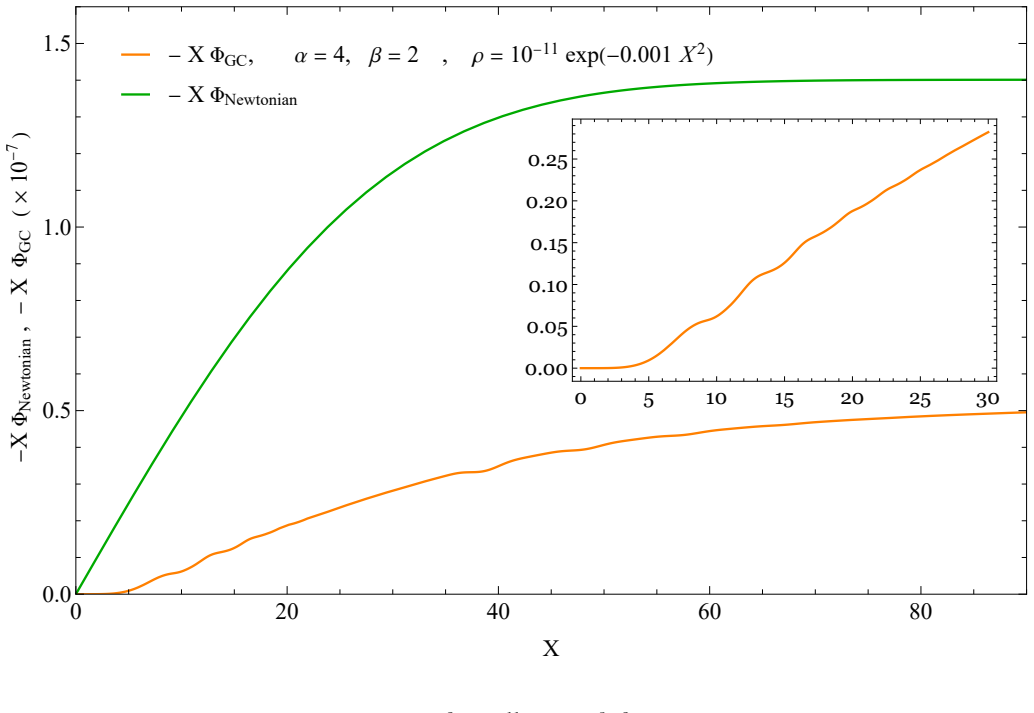
- [Section 2, Figs. 1 and 2] The numerical results are obtained with hand-selected boundary conditions at X=0 (Φ_GC(0) = -10^-12, or second/fourth derivative zero; the Fig. 1 caption lists three arbitrary choices, and Fig. 2 sets Φ_GC(0) = 0 and ∂^2_X Φ_GC(0) = 0). No physical matching to the Newtonian potential at small X or to an asymptotically decaying solution at large X is provided. As a result, the oscillatory profiles are not a unique prediction of the sextic ghost condensate; they depend on these arbitrary constants. The paper should derive the boundary conditions from regularity and from requiring that Φ_GC vanishes at the origin and reduces to GR at short distances.
- [Section 2, Eqs. (2.14)-(2.19) and footnote 5] The entire derivation assumes Φ = Ψ, following the statement that the off-diagonal components of (2.8) 'suggest' this equality. However, Eq. (2.15) shows that (∇/a)^2(Φ - Ψ) = -(9/2)H^2(Φ - Ψ), which admits non-decaying solutions with Φ ≠ Ψ even in the absence of anisotropic stress. The authors acknowledge this and restrict to Φ = Ψ, but this is a nontrivial branch choice. Because the potential equation (2.19) and all subsequent results are derived under this assumption, the paper should either justify why this branch is physically selected or analyze whether the alternative branch changes the claimed density-dependence and oscillations.
minor comments (5)
- [Abstract and Conclusion] The abstract states that oscillations occur 'at the distance M_Pl/M^2' and 'at the time scale M^4/M_Pl^3', while the conclusion states 'scales ∼ M^2/M_Pl in timescales of order M_Pl^3/M^4'. These are inverse to each other; one of the two is wrong. This inconsistency affects how the main result is communicated.
- [Section 3, after Eq. (3.6)] The quoted bounds on σ1 from GW170817 are inconsistent with Eq. (3.6). For f ∼ 10 Hz, k ∼ 4×10^-14 eV, so |σ1| ≲ (M_Pl^2/k^2)|c_T^2 - 1| ∼ 10^81, not 10^69; the f ∼ 10 kHz bound should be correspondingly ∼10^75, not 10^63. The numerical values in the text should be corrected.
- [Section 2, Eq. (2.26)] The coefficient of ∂_X ∂_T Φ_GC is written with a factor 2/(3βH^3X), which contains the dimensionful H^3, unlike all other dimensionless coefficients in the equation; this appears to be a typo and should read a dimensionless combination of α and β.
- [Section 2, Eq. (2.18)] The sound speed c_s^2 is defined but never used in the subsequent analysis; if it is not needed, it should be removed or its role clarified.
- [Section 2, Fig. 1 caption] The caption lists three boundary conditions but the curves in the figure are not labeled by which boundary condition corresponds to which curve; labeling would improve readability.
Circularity Check
The central claim that the Newtonian-potential correction depends on matter density reduces to the Φ=Φ_N+Φ_GC decomposition of the homogeneous equation, so it is partly constructed rather than predicted.
-
self definitional
[Section 2, Eqs. (2.19)-(2.23); see also abstract claim]
"Φ could be decomposed into two parts: Φ = ΦN + ΦGC , (2.21) where ΦGC represents the modification the ghost condensation imparts on the conventional general relativity potential, ΦN, which satisfies the Poisson equation (∂/a)^2 ΦN = ρ/(2MPl^2). (2.22) It should be noted that ρ represents a general matter source. Following this decomposition, the Eq. (2.19) becomes ... = ... ρ/(2MPl^2). (2.23) A notable issue in the above equation is that the differential equation for ΦGC explicitly depends on the the space and time variation of matter density."
Eq. (2.19) is the homogeneous equation for Φ obtained from the sourceless metric EOM (2.8); no matter T_μν enters its derivation. Φ_N is then defined by the standard Poisson equation (2.22), so ρ enters only through that definition. Substituting Φ=Φ_N+Φ_GC into the homogeneous operator LΦ=0 gives LΦ_GC = -LΦ_N, and replacing the (∂/a)^2Φ_N terms by ρ via (2.22) is what produces the ρ-dependent right-hand side of (2.23). The claimed explicit matter-density dependence is therefore the algebraic residual of subtracting the GR potential from a solution of the vacuum equation, not a consequence of coupling the sextic GC to a matter source.
full rationale
The paper is mostly a self-contained derivation from the stated unitary-gauge action (2.1). The tensor-sector result c_T^2 = (1 - 4σ1 k^2/M_Pl^2)^{-1} follows directly from the quadratic action (3.4), and the ρ=0 oscillatory solutions are legitimate solutions of the sixth-order homogeneous equation, although the boundary conditions in Fig. 1 are chosen by hand and not derived from matching or regularity. However, the abstract's central claim—that the correction to the Newtonian potential explicitly depends on matter density—is not derived from a sourced Einstein equation. The derivation starts from the sourceless EOM (2.8), defines Φ_N via the GR Poisson equation (2.22), and then obtains the density-dependent source in (2.23) by substituting the decomposition into the homogeneous equation (2.19). That makes the density dependence an input of the decomposition, not an output of the matter-coupled dynamics. The paper also explicitly assumes Ψ=Φ (footnote 5) while acknowledging that an alternative branch exists, but this is an assumption, not circularity. The self-citation to [59] for the viability of the sextic ghost condensate is load-bearing for the model choice but is reviewed in the text and is not a reduction of the present potential calculation to a fit, so it does not raise the score beyond the definitional issue. Overall: partial circularity, score 6.
Assumptions & free parameters
free parameters (5)
- M (ghost condensate scale) =
~10^-3 eV
- sigma1, sigma2, sigma3, sigma4 (EFT coefficients) =
not fitted; ratios chosen in Eq. (2.25)
- Boundary conditions for Phi_GC at X=0 =
e.g., -10^-12, 0, 0
- alpha = mu/H and beta = H/Upsilon =
alpha=4, beta=2 in the figures
- Matter source amplitude in Fig. 2 =
rho/mu^2 = 10^-11 exp(-10^-3 X^2)
assumptions (6)
- domain assumption The ghost condensate background phi = c t with stability conditions P'(c^2) > 0 and P'(c^2) + 2c^2 P''(c^2) > 0 is assumed.
- domain assumption The unitary-gauge action with the four sigma operators is the correct EFT for the sextic ghost condensate.
- ad hoc to paper The quartic term in the dispersion relation is suppressed by setting the relevant coefficient to zero or by requiring it to be much smaller than the sextic term at the relevant scales.
- domain assumption The sextic ghost condensate stays weakly coupled in the infrared because a bound involving the nonlinearity parameter and the condensate scale is satisfied.
- ad hoc to paper The relation Phi = Psi is assumed for the gravitational potentials.
- domain assumption The Newtonian limit with omega^2 much smaller than k^2 and the absence of anisotropic stress is assumed.
Cite this review
Pith. "Pith review of Extended Effective Field Theory of Dark Energy: Ghost Condensate Dark Energy with Sextic Dispersion Relation in de Sitter Spacetime." pith.science (2026). https://pith.science/paper/B3SMYLOX
@misc{pith2026250202401,
  author       = {Pith},
  title        = {Pith review of: Extended Effective Field Theory of Dark Energy: Ghost Condensate Dark Energy with Sextic Dispersion Relation in de Sitter Spacetime},
  year         = {2026},
  howpublished = {\url{https://pith.science/paper/B3SMYLOX}},
  note         = {Machine review of arXiv:2502.02401}
}
abstract
We continue our studies of the ghost condensate (GC) with sixth-order dispersion relation. Contrary to the GC with quartic dispersion relation, we find that the correction to the Newtonian potential explicitly depends on the space and time dependence of matter density. At late times when the Newtonian potential becomes time-independent, one obtains similar oscillatory behavior at the distance $\frac{M_\textrm{Pl}}{M^2}$, but this time at the time scale $\frac{M^4}{M_\textrm{Pl}^3}$, where $M^2$ is the ghost field velocity. We also show that the speed of gravitational wave is modified in a frequency dependent manner at momenta close to $\frac{M_\textrm{Pl}}{\sqrt{|\sigma_1|}}$, where $\sigma_1$ is the coefficient of $\gamma^{ij} \nabla_i K_{lr} \nabla_j K^{lr}$ operator in the unitary gauge action.
Figures

Reference graph
Works this paper leans on
-
[1]
A. G. Riess, et al., Observational evidence from supernovae for an accelerating universe and a cosmological constant, Astron. J. 116 (1998) 1009–1038. arXiv:astro-ph/9805201, doi:10.1086/300499
arXiv 1998
-
[2]
Perlmutter, et al., Measurements of Ω and Λ from 42 high redshift supernovae, Astrophys
S. Perlmutter, et al., Measurements of Ω and Λ from 42 high redshift supernovae, Astrophys. J. 517 (1999) 565–586. arXiv:astro-ph/ 9812133, doi:10.1086/307221
doi:10.1086/307221 1999
-
[3]
Aghanim, et al., Planck 2018 results
N. Aghanim, et al., Planck 2018 results. I. Overview and the cosmological legacy of Planck, Astron. Astrophys. 641 (2020) A1. arXiv:1807.06205, doi:10.1051/0004-6361/201833880
arXiv 2020
-
[4]
A. G. Riess, et al., A Comprehensive Measurement of the Local Value of the Hubble Constant with 1 km/s/Mpc Uncertainty from the Hubble Space Telescope and the SH0ES Team, Astrophys. J. Lett. 934 (1) (2022) L7. arXiv:2112.04510, doi:10.3847/2041-8213/ ac5c5b. 11
arXiv 2022
-
[5]
E. Di Valentino, D. Brout (Eds.), The Hubble Constant Tension, Springer Series in Astrophysics and Cosmology, Springer, 2024. doi:10.1007/978-981-99-0177-7
-
[6]
Weinberg, The Cosmological Constant Problem, Rev
S. Weinberg, The Cosmological Constant Problem, Rev. Mod. Phys. 61 (1989) 1–23. doi:10.1103/RevModPhys.61.1
- [7]
-
[8]
On the cosmological constant problem
L. Lombriser, On the cosmological constant problem, Phys. Lett. B 797 (2019) 134804. arXiv:1901.08588, doi:10.1016/j.physletb. 2019.134804
work page Pith review arXiv 2019
Show all 65 references
-
[9]
Zlatev, L.-M
I. Zlatev, L.-M. Wang, P. J. Steinhardt, Quintessence, cosmic coincidence, and the cosmological constant, Phys. Rev. Lett. 82 (1999) 896–899. arXiv:astro-ph/9807002, doi:10.1103/PhysRevLett.82.896
1999 arXiv
-
[10]
P. J. Steinhardt, L.-M. Wang, I. Zlatev, Cosmological tracking solutions, Phys. Rev. D 59 (1999) 123504. arXiv:astro-ph/9812313, doi:10.1103/PhysRevD.59.123504
1999 arXiv
-
[11]
L.-M. Wang, R. R. Caldwell, J. P. Ostriker, P. J. Steinhardt, Cosmic concordance and quintessence, Astrophys. J. 530 (2000) 17–35. arXiv:astro-ph/9901388, doi:10.1086/308331
2000 arXiv
-
[12]
Lahav, P
O. Lahav, P. B. Lilje, J. R. Primack, M. J. Rees, Dynamical effects of the cosmological constant, Mon. Not. Roy. Astron. Soc. 251 (1) (1991) 128–136. doi:10.1093/mnras/251.1.128
1991 doi
-
[13]
Mukohyama, L
S. Mukohyama, L. Randall, A Dynamical approach to the cosmological constant, Phys. Rev. Lett. 92 (2004) 211302. arXiv:hep-th/ 0306108, doi:10.1103/PhysRevLett.92.211302
2004 doi
-
[14]
Yoshimura, Dynamical relaxation of cosmological constant (4 2022)
M. Yoshimura, Dynamical relaxation of cosmological constant (4 2022). arXiv:2204.10809
2022 arXiv
-
[15]
Sol` a, Cosmological constant vis-a-vis dynamical vacuum: bold challenging the ΛCDM, Int
J. Sol` a, Cosmological constant vis-a-vis dynamical vacuum: bold challenging the ΛCDM, Int. J. Mod. Phys. A 31 (23) (2016) 1630035. arXiv:1612.02449, doi:10.1142/S0217751X16300350
2016 arXiv
-
[16]
Nakamura, T
T. Nakamura, T. Chiba, Determining the equation of state of the expanding universe: Inverse problem in cosmology, Mon. Not. Roy. Astron. Soc. 306 (3) (1999) 696–700. arXiv:astro-ph/9810447, doi:10.1046/j.1365-8711.1999.02551.x
1999 arXiv
-
[17]
J. Sola, H. Stefancic, Cosmology with variable parameters and effective equation of state for dark energy, J. Phys. A 39 (2006) 6753–6760. arXiv:gr-qc/0601012, doi:10.1088/0305-4470/39/21/S76
2006 arXiv
-
[18]
Tripathi, A
A. Tripathi, A. Sangwan, H. K. Jassal, Dark energy equation of state parameter and its evolution at low redshift, JCAP 06 (2017)
2017
-
[19]
arXiv:1611.01899, doi:10.1088/1475-7516/2017/06/012
2017 arXiv
-
[20]
Janka, A
H.-T. Janka, A. Bauswein, Dynamics and Equation of State Dependencies of Relevance for Nucleosynthesis in Supernovae and Neutron Star Mergers, 2023, pp. 1–98. arXiv:2212.07498, doi:10.1007/978-981-15-8818-1_93-1
2023 arXiv
-
[21]
Ratra, P
B. Ratra, P. J. E. Peebles, Cosmological Consequences of a Rolling Homogeneous Scalar Field, Phys. Rev. D 37 (1988) 3406. doi: 10.1103/PhysRevD.37.3406
1988 doi
-
[22]
R. R. Caldwell, R. Dave, P. J. Steinhardt, Cosmological imprint of an energy component with general equation of state, Phys. Rev. Lett. 80 (1998) 1582–1585. arXiv:astro-ph/9708069, doi:10.1103/PhysRevLett.80.1582
1998 arXiv
-
[23]
Tsujikawa, Quintessence: A Review, Class
S. Tsujikawa, Quintessence: A Review, Class. Quant. Grav. 30 (2013) 214003. arXiv:1304.1961, doi:10.1088/0264-9381/30/21/ 214003
2013 arXiv
-
[24]
R. R. Caldwell, A Phantom menace?, Phys. Lett. B 545 (2002) 23–29. arXiv:astro-ph/9908168, doi:10.1016/S0370-2693(02) 02589-3
2002 arXiv
-
[25]
Armendariz-Picon, V
C. Armendariz-Picon, V. F. Mukhanov, P. J. Steinhardt, Essentials of k-essence, Phys. Rev. D 63 (2001) 103510. arXiv:astro-ph/ 0006373, doi:10.1103/PhysRevD.63.103510
2001 doi
-
[26]
G. W. Gibbons, Phantom matter and the cosmological constant (2 2003). arXiv:hep-th/0302199
2003 arXiv
-
[27]
K. J. Ludwick, The viability of phantom dark energy: A review, Mod. Phys. Lett. A 32 (28) (2017) 1730025. arXiv:1708.06981, doi:10.1142/S0217732317300257
2017 arXiv
-
[28]
Nojiri, S
S. Nojiri, S. D. Odintsov, Modified gravity with negative and positive powers of the curvature: Unification of the inflation and of the cosmic acceleration, Phys. Rev. D 68 (2003) 123512. arXiv:hep-th/0307288, doi:10.1103/PhysRevD.68.123512
2003 arXiv
-
[29]
Nojiri, S
S. Nojiri, S. D. Odintsov, Unified cosmic history in modified gravity: from F(R) theory to Lorentz non-invariant models, Phys. Rept. 505 (2011) 59–144. arXiv:1011.0544, doi:10.1016/j.physrep.2011.04.001
2011 arXiv
-
[30]
Nojiri, S
S. Nojiri, S. D. Odintsov, V. K. Oikonomou, Modified Gravity Theories on a Nutshell: Inflation, Bounce and Late-time Evolution, Phys. Rept. 692 (2017) 1–104. arXiv:1705.11098, doi:10.1016/j.physrep.2017.06.001
2017 arXiv
-
[31]
Capozziello, V
S. Capozziello, V. F. Cardone, A. Troisi, Reconciling dark energy models with f(R) theories, Phys. Rev. D 71 (2005) 043503. arXiv: astro-ph/0501426, doi:10.1103/PhysRevD.71.043503
2005 arXiv
-
[32]
Amendola, D
L. Amendola, D. Polarski, S. Tsujikawa, Are f (R) dark energy models cosmologically viable ?, Phys. Rev. Lett. 98 (2007) 131302. arXiv:astro-ph/0603703, doi:10.1103/PhysRevLett.98.131302
2007 arXiv
-
[33]
Tsujikawa, Observational signatures of f (R) dark energy models that satisfy cosmological and local gravity constraints, Phys
S. Tsujikawa, Observational signatures of f (R) dark energy models that satisfy cosmological and local gravity constraints, Phys. Rev. D 77 (2008) 023507. arXiv:0709.1391, doi:10.1103/PhysRevD.77.023507
2008 arXiv
-
[34]
G. R. Dvali, G. Gabadadze, M. Porrati, 4-D gravity on a brane in 5-D Minkowski space, Phys. Lett. B 485 (2000) 208–214. arXiv: hep-th/0005016, doi:10.1016/S0370-2693(00)00669-9
2000 arXiv
-
[35]
Roos, A model of accelerating dark energy in decelerating gravity (7 2007)
M. Roos, A model of accelerating dark energy in decelerating gravity (7 2007). arXiv:0707.1086
2007 arXiv
-
[36]
Lombriser, W
L. Lombriser, W. Hu, W. Fang, U. Seljak, Cosmological Constraints on DGP Braneworld Gravity with Brane Tension, Phys. Rev. D 80 (2009) 063536. arXiv:0905.1112, doi:10.1103/PhysRevD.80.063536
2009 arXiv
-
[37]
de Rham, G
C. de Rham, G. Gabadadze, A. J. Tolley, Resummation of Massive Gravity, Phys. Rev. Lett. 106 (2011) 231101. arXiv:1011.1232, doi:10.1103/PhysRevLett.106.231101
2011 arXiv
-
[38]
de Rham, Massive Gravity, Living Rev
C. de Rham, Massive Gravity, Living Rev. Rel. 17 (2014) 7. arXiv:1401.4173, doi:10.12942/lrr-2014-7 . 12
2014 arXiv
-
[39]
Hinterbichler, Theoretical Aspects of Massive Gravity, Rev
K. Hinterbichler, Theoretical Aspects of Massive Gravity, Rev. Mod. Phys. 84 (2012) 671–710. arXiv:1105.3735, doi:10.1103/ RevModPhys.84.671
2012 arXiv
-
[40]
S. F. Hassan, R. A. Rosen, Bimetric Gravity from Ghost-free Massive Gravity, JHEP 02 (2012) 126. arXiv:1109.3515, doi:10.1007/ JHEP02(2012)126
2012 arXiv
-
[41]
Deser, M
S. Deser, M. Sandora, A. Waldron, No consistent bimetric gravity?, Phys. Rev. D 88 (2013) 081501. arXiv:1306.0647, doi:10.1103/ PhysRevD.88.081501
2013 arXiv
-
[42]
Deser, K
S. Deser, K. Izumi, Y. C. Ong, A. Waldron, Problems of massive gravities, Mod. Phys. Lett. A 30 (2015) 1540006. arXiv:1410.2289, doi:10.1142/S0217732315400064
2015 arXiv
-
[43]
H¨ og ˚ as, F
M. H¨ og ˚ as, F. Torsello, E. M¨ ortsell, On the stability of bimetric structure formation, JCAP 04 (2020) 046. arXiv:1910.01651, doi:10.1088/1475-7516/2020/04/046
2020 arXiv
-
[44]
H¨ og ˚ as, E
M. H¨ og ˚ as, E. M¨ ortsell, Constraints on bimetric gravity. Part II. Observational constraints, JCAP 05 (2021) 002.arXiv:2101.08795, doi:10.1088/1475-7516/2021/05/002
2021 arXiv
-
[45]
H¨ og ˚ as, E
M. H¨ og ˚ as, E. M¨ ortsell, Constraints on bimetric gravity from Big Bang nucleosynthesis, JCAP 11 (2021) 001. arXiv:2106.09030, doi:10.1088/1475-7516/2021/11/001
2021 arXiv
-
[46]
Dwivedi, M
S. Dwivedi, M. H¨ og ˚ as, 2D BAO vs. 3D BAO: Solving the Hubble Tension with Bimetric Cosmology, Universe 10 (11) (2024) 406. arXiv:2407.04322, doi:10.3390/universe10110406
2024 arXiv
-
[47]
Pourtsidou, C
A. Pourtsidou, C. Skordis, E. J. Copeland, Models of dark matter coupled to dark energy, Phys. Rev. D 88 (8) (2013) 083505. arXiv:1307.0458, doi:10.1103/PhysRevD.88.083505
2013 arXiv
-
[48]
C. G. Boehmer, G. Caldera-Cabral, R. Lazkoz, R. Maartens, Dynamics of dark energy with a coupling to dark matter, Phys. Rev. D 78 (2008) 023505. arXiv:0801.1565, doi:10.1103/PhysRevD.78.023505
2008 arXiv
-
[49]
Fay, Constraints from growth-rate data on some coupled dark energy models mimicking a ΛCDM expansion, Mon
S. Fay, Constraints from growth-rate data on some coupled dark energy models mimicking a ΛCDM expansion, Mon. Not. Roy. Astron. Soc. 460 (2) (2016) 1863–1868. arXiv:1605.01644, doi:10.1093/mnras/stw1087
2016 arXiv
-
[50]
X. Li, A. Shafieloo, A Simple Phenomenological Emergent Dark Energy Model can Resolve the Hubble Tension, Astrophys. J. Lett. 883 (1) (2019) L3. arXiv:1906.08275, doi:10.3847/2041-8213/ab3e09
2019 arXiv
-
[51]
J. A. Lozano Torres, Generalized emergent dark energy in the late-time Universe, Mon. Not. Roy. Astron. Soc. 533 (2) (2024) 1865–
2024
-
[52]
W. Yang, E. Di Valentino, S. Pan, O. Mena, Emergent Dark Energy, neutrinos and cosmological tensions, Phys. Dark Univ. 31 (2021) 100762. arXiv:2007.02927, doi:10.1016/j.dark.2020.100762
2021 arXiv
-
[53]
R. John, S. N., T. K. Mathew, Thermal evolution and stability analysis of phenomenologically emergent dark energy model, Eur. Phys. J. C 83 (8) (2023) 697. arXiv:2301.12172, doi:10.1140/epjc/s10052-023-11840-0
2023 arXiv
-
[54]
E. P. Verlinde, Emergent Gravity and the Dark Universe, SciPost Phys. 2 (3) (2017) 016. arXiv:1611.02269, doi:10.21468/ SciPostPhys.2.3.016
2017 arXiv
-
[55]
D. A. Easson, P. H. Frampton, G. F. Smoot, Entropic Accelerating Universe, Phys. Lett. B 696 (2011) 273–277. arXiv:1002.4278, doi:10.1016/j.physletb.2010.12.025
2011 arXiv
-
[56]
Arkani-Hamed, H.-C
N. Arkani-Hamed, H.-C. Cheng, M. A. Luty, S. Mukohyama, Ghost condensation and a consistent infrared modification of gravity, JHEP 05 (2004) 074. arXiv:hep-th/0312099, doi:10.1088/1126-6708/2004/05/074
2004 arXiv
-
[57]
D ´ ıaz-Salda˜ na, J
I. D ´ ıaz-Salda˜ na, J. L´ opez-Dom ´ ınguez, M. Sabido, An Effective Cosmological Constant From an Entropic Formulation of Gravity, Int. J. Mod. Phys. D 29 (09) (2020) 2050064. arXiv:1806.04918, doi:10.1142/S0218271820500649
2020 arXiv
-
[58]
Piazza, S
F. Piazza, S. Tsujikawa, Dilatonic ghost condensate as dark energy, JCAP 07 (2004) 004. arXiv:hep-th/0405054, doi:10.1088/ 1475-7516/2004/07/004
2004 arXiv
-
[59]
Mukohyama, Accelerating Universe and Cosmological Perturbation in the Ghost Condensate, JCAP 10 (2006) 011
S. Mukohyama, Accelerating Universe and Cosmological Perturbation in the Ghost Condensate, JCAP 10 (2006) 011. arXiv:hep-th/ 0607181, doi:10.1088/1475-7516/2006/10/011
2006 doi
-
[60]
Ashoorioon, R
A. Ashoorioon, R. Casadio, M. Cicoli, G. Geshnizjani, H. J. Kim, Extended Effective Field Theory of Inflation, JHEP 02 (2018) 172. arXiv:1802.03040, doi:10.1007/JHEP02(2018)172
2018 arXiv
-
[61]
Ashoorioon, A
A. Ashoorioon, A. Yousefi-Sostani, Exorcising the ghost condensate dark energy with a sextic dispersion relation, Phys. Lett. B 844 (2023) 138115. arXiv:2304.07344, doi:10.1016/j.physletb.2023.138115
2023 arXiv
-
[62]
B. P. Abbott, et al., GW170817: Observation of Gravitational Waves from a Binary Neutron Star Inspiral, Phys. Rev. Lett. 119 (16) (2017) 161101. arXiv:1710.05832, doi:10.1103/PhysRevLett.119.161101
2017 arXiv
-
[63]
B. P. Abbott, et al., Gravitational Waves and Gamma-rays from a Binary Neutron Star Merger: GW170817 and GRB 170817A, Astrophys. J. Lett. 848 (2) (2017) L13. arXiv:1710.05834, doi:10.3847/2041-8213/aa920c
2017 arXiv
-
[65]
B. P. Abbott, et al., Multi-messenger Observations of a Binary Neutron Star Merger, Astrophys. J. Lett. 848 (2) (2017) L12. arXiv: 1710.05833, doi:10.3847/2041-8213/aa91c9. 13
2017 arXiv
-
[1873]
doi:10.1093/mnras/stae1920
Reviewed August 9, 2026 · model on record in the stance chip above.
Discussion (0). Continue with ORCID to comment.