REVIEW 4 major objections 5 minor 2 cited by
Action-Free Reasoning for Policy Generalization
T0 review · 4 major / 5 minor · reviewed 2026-08-09 · deepseek-v4-flash
Pith's one-line read Training a robot policy to emit a chain of language reasoning before acting lets it learn tasks that appear only in human video data, and scaling such action-free reasoning data improves generalization to unseen tasks.
desk verdict RAD's core idea—training the reasoning head of an ECoT-style policy on action-free human video—is worth taking seriously, but the current evidence is underpowered and the labeler's blind spots are unvalidated. read the letter →
The pith
A machine-rendered reading of the paper's core claim, the machinery that carries it, and where it could break.
The reading
What carries the argument
The load-bearing object is the eight-stage reasoning chain, running from TaskPlan and SubtaskReasoning through Subtask, MoveReasoning, MovePrimitive, GripperPosition, and VisibleObjects, and ending in the low-level action token. It carries the argument because it is the only supervision common to robot demonstrations and human videos: robot data supervises the whole chain plus actions, while human data supervises the chain alone through an auxiliary reasoning objective. To label human video, the pipeline uses off-the-shelf object detection for visible objects, a hand-keypoint tracker to derive movement primitives from the dominant axis of Cartesian hand motion and gripper open/close from fingertip distance, and a pretrained vision-language model to synthesize the higher-level reasoning from these grounded labels. The separation of losses means the human data can improve reasoning at every step without ever having to commit to a robot action.
What would settle it
Record human demonstrations rich in wrist and forearm rotation, run the paper's hand-tracking labeling pipeline on them, and compare the resulting movement labels against human annotation; if the labels disagree substantially, or if RAD fine-tuned on those videos fails on rotation-dominated tasks, the embodiment-invariant reasoning chain breaks exactly where the Cartesian-motion assumption does.
Extended reading notes
Core claim
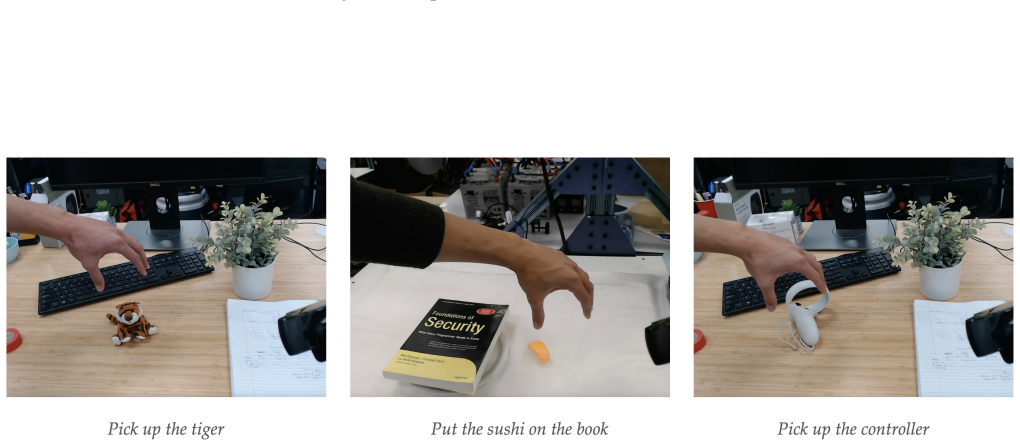
RAD's central claim is that a reasoning chain, a sequence of language tokens describing the task plan, the current subtask, the motion to execute, the gripper's pixel position, and visible objects, acts as an embodiment-invariant intermediate representation between observations and robot actions. The model is trained to autoregressively predict this chain and then the action; on human video, only the reasoning tokens have labels, so the extra data contributes a reasoning-only loss that sharpens the policy's planning and visual grounding without requiring action labels. The paper's experiments support the claim that tasks present only in action-free human data become executable by the robot, that the policy generalizes to compositions, objects, and scenes never seen in either data source, and that scaling the action-free data improves performance. In the authors' framing, RAD separates learning to reason from learning to act, and both capabilities improve from their respective data sources.
Load-bearing premise
All of the transfer rests on the assumption that language reasoning labels extracted from human video, especially the movement-direction and gripper-state labels, are correct, and the paper itself concedes that its hand-tracking pipeline is unreliable for rotational movements.
Editorial extensions
If this is right
- A robot can acquire a task it has never seen performed by a robot: for axis-specific training, success exceeded the zero-shot base policy by 23% on compositional tasks, 25% on new objects, and 12% on new scenes.
- Adding more action-free data helps even without matching robot demonstrations: 100 extra in-domain human demos raised one task's success from 4/10 to 7/10, and 250 out-of-domain demos raised it to 6.5/10.
- Reasoning trained on human video transfers to tasks unseen in both human and robot data, with reported gains of 5% on compositional tasks, 30% on new objects, and 18% on new scenes over the base policy.
- Human video collected in completely different environments still improves policy success in the original environment, outperforming the base policy by 16% and a gripper-position-only baseline by 13%.
Reading between the lines
- Because human data contributes only a reasoning loss, the largest gains should appear in planning and visual grounding rather than in low-level control; ablating individual reasoning steps would reveal which supervision drives the reported success.
- The Cartesian-only movement vocabulary implies a boundary: human manipulations dominated by wrist rotation would be mislabeled, so the same recipe is likely to fail on twisting, pouring, and similar tasks until hand trackers recover rotational primitives.
- If these scaling results extend, an internet-scale action-free reasoning dataset could in principle transfer broad task coverage into a robot policy, but robot demonstrations would still be needed to ground each new behavior in actions; the minimal robot-data fraction is an open question.
Editorial analysis
A structured set of objections, weighed in public.
Referee Report
Summary. The paper proposes Reasoning through Action-free Data (RAD), a method for training a vision-language-action policy on a mixture of robot demonstrations with action labels and human videos with only language reasoning labels. Reasoning chains follow the Embodied Chain-of-Thought format (TaskPlan through MovePrimitive, GripperPosition, VisibleObjects, then action), and labels for human videos are produced by HaMeR hand tracking plus Gemini. Experiments on a WidowX arm in the Bridge V2 Toy Sink and additional real environments compare RAD with ECoT and an ECoT-GT baseline, reporting improvements on compositional, new-object, and new-scene generalization, and on cross-environment transfer. The paper also promises release of 3,377 human-hand demonstrations with reasoning annotations.
Significance. If the empirical claims held, RAD would be a meaningful step: it would show that action-free human video can substitute for robot data through an embodiment-invariant reasoning representation, and the dataset release would be a useful community asset. The loss decomposition in Section III-A is a correct chain-rule factorization, and the objective for training on partial reasoning chains is clearly stated. However, the evidence currently falls short of supporting the central claims because of statistical weakness, baseline confounds, and unvalidated label quality, as detailed below.
major comments (4)
- [Section IV-B, Fig. 4, Tables I-II] All success rates are based on 10 trials per condition and are reported without confidence intervals or significance tests. With 10 trials, a difference of 20 percentage points corresponds to only two successes out of ten, which is within binomial sampling noise for many plausible success rates. Table I already contains a case where all models score identically (pick up the tiger, 3/10). This is load-bearing for the central claims that RAD 'enables effective transfer' and that scaling action-free data 'significantly improves' performance; the paper should report per-task bootstrap intervals or binomial tests, or increase the number of trials.
- [Section IV-A, Appendix VI-B] The ECoT-GT baseline is not a controlled ablation of reasoning supervision. Appendix VI-B states that ECoT-GT uses a different query prompt ('Where is the robot hand in the image?') and omits the stop-token loss relative to RAD. The RAD-vs-ECoT-GT comparisons in Fig. 4 and Table I therefore conflate the choice of reasoning labels with changes in the training objective and prompting. In addition, Fig. 5 compares RAD only against zero-shot ECoT, which has not been finetuned on any human video data; that comparison does not isolate the contribution of reasoning labels from the contribution of additional finetuning data. A controlled baseline should use the same query prompt and loss as RAD, with only the higher-level reasoning tokens removed.
- [Section III-C, Section V] The action-free reasoning labels are extracted by classifying hand motion according to the dominant Cartesian axis (stop, forward/backward, left/right, up/down) plus open/close from HaMeR keypoints, and Section III-C concedes that this is 'not as reliable for detecting rotational movement primitives.' The paper provides no validation of these labels: no inter-annotator agreement, no comparison against ground-truth hand motion, and no estimate of how often unmodeled rotational or diagonal motion occurs in the 3,377 collected videos. Since the low-level MovePrimitive and GripperPosition labels are inputs to Gemini for generating the higher-level reasoning steps, errors propagate upward; without label-quality evidence, the reported gains could be attributed to the additional video data or continued finetuning rather than to the reasoning mechanism. Section V explicitly acknowledges the Cartesian-only restriction, which reinforces that this is a limitation of the method's core data source.
- [Section IV-D, Table II] The data-scaling result that 'scaling up action-free reasoning data significantly improves policy performance' rests on a single task ('pick up the tape') evaluated with 10 trials per condition. The in-distribution (+100 demos) and out-of-distribution (+250 demos) conditions also differ in environment distribution, so the comparison does not isolate data quantity alone. The paper should either report multi-task scaling results or soften the scaling claim to a single-task observation.
minor comments (5)
- [Appendix VI-B] The statement that 'RAD uses the Prismatic VLM [35] architecture' cites reference [35], which is the MimicPlay paper; the Prismatic VLM citation appears to be missing or incorrect.
- [Section IV-D] The word 'enviroment' is misspelled, and the subsection heading 'In-distribution vs. Out-of-Distribution Human Data' uses inconsistent hyphenation.
- [Section IV-B] The sentence 'RAD and RAD-A both improves on ECoT and ECoT-GT' should read 'both improve on ECoT and ECoT-GT.'
- [Table I] The use of fractional successes (4.5/10, 6.5/10) is explained only in Appendix VI-C; a note in the table caption would help readers interpret the partial-credit scoring.
- [Section III-D] The paper should state explicitly how the action-token loss is masked or omitted for action-free samples, since those samples have no action labels.
Circularity Check
No significant circularity: RAD's transfer and scaling claims rest on external baselines and third-party labelers; self-citations are peripheral.
full rationale
The paper's central claim—that training a reasoning-based policy on action-free human video data transfers across embodiments and improves generalization—is not derived from the authors' own equations or from a self-citation chain. The reasoning objective in Section III-A is a stated modeling assumption, not a conclusion. The action-free reasoning labels come from an external VLM (Gemini) and an external hand tracker (HaMeR), rather than from the policy being evaluated. The key experiments compare against an external baseline (ECoT, [40]) and an ablation baseline (ECoT-GT) trained on the same human videos, so the added reasoning supervision is isolated empirically. The self-citations present (e.g., RT-H [2], Open X-Embodiment [10]) appear in related-work or pretraining context and are not load-bearing: the method does not invoke a self-derived uniqueness theorem or a self-authored ansatz to justify its central result. The paper's acknowledged limitation—that Cartesian-only hand-motion primitives may mislabel rotational movements—is a label-quality threat to empirical validity, not a definitional reduction of the output to the input. No fitted parameter is renamed as a prediction; the data-scaling experiments measure same-task training-data scaling and are presented as such. Overall, the derivation chain is self-contained against external benchmarks and no circular step is exhibited.
Assumptions & free parameters
free parameters (1)
- Dominant-axis motion threshold for MovePrimitive classification =
unreported
assumptions (4)
- standard math The joint reasoning-action distribution factorizes via the chain rule into L_action plus L_reasoning.
- domain assumption Every demonstration can be annotated with a chain of C reasoning steps that are sufficient to predict the action.
- domain assumption Gemini, a pretrained vision-language model, generates accurate high-level and intermediate reasoning labels from human videos.
- domain assumption HaMeR hand tracking provides reliable gripper position, and dominant-axis changes in hand pose yield correct MovePrimitive and GripperPosition labels.
Cite this review
Pith. "Pith review of Action-Free Reasoning for Policy Generalization." pith.science (2026). https://pith.science/paper/B62BVABE
@misc{pith2026250203729,
  author       = {Pith},
  title        = {Pith review of: Action-Free Reasoning for Policy Generalization},
  year         = {2026},
  howpublished = {\url{https://pith.science/paper/B62BVABE}},
  note         = {Machine review of arXiv:2502.03729}
}
read the original abstract
End-to-end imitation learning offers a promising approach for training robot policies. However, generalizing to new settings remains a significant challenge. Although large-scale robot demonstration datasets have shown potential for inducing generalization, they are resource-intensive to scale. In contrast, human video data is abundant and diverse, presenting an attractive alternative. Yet, these human-video datasets lack action labels, complicating their use in imitation learning. Existing methods attempt to extract grounded action representations (e.g., hand poses), but resulting policies struggle to bridge the embodiment gap between human and robot actions. We propose an alternative approach: leveraging language-based reasoning from human videos-essential for guiding robot actions-to train generalizable robot policies. Building on recent advances in reasoning-based policy architectures, we introduce Reasoning through Action-free Data (RAD). RAD learns from both robot demonstration data (with reasoning and action labels) and action-free human video data (with only reasoning labels). The robot data teaches the model to map reasoning to low-level actions, while the action-free data enhances reasoning capabilities. Additionally, we will release a new dataset of 3,377 human-hand demonstrations with reasoning annotations compatible with the Bridge V2 benchmark and aimed at facilitating future research on reasoning-driven robot learning. Our experiments show that RAD enables effective transfer across the embodiment gap, allowing robots to perform tasks seen only in action-free data. Furthermore, scaling up action-free reasoning data significantly improves policy performance and generalization to novel tasks. These results highlight the promise of reasoning-driven learning from action-free datasets for advancing generalizable robot control. Project page: https://rad-generalization.github.io
Figures


Figures from the paper (6 more)




Forward citations
Cited by 2 Pith papers
-
EVE: A Generator-Verifier System for Generative Policies
Zero-shot VLM verifiers, ensembled and fused via guided diffusion, improve frozen generative robot policies' success rates by 1-2 percentage points on simulated manipulation tasks.
-
LeapBot-WA: World-Anchor Action Models via Predictive Latent Alignments
LeapBot-WA shows robot policies can be trained with latent world-model predictions instead of pixel video generation, hitting state-of-the-art for predictive action models and staying competitive with generative WAMs.
Reference graph
Works this paper leans on
-
[1]
Human-to-robot imitation in the wild
Shikhar Bahl, Abhinav Gupta, and Deepak Pathak. Human-to-robot imitation in the wild. In Proceedings of Robotics: Science and Systems (RSS) , 2022
2022
-
[2]
RT-H: Action hierarchies using language
Suneel Belkhale, Tianli Ding, Ted Xiao, Pierre Sermanet, Quon Vuong, Jonathan Tompson, Yevgen Chebotar, De- bidatta Dwibedi, and Dorsa Sadigh. RT-H: Action hierarchies using language. In Proceedings of Robotics: Science and Systems (RSS) , 2024
work page 2024
-
[3]
Gen2act: Human video generation in novel scenarios enables generalizable robot manipulation
Homanga Bharadhwaj, Debidatta Dwibedi, Abhinav Gupta, Shubham Tulsiani, Carl Doersch, Ted Xiao, Dhruv Shah, Fei Xia, Dorsa Sadigh, and Sean Kirmani. Gen2act: Human video generation in novel scenarios enables generalizable robot manipulation. arXiv preprint arXiv:2409.16283, 2024
arXiv 2024
-
[4]
Homanga Bharadhwaj, Roozbeh Mottaghi, Abhinav Gupta, and Shubham Tulsiani. Track2act: Predict- ing point tracks from internet videos enables di- verse zero-shot robot manipulation. arXiv preprint arXiv:2405.01527, 2024
arXiv 2024
-
[5]
Rt-1: Robotics transformer for real- world control at scale
Anthony Brohan, Noah Brown, Justice Carbajal, Yev- gen Chebotar, Joseph Dabis, Chelsea Finn, Keerthana Gopalakrishnan, Karol Hausman, Alex Herzog, Jasmine Hsu, Julian Ibarz, Brian Ichter, Alex Irpan, Tomas Jackson, Sally Jesmonth, Nikhil Joshi, Ryan Julian, Dmitry Kalashnikov, Yuheng Kuang, Isabel Leal, Kuang- Huei Lee, Sergey Levine, Yao Lu, Utsav Malla,...
work page 2022
-
[6]
RT-2: Vision-Language-Action Models Transfer Web Knowledge to Robotic Control
Anthony Brohan, Noah Brown, Justice Carbajal, Yevgen Chebotar, Xi Chen, Krzysztof Choromanski, Tianli Ding, Danny Driess, Avinava Dubey, Chelsea Finn, Pete Flo- rence, Chuyuan Fu, Montse Gonzalez Arenas, Keerthana Gopalakrishnan, Kehang Han, Karol Hausman, Alex Herzog, Jasmine Hsu, Brian Ichter, Alex Irpan, Nikhil Joshi, Ryan Julian, Dmitry Kalashnikov, Y...
work page 2023
-
[7]
Do as I can, not as I say: Grounding language in robotic affordances
Anthony Brohan, Yevgen Chebotar, Chelsea Finn, Karol Hausman, Alexander Herzog, Daniel Ho, Julian Ibarz, Alex Irpan, Eric Jang, Ryan Julian, et al. Do as I can, not as I say: Grounding language in robotic affordances. In Conference on Robot Learning, pages 287–318, 2023
work page 2023
-
[8]
Learn- ing generalizable robotic reward functions from” in-the- wild” human videos
Annie S Chen, Suraj Nair, and Chelsea Finn. Learn- ing generalizable robotic reward functions from” in-the- wild” human videos. In Proceedings of Robotics: Science and Systems (RSS) , 2021
work page 2021
Show all 42 references
-
[9]
Pali-x: On scaling up a multilingual vision and language model
Xi Chen, Josip Djolonga, Piotr Padlewski, Basil Mustafa, Beer Changpinyo, Jialin Wu, Carlos Riquelme, Sebastian Goodman, Xiao Wang, Yi Tay, Siamak Shakeri, Mostafa Dehghani, Daniel Salz, Mario Lu ˇci´c, Michael Tschan- nen, Arsha Nagrani, Hexiang (Frank) Hu, Mandar Joshi, Bo P...
2024
-
[10]
Open X-Embodiment Collaboration, Abby O’Neill, Ab- dul Rehman, Abhinav Gupta, Abhiram Maddukuri, Ab- hishek Gupta, Abhishek Padalkar, Abraham Lee, Acorn Pooley, Agrim Gupta, Ajay Mandlekar, Ajinkya Jain, Albert Tung, Alex Bewley, Alex Herzog, Alex Irpan, Alexander Khazatsky, A...
2024
-
[11]
Inner monologue: Embodied reasoning through planning with language models
Wenlong Huang, Fei Xia, Ted Xiao, Harris Chan, Jacky Liang, Pete Florence, Andy Zeng, Jonathan Tompson, Igor Mordatch, Yevgen Chebotar, et al. Inner monologue: Embodied reasoning through planning with language models. In Conference on Robot Learning , 2023
2023
-
[12]
Vid2robot: End-to-end video-conditioned policy learn- ing with cross-attention transformers
Vidhi Jain, Maria Attarian, Nikhil J Joshi, Ayzaan Wahid, Danny Driess, Quan Vuong, Pannag R Sanketi, Pierre Sermanet, Stefan Welker, Christine Chan, et al. Vid2robot: End-to-end video-conditioned policy learn- ing with cross-attention transformers. arXiv preprint arXiv:2403.1...
2024 arXiv
-
[13]
BC-Z: Zero-shot task generalization with robotic imitation learning
Eric Jang, Alex Irpan, Mohi Khansari, Daniel Kappler, Frederik Ebert, Corey Lynch, Sergey Levine, and Chelsea Finn. BC-Z: Zero-shot task generalization with robotic imitation learning. In Conference on Robot Learning (CoRL), 2022
2022
-
[14]
Language-driven representation learning for robotics
Siddharth Karamcheti, Suraj Nair, Annie S Chen, Thomas Kollar, Chelsea Finn, Dorsa Sadigh, and Percy Liang. Language-driven representation learning for robotics. arXiv preprint arXiv:2302.12766 , 2023
2023 arXiv
-
[15]
Droid: A large-scale in-the-wild robot manipulation dataset
Alexander Khazatsky, Karl Pertsch, Suraj Nair, Ash- win Balakrishna, Sudeep Dasari, Siddharth Karam- cheti, Soroush Nasiriany, Mohan Kumar Srirama, Lawrence Yunliang Chen, Kirsty Ellis, et al. Droid: A large-scale in-the-wild robot manipulation dataset. arXiv preprint arXiv:24...
2024 arXiv
-
[16]
Openvla: An open-source vision-language-action model
Moo Jin Kim, Karl Pertsch, Siddharth Karamcheti, Ted Xiao, Ashwin Balakrishna, Suraj Nair, Rafael Rafailov, Ethan Foster, Grace Lam, Pannag Sanketi, et al. Openvla: An open-source vision-language-action model. Confer- ence on Robot Learning (CoRL) , 2024
2024
-
[17]
Shadow: Leveraging segmentation masks for cross-embodiment policy transfer
Marion Lepert, Ria Doshi, and Jeannette Bohg. Shadow: Leveraging segmentation masks for cross-embodiment policy transfer. In 8th Annual Conference on Robot Learning
-
[18]
DexVIP: Learning dexterous grasping with human hand pose priors from video
Priyanka Mandikal and Kristen Grauman. DexVIP: Learning dexterous grasping with human hand pose priors from video. In Conference on Robot Learning (CoRL), 2022
2022
-
[19]
R3m: A universal visual representation for robot manipulation
Suraj Nair, Aravind Rajeswaran, Vikash Kumar, Chelsea Finn, and Abhinav Gupta. R3m: A universal visual representation for robot manipulation. In Conference on Robot Learning (CoRL) , 2022
2022
-
[20]
Dinov2: Learning robust visual features without supervision
Maxime Oquab, Timoth ´ee Darcet, Th ´eo Moutakanni, Huy V o, Marc Szafraniec, Vasil Khalidov, Pierre Fer- nandez, Daniel Haziza, Francisco Massa, Alaaeldin El- Nouby, et al. Dinov2: Learning robust visual features without supervision. arXiv preprint arXiv:2304.07193 , 2023
2023 arXiv
-
[21]
R+ x: Retrieval and exe- cution from everyday human videos
Georgios Papagiannis, Norman Di Palo, Pietro Vi- tiello, and Edward Johns. R+ x: Retrieval and exe- cution from everyday human videos. arXiv preprint arXiv:2407.12957, 2024
2024 arXiv
-
[22]
Reconstructing hands in 3D with transformers
Georgios Pavlakos, Dandan Shan, Ilija Radosavovic, Angjoo Kanazawa, David Fouhey, and Jitendra Malik. Reconstructing hands in 3D with transformers. In Con- ference on Computer Vision and Pattern Recognition (CVPR), 2024
2024
-
[23]
DexMV: Imitation learning for dexterous manipulation from hu- man videos
Yuzhe Qin, Yueh-Hua Wu, Shaowei Liu, Hanwen Jiang, Ruihan Yang, Yang Fu, and Xiaolong Wang. DexMV: Imitation learning for dexterous manipulation from hu- man videos. In European Conference on Computer Vision, 2022
2022
-
[24]
Motion tracks: A unified representation for human-robot transfer in few- shot imitation learning
Juntao Ren, Priya Sundaresan, Dorsa Sadigh, Sanjiban Choudhury, and Jeannette Bohg. Motion tracks: A unified representation for human-robot transfer in few- shot imitation learning. arXiv preprint arXiv:2501.06994, 2025
2025
-
[25]
Concept2Robot: Learning manipu- lation concepts from instructions and human demonstra- tions
Lin Shao, Toki Migimatsu, Qiang Zhang, Karen Yang, and Jeannette Bohg. Concept2Robot: Learning manipu- lation concepts from instructions and human demonstra- tions. The International Journal of Robotics Research (IJRR), 2021
2021
-
[26]
Third-person visual imitation learning via decoupled hi- erarchical controller
Pratyusha Sharma, Deepak Pathak, and Abhinav Gupta. Third-person visual imitation learning via decoupled hi- erarchical controller. In Advances in Neural Information Processing Systems (NeurIPS) , 2019
2019
-
[27]
Videodex: Learning dexterity from internet videos
Kenneth Shaw, Shikhar Bahl, and Deepak Pathak. Videodex: Learning dexterity from internet videos. In Conference on Robot Learning (CoRL) , 2023
2023
-
[28]
Yell at your robot: Improving on-the-fly from language corrections
Lucy Xiaoyang Shi, Zheyuan Hu, Tony Z Zhao, Archit Sharma, Karl Pertsch, Jianlan Luo, Sergey Levine, and Chelsea Finn. Yell at your robot: Improving on-the-fly from language corrections. In Proceedings of Robotics: Science and Systems (RSS) , 2024
2024
-
[29]
Avid: Learning multi-stage tasks via pixel-level translation of human videos
Laura Smith, Nikita Dhawan, Marvin Zhang, Pieter Abbeel, and Sergey Levine. Avid: Learning multi-stage tasks via pixel-level translation of human videos. In Proceedings of Robotics: Science and Systems (RSS) , 2019
2019
-
[30]
Language- conditioned imitation learning for robot manipulation tasks
Simon Stepputtis, Joseph Campbell, Mariano Phielipp, Stefan Lee, Chitta Baral, and Heni Ben Amor. Language- conditioned imitation learning for robot manipulation tasks. Advances in Neural Information Processing Sys- tems (NeurIPS), 2020
2020
-
[31]
Gemini: a family of highly capable multimodal models
Gemini Team, Rohan Anil, Sebastian Borgeaud, Jean- Baptiste Alayrac, Jiahui Yu, Radu Soricut, Johan Schalk- wyk, Andrew M Dai, Anja Hauth, Katie Millican, et al. Gemini: a family of highly capable multimodal models. arXiv, 2023
2023
-
[32]
Octo: An open-source generalist robot policy
Octo Model Team, Dibya Ghosh, Homer Walke, Karl Pertsch, Kevin Black, Oier Mees, Sudeep Dasari, Joey Hejna, Tobias Kreiman, Charles Xu, et al. Octo: An open-source generalist robot policy. arXiv preprint arXiv:2405.12213, 2024
2024 arXiv
-
[33]
Llama 2: Open foundation and fine-tuned chat models
Hugo Touvron, Louis Martin, Kevin Stone, Peter Albert, Amjad Almahairi, Yasmine Babaei, Nikolay Bashlykov, Soumya Batra, Prajjwal Bhargava, Shruti Bhosale, et al. Llama 2: Open foundation and fine-tuned chat models. arXiv preprint arXiv:2307.09288 , 2023
2023 arXiv
-
[34]
Bridgedata v2: A dataset for robot learning at scale
Homer Rich Walke, Kevin Black, Tony Z Zhao, Quan Vuong, Chongyi Zheng, Philippe Hansen-Estruch, An- dre Wang He, Vivek Myers, Moo Jin Kim, Max Du, et al. Bridgedata v2: A dataset for robot learning at scale. In Conference on Robot Learning , pages 1723–
-
[35]
Mimicplay: Long-horizon imitation learning by watching human play
Chen Wang, Linxi Fan, Jiankai Sun, Ruohan Zhang, Li Fei-Fei, Danfei Xu, Yuke Zhu, and Anima Anand- kumar. Mimicplay: Long-horizon imitation learning by watching human play. In Conference on Robot Learning (CoRL), 2023
2023
-
[36]
Masked visual pre-training for motor control
Tete Xiao, Ilija Radosavovic, Trevor Darrell, and Jitendra Malik. Masked visual pre-training for motor control. arXiv, 2022
2022
-
[37]
Learn- ing by watching: Physical imitation of manipulation skills from human videos
Haoyu Xiong, Quanzhou Li, Yun-Chun Chen, Homanga Bharadhwaj, Samarth Sinha, and Animesh Garg. Learn- ing by watching: Physical imitation of manipulation skills from human videos. In International Conference on Intelligent Robots and Systems (IROS) , 2021
2021
-
[38]
Xskill: Cross embodiment skill dis- covery
Mengda Xu, Zhenjia Xu, Cheng Chi, Manuela Veloso, and Shuran Song. Xskill: Cross embodiment skill dis- covery. In Conference on Robot Learning , pages 3536–
-
[39]
La- tent action pretraining from videos
Seonghyeon Ye, Joel Jang, Byeongguk Jeon, Sejune Joo, Jianwei Yang, Baolin Peng, Ajay Mandlekar, Reuben Tan, Yu-Wei Chao, Bill Yuchen Lin, et al. La- tent action pretraining from videos. arXiv preprint arXiv:2410.11758, 2024
2024 arXiv
-
[40]
Robotic control via embodied chain-of-thought reasoning
Michał Zawalski, William Chen, Karl Pertsch, Oier Mees, Chelsea Finn, and Sergey Levine. Robotic control via embodied chain-of-thought reasoning. In Conference on Robot Learning (CoRL) , 2024
2024
-
[41]
stop”, “move forward
Xiaohua Zhai, Basil Mustafa, Alexander Kolesnikov, and Lucas Beyer. Sigmoid loss for language image pre- training. In Proceedings of the IEEE/CVF International Conference on Computer Vision , pages 11975–11986, 2023. APPENDIX We outline the dataset collection and reasoning gen...
2023
-
[42]
Where is the robot hand in the image?
features for the visual encoder, and a LLaMA 2 7B [33] language backbone. All models are fine-tuned to convergence with a learning rate of 2e-4, a LoRA batch size of 2, and anywhere from 2 to 8 GPUs (L40s or A40). Training of the ECoT-GT baseline is the same as RAD except the ...
Reviewed August 9, 2026 · model on record in the stance chip above.
Discussion (0). Continue with ORCID to comment.