The Debris Disk Host β Piscis Austrinus is a Rapidly Rotating Star Seen Nearly Pole-On
Pith reviewed 2026-07-03 04:45 UTC · model grok-4.3
The pith
β PsA is a rapidly rotating star seen nearly pole-on, with its apparent luminosity 48% larger than the true value of 26.2 solar luminosities.
A machine-rendered reading of the paper's core claim, the machinery that carries it, and where it could break.
Core claim
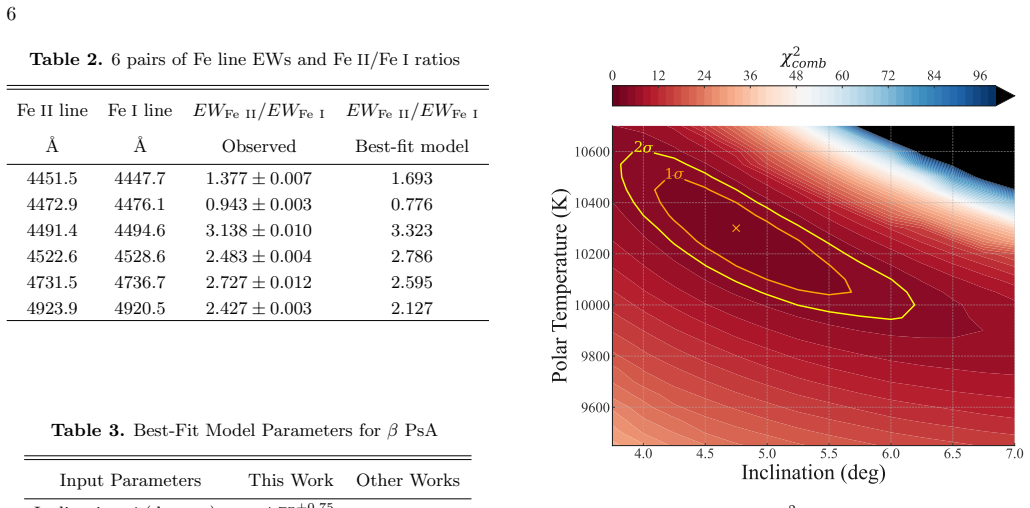
The analysis confirms that β PsA is oriented nearly pole-on (i = 4.75+0.75−0.50°) and experiences substantial gravity darkening caused by its rapid rotation (Ω/Ωcrit=0.93±0.17). β PsA has a polar temperature of 10300+200−250 K that is 24% hotter than its equatorial temperature (8275+317−400 K). This results in its apparent luminosity being 48% larger than its actual luminosity of 26.2+1.9−2.4 L⊙. The same methodology recovers a nearly pole-on orientation for Vega that matches interferometric data.
What carries the argument
The fastrot-spec spectral synthesis code, which models line profiles under rapid rotation and gravity darkening, with additional temperature constraints from Fe II/Fe I line ratios.
If this is right
- β PsA has a mass of 2.20±0.03 solar masses and an age of 141+113−49 Myr based on PARSEC models at similar rotation rates.
- This age is consistent with the lithium-depletion age inferred for its G5V companion CD-32 17127.
- The technique can be applied to other high-dispersion spectra to identify and characterize rapidly rotating pole-on stars.
- The apparent luminosity overestimate must be corrected when using the star as a debris-disk host.
Where Pith is reading between the lines
- Debris-disk models around β PsA may require updates to account for the star's true energy output and evolutionary state.
- Other A-type stars with unusually narrow metallic lines could turn out to be similar near-critical rotators viewed pole-on.
- Wider application of the method could show how common near-critical rotation is among debris-disk host stars.
Load-bearing premise
The fastrot-spec code and Fe II/Fe I line ratio constraints accurately capture the combined effects of rapid rotation, gravity darkening, and temperature distribution on the observed line profiles without significant systematic bias.
What would settle it
An interferometric measurement of β PsA's inclination or equatorial radius that differs substantially from the derived value near 4.75 degrees.
Figures
read the original abstract
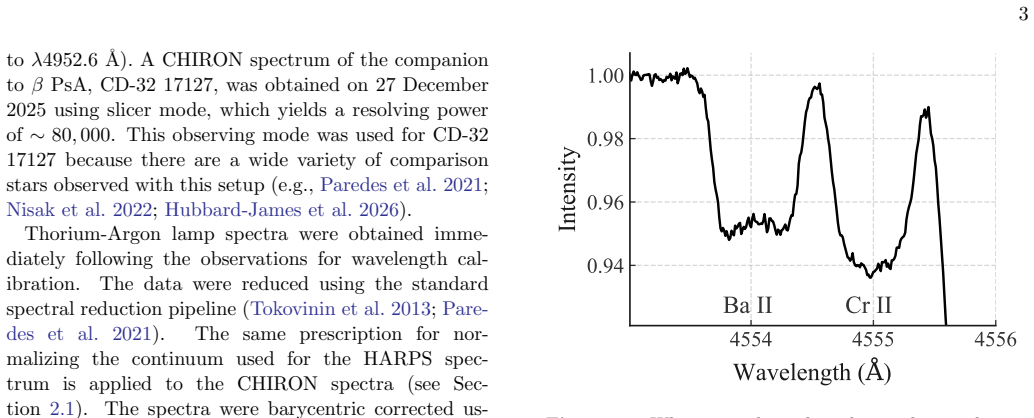
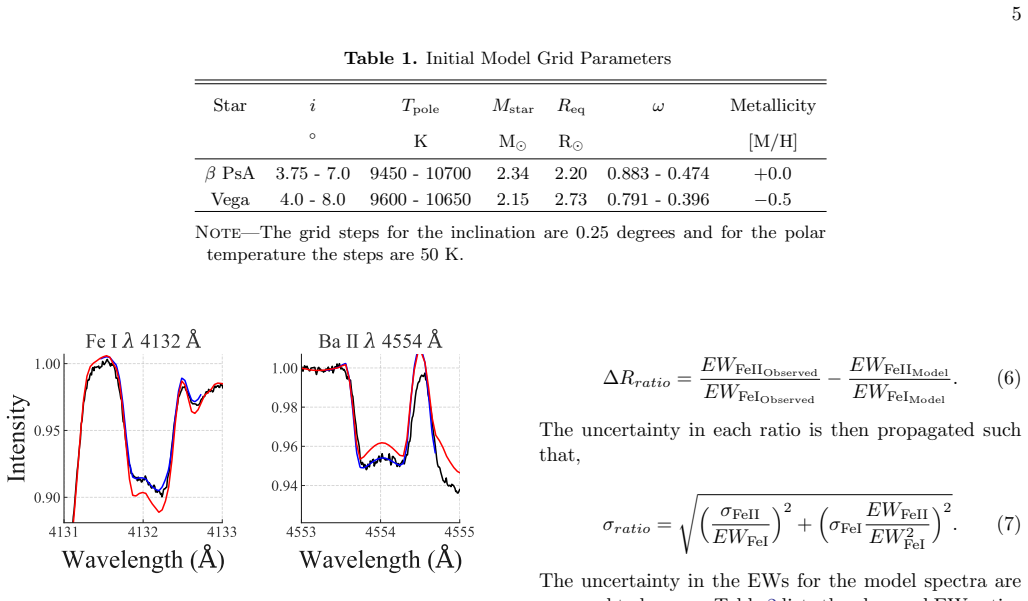
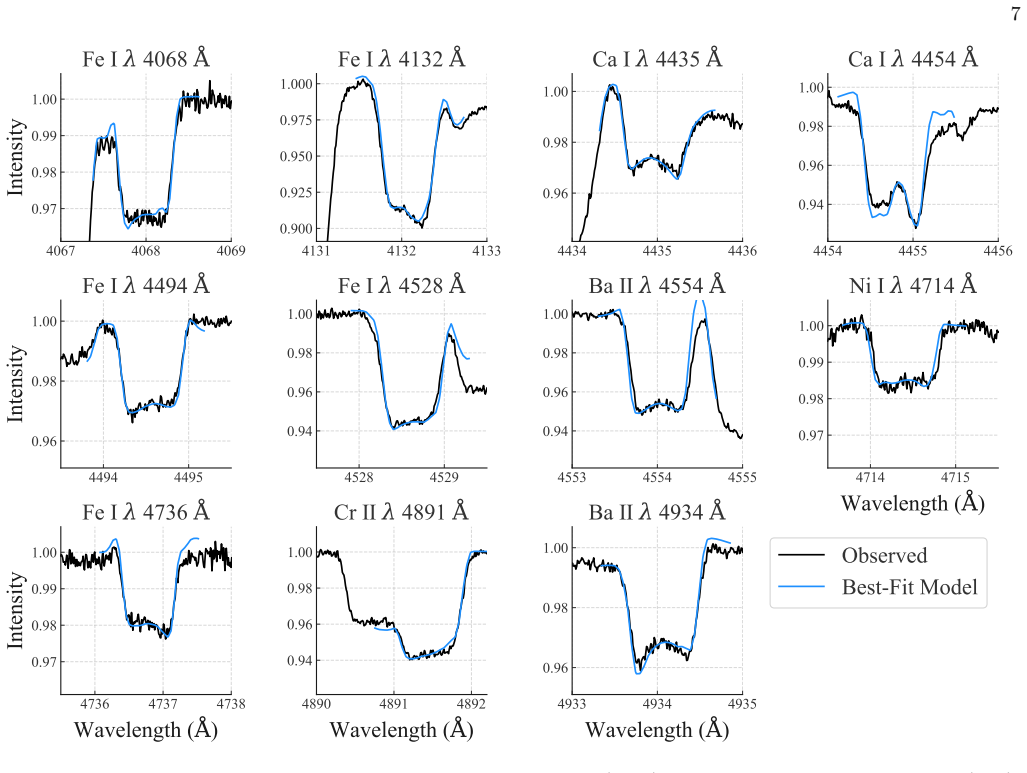
Previous studies of $\beta$ Piscis Austrinus (PsA) have speculated that the narrow and saddle-like shapes of some of its weak metallic lines are a consequence of it being a rapidly rotating star viewed nearly pole-on. Here we use the \texttt{fastrot-spec} spectral synthesis code to model high-dispersion (R = 115,000) HARPS spectra of $\beta$ PsA in order to determine its inclination and photospheric properties, with additional constraints on the surface temperature set by measures of Fe II/Fe I line ratios. The analysis confirms that $\beta$ PsA is oriented nearly pole-on ($i = 4.75^{+0.75}_{-0.50}$$^o$) and experiences substantial gravity darkening caused by its rapid rotation ($\Omega/\Omega_{crit}=0.93\pm0.17$). $\beta$ PsA has a polar temperature of $10300^{+200}_{-250}$ K that is 24% hotter than its equatorial temperature ($8275^{+317}_{-400}$ K). This results in its apparent luminosity being 48% larger than its actual luminosity of 26.2$^{+1.9}_{-2.4}$ L$_\odot$. When this methodology is applied to high-dispersion spectra of the star Vega, the analysis determines a nearly pole-on orientation that is consistent with interferometric measurements, validating the technique. Based on comparisons with PARSEC evolutionary models of stars rotating at similar velocities, $\beta$ PsA has a mass of $2.20\pm0.03$ M$_{\odot}$ and an age of $141^{+113}_{-49}$ Myr; this age is consistent with the age inferred for its G5V companion star, CD-32 17127, based on lithium depletion models. The analysis demonstrates the potential for both identifying and determining the stellar properties of rapidly rotating stars viewed nearly pole-on via spectroscopy alone.
Editorial analysis
A structured set of objections, weighed in public.
Referee Report
Summary. The manuscript uses the fastrot-spec spectral synthesis code to model high-resolution HARPS spectra of β Piscis Austrinus, deriving an inclination of 4.75^{+0.75}_{-0.50}°, Ω/Ω_crit = 0.93 ± 0.17, polar temperature 10300^{+200}_{-250} K, equatorial temperature 8275^{+317}_{-400} K, and a luminosity correction showing apparent luminosity 48% larger than the true value of 26.2^{+1.9}_{-2.4} L_⊙. The analysis is validated by recovering a near-pole-on orientation for Vega consistent with interferometry, and the derived mass (2.20 ± 0.03 M_⊙) and age (141^{+113}_{-49} Myr) are shown to be consistent with the G5V companion via PARSEC models and lithium depletion.
Significance. If the central results hold, the work demonstrates a spectroscopic route to identify and characterize rapidly rotating, nearly pole-on stars without interferometry, which is significant for debris-disk host studies and gravity-darkening corrections. The independent Vega validation and external age cross-check with the companion are explicit strengths that reduce reliance on internal assumptions alone.
major comments (2)
- [Methods] Methods (spectral synthesis section): the claim that Fe II/Fe I line ratios provide an orthogonal temperature constraint independent of the inclination fit is load-bearing for the reported T_pole/T_eq difference; the manuscript does not show explicit tests for how gravity darkening and rotational broadening jointly affect the line-ratio diagnostic, which could introduce systematic bias in the 24% temperature contrast.
- [Results] Results (inclination and rotation fit): the reported uncertainties on i and Ω/Ω_crit are derived from the spectral fit, but the text does not quantify the contribution of model assumptions in fastrot-spec (e.g., limb-darkening law or oblateness treatment) versus data noise; this affects whether the i ≈ 4.75° result is robust to reasonable variations in those parameters.
minor comments (3)
- [Abstract] The abstract and text use inconsistent formatting for the inclination uncertainty (^{+0.75}_{-0.50} vs. similar for other quantities); standardize notation.
- [Figures] Figure captions should explicitly state the wavelength range or specific lines used for the Fe II/Fe I ratio measurements to aid reproducibility.
- [Methods] Add a reference or brief description of the fastrot-spec code's handling of gravity darkening if it is not already cited in the methods.
Simulated Author's Rebuttal
We thank the referee for their constructive review and positive assessment of the manuscript's significance. We address each major comment below and will revise the manuscript to incorporate additional tests and clarifications where needed.
read point-by-point responses
-
Referee: [Methods] Methods (spectral synthesis section): the claim that Fe II/Fe I line ratios provide an orthogonal temperature constraint independent of the inclination fit is load-bearing for the reported T_pole/T_eq difference; the manuscript does not show explicit tests for how gravity darkening and rotational broadening jointly affect the line-ratio diagnostic, which could introduce systematic bias in the 24% temperature contrast.
Authors: We agree that the independence of the Fe II/Fe I diagnostic would be more convincingly demonstrated with explicit sensitivity tests. The line ratios were selected because they form over a range of depths and are measured from equivalent widths rather than detailed profile shapes, but the manuscript does not quantify the joint effects of gravity darkening and macroturbulent/rotational broadening. In revision we will add an appendix containing Monte Carlo tests in which gravity-darkening parameters and v sin i are varied within the posterior ranges while recomputing the line ratios; these will show that the derived 24% temperature contrast is stable to within the reported uncertainties. revision: yes
-
Referee: [Results] Results (inclination and rotation fit): the reported uncertainties on i and Ω/Ω_crit are derived from the spectral fit, but the text does not quantify the contribution of model assumptions in fastrot-spec (e.g., limb-darkening law or oblateness treatment) versus data noise; this affects whether the i ≈ 4.75° result is robust to reasonable variations in those parameters.
Authors: The quoted uncertainties are the formal 1σ intervals from the χ² surface of the spectral fit. We acknowledge that the manuscript does not separate the contributions of data noise from systematic choices internal to fastrot-spec. In the revised version we will add a short subsection reporting the results of refits performed with (i) a quadratic instead of linear limb-darkening law and (ii) a 5% variation in the oblateness prescription; the resulting shifts in i and Ω/Ω_crit will be tabulated so that readers can assess the robustness of the near-pole-on solution. revision: yes
Circularity Check
No significant circularity; derivation is data-driven fitting with external validation
full rationale
The paper derives inclination, rotation rate, and temperatures by fitting high-resolution spectra to the fastrot-spec synthesis code, using Fe II/Fe I line ratios as an orthogonal constraint. The central results (i ≈ 4.75°, Ω/Ωcrit ≈ 0.93, Tp/Teq difference, luminosity correction) are outputs of this fit to the observed data. Validation on Vega recovers a pole-on geometry consistent with independent interferometry. Mass and age come from comparison to external PARSEC evolutionary models and are cross-checked against the companion's lithium depletion age. No step reduces by construction to a fitted input renamed as prediction, no self-citation chain is load-bearing for the geometry or properties, and no ansatz or uniqueness theorem is smuggled in. The derivation chain is self-contained against the spectra and external benchmarks.
Axiom & Free-Parameter Ledger
free parameters (3)
- inclination i =
4.75 degrees
- Ω/Ωcrit =
0.93
- polar temperature =
10300 K
axioms (2)
- domain assumption fastrot-spec correctly models gravity darkening and line profiles for rapid rotators
- domain assumption PARSEC models give reliable mass and age for stars rotating at ~0.93 Ωcrit
Reference graph
Works this paper leans on
-
[1]
Boggess, A. and Wilson, R. , editor =. The. 1987 , pages =. doi:10.1007/978-94-009-3753-6_1 , booktitle =
-
[2]
fastrot-spec , copyright =
Montesinos, Benjamin , year =. fastrot-spec , copyright =
-
[3]
, editor =
Cayrel, R. , editor =. Data. The. 1988 , pages =
1988
-
[4]
The Astrophysical Journal , author =
Evidence for a dispersion in the lithium abundances of extreme halo stars , volume =. The Astrophysical Journal , author =. 1993 , pages =. doi:10.1086/173120 , language =
-
[5]
and Curtis, Jason Lee and Bickle, Thomas P
Gagné, Jonathan and Moranta, Leslie and Faherty, Jacqueline K. and Curtis, Jason Lee and Bickle, Thomas P. and Couture, Dominic and David, Amélie Chiasson and Christie, Katie and Lambier, Samantha and Leclerc, Elise and Poliquin, Livia and Belzile, Danika and Mamajek, Eric E. , year =. The. doi:10.48550/ARXIV.2602.15695 , abstract =
-
[6]
, year =
Gray, David F. , year =. The
-
[7]
2015 , pages =
The Messenger , author =. 2015 , pages =
2015
-
[8]
Astronomy & Astrophysics , author =
New wavelength calibration for echelle spectrographs using. Astronomy & Astrophysics , author =. 2019 , pages =. doi:10.1051/0004-6361/201833852 , abstract =
-
[9]
Astronomy and Astrophysics Review , author =
Interferometric observations of rapidly rotating stars , volume =. Astronomy and Astrophysics Review , author =. 2012 , pages =. doi:10.1007/s00159-012-0051-2 , abstract =
-
[10]
2019 , pages =
Astrophysics Source Code Library , author =. 2019 , pages =
2019
-
[11]
The Astrophysical Journal , author =
Precision. The Astrophysical Journal , author =. 2017 , pages =. doi:10.3847/1538-4357/836/1/77 , abstract =
-
[12]
The Astronomical Journal , author =
Contributions to the. The Astronomical Journal , author =. 2003 , pages =. doi:10.1086/378365 , language =
-
[13]
The Astrophysical Journal , author =
The. The Astrophysical Journal , author =. 2013 , pages =. doi:10.1088/0004-637X/768/1/25 , abstract =
-
[14]
The. The Astrophysical Journal , author =. 2022 , pages =. doi:10.3847/1538-4357/ac7c74 , abstract =
work page internal anchor Pith review doi:10.3847/1538-4357/ac7c74 2022
-
[15]
The Astronomical Journal , author =
The. The Astronomical Journal , author =. 2018 , pages =. doi:10.3847/1538-3881/aabc4f , abstract =
-
[16]
Astropy:. Astronomy and Astrophysics , author =. 2013 , pages =. doi:10.1051/0004-6361/201322068 , abstract =
-
[17]
Monthly Notices of the Royal Astronomical Society , author =
The. Monthly Notices of the Royal Astronomical Society , author =. 2023 , pages =. doi:10.1093/mnras/stad1293 , abstract =
-
[18]
13th Cambridge Workshop on Cool Stars, Stellar Systems and the Sun , author =
Systematic errors in the determination of stellar rotational velocities , volume =. 13th Cambridge Workshop on Cool Stars, Stellar Systems and the Sun , author =. 2005 , pages =
2005
-
[19]
The Astrophysical Journal , author =
The. The Astrophysical Journal , author =. 2004 , pages =. doi:10.1086/379925 , language =
-
[20]
Monthly Notices of the Royal Astronomical Society , author =
The. Monthly Notices of the Royal Astronomical Society , author =. 1924 , pages =. doi:10.1093/mnras/84.9.665 , language =
-
[21]
New Grids of ATLAS9 Model Atmospheres
New. Modelling of Stellar Atmospheres, Poster Contributions. Proceedings of the 210th Symposium of the International Astronomical Union held at Uppsala University, Uppsala, Sweden, 17-21 June, 2002. Edited by N. Piskunov, W.W. Weiss, and D.F. Gray. Published on behalf of the IAU by the Astronomical Society of the Pacific, 2003., p.A20 , author =. doi:10.4...
work page internal anchor Pith review Pith/arXiv arXiv doi:10.48550/arxiv.astro-ph/0405087 2002
-
[22]
The Astronomical Journal, Volume 171, Issue 3, id.175, 32 pp
The. The Astronomical Journal, Volume 171, Issue 3, id.175, 32 pp. , author =. doi:10.3847/1538-3881/ae3de3 , abstract =
-
[23]
The Astrophysical Journal , author =
Chemically. The Astrophysical Journal , author =. 2020 , pages =. doi:10.3847/1538-4357/ab99a5 , abstract =
-
[24]
Diffusion. Astrophysical Journal, vol. 160, p.641 , author =. doi:10.1086/150459 , abstract =
-
[25]
The Astronomical Journal , author =
The. The Astronomical Journal , author =. 2025 , pages =. doi:10.3847/1538-3881/ae0a12 , abstract =
-
[26]
Array programming with. Nature , author =. 2020 , pages =. doi:10.1038/s41586-020-2649-2 , abstract =
-
[27]
Monthly Notices of the Royal Astronomical Society , author =
The case of. Monthly Notices of the Royal Astronomical Society , author =. 2023 , pages =. doi:10.1093/mnras/stad316 , abstract =
-
[28]
Astronomy and Astrophysics , author =
The. Astronomy and Astrophysics , author =. 2026 , pages =. doi:10.1051/0004-6361/202556523 , abstract =
-
[29]
Annual Review of Astronomy and Astrophysics , author =
The. Annual Review of Astronomy and Astrophysics , author =. 2000 , pages =. doi:10.1146/annurev.astro.38.1.143 , abstract =
-
[30]
The Astrophysical Journal , author =
Imaging and. The Astrophysical Journal , author =. 2009 , pages =. doi:10.1088/0004-637X/701/1/209 , abstract =
-
[31]
Imaging the. Science , author =. 2007 , pages =. doi:10.1126/science.1143205 , abstract =
-
[32]
The Astronomical Journal , author =
Mapping out the. The Astronomical Journal , author =. 2022 , pages =. doi:10.3847/1538-3881/ac63c3 , abstract =
-
[33]
IEEE Transactions on Information Theory , author =
On the shape of a set of points in the plane , volume =. IEEE Transactions on Information Theory , author =. 1983 , pages =. doi:10.1109/TIT.1983.1056714 , number =
-
[34]
Astronomy & Astrophysics , author =
Characterization of debris disks observed with. Astronomy & Astrophysics , author =. 2025 , pages =. doi:10.1051/0004-6361/202554953 , abstract =
-
[35]
Modelling of Stellar Atmospheres , author =
Modelling of. Modelling of Stellar Atmospheres , author =
-
[36]
1999 , pages =
Publications of the Yunnan Observatory , author =. 1999 , pages =
1999
-
[37]
The Astronomical Journal , author =
The. The Astronomical Journal , author =. 2021 , pages =. doi:10.3847/1538-3881/ac082a , abstract =
-
[38]
Target selection for the. Monthly Notices of the Royal Astronomical Society , author =. 2010 , pages =. doi:10.1111/j.1365-2966.2009.15641.x , abstract =
-
[39]
The Astrophysical Journal , author =
Determining the. The Astrophysical Journal , author =. 1999 , pages =. doi:10.1086/307944 , abstract =
-
[40]
Astronomy and Astrophysics , author =
Abundance anomalies in main sequence. Astronomy and Astrophysics , author =. 1990 , pages =
1990
-
[41]
Astronomy and Astrophysics , author =
Abundance anomalies in main sequence. Astronomy and Astrophysics , author =. 1989 , pages =
1989
-
[42]
Monthly Notices of the Royal Astronomical Society , author =
Mixing by overshooting and rotation in intermediate-mass stars , volume =. Monthly Notices of the Royal Astronomical Society , author =. 2019 , pages =. doi:10.1093/mnras/stz728 , abstract =
-
[43]
Astronomy and Astrophysics , author =
Multiple stellar populations in. Astronomy and Astrophysics , author =. 2019 , pages =. doi:10.1051/0004-6361/201936409 , abstract =
-
[44]
Astronomy and Astrophysics , author =. 2022 , pages =. doi:10.1051/0004-6361/202244166 , abstract =
-
[45]
Astronomy and Astrophysics , author =. 2025 , pages =. doi:10.1051/0004-6361/202556005 , abstract =
-
[46]
The Astrophysical Journal , author =
A. The Astrophysical Journal , author =. 2010 , pages =. doi:10.1088/0004-637X/708/1/71 , abstract =
-
[47]
Astronomy and Astrophysics , author =
The. Astronomy and Astrophysics , author =. 2016 , pages =. doi:10.1051/0004-6361/201628497 , abstract =
-
[48]
Astronomy and Astrophysics , author =. 2020 , pages =. doi:10.1051/0004-6361/202037722 , abstract =
-
[49]
, volume =
Vega: a rapidly-rotating pole-on star. , volume =. Journal of the Royal Astronomical Society of Canada , author =. 1994 , pages =
1994
-
[50]
A spectral study of. The A-Star Puzzle , author =. 2004 , pages =. doi:10.1017/S1743921304004351 , abstract =
-
[51]
The Astrophysical Journal , author =
Rotational. The Astrophysical Journal , author =. 2008 , pages =. doi:10.1086/528949 , abstract =
-
[52]
Vega is a rapidly rotating star , volume =. Nature , author =. 2006 , pages =. doi:10.1038/nature04661 , abstract =
-
[53]
The Astrophysical Journal , author =
A. The Astrophysical Journal , author =. 2010 , pages =. doi:10.1088/0004-637X/712/1/250 , abstract =
-
[54]
Astronomy and Astrophysics , author =
Extrasolar planets and brown dwarfs around. Astronomy and Astrophysics , author =. 2009 , pages =. doi:10.1051/0004-6361:200810105 , abstract =
-
[55]
The Astrophysical Journal Supplement Series , author =
The. The Astrophysical Journal Supplement Series , author =. 1987 , pages =. doi:10.1086/191237 , abstract =
-
[56]
Astronomy and Astrophysics , author =
High-resolution spectra of "normal". Astronomy and Astrophysics , author =. 1986 , pages =
1986
-
[57]
Astronomical Data Analysis Software and Systems XXIII , author =
The. Astronomical Data Analysis Software and Systems XXIII , author =. 2014 , pages =
2014
-
[58]
Astronomy and Astrophysics , author =
Planet populations inferred from debris discs. Astronomy and Astrophysics , author =. 2022 , pages =. doi:10.1051/0004-6361/202142720 , abstract =
-
[59]
Monthly Notices of the Royal Astronomical Society , author =
An unbiased study of debris discs around. Monthly Notices of the Royal Astronomical Society , author =. 2014 , pages =. doi:10.1093/mnras/stu1864 , abstract =
-
[60]
The Astronomical Journal , author =. 2012 , pages =. doi:10.1088/0004-6256/143/6/135 , number =
-
[61]
Astronomy & Astrophysics , author =
Search for associations containing young stars (. Astronomy & Astrophysics , author =. 2006 , pages =. doi:10.1051/0004-6361:20065602 , number =
-
[62]
Monthly Notices of the Royal Astronomical Society , author =
Binarity and beyond in. Monthly Notices of the Royal Astronomical Society , author =. 2023 , pages =. doi:10.1093/mnras/stad872 , abstract =
-
[63]
Astronomy and Astrophysics , author =
The iron abundance of. Astronomy and Astrophysics , author =. 1986 , pages =
1986
-
[64]
Xu, Xin and Cisewski-Kehe, Jessi and Davis, Allen B. and Fischer, Debra A. and Brewer, John M. , month = jun, year =. Modeling the. doi:10.3847/1538-3881/ab1b47 , number =
-
[65]
The Messenger , author =
Setting. The Messenger , author =. 2003 , pages =
2003
-
[66]
The Astrophysical Journal , author =
Rotational. The Astrophysical Journal , author =. 2002 , pages =. doi:10.1086/340590 , abstract =
-
[67]
Astronomy and Astrophysics Supplement Series , author =
Vitesses radiales. Astronomy and Astrophysics Supplement Series , author =. 1995 , pages =
1995
-
[68]
The Astronomical Journal , author =
The 2001. The Astronomical Journal , author =. 2001 , pages =. doi:10.1086/323920 , abstract =
-
[69]
Putting A Stars into Context: Evolution, Environment, and Related Stars , author =
Normal. Putting A Stars into Context: Evolution, Environment, and Related Stars , author =. 2014 , pages =
2014
-
[70]
2005 , pages =
Memorie della Societa Astronomica Italiana Supplementi , author =. 2005 , pages =
2005
-
[71]
, volume =
Tidal friction in close binary systems. , volume =. Astronomy and Astrophysics , author =. 1977 , pages =
1977
-
[72]
Astronomy & Astrophysics , author =. 2020 , pages =. doi:10.1051/0004-6361/202038210 , abstract =
-
[73]
Astronomy & Astrophysics , author =
Rotational velocities of. Astronomy & Astrophysics , author =. 2012 , pages =. doi:10.1051/0004-6361/201117691 , urldate =
-
[74]
Annales d'Astrophysique , author =
Les marées dans une étoile double serrée (suite) , volume =. Annales d'Astrophysique , author =. 1966 , pages =
1966
-
[75]
Proceedings of the International Astronomical Union , author =
Rapid rotation and mixing in active. Proceedings of the International Astronomical Union , author =. 2010 , pages =. doi:10.1017/S1743921311009926 , abstract =
-
[76]
The Astrophysical Journal , author =
The. The Astrophysical Journal , author =. 2008 , pages =. doi:10.1086/588550 , language =
-
[77]
Astronomy and Astrophysics , author =
Second. Astronomy and Astrophysics , author =. 2016 , pages =. doi:10.1051/0004-6361/201525648 , abstract =
work page internal anchor Pith review doi:10.1051/0004-6361/201525648 2016
-
[78]
Be-star rotation: how close to critical? , volume =. Monthly Notices of the Royal Astronomical Society , author =. 2004 , pages =. doi:10.1111/j.1365-2966.2004.07627.x , language =
-
[79]
The Astrophysical Journal Supplement Series , author =
The. The Astrophysical Journal Supplement Series , author =. 2019 , pages =. doi:10.3847/1538-4365/ab54c4 , number =
-
[80]
Publications of the Astronomical Society of the Pacific , author =. 2013 , pages =. doi:10.1086/674012 , language =
discussion (0)
Sign in with ORCID, Apple, or X to comment. Anyone can read and Pith papers without signing in.