Chem2Gen-Bench: Benchmarking Chemical-to-Genetic Translation in Perturbation Response Space
Pith reviewed 2026-06-26 14:41 UTC · model grok-4.3
The pith
Chemical-to-genetic perturbation translation shows measurable but heterogeneous fidelity in matched cell contexts
A machine-rendered reading of the paper's core claim, the machinery that carries it, and where it could break.
Core claim
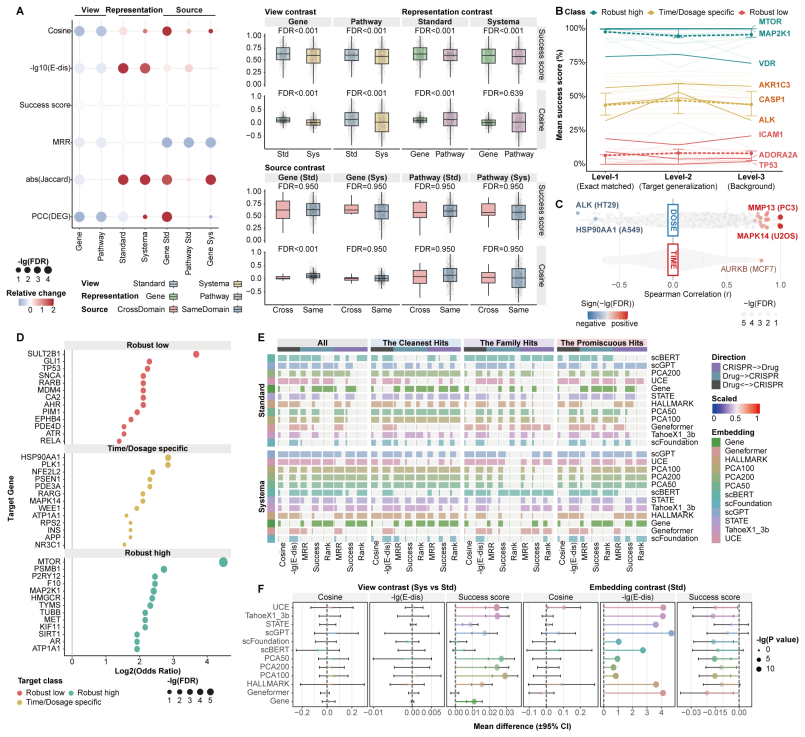
Across matched contexts, translation fidelity is measurable but heterogeneous; background adjustment increases the association between pairwise similarity and retrieval success, while paired tests show lower mean retrieval success after adjustment under the evaluated settings. In a target-matched K562 audit, the evaluated foundation-model embeddings did not consistently improve over gene-delta baselines.
What carries the argument
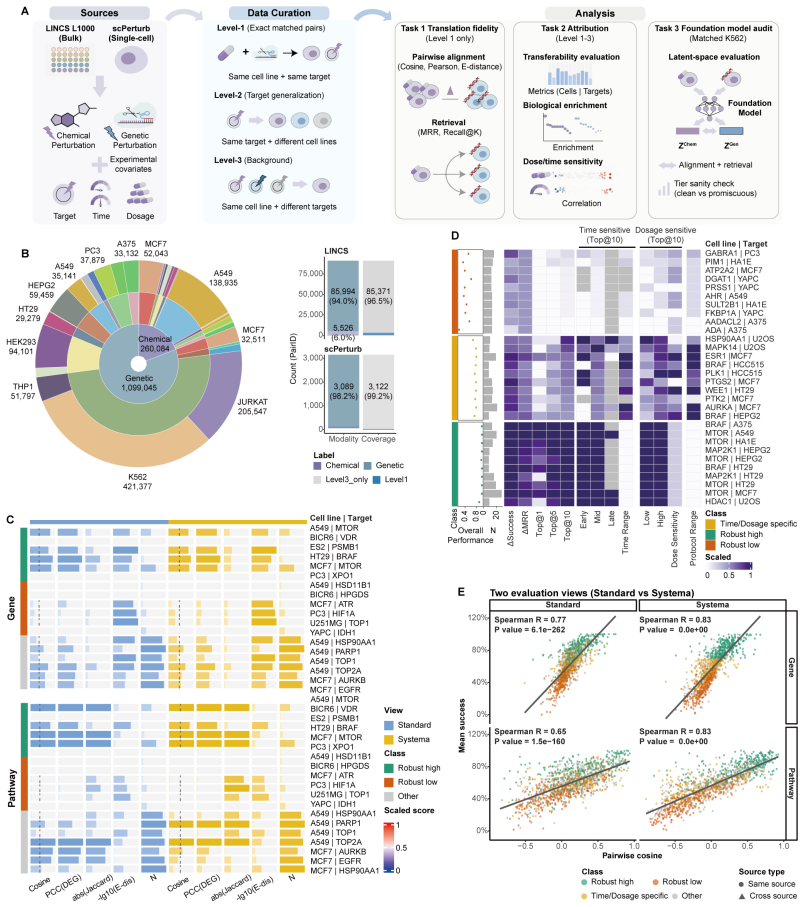
Chem2Gen-Bench, a collection of 260,084 chemical and 1,099,045 genetic perturbation profiles grouped into cell-target contexts for direct pairwise alignment, retrieval, and embedding tests.
If this is right
- Translation fidelity varies by cell-target context and must be audited per context rather than assumed uniform.
- Background adjustment strengthens the link between similarity and retrieval success but reduces average retrieval rates in paired settings.
- Foundation-model embeddings require additional matched evidence before they can be expected to outperform simple gene-delta baselines.
- The benchmark supplies an auditable way to determine when perturbations align around shared targets.
Where Pith is reading between the lines
- Reducing unmeasured protocol differences across datasets could narrow the observed heterogeneity in translation success.
- Gene-delta baselines may remain competitive for many practical predictions until larger matched audits are performed.
- Extending the same matching approach to additional cell types could identify target classes that support more reliable chemical-genetic interchange.
Load-bearing premise
Chemical and genetic perturbation profiles can be meaningfully organized into comparable cell-target contexts that support direct pairwise alignment, retrieval, and embedding comparisons without major unaccounted batch or protocol effects.
What would settle it
A new audit across additional matched cell lines in which background-adjusted similarity scores show no rise in correlation with retrieval success rates, or in which foundation-model embeddings consistently outperform gene-delta baselines.
Figures
read the original abstract
Virtual-cell and perturbation models are increasingly used to predict cellular responses for biomedical discovery, but chemical and genetic perturbations are not automatically interchangeable. Existing evaluations often study chemical response prediction or genetic perturbation prediction separately, leaving target-matched chemical-to-genetic translation under-tested. We introduce Chem2Gen-Bench, a benchmark comprising 260,084 chemical and 1,099,045 genetic perturbation profiles organized into cell-target contexts, and evaluate pairwise alignment, retrieval, protocol covariate associations, feature spaces, and foundation-model embeddings. Across matched contexts, translation fidelity is measurable but heterogeneous; background adjustment increases the association between pairwise similarity and retrieval success, while paired tests show lower mean retrieval success after adjustment under the evaluated settings. In a target-matched K562 audit, the evaluated foundation-model embeddings did not consistently improve over gene-delta baselines. Chem2Gen-Bench provides an auditable framework for testing when chemical and genetic perturbations align around shared targets and when representation gains are supported by matched perturbation evidence.
Editorial analysis
A structured set of objections, weighed in public.
Referee Report
Summary. The paper introduces Chem2Gen-Bench, a benchmark with 260,084 chemical and 1,099,045 genetic perturbation profiles organized into cell-target contexts. It evaluates pairwise alignment, retrieval, protocol covariate associations, feature spaces, and foundation-model embeddings. Key claims are that translation fidelity is measurable but heterogeneous; background adjustment increases the association between pairwise similarity and retrieval success while lowering mean retrieval success in paired tests; and in a target-matched K562 audit, evaluated foundation-model embeddings did not consistently improve over gene-delta baselines. The work positions the benchmark as an auditable framework for testing when chemical and genetic perturbations align around shared targets.
Significance. If the matching of profiles into comparable contexts is valid, the benchmark addresses a gap in separate evaluations of chemical vs. genetic perturbation prediction by providing target-matched translation tests at scale. The explicit provision of an auditable framework and large organized dataset counts as a strength for reproducibility. The findings on heterogeneous fidelity and adjustment effects could inform virtual-cell model development if technical confounds are ruled out.
major comments (2)
- [Abstract (data organization and evaluation)] The central claims on measurable but heterogeneous translation fidelity, background adjustment effects, and foundation-model performance rest on the assumption that the 260k chemical + 1M genetic profiles can be partitioned into comparable cell-target contexts (shared target gene + cell line) without residual technical variation from protocols, platforms, or batches. The abstract states that protocol covariate associations were evaluated, but it is unclear from the description whether these were corrected or only correlated; if only correlated, the reported heterogeneity and retrieval outcomes could be artifacts. This assumption is load-bearing for all empirical results.
- [Abstract (K562 audit)] In the target-matched K562 audit, the conclusion that foundation-model embeddings did not consistently improve over gene-delta baselines is directly sensitive to any platform mismatch between chemical and genetic profiles. Without explicit validation that matching criteria eliminate systematic offsets, the comparison between embeddings and baselines cannot be interpreted as evidence about representation gains.
Simulated Author's Rebuttal
We thank the referee for the detailed and constructive comments on Chem2Gen-Bench. We address each major comment below with clarifications on our methods and indicate where revisions will be made to improve transparency.
read point-by-point responses
-
Referee: [Abstract (data organization and evaluation)] The central claims on measurable but heterogeneous translation fidelity, background adjustment effects, and foundation-model performance rest on the assumption that the 260k chemical + 1M genetic profiles can be partitioned into comparable cell-target contexts (shared target gene + cell line) without residual technical variation from protocols, platforms, or batches. The abstract states that protocol covariate associations were evaluated, but it is unclear from the description whether these were corrected or only correlated; if only correlated, the reported heterogeneity and retrieval outcomes could be artifacts. This assumption is load-bearing for all empirical results.
Authors: We agree that the distinction between correlation and correction is important for interpretation. The manuscript evaluates associations between protocol covariates and the similarity/retrieval metrics (as stated in the abstract) but does not apply any corrections to the profiles. This choice was deliberate to create an auditable benchmark that surfaces the effects of technical variation rather than removing them. We will revise the abstract, methods, and results sections to explicitly state that associations were quantified without correction, and we will add further discussion of how users can apply their own adjustments within the framework. revision: yes
-
Referee: [Abstract (K562 audit)] In the target-matched K562 audit, the conclusion that foundation-model embeddings did not consistently improve over gene-delta baselines is directly sensitive to any platform mismatch between chemical and genetic profiles. Without explicit validation that matching criteria eliminate systematic offsets, the comparison between embeddings and baselines cannot be interpreted as evidence about representation gains.
Authors: We acknowledge that the K562 results are conditional on the target-matched context definition and that no additional post-matching validation for platform offsets was performed beyond the shared cell line and target criteria. The benchmark is presented as an evaluation under these matching rules, with the explicit goal of enabling further audits. We will expand the discussion section to note the potential for residual platform effects and the limitations this imposes on claims about representation gains. revision: partial
Circularity Check
Empirical benchmark evaluation with no derivation chain
full rationale
This is a data-organization and retrieval benchmark paper. It partitions existing chemical/genetic profiles into cell-target contexts, computes pairwise similarities and retrieval success, tests protocol covariates, and compares foundation-model embeddings against gene-delta baselines. No equations, first-principles derivations, or predictions are claimed; all reported quantities (fidelity, adjustment effects, K562 audit) are direct empirical measurements on the assembled dataset. No self-citation load-bearing steps, fitted-input-as-prediction, or ansatz smuggling appear. The work is self-contained against external benchmarks and receives the default low-circularity finding.
Axiom & Free-Parameter Ledger
free parameters (1)
- background adjustment protocol
Reference graph
Works this paper leans on
-
[1]
Nature Methods , author =. 2024 , pmid =. doi:10.1038/s41592-023-02144-y , abstract =
-
[2]
Three million images and morphological profiles of cells treated with matched chemical and genetic perturbations , issn =. Nature Methods , author =. 2024 , pmid =. doi:10.1038/s41592-024-02241-6 , abstract =
-
[3]
Causal identification of single-cell experimental perturbation effects with. Nature Methods , author =. 2023 , pmid =. doi:10.1038/s41592-023-02040-5 , abstract =
-
[4]
A foundation model for clinician-centered drug repurposing , issn =. Nature Medicine , author =. 2024 , pmid =. doi:10.1038/s41591-024-03233-x , abstract =
-
[5]
Nature Biotechnology , author =
Predicting transcriptional outcomes of novel multigene perturbations with. Nature Biotechnology , author =. 2024 , pmid =. doi:10.1038/s41587-023-01905-6 , abstract =
-
[6]
Nature Communications , author =
Predicting transcriptional responses to novel chemical perturbations using deep generative model for drug discovery , volume =. Nature Communications , author =. 2024 , pmid =. doi:10.1038/s41467-024-53457-1 , abstract =
-
[7]
Learning single-cell perturbation responses using neural optimal transport , volume =. Nature Methods , author =. 2023 , pmid =. doi:10.1038/s41592-023-01969-x , abstract =
-
[8]
Genome Biology , author =. 2024 , pmid =. doi:10.1186/s13059-024-03436-y , abstract =
-
[9]
Li, Chen and Gao, Haoxiang and She, Yuli and Bian, Haiyang and Chen, Qing and Liu, Kai and Wei, Lei and Zhang, Xuegong , month = jan, year =. Benchmarking. doi:10.1101/2024.12.20.629581 , abstract =
-
[10]
Nature Communications , author =
Predicting cell morphological responses to perturbations using generative modeling , volume =. Nature Communications , author =. 2025 , pmid =. doi:10.1038/s41467-024-55707-8 , abstract =
-
[11]
Mapping cells through time and space with moscot , copyright =. Nature , author =. 2025 , note =. doi:10.1038/s41586-024-08453-2 , abstract =
-
[12]
Multiplexed single-cell characterization of alternative polyadenylation regulators , volume =. Cell , author =. 2024 , pmid =. doi:10.1016/j.cell.2024.06.005 , abstract =
-
[13]
doi:10.1101/2025.02.05.636714 , abstract =
Wang, Chloe and Cui, Haotian and Zhang, Andrew and Xie, Ronald and Goodarzi, Hani and Wang, Bo , month = feb, year =. doi:10.1101/2025.02.05.636714 , abstract =
-
[14]
Zhang, Jesse and Ubas, Airol A. and Borja, Richard de and Svensson, Valentine and Thomas, Nicole and Thakar, Neha and Lai, Ian and Winters, Aidan and Khan, Umair and Jones, Matthew G. and Tran, Vuong and Pangallo, Joseph and Papalexi, Efthymia and Sapre, Ajay and Nguyen, Hoai and Sanderson, Oliver and Nigos, Maria and Kaplan, Olivia and Schroeder, Sarah a...
-
[15]
Grow. Cell Research , author =. 2025 , pmid =. doi:10.1038/s41422-025-01101-y , language =
-
[16]
Where do proteins go in cells?. Nature , author =. 2025 , note =. doi:10.1038/d41586-025-01045-8 , abstract =
-
[17]
Nature Cell Biology , author =
Decoding heterogeneous single-cell perturbation responses , volume =. Nature Cell Biology , author =. 2025 , pmid =. doi:10.1038/s41556-025-01626-9 , abstract =
-
[18]
Nature Biotechnology , author =
Virtual cells for predictive immunotherapy , volume =. Nature Biotechnology , author =. 2025 , pmid =. doi:10.1038/s41587-025-02583-2 , language =
-
[19]
doi:10.48550/arXiv.2501.06039 , abstract =
Wenckstern, Johann and Jain, Eeshaan and Vasilev, Kiril and Pariset, Matteo and Wicki, Andreas and Gut, Gabriele and Bunne, Charlotte , month = jan, year =. doi:10.48550/arXiv.2501.06039 , abstract =
-
[20]
Transcriptome-wide analysis of differential expression in perturbation atlases , volume =. Nature Genetics , author =. 2025 , pmid =. doi:10.1038/s41588-025-02169-3 , abstract =
-
[21]
doi:10.1101/2025.07.03.663009 , abstract =
Zhang, Mingxuan and Swamy, Vinay and Cassius, Rowan and Dupire, Léo and Kanatsoulis, Charilaos and Paull, Evan and AlQuraishi, Mohammed and Karaletsos, Theofanis and Califano, Andrea , month = jul, year =. doi:10.1101/2025.07.03.663009 , abstract =
-
[22]
Perturb-. Cell , author =. 2025 , pmid =. doi:10.1016/j.cell.2025.05.022 , abstract =
-
[23]
Nature Biotechnology , author =. 2024 , pmid =. doi:10.1038/s41587-023-01772-1 , abstract =
-
[24]
Human interpretable grammar encodes multicellular systems biology models to democratize virtual cell laboratories , volume =. Cell , author =. 2025 , pmid =. doi:10.1016/j.cell.2025.06.048 , abstract =
-
[25]
Adduri, Abhinav K. and Gautam, Dhruv and Bevilacqua, Beatrice and Imran, Alishba and Shah, Rohan and Naghipourfar, Mohsen and Teyssier, Noam and Ilango, Rajesh and Nagaraj, Sanjay and Dong, Mingze and Ricci-Tam, Chiara and Carpenter, Christopher and Subramanyam, Vishvak and Winters, Aidan and Tirukkovular, Sravya and Sullivan, Jeremy and Plosky, Brian S. ...
-
[26]
Nature Biomedical Engineering , author =
A deep generative model for deciphering cellular dynamics and in silico drug discovery in complex diseases , issn =. Nature Biomedical Engineering , author =. 2025 , pmid =. doi:10.1038/s41551-025-01423-7 , abstract =
-
[27]
URLhttps://doi.org/10.1038/s41592-025-02772-6
Deep-learning-based gene perturbation effect prediction does not yet outperform simple linear baselines , volume =. Nature Methods , author =. 2025 , note =. doi:10.1038/s41592-025-02772-6 , abstract =
-
[28]
doi:10.48550/arXiv.2508.02276 , abstract =
Tang, Xiangru and Yu, Zhuoyun and Chen, Jiapeng and Cui, Yan and Shao, Daniel and Wang, Weixu and Wu, Fang and Zhuang, Yuchen and Shi, Wenqi and Huang, Zhi and Cohan, Arman and Lin, Xihong and Theis, Fabian and Krishnaswamy, Smita and Gerstein, Mark , month = aug, year =. doi:10.48550/arXiv.2508.02276 , abstract =
-
[29]
Chandrasekaran, Srinivas Niranj and Ackerman, Jeanelle and Alix, Eric and Ando, D. Michael and Arevalo, John and Bennion, Melissa and Boisseau, Nicolas and Borowa, Adriana and Boyd, Justin D. and Brino, Laurent and Byrne, Patrick J. and Ceulemans, Hugo and Ch’ng, Carolyn and Cimini, Beth A. and Clevert, Djork-Arne and Deflaux, Nicole and Doench, John G. a...
-
[30]
Cell. Nature Methods , author =. 2025 , pmid =. doi:10.1038/s41592-024-02528-8 , abstract =
-
[31]
Li, Lanxiang and You, Yue and Liao, Wenyu and Fan, Xueying and Lu, Shihong and Cao, Ye and Li, Bo and Ren, Wenle and Fu, Yunlin and Kong, Jiaming and Zheng, Shuangjia and Chen, Jizheng and Liu, Xiaodong and Tian, Luyi , month = dec, year =. A. doi:10.1101/2024.12.23.630036 , abstract =
-
[32]
and Torkar, Michaela and Li, Donghui and Karaletsos, Theofanis , month = aug, year =
Istrate, Ana-Maria and Milletari, Fausto and Castrotorres, Fabrizio and Tomczak, Jakub M. and Torkar, Michaela and Li, Donghui and Karaletsos, Theofanis , month = aug, year =. rbio1 - training scientific reasoning. doi:10.1101/2025.08.18.670981 , abstract =
-
[33]
Morphological map of under- and overexpression of genes in human cells , volume =. Nature Methods , author =. 2025 , pmid =. doi:10.1038/s41592-025-02753-9 , abstract =
-
[34]
Multiscale mathematical model-informed reinforcement learning optimizes combination treatment scheduling in glioblastoma evolution , volume =. Science Advances , author =. 2025 , pmid =. doi:10.1126/sciadv.adv3316 , abstract =
-
[35]
doi:10.1101/2025.09.15.676236 , abstract =
Qin, Hua and Zhang, Yilin and Guo, Zhihan and Hu, Luni and Li, Qingsong and Cao, Lei and Xia, Tianyi and Deng, Ziqing and Zhang, Yong and Li, Yuxiang and Fang, Shuangsang , month = sep, year =. doi:10.1101/2025.09.15.676236 , abstract =
-
[36]
Baysoy, Alev and Tian, Xiaolong and Zhang, Feifei and Renauer, Paul and Bai, Zhiliang and Shi, Hao and Li, Haikuo and Tao, Bo and Yang, Mingyu and Enninful, Archibald and Gao, Fu and Wang, Guangchuan and Zhang, Wanqiu and Tran, Thao and Patterson, Nathan Heath and Bao, Shuozhen and Dong, Chuanpeng and Xin, Shan and Zhong, Mei and Rankin, Sherri and Guy, C...
-
[37]
Nature Biotechnology , author =
Disentanglement of single-cell data with biolord , volume =. Nature Biotechnology , author =. 2024 , pmid =. doi:10.1038/s41587-023-02079-x , abstract =
-
[38]
Predicting cellular responses to complex perturbations in high-throughput screens , volume =. Molecular Systems Biology , author =. 2023 , pmid =. doi:10.15252/msb.202211517 , abstract =
-
[39]
Nature Methods , author =. 2019 , pmid =. doi:10.1038/s41592-019-0494-8 , abstract =
-
[40]
and Polanski, Krzysztof and Eliasof, Moshe and Schonlieb, Carola-Bibiane and Teichmann, Sarah A
Megas, Stathis and Chen, Daniel G. and Polanski, Krzysztof and Eliasof, Moshe and Schonlieb, Carola-Bibiane and Teichmann, Sarah A. , month = sep, year =. Celcomen: spatial causal disentanglement for single-cell and tissue perturbation modeling , shorttitle =. doi:10.48550/arXiv.2409.05804 , abstract =
-
[41]
Toward a foundation model of causal cell and tissue biology with a. Cell , author =. 2024 , pmid =. doi:10.1016/j.cell.2024.07.035 , language =
-
[42]
Nature Biomedical Engineering , author =
Integrated in vivo combinatorial functional genomics and spatial transcriptomics of tumours to decode genotype-to-phenotype relationships , copyright =. Nature Biomedical Engineering , author =. 2025 , note =. doi:10.1038/s41551-025-01437-1 , abstract =
-
[43]
Briefings in Bioinformatics , author =. 2023 , note =. doi:10.1093/bib/bbad338 , abstract =
-
[44]
doi:10.1101/2025.11.08.686890 , abstract =
Lin, Xiang and Kong, Zhenglun and Ghosh, Soumya and Kellis, Manolis and Zitnik, Marinka , month = nov, year =. doi:10.1101/2025.11.08.686890 , abstract =
-
[45]
Ramjattun, Koushul and Wang, Alyson and Lee, Hannah and Giri, Shilpi and Chen, Yijia and MacDonald, William A. and Lord, Nathan D. and Poholek, Amanda C. and Lee, Youjin and Das, Jishnu , month = nov, year =. Characterizing spatial functional microniches with. doi:10.1101/2025.11.13.688264 , abstract =
-
[46]
Nature Communications , author =
Prioritizing perturbation-responsive gene patterns using interpretable deep learning , volume =. Nature Communications , author =. 2025 , note =. doi:10.1038/s41467-025-61476-9 , abstract =
-
[47]
Nature Biomedical Engineering , author =
Identifying perturbations that boost. Nature Biomedical Engineering , author =. 2025 , note =. doi:10.1038/s41551-025-01357-0 , abstract =
-
[48]
Teo, Alan Yue Yang and Gautier, Matthieu and Brock, Laurent and Tsai, Jennifer Y. J. and Coucy, Alexandra de and Laskaratos, Achilleas and Regazzi, Nicola and Barraud, Quentin and Sofroniew, Michael V. and Anderson, Mark A. and Courtine, Grégoire and Squair, Jordan W. and Skinnider, Michael A. , month = jun, year =. Identification of perturbation-responsi...
-
[49]
Spatial. Cell , author =. 2022 , pmid =. doi:10.1016/j.cell.2022.02.015 , abstract =
-
[50]
doi:10.1101/2024.09.27.615337 , abstract =
Cao, Shenghao and Yang, Kaiyuan and Cheng, Jiabei and Li, Jiachen and Shen, Hong-Bin and Pan, Xiaoyong and Yuan, Ye , month = aug, year =. doi:10.1101/2024.09.27.615337 , abstract =
-
[51]
Squidiff: predicting cellular development and responses to perturbations using a diffusion model , issn =. Nature Methods , author =. 2025 , pmid =. doi:10.1038/s41592-025-02877-y , abstract =
-
[52]
Nature Biotechnology , author =
Systema: a framework for evaluating genetic perturbation response prediction beyond systematic variation , issn =. Nature Biotechnology , author =. 2025 , pmid =. doi:10.1038/s41587-025-02777-8 , abstract =
-
[53]
Wu, Yan and Wershof, Esther and Schmon, Sebastian M. and Nassar, Marcel and Osiński, Błażej and Eksi, Ridvan and Yan, Zichao and Stark, Rory and Zhang, Kun and Graepel, Thore , month = oct, year =. doi:10.48550/arXiv.2408.10609 , abstract =
-
[54]
Nature Computational Science , author =
Scouter predicts transcriptional responses to genetic perturbations with large language model embeddings , copyright =. Nature Computational Science , author =. 2025 , note =. doi:10.1038/s43588-025-00912-8 , abstract =
-
[55]
doi:10.1101/2025.07.08.663664 , abstract =
Xu, Jing and Yang, Xiaolu and Li, Yunguang and Wang, Huan and Li, Yikai and Tang, Shijie and Guo, Shiwei and Zou, Jiawei and Shi, Xiaohan and Chen, Zexi and Zhong, Chaoliang and Li, Penghao and Jing, Wei and Zheng, Kailian and Wu, Xinqian and Gao, Dong and Chen, Luonan and Jin, Gang , month = jul, year =. doi:10.1101/2025.07.08.663664 , abstract =
-
[56]
Li, Krinos and Xiao, Xianglu and Deng, Shenglong and He, Lucas and Zhong, Zijun and Zou, Yuanjie and Zhan, Zhonghao and Hui, Zheng and Bao, Weiye and Yang, Guang , month = oct, year =. Large. doi:10.48550/arXiv.2510.07706 , abstract =
-
[57]
Nature Communications , author =. 2025 , pmid =. doi:10.1038/s41467-025-67481-2 , abstract =
-
[58]
Benchmarking algorithms for generalizable single-cell perturbation response prediction , issn =. Nature Methods , author =. 2025 , pmid =. doi:10.1038/s41592-025-02980-0 , abstract =
-
[59]
and Yu, John and Merico, Daniele and Goodarzi, Hani and Alidoust, Nima , month = oct, year =
Gandhi, Shreshth and Javadi, Farnoosh and Svensson, Valentine and Khan, Umair and Jones, Matthew G. and Yu, John and Merico, Daniele and Goodarzi, Hani and Alidoust, Nima , month = oct, year =. Tahoe-x1:. doi:10.1101/2025.10.23.683759 , abstract =
-
[60]
Youngblut, Nicholas D. and Carpenter, Christopher and Prashar, Jaanak and Ricci-Tam, Chiara and Ilango, Rajesh and Teyssier, Noam and Konermann, Silvana and Hsu, Patrick D. and Dobin, Alexander and Burke, David P. and Goodarzi, Hani and Roohani, Yusuf H. , month = mar, year =. doi:10.1101/2025.02.27.640494 , abstract =
-
[61]
and Buendia, Alejandro and Brunet, Anne and Zou, James , month = dec, year =
Sun, Eric D. and Buendia, Alejandro and Brunet, Anne and Zou, James , month = dec, year =. doi:10.64898/2025.11.30.691355 , abstract =
-
[62]
Massively multiplex chemical transcriptomics at single-cell resolution , volume =. Science , author =. 2020 , pmid =. doi:10.1126/science.aax6234 , abstract =
-
[63]
Nature Communications , author =
Multiplexed single-cell transcriptional response profiling to define cancer vulnerabilities and therapeutic mechanism of action , volume =. Nature Communications , author =. 2020 , pmid =. doi:10.1038/s41467-020-17440-w , abstract =
-
[64]
and Zhou, Peijie and Wen, Han and Zhu, Yi and Guo, Tiannan , month = feb, year =
Sun, Rui and Qian, Liujia and Li, Yongge and Cheng, Honghan and Xue, Zhangzhi and Zhang, Xuedong and Tan, Lingling and Zhan, Yuecheng and Hu, Wenbin and Xiao, Qi and Liu, Zhiwei and Zhang, Guangmei and Weinan, E. and Zhou, Peijie and Wen, Han and Zhu, Yi and Guo, Tiannan , month = feb, year =. A perturbation proteomics-based foundation model for virtual c...
-
[65]
Huang, Ann C. and Hsieh, Tsung-Han S. and Zhu, Jiang and Michuda, Jackson and Teng, Ashton and Kim, Soohong and Rumsey, Elizabeth M. and Lam, Sharon K. and Anigbogu, Ikenna and Wright, Philip and Ameen, Mohamed and You, Kwontae and Graves, Christopher J. and Kim, Hyunsung John and Litterman, Adam J. and Sit, Rene V. and Blocker, Alex and Chu, Ci , month =...
-
[66]
2026 , file =
arcinstitute/. 2026 , file =
2026
-
[67]
Wei, Zhijian and Ma, Runze and Wang, Zichen and Li, Zhongmin and Song, Shuotong and Zheng, Shuangjia , month = oct, year =
-
[68]
doi:10.64898/2026.01.19.696785 , abstract =
Zhang, Yuhui and Su, Yuchang and Wefers, Zoe and Su, Shiye and Li, He and Li, Tianhong and Wang, Chenyu and Burgess, James and Lozano, Alejandro and Zhou, Linqi and Ding, Daisy and Nirschl, Jeffrey and Lundberg, Emma and Yeung-Levy, Serena , month = jan, year =. doi:10.64898/2026.01.19.696785 , abstract =
-
[69]
Vascularized tumor organoids enable immunotherapy testing in tumor-remodeled stroma , copyright =
Wimmer, Reiner and Krese, Rok and Henniger, Louisa and Niu, Steve and Lagarde, Nadege and Keller, Timon and Clausen, Inga and Köchel, Fabian and Koller, Claudia Ferrara and Waldhauer, Inja and Bacac, Marina and Gjorevski, Nikolche and Melnikov, Fjodor and Villenave, Remi , month = jan, year =. Vascularized tumor organoids enable immunotherapy testing in t...
-
[70]
Inferring virtual cell environments using multi-agent reinforcement learning , copyright =
Kalafut, Noah Cohen and He, Chenfeng and Sheng, Jie and Chandrashekar, Pramod Bharadwaj and Choi, Jerome and Wang, Daifeng , month = nov, year =. Inferring virtual cell environments using multi-agent reinforcement learning , copyright =. doi:10.1101/2025.11.21.689815 , abstract =
-
[71]
Human organoids as. Nature Reviews. Drug Discovery , author =. 2026 , pmid =. doi:10.1038/s41573-025-01317-y , abstract =
-
[72]
Mapping convergent regulators of melanoma drug resistance by. Nature , author =. 2026 , note =. doi:10.1038/s41586-026-10367-0 , abstract =
-
[73]
Global genetic interaction network of a human cell maps conserved principles and informs functional interpretation of gene co-essentiality profiles , volume =. Cell , author =. 2026 , note =. doi:10.1016/j.cell.2026.03.044 , abstract =
-
[74]
Dibaeinia, Payam and Babu, Sudarshan and Knudson, Mei and ElSheikh, Ali and Wen, Yibo and Liu, Han and Perera, Jason and Khan, Aly A. , month = feb, year =. Virtual. doi:10.64898/2026.02.04.703804 , abstract =
-
[75]
Deep learning of functional perturbations from condensate morphology , volume =. Cell , author =. 2026 , pmid =. doi:10.1016/j.cell.2026.05.010 , abstract =
-
[76]
Yuan, Xinyu and Liu, Xixian and Zhang, Ya Shi and Zhang, Zuobai and Guo, Hongyu and Tang, Jian , month = feb, year =. doi:10.48550/arXiv.2602.19685 , abstract =
-
[77]
Cell , volume =
A Next Generation Connectivity Map: L1000 Platform and the First 1,000,000 Profiles , author =. Cell , volume =. 2017 , doi =
2017
-
[78]
Nature Medicine , volume =
The Drug Repurposing Hub: a Next-Generation Drug Library and Information Resource , author =. Nature Medicine , volume =. 2017 , doi =
2017
-
[79]
Cell , volume =
Mapping Information-Rich Genotype-Phenotype Landscapes with Genome-Scale Perturb-seq , author =. Cell , volume =. 2022 , doi =
2022
-
[80]
Nature Methods , volume =
scGPT: Toward Building a Foundation Model for Single-Cell Multi-Omics Using Generative AI , author =. Nature Methods , volume =. 2024 , doi =
2024
discussion (0)
Sign in with ORCID, Apple, or X to comment. Anyone can read and Pith papers without signing in.