REVIEW 4 major objections 6 minor 65 references
A malicious federated-learning client can hide a backdoor that activates only after a legitimate unlearning request removes the camouflage samples.
Reviewed by Pith at T0; open to challenge. T0 means a machine referee read the full paper against a public rubric. the ladder, T0–T4 →
A malicious federated-learning client can hide a backdoor by adding trigger-labeled samples plus camouflage samples, then activate it by requesting unlearning of the camouflage samples.
T0 review reviewed 2026-08-05 challenge →
load-bearing objection BadFU is a credible first demonstration that federated unlearning can activate dormant backdoors; the core claim survives, but the paper needs to fix its unlearning-method instantiations and reporting before I'd trust the breadth claims. the 4 major comments →
BadFU: Backdoor Federated Learning through Adversarial Machine Unlearning
The pith
A machine-rendered reading of the paper's core claim, the machinery that carries it, and where it could break.
The reading
Core claim
Central claim: federated unlearning is an activation switch, not just a compliance service. BadFU has a malicious client add two disjoint poison sets — backdoor samples (trigger + target label) and camouflage samples (same trigger, original label) — whose gradients oppose each other. After aggregation, the global model looks normal (pre-activation ASR in the single digits to roughly 40 percent; benign accuracy within about 1–3 percent of an honest model). Deleting the camouflage samples removes the opposing gradient, and ASR jumps to roughly 50–99 percent. This is validated across three datasets, several architectures, three FL aggregators, and four unlearning methods; Median/Trimean and Neu
What carries the argument
The load-bearing object is the camouflage sample: an attacker-controlled training sample that carries the same backdoor trigger as the poison sample but keeps its original label. Its training gradient opposes the poison gradient, and in federated aggregation this opposition keeps the backdoor dormant during training. The unlearning request is the activation switch — it removes the camouflage samples' influence at sample granularity, leaving the poison gradient unopposed and flipping the global model into the backdoored state.
Load-bearing premise
The attack depends on the unlearning service removing exactly the camouflage samples' influence at sample granularity from a client that stays in the federation, leaving the backdoor samples' influence intact, and processing the deletion request without auditing its contents.
What would settle it
Run the same BadFU setup but have the server unlearn a control set of the same size drawn from random clean samples of the malicious client, and compare post-unlearning ASR; the gradient-cancellation mechanism predicts no activation from the control, so a large ASR jump there would refute the central claim. A simpler check is inspecting the deleted samples: if the camouflage samples do not all carry the attack trigger, the activation should not occur.
If this is right
- Any cross-silo FL service that honors per-sample deletion requests must treat the stream of unlearning requests as adversarial input, not just a compliance operation.
- Because BadFU composes with existing trigger-injection techniques, unlearning-activated backdoors could appear under a variety of visual triggers, including subtle blended patterns.
- Attackers can tune the camouflage-to-poison ratio to improve stealth without sacrificing post-activation potency, so low trigger accuracy during training is not evidence that a backdoor is absent.
- Training-time defenses such as robust aggregation or Neural Cleanse did not stop the attack in the paper's experiments, so defenses must look at the post-unlearning model or at the requests themselves.
- The attack works across exact retraining and approximate unlearning methods, meaning that adopting efficient federated unlearning does not by itself close the vulnerability.
Where Pith is reading between the lines
- An implication the paper does not test: the cancel-and-delete mechanism should generalize to non-backdoor poisoning goals, such as targeted misclassification, whenever a poison signal can be paired with a deletable counter-signal — making sample-level deletion rights a generic poisoning vector.
- The deleted camouflage samples all share the trigger pattern with the surviving backdoor samples, so a server that audits unlearning requests for repeated patterns would have a cheap, likely effective defense that the paper does not evaluate.
- Because the experiments are limited to image classification, the next natural test is whether the gradient cancellation survives in transformer-based or generative models, where feature geometry differs; if it does not, the vulnerability may be narrower than the paper's framing suggests.
- The paper's claimed independence from the backdoor dataset and the global model is what makes the attack practical without influence functions; if that independence holds, the attack works even for adversaries with no knowledge of model internals.
Editorial analysis
A structured set of objections, weighed in public.
Referee Report
Summary. The paper proposes BadFU, a backdoor attack against federated learning that is activated by a legitimate federated unlearning request. A malicious client trains locally on a mixture of clean, backdoor (trigger + target label), and camouflage (trigger + original label) samples. During federated training the camouflage samples are claimed to suppress the backdoor, yielding low pre-activation ASR and preserved accuracy; after the malicious client requests unlearning of the camouflage samples, the backdoor is claimed to activate. Experiments cover MNIST, CIFAR-10, and CIFAR-100; BadNet and Blended triggers; FedAvg, FedSGD, and FedProx; and retraining, FedEraser, FedU, and SIFU unlearning. The central reported pattern is a large ASR increase after unlearning (roughly 11-40% pre-activation to 50-99% post-activation) with ACC approximately unchanged.
Significance. If the central claim holds, the paper identifies a genuinely new attack surface: a malicious FL client can use the unlearning mechanism itself as a backdoor trigger, while submitting updates that are not anomalous during training. The inclusion of a benign-unlearning control (Table V) is a good experimental design choice, and the source-code release is a strength. However, the current evidence for the broad claim across approximate federated unlearning methods is not established, and several reported numbers are internally inconsistent. The novelty relative to prior centralized unlearning-activated backdoors (UBA-Inf, BAMU) is clear, but the federated-specific validation needs substantial repair before the contribution can be assessed.
major comments (4)
- [Sections IV-D, VI-D, VII-H; Table VIII] The threat model requires sample-level removal: only the camouflage samples D_c of a continuing malicious client are unlearned, while D_bd remains. FedEraser and SIFU are client-level federated unlearning methods: FedEraser removes a client's recorded updates, and SIFU adds calibrated noise to erase a client's influence. The paper does not specify how these methods are adapted to delete only a subset of a continuing client's local samples. If the implementation removed the whole malicious client, D_bd would also be erased and the stated mechanism would not hold; if a custom sample-level adaptation was used, the experiments no longer evaluate the published FedEraser/SIFU algorithms. The Table VIII claims of 60.12% and 85.59% post-activation ASR for FedU and SIFU are therefore unsupported. This is load-bearing because the advertised 'broad applicability' across unlearning strategies rests
- [Algorithm 1, lines 8-9] In DataPrepare, both D_bd and D_c are reset to the empty set immediately before the poisoning loops (lines 8-9). The function then returns empty datasets, so Algorithm 1 as printed cannot produce the backdoor and camouflage sets used in the experiments. This is not a presentation typo; it makes the pseudocode inconsistent with the executed method. The authors must correct the algorithm and ensure the printed code matches the released implementation.
- [Tables III, IX, and II; Figure 2] The claim that BadFU keeps the backdoor 'dormant' or leaves the model 'unaffected' during training is undercut by pre-activation ASRs that are far above chance: 40.31% on MNIST with Blended under Dirichlet (Table III), 39.62% and 39.43% on CIFAR-100 (Table IX), and roughly 30% in several FedProx conditions (Table II). For 10-class and 100-class tasks these are not low values. Additionally, Table II reports CIFAR-10 FedProx BadNet ACC as 97.52/97.53%, while the same dataset/model in Table I gives 84.84%, a 12-percentage-point discrepancy that is not explained. These inconsistencies affect the core stealth claim and the aggregation comparison and must be resolved.
- [Section VII-A, Tables I and IV] The exact-retraining rows in Tables I, III, IV, and IX are close to construction: retraining from scratch on the data without the camouflage samples is equivalent to a standard backdoor training run, so a high post-retraining ASR is unsurprising. The non-circular empirical content of the paper lies in the pre-activation dormancy and in the approximate-unlearning transitions. The retraining baseline should be framed as a sanity check rather than as independent evidence that unlearning 'activates' the backdoor. Once the sample-level implementation of FedEraser/SIFU is clarified, the novel burden of proof shifts entirely to those approximate methods, which currently lack sufficient detail.
minor comments (6)
- [Section VII-A, paragraph 3] The text states FedEraser ASR is '65% for VGG-16 and 50% for LeNet-5', but Table I reports 49.23% for VGG-16 and 68.55% for LeNet-5. The example values are swapped and inaccurate.
- [Section VI-B] The paper states each experiment was repeated three times and averages are reported, but no standard deviations, confidence intervals, or per-seed values are shown. Given that some pre/post differences are modest (e.g., FedEraser on LeNet-5, Table I), the absence of variance information makes it hard to judge the stability of the results.
- [Section VII-H, Table VIII] Each approximate unlearning method is evaluated on a single dataset/model pair, with no comparison to the exact-retraining or FedEraser baselines under identical conditions. This limits the generality of the claim that BadFU is 'effective' across FedU and SIFU.
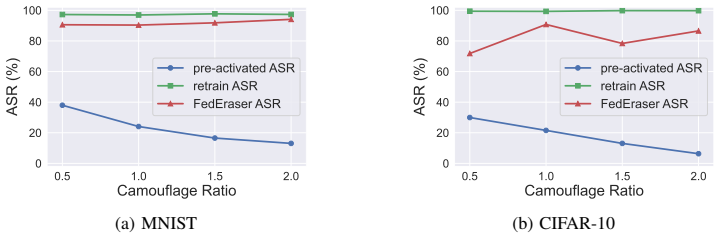
- [Figure 2] The x-axis label 'Camouflage Ratio' is ambiguous. The text indicates it is the ratio of camouflage samples to backdoor samples, but the axis should be labeled explicitly (e.g., |D_c|/|D_bd|).
- [Appendix X-A] There is a typo: 'FedA VG' should be 'FedAvg'.
- [Section VII-G, Table VII] The statement that NC indices are 'unstable across repeated experiments' is not backed by any reported repeated-run statistics. The threshold discussion also assumes the reader knows the NC index scale; a brief explanation of what the values mean would improve clarity.
Circularity Check
Partial circularity: post-activation under exact retraining is the standard backdoor model by construction; pre-activation dormancy and approximate-unlearning results retain independent empirical content.
specific steps
-
self definitional
[Section V-D (Backdoor Activation via Federated Unlearning), Eqs. (7)-(8); cf. Algorithm 1]
"From a gradient perspective, the unlearning process revokes the influence of ∇Lc, such that only ∇Lbd remains, assuming the federated unlearning mechanism effectively removes the information associated with the camouflage samples. As a result, the backdoor gradients take full effect, causing the model to exhibit backdoor behavior when the trigger is present."
In Eq. (7), the local objective is Lclean + Lbd + Lc, where Dbd is defined as backdoor samples (trigger inserted, label flipped to yt) and Dc as camouflage samples (trigger inserted, original labels retained). Section V-D defines activation as removing ∇Lc. Therefore, the post-unlearning model is, by construction, the model trained on benign data plus Dbd alone — i.e., a standard backdoor-poisoned model. The high post-activation ASR under exact retraining is then just the standard backdoor effect of the injected Dbd, not an independent consequence of the unlearning operation. The transition is built into which samples the attacker chooses to delete. The independent empirical content is the low pre-activation ASR (dormancy) and the behavior under approximate unlearning methods, which do not
full rationale
BadFU is fundamentally an attack-construction paper, and most of its reported results are genuine experiments rather than fitted predictions. No parameter is fitted to data and then renamed a prediction; there is no load-bearing self-citation chain, and no uniqueness theorem is imported from the authors' prior work. However, one component of the central claim — that the global model becomes backdoored after exact retraining unlearning — reduces by construction. The paper's own model (Section V-D, Eq. 7-8) defines unlearning of Dc as revoking ∇Lc, leaving exactly the backdoor loss ∇Lbd. Retraining without Dc is definitionally training with Dbd present, so the high post-activation ASR in the retraining rows of Tables I-IV is a standard backdoor-training outcome rather than an independent validation of unlearning as a trigger. The genuinely non-circular findings are the pre-activation dormancy (Tables I-IV, Fig. 2) and the incomplete-activation behavior under approximate unlearning (FedEraser, FedU, SIFU). Separately, the breadth claim across FedEraser/SIFU is a correctness/reproducibility concern, not a circularity: those are client-level unlearning methods, and Section VII-H/Table VIII does not specify how sample-level removal of only Dc from a continuing malicious client is instantiated; the printed Algorithm 1 also sets Dbd and Dc to empty before use (lines 8-9). Those issues should be weighed as experimental validity risks, not as evidence of circular derivation. On balance, the exact-retraining activation result is partially self-definitional, while the attack's core stealth claim is independent, giving a partial circularity score of 6.
Axiom & Free-Parameter Ledger
free parameters (4)
- camouflage-to-backdoor sample ratio =
default 1x; scanned 0.5x, 1x, 1.5x, 2x
- backdoor poisoning budget =
1,000 samples (MNIST), 850 (CIFAR-10/100); under 2% of the global dataset
- trigger pattern and placement =
3x3 corner patch (BadNet); blended watermark (Blended)
- target class yt =
not reported for most runs (class 0 in the NC experiment)
axioms (4)
- domain assumption The unlearning mechanism faithfully removes exactly the camouflage samples' influence at sample granularity and leaves the backdoor samples' influence intact.
- domain assumption The server honors unlearning requests without inspecting the deleted samples, which contain the trigger pattern.
- domain assumption A malicious client holds a majority of target-class data and has a small auxiliary set spanning all labels.
- ad hoc to paper FL aggregation and non-IID heterogeneity amplify the camouflage effect so the global model stays clean pre-activation.
Cite this review
Pith. "Pith review of BadFU: Backdoor Federated Learning through Adversarial Machine Unlearning." pith.science (2026). https://pith.science/paper/BAOWV6ZK
@misc{pith2026250815541,
  author       = {Pith},
  title        = {Pith review of: BadFU: Backdoor Federated Learning through Adversarial Machine Unlearning},
  year         = {2026},
  howpublished = {\url{https://pith.science/paper/BAOWV6ZK}},
  note         = {Machine review of arXiv:2508.15541}
}
read the original abstract
Federated learning (FL) has been widely adopted as a decentralized training paradigm that enables multiple clients to collaboratively learn a shared model without exposing their local data. As concerns over data privacy and regulatory compliance grow, machine unlearning, which aims to remove the influence of specific data from trained models, has become increasingly important in the federated setting to meet legal, ethical, or user-driven demands. However, integrating unlearning into FL introduces new challenges and raises largely unexplored security risks. In particular, adversaries may exploit the unlearning process to compromise the integrity of the global model. In this paper, we present the first backdoor attack in the context of federated unlearning, demonstrating that an adversary can inject backdoors into the global model through seemingly legitimate unlearning requests. Specifically, we propose BadFU, an attack strategy where a malicious client uses both backdoor and camouflage samples to train the global model normally during the federated training process. Once the client requests unlearning of the camouflage samples, the global model transitions into a backdoored state. Extensive experiments under various FL frameworks and unlearning strategies validate the effectiveness of BadFU, revealing a critical vulnerability in current federated unlearning practices and underscoring the urgent need for more secure and robust federated unlearning mechanisms.
Figures

Reference graph
Works this paper leans on
-
[1]
Communication-efficient learning of deep networks from decentralized data,
B. McMahan, E. Moore, D. Ramage, S. Hampson, and B. A. y Arcas, “Communication-efficient learning of deep networks from decentralized data,” in Artificial Intelligence and Statistics . PMLR, 2017, pp. 1273– 1282
work page 2017
-
[2]
T. Nevrataki, A. Iliadou, G. Ntolkeras, I. Sfakianakis, L. Lazaridis, G. Maraslidis, N. Asimopoulos, and G. F. Fragulis, “A survey on feder- ated learning applications in healthcare, finance, and data privacy/data security,” in AIP Conference Proceedings , vol. 2909, no. 1. AIP Publishing, 2023
work page 2023
-
[3]
Federated learning for mobile keyboard prediction,
A. Hard, K. Rao, R. Mathews, S. Ramaswamy, F. Beaufays, S. Augen- stein, H. Eichner, C. Kiddon, and D. Ramage, “Federated learning for mobile keyboard prediction,” arXiv preprint arXiv:1811.03604 , 2018
Pith/arXiv arXiv 2018
-
[4]
Ffd: A federated learning based method for credit card fraud detection,
W. Yang, Y . Zhang, K. Ye, L. Li, and C.-Z. Xu, “Ffd: A federated learning based method for credit card fraud detection,” in Big data– bigData 2019: 8th International Congress, held as part of the Services Conference Federation, SCF 2019, San Diego, CA, USA, June 25–30, 2019, proceedings 8 . Springer, 2019, pp. 18–32
work page 2019
-
[5]
Federated learning with non-iid data,
Y . Zhao, M. Li, L. Lai, N. Suda, D. Civin, and V . Chandra, “Federated learning with non-iid data,” arXiv preprint arXiv:1806.00582 , 2018
Pith/arXiv arXiv 2018
-
[6]
A review on machine unlearning,
H. Zhang, T. Nakamura, T. Isohara, and K. Sakurai, “A review on machine unlearning,” SN Computer Science , vol. 4, no. 4, p. 337, 2023
work page 2023
-
[7]
CJEU - C 131/12 / Judgment | European Union Agency for Fundamental Rights,
“CJEU - C 131/12 / Judgment | European Union Agency for Fundamental Rights,” Apr. 2015. [Online]. Available: https://fra.europa. eu/en/caselaw-reference/cjeu-c-13112-judgment
work page 2015
-
[8]
Federated unlearning: A survey on methods, design guidelines, and evaluation metrics,
N. Romandini, A. Mora, C. Mazzocca, R. Montanari, and P. Bellav- ista, “Federated unlearning: A survey on methods, design guidelines, and evaluation metrics,” IEEE Transactions on Neural Networks and Learning Systems, 2024
work page 2024
-
[9]
Federaser: Enabling efficient client-level data removal from federated learning models,
G. Liu, X. Ma, Y . Yang, C. Wang, and J. Liu, “Federaser: Enabling efficient client-level data removal from federated learning models,” in 2021 IEEE/ACM 29th International Symposium on Quality of Service (IWQOS). IEEE, 2021, pp. 1–10
2021
-
[10]
Asynchronous federated unlearning,
N. Su and B. Li, “Asynchronous federated unlearning,” in IEEE INFO- COM 2023-IEEE Conference on Computer Communications . IEEE, 2023, pp. 1–10
work page 2023
-
[11]
Federated un- learning: How to efficiently erase a client in fl?
A. Halimi, S. Kadhe, A. Rawat, and N. Baracaldo, “Federated un- learning: How to efficiently erase a client in fl?” arXiv preprint arXiv:2207.05521, 2022
Pith/arXiv arXiv 2022
-
[12]
Federated unlearning: Guarantee the right of clients to forget,
L. Wu, S. Guo, J. Wang, Z. Hong, J. Zhang, and Y . Ding, “Federated unlearning: Guarantee the right of clients to forget,” IEEE Network , vol. 36, no. 5, pp. 129–135, 2022
work page 2022
-
[13]
The right to be forgotten in federated learning: An efficient realization with rapid retraining,
Y . Liu, L. Xu, X. Yuan, C. Wang, and B. Li, “The right to be forgotten in federated learning: An efficient realization with rapid retraining,” in IEEE INFOCOM 2022-IEEE Conference on Computer Communications. IEEE, 2022, pp. 1749–1758
work page 2022
-
[14]
Federated unlearning and its privacy threats,
F. Wang, B. Li, and B. Li, “Federated unlearning and its privacy threats,” IEEE Network, vol. 38, no. 2, pp. 294–300, 2023
work page 2023
-
[15]
Fedmua: Exploring the vulnerabilities of federated learning to malicious unlearn- ing attacks,
J. Chen, Z. Lin, W. Lin, W. Shi, X. Yin, and D. Wang, “Fedmua: Exploring the vulnerabilities of federated learning to malicious unlearn- ing attacks,” IEEE Transactions on Information Forensics and Security , 2025
work page 2025
-
[16]
X. Sheng, W. Bao, and L. Ge, “Robust federated unlearning,” in Proceedings of the 33rd ACM International Conference on Information and Knowledge Management , 2024, pp. 2034–2044
work page 2024
-
[17]
A duty to forget, a right to be assured? exposing vulnerabilities in machine unlearning services,
H. Hu, S. Wang, J. Chang, H. Zhong, R. Sun, S. Hao, H. Zhu, and M. Xue, “A duty to forget, a right to be assured? exposing vulnerabilities in machine unlearning services,” in NDSS, 2024
work page 2024
-
[18]
Hidden poison: Machine unlearning enables camouflaged poisoning attacks,
J. Z. Di, J. Douglas, J. Acharya, G. Kamath, and A. Sekhari, “Hidden poison: Machine unlearning enables camouflaged poisoning attacks,” in NeurIPS ML Safety Workshop , 2022
work page 2022
-
[19]
{UBA-Inf}: Unlearning activated backdoor attack with {Influence-Driven} camouflage,
Z. Huang, Y . Mao, and S. Zhong, “ {UBA-Inf}: Unlearning activated backdoor attack with {Influence-Driven} camouflage,” in 33rd USENIX Security Symposium (USENIX Security 24) , 2024, pp. 4211–4228
work page 2024
-
[20]
Backdoor attack through machine unlearning,
P. Zhang, J. Sun, M. Tan, and X. Wang, “Backdoor attack through machine unlearning,” CoRR, 2023
work page 2023
-
[21]
A survey on federated unlearning: Challenges, methods, and future directions,
Z. Liu, Y . Jiang, J. Shen, M. Peng, K.-Y . Lam, X. Yuan, and X. Liu, “A survey on federated unlearning: Challenges, methods, and future directions,” ACM Computing Surveys , vol. 57, no. 1, pp. 1–38, 2024
work page 2024
-
[22]
Learn what you want to unlearn: Unlearning inversion attacks against machine unlearning,
H. Hu, S. Wang, T. Dong, and M. Xue, “Learn what you want to unlearn: Unlearning inversion attacks against machine unlearning,” in 2024 IEEE Symposium on Security and Privacy (SP) . IEEE, 2024, pp. 3257–3275
work page 2024
-
[23]
Unlearn and burn: Adversarial machine unlearning requests destroy model accuracy,
Y . Huang, D. Liu, L. Chua, B. Ghazi, P. Kamath, R. Kumar, P. Manu- rangsi, M. Nasr, A. Sinha, and C. Zhang, “Unlearn and burn: Adversarial machine unlearning requests destroy model accuracy,” in The Thirteenth International Conference on Learning Representations, ICLR 2025, Singapore, April 24-28, 2025 . OpenReview.net, 2025
work page 2025
-
[24]
How to backdoor federated learning,
E. Bagdasaryan, A. Veit, Y . Hua, D. Estrin, and V . Shmatikov, “How to backdoor federated learning,” in International Conference on Artificial Intelligence and Statistics . PMLR, 2020, pp. 2938–2948
work page 2020
-
[25]
When machine unlearning jeopardizes privacy,
M. Chen, Z. Zhang, T. Wang, M. Backes, M. Humbert, and Y . Zhang, “When machine unlearning jeopardizes privacy,” in Proceedings of the 2021 ACM SIGSAC Conference on Computer and Communications Security, 2021, pp. 896–911
work page 2021
-
[26]
The privacy onion effect: Memorization is relative,
N. Carlini, M. Jagielski, C. Zhang, N. Papernot, A. Terzis, and F. Tramer, “The privacy onion effect: Memorization is relative,”Advances in Neural Information Processing Systems , vol. 35, pp. 13 263–13 276, 2022
work page 2022
-
[27]
Membership inference attacks against machine learning models,
R. Shokri, M. Stronati, C. Song, and V . Shmatikov, “Membership inference attacks against machine learning models,” in 2017 IEEE Symposium on Security and Privacy (SP) . IEEE, 2017, pp. 3–18
work page 2017
-
[28]
Data duplication: A novel multi-purpose attack paradigm in machine unlearning,
D. Ye, T. Zhu, J. Li, K. Gao, B. Liu, L. Y . Zhang, W. Zhou, and Y . Zhang, “Data duplication: A novel multi-purpose attack paradigm in machine unlearning,” in 34rd USENIX Security Symposium (USENIX Security 25), 2025
work page 2025
-
[29]
Badnets: Identifying vulnera- bilities in the machine learning model supply chain,
T. Gu, B. Dolan-Gavitt, and S. Garg, “Badnets: Identifying vulnera- bilities in the machine learning model supply chain,” arXiv preprint arXiv:1708.06733, 2017
Pith/arXiv arXiv 2017
-
[30]
Targeted backdoor attacks on deep learning systems using data poisoning,
X. Chen, C. Liu, B. Li, K. Lu, and D. Song, “Targeted backdoor attacks on deep learning systems using data poisoning,” arXiv preprint arXiv:1712.05526, 2017
Pith/arXiv arXiv 2017
-
[31]
Label-consistent backdoor at- tacks,
A. Turner, D. Tsipras, and A. Madry, “Label-consistent backdoor at- tacks,” arXiv preprint arXiv:1912.02771 , 2019
Pith/arXiv arXiv 1912
-
[32]
Neural network semantic backdoor detection and mitigation: A {Causality-Based} approach,
B. Sun, J. Sun, W. Koh, and J. Shi, “Neural network semantic backdoor detection and mitigation: A {Causality-Based} approach,” in 33rd USENIX Security Symposium (USENIX Security 24) , 2024, pp. 2883– 2900
work page 2024
-
[33]
T. D. Nguyen, T. Nguyen, P. Le Nguyen, H. H. Pham, K. D. Doan, and K.-S. Wong, “Backdoor attacks and defenses in federated learning: Survey, challenges and future research directions,” Engineering Appli- cations of Artificial Intelligence , vol. 127, p. 107166, 2024
work page 2024
-
[34]
Can you really backdoor federated learning?
Z. Sun, P. Kairouz, A. T. Suresh, and H. B. McMahan, “Can you really backdoor federated learning?” arXiv preprint arXiv:1911.07963 , 2019
Pith/arXiv arXiv 1911
-
[35]
Attack of the tails: Yes, you really can backdoor federated learning,
H. Wang, K. Sreenivasan, S. Rajput, H. Vishwakarma, S. Agarwal, J.- y. Sohn, K. Lee, and D. Papailiopoulos, “Attack of the tails: Yes, you really can backdoor federated learning,” Advances in Neural Information Processing Systems, vol. 33, pp. 16 070–16 084, 2020
work page 2020
-
[36]
Batch label inference and replacement attacks in black-boxed vertical federated learning,
Y . Liu, T. Zou, Y . Kang, W. Liu, Y . He, Z. Yi, and Q. Yang, “Batch label inference and replacement attacks in black-boxed vertical federated learning,” arXiv preprint arXiv:2112.05409 , 2021
Pith/arXiv arXiv 2021
-
[37]
Unlearning backdoor attacks in federated learning,
C. Wu, S. Zhu, P. Mitra, and W. Wang, “Unlearning backdoor attacks in federated learning,” in 2024 IEEE Conference on Communications and Network Security (CNS) . IEEE, 2024, pp. 1–9
work page 2024
-
[38]
Fedsweep: Unlearning back- doors in federated learning,
Z. Qiu, Q. Zhong, M. Qi, and L. Zhang, “Fedsweep: Unlearning back- doors in federated learning,” in Pacific-Asia Conference on Knowledge Discovery and Data Mining . Springer, 2025, pp. 133–145
work page 2025
-
[39]
Vertical federated unlearning via backdoor certification,
M. Han, T. Zhu, L. Zhang, H. Huo, and W. Zhou, “Vertical federated unlearning via backdoor certification,” IEEE Transactions on Services Computing, 2025
work page 2025
-
[40]
Cross-silo federated learning: Chal- lenges and opportunities,
C. Huang, J. Huang, and X. Liu, “Cross-silo federated learning: Chal- lenges and opportunities,” arXiv preprint arXiv:2206.12949 , 2022
Pith/arXiv arXiv 2022
-
[41]
Y . Li, Y . Jiang, Z. Li, and S.-T. Xia, “Backdoor learning: A survey,” IEEE Transactions on Neural Networks and Learning Systems , vol. 35, no. 1, pp. 5–22, 2022
work page 2022
-
[42]
Machine unlearning,
L. Bourtoule, V . Chandrasekaran, C. A. Choquette-Choo, H. Jia, A. Travers, B. Zhang, D. Lie, and N. Papernot, “Machine unlearning,” in 2021 IEEE Symposium on Security and Privacy (SP) . IEEE, 2021, pp. 141–159
2021
-
[43]
Fedu: Federated unlearning via user-side influence approximation forgetting,
W. Wang, C. Zhang, Z. Tian, and S. Yu, “Fedu: Federated unlearning via user-side influence approximation forgetting,” IEEE Transactions on Dependable and Secure Computing , 2024
work page 2024
-
[44]
Y . Fraboni, M. Van Waerebeke, K. Scaman, R. Vidal, L. Kameni, and M. Lorenzi, “Sifu: Sequential informed federated unlearning for efficient and provable client unlearning in federated optimization,” in Interna- tional Conference on Artificial Intelligence and Statistics. PMLR, 2024, pp. 3457–3465. 14
work page 2024
-
[45]
Federated optimization in heterogeneous networks,
T. Li, A. K. Sahu, M. Zaheer, M. Sanjabi, A. Talwalkar, and V . Smith, “Federated optimization in heterogeneous networks,” Proceedings of Machine Learning and Systems , vol. 2, pp. 429–450, 2020
2020
-
[46]
A. Mantelero, “The eu proposal for a general data protection regulation and the roots of the ‘right to be forgotten’,” Computer Law & Security Review, vol. 29, no. 3, pp. 229–235, 2013
work page 2013
-
[47]
An introduction to the california consumer privacy act (ccpa),
E. Goldman, “An introduction to the california consumer privacy act (ccpa),” Santa Clara Univ. Legal Studies Research Paper , 2020
work page 2020
-
[48]
L. Zhu, Z. Liu, and S. Han, “Deep leakage from gradients,” Advances in Neural Information Processing Systems , vol. 32, 2019
work page 2019
-
[49]
“Index of /exdb/mnist.” [Online]. Available: http://yann.lecun.com/exdb/ mnist/
-
[50]
CIFAR-10 and CIFAR-100 datasets
“CIFAR-10 and CIFAR-100 datasets.” [Online]. Available: https: //www.cs.toronto.edu/∼kriz/cifar.html
-
[51]
Gradient-based learning applied to document recognition,
Y . LeCun, L. Bottou, Y . Bengio, and P. Haffner, “Gradient-based learning applied to document recognition,” Proceedings of the IEEE , vol. 86, no. 11, pp. 2278–2324, 1998
1998
-
[52]
Deep residual learning for image recognition,
K. He, X. Zhang, S. Ren, and J. Sun, “Deep residual learning for image recognition,” in Proceedings of the IEEE Conference on Computer Vision and Pattern Recognition, 2016, pp. 770–778
2016
-
[53]
Very deep convolutional networks for large-scale image recognition,
K. Simonyan and A. Zisserman, “Very deep convolutional networks for large-scale image recognition,” arXiv preprint arXiv:1409.1556 , 2014
Pith/arXiv arXiv 2014
-
[54]
Byzantine-robust dis- tributed learning: Towards optimal statistical rates,
D. Yin, Y . Chen, R. Kannan, and P. Bartlett, “Byzantine-robust dis- tributed learning: Towards optimal statistical rates,” in International Conference on Machine Learning . Pmlr, 2018, pp. 5650–5659
work page 2018
-
[55]
Neural cleanse: Identifying and mitigating backdoor attacks in neural networks,
B. Wang, Y . Yao, S. Shan, H. Li, B. Viswanath, H. Zheng, and B. Y . Zhao, “Neural cleanse: Identifying and mitigating backdoor attacks in neural networks,” in 2019 IEEE Symposium on Security and Privacy (SP). IEEE, 2019, pp. 707–723
work page 2019
-
[56]
Understanding generalization of federated learning via stability: Heterogeneity matters,
Z. Sun, X. Niu, and E. Wei, “Understanding generalization of federated learning via stability: Heterogeneity matters,” in International Confer- ence on Artificial Intelligence and Statistics. PMLR, 2024, pp. 676–684
work page 2024
-
[57]
Ma- chine learning with adversaries: Byzantine tolerant gradient descent,
P. Blanchard, E. M. El Mhamdi, R. Guerraoui, and J. Stainer, “Ma- chine learning with adversaries: Byzantine tolerant gradient descent,” Advances in Neural Information Processing Systems , vol. 30, 2017
work page 2017
-
[58]
Fltrust: Byzantine-robust federated learning via trust bootstrapping,
X. Cao, M. Fang, J. Liu, and N. Gong, “Fltrust: Byzantine-robust federated learning via trust bootstrapping,” in Proceedings of NDSS , 2021
work page 2021
-
[59]
Dp- fl: a novel differentially private federated learning framework for the unbalanced data,
X. Huang, Y . Ding, Z. L. Jiang, S. Qi, X. Wang, and Q. Liao, “Dp- fl: a novel differentially private federated learning framework for the unbalanced data,” World Wide Web, vol. 23, no. 4, pp. 2529–2545, 2020
work page 2020
-
[60]
X. Yin, Y . Zhu, and J. Hu, “A comprehensive survey of privacy- preserving federated learning: A taxonomy, review, and future direc- tions,” ACM Computing Surveys (CSUR), vol. 54, no. 6, pp. 1–36, 2021
work page 2021
-
[61]
A survey on federated learning,
C. Zhang, Y . Xie, H. Bai, B. Yu, W. Li, and Y . Gao, “A survey on federated learning,” Knowledge-Based Systems , vol. 216, p. 106775, 2021
work page 2021
-
[62]
Federated optimization: Distributed machine learning for on-device intelligence,
J. Kone ˇcn`y, H. B. McMahan, D. Ramage, and P. Richt ´arik, “Federated optimization: Distributed machine learning for on-device intelligence,” arXiv preprint arXiv:1610.02527 , 2016
Pith/arXiv arXiv 2016
-
[63]
Machine unlearning of features and labels,
A. Warnecke, L. Pirch, C. Wressnegger, and K. Rieck, “Machine unlearning of features and labels,” arXiv preprint arXiv:2108.11577 , 2021
Pith/arXiv arXiv 2021
-
[64]
Rethinking machine unlearning for large language models,
S. Liu, Y . Yao, J. Jia, S. Casper, N. Baracaldo, P. Hase, Y . Yao, C. Y . Liu, X. Xu, H. Li et al., “Rethinking machine unlearning for large language models,” Nature Machine Intelligence , pp. 1–14, 2025
work page 2025
-
[65]
D. Ye, T. Zhu, C. Zhu, D. Wang, K. Gao, Z. Shi, S. Shen, W. Zhou, and M. Xue, “Reinforcement unlearning,” in NDSS, 2025. APPENDIX X. R ELATED WORK We provide a detailed introduction of related works of federated learning and machine unlearning as follows. A. Federated Learning Federated learning is a collaborative learning paradigm that enables multiple c...
work page 2025
This paper was first reviewed by deepseek-v4-flash on August 5, 2026.
discussion (0)
Sign in with ORCID, Apple, or X to comment. Anyone can read and Pith papers without signing in.