REVIEW 4 major objections 4 minor 2 cited by
Re-FORC trains a lightweight adapter on frozen reasoning models to predict the expected reward of additional thinking tokens, enabling early stopping, compute-aware model selection, and test-time scaling that improve accuracy-compute trade-
Reviewed by Pith at T0; open to challenge. T0 means a machine referee read the full paper against a public rubric. the ladder, T0–T4 →
T0 review · deepseek-v4-flash
2026-08-04 00:13 UTC pith:BB7N3S54
load-bearing objection Promising method for adaptive inference via forecasted reward curves, but reporting inconsistencies and an untested bias in the training labels currently prevent me from trusting the headline numbers. the 4 major comments →
Re-FORC: Adaptive Reward Prediction for Efficient Chain-of-Thought Reasoning
The pith
A machine-rendered reading of the paper's core claim, the machinery that carries it, and where it could break.
Core claim
The central claim is that the forecasting functional ψ(t|x,z,π) — the expected final reward if a model π continues from state (x,z) for exactly t more thinking tokens — can be learned by a lightweight adapter and used as a proxy for the Gittins index. The adapter predicts Beta parameters for each horizon on a token grid, with the Beta mean as point estimate. The paper claims this predicted curve is accurate enough to drive three decisions: stop reasoning when the expected improvement ψ(t)(1−R̄) no longer covers the token cost λt; route a query to the model whose forecasted net utility is highest; and continue sampling answers in test-time scaling until the forecasted improvement is negative.
What carries the argument
The forecasting functional ψ(t|x,z,π)=E[R(x,y)] over t-token continuations, approximated by a Beta(α,β) predictor from penultimate-layer activations (attention pooling + linear head). The Beta distribution gives bounded support matching rewards in [0,1] and a variance signal; the mean is the point estimate. Decisions are made by a Gittins-index-style greedy threshold: continue or switch only when ψ(t)(1−R̄)−λt>0, where λ is a user-set cost per token. Training uses Monte Carlo targets built by reusing segments of full unconstrained trajectories truncated on a uniform grid. The Gittins index, here approximated by the forecast curve, is a reservation value from optimal search theory that tells
Load-bearing premise
Everything rests on the assumption that answers sampled from truncated full-length reasoning traces give unbiased estimates of the expected reward of continuing from that truncation under the actual (possibly early-stopped) inference process; if truncation changes the future-trace distribution, the forecast curve is biased and all downstream decisions inherit the bias.
What would settle it
On a held-out set of queries, generate full trajectories, truncate at several grid points, and compare Re-FORC's forecasted ψ(t) against the reward empirically obtained by sampling fresh continuations of length t from those exact truncation states (not reusing the original trajectory segments). If the mean absolute error of the forecast is large, or the ordering of stop/continue decisions flips relative to the oracle, the claimed compute savings will not materialize.
If this is right
- Early stopping with Re-FORC reduces compute by up to 26% compared with fixed-budget cutoffs while preserving accuracy, across five math benchmarks.
- Joint model-and-length selection reaches 4% higher accuracy at equal compute and 55% less compute at equal accuracy compared with the largest model alone.
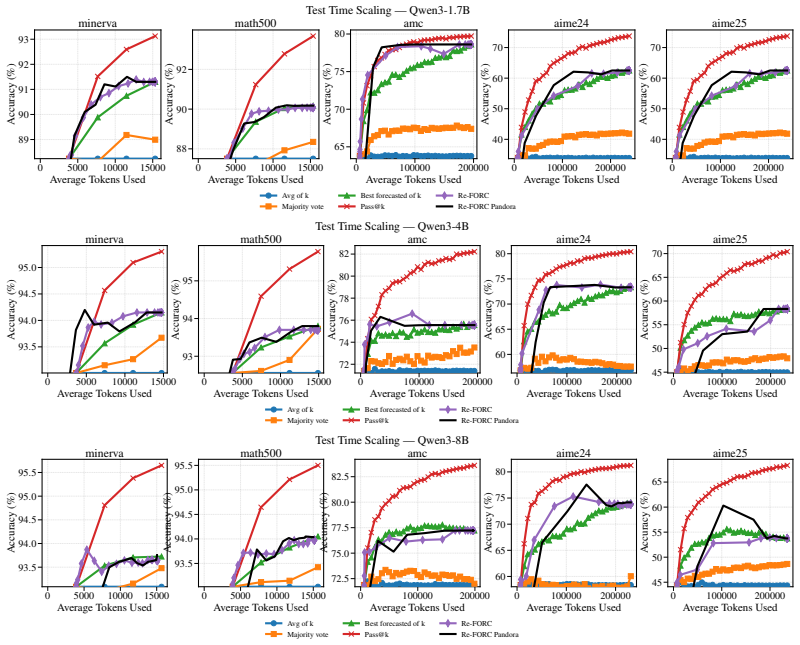
- Adaptive test-time scaling improves accuracy by 7% at low compute and 11% at high compute over confidence-based baselines.
- Users can tune the cost-per-token threshold λ at inference time to trace the whole accuracy-compute frontier without retraining the base model.
- Forecast quality improves as reasoning progresses and with larger models, so the method is most reliable exactly when decisions matter most.
Where Pith is reading between the lines
- Because the forecaster is trained on unconstrained trajectories, an early-stopping policy that changes the distribution of future reasoning traces could bias the forecast; retraining the adapter on traces generated under the stopping policy is a testable fix.
- The paper never states whether the five evaluation benchmarks were excluded from the math-reasoning training set used for the forecaster; if any overlap exists, the reported gains could be inflated by memorization, and a contamination check on disjoint benchmarks would settle it.
- Using the Beta variance (which the paper leaves as future work) could tighten stopping thresholds and reduce the overconfidence the authors observe; this is an immediate, low-cost extension.
- The reward function here is binary correctness on math problems; adapting Re-FORC to continuous or soft rewards (code tests, verifier scores) would test whether the forecast mechanism transfers beyond math.
Editorial analysis
A structured set of objections, weighed in public.
Referee Report
Summary. The paper proposes Re-FORC, a method that trains a lightweight adapter on frozen Qwen3 reasoning models to predict the expected reward of generating t additional thinking tokens from a partial reasoning trace, formalized as ψ(t|x,z,π) in Eq. (3) and approximated by a Beta-mean forecaster in Eq. (4). Using this forecaster, the authors derive greedy stopping, model-routing, and test-time-scaling rules inspired by Gittins-index/Pandora-box theory (Eqs. 8, 10, 12). They report improved accuracy–compute trade-offs on five mathematics datasets: early stopping saves up to 26% compute, model selection achieves 4% higher accuracy at equal compute or 55% less compute at equal accuracy, and adaptive test-time scaling improves accuracy by 7–11% over confidence-based baselines. The main claimed contribution is a continuous, query- and path-dependent forecast of reward as a function of reasoning length, enabling user-controlled cost–accuracy trade-offs at inference time.
Significance. If the forecasting functional is accurate and the reuse-based training estimator is unbiased, Re-FORC is a useful and fairly general mechanism for compute-aware inference: it applies to base or black-box models, provides a tunable λ parameter, and connects an empirically practical adapter to the principled Gittins/Pandora-box framework. The idea of predicting the marginal value of additional thinking tokens as a continuous curve is timely and the three applications are natural and well-motivated. However, the current manuscript's empirical support is substantially thinner than the claims require: there are no error bars or multi-seed results, the headline numbers in the abstract and body disagree, and the key unbiasedness assumption behind the training data is asserted rather than established. The paper does not ship code or data, and it does not report whether evaluation benchmarks were excluded from the training distribution, so the reported gains could be inflated by memorization. The central claim is defensible and worth pursuing, but the present evidence is not yet at the bar for publication.
major comments (4)
- [§3.3, Eq. (3)–(4)] The claim that truncating full unconstrained trajectories and reusing trajectory segments yields 'unbiased estimates of ψ(t|x,z,π)' is not established and is questionable. In Eq. (3), ψ conditions on drawing exactly t additional thinking tokens from π(r)(·|x,z,t). But the reuse estimator conditions on the event that a natural rollout did not stop before the truncation point plus t. These are different events; trajectories that would have stopped early are overrepresented in long continuations, and segments that cross a natural stop contain answer tokens rather than thinking tokens. The paper's own difficulty-allocation results suggest that stopping behavior correlates with query difficulty and likely with correctness. The limitation section's admission of 'forecaster overconfidence' is consistent with this label bias. Because Eqs. (8), (10), and (12) all threshold the same forecaster, th
- [Figs. 2–4 and Section 6] No error bars, confidence intervals, or multi-seed results appear anywhere in the paper. The central empirical claims are numeric point comparisons — 26% compute savings, 4% accuracy gain, 55% vs. 12% compute reduction, 7–11% scaling gains. On benchmark sets like AIME, with roughly 30 problems per year, a difference of a few percentage points can be noise. Since the paper uses a learned adapter with random initialization and Monte Carlo sampling (N=8), seed variance is non-negligible. The authors should report means and variances over multiple training seeds or subsamples, and state whether the reported gains are statistically significant. Without this, the headline comparisons are not reproducible.
- [Abstract vs. Sections 4–6] The reported headline numbers are internally inconsistent. The abstract states: 26% compute reduction, '1.7 percentage points higher peak accuracy,' '12% less compute' to match the largest model, and '9.9 percentage points' scaling gain. The body states (Sections 4.3, 4.4, 6): 4% higher accuracy at equal compute, '55% less compute at equal accuracy,' and '11% ... and 7%' scaling gains, with Section 6 also saying 'approximately 25%' and '50% less compute.' These are not minor wording differences; they change the magnitude of the claimed contribution. The authors must reconcile the abstract, body, and figure captions and state which numbers correspond to which setting (e.g., average over datasets vs. specific model or λ).
- [§5.1–5.2] The paper never states whether the five evaluation datasets (AMC 2024, Minerva, MATH500, AIME 2024/25) were excluded from the DeepScaleR-Preview training distribution used to generate forecaster training data. If any of these benchmarks appear in the pretraining or RL data of DeepScaleR/Qwen3, the forecast labels and final-accuracy measurements could be inflated by memorization. At minimum, the authors should report their contamination check or explicitly state the overlap status. This is standard practice for reasoning benchmarks and directly affects the validity of every reported accuracy gain.
minor comments (4)
- [§4.4 / Fig. 4] The caption uses 'Re-FoRC' inconsistently with the body's 'Re-FORC.' Also, the figure legend lists 'Avg of k' and 'Majority vote' but the caption text references 'Avg-of-k' and 'Pass-at-k'; unify the naming.
- [§5.1] The training details for the adapter are incomplete: no learning rate, number of epochs, optimizer, loss weighting, or early stopping criteria are reported. Without these, the forecaster training is not reproducible.
- [§3.3] The sentence 'we sample the model's answer directly from state (x, z)' is ambiguous: it is unclear whether this refers to a t=0 sample or to sampling an answer after a forced continuation. Clarify the data-generation protocol and how the reward R(x,y) is computed (e.g., exact match vs. rubric).
- [§4.1, Eq. (6)] In Eq. (6), the term (R(x,y) − R*)+ is dimensionally a reward, but the right-hand side subtracts λt which has units of cost; the authors should clarify the units of λ (cost per token) and how R* is normalized. The later claim that Eq. (7) follows for 'binary reward distribution' deserves a derivation, as the simplification from expectation of positive part to ψ(1−R̄) is not immediate when R is binary and R* is itself a random variable.
Circularity Check
No significant circularity: the forecaster is supervised, but downstream claims are validated on external accuracy/compute; only minor self-citation reliance.
full rationale
Re-FORC's forecaster is a fitted supervised predictor (Eq. 4, trained with Eq. 5), but the paper's central empirical claims are not forced by that fit. Early stopping (Eq. 8), model selection (Eqs. 10-11), and test-time scaling (Eq. 12) are evaluated on actual benchmark accuracy and token/compute cost of the base reasoning models, against non-forecaster baselines (fixed budgets, S1, Avg-of-k, majority vote, Pass@k oracle). A forecaster that merely recapitulated its training labels would not produce the reported accuracy-compute frontiers. The strongest concern is not circularity but estimator validity: Section 3.3 asserts that reusing segments of full unconstrained trajectories gives 'unbiased estimates of ψ(t|x,z,π)' without comparing to fresh length-conditioned continuations. If natural stopping is informative, the reuse labels differ from the Eq. 3 quantity, and the forecaster (and downstream thresholds) inherit bias. This is a correctness/bias risk, not a construction-equivalent reduction. The paper's own limitation section concedes 'forecaster overconfidence,' consistent with this risk. The Pandora's-box/Gittins framing leans on the authors' self-citations ([1], [44]), but the underlying optimal-stopping theory is independently sourced (Weitzman [2]; Gittins [46]), so the self-citation is motivational rather than load-bearing. There is also no stated exclusion of the AMC/AIME/MATH500/Minerva benchmarks from DeepScaleR-Preview training data, a contamination risk rather than a construction-equivalent circularity. Overall, no step in the derivation is identical by construction to its inputs; score 1 reflects only the minor self-citation reliance.
Axiom & Free-Parameter Ledger
free parameters (3)
- λ (cost-per-token) =
swept values e.g. 2e-05–3.4e-04
- Monte Carlo sample count N =
8
- Forecast grid resolution Δ and horizon t_max =
Δ=512, t_max=8192
axioms (5)
- domain assumption Reward R is binary correctness, so E[(R−R̄)+] = ψ(1−R̄)
- ad hoc to paper Trajectory reuse yields unbiased Monte Carlo estimates of ψ(t|x,z,π)
- domain assumption Gittins-index / Pandora's-box policy is a valid optimal-stopping framework for the LLM continuation decision
- domain assumption The adapter's Beta mean is a sufficiently calibrated estimate of ψ for the proposed decision rules
- domain assumption Evaluation benchmarks are not seen by the forecaster during training
read the original abstract
We propose Re-FORC, an adaptive reward prediction method that, given a query, enables prediction of the expected future rewards as a function of the number of future thinking tokens. Re-FORC trains a lightweight adapter on reasoning models, demonstrating improved prediction with longer reasoning and larger models. Re-FORC enables: 1) early stopping of unpromising reasoning chains, reducing compute by up to 26\% compared to fixed-budget cutoffs, while maintaining accuracy, 2) optimized model and thinking length selection that outperforms the largest model alone--- reaching 1.7 percentage points higher peak accuracy while needing up to 12\% less compute to match the largest model's accuracy, 3) adaptive test-time scaling, which increases accuracy by 9.9 percentage points (on average at maximum compute) over confidence-based baselines. Re-FORC allows dynamic reasoning with length control via cost-per-token thresholds while estimating computation time upfront.
Figures


Forward citations
Cited by 2 Pith papers
-
Cache-Aware Prompt Compression:A Two-Tier Cost Model for LLM API Caching
CAPC combines query-agnostic compression with prompt caching and is reported cheapest in 16/16 LongBench configurations, but the empirical support has unresolved specification and consistency gaps.
-
ExecTune: Effective Steering of Black-Box LLMs with Guide Models
ExecTune trains guide models via acceptance sampling, supervised fine-tuning, and structure-aware RL to boost executability of strategies for black-box LLMs, yielding up to 9.2% higher accuracy and 22.4% lower cost on...
Reference graph
Works this paper leans on
-
[1]
Ai agents as universal task solvers.arXiv preprint arXiv:2510.12066, 2025
Alessandro Achille and Stefano Soatto. Ai agents as universal task solvers.arXiv preprint arXiv:2510.12066, 2025
arXiv 2025
-
[2]
Weitzman
Martin L. Weitzman. Optimal search for the best alternative.Econometrica, 47(3):641–654, 1979
1979
-
[3]
Adaptive inference-time compute: Llms can predict if they can do better, even mid-generation, 2024
Rohin Manvi, Anikait Singh, and Stefano Ermon. Adaptive inference-time compute: Llms can predict if they can do better, even mid-generation, 2024
2024
-
[4]
Learning how hard to think: Input-adaptive allocation of lm computation, 2024
Mehul Damani, Idan Shenfeld, Andi Peng, Andreea Bobu, and Jacob Andreas. Learning how hard to think: Input-adaptive allocation of lm computation, 2024
2024
-
[5]
Reasoning models know when they’re right: Probing hidden states for self-verification, 2025
Anqi Zhang, Yulin Chen, Jane Pan, Chen Zhao, Aurojit Panda, Jinyang Li, and He He. Reasoning models know when they’re right: Probing hidden states for self-verification, 2025
2025
-
[6]
Reasoning models better express their confidence
Dongkeun Yoon, Seungone Kim, Sohee Yang, Sunkyoung Kim, Soyeon Kim, Yongil Kim, Eunbi Choi, Yireun Kim, and Minjoon Seo. Reasoning models better express their confidence. arXiv preprint arXiv:2505.14489, 2025
arXiv 2025
-
[7]
Are the hidden states hiding something? testing the limits of factuality-encoding capabilities in llms, 2025
Giovanni Servedio, Alessandro De Bellis, Dario Di Palma, Vito Walter Anelli, and Tommaso Di Noia. Are the hidden states hiding something? testing the limits of factuality-encoding capabilities in llms, 2025
2025
-
[8]
When do llms admit their mistakes? understanding the role of model belief in retraction, 2025
Yuqing Yang and Robin Jia. When do llms admit their mistakes? understanding the role of model belief in retraction, 2025
2025
-
[9]
Latts: Locally adaptive test-time scaling.arXiv preprint arXiv:2509.20368, 2025
Theo Uscidda, Matthew Trager, Michael Kleinman, Aditya Chattopadhyay, Wei Xia, and Stefano Soatto. Latts: Locally adaptive test-time scaling.arXiv preprint arXiv:2509.20368, 2025
arXiv 2025
-
[10]
Charlie Snell, Jaehoon Lee, Kelvin Xu, and Aviral Kumar. Scaling llm test-time compute opti- mally can be more effective than scaling model parameters.arXiv preprint arXiv:2408.03314, 2024
Pith/arXiv arXiv 2024
-
[11]
Yangzhen Wu, Zhiqing Sun, Shanda Li, Sean Welleck, and Yiming Yang. Inference scaling laws: An empirical analysis of compute-optimal inference for problem-solving with language models.arXiv preprint arXiv:2408.00724, 2024
Pith/arXiv arXiv 2024
-
[12]
Scaling LLM test-time com- pute optimally can be more effective than scaling parameters for reasoning
Charlie Victor Snell, Jaehoon Lee, Kelvin Xu, and Aviral Kumar. Scaling LLM test-time com- pute optimally can be more effective than scaling parameters for reasoning. InThe Thirteenth International Conference on Learning Representations, 2025
2025
-
[13]
Adaptive test-time reasoning via reward-guided dual-phase search, 2025
Yingqian Cui, Zhenwei Dai, Pengfei He, Bing He, Hui Liu, Xianfeng Tang, Jingying Zeng, Suhang Wang, Yue Xing, Jiliang Tang, and Benoit Dumoulin. Adaptive test-time reasoning via reward-guided dual-phase search, 2025
2025
-
[14]
Large language model guided tree-of-thought, 2023
Jieyi Long. Large language model guided tree-of-thought, 2023
2023
-
[15]
Demystifying chains, trees, and graphs of thoughts.IEEE Transactions on Pattern Analysis and Machine Intelligence, page 1–20, 2025
Maciej Besta, Florim Memedi, Zhenyu Zhang, Robert Gerstenberger, Guangyuan Piao, Nils Blach, Piotr Nyczyk, Marcin Copik, Grzegorz Kwa´sniewski, Jurgen Müller, Lukas Gianinazzi, Ales Kubicek, Hubert Niewiadomski, Aidan O’Mahony, Onur Mutlu, and Torsten Hoefler. Demystifying chains, trees, and graphs of thoughts.IEEE Transactions on Pattern Analysis and Mac...
2025
-
[16]
Fractured chain-of-thought reasoning, 2025
Baohao Liao, Hanze Dong, Yuhui Xu, Doyen Sahoo, Christof Monz, Junnan Li, and Caiming Xiong. Fractured chain-of-thought reasoning, 2025
2025
-
[17]
Don’t get lost in the trees: Streamlining llm reasoning by overcoming tree search exploration pitfalls, 2025
Ante Wang, Linfeng Song, Ye Tian, Dian Yu, Haitao Mi, Xiangyu Duan, Zhaopeng Tu, Jinsong Su, and Dong Yu. Don’t get lost in the trees: Streamlining llm reasoning by overcoming tree search exploration pitfalls, 2025. 11
2025
-
[18]
Bartoldson, Bhavya Kailkhura, Guillaume Lajoie, Glen Berseth, Nikolay Malkin, and Moksh Jain
Siddarth Venkatraman, Vineet Jain, Sarthak Mittal, Vedant Shah, Johan Obando-Ceron, Yoshua Bengio, Brian R. Bartoldson, Bhavya Kailkhura, Guillaume Lajoie, Glen Berseth, Nikolay Malkin, and Moksh Jain. Recursive self-aggregation unlocks deep thinking in large language models, 2025
2025
-
[19]
Self-consistency improves chain of thought reasoning in language models, 2023
Xuezhi Wang, Jason Wei, Dale Schuurmans, Quoc Le, Ed Chi, Sharan Narang, Aakanksha Chowdhery, and Denny Zhou. Self-consistency improves chain of thought reasoning in language models, 2023
2023
-
[20]
Escape sky-high cost: Early-stopping self-consistency for multi-step reasoning, 2024
Yiwei Li, Peiwen Yuan, Shaoxiong Feng, Boyuan Pan, Xinglin Wang, Bin Sun, Heda Wang, and Kan Li. Escape sky-high cost: Early-stopping self-consistency for multi-step reasoning, 2024
2024
-
[21]
Answer convergence as a signal for early stopping in reasoning, 2025
Xin Liu and Lu Wang. Answer convergence as a signal for early stopping in reasoning, 2025
2025
-
[22]
Confidence improves self-consistency in llms
Amir Taubenfeld, Tom Sheffer, Eran Ofek, Amir Feder, Ariel Goldstein, Zorik Gekhman, and Gal Yona. Confidence improves self-consistency in llms. InFindings of the Association for Computational Linguistics: ACL 2025, page 20090–20111. Association for Computational Linguistics, 2025
2025
-
[23]
Best-of-∞ – asymptotic performance of test-time compute, 2025
Junpei Komiyama, Daisuke Oba, and Masafumi Oyamada. Best-of-∞ – asymptotic performance of test-time compute, 2025
2025
-
[24]
Reasoning at the right length: Adaptive budget forcing for efficient and accu- rate LLM inference
Anonymous. Reasoning at the right length: Adaptive budget forcing for efficient and accu- rate LLM inference. InSubmitted to The Fourteenth International Conference on Learning Representations, 2025. under review
2025
-
[25]
Stop when enough: Adaptive early-stopping for chain-of-thought reasoning, 2025
Renliang Sun, Wei Cheng, Dawei Li, Haifeng Chen, and Wei Wang. Stop when enough: Adaptive early-stopping for chain-of-thought reasoning, 2025
2025
-
[26]
Dynamic early exit in reasoning models, 2025
Chenxu Yang, Qingyi Si, Yongjie Duan, Zheliang Zhu, Chenyu Zhu, Qiaowei Li, Minghui Chen, Zheng Lin, and Weiping Wang. Dynamic early exit in reasoning models, 2025
2025
-
[27]
Zhenni Bi, Kai Han, Chuanjian Liu, Yehui Tang, and Yunhe Wang. Forest-of-thought: Scaling test-time compute for enhancing llm reasoning.arXiv preprint arXiv:2412.09078, 2024
Pith/arXiv arXiv 2024
-
[28]
Tran, Yi Tay, and Donald Metzler
Tal Schuster, Adam Fisch, Jai Gupta, Mostafa Dehghani, Dara Bahri, Vinh Q. Tran, Yi Tay, and Donald Metzler. Confident adaptive language modeling, 2022
2022
-
[29]
Learning when to plan: Efficiently allocating test-time compute for llm agents, 2025
Davide Paglieri, Bartłomiej Cupiał, Jonathan Cook, Ulyana Piterbarg, Jens Tuyls, Edward Grefenstette, Jakob Nicolaus Foerster, Jack Parker-Holder, and Tim Rocktäschel. Learning when to plan: Efficiently allocating test-time compute for llm agents, 2025
2025
-
[30]
Can past experience accelerate llm reasoning?, 2025
Bo Pan and Liang Zhao. Can past experience accelerate llm reasoning?, 2025
2025
-
[31]
React: Synergizing reasoning and acting in language models, 2023
Shunyu Yao, Jeffrey Zhao, Dian Yu, Nan Du, Izhak Shafran, Karthik Narasimhan, and Yuan Cao. React: Synergizing reasoning and acting in language models, 2023
2023
-
[32]
Least-to-most prompting enables complex reasoning in large language models, 2023
Denny Zhou, Nathanael Schärli, Le Hou, Jason Wei, Nathan Scales, Xuezhi Wang, Dale Schuurmans, Claire Cui, Olivier Bousquet, Quoc Le, and Ed Chi. Least-to-most prompting enables complex reasoning in large language models, 2023
2023
-
[33]
Plan-and-solve prompting: Improving zero-shot chain-of-thought reasoning by large language models, 2023
Lei Wang, Wanyu Xu, Yihuai Lan, Zhiqiang Hu, Yunshi Lan, Roy Ka-Wei Lee, and Ee-Peng Lim. Plan-and-solve prompting: Improving zero-shot chain-of-thought reasoning by large language models, 2023
2023
-
[34]
Universal model routing for efficient llm inference, 2025
Wittawat Jitkrittum, Harikrishna Narasimhan, Ankit Singh Rawat, Jeevesh Juneja, Congchao Wang, Zifeng Wang, Alec Go, Chen-Yu Lee, Pradeep Shenoy, Rina Panigrahy, Aditya Krishna Menon, and Sanjiv Kumar. Universal model routing for efficient llm inference, 2025
2025
-
[35]
Chen, Trevor Chow, Ishan S
Neel Guha, Mayee F. Chen, Trevor Chow, Ishan S. Khare, and Christopher Ré. Smoothie: Label free language model routing, 2024. 12
2024
-
[36]
Dujian Ding, Ankur Mallick, Shaokun Zhang, Chi Wang, Daniel Madrigal, Mirian Del Car- men Hipolito Garcia, Menglin Xia, Laks V . S. Lakshmanan, Qingyun Wu, and Victor Rühle. Best-route: Adaptive llm routing with test-time optimal compute, 2025
2025
-
[37]
Masrouter: Learning to route llms for multi-agent systems, 2025
Yanwei Yue, Guibin Zhang, Boyang Liu, Guancheng Wan, Kun Wang, Dawei Cheng, and Yiyan Qi. Masrouter: Learning to route llms for multi-agent systems, 2025
2025
-
[38]
Daya Guo, Dejian Yang, Haowei Zhang, Junxiao Song, Ruoyu Zhang, Runxin Xu, Qihao Zhu, Shirong Ma, Peiyi Wang, Xiao Bi, et al. Deepseek-r1: Incentivizing reasoning capability in llms via reinforcement learning.arXiv preprint arXiv:2501.12948, 2025
Pith/arXiv arXiv 2025
-
[39]
s1: Simple test-time scaling.arXiv preprint arXiv:2501.19393, 2025
Niklas Muennighoff, Zitong Yang, Weijia Shi, Xiang Lisa Li, Li Fei-Fei, Hannaneh Hajishirzi, Luke Zettlemoyer, Percy Liang, Emmanuel Candès, and Tatsunori Hashimoto. s1: Simple test-time scaling.arXiv preprint arXiv:2501.19393, 2025
Pith/arXiv arXiv 2025
-
[40]
Pranjal Aggarwal and Sean Welleck. L1: Controlling how long a reasoning model thinks with reinforcement learning.arXiv preprint arXiv:2503.04697, 2025
Pith/arXiv arXiv 2025
-
[41]
Principles of metareasoning.Artificial Intelligence, 49(1):361– 395, 1991
Stuart Russell and Eric Wefald. Principles of metareasoning.Artificial Intelligence, 49(1):361– 395, 1991
1991
-
[42]
The pandora’s box problem with sequential inspections, 2025
Ali Aouad, Jingwei Ji, and Yaron Shaposhnik. The pandora’s box problem with sequential inspections, 2025
2025
-
[43]
Deep think with confidence, 2025
Yichao Fu, Xuewei Wang, Yuandong Tian, and Jiawei Zhao. Deep think with confidence, 2025
2025
-
[44]
Ai agents as universal task solvers, 2025
Alessandro Achille and Stefano Soatto. Ai agents as universal task solvers, 2025
2025
-
[45]
e1: Learning adaptive control of reasoning effort.arXiv preprint arXiv:2510.27042, 2025
Michael Kleinman, Matthew Trager, Alessandro Achille, Wei Xia, and Stefano Soatto. e1: Learning adaptive control of reasoning effort.arXiv preprint arXiv:2510.27042, 2025
arXiv 2025
-
[46]
Ziv Scully and Alexander Terenin. The gittins index: A design principle for decision-making under uncertainty.arXiv preprint arXiv:2506.10872, 2025
Pith/arXiv arXiv 2025
-
[47]
Universal sequential search problems.Problems of information transmission, 9(3):265–266, 1973
Leonid A Levin. Universal sequential search problems.Problems of information transmission, 9(3):265–266, 1973
1973
-
[48]
Department of Energy, 1978
Martin Weitzman.Optimal search for the best alternative, volume 78. Department of Energy, 1978
1978
-
[49]
Cost-aware bayesian optimization via the pandora’s box gittins index.Advances in Neural Information Processing Systems, 37:115523–115562, 2024
Qian Xie, Raul Astudillo, Peter Frazier, Ziv Scully, and Alexander Terenin. Cost-aware bayesian optimization via the pandora’s box gittins index.Advances in Neural Information Processing Systems, 37:115523–115562, 2024
2024
-
[50]
Qwen3 technical report.arXiv preprint arXiv:2505.09388, 2025
An Yang, Anfeng Li, Baosong Yang, Beichen Zhang, Binyuan Hui, Bo Zheng, Bowen Yu, Chang Gao, Chengen Huang, Chenxu Lv, et al. Qwen3 technical report.arXiv preprint arXiv:2505.09388, 2025
Pith/arXiv arXiv 2025
-
[51]
Tang, Manan Roongta, Colin Cai, Jeffrey Luo, Li Erran Li, Raluca Ada Popa, and Ion Stoica
Michael Luo, Sijun Tan, Justin Wong, Xiaoxiang Shi, William Y . Tang, Manan Roongta, Colin Cai, Jeffrey Luo, Li Erran Li, Raluca Ada Popa, and Ion Stoica. Deepscaler: Surpassing o1-preview with a 1.5b model by scaling rl. https://pretty-radio-b75.notion.site/ DeepScaleR-Surpassing-O1-Preview-with-a-1-5B-Model-by-Scaling-RL-19681902c1468005bed8ca303013a4e2 ,
-
[52]
2024 amc 12b — problems and solutions
Art of Problem Solving. 2024 amc 12b — problems and solutions. https: //artofproblemsolving.com/wiki/index.php/2024_AMC_12B, 2024. Administered November 12, 2024
2024
-
[53]
2024 amc 12a — problems and solutions
Art of Problem Solving. 2024 amc 12a — problems and solutions. https: //artofproblemsolving.com/wiki/index.php/2024_AMC_12A, 2024. Administered November 6, 2024
2024
-
[54]
2024 amc 10b — problems and solutions
Art of Problem Solving. 2024 amc 10b — problems and solutions. https: //artofproblemsolving.com/wiki/index.php/2024_AMC_10B, 2024. Administered November 12, 2024. 13
2024
-
[55]
2024 amc 10a — problems and solutions
Art of Problem Solving. 2024 amc 10a — problems and solutions. https: //artofproblemsolving.com/wiki/index.php/2024_AMC_10A, 2024. Administered November 6, 2024
2024
-
[56]
Solving quantitative reasoning problems with language models
Aitor Lewkowycz, Anders Andreassen, David Dohan, Ethan Dyer, Henryk Michalewski, Vinay Ramasesh, Ambrose Slone, Cem Anil, Imanol Schlag, Theo Gutman-Solo, Yuhuai Wu, Behnam Neyshabur, Guy Gur-Ari, and Vedant Misra. Solving quantitative reasoning problems with language models. InProceedings of the 36th International Conference on Neural Information Process...
2022
-
[57]
Let’s verify step by step, 2023
Hunter Lightman, Vineet Kosaraju, Yura Burda, Harri Edwards, Bowen Baker, Teddy Lee, Jan Leike, John Schulman, Ilya Sutskever, and Karl Cobbe. Let’s verify step by step, 2023
2023
-
[58]
2024 aime i — problems and solutions
Art of Problem Solving. 2024 aime i — problems and solutions. https: //artofproblemsolving.com/wiki/index.php/2024_AIME_I, 2024. Held January 31–February 1, 2024
2024
-
[59]
2024 aime ii — problems and solutions
Art of Problem Solving. 2024 aime ii — problems and solutions. https:// artofproblemsolving.com/wiki/index.php/2024_AIME_II, 2024. Held February 7, 2024
2024
-
[60]
2025 aime i — problems and solutions
Art of Problem Solving. 2025 aime i — problems and solutions. https:// artofproblemsolving.com/wiki/index.php/2025_AIME_I, 2025. Held February 6, 2025
2025
-
[61]
2025 aime ii — problems and solutions
Art of Problem Solving. 2025 aime ii — problems and solutions. https:// artofproblemsolving.com/wiki/index.php/2025_AIME_II, 2025. Held February 12, 2025. 14 Appendix A Additional Experiments A.1 Problem Difficulty 0.0 0.5 1.0 Cumulative % of Problems 0 1Cumulative % of Tokens Minerva 0.0 0.5 1.0 Cumulative % of Problems 0 1Cumulative % of Tokens MATH500 ...
2025
discussion (0)
Sign in with ORCID, Apple, or X to comment. Anyone can read and Pith papers without signing in.