Thermodynamic inference from noisy single-molecule time series
Pith reviewed 2026-06-26 06:18 UTC · model grok-4.3
The pith
Both strategies for estimating entropy production from noisy single-molecule trajectories yield lower bounds on the true value
A machine-rendered reading of the paper's core claim, the machinery that carries it, and where it could break.
Core claim
Given an experimental time series Y(t) degraded by noise and corresponding to a microscopic variable X(t), both the strategy of inferring the statistical properties of X(t) from Y(t) before estimating entropy production and the strategy of applying the entropy production estimator directly to Y(t) result in lower bounds on the true entropy production. Noise-degraded observables Y(t) undergo non-Markovian dynamics even when X(t) are Markovian, and non-Markovian entropy production estimators are advantageous. There is a nontrivial interplay between spatial and temporal resolution: in the presence of detection noise, improving the temporal resolution alone may lead to poorer rather than better
What carries the argument
The two strategies for thermodynamic inference from noisy observables Y(t), together with the proofs that each produces a lower bound on entropy production of the underlying X(t); the demonstration that Y(t) is non-Markovian whenever X(t) is Markovian.
If this is right
- Non-Markovian entropy production estimators are advantageous over Markovian ones when applied to noise-degraded data.
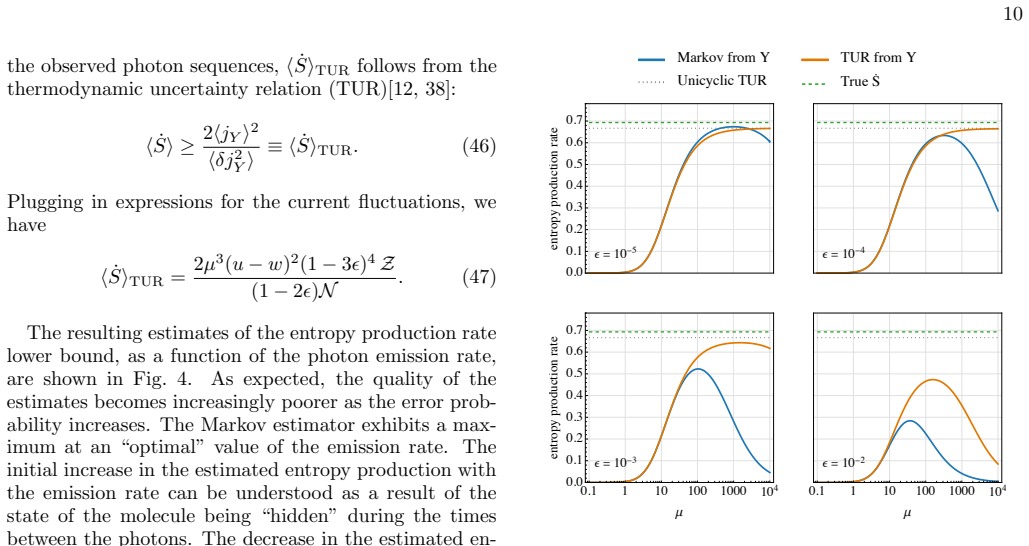
- Improving temporal resolution in isolation can degrade the quality of entropy production estimates when spatial detection noise is present.
- Entropy production remains detectable from below even with severely limited experimental resolution.
- Measurements obtained by either strategy can be interpreted as conservative lower bounds on actual dissipation.
Where Pith is reading between the lines
- Experimental design may require joint optimization of spatial and temporal sampling rather than maximizing frame rate alone.
- The lower-bound property could extend to inference of other nonequilibrium signatures from noisy single-particle tracks.
- Targeted denoising algorithms might be developed to tighten these bounds on thermodynamic quantities specifically.
Load-bearing premise
The underlying microscopic dynamics X(t) are Markovian.
What would settle it
Simulate exact Markovian trajectories X(t) to compute their true entropy production, add realistic spatial and temporal noise to generate Y(t), apply both estimation strategies to the noisy series, and check whether the resulting values are always less than or equal to the true entropy production.
Figures
read the original abstract
Single-molecule or single-particle tracking measurements inherently yield noisy microscopic trajectories, often significantly constrained by the diffraction limit and by the finite rate at which photons are emitted and counted. Here we study systematically the resulting effects of finite spatial and temporal resolution on one's ability to discern and quantify the arrow of time in microscopic trajectories. Given an experimental time series Y(t) degraded by noise, we consider the problem of estimating the entropy production associated with the corresponding microscopic variable X(t) using two strategies. The first attempts to infer the statistical properties of X(t) from those of Y(t) before estimating the entropy production. The second uses the experimental observable as a proxy for the true microscopic observable, with the entropy production estimator applied directly to Y(t). We prove that both strategies result in lower bounds on the true entropy production. Importantly, noise-degraded observables Y(t) undergo non-Markovian dynamics even when X(t) are Markovian, and non-Markovian entropy production estimators are advantageous. We further note nontrivial interplay between spatial and temporal resolution: in the presence of detection noise, improving the temporal resolution alone may lead to poorer rather than better entropy production estimates.
Editorial analysis
A structured set of objections, weighed in public.
Referee Report
Summary. The manuscript examines how finite spatial and temporal resolution in single-molecule tracking introduce noise into observed trajectories Y(t) derived from underlying Markovian microscopic dynamics X(t). It analyzes two inference strategies for entropy production: (i) first recovering statistical properties of X(t) from Y(t) then estimating entropy production, and (ii) applying entropy production estimators directly to the noisy Y(t). The central claims are that both strategies produce rigorous lower bounds on the true entropy production, that Y(t) is non-Markovian even when X(t) is Markovian (making non-Markovian estimators advantageous), and that there is a nontrivial interplay between spatial and temporal resolution such that improving temporal resolution alone can worsen entropy production estimates under detection noise.
Significance. If the stated proofs hold, the work supplies parameter-free lower bounds on entropy production together with falsifiable predictions about estimator performance and resolution trade-offs. These results are significant for stochastic thermodynamics and single-molecule experiments, as they directly address practical limitations in quantifying the arrow of time from noisy data and credit the non-Markovian character of the observable.
minor comments (1)
- The abstract and introduction state the Markovian assumption for X(t) explicitly, but a dedicated section clarifying the precise noise model (e.g., additive Gaussian detection noise versus photon-counting statistics) would aid reproducibility of the derivations.
Simulated Author's Rebuttal
We thank the referee for the careful reading and positive assessment of our manuscript, including the accurate summary of our central claims and the recommendation for minor revision. No specific major comments were raised in the report.
Circularity Check
No significant circularity; central claims are explicit mathematical proofs from stated assumptions
full rationale
The manuscript derives lower bounds on entropy production via two inference strategies applied to noisy observables Y(t) when the underlying X(t) is Markovian. These are presented as direct proofs under the given noise model, without parameter fitting, self-referential definitions, or load-bearing self-citations. The non-Markovian character of Y(t) and the resolution-interplay result follow from the same first-principles stochastic-process arguments. The derivation chain is self-contained against external benchmarks and does not reduce any prediction to its inputs by construction.
Axiom & Free-Parameter Ledger
axioms (1)
- domain assumption The true microscopic dynamics X(t) are Markovian.
Reference graph
Works this paper leans on
-
[1]
Thus a first-order Markovian estimate suffices
IfP(Y|X) =δ Y X (i.e., no errors in determining the stateX) then the sequence of observed statesX k is Markovian, and⟨ ˙S⟩k(τ) is the same for anyk≥1. Thus a first-order Markovian estimate suffices
-
[2]
In the limitτ→0 andP(Y|X)→δ Y X this esti- mator will give the exact entropy production rate for anyk≥1,⟨ ˙S⟩k(τ)→ ⟨ ˙S⟩
-
[3]
PROOF: Since the discrete-time dynamics ofXis Markovian, the estimated entropy production can be written as ⟨ ˙S⟩k(τ) =⟨ ˙S⟩1(τ) = 1 τ X X0,X1 P(X 1, X0) log P(X 1, X0) P(X 0, X1)
In the caseP(Y|X) =δ Y X we have the inequality ⟨ ˙S⟩k ≤ ⟨ ˙S⟩, which becomes identity whenτ→0. PROOF: Since the discrete-time dynamics ofXis Markovian, the estimated entropy production can be written as ⟨ ˙S⟩k(τ) =⟨ ˙S⟩1(τ) = 1 τ X X0,X1 P(X 1, X0) log P(X 1, X0) P(X 0, X1) . (20) LetX 1(0),0(1)(t) denote any microscopic path sat- isfying the conditionsX...
-
[4]
In other words, experi- mental errors in measuringX(t) or finite time res- olution cannot introduce spurious irreversibility in Y(t)
If the microscopic trajectoryX(t) satisfies detailed balance then⟨ ˙S⟩k(τ) = 0. In other words, experi- mental errors in measuringX(t) or finite time res- olution cannot introduce spurious irreversibility in Y(t). PROOF: Using Eq. (10), one finds that, if the detailed balance conditionP(X ′, τ;X,0) = P(X, τ;X ′,0) is satisfied forX(t), it is also sat- isf...
-
[5]
Markov estimate of the entropy production from Y(t) is always a lower bound on that estimated fromX(t). More precisely, 1 τ X X0,X1 P(X 1, X0) log P(X 1, X0) P(X 0, X1) ≥ 1 τ X Y0,Y1 P(Y 1, Y0) log P(Y 1, Y0) P(Y 0, Y1) (21) PROOF: First, let us prove the following auxiliary statement, which is a form of the data processing inequality. Letxbe a random vec...
-
[6]
The entropy production estimated from sequencesY 0, Y1
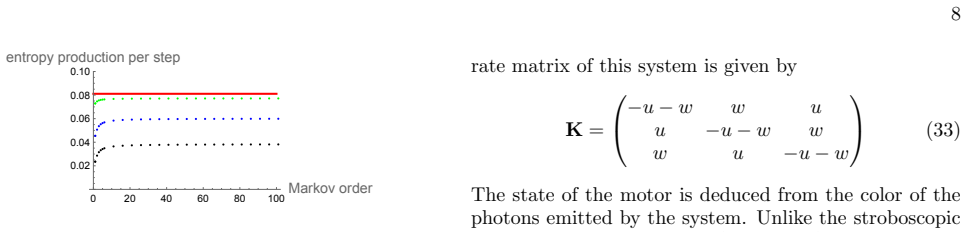
The above argument can be extended to higher- order entropy production estimates. The entropy production estimated from sequencesY 0, Y1 . . . Yk will always be lower than or equal to that from sequencesX 0, X1 . . . Xk. But the latter does not depend onksinceXis Markovian. We conclude that the entropy production estimated fromY i to arbitrary Markov orde...
-
[7]
Generate noiseless trajectory with 2×10 7 transi- tions using the Gillespie algorithm
-
[8]
Sample the trajectory at time intervalsτ
-
[9]
Introduce measurement noise every time step
-
[10]
Compute transition probabilities from the uncor- rected trajectories and estimate entropy production with the first-order Markov estimator
-
[11]
microscopic rate matrix
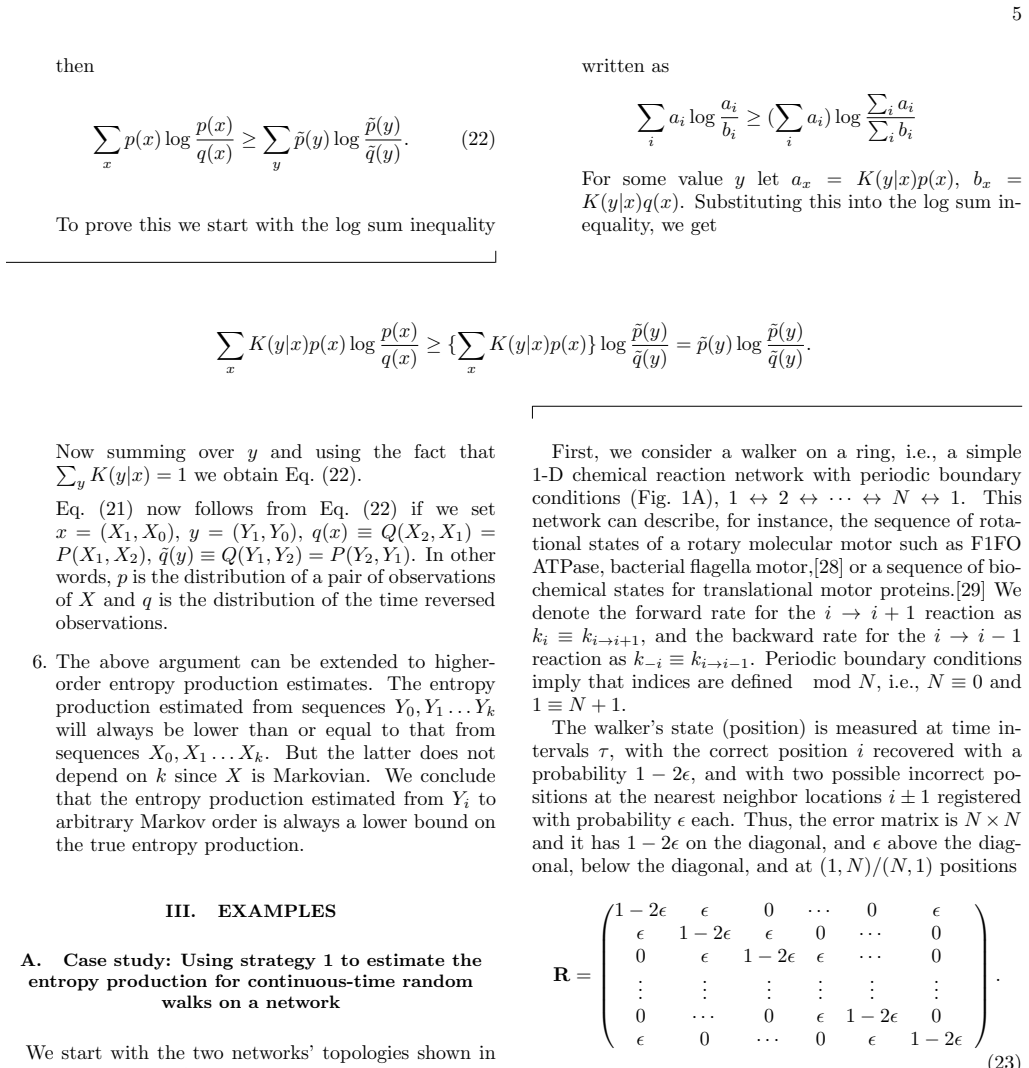
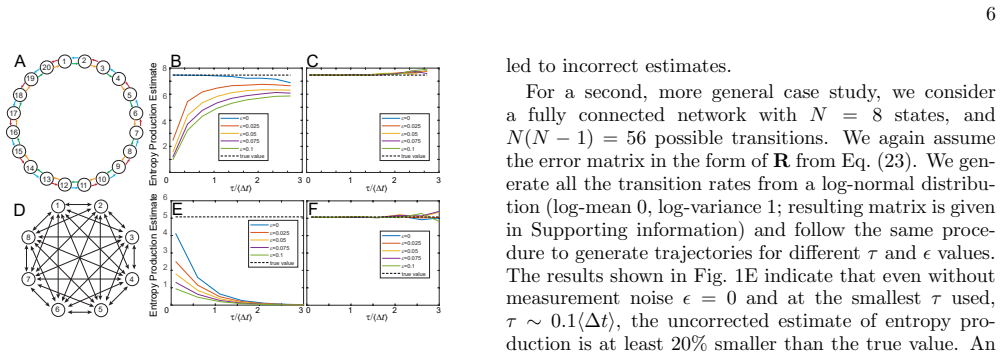
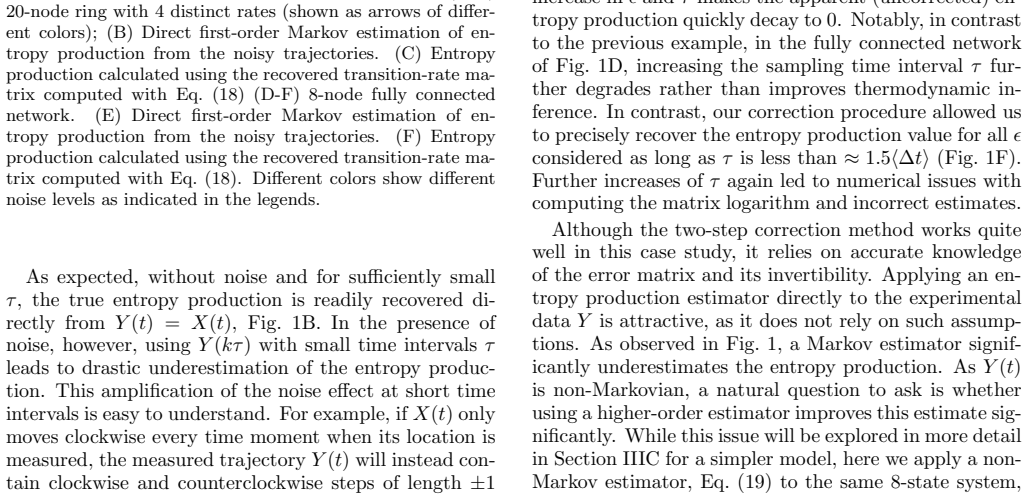
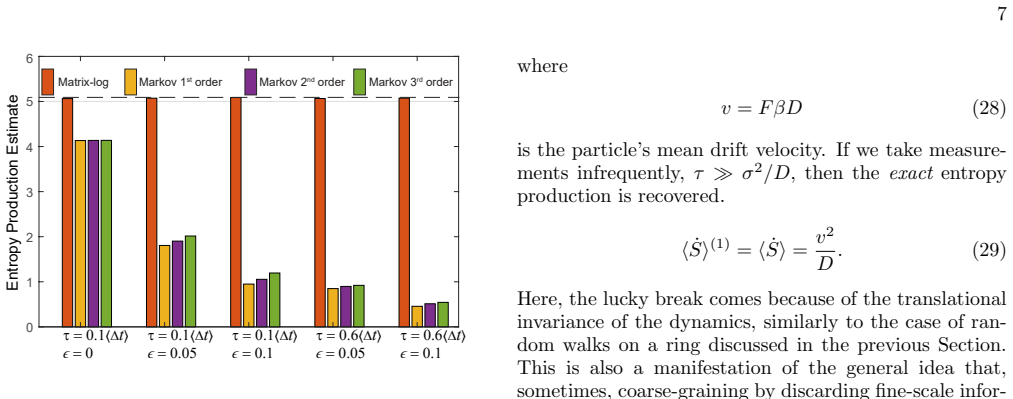
Compute the corrected entropy production using the recovered transition-rate matrix computed with Eq. (18). First, we consider a walker on a ring, i.e., a simple 1-D chemical reaction network with periodic boundary conditions (Fig. 1A), 1↔2↔ · · · ↔N↔1. This network can describe, for instance, the sequence of rota- tional states of a rotary molecular moto...
-
[12]
Peliti and S
L. Peliti and S. Pigolotti,Stochastic Thermodynamics: An Introduction(Princeton University Press, 2021)
2021
-
[13]
Seifert,Stochastic Thermodynamics(Cambridge Uni- versity Press, Cambridge, 2025)
U. Seifert,Stochastic Thermodynamics(Cambridge Uni- versity Press, Cambridge, 2025)
2025
-
[14]
Rold´ an and J
E. Rold´ an and J. M. R. Parrondo, Entropy production and Kullback-Leibler divergence between stationary tra- jectories of discrete systems, Phys. Rev. E85, 031129 (2012)
2012
-
[15]
Hartich and A
D. Hartich and A. Godec, Violation of local detailed bal- ance upon lumping despite a clear timescale separation, Phys. Rev. Res.5, L032017 (2023)
2023
-
[16]
van der Meer, J
J. van der Meer, J. Deg¨ unther, and U. Seifert, Time- resolved statistics of snippets as general framework for model-free entropy estimators, Phys. Rev. Lett.130, 257101 (2023)
2023
-
[17]
van der Meer, B
J. van der Meer, B. Ertel, and U. Seifert, Thermodynamic inference in partially accessible Markov networks: A uni- fying perspective from transition-based waiting time dis- tributions, Phys. Rev. X12, 031025 (2022)
2022
-
[18]
P. E. Harunari, A. Dutta, M. Polettini, and E. Rold´ an, What to learn from a few visible transitions’ statistics?, Phys. Rev. X12, 041026 (2022)
2022
-
[19]
J. Li, J. M. Horowitz, T. R. Gingrich, and N. Fakhri, Quantifying dissipation using fluctuating currents, Nat. Commun.10, 1666 (2019)
2019
-
[20]
J. M. Horowitz and T. R. Gingrich, Thermodynamic uncertainty relations constrain non-equilibrium fluctua- tions, Nat. Phys.16, 15 (2019)
2019
-
[21]
Bisker, M
G. Bisker, M. Polettini, T. R. Gingrich, and J. M. Horowitz, Hierarchical bounds on entropy production in- ferred from partial information, J. Stat. Mech.2017, 093210 (2017)
2017
-
[22]
T. R. Gingrich, G. M. Rotskoff, and J. M. Horowitz, In- ferring dissipation from current fluctuations, J. Phys. A: Math. Theor.50, 184004 (2017)
2017
-
[23]
T. R. Gingrich, J. M. Horowitz, N. Perunov, and J. L. England, Dissipation bounds all steady-state current fluctuations, Phys. Rev. Lett.116, 120601 (2016)
2016
-
[24]
P. E. Harunari, Uncovering nonequilibrium from unre- solved events, Phys. Rev. E110, 024122 (2024)
2024
-
[25]
Godec and D
A. Godec and D. E. Makarov, Challenges in inferring the directionality of active molecular processes from single- molecule fluorescence resonance energy transfer trajecto- ries, J. Phys. Chem. Lett.14, 49 (2023). 14
2023
-
[26]
J. H. Fritz, B. Ertel, and U. Seifert, Entropy estimation for partially accessible Markov networks based on im- perfect observations: Role of finite resolution and finite statistics, Phys. Rev. E111, 044106 (2025)
2025
-
[27]
M. T. Bauer, U. Seifert, and J. van der Meer, Strobo- scopic measurements in Markov networks: exact genera- tor reconstruction vs. thermodynamic inference, J. Phys. A: Math. Theor.58, 125001 (2025)
2025
-
[28]
K. Song, D. E. Makarov, and E. Vouga, Information- theoretical limit on the estimates of dissipation by molec- ular machines using single-molecule fluorescence reso- nance energy transfer experiments, J. Chem. Phys.161, 044111 (2024)
2024
-
[29]
Yu and P
Q. Yu and P. E. Harunari, Dissipation at limited reso- lutions: power law and detection of hidden dissipative scales, Journal of Statistical Mechanics: Theory and Ex- periment2024, 103201 (2024)
2024
-
[30]
Fazel, K
M. Fazel, K. S. Grussmayer, B. Ferdman, A. Radenovic, Y. Shechtman, J. Enderlein, and S. Press´ e, Fluorescence microscopy: A statistics-optics perspective, Rev. Mod. Phys.96, 025003 (2024)
2024
-
[31]
Hartich and A
D. Hartich and A. Godec, Emergent memory and kinetic hysteresis in strongly driven networks, Phys. Rev. X11, 041047 (2021)
2021
-
[32]
Esposito, Stochastic thermodynamics under coarse graining, Phys
M. Esposito, Stochastic thermodynamics under coarse graining, Phys. Rev. E85, 041125 (2012)
2012
-
[33]
Rahav and C
S. Rahav and C. Jarzynski, Fluctuation relations and coarse-graining, J. Stat. Mech.2007, P09012 (2007)
2007
-
[34]
K. Blom, K. Song, E. Vouga, A. Godec, and D. E. Makarov, Milestoning estimators of dissipation in sys- tems observed at a coarse resolution, Proc. Natl. Acad. Sci. U.S.A.121, e2318333121 (2024)
2024
-
[35]
G´ omez-Mar´ ın, J
A. G´ omez-Mar´ ın, J. M. R. Parrondo, and C. Van den Broeck, Lower bounds on dissipation upon coarse grain- ing, Phys. Rev. E78, 011107 (2008)
2008
-
[36]
This case can be considered using the same formalism, as will be seen below
In fluorescence experiments, photons arrive at random times, with only the average timeτknown. This case can be considered using the same formalism, as will be seen below
-
[37]
Zwanzig,Nonequilibrium Statistical Mechanics(Ox- ford University Press, 2001)
R. Zwanzig,Nonequilibrium Statistical Mechanics(Ox- ford University Press, 2001)
2001
-
[38]
Note that this is a deconvolution problem, which is often notoriously difficult numerically
-
[39]
Oster and H
G. Oster and H. Wang, Rotary protein motors, Trends Cell Biol.13, 114 (2003)
2003
-
[40]
A. B. Kolomeisky,Motor Proteins and Molecular Motors (CRC Press, 2015) p. 222
2015
-
[41]
O. A. Igoshin, A. B. Kolomeisky, and D. E. Makarov, Uncovering dissipation from coarse observables: A case study of a random walk with unobserved internal states, J. Chem. Phys.162, 034111 (2025)
2025
-
[42]
Rold´ an and J
E. Rold´ an and J. M. R. Parrondo, Estimating dissipation from single stationary trajectories, Phys. Rev. Lett.105, 150607 (2010)
2010
-
[43]
Haran and H
G. Haran and H. Hofmann, Single-molecule fluores- cence spectroscopy of fast protein dynamics, Curr. Opin. Struct. Biol.98, 103242 (2026)
2026
-
[44]
Vollmar, J
L. Vollmar, J. Schimpf, B. Hermann, and T. Hugel, Cochaperones convey the energy of ATP hydrolysis for directional action of Hsp90, Nat. Commun.15, 569 (2024)
2024
-
[45]
Ratzke, B
C. Ratzke, B. Hellenkamp, and T. Hugel, Four-colour FRET reveals directionality in the Hsp90 multicompo- nent machinery, Nat. Commun.5, 4192 (2014)
2014
-
[46]
A. B. Kolomeisky, Motor proteins and molecular motors: how to operate machines at the nanoscale, J. Phys.: Con- dens. Matter25, 463101 (2013)
2013
-
[47]
Koza, General technique of calculating the drift veloc- ity and diffusion coefficient in arbitrary periodic systems, J
Z. Koza, General technique of calculating the drift veloc- ity and diffusion coefficient in arbitrary periodic systems, J. Phys. A: Math. Gen.32, 7637 (1999)
1999
-
[48]
Koza, Diffusion coefficient and drift velocity in peri- odic media, Phys
Z. Koza, Diffusion coefficient and drift velocity in peri- odic media, Phys. Rev. E65, 031905 (2002)
2002
-
[49]
A. C. Barato and U. Seifert, Thermodynamic uncertainty relation for biomolecular processes, Phys. Rev. Lett.114, 158101 (2015)
2015
-
[50]
I. V. Gopich and A. Szabo, Decoding the pattern of pho- ton colors in single-molecule FRET, J. Phys. Chem. B 113, 10965 (2009)
2009
-
[51]
I. V. Gopich, Accuracy of maximum likelihood estimates of a two-state model in single-molecule FRET, J. Chem. Phys.142, 034110 (2015)
2015
-
[52]
Press´ e and I
S. Press´ e and I. Sgouralis,Data Modeling for the Sci- ences: Applications, Basics, Computations(Cambridge University Press, 2023)
2023
-
[53]
Saurabh, M
A. Saurabh, M. Fazel, M. Safar, I. Sgouralis, and S. Press´ e, Single-photon smFRET. I: Theory and con- ceptual basis, Biophys. Rep.3, 100089 (2023)
2023
-
[54]
Saurabh, M
A. Saurabh, M. Safar, M. Fazel, I. Sgouralis, and S. Press´ e, Single-photon smFRET: II. application to con- tinuous illumination, Biophys. Rep.3, 100087 (2023)
2023
-
[55]
Schweiger, A
M. Schweiger, A. Saurabh, and S. Press´ e, A cautious user’s guide in applying HMMs to physical systems, J. Chem. Phys.163, 210901 (2025)
2025
discussion (0)
Sign in with ORCID, Apple, or X to comment. Anyone can read and Pith papers without signing in.